61 http://dx.doi.org/10.4196/kjpp.2014.18.1.61
ABBREVIATIONS: EGCG, epigallocatechin gallate; ELISA, Enzyme- linked immunosorbent assay; GAS 6, growth arrest-specific 6; IL-6, interlukine-6; NSCLC, non-small cell lung cancer; PDT, population doubling time; RTK, receptor tyrosine kinase; SCLC, small cell lung cancer; STAT, Signal transducers and activators of transcription.
Received November 11, 2013, Revised December 8, 2013, Accepted December 27, 2013
Corresponding to: ChuHee Lee, Department of Biochemistry &
Molecular Biology, School of Medicine, Yeungnam University, 317-1 Daemyung-5-dong, Daegu 705-717, Korea. (Tel) 82-53-620-4344, (Fax) 82-53-623-8032, (E-mail) [email protected]
This is an Open Access article distributed under the terms of the
Creative Commons Attribution Non-Commercial License (http://
creativecommons.org/licenses/by-nc/3.0) which permits unrestricted non-commercial
use, distribution, and reproduction in any medium, provided the original work
is properly cited.
Reversal of Cisplatin Resistance by Epigallocatechin Gallate Is Mediated by Downregulation of Axl and Tyro 3 Expression in Human Lung Cancer Cells
Kyung-Chan Kim
1, and ChuHee Lee
2
1
Department of Internal Medicine, College of Medicine, Catholic University of Daegu, Daegu 705-718,
2Department of Biochemistry and Molecular Biology, School of Medicine, Yeungnam University, Daegu 705-717 Korea
Lung cancer is still the number one cause of death from cancer worldwide. The clinical effect of platinum-based chemotherapy for non-small cell lung cancer is constrained by the resistance to drug.
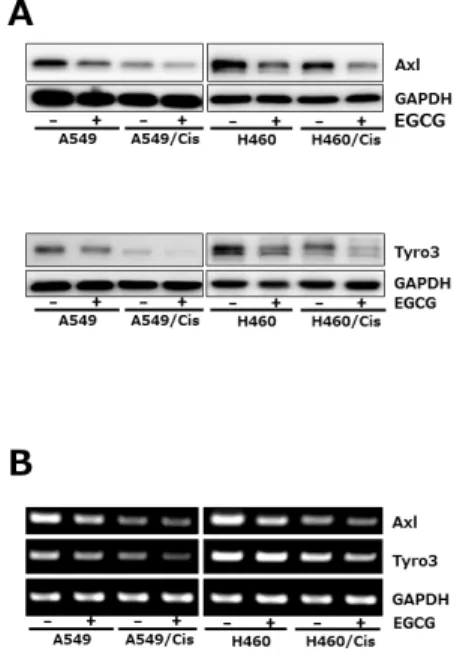
To overcome chemo-resistance, various modified treatment including combination therapy has been used, but overall survival has not been improved yet. In this study, chemo-resistant lung cancer cells, A549/Cis and H460/Cis, were developed by long-term exposure of cells to cisplatin and the proliferative capability of these resistant cells was verified to be reduced. W e found cytotoxic effect of epigal- locatechin gallate (EGCG), a major catechin derived from green tea, on both the parental lung cancer cells, A549 and H460, and their cisplatin resistant cells, A549/Cis and H460/Cis. ELISA and W estern blot analysis revealed that EGCG was able to increase interlukine-6 (IL-6) production per cell, whereas its downstream effector Signal transducers and activators of transcription 3 (STAT3) phosphorylation was not changed by EGCG, indicating that IL-6/STAT3 axis is not the critical signaling to be inhibited by EGCG. We next found that EGCG suppresses the expression of both Axl and Tyro 3 receptor tyrosine kinases at mRNA and protein level, explaining the cytotoxic effect of EGCG on lung cancer cells, especially, regardless of cisplatin resistance. Taken together, these data suggest that EGCG impedes proliferation of lung cancer cells including their chemo-resistant variants through downregulation of Axl and Tyro 3 expression.
Key Words: Axl, Cisplatin resistance, EGCG, Lung cancer, Tyro 3
INTRODUCTION
Lung cancer has been in the first place worldwide in re- spect of both incidence and mortality [1]. Among two classes of lung cancer, non-small cell (NSCLC) and small cell lung cancer (SCLC), the majority of lung cancer is NSCLC (about 85% to 90%) which grows slowly and is insensitive to che- motherapy, compared to SCLC. Platinum-based chemo- therapy has been the most effective treatment for NSCLC.
However, one of the difficulties to be faced during chemo- therapy is the intrinsic and developed resistance to chemo- therapeutic drugs, which leads to poor prognosis [2]. To avoid such resistance and take synergistic effect between drugs, combination therapy has been used for the last two
decades, but long-term survival rate is not strikingly im- proved, yet.
Among 58 receptor tyrosine kinases (RTK), the TAM fam-
ily includes three structurally related RTKs; Tyro-3 (also
called Sky), Axl, and Mer [3]. All of them have same ex-
tracellular domains (each of two immunoglobin-like do-
mains as well as fibronectin type III domains) and cytoplas-
mic domain with kinase activity [4]. Their ligand is also
in common, which is vitamin K-dependent protein, growth
arrest-specific 6 (Gas 6) [5]. TAM receptor-mediated signal-
ing pathway has been reported to promote cell proliferation,
inhibit apoptosis and be highly activated in cancer cells
through overexpression of these RTKs as well as their
ligands. Of note, overexpression of Axl, Mer, and/or Gas 6
was observed in various cancer cell lines and patient sam-
ples including acute leukemia [6], breast cancer [7,8], color-
ectal carcinoma [9], lung cancer [10], melanoma [11], ovar-
ian cancer [12] and prostate cancer [13]. Therefore, TAM
family members and their ligands are deeply involved in
initiation, progression and physiology of cancer and could
be potential biomarker for diagnosis and prognosis of can-