Clinical Efficacy of Allergen-Specific Immunotherapy from Patient and Physician Perspectives
Yoo Seob Shin1*, Jae-Woo Jung2*, Jung-Won Park3, Jeong-Hee Choi4, Jae-Woo Kwon5, Sooyoung Lee6, Ji Hye Kim7, Sang Min Lee8, Young Min Ahn9, and Man Yong Han10 on behalf of the Allergen and
Immunotherapy Work Group of the Korean Academy of Asthma, Allergy and Clinical Immunology (KAAACI)
1Department of Allergy and Clinical Immunology, Ajou University School of Medicine, Suwon;
2Department of Internal Medicine, Chung-Ang University College of Medicine, Seoul;
3Department of Internal Medicine, Institute of Allergy, Yonsei University College of Medicine, Seoul;
4Department of Pulmonology and Allergy, Hallym University College of Medicine, Chuncheon;
5Department of Internal Medicine, Kangwon National University School of Medicine, Chuncheon;
6Department of Pediatrics, Ajou University School of Medicine, Suwon;
7Division of Pulmonology and Allergy, Konyang University College of Medicine, Daejeon;
8Division of Pulmonology and Allergy, Department of Internal Medicine, Gachon University Gil Medical Center, Incheon;
9Department of Pediatrics, Eulji General Hospital, Eulji University School of Medicine, Seoul;
10Department of Pediatrics, CHA Bundang Medical Center, CHA University School of Medicine, Seongnam, Korea.
Purpose: Allergen-specific immunotherapy (AIT) is the only curative treatment for allergic diseases, but a few allergic patients re- ceive AIT. In this multicenter cross-sectional study, we aimed to explore patient and physician perspectives on AIT through a questionnaire survey.
Materials and Methods: Allergic patients who received subcutaneous immunotherapy for at least 1 year were asked to answer a questionnaire developed by an expert panel of allergen and immunotherapy workgroup in Korea.
Results: A total of 267 patients (adults, 60.3%) with allergic rhinitis (91.4%), asthma (42.7%), or atopic dermatitis (20.2%) from re- ferred hospitals completed the survey. Among patients and physicians, respectively, the overall rates of satisfaction with AIT for al- lergic rhinitis were 86.4% and 83.3% (kappa agreement=0.234, p<0.001), and those for asthma were 85.3% and 72.9% (kappa agree- ment=0.373, p<0.001). Moreover, pediatric asthmatic patients reported a significantly higher satisfaction rate than adult asthmatic patients after AIT (p=0.040). Symptom severity (p<0.001, respectively) and drug use for allergic rhinitis and asthma decreased after AIT. However, there was no significant difference in satisfaction rates between children and adults in allergic rhinitis (p=0.736). In- terestingly, 35.7% and 35% of allergic rhinitis and asthma patients, respectively, reported experiencing improvement in their symp- toms within 6 months of starting AIT.
Conclusion: In this study evaluating the perspectives of patients and physicians on AIT, the majority of patients were satisfied with the efficacy and safety of AIT, but not its cost. AIT should be recommended for AR and allergic patients.
Key Words: Allergen immunotherapy, patient satisfaction, surveys and questionnaire
pISSN: 0513-5796 · eISSN: 1976-2437
Received: January 23, 2019 Revised: February 19, 2019 Accepted: March 13, 2019
Co-corresponding authors: Man Yong Han, MD, Department of Pediatrics, CHA Bundang Medical Center, CHA University School of Medicine, 59 Yatap-ro, Bundang-gu, Seongnam 13488, Korea.
Tel: 82-31-780-6262, Fax: 82-31-780-5239, E-mail: [email protected] and
Young Min Ahn, MD, PhD, Department of Pediatrics, Eulji General Hospital, Eulji University School of Medicine, 68 Hangeulbiseok-ro, Nowon-gu, Seoul 01830, Korea.
Tel: 82-2-970-8228, Fax: 82-2-976-5441, E-mail: [email protected]
*Yoo Seob Shin and Jae-Woo Jung contributed equally to this work.
•The authors have no potential conflicts of interest to disclose.
© Copyright: Yonsei University College of Medicine 2019
This is an Open Access article distributed under the terms of the Creative Commons Attribution Non-Commercial License (https://creativecommons.org/licenses/by-nc/4.0) which permits unrestricted non-commercial use, distribution, and reproduction in any medium, provided the original work is properly cited.
Yonsei Med J 2019 May;60(5):446-453 https://doi.org/10.3349/ymj.2019.60.5.446
INTRODUCTION
Since Leonard Noon and John Freeman reported the effect of prophylactic inoculation of grass pollen in hay fever patients in 1911, allergen-specific immunotherapy (AIT) has been used to treat allergic diseases in clinical practice for more than 100 years.1 It is well known that AIT can reduce symptoms and medication scores,2,3 alter the natural course of allergic diseases4,5 and prevent disease progression from allergic rhi- nitis to asthma6,7 as well as new sensitization.8,9 However, rela- tively long treatment duration, high cost, and frequent hyper- reactivity reactions, including anaphylaxis, can be hurdles to choose AIT.
Although AIT is a well-established, effective therapeutic modality for treating allergic disease, the use of AIT is not widely used in most countries. A minor portion (2–9%) of al- lergic patients in the United States have been treated with AIT according to previous reports,10,11 and only 36.2% of patients recommended AIT by their doctors doctors eventually under- went AIT.12 This seems to suggest a lack of education and un- derstanding of AIT among both patients and doctors. Demoly, et al.13 reported that about 50% of patients recognized AIT as a therapeutic option, of whom 14% had negative opinion there- of. However, once AIT is started, approximately 60% of pa- tients are satisfied with it. Among doctors, less than 50% of general practitioners were aware of the exact placement of AIT, and almost all of them wanted detail information about AIT in Italy.14,15 Several aspects of AIT in controlled studies have been extensively investigated, including clinical effica- cy,16-18 tolerability,19 and effects on health-related quality of life (QoL);20-22 however, a few studies addressing patient and phy- sician perspectives on AIT have been published, especially in Korea.
Accordingly, this multicenter cross-sectional study aimed to explore patient and physician satisfaction with the efficacy, safety, and economic parameters of AIT through a question- naire survey: this survey addressed symptom changes, medi- cation use, economic aspects, side effects, and satisfaction rate among allergic patients, as well as changes in disease se- verity based on international guidelines.
MATERIALS AND METHODS
Patients
A total of 273 patients with allergic rhinitis, allergic conjuncti- vitis, allergic asthma, and/or atopic dermatitis were recruited from 10 secondary or tertiary hospitals around Korea between April 2017 and July 2018 in this study. Inclusion criteria were patients who gave written informed consent and received AIT to house dust mites, tree/grass/weed pollen, animal dander, or fungi for at least 1 year, regardless of AIT methods and manufacturing companies. Of the 273 patients, only six re-
ceived sublingual immunotherapy (SLIT) for their allergic disease and were excluded from the study. The study protocol was approved by the institutional review boards of each hos- pital (AJIRB-MED-SUR-17-159, Ajou University Hospital).
Survey
The questionnaire was developed by an expert panel from the Korean Academy of Asthma, Allergy and Clinical Immunolo- gy (KAAACI) on the basis of experience and literature review.
After a literature search for perspectives of AIT, workgroup members made a draft of this study. For each question, re- sponses and comments from the workgroup members were collected and synthesized into a draft manuscript that was re- circulated until consensus was reached. The questionnaire consisted of 15 items for patients and 10 items for physicians.
The patient questionnaire included demographics, percep- tion, expectation, side effects, and satisfaction on a 5-point Likert scale (much improved/improved/no difference/aggra- vated/much aggravated; excellent/good/fair/poor/very poor;
very favorable/favorable/neutral/unfavorable/very unfavor- able). The physician questionnaire included allergic status, AIT products, and changes in disease severity based on inter- national guidelines. The questionnaire items for patients and physicians are presented in the Supplementary Materials (only online).
Statistical analysis
All analyses were carried out using SPSS 22.0 (IBM Corp., Ar- monk, NY, USA). Descriptive statistics were used to analyze demographic and clinical data obtained from the patients’
and physicians’ responses to the questionnaire. Continuous variables are expressed as means±SD and categorical vari- ables are expressed as percentage. The clinical data were compared among age groups using the chi-square test or McNemar’s test. All p values <0.05 were considered statistical- ly significant.
RESULTS
General characteristics
A total of 267 patients who received subcutaneous immuno- therapy were analyzed in this study. Enrolled patients consist- ed of 161 (60.3%) patients treated at the Department of Inter- nal Medicine and 106 (39.7%) treated at the Department of Pediatrics. The mean age was 25.6±15.4 years, and 133 (49.8%) were male. AIT was most frequently prescribed to patients in their 10s; it was rarely prescribed to patients in their 60s. In addition, 79.0% of patients had a family history of allergic dis- ease, and 10.2% of patients had a previous AIT history. Most patients (69.6%) had heard about AIT by general hospital phy- sicians; however, only 5.9% of allergic patients had heard about AIT by general practitioners.
Allergic rhinitis (91.4%) was the most common disease to be treated by AIT, followed by asthma (42.7%) and atopic der- matitis (20.2%). Their mean duration of AIT was 27.3±15.0 months. Moreover, 91.6% of patients reported that they had good adherence to AIT, and these data were correlated with that of the doctors’ views (kappa agreement=0.356, p<0.001).
Detailed data on the patient characteristics and immunother- apy-related factors are shown in Table 1.
Changes in symptoms and disease severity after AIT After more than 1 year AIT of treatment for asthma, most pa- tients reported a better than ‘improved’ state in their daytime symptoms (91.0%), nighttime symptoms (92.8%), short-acting beta-agonist use (82.4%), asthma attack (87.2%), and QoL (90.5%) (Fig. 1A). Physician indicated in the questionnaire on allergy symptoms and medication use that disease severity
dramatically decreased after AIT for asthma (intermittent from 7.9% to 63.4%, mild persistent from 38.6% to 28.7%, moderate persistent from 46.5% to from 6.9%, and severe per- sistent 6.9% to 1.0%, p<0.001) (Fig. 1C).
For patients with rhinitis, there were improvements in symptoms, including rhinorrhea (92.3%), nasal obstruction (87.2%), sneezing (88.0%), itching (82.2%), eye itching (80.1%), and eye redness (76.1%) (Fig. 1B), as well as disease severity (mild intermittent from 0% to 64.8%, moderate-severe inter- mittent from 8% to 20.2%, mild persistent from 10.8% to 14.1%, and moderate-severe persistent from 81.2% to 0.9%; p<0.001), (Fig. 1D).
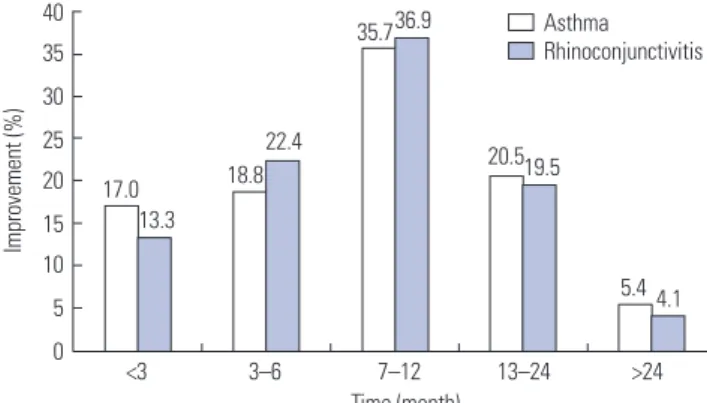
Interestingly, about 15% of patients reported symptom im- provements within 3 months after starting AIT, and almost 3 out of 4 patients reported that their symptoms were dimin- ished within 1 year after starting AIT (Fig. 2). However, wheth- er patients had only one of rhinitis or asthma or both diseases did not affect satisfaction with AIT among patients and their physicians.
Changes in medication use after AIT
Prescription rates were evaluated for individual drugs in the questionnaire for physicians. Before starting AIT, ICS, beta- agonists, LTRA, and theophylline were administered to 79.8, 61.1, 57.5, and 2.9% of the asthmatic patients, respectively;
however, the prescription rates dramatically dropped to 49.1, 37.5, 29.7, and 1%, respectively, after AIT treatment (Fig. 3A).
Drug prescription rates were also investigated in patients with allergic rhinitis. The prescription rates of intranasal corti- costeroid, antihistamines, and LTRA were 82.5, 89.8, and 66.9%, respectively, before starting AIT. The prescription rates were significantly decreased to 35.6, 48.8, and 32.8%, respec- tively, after AIT (Fig. 3B).
Medical and socioeconomic aspects of AIT
As for advantages of AIT, disease aggravation and drug de- mand were decreased such that patients reported a better than ‘good’ state in 84.3% and 83.0% of patients, respectively, and 79.2% of patients were in a better than ‘good’ state with respect to adverse reactions to AIT. Regarding economic as- pects of AIT, 78.7% and 83.2% of patients reported a better than ‘good’ state for time consumption with AIT treatment and methodologic discomfort of AIT; however, 53.6% of pa- tients described burden with the cost of AIT (Fig. 4). In addi- tion, the rates of overall satisfaction with AIT higher than
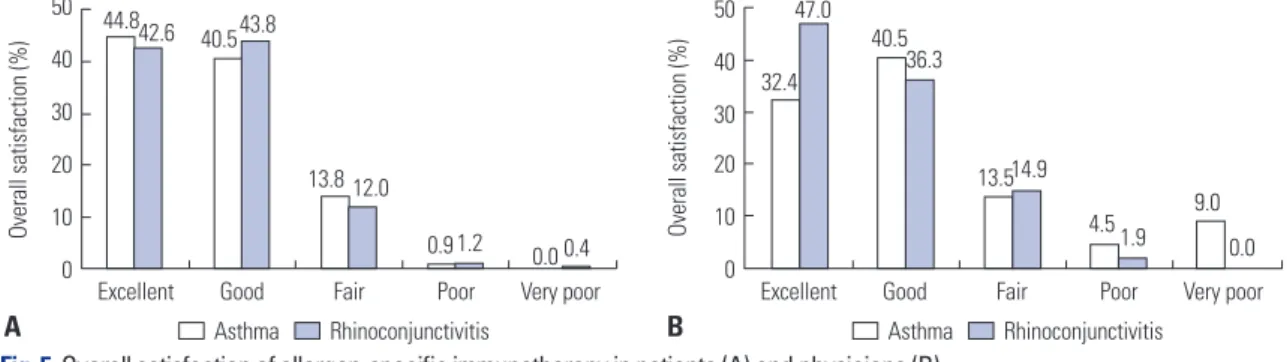
‘good’ were 85.3% and 86.4%, respectively, in patients with asthma and allergic rhinitis (Fig. 5), and these were corre- sponded with those results of their physicians (kappa agree- ment=0.234, p<0.001 in allergic rhinitis and kappa agree- ment=0.373, p<0.001 in asthma). Interestingly, the rates of satisfaction with AIT for asthma tended to be higher in pa- tients than in physicians.
Moreover, 91% of patients wanted to continue AIT, and Table 1. Demographic- and Immunotherapy-Related Characteristics of
Patients in This Study
Variables n=267 (%)
Age (yr) 25.6±15.4 (1–69)
1–9 35
10–19 82
20–29 45
30–39 51
40–49 30
50–59 20
60–69 3
Sex, male 133 (49.8)
Family history of allergic diseases 211 (79.0) Indicated diseases for AIT (duplicated)
Asthma 114 (42.7)
Allergic rhinoconjunctivitis 244 (91.4)
Atopic dermatitis 54 (20.2)
Previous AIT history 27 (10.2)
Mean duration of AIT (month) 27.3±15.0 (12–90) Information source of AIT
General hospital physician 165 (69.6)
General practitioner 14 (5.9)
Acquaintances 33 (13.9)
Internet/media 19 (8.0)
Other patients 1 (0.4)
Others 5 (2.1)
Subjective adherence to AIT (patients)
Excellent 239 (91.6)
Good 7 (2.7)
Pair 8 (3.1)
Poor 4 (1.5)
Very poor 3 (1.1)
AIT, allergen-specific immunotherapy.
Family history represents to have allergic diseases in the direct blood rela- tives of the patient. Data are presented as a mean±SD (range) or number (percentage).
88.7% were willing to recommend AIT for other allergic pa- tients. The results demonstrated that AIT can be a safe and ef- fective therapeutic option for allergic patients in both medical and economic aspects, except for its cost.
The efficacy of AIT according to age groups
The efficacy of AIT was assessed in the pediatric and adult groups. Although parameters of allergic rhinitis/asthma symptoms or adverse reactions were not different between the groups (data not shown), there was a significant difference in guideline-based disease severity and medication use. The proportions of patients with intermittent severity asthma were 86.2% and 54.2%, respectively, in the pediatric and adult
100 80 60 40 20 0
100 80 60 40 20
Before AIT After AIT 0 Before AIT After AIT Intermittnet Mild persistent
Moderate persistent Severe persistent Mild intermittnet Mod-severe intermittent Mild persistent Mod-severe persistent 10090
8070 6050 4030 2010 0
100 80 60 40 20
Day Sx. Night Sx. SABA use Attack QoL 0 Rhinorrhea Obstruction Sneezing Itching Eye Eye itching redness Much improved Improved No difference
Aggravated Much aggravated
Much improved Improved No difference Aggravated Much aggravated
Symptom change (%) Symptom change (%)
A B
Severity change (%) Severity change (%)
C D
58.9 64.9 61.1 67.6 66.0
49.0 47.6 51.9 49.0 47.5 43.8
32.1 27.9
21.3 19.6 24.5
43.3 39.6 36.1 33.2 32.6 32.3
8.9 6.3 17.6 12.7 8.5 7.8 12.4 11.6 16.6 18.6 22.6
0.0 0.9 0.0 0.0 0.9 0.0 0.4 0.4 1.2 0.8 1.3
7.9
38.6 63.4
8.0
64.8
46.5 28.7 20.2
10.8 6.9 14.1
81.2
6.9 1.0 0.9
Fig. 1. Changes in allergy symptom and severity after AIT. (A) Symptom changes in patients with asthma. (B) Symptom changes in patients with allergic rhinitis. (C) Asthma severity change based on the GINA guideline. (D) Allergic rhinitis severity change based on the ARIA guideline. AIT, allergen-specif- ic immunotherapy; SABA, short-acting bata-agonist; QoL, quality of life.
40 35 30 25 20 15 10 5
0 <3 3–6 7–12 13–24 >24 Time (month)
Asthma Rhinoconjunctivitis
Improvement (%)
17.0 13.3
18.8 22.4
35.736.9
20.519.5
5.4 4.1
Fig. 2. Time to symptom improvement after allergen-specific immuno- therapy.
groups after AIT. The use of inhaled corticosteroids (ICS) (28.1% vs. 57.7%), beta-agonists (22.6% vs. 44.6%), and leukot- riene receptor antagonists (LTRA) (9.4% vs. 36.8%) were sig- nificantly less frequent in the pediatric group than in the adult group. Moreover, the prescription rates of antihistamine were quite decreased in pediatric allergic rhinitis patients com- pared to those in adult patients (Table 2).
The overall rates of satisfaction with AIT for asthma were significantly higher in the pediatric group than in the adult group (1.83±0.66 vs. 1.64±0.77, p=0.040). However, such re- sults were not observed in allergic rhinitis patients who re- ceived AIT (Table 2). Sex, adherence to AIT, initial disease se- verities, and associated diseases did not affect satisfaction with AIT in both asthma and rhinitis patients.
Taken together, our results showed that AIT might reduce allergy symptoms, medication use and disease severity based on the GINA or ARIA guidelines in Korean patients with asth- ma or allergic rhinitis.
DISCUSSION
In this cross-sectional study, we aimed to evaluate patient perspectives on AIT together with those of their physicians, and found excellent satisfactions with AIT in regarding to its efficacy and time-consuming and methodologic difficulties in both groups with good correlation. We also clearly showed
Fig. 5. Overall satisfaction of allergen-specific immunotherapy in patients (A) and physicians (B).
50 40 30 20 10 0 50
40 30 20 10
0 Excellent Good Fair Poor Very poor Excellent Good Fair Poor Very poor
Overall satisfaction (%)
Overall satisfaction (%)
B A
44.842.6 40.543.8
13.8 12.0
0.9 1.2 0.0 0.4
32.4 47.0
40.536.3
13.514.9
4.5 1.9 9.0 0.0
Asthma Rhinoconjunctivitis Asthma Rhinoconjunctivitis Before AIT After AIT Before AIT After AIT 100
9080 7060 50 4030 20 100
100 9080 7060 50 4030 20 100
ICS Beta-agonist LTRA Theophylline INS Antihistamine LTRA
Prescription rate (%) Prescription rate (%)
A B
79.8
49.1 61.1
37.5 57.5
28.7
2.9 1
82.5
35.6
89.8
48.8
66.9
32.8
Fig. 3. Changes in drug prescription patterns after AIT. (A) Prescription patterns after AIT in patients with asthma. (B) Prescription patterns after AIT in patients with allergic rhinitis. AIT, allergen-specific immunotherapy; ICS, inhaled corticosteroids; LTRA, leukotriene receptor antagonists; INS, intra- nasal corticosteroid.
Fig. 4. The subjective advantage of AIT in medical (A) and economic and methodologic aspects (B) from the patients’ perspective. AIT, allergen-specific immunotherapy.
100 80 60 40 20 0
100 80 60 40 20
Disease aggravation Drug demand Adverse reaction 0 Time consuming Cost Method of AIT
Percentage (%) Percentage (%)
A Excellent Good Fair Poor Very poor B Excellent Good Fair Poor Very poor
41.6 40.7
34.8 35.6
20.0 33.2
43.1
26.4
50.0 18.6
40.0
2.4 12.8 15.61.2
42.7 42.3
44.4
15.3 16.2 18.0
0.4 0.8 2.8
that about three-quarter of the patients experienced symptom improvement within a year after AIT in this study.
Although many surveys of prescription patterns in AIT have been published,23,24 studies regarding perspectives or satisfac- tion with AIT are extremely rare, especially in Korea. This study had some heterogeneity in disease patterns, hospital settings, ages, and products for AIT and the specialties of phy- sicians due to its retrospective design. Despite this heteroge- neity, it is interesting that the overall rate of satisfaction with AIT was more than 80% for asthma or allergic rhinitis patients, moreover, it was more than 70% for physicians. This result is in line with those of previous studies performed in Italy and Spain.19,20 The rates of patient and physician satisfaction with AIT were 74/100 and 78/100, respectively, using VAS scores, and showed a significant similarity between them.25 The Satis-
faction Scale for Patients Receiving Allergen Immunotherapy (ESPIA) totaled 69.2 points on a 0–100 scale after sublingual grass pollen immunotherapy.26 Although the methods for evaluating the overall rate of satisfaction with AIT were not similar between studies, AIT appeared to be an excellent ther- apeutic option meeting the expectations of allergic patients and physicians. In contrast, the most unsatisfactory part had answered the cost of AIT. More than 50% of patients answered fair or worse opinions in that question.
Another interesting result of this study was that the rate of satisfaction with AIT was higher in pediatric asthmatics than in adult asthmatics. While patient age does not seem to be a limitation to AIT, the efficacy of AIT according to age groups is still debatable. Asthma is a chronic inflammatory disease that leads to irreversible changes in the airway. Therefore, it would
be advisable to start AIT earlier in the disease process. Our data showed no differences in allergy symptoms between pa- tients of ages less than 15 years and those older than 15 years, but showed a significant difference in guideline-based dis- ease severity and medication use after AIT, especially in asth- matics. Previous studies have reported similar results as ours.
SLIT with house dust mite extracts seems to be as effective in school-age children and adolescents as in adults; however, the degree of reduction in medication use tended to be higher in the young age group than in the adolescent group.27 Inter- estingly, a significant difference in disease severity was found only in asthma, but not in allergic rhinitis. Airway remodeling such as collagen deposition could prominently occur in sub- optimally treated or untreated asthma, in contrast, those fea- tures are not prominent in allergic rhinitis. We thought the above difference may attribute to our results in asthma and rhinitis. Moreover, some discrepancies in satisfaction rates with AIT for asthma between patients and physicians may have been attributed to the lack of objective monitoring tools such as pulmonary function tests to patients. Further studies are needed to confirm our findings.
Patients should be educated about AIT before the start of AIT because AIT requires a long treatment duration and sometimes causes hypersensitivity reactions. In this study, only 5.9% of the patients had heard about AIT from general practitioners. The Internet, media, or acquaintances were im- portant sources of information on AIT. This could disseminate incorrect knowledge about AIT to many allergic patients. This finding was also in line with those of previous studies con-
cerning the sources of information on AIT.13,15,25 Approximate- ly 30% of patients expected immediate therapeutic effects from AIT, and about 20% of the patients wanted the treatment to be performed for a short period of time.25 Our results can explain the reasons why AIT is not frequently offered to pa- tients and why many patients hold misconceptions about AIT in Korea. We should consider the education of general practi- tioners and the use of multimedia for better understanding and more prescriptions of AIT in Korea.
AIT significantly decreased all clinical symptoms in patients with asthma or allergic rhinitis as reported in previous stud- ies.28,29 More than 80% of patients reported an ‘improved’ or
‘much improved’ state in regarding to clinical symptoms after AIT. In addition, disease severity, an objective parameter, was also reduced after AIT in many patients. In this study, 81.2% of allergic rhinitis patients showed a moderate to severe persis- tent state before AIT; 64.8% of the patients changed to mild intermittent state; and only 20.2% of the patients showed a moderate to severe intermittent state after AIT. Similarly, 7.9%
of intermittent asthma patients turned to 63.4% after AIT.
These results are also consistent with those of previous studies demonstrating that the severity of allergic rhinitis was reduced from moderate to severe severity to mild severity in 49.1% of patients.26 This study also showed the decreased medication prescription rate after AIT in both allergic rhinitis and asthma patients. Taken together, AIT might be very effective in im- proving disease severity and reducing the frequency of medi- cation use.
Our survey evaluated the time of symptom improvement.
About 15% of patients reported symptom improvement with- in 3 months, more than 30% of the patients within 6 months, and 75% of patients within 1 year. It is conceivable that AIT can show quick therapeutic effects through early desensitiza- tion of mast cells within 1 week and production of regulatory cytokines, such as IL-10 and TGF-beta, within 6 months.30,31 Although further studies are needed to confirm our findings, time to symptom improvement can help to explain the onset timing of AIT to allergic patients.
Our study has some limitations. First, we only analyzed re- sults from patients receiving subcutaneous immunotherapy.
In a previous study in Korea, SLIT was usually prescribed by otolaryngologists.32 However, enrolled doctors in our study were only from internal medicine and pediatrics. This is the reason why the number of patients receiving SLIT was small in our study. Secondly, we could not compare the efficacy and safety of AIT between AIT products or administration meth- ods. The questionnaire developed by an expert panel of the allergen and immunotherapy workgroup of the KAAACI was inadequate for these purposes. Our workgroup is planning to compare AIT products in future studies. However, the strengths of the present study are that data were collected in real-life settings and that relevant data based on current guidelines were provided for the management of patients re- Table 2. Effects of AIT according to Age Groups
Age ≤15 Age >15 Total p value
Asthma severity after AIT 0.004
Intermittent 25 (86.2) 39 (54.2) 64 (63.4) Mild persistent 3 (10.3) 26 (36.1) 29 (28.7) Moderate persistent 0 (0) 7 (9.7) 7 (6.9)
Severe persistent 1 (3.4) 0 (0) 1 (1)
Rhinitis severity after AIT 0.794
Mild intermittent 38 (67.9) 100 (63.7) 138 (64.8) Mod-severe intermittent 10 (17.9) 33 (21.0) 43 (20.2) Mild persistent 8 (14.3) 22 (14.0) 30 (14.1) Mod-severe persistent 0 (0) 2 (1.3) 2 (0.9) Beta-agonist use after AIT 7 (22.6) 29 (44.6) 36 (37.5) 0.044 ICS use after AIT 9 (28.1) 45 (57.7) 54 (49.1) 0.006 LTRA use after AIT (asthma) 3 (9.4) 28 (36.8) 31 (28.7) 0.005 INS use after AIT 20 (42.6) 48 (33.3) 68 (35.6) 0.293 Antihistamine use after AIT 19 (34.5) 82 (53.9) 101 (48.8) 0.018 LTRA use after AIT (rhinitis) 17 (30.4) 40 (33.9) 57 (32.8) 0.730 Overall satisfaction in asthma 1.83±0.66 1.64±0.77 1.71±0.73 0.040 Overall satisfaction in rhinitis 2.99±1.08 2.85±1.27 2.90±1.20 0.736 AIT, allergen-specific immunotherapy; ICS, inhaled corticosteroids; LTRA, leu- kotriene receptor antagonists; INS, intranasal corticosteroid.
Data are presented as a number (percentage) or mean±SD.
ceiving AIT, emphasizing the importance of the patient’s point of view on AIT. Thirdly, since some children may have sponta- neous remissions of allergic symptoms as they become older, we cannot confirm the superiority of AIT in childhood asthma on the basis of the above results.
In conclusion, in this study evaluating the perspectives on AIT in both patients and physicians, the majority of patients and physicians were satisfied with the efficacy and safety of AIT, except for its cost. Physicians who treat allergic patients should recognize the strength and weakness of AIT and rec- ommend more AIT to allergic patients.
ACKNOWLEDGEMENTS
This work was supported by a grant from the Korean Academy of Asthma, Allergy and Clinical Immunology (KAAACI).
AUTHOR CONTRIBUTIONS
Conceptualization: Yoo Seob Shin and Jae-Woo Jung. Data curation:
Jae-Woo Kwon and Sang Min Lee. Formal analysis: Yoo Seob Shin and Ji Hye Kim. Funding acquisition: Sooyoung Lee and Jung-Won Park. Investigation: Yoo Seob Shin, Jae-Woo Jung, and Jeong-Hee Choi. Methodology: Jae-Woo Jung, Jae-Woo Kwon, and Jung-Won Park. Project administration: Yoo Seob Shin. Resources: Ji Hye Kim, Sang Min Lee, and Jae-Woo Kwon. Software: Yoo Seob Shin, Jae-Woo Jung, and Sooyoung Lee. Supervision: Man Yong Han, Young Min Ahn, and Jung-Won Park. Validation: Jeong-Hee Choi and Jae-Woo Jung. Visualization: Sooyoung Lee and Sang Min Lee. Writing—origi- nal draft: Yoo Seob Shin and Jeong-Hee Choi. Writing—review & ed- iting: Man Yong Han and Young Min Ahn.
ORCID iDs
Yoo Seob Shin https://orcid.org/0000-0002-9855-3185 Jae-Woo Jung https://orcid.org/0000-0002-3411-735X Jung-Won Park https://orcid.org/0000-0003-0249-8749 Jeong-Hee Choi https://orcid.org/0000-0002-0599-875X Jae-Woo Kwon https://orcid.org/0000-0003-1639-3606 Sooyoung Lee https://orcid.org/0000-0003-1734-4101 Ji Hye Kim https://orcid.org/0000-0003-4677-0513 Sang Min Lee https://orcid.org/0000-0002-9568-2096 Young Min Ahn https://orcid.org/0000-0002-1697-8041 Man Yong Han https://orcid.org/0000-0002-9077-5779
REFERENCES
1. Noon L. Prophylactic inoculation against hay fever. Int Arch Aller- gy Appl Immunol 1953;4:285-8.
2. Varney VA, Tabbah K, Mavroleon G, Frew AJ. Usefulness of spe- cific immunotherapy in patients with severe perennial allergic rhinitis induced by house dust mite: a double-blind, randomized, placebo-controlled trial. Clin Exp Allergy 2003;33:1076-82.
3. Blumberga G, Groes L, Haugaard L, Dahl R. Steroid-sparing effect of subcutaneous SQ-standardised specific immunotherapy in moderate and severe house dust mite allergic asthmatics. Allergy 2006;61:843-8.
4. Niggemann B, Jacobsen L, Dreborg S, Ferdousi HA, Halken S, Høst
A, et al. Five-year follow-up on the PAT study: specific immuno- therapy and long-term prevention of asthma in children. Allergy 2006;61:855-9.
5. Durham SR, Emminger W, Kapp A, de Monchy JG, Rak S, Scadding GK, et al. SQ-standardized sublingual grass immunotherapy: con- firmation of disease modification 2 years after 3 years of treatment in a randomized trial. J Allergy Clin Immunol 2012;129:717-25.
6. Jacobsen L, Niggemann B, Dreborg S, Ferdousi HA, Halken S, Høst A, et al. Specific immunotherapy has long-term preventive effect of seasonal and perennial asthma: 10-year follow-up on the PAT study. Allergy 2007;62:943-8.
7. Novembre E, Galli E, Landi F, Caffarelli C, Pifferi M, De Marco E, et al. Coseasonal sublingual immunotherapy reduces the devel- opment of asthma in children with allergic rhinoconjunctivitis. J Allergy Clin Immunol 2004;114:851-7.
8. Inal A, Altintas DU, Yilmaz M, Karakoc GB, Kendirli SG, Sertdemir Y. Prevention of new sensitizations by specific immunotherapy in children with rhinitis and/or asthma monosensitized to house dust mite. J Investig Allergol Clin Immunol 2007;17:85-91.
9. Reha CM, Ebru A. Specific immunotherapy is effective in the pre- vention of new sensitivities. Allergol Immunopathol (Madr) 2007;
35:44-51.
10. Hankin CS, Cox L, Lang D, Levin A, Gross G, Eavy G, et al. Allergy immunotherapy among Medicaid-enrolled children with allergic rhinitis: patterns of care, resource use, and costs. J Allergy Clin Im- munol 2008;121:227-32.
11. Law AW, Reed SD, Sundy JS, Schulman KA. Direct costs of allergic rhinitis in the United States: estimates from the 1996 Medical Ex- penditure Panel Survey. J Allergy Clin Immunol 2003;111:296-300.
12. Anolik R, Schwartz AM, Sajjan S, Allen-Ramey F. Patient initiation and persistence with allergen immunotherapy. Ann Allergy Asth- ma Immunol 2014;113:101-7.
13. Demoly P, Didier A, Mathelier-Fusade P, Drouet M, David M, Bonnelye G, et al. Physician and patient survey of allergic rhinitis in France: perceptions on prevalence, severity of symptoms, care man- agement and specific immunotherapy. Allergy 2008;63:1008-14.
14. Lombardi C, Canonica GW, Passalacqua G. The perception of al- lergen-specific immunotherapy among chest physicians: an Ital- ian survey. Eur Ann Allergy Clin Immunol 2014;46:132-6.
15. Lombardi C, Bettoncelli G, Canonica GW, Passalacqua G. The per- ception of allergen-specific immunotherapy among Italian gener- al practitioners. Eur Ann Allergy Clin Immunol 2012;44:80-2.
16. Radulovic S, Calderon MA, Wilson D, Durham S. Sublingual im- munotherapy for allergic rhinitis. Cochrane Database Syst Rev 2010;
12:CD002893.
17. Boz˙ek A, Kołodziejczyk K, Kozłowska R, Canonica GW. Evidence of the efficacy and safety of house dust mite subcutaneous immu- notherapy in elderly allergic rhinitis patients: a randomized, dou- ble-blind placebo-controlled trial. Clin Transl Allergy 2017;7:43.
18. Virchow JC, Backer V, Kuna P, Prieto L, Nolte H, Villesen HH, et al.
Efficacy of a house dust mite sublingual allergen immunotherapy tablet in adults with allergic asthma: a randomized clinical trial.
JAMA 2016;315:1715-25.
19. Serrano P, Justicia JL, Sánchez C, Cimarra M, Fernández-Távora L, Orovitg A, et al. Systemic tolerability of specific subcutaneous im- munotherapy with index-of-reactivity-standardized allergen ex- tracts administered using clustered regimens: a retrospective, ob- servational, multicenter study. Ann Allergy Asthma Immunol 2009;
102:247-52.
20. Ciprandi G, Cadario G, Valle C, Ridolo E, Verini M, Di Gioacchino M, et al. Sublingual immunotherapy in polysensitized patients:
effect on quality of life. J Investig Allergol Clin Immunol 2010;20:
274-9.
21. Wyrzykowska N, Czarnecka-Operacz M, Adamski Z. Long-term efficacy of allergen specific immunotherapy in atopic dermatitis patients in relation to quality of life. Eur Ann Allergy Clin Immu- nol 2015;47:5-9.
22. Rak S, Yang WH, Pedersen MR, Durham SR. Once-daily sublingual allergen-specific immunotherapy improves quality of life in pa- tients with grass pollen-induced allergic rhinoconjunctivitis: a double-blind, randomised study. Qual Life Res 2006;16:191-201.
23. Lombardi C, Senna G, Passalacqua G. Specific immunotherapy among Italian specialists. Allergy 2006;61:898-9.
24. Coifman RE, Cox LS; Immunotherapy and Allergy Diagnostics Committee of the AAAAI. 2006 American Academy of Allergy, Asthma & Immunology member immunotherapy practice pat- terns and concerns. J Allergy Clin Immunol 2007;119:1012-3.
25. Baiardini I, Puggioni F, Menoni S, Boot JD, Diamant Z, Braido F, et al. Patient knowledge, perceptions, expectations and satisfaction on allergen-specific immunotherapy: a survey. Respir Med 2013;
107:361-7.
26. Antolín-Amerigo D, Tabar IA, Del Mar Fernández-Nieto M, Calle- jo-Melgosa AM, Muñoz-Bellido FJ, Martínez-Alonso JC, et al. Sat- isfaction and quality of life of allergic patients following sublingual five-grass pollen tablet immunotherapy in Spain. Drugs Context 2017;6:212309.
27. Han DH, Choi YS, Lee JE, Kim DY, Kim JW, Lee CH, et al. Clinical efficacy of sublingual immunotherapy in pediatric patients with al-
lergic rhinitis sensitized to house dust mites: comparison to adult patients. Acta Otolaryngol 2012;132 Suppl 1:S88-93.
28. Frew AJ, Ljørring C, Wolf H, Wüstenberg E, Durham SR, Corrigan CJ, et al. UK Immunotherapy study: reanalysis by a combined symptom and medication score. J Allergy Clin Immunol 2018;142:
1998-9.
29. Grouin JM, Vicaut E, Devillier P. Comparison of scores associating symptoms and rescue medication use for evaluating the efficacy of allergy immunotherapy in seasonal allergic rhinoconjunctivi- tis: results from five trials. Clin Exp Allergy 2017;47:254-63.
30. Burks AW, Calderon MA, Casale T, Cox L, Demoly P, Jutel M, et al.
Update on allergy immunotherapy: American Academy of Allergy, Asthma & Immunology/European Academy of Allergy and Clini- cal Immunology/PRACTALL consensus report. J Allergy Clin Im- munol 2013;131:1288-96.
31. Tordesillas L, Mondoulet L, Blazquez AB, Benhamou PH, Samp- son HA, Berin MC. Epicutaneous immunotherapy induces gastro- intestinal LAP+ regulatory T cells and prevents food-induced ana- phylaxis. J Allergy Clin Immunol 2017;139:189-201.
32. Hur GY, Kim TB, Han MY, Nahm DH, Park JW; Allergen and Im- munotherapy Work Group of the Korean Academy of Asthma, Al- lergy and Clinical Immunology (KAAACI). A survey of the pre- scription patterns of allergen immunotherapy in Korea. Allergy Asthma Immunol Res 2013;5:277-82.