507
흰쥐 대동맥에서 phospholipase C를 경유한 melatonin의 혈관 이완 작용
김상진·백성수·강형섭·김진상*
전북대학교 생체안전성연구소 (게재승인: 2005년 11월 22일)
Phospholipase C-mediated vasorelaxing action of melatonin in rat isolated aorta
Shang-Jin Kim, Sung-Soo Baek, Hyung-Sub Kang, Jin-Shang Kim*
Bio-Safety Research Institute, Chonbuk National University, Jeonju 561-756, Korea
(Accepted: November 22, 2005)
Abstract: Melatonin, the principal hormone of the vertebral pineal gland, participates in the regulation of cardiovascular system in vitro and in vivo. However, the effects of melatonin on vascular tissues are still vague. The aim of this study was to assess the relationship between phospholipase C (PLC) and nitric oxide synthase (NOS)/cyclic guanosine 3',5'-monophosphate (cGMP) signaling cascade in the relaxatory action of melatonin in isolated rat aorta. Melatonin induced a concentration-dependent relaxation in phenylephrine (PE)- and KCl-precontracted endothelium intact (+E) aortic rings. In KCl-precontracted +E aortic rings, the melatonin-induced vasorelaxation was not inhibited by endothelium removal or by pretreatment with NOS inhibitors, L-NG-nitro-arginine (L-NNA) and L-NG-nitro-arginine methyl ester (L-NAME), guanylate cyclase (GC) inhibitors, methylene blue (MB) and 1H-[1,2,4] oxadiazolo-[4,3-a] quinoxalin-1-one (ODQ).
In PE-precontracted +E aortic rings, the melatonin-induced vasorelaxation was inhibited by endothelium removal or by pretreatment with L-NNA, L-NAME, MB, ODQ and 2-nitro-4- carboxyphenyl-n,n-diphenylcarbamate (NCDC). Moreover, in without endothelium (-E) aortic rings and in the presence of L-NNA, L-NAME, MB and ODQ in +E aortic rings, the melatonin-induced residual relaxations and residual contractile responses to PE were not affected by NCDC, a PLC inhibitor. It is concluded that melatonin can evoke vasorelaxation due to inhibition of PLC pathway through the protein kinase G activation of endothelial NOS/cGMP signaling cascade.
Key words :aorta, cGMP, melatonin, NOS, 2-nitro-4-carboxyphenyl-n,n-diphenylcarbamate, vasorelaxation
서 론
Melatonin(N-acetyl-5-metoxytryptamine)은포유류의번
식, 동면과같은계절주기조절, 조류와파충류의일주
기조절및명암반응에관여하며 [2, 27, 32], 심혈관계
[6, 21, 32, 33]를비롯한면역계 [26], 신경·내분비계
[33] 및체온조절계 [20] 등을포함한다양한생리학적
기능 [33]을갖고있는 indole계신경호르몬이다. 또한
허혈성심장과재관류에의한심장의산화적손상에대 한억제효과가있다고하였다 [25]. 이와같이 melatonin
은생체내다른내인성물질과마찬가지로다양한생리 학적역할을담당하고있는데그중심혈관기능을직·
간접적으로조절한다 [18]. 또한혈압하강, 심박수, 혈
관수축및이완작용이보고되었다 [3, 6, 9, 11, 28, 29].
*Corresponding author: Jin-shang Kim
College of Veterinary Medicine, Chonbuk National University, Jeonju 561-756 [Tel: +82-63-270-2554, Fax: +82-63-270-3780, E-mail: [email protected]]
508 김상진·백성수·강형섭·김진상 심혈관계기능조절은생체항상성유지를위해매우중
요하며이는주로신경계및내분비계에의해이뤄질뿐 만아니라내인성물질에의한신경계반응으로이뤄진 다. 심혈관계기능지표가되는혈압변동은다양한생
리학적및병리학적인자에의해혈관의직접적인이완 및수축그리고심근의수축력및심박수변동에기인 하기 [8]때문에 melatonin과같은내인성물질의혈관에
대한 작용기전은 매우 중요시되고 있다. 따라서
melatonin의혈관에대한효과및작용기전에대하여
많은연구들이진행되어왔다.
일반적인주요혈관이완기전으로세포내 Ca2+농도 를감소시켜혈관을이완시키는 Ca2+통로차단이다. 혈 관이완을야기하는 Ca2+통로차단은세포내에서두가
지기전에의하여일어난다. 즉, cyclic guanosine 3',5'- monophosphate(cGMP) 활성에 의한 protein kinase G (PKG) 활성과직접적인 Ca2+통로차단이다. PKG 활성
은 Ca2+-활성 K+통로활성, 원형질막 Ca2+펌프활성,
근형질세망내 Ca2+ 펌프활성, inositol triphosphate(IP3)
수용체억제, IP3합성억제, 근수축계의 Ca2+감수성감
소및 protein kinase C(PKC) 활성을 감소시켜혈관을
이완시킬 수있다 [4]. 이전 많은연구보고에따르면
melatonin의혈관이완기전역시상기다양한일반적인
혈관이완기전에포함되고있음을알수있다. Melatonin
의 혈관 이완 기전 중 혈관내피 의존성 nitric oxide
synthase(NOS)/cGMP 경로는잘알려져 있다. 그러나 phospholipase C(PLC) 경로관련성은물론 NOS/cGMP
경로활성과 PLC 경로와의상호관계는보고된바없다.
따라서이연구에서는 melatonin의주요혈관이완기
전인 NOS/cGMP 경로활성에의한혈관이완을재확인
함과동시에 PLC 경로그리고 NOS/cGMP 경로와 PLC
경로의상호관련성을밝히고자하였다.
재료 및 방법
혈관 적출 및 수축력 측정
전북대학교 생체안전성연구소로부터 공급받은
Sprague-Dawley계수컷흰쥐(200~300 g)를치사시켜방 혈시킨후흉대동맥(thoracic aorta)을적출하여 30oC의 산소포화영양액(133.0 mM NaCl, 5.0 mM KCl, 2.5 mM CaCl2, 1.2mM MgSO4, 1.0 mM KH2PO4, 11.0mM glucose
및 12.0 mM NaHCO3와 95% O2: 5% CO2, pH 7.3~7.4)
으로혈액을제거한다음실체현미경하에서흉대동맥
주위의지방및결합조직편등을제거하고약 2~3 mm
의길이로절단하였다. 절단된한개의혈관고리를상 기영양액이관류(4±0.5 ml/min)되는 tissue chamber내에
직경 50µm 고정핀에고정하고한쪽은직경 25µm 은
선에연결된고리에연결한후 tension transducer (Model 400A; Cambridge, USA)에연결하였다. 연결후 250~300
µg의장력(정지장력)을준후안정되면등장성 40 mM KCl의영양액을 20~30분간 2~3회관류시켜장력을안
정시켰다. 장력변동은 recording system (Model 3400;
Gould, USA)을이용하여기록하였다.
약물 처치 및 혈관 내피 제거
Phenylephrine(PE) 또는고농도 KCl을투여하여수축 력이일정해지면농도별 melatonin의혈관이완효과를
관찰하고동일조직에서혈관내피를제거하거나여러 억제제들을일정시간동안전처치한후다시 melatonin
의혈관이완효과를관찰하여비교하였다. 내피존재유
무에따른실험은내피가존재한상태에서혈관이완효
과를관찰한후정지장력이유지된상태에서 saponin(0.3
mg/ml)을영양액에녹여 12~15분간관류시켜내피를제
거하고다시 melatonin의혈관이완효과를관찰하였다.
혈관내피존재유무는 0.5 µM의 acetylcholine (Ach)을 투여하여그이완여부로혈관내피제거상태를확인 하였다.
사용 약물 및 통계 처리
Ach, L-NG-nitro-arginine(L-NNA), L-NG-nitro-arginine methyl ester(L-NAME), methylene blue(MB), 2-nitro-4- carboxyphenyl-n,n-diphenylcarbamate(NCDC), 1H-[1,2,4]
oxadiazolo-[4,3-a] quinoxalin-1-one (ODQ), PE 및 saponin
은 Sigma Chemical Co.(USA)로부터 구입하였고, melatonin은 ICN Biomedical Inc.(Solon, USA)으로부터
구입하여사용하였다. 실험성적은 mean ± S.E.M으로나 타내었고, 각실험결과의유의성은 Student's t-test에의
해검정하였다.
결 과
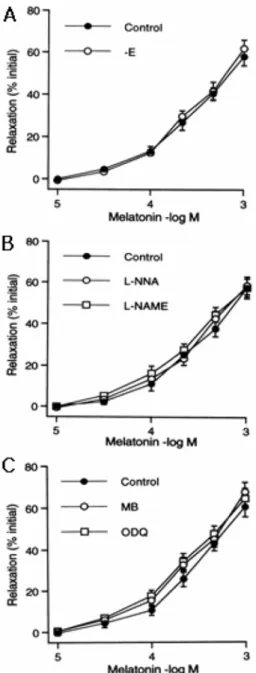
내피 제거, L-NNA, L-NAME, MB 및 ODQ이 고 농도 KCl에 의한 수축 혈관에서 melatonin의 혈관 이완작용에 미치는 영향
내피가존재하는혈관을 40 mM KCl로수축시킨후
10, 30, 100, 300, 600 및 1000 µM melatonin을관류시
킨결과농도의존적으로혈관을이완시켰다. 동일조직 에 saponin을처리하여혈관내피를제거(Ach 이완여 부로내피존재유무확인)하거나 NOS 억제제인 10 µM L-NNA이나 100 µM L-NAME 그리고 GC 억제제인 10 µM MB나 10 µM ODQ을 40~60분동안관류시켰다. 그 리고다시 KCl로혈관을수축시킨후 melatonin을상기
와같은농도별로관류시킨결과, 혈관내피제거또는
각각의억제제들에의하여 melatonin의혈관이완효과가
억제되지않았다(Fig. 1). 상기억제제들의농도를변동
시키거나전처치시간을변동시켜도 melatonin의혈관 이완효과는억제되지않았다.
내피 제거, L-NNA, L-NAME, MB 및 ODQ이 PE 에 의한 수축 혈관에서 melatonin의 혈관 이완작용 에 미치는 영향
내피가존재하는혈관을 PE으로수축시킨후 10, 30,
100, 300, 600 및 1000 µM melatonin을관류시킨결과
농도의존적으로혈관을이완시켰다(Fig. 6A). 동일조
직에 saponin을처리하여혈관 내피를제거하거나 10
µM L-NNA, 100 µM L-NAME, 10 µM MB나 10 µM ODQ을 40~60분동안관류시켰다. 그후반복하여혈관 을 PE으로수축시키고상기와동일농도의 melatonin을
관류시킨결과, melatonin의농도의존적인혈관이완효
과가내피존재혈관과각각의억제제처리전의이완정 도를비교할때유의성있게억제되었다(Fig. 2, 3A).
NCDC가 PE에 의한 수축 혈관에서 melatonin의 혈관 이완작용에 미치는 영향
내피가존재하는혈관에서 melatonin의농도별혈관
이완효과를관찰한 후 PLC 억제제인 30 µM NCDC를
Fig. 1. Effects of removal of endothelium, NOS inhibitors and GC inhibitors on the melatonin-induced relaxation in KCl-precontracted aortic rings. Graph showing the data summary of the effects of saponin (0.3 mg/ml; removal of endothelium, A), NO synthase (NOS) inhibitors (20 µM L- NNA and 100 µM L-NAME, B) and guanylate cyclase (GC) inhibitors (10 µM MB, methylene blue and 10 µM ODQ, C) on the melatonin-induced relaxation in KCl- precontracted +E aortic rings. Responses are expressed as a percentage of the initial KCl-induced tone. Each point represents the mean ± S.E.M by joining data files from separate experiments (n = 5).
Fig. 2. Effects of removal of endothelium on the melatonin- induced relaxation in PE-precontracted aortic rings. Typical tracings of the relaxant effects of melatonin in phenylephrine (PE)-precontracted aortic rings with (+E, A) or without (-E, B) endothelium. Where indicated, chemicals were added to the perfusing medium.
510 김상진·백성수·강형섭·김진상
포함하는영양액을각각 40분동안관류시켰다. 그후 반복하여혈관을 PE으로수축시킨후상기와같은농도 로 melatonin을처치한결과 NCDC에의하여 melatonin
의혈관이완효과가유의성있게억제되었다(Fig. 4).
혈관 내피 제거, NOS 억제제 또는 GC 억제제 존재하에서 melatonin의 혈관 이완작용에 미치는 NCDC의 영향
PE으로수축시킨혈관에서 melatonin은농도의존적
으로혈관을이완시켰으며(Fig. 4, 5A), 이러한 melatonin
의혈관이완효과는 혈관내피 제거, NOS 억제제및
GC 억제제에의하여각각유의성있게억제되었다. 그
후혈관내피를제거하거나 NOS 억제제및 GC 억제제
가함유된관류액에 30 µM NCDC를 40분동안전처
리한후 melatonin의혈관이완효과를관찰한결과, 혈
관이완효과가더이상억제되지않았다(Fig. 5, 6, 7).
추가적으로 10~1000 µM melatonin 존재하에서농도 의존적으로 PE에의한수축력이억제되었다. 동일조직
에 saponin을처리하여혈관내피를제거하거나 10 µM
L-NNA, 100 µM L-NAME, 10 µM MB 또는 10 µM ODQ
을 40~60분동안관류시킨후 melatonin을 30분간전처
치하고 2~5 µM PE의 최대 수축력을 측정한 결과,
Fig. 3. Effects of removal of endothelium, NOS inhibitors and GC inhibitors on the melatonin-induced relaxation in PE-precontracted aortic rings. Graph showing the data summary of the effects of saponin (A), NOS inhibitors (20 µM L-NNA and 100 µM L-NAME, B) and GC inhibitors (10 µM MB and 10 µM ODQ, C) on the melatonin-induced relaxation in PE-precontracted +E aortic rings. Each point represents the mean ± S.E.M by joining data files from separate experiments (n = 4~5). *p< 0.05,
**< 0.001 vs. +E or control.
Fig. 4. Effects of PLC inhibitor on the melatonin-induced relaxation in PE-precontracted aortic rings. Typical tracings of the effects of PLC inhibitor (30 µM NCDC) on the melatonin-induced relaxation in PE-precontracted +E aortic rings. Where indicated, chemicals were added to the perfusing medium.
melatonin의수축력억제효과가혈관내피제거또는각 각의상기억제제들에의하여유의성있게회복되었다.
동일조직에서혈관내피를제거하거나 10 µM L-NNA, 100 µM L-NAME, 10 µM MB 또는 10 µM ODQ을 40~60
분동안관류시킨후 melatonin과 NCDC를동시에 40분
간전처치하고 2~5 µM PE의최고수축력을측정한결
과혈관내피제거또는각각의상기억제제들에의한
회복정도에비교하여 NCDC에의하여더이상회복되
지않았다(자료제시하지않음).
고 찰
Melatonin의심혈관계작용중혈관에대하여수축과
이완에대한상반된보고가 있다. 첫째, 수축기전으로, melatonin은수용체를통한 Ca2+ 의존성 K+통로 억제
Fig. 5. Influences of PLC inhibitor on the effect of removal of endothelium and NOS inhibitor on the melatonin- induced relaxation in PE-precontracted aortic rings. Graph showing the data summary of the effects of NCDC on the melatonin-induced relaxation in PE-precontracted +E aortic rings (A) and the effects of NCDC on the melatonin- induced relaxation in saponin (B)- and L-NAME (C)- pretreated +E aortic rings. Each point represents the mean
± S.E.M by joining data files from separate experiments (n = 4~5). *p< 0.01, **< 0.001 vs. +E or control.
Fig. 6. Influences of PLC inhibitor on the effect of GC inhibitor on the melatonin-induced relaxation in PE- precontracted aortic rings. Typical tracings of the effects of MB on the melatonin-induced relaxation in PE-precontracted +E aortic rings (A and B), and the effect of NCDC on melatonin-induced relaxation in MB-pretreated +E aortic rings (C). Where indicated, chemicals were added to the perfusing medium.
512 김상진·백성수·강형섭·김진상
[11], cyclic adenosine 3',5'-monophosphate(cAMP)의생성 억제및 protein kinase A(PKA)의활성억제 [13] 또는 prostaglandin 및 NO 등의혈관이완물질을감소시켜혈
관을수축시킨다 [19, 22]. 둘째, 이완기전으로, 일반적 인근수축은 adenylate cyclase (AC)와 guanylate cyclase (GC) 활성에 의한 cAMP와 cGMP의증가로 PKA 및 PKG가활성화에의해조절되는데, melatonin에의한혈 관이완은혈관내피세포에의존적이며 [28], melatonin은 cGMP 대사억제 [28], Ca2+ 농도감소 [1], Ca2+통로활
성억제 [32], GC 활성촉진 [10]과 cGMP-phosphodies-
terase(PDE) 활성억제 [29] 등에의한다고하였다. 또한
혈관 이완 작용이 있음을 뒷받침해주는 연구로,
melatonin은정상적인쥐에서뿐만아니라송과선을제
거한흰쥐 [7, 17]와자연발생적고혈압 흰쥐 [16]에서
혈압을감소시키며, 흰쥐의송과선을제거하면고혈압 이유발되고 [16], 이러한고혈압효과가 melatonin 급여 로억제되었고 [14], melatonin이고혈압환자에대한임
상적치료제로도사용될수도있다 [18]는보고등이있 다. 이와같은 melatonin의혈관이완작용에대한보고 들을살펴보면 PLC의관련성이보고되지않았을뿐만
아니라부분적인연구에따라부분적인작용기전을설 명하고있을뿐이다. 따라서이연구결과를토대로주
요혈관이완기전으로밝혀진 PLC 경로관련성및
NOS/cGMP 경로와 PLC 경로와의상호관계를설명하고
자한다.
고농도 KCl에의한혈관수축은 세포외 Ca2+제거나 L-type Ca2+통로차단제에의하여억제 [5]되기때문에
KCl에의한 수축은 전위 의존성 Ca2+ 통로를경유한
Ca2+유입에의존적임을의미한다. 따라서어떤물질이
고농도 KCl에의한수축을억제하거나수축혈관을이 완시키면세포막탈분극에의한 Ca2+유입이억제되었 다고할수있다. 고농도 KCl로수축된혈관에 melatonin
을처치한결과농도의존적인혈관이완효과가관찰되 었으며, 이러한결과에의하면 melatonin이막전위의존 성 Ca2+통로활성화에의한세포막탈분극으로인한 Ca2+ 유입을억제하여혈관을이완시키는것으로생각 한다. 또한직접적인 L-type Ca2+ 통로활성제인 Bay K 8644로수축시킨혈관에서도동일하게 melatonin이혈관
을이완(자료제시하지않음)시켜 L-type Ca2+통로활 성화억제에의한혈관이완을확인할수있었다. 또다 른연구방법중하나인수용체효현제에의한혈관평 활근수축은주로수용체자극경로를경유한 Ca2+통 로의개방에의한세포외 Ca2+의세포내로유입, 세포내
저장소로부터 Ca2+유리 [31] 및비선택적양이온통로
를경유한 Ca2+유입 [15, 21]에의하여일어난다. 본연 구에서는α1-adrenoceptor 효현제인 PE을전처치하여수
축시킨혈관에 melatonin을처치한결과농도의존적으
로혈관이이완되었다. 그러나 PE으로수축시킨혈관에 서와는달리고농도 KCl에의해수축된혈관에서는혈
관내피 제거, NOS 억제제 및 GC 억제제에 의하여
melatonin에의한혈관이완효과가억제되지않았다. 따
라서 melatonin은 KCl에의한수축혈관에서는내피의
존성 NOS/cGMP계와무관하게막전위의존성 Ca2+통
로를통한 Ca2+유입을억제하여 혈관을이완시킨다는 것을알수있었다.
혈관내피가존재하는경우, 혈관내피유래이완인
Fig. 7. Influences of PLC inhibitor on the effect of GC inhibitors on the melatonin-induced relaxation in PE- precontracted aortic rings. Graph showing the data summary of the effects of NCDC on the melatonin-induced relaxation in MB (A) and ODQ (B)-pretreated +E aortic rings. Each point represents the mean ± S.E.M by joining data files from separate experiments (n = 5). *P < 0.05,
**< 0.001 vs. control.
자인 nitric oxide(NO) 유리는물론평활근에서외래성
NO는 cGMP를증가시키기때문에혈관이완및수축기
전연구에서혈관내피의유무, NOS 억제및활성상
태는매우중요하다. 혈관이완물질중외인성유기질
산화합물혈관이완제(nitrovasodilator)는혈관내피세
포와 관련없이 NO를제공하여 GC를활성화시키고,
melatonin과같은내인성호르몬또는신경전달물질들은
혈관내피세포에서 NOS 활성으로 NO를유리시켜 GC
를활성화시킴으로써세포내 cGMP를증가시킨다 [4].
생체에서 melatonin은 NOS의활성을조절하여혈관내
피에서유래하는혈관이완인자인 NO의생산에영향을
미친다 [23, 24]. 자연발생적인고혈압흰쥐의장간막동
맥 및 대동맥에서 혈관 내피 의존적 이완효과가
melatonin 처치에 의하여강화되고 melatonin을처치한
고혈압쥐에서의 NOS 억제제인 L-NAME의처치는동
맥압을 상승시킴으로 melatonin의저혈압유발효과는
혈관의 NOS 경로의활성화를통해이루어진다고하였
다 [12]. 토끼및흰쥐혈관에서 melatonin은 cGMP에특 이적인 PDE 활성을억제하고 [28, 29, 30], 이로인해
혈관이이완된다고하였다. 즉, melatonin은 cGMP-PDE
억제제인 zaprinast와유사하게토끼대동맥에서 nitrogly- cerin에의한이완을강화시키고이러한 melatonin의혈
관이완효과가 GC 억제제인 MB에의하여억제되었다
[29]. 이와같은이전의연구결과들에의하면, melatonin
및많은혈관 이완물질들의작용기전이 NOS, GC 및
cGMP 활성화경로와밀접한관련됨을알수있다. 상
기의연구결과들과유사하게본연구에서도 PE에의한
수축혈관에서 melatonin의이완효과가혈관내피제거,
NOS 억제제및 GC 억제제에의하여유의성있게억제
되었다. 이러한결과는흰쥐대동맥에서직접적으로
melatonin이혈관을이완시키는효과 [34]와면양의폐
동맥과정맥 [35]에서 melatonin의혈관이완효과와일 치하였다. 따라서 PE 수축혈관에대한 melatonin의이
완효과가내피의존성 NOS/cGMP 활성화경로를통하
여나타나는것임을재확인하였다.
PE에의한혈관수축은세포막의 PLC가활성화되어 PIP2가가수분해됨으로써두종류의이차전달물질인
IP3와 DAG가형성되고 IP3에의한세포내 Ca2+ 유리및
DAG에의한 PKC 활성화로혈관은수축한다. 반면, 혈
관이완은직접적인 Ca2+통로차단과 cGMP 활성에의
한 PKG 활성으로다양한경로를통하여세포내 Ca2+
농도가감소됨으로써일어난다 [4]. 이중 cGMP 활성에
의한 PKG 활성결과로 PKC 활성을억제로세포내 Ca2+
농도가감소될수있기때문에이경로중이전경로인
PLC의관련성을고려할수있다. 즉, PLC의억제에의
한세포내 Ca2+농도감소로혈관이이완될수있다. 이
연구에서 PE으로수축된혈관에서 melatonin의혈관이
완효과에대한 PLC 억제제인 NCDC의영향을관찰하
였다. 그결과 melatonin의혈관이완효과가 NCDC에의 하여유의성있게억제되었음은 PLC 억제에의하여나
타남을알수있고이전의연구결과와본연구결과에 의하면 melatonin은 cGMP을활성화시켜 PKG 활성으로 인하여 PLC를억제하여혈관을이완시킬수있음을의
미한다. 또한 melatonin에의한혈관이완이 cGMP 활성 에의한 PLC 억제는물론직접적인 PLC 억제또는 IP3
와 DAG 생성억제에의한결과일가능성을추측할수
가있으므로이연구에서는 NOS/cGMP 경로와 PLC 경 로와의상호관련성을알아보기위하여 PE으로수축된
혈관에서혈관내피제거, NOS 억제제및 GC 억제제
들의이완억제에대한 NCDC의영향을관찰하였다. 그
결과 melatonin의혈관이완효과에대한혈관내피제
거, NOS 억제제및 GC 억제제들의혈관이완억제효과
가 NCDC 처치에의하여더이상억제되지않았다. 만
약, melatonin의 혈관 이완효과가 각각의 단계(NOS/
cGMP와 PLC 단계)를경유한다면이러한두단계가각
각억제될것이므로혈관내피 제거, NOS 억제제및
GC 억제제들에의한 melatonin의혈관이완억제효과와 더불어 NCDC의억제효과로 melatonin의혈관이완억
제효과는 더욱 강화되었어야 할 것이다. 그러나
melatonin의이완효과에대한 NO/cGMP 단계차단또
는 PLC 단계의각각의차단영향과동시두단계(NOS/
cGMP와 PLC 단계) 차단영향과차이가없었다. 즉, 억
제정도가강화되지않았다. Melatonin의수축력억제
효과역시이완실험에서와유사하게혈관내피제거, NOS 억제제및 GC 억제제들에의하여회복되었으나
이회복효과도 NCDC에의하여강화되지않았다. 이러
한결과는 melatonin의혈관이완효과가혈관내피의존
성 NOS/cGMP 경로와관련된세포막의 PLC 경로를경
유하여나타난효과즉, melatonin은혈관내피세포의
NOS/cGMP 경로를활성화시켜이로인하여 PKG가활
성화됨으로서 PLC가억제되어혈관을이완시킬수있 음을알수있다.
결 론
PE 및 KCl로수축시킨흰쥐분리대동맥에서 melatonin
은농도의존적으로혈관을이완시켰다. KCl 수축혈관 에서이완효과는내피제거, NOS 억제제및 GC 억제
제들에의하여억제되지않았으나 PE 수축혈관에서는
melatonin의혈관이완효과가내피제거, NOS 억제제및
GC 억제제들에의하여억제되었다. 또한 melatonin의혈
관이완효과가 PLC 억제제인 NCDC에의하여억제되
514 김상진·백성수·강형섭·김진상 었다. PE 수축혈관에서 melatonin의혈관이완에대한
내피제거, NOS 억제제또는 GC 억제제들의억제효과
가 NCDC 병용 처치에 의하여 강화되지 않았다.
Melatonin의수축력억제효과역시이완실험에서와유
사하게혈관내피제거, NOS 억제제 및 GC 억제제들
에의하여회복되었으나이회복효과도 NCDC에의하 여강화되지않았다. 따라서 melatonin은혈관내피세포
의존적 NOS/cGMP를활성화시켜 PKG를활성화시킴으
로서 PLC가억제되어혈관을이완시킬것으로생각된다. 참고문헌
1.Benitez-King G, Rios A, Martinez A, Anton-Tay F.
In vitro inhibition of Ca2+/calmodulin-dependent kinase II activity by melatonin. Biochim BiophysActa1996, 1290, 191-196.
2.Bitman EL, Karsch EJ. Nightly duration of pineal melatonin secretion determines the reproductive response to inhibitory day length in the ewe. Biol Repord 1984, 30, 585-593.
3.Bosman H, Dormehl IC, Hugo N, Redelinghuys IF, Theron JJ. The effect of intravenous administration of melatonin on cardiovascular parameters of the baboon (Papio ursinus). J Pineal Res 1991, 11, 179-181.
4.Carvajal JA, Germain AM, Huidobro-Toro JP, Weiner CP. Molecular mechanism of cGMP-mediated smooth muscle relaxation. J Cell Physiol 2000, 184, 409-420.
5.Cauvin C, Loutzenhiser R, Van Breemen C.
Mechanism of calcium-antagonist induced vasodilation.
Annu Rev Pharmacol 1983, 23, 373-396.
6.Chuang JI, Chen SS, Lin MT. Melatonin decreases brain serotonin release, arterial pressure and heart rate in rats. Pharmacology 1993, 47, 91-97.
7.Cunnane SC, Manku MS, Oka M, Horrobin DP.
Enhanced vascular reactivity to various vasoconstrictor agents following pinealectomy in the rat: role of melatonin. Can J Physiol Pharmacol 1980, 58, 287-293.
8.Dart AM, Kingwell BA. Pulse pressure-a review of mechanisms and clinical relevance. J Am Coll Caridiol 2001, 37, 975-984.
9.Doolen S, Krause DN, Dubocovich ML, Duckles SP. Melatonin mediates two distinct responses in vascular smooth muscle. Eur J Pharmacol 1998, 345, 67-69.
10. Faillace MP, Keller Sarmiento MI, Rosenstein RE.
Melatonin effect on the cyclic GMP system in the golden hamster retina. Brain Res 1996, 711, 112-117.
11. Geary GG, Krause DN, Duckles SP. Melatonin directly constricts rat cerebral arteries through modulation of potassium channels. Am J Physiol 1997, 273, 1530- 1536.
12. Girouard H, Chulak C, Lejossec M, Lamontagne D Lamontagne D, De Champlain J. Vasorelaxant effects of the chronic treatment with melatonin on mesenteric artery and aorta of spontaneously hypertensive rats. J Hypertens 2001, 19, 1369-1377.
13. Godson C, Reppert SM. The Mella melatonin receptor is coupled to parallel signal transduction pathways.
Endocrinology 1997, 138, 397-404.
14. Holmes SW, Sugden D. The effect of melatonin on pinealectomy-induced hypertension in the rat. Br J Pharmacol 1976, 56, 360-361.
15. Karaki H, Ozaki H, Hori M, Mitsui-Saito M, Amano K, Harada K, Miyamoto S, Nakazawa H, Won KJ, Sato K. Calcium movements, distribution, and functions in smooth muscle. Pharmacol Rev 1997, 49, 157-230.
16. Kawashima K, Miwa Y, Fujimoto K, Oohata H, Nishino H, Koike H. Antihypertensive action of melatonin in the spontaneously hypertensive rat. Clin Exp Hypertens 1987, 9, 1121-1131.
17. Kilic E, Ozdemir YG, Bolay H, Kelestimur H, Dalkara T. Pinealectomy aggravates and melatonin administration attenuates brain damage in focal ischemia.
J Cereb Blood Flow Metab 1999, 19, 511-516.
18. Lusardi P, Piazza E, Fogari R. Cardiovascular effects of melatonin in hypertensive patients well controlled by nifedipine: a 24-hour study. Br J Clin Pharmacol 2000, 49, 423-427.
19. Martinuzzo M, Del Zar MM, Cardinali DP, Carreras LO, Vacas MI. Melatonin effect on arachidonic acid metabolism to cyclooxygenase deriva- tives in human platelets. J Pineal Res 1991, 11, 111- 20. 115.McLellan TM, Gannon GA, Zamecnik J, Gil V, Brown GM. Low doses of melatonin and diurnal effects on thermoregulation and tolerance to uncompe- nsable heat stress. J Appl Physiol 1999, 87, 308-316.
21. Nakajima T, Hazama H, Hamada E, Wu SN, Igarashi K, Yamashita T, Seyama Y, Omata M, Kurachi Y. Endothelin-1 and vasopressin activate Ca2+-permeable non-selective cation channels in aortic smooth muscle cells: mechanism of receptor-mediated Ca2+ influx. J Mol Cell Cardiol 1996, 28, 707-722.
22. Okatani Y, Wakatsuki A, Watanabe K, Taniguchi K, Fkaya T. Weak vasoconstrictor activity of melatonin in human umbilical artery: relation to nitric oxide- scavenging action. Eur J Pharmacol 2001, 417, 125- 23. 129.Pozo D, Reiter RJ, Calvo JR, Guerrero JM.
Inhibition of cerebellar nitric oxide synthase and cyclic GMP production by melatonin via complex formation with calmodulin. J Cell Biochem 1997, 65, 430-442.
24. Pozo D, Reiter RJ, Calvo JR, Guerrero JM.
Physiological concentrations of melatonin inhibit nitric oxide synthase in rat cerebellum. Life Sci 1994, 55, 455-460.
25. Reiter RJ. Pineal melatonin: cell biology of its synthesis and of its physiological interactions. Endocr Rev 1991, 12, 151-180.
26. Reiter RJ, Calvo JR, Karbownik M, Oi W, Tan DX.
Melatonin and its relation to the immune system and inflammation. Ann N Y Acad Sci 2000, 917, 376-386.
27. Reiter RJ, Tan DX. Melatonin: a novel protective agent against oxidative injury of the ischemic/
reperfused heart. Cardiovasc Res 2003, 58, 10-19.
28. Satake N, Oe H, Shibata S. Vasorelaxing action of melatonin in rat isolated aorta; possible endothelium
dependent relaxation. Gen Pharmacol 1991,22, 1127- 1133.
29. Satake N, Sawada HOT, Shibata S. The mode of vasorelaxing action of melatonin in rabbit aorta. Gen Pharmacol 1991, 22, 219-221.
30. Satake N, Shibata S, Takagi T. The inhibitory action of melatonin on the contractile response to 5- hydroxytryptamine in various isolated vascular smooth muscles. Gen Pharmacol 1986, 17, 553-558.
31. Somlyo AP, Himpens B. Cell calcium and its regulation in smooth muscle. FASEB J 1989, 3, 2266- 2276.
32. Underwood H, Goldman BD. Vetebrate circadian and photoperiodic system: role of the pineal gland and melatonin. J Biol Rhythms 1987, 2, 279-315.
33. Vanecek J. Cellular mechanisms of melatonin action.
Physiol Rev 1998, 78, 687-720.
34. Weekley B. Effects of melatonin on isolated pulmonary artery and vein; role of vascular endothelium. Pulm Pharmacol 1993, 6, 149-154.
35. Weekley B. Pharmacologic studies on the mechanism of melatonin-induced vasorelaxation in rat aorta. J Pineal Res 1995, 19, 133-138.