www.e-roj.org
This is an Open Access article distributed under the terms of the Creative Commons Attribution Non-Commercial License (http://creativecommons.org/
licenses/by-nc/4.0/) which permits unrestricted non-commercial use, distribution, and reproduction in any medium, provided the original work is properly cited.
Received 18 February 2016, Revised 14 March 2016, Accepted 31 March 2016.
Correspondence: Jin Hee Kim, MD, PhD, Department of Radiation Oncology, Dongsan Medical Center, Keimyung University School of Medicine, 56 Dalseong-ro, Jung-gu, Daegu 41931, Korea. Tel: +82-53-250-7665, Fax: +82-53-250-7487, E-mail:
[email protected]
Radiat Oncol J 2016;34(2):121-127 http://dx.doi.org/10.3857/roj.2016.01683 pISSN 2234-1900 · eISSN 2234-3156
Purpose: To investigate treatment outcome and long term complication after surgery and radiotherapy (RT) for pituitary adenoma.
Materials and Methods: From 1990 to 2009, 73 patients with surgery and RT for pituitary adenoma were analyzed in this study. Median age was 51 years (range, 25 to 71 years). Median tumor size was 3 cm (range, 1 to 5 cm) with suprasellar (n = 21), cavernous sinus extension (n = 14) or both (n = 5). Hormone secreting tumor was diagnosed in 29 patients; 16 patients with prolactin, 12 patients with growth hormone, and 1 patient with adrenocorticotrophic hormone. Impairment of visual acuity or visual field was presented in 33 patients at first diagnosis. Most patients (n = 64) received RT as postoperative adjuvant setting.
Median RT dose was 45 Gy (range, 45 to 59.4 Gy).
Results: Median follow-up duration was 8 years (range, 3 to 22 years). In secreting tumors, hormone normalization rate was 55%
(16 of 29 patients). For 25 patients with evaluable visual field and visual acuity test, 21 patients (84%) showed improvement of visual disturbance after treatment. The 10-year tumor control rate for non-secreting and secreting adenoma was 100% and 58%, respectively (p < 0.001). Progression free survival rate at 10 years was 98%. Only 1 patient experienced endocrinological recurrence.
Following surgery, 60% (n = 44) suffered from pituitary function deficit. Late complication associated with RT was only 1 patient, who developed cataract.
Conclusion: Surgery and RT are very effective and safe in hormonal and tumor growth control for secreting and non-secreting pituitary adenoma.
Keywords: Pituitary adenoma, Radiotherapy, Treatment outcome, Complication
Long-term outcomes of surgery and radiotherapy for secreting and non-secreting pituitary adenoma
Mi Young Kim, MD
1, Jin Hee Kim, MD, PhD
1, Young Kee Oh, PhD
1, El Kim, MD, PhD
2Departments of
1Radiation Oncology and
2Neurosurgery, Dongsan Medical Center, Keimyung University School of Medicine, Daegu, Korea
Introduction
Pituitary adenoma is a benign tumor representing 10%
to 15% of primary intracranial tumors. This tumor may cause nonspecific headache, diminished vision, diplopia, hypopituitarism, and other neurologic symptoms as a result of mass effect on adjacent intracranial structures. Functioning
adenoma may cause various metabolic symptoms due to
hypersecretion of pituitary hormone, such as prolactin
(PRL), growth hormone (GH), thyroid-stimulating hormone,
adrenocorticotropic hormone (ACTH), and gonadotropins. In
patients with non-secreting macroadenoma or non-prolactin-
secreting adenoma, surgery (usually the transsphenoidal
approach) is considered the treatment of choice. In prolactin-
secreting adenoma, medical treatment is the treatment of choice. Radiotherapy (RT) usually is applied to patients with residual or recurrent disease after surgical resection, patients who are not operative candidates, and patients with secreting adenoma that do not respond to surgery or medication. RT can achieve excellent long term tumor control, with reported rates of 80%–95% at 10 years after 45–50 Gy [1-4].
Nevertheless, RT has been associated with possible long- term complications, such as hypopituitarism, cerebrovascular accident, damage to the visual apparatus, and secondary brain neoplasm. The incidence of hypopituitarism has been reported to be 20%–60% at 5–10 years after RT [1,2,4-6].
Some authors reported that cerebrovascular accident (usually ischemic stroke) was increased after RT [5,7]. However, it is unclear that RT is associated with increased incidence of these complication, and its cause is likely multifactorial. In case of stroke, other factors, such as diabetes mellitus, heart arrhythmia, can play an important role to develop stroke.
Pituitary adenoma is a benign tumor that has a long natural history, and complication can occur even more than 10 years after RT, so proper evaluation of treatment requires a long-term follow-up [2,4,5,7]. This study was performed to investigate the long-term outcome and complication after surgery and RT for pituitary adenoma.
Materials and Methods
1. Patient characteristics
From 1999 to 2009, 101 patients who had diagnosed pituitary adenoma received RT in Dongsan Medical Center, Keimyung University School of Medicine. Of these patients, 21 patients without regular follow-up, 4 patients without medical records, 3 patients with incomplete RT were excluded, and 73 patients were analyzed in this study. Patient characteristics are summarized in Table 1. Median age was 51 years (range, 25 to 71 years). Median tumor size was 3 cm (range, 1 to 5 cm) with suprasellar (n = 21), cavernous sinus extension (n = 14) or both (n = 5). Forty-four patients (60%) had non-secreting adenomas, and 29 (40%) had secreting adenomas. For secreting adenomas, patients, who do not respond to hormone suppressive medication or first operation, received RT. Mass- related symptoms comprised; 28 patients with visual field defect or visual acuity impairment, 18 patients with headache, and 3 patients with hypopituitarism. Four patients had both visual field defect and headache, and 1 patient had both visual field defect and hypopituitarism. Regarding the 29 secreting adenomas, 16 were PRL secreting, 12 were GH secreting, and
1 was ACTH secreting. Symptoms of secreting adenomas were present in 27 patients (2 patients with elevated PRL had no hormone-related symptoms). Acromegaly (n = 12), amenorrhea (n = 11), hypogonadism (n = 2), Cushing’s disease (n = 1), and gynecomastia (n = 1) were present before surgery.
2. Treatment
In this analysis, all patients received surgery before RT.
Sixty four patients had RT in the postoperative adjuvant setting. In the remaining 9 patients, RT was performed as a salvage treatment for recurrent or persistent disease after the first operation. Most patients (n = 70) had surgery with transsphenoidal approach. Surgical extent was determined by imaging methods like computed tomography (CT) or magnetic resonance imaging (MRI), operation record, or surgeon’s opinion. Based on brain CT or MRI after operation, gross total resection was defined as no residual tumor, and subtotal resection was defined as residual tumor enhancement. Of total 73 patients, 64 patients who had subtotal resection of tumor received RT as postoperative adjuvant setting. For RT, CT simulation was performed in patients immobilized using a thermoplastic mask. Before three-dimensional (3D) conformal therapy, simulation film was used to shield and shape the radiation field, and treated with the 3-field technique (1 antero-superior oblique and 2 lateral fields). In 3D conformal therapy, gross tumor volume (GTV) was defined as gross disease, which was seen in the contrast-enhanced CT or MRI.
Table 1. Patients and tumor characteristics
Variable No. of patients (%)
Age (yr), median (range) 51 (25–71) Gender
Male 33 (45)
Female 40 (55)
Tumor size (cm), median (range) 3 (1–5) Tumor extension
Sella only (no extension) 18 (25)
Suprasellar 26
a)(36)
Cavernous sinus 19
a)(26)
Sphenoid sinus 2 (3)
Unknown 13 (18)
Hormone secreting
Non-secreting 44 (60)
Secreting 29 (40)
Prolactin 16
Growth hormone 12
Adrenocorticotrophic hormone 1
a)
5 patients had both suprasella and cavernous sinus extension.
Median tumor dose was 45 Gy (range, 45 to 59.4 Gy) with 1.8 Gy per fraction, once a day, 5 times a week.
Two patients with PRL secreting adenoma, 1 patient with ACTH secreting, and 1 patient with GH secreting treated with medication, such as bromocriptine, ketoconazole, and octreotide either before or after surgery.
3. Evaluation of treatment results
The follow-up period was calculated from the last date of RT to time of last follow-up or death. Treatment outcomes was evaluated by ophthalmological (visual acuity and visual field test), endocrinological (thyroid stimulating hormone, thyroxine, triiodothyronine, ACTH, PRL, GH, luteinizing hormone, and follicle-stimulating hormone) and radiological (brain MRI) studies after completion of RT at 6 months, 1 year and then once a year.
The primary outcome of this study were tumor control, disease-specific survival (DSS), overall survival (OS), progression-free survival (PFS) and hormone normalization rate of secreting adenomas. In non-secreting adenoma, tumor control was defined as lack of radiological progression on follow-up brain imaging studies and lack of mass-related symptom. Regardless of conservative management, if there was an improvement of mass-related symptom, such as headache, it was defined as resolution of symptom. In secreting adenoma, tumor control was defined as normalization of hypersecreted hormones, maintenance of normalized status, and lack of radiological progression. Secreting adenomas was considered to have had a hormone normalization to RT if there hypersecreted hormone decreased to the normal range without suppressive medication after surgery and RT. Progression free interval was defined as duration from the date of end of RT to the date of radiological or endocrinological relapse after control of tumor. The tumor control rate DSS, OS, and PFS rate was calculated using Kaplan-Meier method. For patients who never achieved hormone normalization during the follow-up period, we considered that patients did not have tumor control at the time of last follow-up time.
The secondary outcome of interest in this study was treatment-related chronic complication, including hypopituitarism, radiation-induced optic neuropathy, cataract, cerebrovascular accident, and so on.
Results
Median follow-up duration was 8 years (range, 3 to 22 years) and 26 patients (36%) had 10 year or more follow-up duration.
RT was well tolerated by all patients. No acute toxicities during RT was observed except headache reported by 16 patients (all grade 1), and nausea reported by 3 patients (all grade 1 or 2).
1. Treatment outcomes
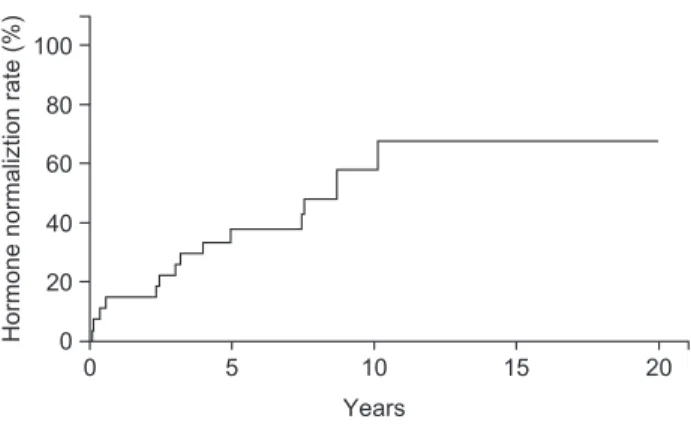
Of the 29 patients with all type of secreting adenomas, with a median follow-up duration of 8 years, 16 patients (55%) showed complete hormone normalization without suppressive medication. The 10-year tumor control rate for secreting adenoma was 58% (Fig. 1). The median time to hormone normalization after RT was 3.1 years (range, 0.1 to 10.1 years).
Of the 16 patients with PRL secreting adenoma, 7 patients (44%) had hormone normalization after median 2.4 years. Of the 12 patients with GH secreting adenoma, 9 patients (75%) had hormone normalization after a median 4.9 years. One patient with ACTH secreting adenoma still required suppressive medication, because that patient never achieved hormone normalization. There was no difference between radiation dose and hormone normalization rate.
Of the 23 patients with headache, all patients showed resolution of symptoms after surgery and RT. Of the 33 patients with initial visual field defect or visual acuity impairment, 8 patients did not have ophthalmologic test during the follow-up period. For 25 patients with evaluable visual field and visual acuity test, 21 patients (84%) showed improvement of visual disturbance after treatment (17 patients after surgery and 4 patients after RT).
The 10-year tumor control rate for non-secreting and secreting adenoma was 100% and 58%, respectively (p <
0.001). Whether the adenoma was secreting or non-secreting was the significant prognostic factor for local control in multivariate analysis (p = 0.015) (Table 2). Tumor extension,
Fig. 1. Hormone normalization rate after treatment. Sixteen patients (55%) showed complete hormone normalization with median follow-up duration of 8 years.
Hormone normaliztion rate (%)
Years
0 5 10 20
0 20 40 100
60 80
15
radiation dose, and tumor size did not affect the tumor control.
The DSS and OS rate at 10 years was 100% and 92.8%, respectively. Of the 5 patients who died during the follow- up period, none had a cause of death that was attributable to the pituitary adenoma, and RT; traffic accident, gastric cancer, chronic renal failure, pontine infarction, and unknown cause. Patients who died due to pontine infarction had uncontrolled diabetes mellitus. Thus, the pituitary adenoma itself or treatment might be not associated with death (see below “treatment-related late complication”). The PFS rate at 10 years was 98%. There was no tumor regrowth of non- secreting adenoma on follow-up brain image. However, 1 patient experienced endocrinological recurrence of disease 4.5 years after RT leading to hormone suppressive medication. This patient required octreotide to inhibit secretion and action from GH until last follow-up.
2. Treatment-related late complication
After surgery, 44 patients (60%) suffered from pituitary function deficit, and had hormone replacement with levothyroxine, and/or hydrocortisone. After RT, none had newly diagnosed as treatment-related hypopituitarism.
Headache was the most common acute complication during RT (n = 13), and all was the grade I (Common Terminology Criteria for Adverse Events [CTCAE] ver. 4). Of 13 patients, 10 patients had headache before surgery. These 10 patients with preoperative headache were defined as tumor control, not progression of tumor, because preoperative headache was disappeared after surgery, and grade I headache during RT was also disappeared after RT despite of no conservative management.
Six patients (8.2%) experienced ischemic stroke after a median 5.3 years (range, 2.3 to 8.5 years) (Table 3). Although stroke of pons and midbrain were close or in the RT field, it is unclear that RT was the causative factor of ischemic stroke, because 2 patients (patients 1, 2) with pons infarction had uncontrolled diabetes mellitus, which is strong risk factor of ischemic stroke. Patients 5 and 6 had heart arrhythmia (atrial fibrillation) as a cause of stroke, and stroke lesions were far from the radiation field.
One patient who had received RT at 66 years experienced cataract after 7 years. No patient experienced radiation- induced optic neuropathy, brain necrosis, and secondary malignancy as a result of RT.
Discussion and Conclusion
This study is a retrospective analysis with long-term follow- up results of surgery and RT for pituitary adenoma. Our study confirms that surgery and RT are very effective and safe in hormonal and tumor growth control, similarly, in other studies.
Numerous studies demonstrated that surgery followed by RT or RT alone achieved excellent long-term outcome of both secreting and non-secreting pituitary adenoma. Brada et al.
Table 3. Cerebrovascular accident after treatment
Patient Age (yr)
a)Sex Tumor type RT dose (cGy)
Time since RT (yr)
Hormone
normalization Stroke lesion Stroke risk factors
1 53 M Secreting (GH) 5,400 5.2 Yes Pons DM
2 29 F Secreting (PRL) 5,400 3.8 Yes Pons DM
3 68 F Non-secreting 5,400 8.5 - Midbrain -
4 59 M Non-secreting 5,220 2.3 - Unknown HTN
5 66 M Non-secreting 4,500 6.0 - Right inferior
cerebellum
Arrhythmia
6 48 F Non-secreting 5,400 5.5 - Left frontal lobe
(subcortical area)
Arrhythmia
RT, radiotherapy; M, male; F, female; GH, growth hormone; DM, diabetes mellitus; PRL, prolactin; HTN, hypertension; Arrhythmia, atrial fibrillation.
a)