Effect of Nicotinic Acid on Fresh Semen Characteristics in Miniature Pigs
Yeon-Ju Lee
1, Sang-Hee Lee
1, Eunsong Lee
2, Seung Tae Lee
1, Hee-Tae Cheong
2, Boo-Keun Yang
1, Seunghyung Lee
3and Choon-Keun Park
1,†1
College of Animal Life Science, Kangwon National University, Chuncheon 200-701, Republic of Korea
2
College of Veterinary Medicine, Kangwon National University, Chuncheon 200-701, Republic of Korea
3
Institute of Animal Resources, Kangwon National University, Chuncheon 200-701, Republic of Korea
ABSTRACT
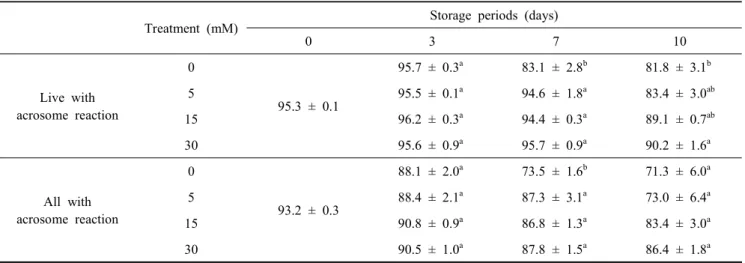
Objective of this study was to investigate the effect of nicotinic acid (NA) on the characteristics in fresh semen of miniature pig. We evaluated viability, acrosome reaction and mitochondrial integrity of sperm on 0, 3, 7 and 10 days during storage period with nicotinic acid. As results, the survival rate of sperm in 15 mM NA (day 3, 87.8 ± 1.2%; day 5, 84.0 ± 2.7%; day 7, 82.2 ± 0.9%) and 30 mM NA (day 3, 87.7 ± 0.3%; day 5, 84.4 ± 2.5%; day 7, 82.3 ± 0.7%) groups were higher than control and 5 mM NA groups in 3, 7 and 10 days of semen storage. The NA-treated sperm on 10 day was used day for observing acrosome integrity. The survival sperm with acrosome reaction was higher in 30 mM NA group (day 3, 2.7 ± 0.2%; day 5, 3.3 ± 0.6%; day 7, 11.4 ± 0.3%) than in the control, significantly (P<0.05). Moreover, the live sperm with mitochondrial integrity was higher in whole treatment groups of NA than control group, significantly (P<0.05). Specially, most mitochondrial integrity on 10 day of semen storage was significantly higher in 30 mM NA group (90.2 ± 1.6%) than other treatment groups (control, 81.8 ± 3.1%; 5 mM NA, 83.4 ± 3.0%; 15 mM NA, 89.1 ± 0.7%, P<0.05). In conclusion, supplement of NA in liquid semen of miniature pig can improve and maintain semen quality, such as viability, acrosome reaction, and mitochondria integrity.
(Key words: flow cytometry, nicotinic acid, fresh semen, mitochondria, miniature pig)
*
This research was supported by Bio-industry Technology Development Program (IPET 312060-05-1-CG000), Ministry for Food, Agriculture, Forestry and Fisheries, Republic of Korea.
†
Correspondence : [email protected]
INTRODUCTION
Artificial insemination (AI) is a common fertilization method that is infection the diluted sperm to female domestic animals used by farmers. Sperm used to AI is usually fresh semen stored liquid state at 15 ∼18℃. However, because the fresh sperm can not keep a long period of time, the collected semen has the disadvantage that should be used within 0 ∼5 days.
And even if sperm used within 5 days, the abilities such as viability and motility of fresh sperm are reduced.
Sperm emitted from the body of the male is move and fertility to adenosine triphosphate (ATP) produced by to mito- chondria. To produce energy mitochondria plays an important role in motility and fertility in sperm (O'connell et al., 2002).
Thus, several experiments have been made to improve the mitochondrial function. The experiments were made chemical substances like to dimethyl sulfate (Me
2SO
4) and glycine (He and Woods Iii, 2004), antioxidants like to carnitine (Lenzi et al., 2003) and vitamin E (Breininger et al., 2005), hormone
like to melatonin (Li et al., 2012) and inhibitor (Huynh et al., 2000). And methods of study is addition in diluted medium (Gravance et al., 2003) or diet (Marin-Guzman et al., 2000).
Antioxidant associated with mitochondrial is nicotinic acid
called vitamin B
3and niacin. Nicotinic acid is an organic com-
pound with the formula C
6H
5NO
2and precursors of the coen-
zymes nicotinamide adenine dinucleotide (NAD) and nicotina-
mide adenine dinucleotide phosphate (NADP) in vivo. NAD and
NADP are coenzymes for many dehydrogenases containing many
hydrogen transfer processes. This hydrogen transfer processes
are responded using NADH dehydrogenase called complex I
and act in the mitochondria. In mitochondria, this process is
essential process because of enzyme of the mitochondrial elec-
tron transport chain and enzyme made to electrochemical po-
tential difference used to produce ATP (Krauss, 2001). In the
same function, nicotinic acid has been used in monocyte of
human (Digby et al., 2012), egg of sea urchin (Walseth et al.,
2012), guinea pig trachea (Aley et al., 2013) and muscle of
pig (Khan et al., 2013). But, nicotinic acid was not used in the
386 Y.-J. Lee, S.-H. Lee, E. Lee, S. T. Lee, H.-T. Cheong, B.-K. Yang, S. Lee and C.-K. Park
semen in pig. Therefore, the objective of this study was to investigate the effect of nicotinic acid on the characteristics in fresh semen of boar.
MATERIALS AND METHODS
All experiment procedures that included animals followed the scientific and ethical regulations proposed by the European Animal Experiment Handling License Textbook (Baumans et al., 1997) and board approval (No: KIACUC-09-0139) was attained from the Animal Experiment Ethics Committee in Kangwon National University, Republic of Korea.
1. Semen Collection
Fresh semen samples from 3 miniature pigs housed at a Kangwon National University farm (Republic of Korea) were collected using a gloved-hand method. Collected semen was diluted 1 × 10
7spermatozoa/ml using Modena B. In this pro- cess, Modena B used semen conservative solution was divided as 0, 5, 15 and 30 mM of nicotinic acid concentration. Diluted semen was storage at 18 ℃ refrigerator to analysis and every semen analysis was repeated 3 times.
2. Analysis of Sperm Characteristics
Flow cytometry methods and assessment of semen were pro- cessed using the manufacturer’s protocol (Lee et al., 2014).
The viability of sperm was analyzed by fluorescent staining using the LIVE/DEAD sperm Viability Kit (Molecular Probes, Eugen, OR, USA). Live sperm were stained as green fluorescent by SYBR-14 and membrane-compromised sperm was stained as red fluorescent by propidium iodide (PI). Each semen were diluted 1 × 10
8spermatozoa/ml in Modena B of 1 ml and 1 µl of SYBR-14 (40 nM) was used in diluted semen for 5 min at 37 ℃. Then, 1 µl of PI (2 µM) was added to diluted semen included SYBR-14 for 10 min at 37 ℃. Stained sperms were centrifuged at 1,500 rpm for 5 min and the pellets were re- suspended in 500 µl of PBS. And, stained sperm was analyzed by flow cytometry.
The acrosome integrity of sperm was analyzed by fluorescent staining using the isothiocyanate-conjugated peanut agglutinin (FITC-PNA, Sigma, Saint Louis, Missouri, USA) and PI. Acti- vated acrosome was stained as green fluorescent by FITC-PNA and membrane-compromised sperm was stained as red fluore-
scent by PI. Each semen were diluted 1 × 10
8spermatozoa/ml in Modena B of 1 ml, 1 µl of FITC-PNA was used in diluted semen for 5 min at 37 ℃ and 1 µl of PI (2 µM) was added to diluted semen included FITC-PNA (2 ng/ ml) for 10 min at 3 7 ℃. After staining, stained sperms were centrifuged at 1,500 rpm for 5min and the pellets were re-suspended in 500 µl of PBS. Stained sperm was analyzed by flow cytometry.
The mitochondria integrity of sperm was analyzed by fluo- rescent staining using the Rhodamine 123 (Sigma, Steinheim, Germany) and PI. The activated mitochondria stained as green fluorescent by Rhodamine 123 and membrane-compromised sperm was stained as red fluorescent by PI. Each semen were diluted 1 × 10
8spermatozoa/ml in Modena B of 1 ml, 1 µl of Rhodamine 123 (530 mM) was used in diluted semen for 5 min at 37 ℃ and 1 µl of propidium iodide PI (2 µM) was added to diluted semen included Rhodamine 123 for 10 min at 37 ℃.
Stained sperms were centrifuged at 1,500 rpm for 5 min. And, after the pellets were resuspended in 500 µl of PBS, stained sperm was analyzed by flow cytometry.
3. Statistical Analysis
The analysis of variance (ANOVA) using SAS version 9.1 (SAS Institute Inc., Cary, NC, USA) was used statistical ana- lysis. Data are presented as mean ± standard error of the mean (S.E.M). Differences in the mean values of sperm condition after treatment were analyzed using Duncan’s multiple range tests.
RESULTS
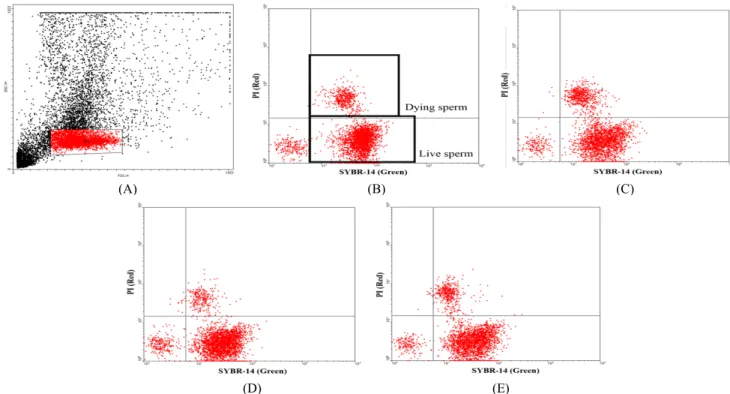
The effect of nicotinic acid on viability and dying in pig’s sperm is show in Fig. 1 and 2. In Fig. 1, the percentages of live sperm stained by SYBR-14 were higher in 15 mM (87.8
± 1.2%, 84.0 ± 2.7%, 82.2 ± 0.9%) and 30 mM (87.7 ± 0.3%, 84.4 ± 2.5%, 82.3 ± 0.7%) of nicotinic acid than in control group (83.3 ± 1.2%, 78.8 ± 1.9%, 72.5 ± 0.9%) and 5 mM (82.7 ± 1.1%, 82.2 ± 1.7%, 74.1 ± 2.4%) in 3, 7 and 10 days of semen storage. The 3 and 10 days of semen storage were significantly (P<0.05) higher in treatment of nicotinic acid, but there were not significantly different in 7 days of semen storage.
In Fig. 2, the percentages of dying sperm stained by SYBR-14 and PI were not significantly different among the control (8.8
± 1.2%, 10.4 ± 0.8%, 19.9 ± 3.2%), 5 mM (12.0 ± 2.0%, 10.9
± 2.2%, 20.3 ± 3.7%), 15 mM (6.6 ± 1.9%, 8.6 ± 1.6%, 12.0
(A) (B) (C)
(D) (E)
Fig. 1. Flow cytometric anaysis on sperm viability using SYBR-14 and propidium idodie (PI) double staining during liquid storage in semen extender with nicotinic acid (A) in miniature pigs. (B) control group, (C) 5 mM treatment group, (D) 15 mM treatment group, (E) 30 mM treatment group.
(A) (B) (C)
(D) (E)
Fig. 2. Flow cytometric anaysis on acrosome reaction using FITC-PNA and PI double staining during liquid storage in semen extender
with nicotinic acid (A) in miniatrue pigs. (B) control group, (C) 5 mM treatment group, (D) 15 mM treatment group, (E) 30 mM
treatment group.
388 Y.-J. Lee, S.-H. Lee, E. Lee, S. T. Lee, H.-T. Cheong, B.-K. Yang, S. Lee and C.-K. Park
Table 1. Effect of nicotinic acid on sperm acrosome reaction rate (%) in miniature pig
Treatment (mM)
Storage periods (days)
0 3 7 10
Live with acrosome reaction
0
3.3 ± 1.5
4.5 ± 0.7
a6.9 ± 0.7
a16.3 ± 0.6
a5 2.5 ± 0.3
b4.5 ± 0.9
ab10.8 ± 1.2
b15 3.5 ± 0.6
ab4.0 ± 0.8
b12.0 ± 0.3
b30 2.7 ± 0.2
b3.3 ± 0.6
b11.4 ± 0.3
bAll with acrosome reaction
0
7.5 ± 1.2
11.7 ± 1.3
a18.2 ± 6.3
a28.4 ± 1.7
a5 6.7 ± 1.2
b13.6 ± 6.2
a21.0 ± 2.3
b15 7.0 ± 0.9
b9.4 ± 1.3
a16.0 ± 1.5
b30 6.4 ± 0.9
b8.3 ± 1.5
a19.8 ± 1.0
ba,b
Values in the same column with different superscripts are significantly different (p<0.05), n=3.
*
All treatment groups were analyzed with 10,000 sperms.
Table 2. Effect of nicotinic acid on sperm live mitochondrial integrity rate (%) in miniature pig
Treatment (mM)
Storage periods (days)
0 3 7 10
Live with acrosome reaction
0
95.3 ± 0.1
95.7 ± 0.3
a83.1 ± 2.8
b81.8 ± 3.1
b5 95.5 ± 0.1
a94.6 ± 1.8
a83.4 ± 3.0
ab15 96.2 ± 0.3
a94.4 ± 0.3
a89.1 ± 0.7
ab30 95.6 ± 0.9
a95.7 ± 0.9
a90.2 ± 1.6
aAll with acrosome reaction
0
93.2 ± 0.3
88.1 ± 2.0
a73.5 ± 1.6
b71.3 ± 6.0
a5 88.4 ± 2.1
a87.3 ± 3.1
a73.0 ± 6.4
a15 90.8 ± 0.9
a86.8 ± 1.3
a83.4 ± 3.0
a30 90.5 ± 1.0
a87.8 ± 1.5
a86.4 ± 1.8
aa,b
Values in the same column with different superscripts are significantly different (p<0.05), n=3.
*