• 검색 결과가 없습니다.

Study on the Engineering Properties of 150MPa Ultra-high Strength Concrete

N/A
N/A
Protected

Academic year: 2021

Share "Study on the Engineering Properties of 150MPa Ultra-high Strength Concrete"

Copied!
10
0
0

로드 중.... (전체 텍스트 보기)

전체 글

(1)

Study on the Engineering Properties of 150MPa Ultra-high Strength Concrete

Jung, Sang-Jin

11)

Yoshihiro MASUDA

2

Kim, Woo-Jae

3

Lee, Young-Ran

2

Kim, Seong-Deok

4*

Ha, Jung-Soo

4

Department of Architecture Engineering, Dankook University, Suji -Gu, Yongin-si Gyeonggi-do, 448-701, Korea

1

Architecture and Civil Eng. Dept., Utsunomiya University, Tochigi-Ken, Minemachi, 321-8505, Japan

2

Architectural Engineering Reserch Group, POSCO E&C R&D Center , Dongtan, Hwasung Kyunggi-D0, 445-810, Korea

3

Graduate School , Dankook University, Suji -Gu, Yongin-si Gyeonggi-do, 448-701, Korea

4

Abstract

In this study, 150MPa ultra-high-strength concrete was manufactured, and its performance was reviewed. As technically meaningful autogenous shrinkage reportedly occurs at a W/B ratio of 40% or less, although it occurs in all concrete regardless of the W/B ratio, the effects of the use of expansive admixture and shrinkage reducer, or of the friction and restraint of forms that may result in the effective reduction of autogenous shrinkage, were reviewed. As a result, considering the flow and strength characteristics, it was found that the slump flow time was shorter with expansive admixture, and shortest with shrinkage reducer. All specimens with 30㎏/㎥expansive admixture showed high strength at early material age. Their strength decreased due to the expansion cracks when there was excessive use of expansive admixture, and the use of shrinkage reducer did not influence the change in the strength according to the material age. The expansive admixture had a shrinkage reduction effect of 80%, while the shrinkage reducer had a shrinkage reduction effect of 30%, indicating that the expansive admixture had a stronger effect. It seems that mixing the two will have a synergistic effect. The shrinkage reduction rate was highest when the W/B ratio was 20%. The form suppressed the expansion and shrinkage at the early period, and the demolding time did not significantly influence the shrinkage. The results of the study showed that the excessive addition of expansive admixture leads to expansion cracks, and the expansive admixture and shrinkage reducer have the highest shrinkage reduction effect when they are mixed

Keywords : Ultra High Strength Concrete, Autogenous Shrinkage, Expansion Agent, Shrinkage Reducing Admixture

1. Introduction

1.1 Background of the Research

Accompanied by the high-rise buildings and high-density, the demand for high-rise RC type apartment buildings has been on the rise so that ultra-high strength concrete became required due to Received : June 30, 2010

Revision received : July 21, 2010 Accepted : August 9, 2010

* Corresponding author:

[Tel: 82-31-8005-3738, E-mail: [email protected]]

ⓒ2010 The Korea Institute of Building Construction, All rights reserved.

overall insufficient aggregates and slimness of columns.

High strength concrete with 60MPa are actually being

used in many construction sites, and ultra-high strength

developed to have more than 100MPa concrete has

recently been in trial use for some of building

construction projects.[1,2] The strength-enhanced

concrete like this ultra-high strength concrete generally

showed a hydration reaction different from t that of the

existing one in that it has higher uncertainty and in

terms of autogenous shrinkage in the engineering

meaning mainly appears at a W/B ratio of 40 percent or

less.[3,4.5] More than anything else, the dense structure

of the ultra-high strength concrete keeps it from being

(2)

Study on the Engineering Properties of 150MPa Ultra-high Strength Concrete

Table 2. Table of Mix Proportion of Concrete Name of Mix W/B

(%)

S/a (%)

Unit weight (㎏/㎥) SP

(B×%)

SP-SR (B×%)

W C S G EX

20

20 39 150

750

609 968

- 1.4 -

20E30 720 30 1.4 -

20E60 690 60 1.4 -

20SR 750 - - 1.5

20E30SR 720 30 - 1.5

20E60SR 690 60 - 1.5

16

16 37 150

938

507 914

- 1.65 -

16E30 908 30 1.65 -

16E60 878 60 1.65 -

16SR 938 - - 1.8

16E60SR 878 60 - 1.8

shrunken by dryness while its own autogenous shrinkage has been reported as a problem[8,9]. The actual volume was shrunken by more than 10 percent by autogenous shrinkage, which is relatively high. To make the volume less shrunken by autogenous shrinkage, admixture like expansive admixture or shrinkage reducing admixture is currently being used.[6,7] However, the effects on the ultra-high strength concrete of such admixture have not yet been fully identified and the ultra-high strength concrete should be more studied in the future.[10,11,12,13]

Therefore, this study aims to analyze change in properties, strength and autogenous shrinkage depending on the amount of expansive admixture or shrinkage reducing admixture added in the ultra-high strength concrete and to suggest a future direction of development of concrete and its control method.

1.2 Research Purpose and Scope

Experiment is conducted, above all, to review characteristics of property and strength in the manufacture of the 150MPa ultra-high strength concrete, and then to evaluate the effects on deformation behavior of the ultra-high strength concrete by the friction and restraint of forms at the early age as well as the shrinkage reducing effects when using either expansive admixture or shrinkage reducer or when using the admixture mixed with the two agents altogether.

To do this, this experiment aims to conduct a review at a dynamic perspective on the concrete characteristics

of property, strength and shrinkage and the manufacture of 150MPa ultra-high strength concrete.

2. Experimental Scheme and Method

2.1 Experimental Scheme

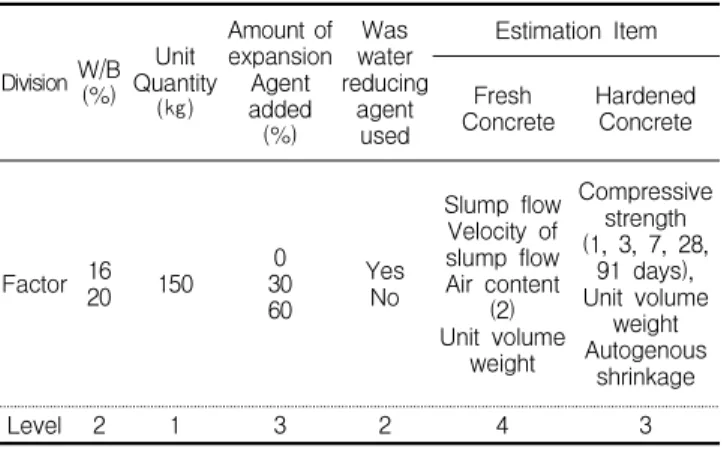
To manufacture the concrete with the design strength of 150MPa, the water-to-binder ratio (hereinafter referred to as W/B) was consistently maintained at 16 percent and 20 percent, respectively by setting the target air content at 2 percent or less. Expansive admixture was used at three different levels of 0, 30, 60 ㎏/㎥, each of which was used either as it is or after mixed with shrinkage reducer, respectively. As a binder, Gypsum-type expansive admixture was used with Japanese cement premixed with silica fume.

Table 1. Experimental Scheme

Division

W/B

(%)

Quantity Unit (㎏)

Amount of expansion Agent added (%)

water Was reducing

agent used

Estimation Item Fresh

Concrete Hardened Concrete

Factor 16 20 150 0 30 60

Yes No

Slump flow Velocity of slump flow Air content Unit volume (2)

weight

Compressive strength (1, 3, 7, 28,

91 days), Unit volume

weight Autogenous

shrinkage

Level 2 1 3 2 4 3

(3)

and either high-performance AE water reducing agent or high-performance AE water reducing agent included with shrinkage reducer was used. The detailed experimental scheme and the table of mix proportion are shown in Table 1 and Table 2, respectively.

2.2 Material Used

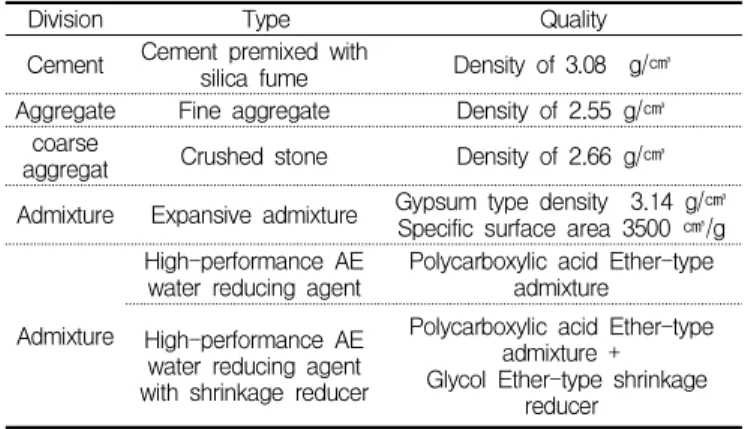
T he material used to manufacture the 150MPa ultra-high strength concrete includes cement premixed with silica fume (hereinafter C), fine aggregate with a density of 2.55 g/㎤ for aggregate, (hereinafter S), and crushed stone from Gunwui-san, Gyeongsangbuk-do for coarse aggregate. Gypsum-type expansive admixture with a density of 3.14 g/㎤ and a specific surface area of 3500 ㎤/g (hereinafter EX) and polycarboxylic acid Ether-type admixture, a high-performance AE water reducing agent (hereinafter SP) and high-performance AE water reducing agent included with a Glycol Ether-type shrinkage reducing agent were used. The types and specifications of the material are shown in Table 3.

Table 3. Material Used

Division Type Quality

Cement Cement premixed with

silica fume Density of 3.08 g/㎤

Aggregate Fine aggregate Density of 2.55 g/㎤

coarse

aggregat Crushed stone Density of 2.66 g/㎤

Admixture Expansive admixture Gypsum type density 3.14 g/㎤

Specific surface area 3500 ㎤/g

Admixture

High-performance AE

water reducing agent Polycarboxylic acid Ether-type admixture

High-performance AE water reducing agent with shrinkage reducer

Polycarboxylic acid Ether-type admixture + Glycol Ether-type shrinkage

reducer

2.3 Experimental Method

2.3.1 Concrete Test

A concrete test was done with the 150 MPa ultra-high strength concrete mixed by a forced action pan-type mixer specified in the KS F 8009 in a room with an ambient temperature of 20℃. KS F 2594, KS F 2409 and KS F 2421 were referred to for the slump flow test

air content test (mass method), and the air content test in the fresh concrete not hardened by pressure method, respectively, and the results were evaluated.

∅100×200 ㎜ - sized cylinders for management were cured at a constant temperate of 20℃, whose seal curing times were set at 1, 3, 7, 28 or 91 days, respectively.

Compressive strength tests were performed on the specimens reaching each of the target curing days based on KS F 2403 and 2405, and the strength values for each experimental variable were then evaluated.

2.3.2 Autogenous shrinkage test

To measure autogenous shrinkage, an embedded gauge with a thermometer was used to measure autogenous shrinkage at early age before removal of the form, as shown in Figure 1, while a dial gauge-type displacement transducer was used after removal of the form, as shown in Figure 2. Two types of forms were used: Form 1 (without friction) that can measure free expansion and shrinkage as specified in the Autogenous Shrinkage Test Method for High Flow able Concrete, and Form 2 made out of plywood, on which no treatment was done. In addition, to seal it after placing the cement, each Form was covered with its lid, and then stored. Form 1 was removed at the age of 3 days, while Form 2 was removed at the ages of 1, 2, and 3 days, respectively.

The dimension of the cylinder was set at 70x70x400 ㎜.

To prevent the cylinder from becoming dried, the entire body was sealed and kept in an environment with 60%

R.H. at 20℃.

Considering the setting of ultra-high strength concrete

reported in previous research, the starting point of

shrinkage deformation was set at about 0.5 days by

employing the peak of the deformation behavior, since the

behavior of the deformation gauge changed depending on

the behavior of concrete shrinkage and expansion, as

shown in Figure 2. When measured both by the

embedded gauge and by the dial gauge-type

displacement transducer, the values measured in some

cylinders were also identified to have been interrelated

after the removal of the forms. All the cylinders were

measured by the dial gauge-type displacement

(4)

Study on the Engineering Properties of 150MPa Ultra-high Strength Concrete

transducer, and the measured values were then compared with those measured by the embedded gauge.

Figure 1. Measurement by an embedded gauge

Figure 2.

Dial gauge-type displacement

transducer

Figure 3. Specimen after removal of the form

Figure 4. Time of measurement

3. Experimental results and considerations

3.1 Characteristics of the fresh concrete

3.1.1 Flow characteristics

At W/B rates of 20 percent and of 16 percent, the slump flow of all specimens ranged within 650±50 ㎜ and 600±100 ㎜, respectively. In the specimens to which

expansive admixture was added, the slump flow was shorter, while when the shrinkage reducing agent was used, the slump flow showed a tendency to get shorter.

As the shrinkage reducing agent lowers the surface tension of water, which results in the concrete viscosity being lowered, when shrinkage reducer is used, the slump slow is believed to have been shorter.

In addition, the slump flow of a general type of high-strength concrete appears between 0.5 ㎝/sec and 08 ㎝/sec, while that of the ultra-high strength concrete was measured between 0.2 ㎝/sec and 0.4 ㎝/sec, which can be considered to show that the concrete used in this study has a very high viscosity.

Figure 5 shows the relationship between the slump flow of each fresh concrete mix and the velocity of the slump flow.

Figure 5. Relationship between slump flow and the velocity of slump flow

3.1.2 Air Content

In terms of air content, all mixes could be controlled to have air content of 2 percent or less, with the exception of Mix-16, whose air content increased to 3.9 percent.

Generally, whenever the air content increases by 1 percent, the strength decreases by 3-4 percent. Mix-16, which held higher air content, is believed to have shown lower compressive strength compared with the other Mixes for this reason. In terms of air content, the ultra-high strength concrete showed that fresh concrete tended to hold 0.5-1.5 percent more than bulk density.

Figure 6 shows the relationship between the air

content of bulk density and that of fresh concrete.

(5)

Figure 6. Relationship between air content of bulk density (mass method) and that of fresh concrete (pressure method)

3.1.3 Bulk density

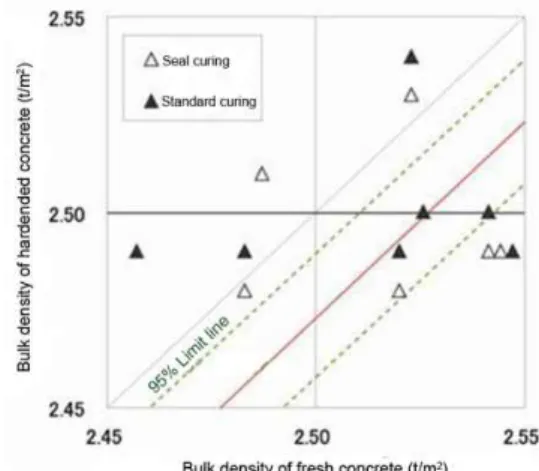
In terms of bulk density, when compared with fresh concrete, hardened concrete tended to be about 0.02-0.05 t/㎥ lower. Moreover, the bulk density stood at 2.5 t/㎥, which is higher than that of concrete with a general level of strength. There were no significant differences shown between standard cured cylinder and seal cured cylinder.

Figure 7 is a comparison of bulk density between fresh and hardened concrete.

Figure 7. Bulk density of fresh and hardened concrete

3.2 Characteristics of hardened concrete

3.2.1 Strength characteristics

When expansive admixture of 30 ㎏/㎥ was used, the compressive strength was shown to be high on the 1

st

day

W/B rate of 20 percent, which indicates that in concrete mixed with expansive admixture at a low W/B rate, strength develops more quickly compared to concrete with no admixture. Expression rate of the 3-day age compressive strength of all specimens at a W/B rate of 16 percent was shown to be higher than 70MPa, and all specimens at a W/B rate of 20 percent as well as of 16 percent showed a nearly certain high level of compressive strength, regardless of whether or not either expansive admixture or shrinkage reducing agent was used. Expression rate of 28-day age compressive strength of all cylinders at a W/B rate of 16 percent was shown to have reached nearly 140MPa, while that of the cylinders either with expansive admixture or with shrinkage reducing agent showed a similar level. At a W/B rate of 20 percent, cylinders with expansive admixture showed only slightly higher compressive strength than those with a shrinkage reducer only. The cylinders with both agents showed compressive strength of nearly 130MPa, which his much higher. Expression rate of 910-day old compressive strength of cylinders at the W/B rate of 16 percent was shown to be higher than 150MPa, while that of cylinders at the W/B rate of 20 percent to was nearly 150MPa, which may indicate that when used at W/B rates of 16 percent and 20 percent, a shrinkage reducer does not greatly affect the compressive strength characteristics at early age, and the combined use of both the expansive admixture and the shrinkage reducing agent did not greatly affect the expression rate of 7-day age compressive strength. On the other hand, at a high W/B rate when either expansive admixture only or a combination of expansive admixture and shrinkage reducing agent was used, it had a great impact on the compressive strength in both cases. Judging from this fact, it is believed that if expansive admixture and shrinkage reducer is used to make ultra-high strength concrete at as high a W/B rate as possible, a high expression rate of compressive strength can be obtained, and at long-term ages, using either expansive admixture or shrinkage reducing agent only has a higher impact on the expression rate of the compressive strength as well.

As shown in Figure 10, when standard curing was

used, expansion crack developed in the cylinder with 60

(6)

Study on the Engineering Properties of 150MPa Ultra-high Strength Concrete

㎏/㎥ expansive admixture at 7-day age, making the compressive strength test difficult to continue. When seal cured, the concrete was covered with the cylindrical mold, and crack could barely be seen by naked eyes, but after 7-day age, compressive strength dramatically decreased at the W/B rate of 16 percent, while a certain level was maintained at the W/B rate of 20 percent. Too much expansive admixture seems to have been added, and compressive strength deteriorated at the W/B rate of 16 percent while a constant level of compressive strength was shown at the W/B rate of 20 percent, from which it can be interpreted that the amount of expansive admixture has a close relationship with the W/B rate.

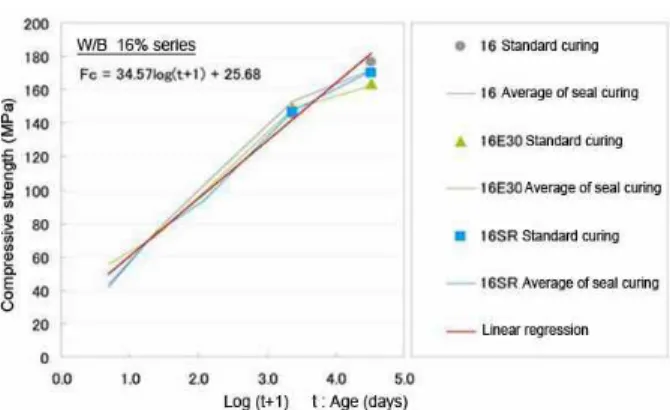
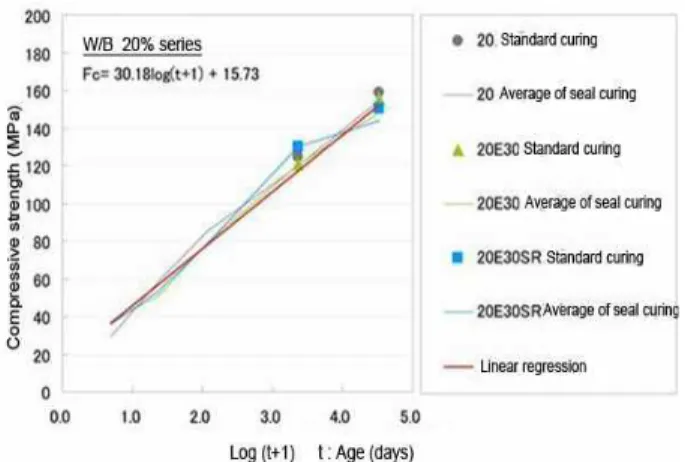
Figures 11 and 12 show the relationship between strength and material age at the W/B rates of 16 percent and of 20 percent, respectively, and the equation for these was expressed using α log(t+1)+β. In terms of strength, when either expansive admixture or shrinkage reducing admixture only was used at the W/B rate of 16 percent, the cylinders showed a similar level at an early material age, while the seal cured concrete with shrinkage reducer showed a higher tendency at 91-day age. Standard cured concrete with both expansive admixture and shrinkage reducer used showed a faster expression rate of compressive strength at the W/B rate of 20 percent, the compressive strength of which tended to be lower than that of the seal cured concrete with expansive admixture only at 91-day age, the longest age of this research. For the concrete that used both expansive and shrinkage reducing admixture, the strength characteristics varied depending on the curing method. It is believed that the seal cured concrete was constrained by the cylindrical form, and its compressive strength was identified as high.

Figures 8 and 9 indicate the test results of compressive strength of seal cured concrete mix except for compressive strength affected by 60 ㎏/㎥ expensive admixture, while Figure 10 shows the compressive strength affected by expansive admixture of 60 ㎏/㎥, and Figures 11 and 12 the expression rate of compressive strength when expressed using the logarithm.

Figure 8. Compressive strength at a W/B rate of 16 percent

Figure 9. Compressive strength at a W/B rate of 20 percent

Figure 10. Compressive strength affected by expansive admixture of 60㎏/㎥

Figure 11. Increase in compressive strength at a W/B rate of

16 percent according to increase in material day

(7)

20 percent according to increase in material day 3.3 Autogenous shrinkage

3.3.1 Effects of Expansive admixture and shrinkage reducer

It is shown that the expansive admixture had a shrinking reducing effect of about 85 percent for Mix-20 and Mix-20E30, while the shrinkage reducing agent had an effect of about 32 percent, which means that expansive admixture has a much greater effect than shrinkage reducer. In addition, when both of the admixtures were used together, the shrinkage reducing rate stood at 130.6 percent, while the sum of each shrinkage reducing rate stood at 117 percent when either agent was used alone. From these results, it can be considered that using both admixtures together can achieve a synergistic effect compared to using either admixture alone. Figure 15 shows that the shrinkage deformation affected by admixture was higher at the W/B rate of 16 percent than at 20 percent, but a higher shrinkage reducing effect was shown compared with the plain cement with nothing added at the W/B rate of 20 percent.

Figure 13 shows the results of the autogenous shrinkage test using Form 1, and Figure 14 shows the shrinkage reducing rates measured in Mix-20 at the 45-day age, while Figure 15 shows the shrinkage rates measured in the plain cement at the 45-day age

Figure 14. Shrinkage reducing rate at a W/B rate of 20 percent depending on admixture

Figure 15. Shrinkage reducing rate depending on plain concrete

3.3.2 Effect of admixture depending on a W/B rate

As shown in Figure 16, in terms of shrinkage rate, the

difference stood at about 150×10

-6

when Mix-16 and

Mix-16SR were compared, while it stood at 100×10

-6

between Mix-20 and Mix-20SR, which indicates that the

shrinkage rate varies depending on the W/B rate. In

addition, Figures 16 and 17 show that in terms of the

shrinkage rate, the difference stood at 350×10

-6

when

(8)

Study on the Engineering Properties of 150MPa Ultra-high Strength Concrete

Mix-20E30 and Mix-20 were compared, while it was 400×10

-6

when comparing Mix-16E30 with Mix-16.

Regardless of whether the admixture, expansive or shrinkage reducing agent was added, cement at the W/B rate of 16 percent was shown to be more shrunken, at a constant level of 50×10

-6

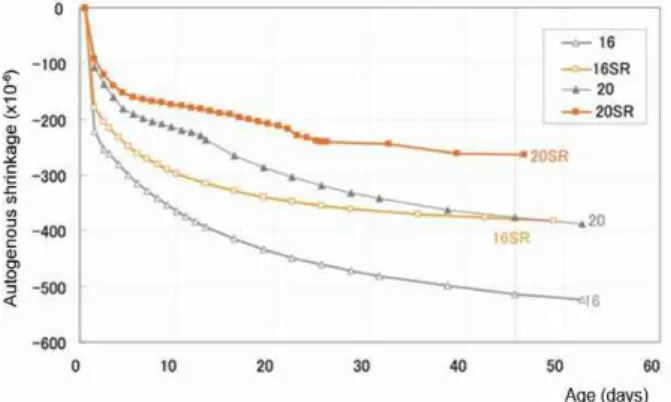
. In addition, in terms of the shrinkage reducing rate, regardless of whether admixture, expansive or shrinkage reducing was added, concrete at the W/B rate of 20 percent was shown to be high, which means that an appropriate mixture of expansive and shrinkage reducing admixture can result in a more effective shrinkage reducing effect. It is believed that in terms of the shrinkage reducing rate, shrinkage reducer is more effective than expansive agent.

Figure 16 indicates the results of shrinkage deformation according to W/B rate and the presence or absence of a shrinkage reducing agent, and Figure 17 shows the results of shrinkage deformation according to W/B rate and the presence or absence of expansive admixture.

Figure 16. Effects of shrinkage reducing agent

Figure 17. Effects of expansive agent

3.3.3 Effects on autogenous shrinkage of a form at removal

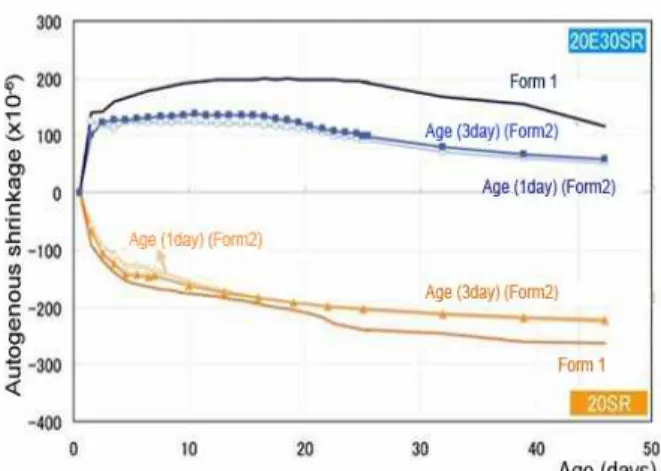
There were no effects of a form at removal found on Mix-20 and Mix-20SR, and at the early material age when expression rate was not fully developed, cement was more shrunken in Form 1 (without friction) in which shrinkage is not restricted by any factors due to the lack of restraint factors by the Form itself; however, the difference became smaller and similar to that of Form 2 in the end. In addition, when using expansive admixture, there was no difference in shrinkage found upon the removal of a form. The delayed removal of a form caused the peak of expansion to be delayed. In addition, when comparing Form 1 and Form 2, changes in expansion and shrinkage were found in Form 1 (without friction), which resulted in a difference in the shrinkage rate at 40-day age. In terms of the shrinkage rate, there were no significant differences found between cement in which whatever admixture was added according to removal time, with the exception of the cement with expansive admixture in Forms 1 and 2, in which significant differences were found. This is because the expansion of cement affected by Form is only related with the constraint that affects cement at an age of less than 1 day, and the effects of friction last only for a short period of time at an early material age, having little influence on the final shrinkage rate.

Figures. 18 and 19 show the results of shrinkage rates depending on removal and form type.

Figure 18. Effect I depending on the form type at removal Ⅰ

(9)

Figure 19. Effect II depending on the form type at removal Ⅱ

4. Conclusion

This research identified the material properties and characteristics of strength, shrinkage reduction depending on W/B rate and mix of expansive admixture and shrinkage reducer. In addition, autogenous shrinkage was also identified depending on mold type and removal. The following are the experimental results.

1) All the cement mixes satisfied the target content at W/B rates of 16 percent and 20 percent, regardless of the amount of admixture. The use of shrinkage reducer had a better effect on slump flow than the use of expansive admixture.

2) At an early material age, admixtures had little impact on compressive strength, regardless of the amount of admixture used. As days went by, the use of expansive admixture only or of expansive and shrinkage reducing admixture together had a great influence on compressive strength.

3) In terms of compressive strength, cement with expansive admixture of 60 ㎏/㎥showed lower at a W/B of 16 percent, while it showed a constant level at 20 percent, from which it can be determined that the amount of expansive admixture greatly affected the W/B rate.

4) Depending on the curing method, the compressive strength of cement was shown to be different. In

was stronger than standard cured cylinder, which seems to be because seal cured cylinder was constrained by the form, and thus showed a higher compressive strength as a result.

5) Mix-20and Mix-20E30 showed 85 percent shrinkage reduction through the use of expansive admixture, while a 32 percent shrinkage reduction through the use of a shrinkage reducing agent. This showed that expansive admixture is more effective. When the two admixtures were used together, the shrinkage reducing rate stood at 130.6 percent, which was higher than when either of them was used alone. It is considered that using the two admixtures together has a synergistic effect.

6) In terms of shrinkage rate, the difference stood at about 150×10

-6

when comparing Mix-16 and Mix-16SR

,

while it was 100×10

-6

when comparing Mix-20 and Mix-20SR. From this, it is determined that the shrinkage rate varies depending on the W/B rate. The difference stood at 350×10

-6

when comparing Mix-20E30 and Mix-20, while it was 400×10

-6

when comparing Mix-16E30 and Mix-16, which indicates that the shrinkage rate was higher at the W/B rate of 16 percent. When using either shrinkage reducer or expansion admixture, the shrinkage reducing rate was shown to be higher at the W/B rate of 20 percent

7) When using expansive admixture, there were no significant differences found in shrinkage rate in relation t or emoval time, and it was found that if the removal was delayed, so was the peak of expansion. When the two cement cylinders in Form 1 and Form 2 were compared, the cement in Form 1 (without friction) got bigger, and there were some differences found at 40-day age. There were no differences in shrinkage rate caused by the removal time. However, the mixes of Form 1 and Form 2 with expansion admixture only showed a big difference in the shrinkage rate.

References

1. Ichise K, Tuzuki M, Koshiro Y, Kawaguchi T,

(10)

Study on the Engineering Properties of 150MPa Ultra-high Strength Concrete

High-Strength Concrete over Fc100N/㎟ for High-rise Reinforced Concrete Buildings  Part.1 Fresfh and Strength Properties of High-Strength Concrete mixed Expansive additive, Architectural Institute of Japan, Journal of Structural and Construction Engineering, 2004:497-498

2. Korea Concrete Institute, The Latest Concrete Engineering, Gimundang, 2005

3. Lee HG ,Lee MK, Prediction Technology for Autogenous Shrinkage of Ultra-high Strength Concrete at an Early Material Age, Proceedings of Korea Concrete Institute 2005;17(4):34-40

4. AÏtcin PC, Hight-Performance Concrete, E&FN Spon, London and New York, 1998.

5. Kuroiwa S , Namiki S, Jinnai h, Watanabe S, Nito N, Ishihara M, Autogenous shrinkage and self induced stress of 150MPa concrete using lime based admixture, Architectural Institute of Japan, Journal of Structural and Construction Engineering, A-1 2007:9-10

6. Takamori N, Katayose N, Nishida H, Teraoka M, Autogenous Shrinkage Behavior of Ultra-High-Strength Concrete with Expansive Additive and Shrinkage-Reducing Admixture.  Part1 Outline of Experiment, Architectural Institute of Japan, Journal of Structural and Construction Engineering, A-1 2006:97-98

7. Nishimoto Y , Matsuda Y, Kawakaml H, A Study on the Decrease of Self-Shrinkage in Super-High-Strength Concrete(The Influence of Expansive Additive on Concrete Properties),Japan Concrete Institute Jounal, 1997;19(1):169-174

8. Kuroiwa S, Watanabe S, Jinnai H, Satoru H, Autogenous shrinkage and self induced stress of 150MPa concrete, Architectural Institute of Japan, Journal of Structural and Construction Engineering, 2005:398-399

9. Ishhikawa S, Tateyama S, Abe H, Shrinkage Characteristic of Ultra-High-Strength Concrete with Expansive Additive, Architectural Institute of Japan, Journal of Structural and Construction Engineering, A-1 2007:7-9

10. Han MC, An Analysis of Autogenous Shrinkage of Ultra-high Strength Concrete Added with Expansive admixture and Shrinkage Reducer, Proceedings of the Korean Institute of Building Construction, 2007;7(3):123-130

11. Umemoto M, Nonaka A, Urakaw K, Nishiura N, Yamada H, Nishida H, Kajita H, Experimental Study on

Autogenous Shrinkage of Ultra High Strength Concrete  Part4 Properties of Autogenous Shrinkage, Architectural Institute of Japan, Journal of Structural and Construction Engineering, 2007:261-262

12. Okamoto S, Yokota K, Matsuoka Y, Effect of Autogenous Shrinkage on Strain-Temperature Curve of Concrete at early age, Proceedings of annual Conference of the japan Society of Civil Engineers , 1995;50:678-679

13. Nishida H, Nonaka A, Urakawa K, Umemoto M, Nishiura

N, Yamada H, Kajita H, Experimental Study on

Autogenous Shrinkage of Ultra High Strength Concrete 

Part1 Outline of Experiment, Compressive Strength and

Young's Modulus, Architectural Institute of Japan, Journal

of Structural and Construction Engineering, 2007:255-256

수치

Table 2. Table of Mix Proportion of Concrete Name of Mix W/B (%) S/a(%) Unit weight (㎏/㎥) SP (B×%) SP-SR(B×%)WCSGEX 20 20 39 150 750 609 968 - 1.4 -20E30720301.4-20E60690601.4 -20SR 750 - - 1.5 20E30SR 720 30 - 1.5 20E60SR 690 60 - 1.5 16 16 37 150 938 507
Table 3. Material Used
Figure 7 is a comparison of bulk density between fresh and hardened concrete.
Figure 11. Increase in compressive strength at a W/B rate of 16 percent according to increase in material day
+4

참조

관련 문서

The spalling properties of ultra high strength concrete specimens with various contents of PP fiber were investigated in this study.. In results, the content of PP fiber for

The Influence of steel fiber on modulus of elasticity, compressive, splitting tensile and flexural strength, and drying shrinkage and creep of HSFRC are investigated,

High tensile steel with yield strength up to 780 MPa and ultra-high strength concrete with compressive cylinder strength up to 180 MPa were used to construct the test

In order to verify attainment of design compressive strength and the durability of the manufactured concretes we examined the tests such as compressive strength

According to the test results, the workability, compaction, and compressive strength of the high-fluidity concrete increased when replacing 30% of the cement with copper slag..

From the test results, the confinement effect of steel tube on the compressive strength of infilled concrete is remarkably appeared in the thin-walled

With wide range of compressive strength of UHPCC, experiments on the fiber reinforcement effect confirmed that the compressive strength in UHPCC is also improved

Therefore, in this study, we investigated proper cement content satisfying durability, workability, compressive strength, and reviewed use of admixtures, proper