This is an Open Access
ar ticle distributed
under the terms of the Creative Commons
Attribution Non-Commercial License (http:
//creativecommons.org/licenses/by-nc/4.0/)
which permits unrestricted non-commercial use,
distribution, and reproduction in any medium,
provided the original work is properly cited.
© 2021 THE KOREAN SOCIETY OF MYCOLOGY.
Accepted: September 08, 2021
Revised: September 06, 2021
Received: August 06, 2021
https://doi.org/10.4489/KJM.20210034
Kor. J. Mycol. 2021 September, 49(3): 379-383
OPEN ACCESS
pISSN : 0253-651X
eISSN : 2383-5249
RESEARCH NOTE
Bremia lactucae causing Downy Mildew on Lactuca serriola in Korea
Jin A Lee, Bora Kim, Dong-Jae Lee, Young-Joon Choi*
Department of Biology, Kunsan National University, Gunsan 54150, Korea
*Corresponding author: [email protected]
ABSTRACT
Lactuca serriola L. (syn. L. scariola L.), commonly known as prickly lettuce, invaded Korea in
the late 1970s. The plant has since become widely naturalized and disruptive to native plant
communities. In May 2020, downy mildew infections were observed on L. serriola in Gimje-
si, Korea. Molecular phylogenetic and morphological analyses identified the causal agent as
Bremia lactucae. This is the first report of B. lactucae infection on L. serriola in Korea.
Keywords: Invasive weed, Lactuca scariola, Lettuce, Oomycota
Lactuca serriola L. (syn. L. scariola L.), commonly known as prickly lettuce, is native to Europe and is considered to be a major gene source for the breeding of lettuce (L. sativa). L. serriola invasion in Korea was first detected in the late 1970s [1]. Since then, the plant has become widely naturalized. It has disrupted native plant communities and has been designated as one of 12 “Harmful nonindigenous plants” by the Korean Ministry of Environment [2]. In May 2020, downy mildew infections on L. serriola were observed on the roadside (35°52'07" N, 126°50'25" E) in Gimje-si, Korea.
Symptoms of infected L. serriola appeared as yellow brownish or light brownish spots on the leaves (Fig.
1A and 1B). The lesions were water-soaked, polyangular, and clearly delimited by the leaf veins (Fig. 1C).
White dense oomycete growth was observed on the corresponding abaxial leaf surface (Fig. 1D). A dried specimen was deposited in the Kunsan National University Herbarium (KSNUH656), Korea.
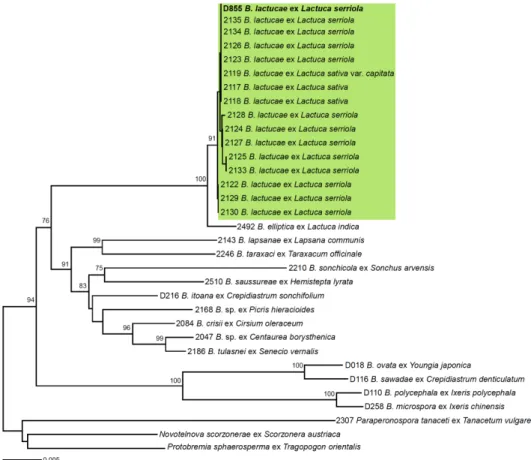
To identify the causal agent, morphological and molecular sequence analyses were performed. For
detailed microscopic examination, conidiophores and conidia formed underneath the infected leaves were
examined and photographed using an Imager M2 AX10 microscope (Carl Zeiss, Jena, Germany) equipped
with an AxioCam 512 camera (Carl Zeiss). Conidiophores were tree-like, hyaline, straight to slightly curved,
with sizes of (211.1-)290.4 to 503.1(-632.0) ×(7.3-)8.7 to 11.6(-14.4) μm (n=50). The conidiophores were
monopodially branched in four to six orders (Fig. 1E and 1F). Trunks were hyaline with sizes of (77.7-)119.5
to 292.9(-409.6) ×(7.0-)8.6 to 11.6(-14.3) μm (n=50). Ultimate branchlets were in pairs or triplets and were
straight to slightly curved, 7.8 to 26.7 μm long and 8.2 to 10.5 μm wide at the base (n=50), with truncate or
infrequently swollen tips (Fig. 1G and 1H). Conidia were hyaline, ovoidal or lemon-shaped, and measured
(17.2-)17.5 to 21.3(-24.6)×(15.2-)15.1 to 17.5(-19.8) μm, with a length to width ratio of (1.09-)1.14 to 1.24(-
1.29) (n=50) (Fig. 1I and 1J). The morphological characteristics unequivocally identified the pathogen