• 검색 결과가 없습니다.

An Asian Airline Implementation of Smartphone Collaboration: From Training to Operations

N/A
N/A
Protected

Academic year: 2021

Share "An Asian Airline Implementation of Smartphone Collaboration: From Training to Operations"

Copied!
11
0
0

로드 중.... (전체 텍스트 보기)

전체 글

(1)

An Asian Airline Implementation of Smartphone Collaboration: From Training to Operations

Dante Dionne 1 , Douglas M. Schutz 2 , Yong-Young Kim 3*

1

Senior Consultant, Bushido Management

2

Vice President, Talent Management, Citizens Bank

3

Professor, Division of International Business, Konkuk Univerisity

스마트폰을 활용한 항공사의 협업 사례 연구:

훈련 기간과 운영 기간의 차이 분석

Dante Dionne

1

, Douglas M. Schutz

2

, 김용영

3*

1

Senior Consultant, Bushido Management,

2

Vice President, Citizens Bank,

3

건국대학교 교수

Abstract In order to provide quality services across international airports, airline personnel must rapidly and effectively develop and share knowledge. Combining components of adaptive structuration theory (AST) and media synchronicity theory (MST), a research framework was developed to convey three distinct stages of knowledge sharing. We use the grounded theory research method for the qualitative data collected from audio transcripts of employees learning how to use and work with company issued smartphones with push-to-talk functionalities. Data was collected from 33 operations personnel. The results of the content analysis are recorded for the elements of each of the three concepts of our research framework. During the social interaction stage, the content of the audio conversations shifts mainly from conflict management to task management; for media synchronicity, from quality to quantity; for productive outcomes, from efficiency to commitment. New insights are uncovered from our analysis of data from the field as users advance from learning how to use the mobile devices, to using the devices for managing knowledge for their work in the airline industry.

Key Words : Enterprise Mobility, Corporate Smartphones, Knowledge Sharing, Content Analysis, Grounded Theory Method, Mixed Methods

요 약 공항에서 품질 높은 서비스를 제공하기 위해 항공사 직원들은 신속하고 효과적으로 지식을 개발하여 공유하여야 한다. 본 연구는 항공사에서 스마트폰을 이용한 협업의 효과를 검증하기 위하여 적응적 구조화 이론과 미디어 일치성 이론 에 근거하여 사회적 상호작용, 미디어 일치성, 생산적 산출물로 이어지는 이론적 프레이워크를 개발하였다. 아시아에 거점 을 둔 항공사A를 대상으로 훈련 및 운영 기간 동안 33명 인력으로부터 S사에서 제작한 10대의 스마트폰을 이용해 대화한 내용이 담긴 6개월간의 음성 파일을 수집하였다. 근거이론 방법에 기초하여 이론적 프레임워크에 따라 훈련 기간과 운영 기간으로 나눠 이 음성 파일을 분류했다. 정성적・정량적 콘텐트 분석에 기반을 둔 훈련 기간과 운영 기간 간 차이 분석 결과, 사회적 상호작용 단계에서는 갈등 관리에서 업무 관리로, 미디어 일치성 단계에서는 품질에서 양으로, 생산적 산출물 단계에서는 효율에서 몰입으로 주요한 전환이 발생하였다는 점을 발견하였다. 이러한 결과는 항공사 현업 인력들이 훈련 기간 스마트폰 기능의 학습에 중점을 두는 반면, 운영 기간 스마트폰을 활용하여 지식 관리를 수행한다는 점을 시사한다.

주제어 : 전사적 모빌리티, 기업용 스마트폰, 지식공유, 내용 분석, 근거이론 방법, 통합연구법

*Corresponding Author : Yong-Young Kim ([email protected]) Received July 12, 2018

Accepted October 20, 2018

Revised August 16, 2018

Published October28, 2018

(2)

1. Introduction

The sustained use of mobile computing devices such as smartphones in the organization requires their successful implementation and adoption [1-3]. In this study, we analyze the successful implementation and adoption of corporate smartphones at an airport in the United States, by airline employees from Asia who serve customers from around the world. Through this research, we seek to answer the following research questions:

Q1. How do employees use corporate smartphones for mediating multicultural, social interactions for enhanced outcomes?

Q2. How do these uses change from implementation to adoption?

In order to answer these questions, we perform grounded theory research from transcribed audio conversations between airline operations personnel as they advance from the initial implementation to adoption in their work. We draw on theoretical concepts from the literature and identify new relations with respect to learning how to use the functionalities of the new mobile computing devices for serving diverse customers. In identifying the theoretical concepts for our research model, we draw from adaptive structuration theory (AST) and media synchronicity theory (MST) [4, 5]. We then apply our research model in the field with employees of a global airline organization at an international airport located in the United States.

From our analysis, we are able to determine the changes in how employees use corporate smartphones from implementation to adoption. Through these findings we are able to observe how the new, distributed information system for personnel fits with the communications performance needs of the environment. The smartphones were implemented by the organization to replace walkie-talkies so that there is greater operations knowledge transparency from the employees on the runways around the world to the

highest executives based in Asia. Airline personnel stationed at the airport are at the front lines of operations and are typically the first human interaction in the traveler's journey. Smartphone implementation has also led to an enhanced digital ecosystem;

including digital playback of recorded messages, targeted replies, integrated texts, pictures, videos and a host of just-in-time smartphone based features.

Research shows that the implementation and adoption of new innovations in an organization follow two distinct phases [6]. A company may implement a new technology throughout an organization, but few employees may continue to use, or actually realize the intended benefits of the new technology. In our study, for example, the success of switching from legacy walkie-talkie radios to smartphones depends on their actual use by employees to seek and to share knowledge. Distributed information systems of the past often experienced unsuccessful implementations despite having executive support and being deployed to large numbers of employees [7, 8]. Implementation research shows that obstacles have typically been related to cognitive and structural organization elements [8]. For example, user cognitive issues were not adequately managed through communications and training.

Structural issues such as professional norms, rigid hierarchies, and design standard limitations often impeded the use of these systems for the benefits of sharing knowledge. While some employees that used these systems may have benefited individually through improved efficiency and effectiveness, they often did not realize the collective benefits through the use of these systems for the mutual sharing of knowledge with others in the organization [7, 9].

Our results from data collected in the field go

beyond confirming that the implementation of corporate

smartphones requires employees to know how to use

their functions. In order to successfully advance from

implementation to adoption for continuous use,

employees also need to know how using smartphones

can manage knowledge collectively for their own

(3)

benefit in their work for the firm. This involves the reduction of cognitive as well as structural organizational elements so that the use of functionalities of the smartphones becomes seamless for the airline users managing knowledge for the benefit of their customers and organization. We conclude the paper with both theoretical and managerial implications and opportunities for further research.

2. Literature Review: AST & MST

2.1 Adaptive Structuration Theory (AST) Adaptive Structuration Theory is based on the Structuration Theory of Giddens[10]. According to Structuration Theory, human behavior is socially structured, which is constrained by regulations and resources, but it also influences the social structure by the process of using them constantly. This process of social structure being continuously created or re-created in society is called structuration [5,11,12].

According to AST, the information system affects users, while, as users continue to use it, they can also change its' process or the way they use it or the use of the system. Therefore AST provides a model that describes the relationship between information technology, social structure, and human interactions[5].

At the core of this theory is 'technology appropriation', which means the features and methods in which users reproduce or recreate their own rules and resources while using technology. Users will decide how to use the structure of the technology in their tasks and what other structures to choose [5, 13].

When AST was first proposed, the target information technology was advanced information technology that could support communication between users, such as a group decision support system[5]. With today's advanced information technology environment, AST can also be applied to various Internet-based information systems, including mobile systems [11, 14].

If collaboration is carried out using mobile systems, it

is an appropriate technology to apply AST, because it supports communication between workers and allows them to co-work efficiently and effectively.

2.2 Media Synchronicity Theory (MST) If an organization's team members cannot solve the problem by themselves, they want to solve the problem by utilizing their own diverse networks. These work networks are derived from a variety of activities and relationships, including personal past projects and experiences, and different networks are being used for different types of problems. In a collaborative work environment, the performance of the task is greatly influenced by how well the individuals on the team use the work network to perform their tasks. These network effects show the following situation : even the same system, different individuals, groups, and organizations use different kinds of things in their daily lives [15].

The MIS study of computer-mediated communication (CMC) can be divided into two main categories:

Rational Technology Selection(RTS) for media choices and Social Interaction Theory(SIT) for user behavior[16]. Rational Technology Selection viewing that communication technology is chosen best suited to the characteristics of the job is a trait theory which focuses on the traits of the media that affect business performance, and Media Richness Theory(MRT) [17]

can be referred as a prime example of RTS. Social Interaction Theory suggests that the use and selection of media is determined through interaction with others rather than by the nature of the media, and Social Influence Model [18] is a representative model of SIT.

Social Influence Model argues that recognition and choice of media is influenced by peers and that perceptions may vary depending on individual characteristics and circumstances.

From RTS, mobile information technologies are

closely related to the synchronicity, which is an

important function of the CMC. The emergence of

mobile information technologies is close to increased

(4)

acceptance of synchronicity, and Media Synchronicity Theory(MST) provides a theoretical basis[4]. MST, which was proposed after criticizing MRT, focuses on the varying degrees of communication that information technology supports real-time communication between the communicating parties. The capability to support degree of synchronicity consists of five factors :

“immediacy of feedback, symbol variety, parallelism, rehearsability, and reprocessability.” As with MRT, MST adopts a contextual perspective, arguing that communication information technology should match the situation at the time of communication with each other to produce desired results.

3. Research Methodology

3.1. Research Framework

We combine concepts from adaptive structuration theory (AST) and media synchronicity theory (MST) for developing our research framework. AST provides a means for understanding how the use of IT innovations impact organizations 1) through the structures of the technologies and 2) through the structures of social interactions [5]. MST provides a means for understanding how well the capability of media supports the synchronicity of matching communication process requirements of individuals working together [4].

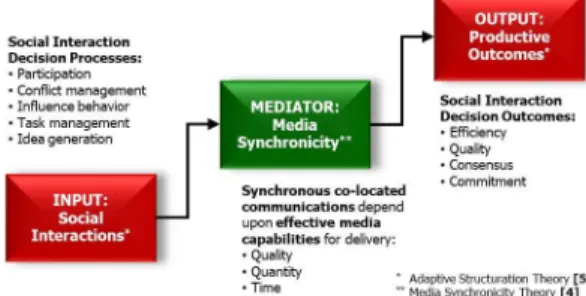
By combining the concepts of social interactions mediated through the concept of media synchronicity resulting in the concept of productive outcomes, we

have our research framework in Fig. 1. The elements of these concepts show their relations which we draw from for our data collection.

Social interactions provide the first concept in our research model. From AST, we draw from the concept of social interactions which consists of the decision process elements of participation, conflict management, influence behavior, and task management as following [5]:

∙ Task: assigned where users attempted to elicit other users to get an update, to provide or receive information or to request some form of action be taken

∙ Influence Behavior: assigned where users motivated others to behave differently

∙ Conflict Management: assigned where users tested the efficacy of the communications system

∙ Participation: Assigned where users interacted with one another

Social interactions are mediated by the use of the distributed smartphones which serve as distributed information systems for the participating airline organization. Media synchronicity is the second concept of our research model which mediates relations between the concepts of social interactions and the productive outcomes of the users. From MST, we draw from the concept of media synchronicity which consists of the elements of quality, quantity, and time as following:

∙ Quality: assigned where users were focused on quality related concerns

∙ Quantity: assigned where users were concerned with quantities measured in amounts or distances

∙ Time: assigned where users were concerned with temporal related constraints

From AST, we draw from the concept of socio-behavioral productive outcomes through the use of smartphones [5]. Productive outcomes serve as the third concept of our research model - as mediated by media synchronicity. Productive outcomes consist of the elements of quality, quantity, and time as following:

Fig. 1. Research Framework

(5)

∙ Efficiency: assigned where user communications were concerning efficient task related outcomes

∙ Commitment: assigned where user communications were concerned with gaining commitment as outcomes

∙ Consensus: assigned where user communications were concerned with gaining consensus

∙ Quality: assigned where user communications were concerned with quality related outcomes

3.2 Design

A preponderance of scholarly research exists in the realms of grounded theory and quantitative content analysis [19, 20]. The scientific practice of applying separate theoretical frameworks in combination with the aforementioned methods is a nascent field, that is rife with opportunities. Seeing empirical research supporting this approach to be scant, this study sought to extend prior work by positing a framework for exploring the effects of technology mediation on productivity outcomes, in aegis of social antecedents in commercial environments. Leading scholars suggest

that a multifaceted approach to data analysis can provide deeper insights into the phenomenon under study and add a dimension of reliability to research [21, 22]. Moving beyond a focus on characteristics of communications technologies, this exploratory qualitative study employs a grounded theory-content analysis approach to answer the research questions.

The underlying logic for the mixing of the methods in our research study was, to complement the qualitative content analysis with quantitative content analysis to yield a more comprehensive understanding within and across the data set. Seeking to generate generalizable conclusions, a nomothetic approach to scientific investigation was emphasized.

3.3 Sample and Unit of Analysis

In this study, the unit of analysis consisted of individual communications between airline operations personnel. The communications were all made using customized Smartphone based push-to-talk software (PTT). All transmissions (1-to-1 and 1-to-many) were made during normal airline operations procedures.

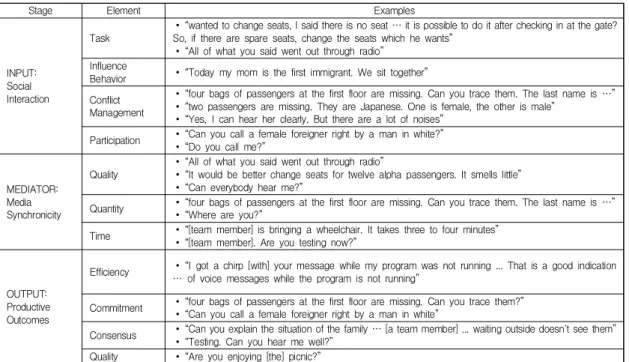
Stage Element Examples

INPUT:

Social Interaction

Task

∙ “wanted to change seats, I said there is no seat … it is possible to do it after checking in at the gate?

So, if there are spare seats, change the seats which he wants”

∙ “All of what you said went out through radio”

Influence

Behavior ∙ “Today my mom is the first immigrant. We sit together”

Conflict Management

∙ “four bags of passengers at the first floor are missing. Can you trace them. The last name is …”

∙ “two passengers are missing. They are Japanese. One is female, the other is male”

∙ “Yes, I can hear her clearly. But there are a lot of noises”

Participation ∙ “Can you call a female foreigner right by a man in white?”

∙ “Do you call me?”

MEDIATOR:

Media Synchronicity

Quality

∙ “All of what you said went out through radio”

∙ “It would be better change seats for twelve alpha passengers. It smells little”

∙ “Can everybody hear me?”

Quantity ∙ “four bags of passengers at the first floor are missing. Can you trace them. The last name is …”

∙ “Where are you?”

Time ∙ “[team member] is bringing a wheelchair. It takes three to four minutes”

∙ “[team member]. Are you testing now?”

OUTPUT:

Productive Outcomes

Efficiency ∙ “I got a chirp [with] your message while my program was not running ... That is a good indication

… of voice messages while the program is not running”

Commitment ∙ “four bags of passengers at the first floor are missing. Can you trace them?”

∙ “Can you call a female foreigner right by a man in white”

Consensus ∙ “Can you explain the situation of the family … [a team member] ... waiting outside doesn't see them”

∙ “Testing. Can you hear me well?”

Quality ∙ “Are you enjoying [the] picnic?”

Table 1. Examples of Content Analysis

(6)

The nature of PTT communications is such that organizational participants take turns communicating (interaction turn) over a shared talk group. All team members can hear all communications within their talk group and can send or transmit messages when other users are not attempting to send a message to the group. Message transmissions where recorded and saved as individual audio files on the software providers servers. For purposes of scientific research, recordings were made available to the primary researcher. All recorded audio dialog was then transcribed as individual textual transmission units and anonymized for further analysis by the research team.

Originally, 684 individual MP3 files were recorded over the course of five separate flight operations shifts.

Preliminary analysis identified that 6 of the files not associated with the user study and were removed prior to analysis. Approximately 82% (n=557) of the captured audio files were in the Korean language with English language interspersed. All Korean language files were first transcribed in the Korean language, then translated from Korean to English. To ensure translation accuracy, these translated transcripts were then translated back to Korean again and compared to the original transcripts. The remaining 18% of captured audio files and resulting transcripts, were in the English language (n=127), which did not require translation, only transcription. The final transcribed and translated communications (n=678) were included in the remainder of the current study.

3.4 Procedures

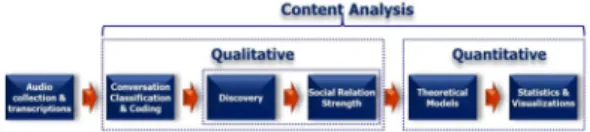
In sum, as shown on Fig. 3, the entire process entailed 1) cataloging and transcribing the 678 recorded audio files; 2) qualitative content analysis, which entailed data exploration/discovery and manifest coding; and 3) quantitative content analysis, which entailed theoretical coding, statistical analysis and visualization.

Fig. 2. Content Analysis Process

To date, no other research has been identified that investigates mobility and corporate communications within the high-touch customer service scenarios of a commercial airline. Retaining competitive advantages in an increasingly demanding marketplace, organizational members rely on technologies that enable measurable effective outcomes. The procedures used to answer the research questions for how and why mobile technologies mediates productivity in airline operations, began with translation and transcription of PTT radio transmissions.

While the prior implementation study took a more pragmatic approach, the current study employed a constructivist worldview. Mixing qualitative and quantitative methods in this study, provided the opportunity to explore how employees learn to use, and work with company issued smartphones with push-to-talk functionalities. Initial qualitative content analysis sought to understand the actions, processes, interactions, language usage and most specifically, the workgroups concurrent interactions. A grounded theory approach was employed to better explore and understand these collaborative behaviors [23].

Operating from the premise that an abductive investigation into the invisible and ambiguous social world elements of distributed airline operations could reveal the salient aspects of media enablement [24].

This manifested insights into psychological properties of the communications such as individual and group achievement motivations, affiliative trust levels, social power dynamics, conceptual integrity, and contextual complexities.

3.5 Data Analysis

3.5.1 Qualitative content analysis

(7)

A modified version of Glaser and Strauss [25]

Grounded Theory research method was taken for content analysis. Once the initial data transcriptions and translations were complete, two stages of qualitative content analysis were performed; open coding and axial coding. The outcomes of the qualitative content analysis provided the impetus for final stage theoretical coding by consensus and quantitative analysis.

Open coding consisted of listing content by date/time and workstream (inbound/arriving flights versus outbound/departing flights). Axial coding was employed to make explicit connections between categories and sub-categories to explain the relationships between specific activities, transmitter communications and receiver responses. For example, which areas in the airport activities were taking place, whether the activity pertained to training or testing by personnel, and the primary and secondary focus on specific activities or tasks. Examples of which include:

functional testing devices during orientation, locating lost luggage at the carousel, retrieving passengers in customs, and ensuring aircraft is hygienically fit for passenger boarding.

Other areas of concern to operations staff included pre-and-post flight workflows (ex. boarding passengers, aircraft cleaning, luggage drop and ticketing check-in), special services (e.g. wheelchair courier, VIP transportation, and language interpretation), and other operational concerns (e.g. privacy concerns, changing seat assignments, and staff management). Information mapping and situational analysis of real-time interactions included insights into goal attainment, location and time related context, responsiveness of receivers, services delivery levels and more. The data evidenced a lack of need for reiteration or recall in the conversations, indicating previously developed workgroup efficiencies, effective communications practices and comfort levels in use of the technologies under review.

Members of the research team interacted regularly

for several months to share ideas to increase insights.

Manifest content analysis led to latent content analysis.

Initial coding focused on communications based on key words that reflected actions to develop the temporal and structural orderings word-by-word, line-by-line, and interaction-by-interaction. This was followed up with more synthesized focused and axial coding [26]

that partitioned and examined larger segments of data to better understand the phenomenon. An abstract situational map [24] conditional/consequential matrix was then used as a means to examine the patterns of micro social interactions to establish contextual location of personnel. This complex iterative process of raising generative questions to guide the research evolved the central tenants, and core theoretical concepts were identified.

3.5.2 Quantitative content analysis

During the initial manifest qualitative content coding phase, the research team determined that staff decision making processes coincided directly with the social interaction goals and outcome tenets outlined by DeSanctis & Poole [5] adaptive structuration theory (AST). In order to objectively measure the communications technologies capacity to mediate socio-behavioral outcomes, the task performance concepts of Dennis, Fuller, & Valacich [4] media synchronicity theory (MST) was employed. Opting for a more focused method of extracting salient concepts of the phenomenon under study, rigorous alignment on concept definitions and interrater coding agreement was necessary. Mutually agreed upon concept definitions were established to systematically guide the research team to separately assign values to communications that would be consistent, limit bias towards creating reproducible results, and allow inferences to be made through quantification analysis.

The guiding framework characteristics for the

theoretical coding categories was applied by all three

investigators to: 1) Closely examine variations in the

communication process; 2) Identify which theoretical

(8)

concept was best delineated in each of the individual communications; and 3) apply the appropriate code to each of the individual communications. The theoretical research model imposed external logic on the social interaction phenomenon. Grounded in observations, this inductive approach relied upon interpretations of the researchers to make objective and systematic inferences about theoretically relevant content in the communications data [19]. As coding designations by multiple raters involved a degree of judgement, an index of interrater reliability was computed. A 97%

alpha (α=.97) was observed, indicating a high degree of consistency between raters for all coding designations.

The few discrepancies were resolved in a final collaborator review.

3.5.3 Implementation versus Adoption

At this stage, the data file was split and analyzed in both NVIVO (v11) and IBM SPSS (v23) software applications. Out of the 678 coded communications transcripts, 499 were from adoption (operations) related activities; and 179 were from implementation (training or testing) related activities. Similar analysis was employed for both training and operations functions for data comparison.

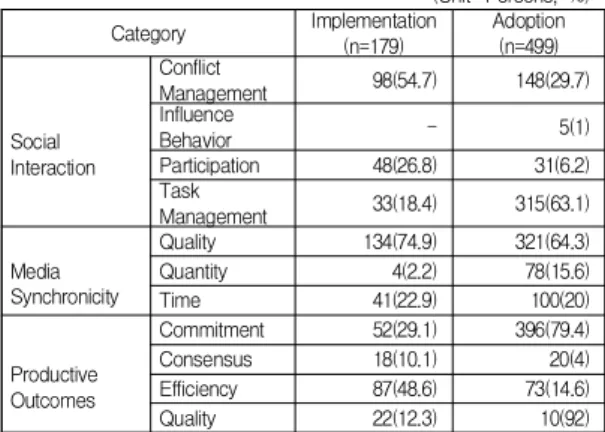
To address research question 1, “How do employees use corporate smartphones for mediating multicultural, social interactions for enhanced outcomes?”, the following frequency Table 2 was created to illustrate

and compare the relative frequencies of each of the concept categories across all 5-workshifts, for both implementation and adoption phases.

To address research question 2, “How do these uses change from implementation to adoption?”, the following word tag clouds (Fig. 3) were created to illustrate the relative frequencies of each category across all 5-workshifts.

Fig. 3. Tag Clouds

4. Results

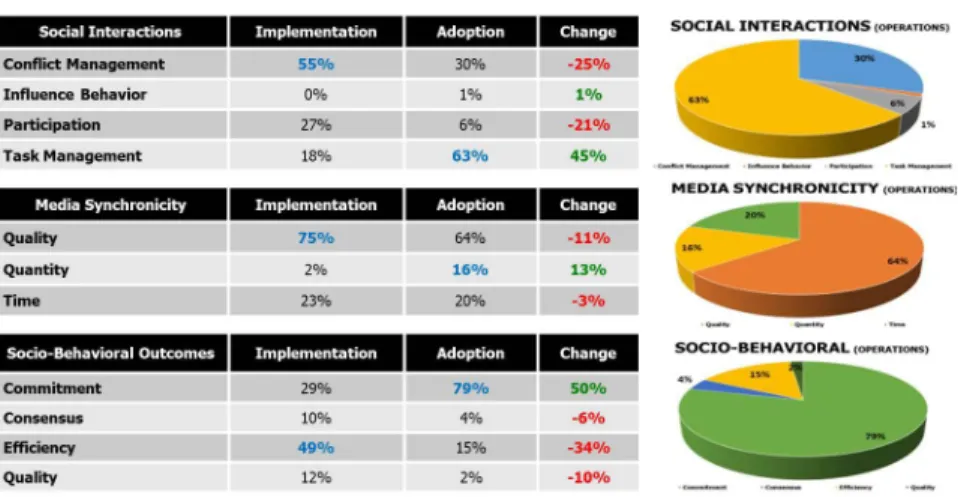
The results of the content analysis are shown in Fig.

4, and they are recorded for the elements of each of the three concepts of our research model. The results also show the changes recorded between the training for implementation and the adoption for operations. For social interactions, the content of the audio conversations shifts mainly from conflict management to task management as employees successfully learn how to use the functionalities of the smartphones by interacting with each other. For media synchronicity, the content of the conversations is mainly on quality during training; and operations indicating quantity as having the greatest positive change with an observed increase of 13%. For the concept of productive outcomes, efficiency is mainly emphasized during training followed by commitment mainly emphasized in operations with a large positive change with an observed increase of 50%.

In summary,

(Unit: Persons, %)

Category Implementation

(n=179)

Adoption (n=499)

Social Interaction

Conflict

Management 98(54.7) 148(29.7)

Influence

Behavior - 5(1)

Participation 48(26.8) 31(6.2)

Task

Management 33(18.4) 315(63.1)

Media Synchronicity

Quality 134(74.9) 321(64.3)

Quantity 4(2.2) 78(15.6)

Time 41(22.9) 100(20)

Productive Outcomes

Commitment 52(29.1) 396(79.4)

Consensus 18(10.1) 20(4)

Efficiency 87(48.6) 73(14.6)

Quality 22(12.3) 10(92)

Table 2. Number of Decision

(9)

∙ After implementation, the smartphones were used primarily by sharing knowledge through social interactions toward collective goal attainment.

∙ Smartphones enable multitasking and the compression of space.

∙ Outcomes of smartphone enabled mediations pivot from focusing on the technology to collectively serving customers.

5. Implications and Limitations

There are some contributions to academic researchers and practitioners. Grounded Theory Method helps understand the meanings of operational data for an emerging technology at the workplace [23], and answers how and why using smartphones mediates social interactions for productive socio-behavioral outcomes in the organization. Our grounded theory based results reveal several theoretical and managerial contributions. For example, the data shows that the employees initially socially interact in mainly resolving conflicts for understanding how to use the functionalities of the new smartphones during implementation. The dramatic shift to social interactions emphasizing task management implies that the smartphones were adopted after implementation and used primarily as intended by sharing knowledge through social

interactions toward collective goal attainment. For the media synchronicity concept, quantity makes a big jump from implementation to adoption implying that smartphones enable multitasking and the compression of space as intended. The shift in productive outcomes from efficiency to commitment implies that as intended, that outcomes of smartphone enabled mediations pivot from focusing on the technology to focusing on collectively serving customers. Thus enhancing the customer experience and leading greater efficiencies and operations outcomes. Managers need to understand that in order to have successful adoptions of new mobile technologies for operations, there needs to be successful implementations through ample testing cycles.

But there are some limitations of this research. The convenience sample of a single airline operations staff members at a single US airport is not generalizable to the larger target population of expatriate only airport operations members; Korean only airport operations members; or to all airport operations staff.

Cultural psychology scholars have suggested that in Western cultures, the speaker is responsible for communicating clearly, entirely un-reliant on context [27]. Additionally, Westerners believe in one's ability to manipulate their environment. Whereas the Asian cultures tend to adjust their orientations to fit their environment [27].

Fig. 4. Results: Implementation versus Adoption

(10)

Although the entire participant group were of East Asian origins, this study did not account for the Asian cultural predispositions for making the receiver responsible for message decoding accuracy. These, and a host of other culturally dichotomous factors were not considered here and may be crucial aspects in better understanding the global effects of technology mediation. Closely examining these and other aspects in future studies of this nature should be considered.

REFERENCES

[1] S. Oh, J.M. Lee, & Y.-Y. Kim. (2017). A Study on the Job Satisfaction in the Smart Work Environment, Journal of the Korea Convergence Society, 8(11), 393-401.

[2] Y.-Y. Kim. (2017). An Exploratory Study on the Role of Empathy for Facilitating Smart Work, Journal of the Korea Convergence Society, 8(5), 201-211.

[3] J.-Y. Lee & P.-S. Jang. (2017). Study on Research Trends in Airline Industry Using Keyword Network Analysis, Journal of the Korea Convergence Society, 8(5), 169-178.

[4] A.R. Dennis, R.M. Fuller, & J.S. Valacich. (2008). Media, Tasks, and Communication Processes, MIS Quarterly, 32(3), 575-600.

[5] G. DeSanctis & M.S. Poole. (1994). Capturing the Complexity in Advanced Technology Use, Organization Science, 5(2), 121-147.

[6] E.M. Rogers. (1983). Diffusion of Innovations, Free Press.

[7] K. Olesen & M.D. Myers. (1999). Trying to Improve Communication and Collaboration with Information Technology, Information Technology & People, 12(4), 317-332.

[8] W.J. Orlikowski. (1992). Organizational Issues in Groupware Implementation, ACM Conference on Computer-Supported Cooperative Work, 362-369.

[9] J. Halloran, Y. Rogers, & M. Scaife. (2002). Taking the

‘No’ out of Lotus Notes, Conference on Computer Support for Collaborative Learning, 169-178.

[10] A. Giddens. (1979). Central Problems in Social Theory, University of California Press.

[11] M.S. Poole and G. DeSanctis. (2004). Structuration Theory in Information Systems Research: Methods and Controversies, IDEA Group Publishing.

[12] W. Orlikowski & D. Robey. (1991). Information Technology and the Structuring of Organizations, Information Systems Research, 2(2), 143-169.

[13] A. Majchrzak, R.E. Rice, A. Malhotra, N. King, & S. Ba.

(2000). Technology Adaptation, MIS Quarterly, 24(4), 569-600.

[14] W.D. Salisbury, W.W. Chin, A. Gopal, & P.R. Newsted.

(2002). Better Theory Through Measurement, Information Systems Research, 13(1), 91-103.

[15] S.R. Barley. (1986). Technology as an Occasion for Structuring, Administrative Science Quarterly, 31(1), 78-108.

[16] A. Sivunen & M. Valo. (2006). Team Leaders’ Technology Choice in Virtual Teams, IEEE Transactions on Professional Communication, 49(1), 57-68.

[17] R.L. Daft & R.H. Lengel. (1986). Organizational Information Requirements, Media Richness and Structural Design, Management Science, 32(5), 554-571.

[18] J. Fulk. (1993). Social Construction of Communication Technology, Academy of Management Journal, 36(5), 921-950.

[19] K. Charmaz. (2006). Constructing Grounded Theory: A Practical Guide Through Qualitative Research, Sage.

[20] K.A. Neuendorf. (2016). The Content Analysis Guidebook, Sage.

[21] J.W. Creswell. (2003). Research Design: Qualitative, Quantitative, and Mixed Methods Approaches, Sage.

[22] A.M. Tashakkori & C.B. Teddlie, Mixed Methodology:

Combining Qualitative and Quantitative Approaches, Sage, 1998.

[23] M.D. Myers. (2013). Qualitative Research in Business and Management, Sage.

[24] A. Strauss & J. Corbin (1994). Grounded Theory Methodology: An Overview, Handbook of Qualitative Research, Sage, 273-285.

[25] B.G. Glaser and A.L. Strauss. (1967). The Discovery of Grounded Theory: Strategies for Qualitative Research, Aldine Publishing.

[26] B.G. Glaser. (1978), Theoretical Sensitivity: Advances in the Methodology of Grounded Theory, Sociology Press.

[27] R.E. Nisbett. (2004). The Geography of Thought: How

Asians and Westerners Think Differently...and Why, The

Free Press.

(11)

Dante Dionne [정회원]

․2003년 12월 : University of the Pacific Business Management (BS)

․2012년 8월 : The Chicago School of Professional Psychology (MA)

․2017년 4월 : The Chicago School of Professional Psychology (PhD)

․2018년 3월 ~ 현재 : Senior Consultant, Bushido Management

․관심분야 : socio-technological innovation, leader development, the neuroscience of optimal human experience

․E-Mail : [email protected]

Douglas M. Schutz [정회원]

․1987년 5월 : United States Naval Academy (BS)

․1996년 5월 : The University of Texas (MBA)

․2013년 8월 : Temple University (PhD)

․2017년 8월 ~ 현재 : Vice President, Citizens Bank

․관심분야 : social networking, online learning, mobile computing, knowledge sharing, heterogeneity, innovation

․E-Mail : [email protected]

김 용 영(Kim, Yong-Young) [정회원]

․1996년 2월 : 충북대학교 경영학 과(경영학사)

․1999년 2월 : 서울대학교 대학원 경영학과(경영학석사)

․2007년 2월 : 서울대학교 대학원 경영학과(경영학박사)

․2011년 3월 ~ 현재 : 건국대학교 국제비즈니스학부 부 교수

․관심분야 : 스마트워크, 정보기술 수용 전후 사용자 행 태, 모바일 및 스마트 비즈니스

․E-Mail : [email protected]

수치

Fig.  1.  Research  Framework
Table  1.  Examples  of  Content  Analysis
Fig.  2.  Content  Analysis  Process
Table  2.  Number  of  Decision
+2

참조

관련 문서