ALA-accredited Library and Information Science Programs
*문헌정보학 건강 관련 과목의 주제 및 내용 분석: ALA 인가를 받은 프로그램을 중심으로
Sanghee Oh (오상희)**
Soojung Kim (김수정)***
ABSTRACT
This study aims to examine the current status of health-related courses at the graduate level from American Library Association-accredited LIS programs and to identify the core topics and contents that have been covered in those courses by analyzing the course syllabi. Findings reveal that 44 out of 61 Library and Information Science (LIS) programs were offering at least one health-related course and the three most offered courses were ‘health information resources’,
‘health informatics’, and ‘consumer health information (CHI)’. We collected a total of 21 course syllabi available online in the three areas and further analyzed their course descriptions, weekly topics, readings, and assignments. The findings of the study could be valuable for instructors who want to design or upgrade health-related courses in LIS programs.
초 록
본 연구는 미국도서관협회의 인가를 받은 문헌정보학과의 대학원 수준에서 제공되는 건강 관련 수업의
현황을 조사하고
,
학업계획서 분석을 통해 해당 수업에서 다뤄지는 주요 주제와 내용을 살펴보는 것을 목적으로한다
.
분석 결과61
개 문헌정보학 프로그램 중44
개 프로그램에서 최소 한 개 이상의 건강 관련 수업을 제공하고 있었으며 가장 많이 개설된 수업은‘
건강 정보원’, ‘
의료정보학’, ‘
소비자건강정보’
인 것으로 나타났다.
이 세 분야에서 총21
개의 학업계획서를 온라인을 통해 수집하였고,
수업 개요,
주별 주제,
교재,
숙제 등을 분석하였다.
본 연구의 결과는 문헌정보학 프로그램에서 건강 관련 수업을 개설하거나 개선하려는 강사들에게 도움이 될 것이다.
Keywords:
Health Librarian, Medical Librarian, LIS Education, Health-related Courses 건강정보사서, 의학사서, 문헌정보학 교육, 건강 관련 과목*
**
***
이 연구는 충남대학교 학술연구비에 의해 지원되었음.
이 논문은 2018년도 전북대학교 연구기반 조성비 지원에 의하여 연구되었음.
충남대학교 문헌정보학과 조교수([email protected]) (제1저자)
전북대학교 문헌정보학과 부교수, 문화융복합아카이빙연구소 연구원([email protected]) (교신저자)
논문접수일자 : 2018년 11월 10일 논문심사일자 : 2018년 12월 18일 게재확정일자 : 2018년 12월 19일
한국비블리아학회지, 29(4): 69-89, 2018. [http://dx.doi.org/10.14699/kbiblia.2018.29.4.069]
1. Introduction
Librarians provide various health information services to users. For example, as well as disseminat- ing health information, they provide consumer health information services and education in relation to is- sues such as collecting, managing, locating, and eval- uating health information resources, and also advo- cate for consumers’ rights to access (Medical Library Association and Consumer and Patient Health Information Section 1996). Librarians in hospital li- braries assist clinicians’ decision making with evi- dence-based practice at the point of care (Kronenfeld et al. 2007; Urquhart and Hepworth 1995). Librarians in medical libraries supply scientists with highly spe- cialized research datasets and resources in order to support their research on biomedicine or genome proj- ects (Homan and McGowan 2002). In addition, they have been heavily involved in a variety of information and data management services related to the emerging technology in health, such as telehealth, eHealth, and Health 2.0 (Barron and Manhas 2011; Corbett, Deardorff, and Kovar-Gough 2014; Randeree 2009).
New roles for health librarians, such as librarians with specialized topics in health (e.g., clinical in- formationists, bioinformationists, public health in- formationists, disaster information specialists), sys- tematic review librarians, continuing medical educa- tion librarians, and data management librarians, have been proposed in a number of previous studies and job announcements in the field and are considered to be crucial (Cooper and Crum 2013).
In Korea, the professional role of librarians in providing health information has been fully recog- nized recently. Only a few LIS programs in Korea offer health-related courses in their undergraduate or graduate programs, meaning their students become librarians without much prior knowledge or experi- ence of dealing with health information; - a small number of post-graduate training programs are avail- able as an option. Recent research, however, identi- fied health as an important topic to cover in Korean public libraries (Na and Jeong 2017; Kim and Cha 2016; Noh 2014). For example, Nam and Park (2014) analyzed the contents of health information from the websites of several U.S. public libraries in order to identify a list of health topics that could be provided in public libraries in Korea, such as information about diseases, treatments, self-health, cancer, and health check-ups. The studies of serving underserved pop- ulations such as older adults or multi-cultural users in public libraries revealed that health is one of the frequently requested topics by these user groups (Kim and Cha 2016; Yoon 2012).
Health librarianship can be a challenge for li- brarians in public libraries; they need to learn the medical context and terminology as well as in- formation resources and systems associated with the health domain, especially if they have a background in liberal arts rather than health sciences or other related fields (Lyon 2003). Myers and Rodriguez (2016), who surveyed early career health information professionals, found that they largely rely on their LIS education to attain professional competencies.
The undergraduate or graduate level of LIS education,
however, was not the most cited method of attainment for health sciences, health care environment, and information policies competency. This implies that there might be a gap between LIS education on health information and the skills needed in practice for future health librarians. However, most previous research has focused on post-graduate training programs for current health librarians to enhance their professional competency in health services (Rook and Adshead 2001; Whitmore, Grefsheim, and Rankin 2008;
Rubenstein 2017) and little attention has been given to undergraduate or graduate levels of education on health for future librarians.
Therefore, in an attempt to fill the research gap, the present study aims to investigate the current status of health-related courses offered at the graduate level from American Library Association (ALA) - ac- credited LIS programs. It also aims to identify the core topics and contents that have been covered in those courses by analyzing the course syllabi. We had reviewed the health syllabus from the ALA ac- credited LIS programs only in this study because health is one of the advanced topics in research and teaching from these programs. We believe findings will be useful for those who have taught or would like to offer health courses in their LIS programs by providing a guide for what to include for course topics, readings, and assignments when they revise or design health courses. In this respect, we provide some observations later specifically in relation to designing health courses in Korea’s LIS programs.
The research questions that guide the study are as follows:
1) What is the current status of health-related cours- es being offered from LIS programs?
2) What are the most frequently taught topics in health-related courses from LIS programs?
3) What are the contents (e.g., weekly topics, read- ings, assignments) of the courses identified in the topic areas in the second research question?
2. Literature Review
Library and Information Science (LIS) institutions and associations have offered series of education and training programs for health librarians. The Medical Library Association (MLA) has proposed various approaches to educate and train health li- brarians effectively during graduate level coursework in LIS programs, continuous professional develop- ment (CPD) programs, credential and certificate pro- grams, and fellowship offers (Homan and McGowan 2002). Specifically, graduate-level education in LIS programs is the entry-level training required for health librarians to be successful in building and devel- oping their careers and performing their diverse roles in the field (Homan and McGowan 2002). Health librarianship presents the opportunity for graduate students to further develop and apply their knowledge and skills in collection management, information ac- cess, information evaluation, information retrieval, and technology to the increasingly diverse and dynam- ic populations of users in the health domain. This leads to highly specialized and advanced information services courses that go beyond the currently popular
subject areas in LIS programs.
Most previous studies have focused on post-gradu- ate training programs for current health librarians to enhance their professional competency in health services; the programs are offered by several medical school libraries (Rook and Adshead 2001)―the Library of the National Institutes of Health (NIH) (Whitmore, Grefsheim, and Rankin 2008), and the National Library of Medicine (NLM) (Kouame, Allard, and Mays 2005). Petrinic and Urquhart (2007) investigated the needs of health librarians to develop their skills in teaching, advanced searching, project management, and research methods that would satisfy the job requirements needed by medical libraries.
Research has shown that having a specific degree or training in relation to acquiring subject knowledge in health makes a significant difference to perform- ance (Fikar and Corral 2001). For example, Lyon (2003) found that health librarians often lack con- fidence in providing services when they have not had proper training in biomedical sciences, whereas a review of literature related to the effectiveness of training in information searching for improving the quality of health information services by Garg and Turtle (2003) showed that such training was definitely useful. Brettle (2007) identified the out- come measures of the effectiveness of health librarian training from a comprehensive review of literature related to LIS skills and training. Rubenstein (2016a;
2016b) and Luo and Park (2013) reported that many public librarians have difficulties with medical termi- nology and lack knowledge about medical information resources and how to use them.
Most of these previous studies offer systematic reviews and analyses of health-related knowledge and practices in the field of health librarianship. Little research, however, has been conducted on health information and librarianship education in the gradu- ate level LIS programs. Rubenstein (2017) addressed the issue of graduate-level education, but her emphasis was on experiential learning such as practicum, intern- ship, and field experience. She suggested health-re- lated practice-based education such as practicum or internship would enhance their skills with medical databases, increase their understanding of consumer health issues, and address the issue of interacting with clients. Recently, Mehra and Tidwell (2014) provided a comprehensive review of health-related courses in LIS programs, but they focused on health-gender and health-sexual orientation topics in those courses.
In relation to health librarianship in Korea, only a few researchers have carried out studies on health librarianship. Noh and Oh (2011a; 2011b; 2011c) researched consumer health information services in public libraries. Consumer health information serv- ices offered in the United States, Canada, and Europe and related research were reviewed (Noh and Oh 2011a) and the needs of public library users as well as librarians in relation to consumer health in- formation services were examined (Noh and Oh 2011b; 2011c). The types of consumer health in- formation services offered by public libraries in Korea, such as linking health-related information websites to the library homepages, and health-related forums or presentations in public libraries for com-
munity services, were also investigated (Noh 2011).
Based on the findings from these studies, Noh (2013a;
2013b) identified the roles and qualifications of health librarians and developed a guideline for consumer health information reference services in public libraries. Noh (2014) also compared librarians’ per- ceptions of health information services in public and in medical libraries. Oh and Noh (2013) surveyed librarians to develop a core set of evaluation criteria of health information resources and developed guide- lines that are applicable in public library settings.
In addition, extensive research has been conducted to evaluate the current status of LIS education in Korea and suggest improvements for overall LIS curricular or a particular course. Examples of research focusing on a particular course include library management course (Kim 2014), reference service course (Chung 2011), information organization course (Rho 2011), records management course (Han and Noh 2015), cap- stone design course (Noh 2015) and so on. These studies are meaningful as they reveal the problems of the education in a specific area and seek possible ways to improve. Unfortunately, no research exists on health-related courses due to the lack of those courses in Korea. Therefore, examining health-related courses long-established in ALA-accredited LIS pro- grams will give new insights into how to develop health-related courses effectively in Korea.
3. Methods
First, a total of 61 ALA-accredited LIS programs,
either fully or conditionally accredited at the time of data collection in 2018, were identified from the LIS program directory of the ALA website. The URLs of the LIS program websites were obtained from the ALA directory page on its website (http://www.ala.
org/educationcareers/accreditedprograms/directory).
Then, we visited all 61 websites and reviewed the course titles of each one from their course catalogs or course description pages. When any of the keywords
“health,” “medical,” “medicine,” or “biomedical” ap- peared in the course titles, we considered it a health-re- lated course. Once the relevant courses were identified, we manually collected their course syllabi from the LIS program websites or by googling with the course titles, regarding the online version of the course syllabi as a public good. There are health courses offered by non-LIS programs such as public health, in- formation management, and nursing programs, but we did not include them in our study.
Next, a method of content analysis was used to analyze the course content of the syllabi we collected.
Course titles and descriptions were first reviewed in order to investigate the topics covered in health-re- lated courses. The scope of health-related courses was diverse, anything from an introductory course to special topics courses listed in Table 1. From this analysis, we were able to identify the top three courses that have been most frequently offered from the LIS programs―health information resources, health informatics, and consumer health informatics.
Thus, we carried out a thorough review of the contents of these three topics and report the findings in this paper. The weekly topics presented in course syllabi
in these courses were further analyzed by identifying topics taught in courses. The required and recom- mended readings, including textbooks, journal ar- ticles, white papers, technical reports and others, were identified in order to ascertain what reading materials have been most frequently cited or used in health-related courses. In-class activities, assign- ments, and projects were reviewed in order to under- stand the learning activities that have been carried out in course settings.
4. Results
4.1 Current Status of Health-Related Courses in LIS Programs
Of the 61 ALA-accredited LIS programs, 44 pro- grams (72%) provide at least one health-related course, and there are 106 such courses in total (Table 1).
The number of health-related courses offered by each LIS program ranges widely, from 0 to 10, with an average of 1.7. The health-related courses were found to be concentrated in a small number of LIS programs such as the University of Michigan (UM) and the University of North Carolina at Chapel Hill (UNC-CH), which offer ten and eight courses respectively. The concentration of courses in certain universities is partly related to the provision of a certificate or a degree program in health informatics.
Five of eleven LIS programs offering more than three health-related courses have a degree or certifi- cate program in health informatics as shown in Table
2. The number of health-related courses offered by the five LIS programs in Table 2 accounts for 26.4%
of all identified courses in Table 1.
4.2 Topics of Health-Related Courses in the LIS Programs
A total of 106 health-related courses in Table 1 were reviewed and grouped into eight topic categories (Table 3). Each course was assigned to one of the topic categories based on information reviewed from course titles, course descriptions, and course ob- jectives available on each program’s website and/or in the syllabi. Examples of course titles in each cat- egory are shown in Table 3.
A summary of descriptions and topics covered in each category in Table 3 is as follows:
∙‘Health informatics’ courses provide an overview of the emerging health informatics field. Students learn broad aspects of health informatics includ- ing basic concepts, legal and ethical implications, and applications.
∙‘Health information resources’ courses in- troduce a variety of health information resources and examine issues related to the provision of health information services.
∙‘Consumer health informatics’ (also known as CHI) courses deal with informatics from pa- tients’ points of views. Topics covered include areas such as health literacy, patient education, and personal health records.
University Name N of Health-related Courses
Michigan, University of 10
North Carolina at Chapel Hill, University of (UNC-CH) 8
Arizona, University of 5
Drexel University 5
Oklahoma, University of 5
Pittsburgh, University of 5
California, Los Angeles, University of (UCLA) 4
Florida State University (FSU) 4
Kentucky, University of (UK) 4
South Carolina, University of 4
Western Ontario, University of 4
North Carolina Central University (NCCU) 3
North Texas, University of (UNT) 3
Texas at Austin, University of 3
Texas Woman’s University 3
Catholic University of America (CUA) 2
Clarion University of Pennsylvania (CUP) 2
Emporia State University 2
Illinois at Urbana-Champaign, University of 2
McGill University 2
Wayne State University 2
Wisconsin-Madison, University of 2
Alabama, University of 1
Albany, University of, SUNY 1
British Columbia, University of 1
Buffalo, University at, SUNY 1
Dalhousie University 1
Indiana University - Bloomington 1
Indiana University - Purdue University, Indianapolis (IUPUI) 1
Iowa, University of 1
Kent State University 1
Long Island University 1
Louisiana State University 1
Queens College, CUNY 1
Rhode Island, University of 1
Rutgers, The State University of New Jersey 1
Simmons College 1
South Florida, University of 1
Southern Mississippi, University of 1
Syracuse University 1
Tennessee, University of 1
Toronto, University of 1
Washington, University of 1
Wisconsin-Milwaukee, University of 1
Total (44 Universities/LIS Programs) 106
<Table 1> Universities that offer health-related courses in their LIS programs
School Name N of Courses Certificate/Degree Program Michigan, University of 10 ∙MS of Health Informatics
∙Graduate Certificate in Health Informatics
Arizona, University of 5 ∙Certificate in Medical & Community Health Information
Drexel University 5 ∙MS in Health Informatics
∙Graduate Certificate in Healthcare Informatics Florida State University 4 ∙Health Information Technology Certificate Western Ontario, University of 4 ∙MS of Health Information Science
∙Ph.D. in Health Information Science
Total 28
<Table 2> Health-related Certificate/Degree Programs in LIS Programs
Topic Categories Course Title Examples
Health information resources/services
∙“Health Information Resource Services”
∙“Health Sciences Librarianship”
∙“Health Sciences Information Centers”
∙“Bioinformatics Resources”
Health informatics
∙“Health Informatics”
∙“Introduction to Health Informatics and E-Science”
∙“Healthcare Informatics: Theory and Practice”
Consumer health informatics (CHI)
∙“Introduction to Consumer Health Information”
∙“Consumer Health Information Resources”
∙“Digital Health: Information and Technologies Supporting Consumers and Patients”
Community health informatics ∙“Community-based Health Information”
∙“Population Health Informatics”
Systems/technologies ∙“Designing Consumer-Health Technologies”
∙“Health Information Systems”
Evidence-based health care
∙“Evidence-based Healthcare for Librarians”
∙“Evidence-informed Decision Making for the 21st Century for Health Care”
Management in health informatics ∙“Managing Health Informatics”
∙“Critical Policy Issues in Health IT”
Others ∙“Public Health Informatics”
∙“Health Reporting and Health Communication”
<Table 3> Categories of Health-Related Course Topics
∙‘Community health informatics’ courses ad- dress health disparities that marginalize pop- ulation experience.
∙‘Systems/technologies’ courses examine the de-
velopment and evaluation of health information systems, technologies, and major applications.
∙In ‘Evidence-based healthcare’ courses, stu- dents learn how to search health-related liter-
ature using evidence-based resources and crit- ically appraise research studies.
∙‘Management in health informatics’ courses em- phasize managerial issues in Health Information Technology (HIT) organizational contexts.
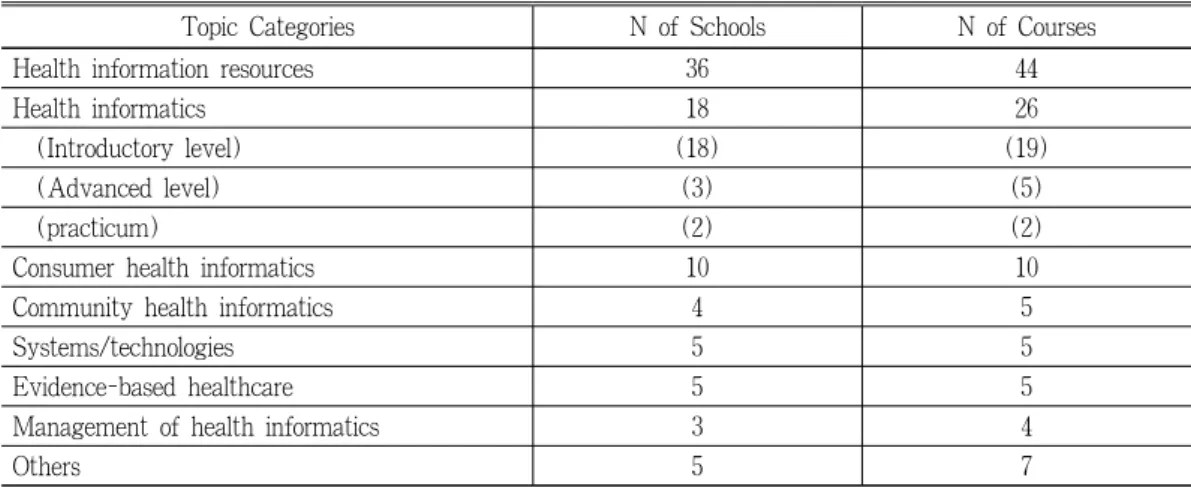
Table 4 shows the number of LIS programs offer- ing courses that belong to each category.
Of the 44 LIS programs that provide at least one health-related course, 36 programs (82%) offer 44
‘health information resources’ courses, making it the most offered course type. The second-most-offered course was ‘health informatics.’ Eighteen LIS pro- grams (41%) provide 26 health informatics courses.
Among them, nineteen are an introductory to health informatics, five are advanced courses or seminars, and two are practicum courses. Ten LIS programs (24%) offer ‘consumer health information (CHI)’
courses. ‘Systems/technologies,’ ‘management in health informatics’, ‘evidence-based health care’, and other courses were provided by only a few LIS
programs.
4.3 The Three Most-Offered Health- Related Courses in LIS Programs
The topics of health information resources, health informatics, and CHI were found to be the most frequently taught health-related courses in the LIS programs. A total of 21 syllabi of the courses in the three areas were collected from their program websites. Since all the syllabi collected include information about the semester the class was of- fered, class time, and an instructor’s email address, it is assumed that those classes were actually offered to students in the designated semester. The content of these syllabi was analyzed by comparing weekly topics, readings, and assignments across courses in each topic in order to find if there is a consensus on topics, readings, and assignments that could be identified as core knowledge and practice in health.Topic Categories N of Schools N of Courses
Health information resources 36 44
Health informatics 18 26
(Introductory level) (18) (19)
(Advanced level) (3) (5)
(practicum) (2) (2)
Consumer health informatics 10 10
Community health informatics 4 5
Systems/technologies 5 5
Evidence-based healthcare 5 5
Management of health informatics 3 4
Others 5 7
<Table 4> Topic Categories and N of Courses in Each Category
4.3.1 Health Information Resources Course topics covered in nine health information resources courses are presented in Table 5.
Every course in this category introduces useful databases for information searching in the field of health science. The most frequently mentioned data- base was PubMed. However, there was substantial variation in the range of databases taught in each syllabus. One syllabus states that students would be exposed to a wide spectrum of medical databases such as TOXNET (an online database on toxicology, hazardous chemicals, environmental health, and toxic releases), EMBASE (an online database on bio-
medicine), and CINAHL (an online database on nurs- ing, allied health, biomedicine, and healthcare).
Another syllabus covers print resources more ex- tensively than online databases. This difference is made because the courses vary in terms of scope:
some are broad to address a wide range of topics such as resources, search strategies, and library man- agement, while others are narrow, for example, con- centrating on medical databases.
Like general information services courses, the health information resources courses teach reference services, and user needs and seeking behaviors, but many other topics are specific to the health domain.
Course Topics N of Courses Teaching
the Topics (n=9) Examples of Weekly Topics
DB searching 9 Searching PubMed; Searching in MEDLINE; TOXNET;
Searching strategies; Indexing & digital database resources
Resources 8
Consumer health sources; Medical and health statistics;
Point-of-care and clinical support decision sources; Major websites
Introduction to health
sciences librarianship 7 Role of today’s healthcare professionals; Health care environment
Evidence-based medicine &
clinical librarianship 7 The evidence-based practice of healthcare; Systematic reviews; Clinical librarianship
Consumer health informatics 6 Consumer health information
MeSH 5 The Medical Subject Headings (MeSH)
Reference services 5 Reference services for consumers, patients, health professionals, other user groups
Health literacy 5 Health literacy & health misinformation User needs & health
information seeking 4 Meeting the needs of diverse groups; Information behaviors of health professionals
Complementary &
alternative medicine 4 Complementary & alternative medicine Terminology 3 Biomedical terminology, dictionaries, thesauri
Health informatics 3 Health informatics
Others - Citation management software; Social media; Technologies;
Policies; Standards
<Table 5> Course Topics in the Health Resources Category
For example, evidence-based medicine, consumer health information, and health literacy were popular topics appearing in most syllabi. Moreover, these topics overlap with those in health informatics courses. It should be noted here that among 22 LIS programs offering a single health-related course, 19 programs offer health information resources courses.
It seems that the health resources courses not only serve as specialized or advanced information services courses by introducing health-specialized resources, but serve as health informatics courses by introducing basic concepts and key issues related to this field.
In addition, a small number of topics (e.g., social media, policies) were found in one course only, in- dicating substantial agreement on the topics among the courses in this category. As mentioned above, however, specific resources introduced differ.
For readings, seven out of nine syllabi include the same book by Huber and Swogger (2014) below as a textbook (Table 6). The book is a collection of reference resources in health, including both print resources and online databases, and has been pub- lished and updated every 4-6 years since 1994.
The books by Ennis and Mitchell (2010) and Spatz
(2014) were cited as required textbooks/readings on 2-3 health information resources courses. Both books are about health librarianship, offering a guide to or strategies for responding to library users who have health needs and resources to provide responses.
Additionally, Edhlund and McDougall’s (2014) book was used on two courses as reading for using PubMed (an online database of life science and biomedicine, MEDLINE). This book is a manual for using the database, covering the skills and strategies for carry- ing out basic and advanced searches, saving search resources, and other database features.
The rest of the readings were journal articles from library science or biomedicine as shown in the health informatics readings. In addition, URLs of online medical databases, such as MEDLINE, and library websites listing online medical resources were provided.
Regarding assignments, all health resources cours- es required practical assignments in various forms in addition to typical assignments such as class attend- ance, discussion, and research papers commonly list- ed across health courses. Some were more traditional reference services assignments such as instructional
Book Information N of Syllabi
Huber, J. T., and Swogger, S. (Eds.). (2014). Introduction to reference sources in the health
sciences. American Library Association. 7
Ennis, L. A., and Mitchell, N. (2010). The accidental health sciences librarian. Information Today,
Inc. 3
Spatz, M. (2014). The Medical Library Association guide to providing consumer and patient
health information. Rowman & Littlefield. 2
Edhlund, B., and McDougall, A. (2014). PubMed Essentials, Mastering the World’s Health
Research Database. Lulu. com. 2
<Table 6> Textbooks Used in the Health Resources Category
tutorial development, reference consultation practice, resource collection creation, and DB searches. Others were related specifically to health information refer- ence services. For example, for evidence summary assignments, students comment on the implication of the results of an empirical study for practice in the relevant information setting. Another course re- quired students to subscribe to a Listserv of medical librarians, on which they read all posted messages for two months. Another interesting assignment is a scenario assignment. Students select a given scenar- io that medical librarians may encounter in their daily practice and describe what action they would
take to tackle the issue involved. Moreover, news article summaries, site visits, and discussions were required in some courses.
4.3.2 Health Informatics
In the health informatics category, the syllabi of the six introductory health informatics courses were analyzed to identify topics and readings. Table 6 lists course topics along with the number of courses teaching the topics.
As introductory courses, they cover a variety of course topics. The topics included in all six courses were health informatics overview, consumer health
Course Topics N of Courses Teaching
the Topics (n=6) Examples of Weekly Topics
Health informatics overview 6 Overview of health informatics; Historical, current, and emerging information systems in health care
Consumer health
informatics 6 Consumer health informatics; Consumer information settings and services
Evidence-based medicine
& clinical decision support 6 Evidence-based medicine and clinical practice guidelines;
Clinical decision support systems Public health informatics 4 Public health informatics
Electronic health records 4 Electronic health records; Electronic medical records; Health information exchange
Telehealth 4 Telehealth; Telemedicine
Ethics, security, privacy 4 Information copyright, fair use, network security, privacy &
confidentiality
Resources/services 3 Online health resources; Literature & resources; Health sciences research services
Data analytics 3 Data analytics; Data driven health care initiatives (i.e.
e-Science, data-intensive science, and data curation)
Health literacy 3 Health literacy
Standards 2 Data standards; Health systems standards
eHealth/mHealth 2 eHealth; Mobile technology and mHealth Pharmaceutical informatics 2 Pharmaceutical information issues
Others - Disease management and disease registries; ePrescribing;
Medical imaging informatics; Veterinary informatics
<Table 7> Course Topics in the Health Informatics Category
informatics, and evidence-based medicine. Public health informatics, electronic health records, and Telehealth were also frequently found as four out of six courses addressed them. Although some topics were mentioned only in one course (e.g., ePrescribing, medical imaging, health insurance policy issues), overall, there is significant agreement among the course topics in the Health Informatics category.
Two out of six courses include a list of readings in their syllabi. Two books below were shown as a textbook of each course (Table 8). The course topics were chosen from the table of contents in the books.
Cleveland and Cleveland (2009) is somehow out- dated, since it was published in 2009 and no new edition has been published since then. Both authors are professors in the field of LIS. For the other book, however, Hoyt and Yoshihashi (2014), the authors are physicians and researchers, the book has been updated frequently, and the newest version was pub- lished in 2017.
The rest of the readings were journal articles in the areas of medical libraries as well as medical in- formatics, such as the Journal of the Medical Library Association, the Journal of the American Medical Informatics Association, and the Health Informatics Journal. The URLs of useful websites were included
in the readings, such as the National Library of Medicine, the Medical Library Associations, the American Medical Informatics Association, the Healthcare Information Management Systems Society, the Agency for Healthcare Research and Quality, and OpenEMR.
Three health informatics courses required practical exercises. One course asked students to get HIPAA training certification: HIPAA (the Health Insurance Portability and Accountability Act) training is essen- tial for anyone who comes into contact with protected health information. After completing the module on a designated website, students are given a certification of completion. In another course, students visit and observe a health sciences environment. Reviews of health websites were required in two courses.
4.3.3 Consumer Health Informatics Table 9 lists course topics of six CHI courses.
Course topics vary across the syllabi depending on the course objectives in this topic category. For exam- ple, a syllabus indicates that students would learn in detail about the selection, use, and evaluation of health information resources. Another syllabus’s em- phasis is put on the development of CHI application.
Broadly speaking, CHI courses take either a technol- ogy-based approach or a resource-based approach,
Book Information N of Syllabi
Cleveland, A. D., & Cleveland, D. B. (2009). Health informatics for medical librarians. Neal Schuman Publication.
1 Hoyt, R. E., & Yoshihashi, A. K. (2014). Health informatics: practical guide for healthcare and information technology professionals (5
thedition). Lulu. com.
1
<Table 8> Textbooks Used in the Health Informatics Category
Course Topics N of Courses Teaching
the Topics (n=6) Examples of Weekly Topics User needs & health
information seeking 6
Assess consumers’ health-related needs, health behaviors;
Information behaviors of consumers, patients, and their caregivers
Health literacy 5 Consumer health information literacy
CHI overview 4 What is CHI?; Consumer health informatics; Consumerism and the health care environment
Application design 4 Designing effective eHealth applications; CHI app evaluation; Develop guidelines
Resources/services 4
Collection development, general health books, clearinghouses, and resources; Electronic CHI resources; Book reviews;
Pamphlets
mHealth 3 mHealth
Technologies 3 Emerging technologies; Issues and concerns influencing adoption
Social media 3 Social media and patient expertise; Online social support group
Health communication 3 CHI in the media: print, broadcasting, internet, etc.;
Doctor-patient communication Complementary &
alternative medicine 3 Complementary and alternative medicine Patient records 2 Personal health records & patient portals Health games 2 Health games & gamification; Serious games Future directions of CHI 2 CHI: What’s next?; Future directions
Others -
Evidence-based medicine and CHI; Health Insurance Issues/Affordable Care Act(ACA); Patient Bill(s) of Rights, ethical issues and considerations
<Table 9> Course Topics in the Consumer Health Informatics Category
with more courses focusing on the latter. The most popular topics were user needs, health information seeking behaviors, and health literacy. This implies that in the CHI courses, students learn how to design consumer-oriented applications or services to en- hance consumers’ health literacy. Application design, mHealth, technologies, and social media were popu- lar topics as well. The topics which appeared in only one course include evidence-based medicine, health insurance issues, Patient Bill(s) of Rights, and ethical issues.
For readings, three out of six courses provide in- formation in their syllabi about readings. Three books, including Spatz’s (2014) book, were used as reading in health information resources courses (Table 10).
For Glanz et al.’s (2008) book, the newest edition came out in 2015, but the older version has been used in the courses. This book is a collection of theories in various areas related to health information behaviors. Hayes and Aspray’s (2010) book is specif- ic to patients with diabetes. The rest of the readings
Book Information N of Syllabi Glanz, K., Rimer, B.K., and Viswanath, K. (2008). Health Behavior and Health Education:
Theory, Research, and Practice. Jossey-bass (4th Ed.)
1 Hayes, B.M., and Aspray, W. (2010). Health Informatics: A Patient-Centered Approach
to Diabetes. Cambridge, Massachusetts, the MIT Press.
1 Spatz, M. (2014). The Medical Library Association guide to providing consumer and patient
health information. Rowman & Littlefield
1
<Table 10> Textbooks Used in the Consumer Health Informatics Category
are mostly journal articles as in other health-related courses. Additionally, URLs linking to consumer health applications, such as Microsoft HealthVault, video lectures on health application, HealthWeaver, or health literacy, and websites on health literacy or user interface design have been included in the syllabi.
In two CHI courses, students are required to con- duct needs analyses and suggest intervention plans.
Students are instructed to identify the needs of a target population, and propose an effective health intervention or application to support patient educa- tion, health promotion, or patient self-management.
Reviewing websites, creating bibliographies, and vis- iting a health sciences setting were also mentioned in some courses. The fact that the discussion assign- ment was not frequently found in this category is in line with the dominance of technology-based ap- proaches in the CHI courses.
5. Discussion
Over 70% of ALA-accredited LIS programs cur- rently provide at least one health-related course, in- dicating that the topic of health and health librarianship
is one of the important fields LIS programs prepare students to work in. Moreover, this study demonstrates that a wide range of health-related courses are available for students enrolled in those programs. Some pro- grams, especially those awarding a certificate or degree in health informatics, offer multiple health-related courses including advanced/specialized courses (e.g., managing health informatics projects) as well as basic courses (e.g., introductory health informatics). Of the 106 courses categorized, health information resources (n=36), health informatics (n=18), and CHI courses (n=10) were the most popular.
In the health information resources and health in- formatics categories, significant agreement was ob- served on course topics. Instructors wishing to design a health course in these areas can refer to the major course topics identified in this study, but it should be noted that the frequency of the topics in Tables 5-7 does not necessarily represent their importance in education. The ‘terminology’ topic, for example, was mentioned only three times in the nine health information resources courses. Considering that many public librarians struggle with medical terminology (Luo and Park 2013) students should have a good command of medical terminology before they enter into the workplace. In other words, ‘terminology’
should be an essential topic in any introductory health-related course.
For readings in the three popular categories, there are a few textbooks that have been used in several courses, but they were mostly outdated and may not fully cover the topics in advanced technology or newly developed online databases or resources.
A list of journal articles as well as web resources has been used as alternative or supporting resources to the books.
It is also noteworthy that the assignments required of students involve both theoretical and practical exercises. As graduate courses, a majority of the courses include discussion and research papers as assignments. Depending on the course objectives, however, hands-on exercises such as evidence sum- mary and development of applications for health con- sumers were required. As a whole, the assignments afford students the opportunity to develop both the theoretical and the practical knowledge they will need to become successful health librarians.
Findings from our study indicate that there was little agreement on textbooks and readings across courses, even in the same topic category. The course topics combined with the examples of the assign- ments in this study could provide a guide to build a foundation for health-related courses with a hint of how the curriculum could be designed to best prepare future health librarians.
Contrary to the abundant course offerings from ALA-accredited programs, only a few LIS programs in Korea are known to offer a health-related course at the undergraduate or graduate level. According
to Noh and Oh (2011b), however, 30% of public librarians in Korea are already providing health in- formation services and 50% believe such services are necessary in a public library setting. This neces- sitates the offering of health-related courses in Korean LIS programs to equip students with relevant skills and knowledge.
The key findings of the present study offer im- portant implications for instructors who want to ini- tiate a new health-related course in their LIS programs in Korea. For example, the topics in the course could cover a wide range of introductory and advanced levels in health librarianship. The list of common and special topics shown in the course syllabus analy- sis could allow instructors to be selective when decid- ing which health-related course to teach. As for a new health-related course, the most appropriate would be a health information resource or health informatics course, which would be a dedicated course introducing students to the field of health by providing an overview of the role of health sciences librarians with useful health information resources.
As students’ interests in health librarianship grow, more advanced or specialized courses could be added later to satisfy students’ demands. A practicum or internship course would be particularly valuable as Rubenstein (2017) emphasizes practice-based educa- tion in this field. Readings from this study may not be fully integrated with the Korean health curriculum since the policies, rules, and social contexts of manag- ing health libraries, as well as the mechanics of deal- ing with the needs of health information consumers, could differ in Korea, so instructors may need to
build their own collection for the courses. Instead, assignments can be created to incorporate both theo- retical and practical aspects of learning health in- formation resources and services in libraries. A sce- nario-based practice or a field-experience program could be developed in collaboration with health scien- ces librarians who provide health services in public libraries or other settings.
The present study has some limitations that suggest directions for future research. First, it only analyzed a relatively small number of syllabi available online.
The 21 online syllabi analyzed accounted for only 26% of 80 courses in health information resources, health informatics, and CHI categories. This was all of the syllabi that we were able to collect from the Web for this study. The rest of syllabi seems available internally to those who registered the cours- es in each program. Therefore, the findings are de- scriptive and constrained in terms of generalization.
Future research should conduct a more compre- hensive survey of the syllabi to get a clearer under- standing of the contents of the courses. We may have to obtain the course syllabi from the instructors by asking them to share for the study. Second, some syllabi did not contain sufficient details about weekly topics, readings, and/or assignments. It would be useful for future research to ask faculty members for additional information not addressed in the syllabi.
Third, although syllabus analysis provides a glimpse of the current state of health-related courses, by the nature of the study design, it was not possible to gather faculty members’ opinions. Further inves- tigations could survey or interview faculty members
to collect their opinions regarding the topics, training, and resources that they believe are important to cover in a graduate-level health-related curriculum. Based on the findings of the present study, health librarians could be asked to evaluate the appropriateness of the current educational resources and approaches, and to provide suggestions to enhance the curriculum.
Fourth, the views and opinions of the students who attended health-related courses could be collected and analyzed to complement the findings of the pres- ent study.
6. Conclusions
The constant development of information and com- munication technologies and the changes in the health sciences profession have prompted health librarians to redefine their roles and, accordingly, the approaches to their education and training. Today's health li- brarians have to possess not only the traditional li- brarian skills, but also a new set of skills such as
“knowledge of clinical medicine” and “expertise in evidence-based medicine” to become information specialists. In order to prepare students for careers in the ever-changing health field, the health librarian- ship curriculum in LIS programs should be well-struc- tured with relevant and updated course topics, read- ings, and assignments.
Based on the content analysis of 21 syllabi of health-related courses from ALA-accredited LIS pro- grams, this study identified core topics and contents that have been covered in those courses as well as
readings and assignments. The findings of the study will be valuable for those who have taught or are considering offering a health course in their LIS
programs by providing a guide as to what course topics, readings, and assignments to include.
References
김다은, 차미경. 2016. 고령자를 위한 공공도서관 지역정보서비스에 관한 연구. 한국비블리아학회지 , 27(2):
213-233.
김영석. 2014. 문헌정보학의 도서관경영 분야 교육에 관한 연구. 한국도서관․정보학회지 , 45(1): 173-196.
나경식, 정용선. 2017. 건강정보검색에서 노인이 경험하는 어려움과 감정변화. 한국도서관․정보학회지 , 48(1):
227-243.
남재우, 박태연. 2014. 공공도서관 이용자의 건강정보서비스 수용의도에 관한 연구. 한국문헌정보학회지 , 48(2):
221-240.
노영희, 오상희. 2011a. 문헌분석을 통해서 도출한 공공도서관 소비자건강정보(CHI) 서비스 연구. 한국비블리아학 회지 , 22(1): 47-77.
노영희, 오상희. 2011b. 공공도서관의 소비자건강정보서비스에 대한 이용자인식 조사연구. 한국도서관․정보학회 지 , 42(3): 45-77.
노영희, 오상희. 2011c. 공공도서관에서 소비자건강정보를 제공하는 것에 대한 사서의 인식 조사연구. 한국비블리아 학회지 , 22(3): 25-55.
노영희. 2011. 국내 공공도서관의 소비자건강정보 제공현황 조사분석 연구. 한국문헌정보학회지 , 45(2): 415-437.
노영희. 2013a. 소비자건강정보(CHI) 참고서비스 가이드라인 개발에 관한 연구. 한국도서관․정보학회지 , 44(2): 345-376.
노영희. 2013b. 건강정보전문사서의 역할 및 자격제안에 관한 연구. 한국도서관․정보학회지 , 44(4): 93-122.
노영희. 2014. 건강정보원 평가기준에 대한 공공도서관 및 의학도서관 사서간 인식비교 연구, 한국비블리아학회지 . 25(1): 107-129.
노영희. 2015. 문헌정보학 캡스톤디자인 교육과정 운영과 학습만족도 측정연구. 한국도서관․정보학회지 , 46(3):
89-118.
노지현. 2011. 한국의 자료조직 교육에 대한 진단과 방향 모색. 한국도서관․정보학회지 , 42(1): 225-245.
윤희윤. 2012. 공공도서관의 지식정보 취약계층서비스 전략. 한국도서관․정보학회지 , 43(2): 53-75.
정재영. 2011. 문헌정보학 교육의 현황 분석 및 개선방안: 정보서비스(Reference Service) 관련 교과목을 중심으로.
한국도서관․정보학회지 , 42(1): 205-223.
한미경, 노영희. 2015. 문헌정보학과의 기록관리 교과목과 문헌정보학 교수의 기록관리학 논문 출판 동향 분석.
한국기록관리학회지 , 15(4): 125-149.
Barron, S. and S. Manhas. 2011. “Electronic Health Record (EHR) Projects in Canada: Participation Options for Canadian Health Librarians 1.” Journal of the Canadian Health Libraries Association, 32(3):
137-143.
Brettle, A. 2007. “Evaluating Information Skills Training in Health Libraries: A Systematic Review.” Health
Information & Libraries Journal, 24(s1): 18-37.
Cooper, I. D. and J. A. Crum. 2013. “New Activities and Changing Roles of Health Sciences Librarians:
A Systematic Review, 1990-2012.” Journal of the Medical Library Association, 101(4): 268.
Corbett, M., A. Deardorff, and I. Kovar-Gough. 2014. “Emerging Data Management Roles for Health Librarians in Electronic Medical Records.” Journal of the Canadian Health Libraries Association, 35(2): 55-59.
Fikar, C. R. and O. L. Corral. 2001. “Non-librarian Health Professionals Becoming Librarians and Information Specialists: Results of an Internet Survey.” Bulletin of the Medical Library Association, 89(1): 59.
Garg, A. and K. M. Turtle. 2003. “Effectiveness of Training Health Professionals in Literature Search Skills Using Electronic Health Databases - a Critical Appraisal.” Health Information & Libraries
Journal, 20(1): 33-41.
Homan, J. M. and J. J. McGowan. 2002. “The Medical Library Association: Promoting New Roles for Health Information Professionals.” Journal of the Medical Library Association, 90(1): 80.
Kouame, G., R. Allard, and T. L. Mays. 2005. “The National Network of Libraries of Medicine and Consumer Health Outreach: 1998 to the Present.” Journal of Consumer Health on the Internet, 9(1): 1-15.
Kronenfeld, M., P. L. Stephenson, B. Nail-Chiwetalu, E. M. Tweed, E. L. Sauers, T. C. V. McLeod, and B. Hill. 2007. “Review for Librarians of Evidence-based Practice in Nursing and the Allied Health Professions in the United States.” Journal of the Medical Library Association, 95(4): 394.
Luo, L. and V. T. Park. 2013. “Preparing Public Librarians for Consumer Health Information Service:
A Nationwide Study.” Library & Information Science Research, 35(4): 310-317.
Lyon, J. 2003. “Beyond the Literature: Bioinformatics Training for Medical Librarians.” Medical Reference
Services Quarterly, 22(1): 67-74.
Medical Library Association and Consumer and Patient Health Information Section. 1996. “The Librarian's Role in the Provision of Consumer Health Information and Patient Education.” Bulletin of Medical
Library Association, 84(2): 238.
Mehra, B. and W. T. Tidwell. 2014. “Mapping the Infoscape of LIS Courses for Intersections of Health-gender and Health-sexual Orientation Topics.” Journal of Education for Library and Information Science, 191-211.
Myers, B. A. and B. Rodriguez. 2016. “How Do Early Career Health Sciences Information Professionals Gain Competencies?” Journal of the Medical Library Association, 104(3): 215.
Oh, S. and Y. Noh. 2013. “Online Health Information in South Korean Public Libraries: Developing Evaluation Criteria.” Library & Information Science Research, 35(1): 78-84.
Petrinic, T. and C. Urquhart. 2007. “The Education and Training Needs of Health Librarians - the Generalist versus Specialist Dilemma.” Health Information & Libraries Journal, 24(3): 167-176.
Randeree, E. 2009. “Exploring Technology Impacts of Healthcare 2.0 Initiatives.” Telemedicine and e-Health, 15(3): 255-260.
Rook, R. and F. Adshead. 2001. “Postgraduate Training in Public Health Medicine: St George's Hospital Medical School Library Public Health Information Service.” Health Information & Libraries Journal, 18(1): 38-44.
Rubenstein, E. L. 2017. “I Didn't Learn That in Library School” - Experiential Learning in Consumer Health for Future Public Librarians.” Library Trends, 66(1): 37-51.
Urquhart, C. and J. Hepworth. 1995. “The Value of Information Supplied to Clinicians by Health Libraries:
Devising an Outcomes-based Assessment of the Contribution of Libraries to Clinical Decision-making.”
Health Libraries Review, 12(3): 201-213.
Whitmore, S. C., S. F. Grefsheim, and J. A. Rankin. 2008. “Informationist Programme in Support of Biomedical Research: A Programme Description and Preliminary Findings of an Evaluation.” Health Information
& Libraries Journal, 25(2): 135-141.
• 국문 참고자료의 영어 표기
(English translation / romanization of references originally written in Korean)
Chung, Jae-Young. 2011. “Analysis and Improvement Strategy of Library and Information Science Education Focusing on the Reference Service Curriculums.” Journal of Korean Library and Information Science
Society, 42(1): 205-223.
Han, Mi-Kyung and Younghee Noh. 2015. “An Analysis of Records Management Courses Offered at the Department of Library and Information Science and Publication Trend of Records Management Articles by Library and Information Science Professors.” Journal of Korean Society of Archives
and Records Management, 15(4): 125-149.
Kim, Daeun and Mikyeong Cha. 2016. “A Study on Community Information Services for Elderly People in Public Libraries.” Journal of the Korean Biblia Society for Library and Information Science, 27(2): 213-233.
Kim, Young-Seok. 2014. “A study on the education of library management in Library and Information Science.” Journal of Korean Library and Information Science Society, 45(1): 173-196.
Na, Kyoungsik and Yongsun Jeong. 2017. “Exploring Older Adults’ Experienced Barriers and Emotional Changes in Seeking Health Information.” Journal of Korean Library and Information Science Society, 48(1): 227-243.
Nam, Jaewoo and Taeyeon Park. 2014. “A Study on Intention of Accepting for Consumer Health Information Services in Public Libraries.” Journal of the Korean Society for Library and Information Science, 48(2): 221-240.
Noh, Younghee. 2011. “An Analyzing of the Current CHI Services in Korean Public Libraries.” Journal
of the Korean Society for Library and Information Science, 45(2): 415-437.
Noh, Younghee. 2013a. “A Study on Developing the Guideline for CHI Reference Service.” Journal of
Korean Library and Information Science Society, 44(2): 345-376.
Noh, Younghee. 2013b. “A Study on Investigating Roles and Qualifications of Health Information Librarian.”
Journal of Korean Library and Information Science Society, 44(4): 93-122.
Noh, Younghee. 2014. “A Study Comparing Public and Medical Librarians’ Perceptions of Evaluation Guidelines for Health & Medical Information.” Journal of the Korean Biblia Society for Library
and Information Science, 25(1): 107-129.
Noh, Younghee. 2015. “A Study on the LIS Capstone Design Curriculum and the Learning Satisfaction Survey.” Journal of Korean Library and Information Science Society, 46(3): 89-118.
Noh, Younghee and Sanghee Oh. 2011a. “A Critical Analysis of Literature for Consumer Health Information Services in Public Libraries.” Journal of the Korean Biblia Society for Library and Information
Science, 22(1): 47-77.
Noh, Younghee and Sanghee Oh. 2011b. “An Analysis of Users’ Perception of Providing CHI Services in Public Libraries.” Journal of Korean Library and Information Science Society, 42(3): 45-77.
Noh, Younghee and Sanghee Oh. 2011c. “An Analysis of the Librarians’ Perception of Providing CHI Services in Public Libraries.” Journal of the Korean Biblia Society for Library and Information
Science, 22(3): 25-55.
Rho, Jee-Hyun. 2011. “A New Direction in Korea's LIS Education: Focused on the Field of Information Organization.” Journal of Korean Library and Information Science Society, 42(1): 225-245.
Yoon, Hee-Yoon. 2012. “Strategies of the Knowledge and Information Services for Vulnerable Classes in Public Libraries.” Journal of Korean Library and Information Science Society, 43(2): 53-75.