JKSCI
An Efficient Wireless Sensor Network Design considering the different preamble detection capability
1)
Young-myoung Kang*
*Staff Researcher, Network Business, Samsung Electronics, Suwon, Korea
[Abstract]
This paper proposes a method of applying an advanced preamble detection technology to wireless sensor nodes and analyzes the trade-off relationship between throughput and fairness that may occur when sensor nodes equipped with the MIM function compete with the legacy IEEE 802.15.4 sensors.
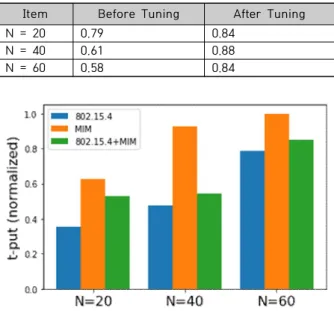
Sensor nodes employing the MIM capability have more chances of concurrent transmissions than the legacy IEEE 802.15.4-based sensor nodes, resulting in gains in terms of throughput, whereas the transmission opportunities of 802.15.4 sensor nodes might be limited due to the additional simultaneous transmissions of the MIM sensor nodes. The extensive evaluation results performed under a test environment built using Python program with reflecting the setting value of a commercial sensor node shows MIM sensor nodes outperform up to 40% over the legacy 802.11 sensors. Meanwhile, it was confirmed that a balance can be achieved in terms of throughput and fairness by properly adjusting the concurrent transmission threshold.
▸Key words: wireless sensor network, mim, capture effect, 802.15.4, temporal fairness
[요 약]
본 논문에서는 진보된 프리앰블 탐지 기술인 MIM을 무선 센서 노드에 적용하는 방안을 제시한다.
또한 MIM 기능을 탑재한 센서 노드들이 IEEE 802.15.4 방식의 센서와 경쟁할 경우 발생할 수 있는 처리량과 공정성 사이의 트레이드오프 관계를 분석한다 . MIM 센서들은 IEEE 802.15.4 기반의 센서에 비해 추가적인 동시전송 기회를 가져 처리량 측면에서 이득이 생기는 반면 IEEE 802.15.4 방식의 센서 노드들은 MIM 센서 노드들의 동시다발적인 추가 전송으로 인해 전송 기회를 제한받는다. 성능 평가를 위해 파이썬으로 시험환경을 구축하고 상용 센서 노드의 설정값을 반영하여 모의시험을 수행한 결과 MIM을 적용한 경우 최대 40% 수준의 처리량 향상을 확인하였다. 한편 동시전송 임계값을 적절히 조절 함으로써 처리량과 공정성 측면에서 균형을 맞출 수 있음을 확인하였다.
▸주제어: 무선 센서 네트워크, 메시지인메시지, 캡처 효과, 802.15.4, 시간 공정성
∙First Author: Young-myoung Kang, Corresponding Author: Young-myoung Kang
*Young-myoung Kang ([email protected]), Network Business, Samsung Electronics
∙Received: 2020. 10. 13, Revised: 2020. 11. 10, Accepted: 2020. 11. 10.
Copyright ⓒ 2020 The Korea Society of Computer and Information http://www.ksci.re.kr pISSN:1598-849X | eISSN:2383-9945