• 검색 결과가 없습니다.

Reliability of joint angle during sit-to-stand movements in persons with stroke using portable gait analysis system based wearable sensors

N/A
N/A
Protected

Academic year: 2021

Share "Reliability of joint angle during sit-to-stand movements in persons with stroke using portable gait analysis system based wearable sensors"

Copied!
6
0
0

로드 중.... (전체 텍스트 보기)

전체 글

(1)

http://crossmark.crossref.org/dialog/?doi=10.14474/ptrs.2019.8.3.146&domain=pdf&date_stamp=2019-9-25

Received: 29 August, 2019 Revised: 17 September, 2019 Accepted: 18 September, 2019 Corresponding author: Byoung Hee Lee (ORCID https://orcid.org/0000-0001-9766-6068)

Department of Physical Therapy, College of Health Science and Social Welfare, Sahmyook University, 815 Hwarang-ro, Nowon-gu, Seoul 01795, Republic of Korea

Tel: 82-2-3399-1634 Fax: 82-2-3399-1639 E-mail: [email protected]

This is an Open-Access article distributed under the terms of the Creative Commons Attribution Non-Commercial License (http://creativecommons.org/licenses/

by-nc/4.0) which permits unrestricted non-commercial use, distribution, and reproduction in any medium, provided the original work is properly cited.

Copyright © 2019 Korean Academy of Physical Therapy Rehabilitation Science https://doi.org/10.14474/ptrs.2019.8.3.146

pISSN 2287-7576 eISSN 2287-7584

Phys Ther Rehabil Sci 2019, 8 (3), 146-151 www.jptrs.org

Reliability of joint angle during sit-to-stand movements in persons with stroke using portable gait analysis system based wearable sensors

Jung-Ae An a , Byoung-Hee Lee b

a

Department of Physical Therapy, Seoul Now Hospital, Seongnam, Republic of Korea

b
Department of Physical Therapy, College of Health Science and Social Welfare, Sahmyook University, Seoul, Republic of Korea

Objective: The purpose of this study was to investigate the test-retest reliability and concurrent validity of the joint angle of the lower extremities during sit-to-stand movements with wearable sensors based on a portable gait analysis system (PGAS), and the results were compared with a analysis system (MAS) to predict the clinical potential of it.

Design: Cross-sectional study.

Methods: Sixteen persons with stroke (9 males, 7 females) participated in this study. All subjects had the MAS and designed PGS applied simultaneously and eight sensor units of designed PGAS were placed in a position to avoid overlap with the reflexive markers from MAS. The initial position of the subjects was 90º of hip, knee, and ankle joint flexion while sitting on a chair that was armless and backless. The height of the chair was adjusted to each individual. After each trial, the test administrator checked the quality of data from both systems that measured sit-to-stand for test-retest reliability and concurrent validity.

Results: As a result, wearable sensor based designed PGAS and MAS demonstrated reasonable test-retest reliability for the as- sessment of joint angle in the lower extremities during sit-to-stand performance. The intra-class correlation coefficients (ICCs) for wearable sensor based designed PGAS showed an acceptable test-retest reliability, with ICCs ranging from 0.759 to 0.959. In con- trast, the MAS showed good to excellent test-retest reliability, with ICCS ranging from 0.811 to 0.950. In concurrent validity, a sig- nificant positive relationship was observed between PGAS and MAS for variation of joint angle during sit-to-stand movements (p<0.01). A moderate to high relationship was found in the affected hip (r=0.665), unaffected hip (r=0.767), affected knee (r=0.876), unaffected knee (r=0.886), affected ankle (r=0.943) and unaffected ankle (r=0.823) respectively.

Conclusions: The results of this study indicated that wearable sensor based designed PGAS showed acceptable test-retest reli- ability and concurrent validity in persons with stroke for sit-to-stand movements and wearable sensors based on developed PGAS may be a useful tool for clinical assessment of functional movement.

Key Words: Analysis, Movement, Position, Stroke

Introduction

Sit-to-stand (STS) performance is important ability for daily activities such as transfer, ambulation, toileting, and stair climbing in healthy individuals particularly for persons with stroke [1]. In addition, STS ability is intimately related with gait and provides further functional self-support [2,3].

The STS test has been used for stroke survivors to predict

their balance ability and fall risk and training of STS is rou-

tinely performed in the rehabilitation unit. Several research-

ers investigated that the effects of STS training on balance in

persons affected with stroke and have shown improvements

[4,5] and plenty of evidence of interventions for improving

STS ability has been suggested, however the quality of mea-

(2)

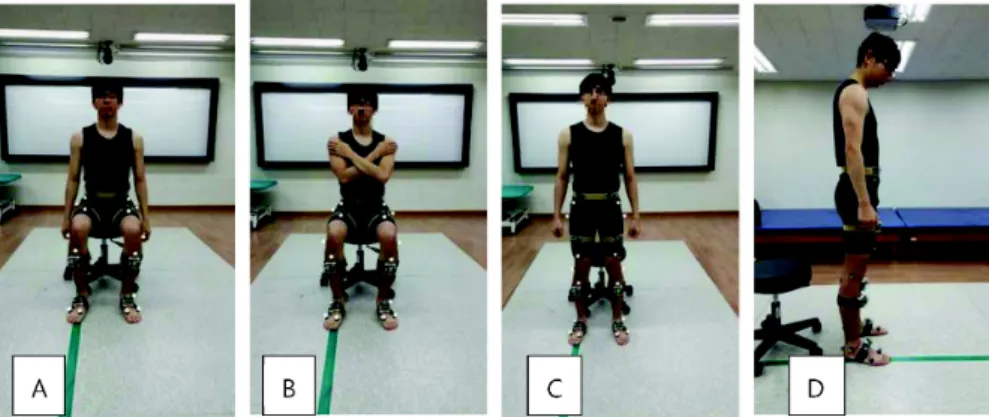
Figure 1. Experimental procedure. (A) Sitting. (B) Crossed arm. (C) Standing up. (D) Side-view.

surements are unclear [6]. With altered knee joint angles, varying amounts and levels of plantar pressure affects STS pattern on the affected side [7].

To assess STS performance, a variety of assessment tools have been used but researchers still prefer three-dimensiona (3D) motion capture systems based on image due to their ac- curacy aside from their uncomfortable features such as spe- cialized gait analysis laboratory environment, painful cost, and the post processing period [8]. In recent years, the limi- tations of the motion capture systems lead to diverse ap- proaches to developing wearable sensors and created a great deal of improvement. Furthermore, wearable sensors, which are wearable, extensible, and affordable, may more conveni- ently provide useful information in the field of stroke re- habilitation [9].

The gait analysis system based on wearable sensors may estimate static and dynamic kinematic data. In this study, the focus was placed on static kinematic data measurement, es- pecially during STS movements, and variation of joint an- gles in the lower body segment of stroke survivors.

The purpose of this study was to investigate the reliability joint angles in the lower extremity in persons with stroke during STS movements with the wearable sensor-based portable gait analysis system (PGAS), and the results were compared with motion capture system in order to be able to predict its potential to serve as a valuable clinical measure- ment.

Methods Participants

Twenty persons with stroke were initially recruited from a local rehabilitation hospital, however, two potential partic- ipants did not meet the experimental criteria and two partic- ipants withdrew during the experimental trials. For that rea-

son, only sixteen subjects were participated in this study.

The inclusion criteria were stroke survivors who were at least six months post stroke and those able to understand the given instruction during the experimental procedure [10].

Subjects who had a Modified Mini Mental State Examina- tion-Korea score of under 24, comprehensive aphasia, ne- glect, medical instability such as uncontrolled hypertension, and arrhythmia were excluded [11].

In addition, all procedures involved in the experimental protocol were explained to each participant and were ap- proved by the Institutional Review Board of Sahmyook University (SYUIRB2014-092). All subjects provided writ- ten informed consent prior to enrollment in this study.

Procedures

The motion analysis system (MAS) and wearable sen- sor-based PGAS were simultaneously applied on the partic- ipant and eight sensor units of designed PGAS were located without overlapping the reflective markers of the MAS. The initial position of subject was 90º angle of hip and knee flex- ion while sitting on a chair and 90º angle of ankle dorsi- flexion with foot placed on the ground. The chair which was an armless, backless chair that was firmly fixed to the floor, and the height was adjustable for each individual [12]. Eight sensor units, which were consisted of a wireless tri-axial ac- celerometer and gyroscope sensors, were attached on the lower extremities with straps for measurement of variation of joint angles during the sit to stand performance [13].

Markers, which enabled the Visual 3D (C-Motion, Rockville, MD, USA, 2012) to reconstruct the digital skel- eton of the subject and the sensor units from the designed PGAS were attached by the identical physical therapist.

Eight sensor units were placed in a position to avoid overlap

with reflective markers from the motion capture system. All

subjects performed three trials of sit to stand, which con-

(3)

sisted of one practice trial and a repetition of two more trials (Figure 1). After each trial, the test administrator checked the quality of measured data during sit to stand for test-retest reliability.

Four skilled physical therapists that had received training for the experimental protocol had supervised the patient dur- ing the experimental procedure and two test administrators had checked the data from each system. Before the experi- ment, leg lengths (from great trochanter to lateral epicon- dyle, from lateral epicondyle to heel though the lateral mal- leolus) were measured. Eight sensor units were placed on the anterior superior iliac spine (ASIS on pelvis), mid-thigh, mid-shank, and the forefoot of both lower extremities and were attached with straps. In addition, reflective markers from the MAS were placed on the ASIS (pelvis), sacrum, iliac crest, greater trochanter, thigh, lateral knee, medial knee, shank, lateral ankle, medial ankle, heel, and the first and fifth metatarsal bone [14,15].

Experimental assessment tools and data collection 3D motion analysis system

In this study, the Qualisys (Qualisys AB, Gothenburg, Sweden, 2012) was used, which consisted with six infrared cameras and software. The system recorded the data from the camera every 100 Hz and the cameras were calibrated on the test day. This system tracked the position of the retro-re- flective markers, calculated the temporal and spatial param- eters, and then reconstructed a digital skeleton of the subject by Visual 3D.

The software ‘Track Manager’ (Track Manager version 2.5, Qualisys, 2012) was used for processing and computing the temporal and spatial parameters of the motion data and the ‘Visual 3D Basic’ (C-Motion, Rockville, MD, USA, 2012) reconstructed the anatomical structure of the lower body. This program had likewise calculated the angle varia- tions for the subjects’ lower extremities, hip, knee and ankle joints [16].

Portable gait analysis system

The PGAS used in this study consisted of eight 3D inertial measurement unit (IMU) boards as wireless sensors, and one main board as a fusion center. Basically, Euler’s angles (roll, pitch, and yaw) can be adopted in the space coordinate to measure the patients' joint angles and walking speeds with the IMU [17], i.e., a roll is a clockwise rotation about the x-axis, a pitch is a clockwise rotation about the y-axis, and a yaw is a clockwise rotation about the z-axis. Each IMU

board possessed a magnetometer, an accelerometer, a gyro- scope, and a Bluetooth transmitter powered by a recharge- able battery, while the main board included eight Bluetooth receivers and a micro controller unit (MCU) powered by a host computer through a universal asynchronous receiver and transmitter (UART) to a universal serial bus (USB) bridge [18]. Using the sensors attached to the parts of the body, each IMU board could measure the absolute angles of the foot, shank, thigh, and trunk referenced to the axis per- pendicular to ground, and transmit the measured angle data to the main board through the air. In this case, the IMU boards were attached to each part of the body for the z-axis to face the direction of movement, so that the precise roll an- gles could be used to obtain the joint angles. Once the fusion center receives the raw angle data via the Bluetooth re- ceivers, the MCU of the fusion center combined the angle data, and transmited the combined data to the computer con- nected by a UART and USB bridge. Then, the application software in the computer manipulated the raw data to obtain the relative joint angles of the ankle, knee, and hip, and dis- played the raw and manipulated data on the computer screen so that researchers could recognize and use the data for analysis.

Statistical analysis

The IBM SPSS Statistics for Windows, Version 20.0 (IBM Co., Armonk, NY, USA) used in performance of all statistical analyses. Results were presented as mean±stand- ard deviation.

The Shapiro-Wilk test was used to analyze the normal dis- tribution of the medical and general characteristics of subjects. Test-retest reliability between the PGAS and MAS were estimated using the intra-class correlation coefficient (ICCs). Pearson correlation coefficient (r) was used for con- current validity between systems for the sit to stand joint angles. For all tests, the statistical significance was set at 0.05.

Results

Subjects’ general characteristics

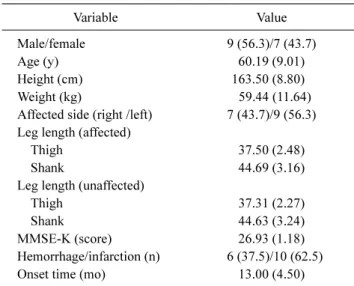
For general characteristics of subjects, the sex, age, height, weight, leg length, affected side and stroke type were evaluated (Table 1).

Out of the 16 adults with stroke, there were 9 males

(56.3%) and 7 females (43.7%). Considering the stroke type

there were 6 with hemorrhagic (37.5%) and 10 with in-

(4)

Table 3. Concurrent validity between systems for joint angle of sit-to-stand (N=16) Trial Affected hip (º) Unaffected hip (º) Affected knee (º) Unaffected knee (º) Affected ankle (º) Unaffected ankle (º)

Test (r) 0.665** 0.767** 0.876** 0.886** 0.943** 0.823**

Pearson correlation coefficient (r).

**p<0.01.

Table 2. Test-retest reliability (N=16)

Variable Test Retest ICC

PGAS

Affected hip (º) 80.687 (9.469) 77.386 (10.579) 0.959

Unaffected hip (º) 80.421 (9.377) 81.536 (5.786) 0.795

Affected knee (º) 80.535 (12.729) 80.627 (10.155) 0.897

Unaffected knee (º) 83.306 (9.146) 82.473 (5.908) 0.897

Affected ankle (º) 11.432 (5.676) 8.884 (6.435) 0.759

Unaffected ankle (º) 10.742 (5.432) 11.428 (4.709) 0.914

MAS Affected hip (º) 75.753 (9.222) 75.468 (10.306) 0.904

Unaffected hip (º) 76.880 (9.382) 76.787 (9.520) 0.891

Affected knee (º) 82.180 (10.240) 84.369 (8.763) 0.947

Unaffected knee (º) 84.323 (9.713) 85.073 (7.119) 0.811

Affected ankle (º) 9.491 (6.614) 10.925 (6.354) 0.950

Unaffected ankle (º) 12.068 (5.382) 11.793 (4.253) 0.833

Values are presented as mean (SD).

ICC: intra-class correlation coefficient, PGAS: portable gait analysis system, MAS: motion analysis system.

Table 1. General characteristics of subjects (N=16)

Variable Value

Male/female 9 (56.3)/7 (43.7)

Age (y) 60.19 (9.01)

Height (cm) 163.50 (8.80)

Weight (kg) 59.44 (11.64)

Affected side (right /left) 7 (43.7)/9 (56.3) Leg length (affected)

Thigh 37.50 (2.48)

Shank 44.69 (3.16)

Leg length (unaffected)

Thigh 37.31 (2.27)

Shank 44.63 (3.24)

MMSE-K (score) 26.93 (1.18)

Hemorrhage/infarction (n) 6 (37.5)/10 (62.5)

Onset time (mo) 13.00 (4.50)

Values are presented as n (%) or mean (SD).

MMSE-K: Mini Mental State Examination-Korea.

farction 10 (62.5%), in addition, 9 subjects were affected on the left (56.3%) and 7 were affected on the right (43.7%).

The mean age was 60.19±9.01 years, the mean height was 163.50±8.80 cm and the mean weight was 59.44±11.64 kg.

The mean thigh length was 37.50±2.48 cm (affected) and

37.31±2.27 cm (unaffected). The mean shank length was 44.69±3.16 cm (affected) and 44.63±3.24 cm (unaffected) respectively.

Test-retest reliability

As can be seen in Table 2, a reasonable reliability of both systems in variation of joint angle during sit to stand per- formance is indicated. The ICCs for the wearable sen- sor-based designed PGAS showed an acceptable test-retest reliability value, with ICC values were ranging from 0.759 to 0.959. The MAS showed good to excellent test-retest reli- ability, with ICC values ranging from 0.811 to 0.950.

Concurrent validity between PGAS and MAS

The results of concurrent validity between PGAS and MAS for joint angle of sit to stand are as follows (Table 3).

A significant positive relationship was observed between

PGAS and MAS for variation of joint angle during sit to

stand movements (p<0.01). A moderate to high relationship

was found in affected hip (r=0.665), unaffected hip (0.767),

affected knee (r=0.876), unaffected knee (r=0.886), affected

ankle (0.943) and unaffected ankle (0.823) respectively.

(5)

Discussion

The aim of this study was to evaluate the test-retest reli- ability of the lower extremity joint angles during STS move- ment performance with wearable sensors based on the de- veloped PGAS. Test-retest reliability was determined by ICCs. The ICC range of 0.7 to 0.79 was considered ‘good’

reliability, 0.8 to 0.89 was ‘great’ reliability, and greater than 0.9 was considered to be ‘excellent’ reliability [19]. The wearable sensor-based designed PGAS and MAS, which is well-known as gold standard system, demonstrated reason- able test-retest reliability for the assessment of lower ex- tremity joint angles when performing STS (Table 2). Con- sidering the concurrent validity, a significant positive rela- tionship was observed between the wearable sensor-based designed PGAS and the MAS for variation of joint angle during STS movements (Table 3).

Recently, the application of portable systems with wear- able sensors in the rehabilitation field has been widely stud- ied due to its convenience [20] and the analysis and applica- tion of STS performance in stroke rehabilitation also has been studied with a variety of subjects of different ages. The PGAS based on wearable sensor provides beneficial in- formation as an effective clinical tool in flexible environ- ments. In order to achieve STS, it requires body coordina- tion, balance, stability, and muscle strength [21]. STS is a series of sequence, such as preparatory phase which leads to the seat off state, transfer phase, which is displacement of the center of body mass, the extension phase, and the stabiliza- tion phase, which is the final rising [22]. However, indivi- duals post stroke suffer lack of body coordination, muscular activation change, difficulty with postural control and asym- metrical weight bearing [23].

In stroke rehabilitation, analysis of the lower extremities during STS provide information for planning of treatment, clinical progress and outcome measurement, and assist to re- store an independent functional levels for stroke survivors.

In addition, fall risk estimation is one of the important proc- esses as a prerequisite for ambulation, and the Timed Up and Go test is one of the most useful tools for predicting fall risk.

Therefore, the STS movement is a process that should be carried out in advance to perform ambulation, and is a basic element to acquire functional self-reliance for post stroke in- dividuals [24-26]. Furthermore, independence in activity of daily living is associated with quality of life and is important in rehabilitation of the stroke survivor.

This study may eventually lead to a wide range of applica-

tion of motion analysis using wearable sensors during STS in in the rehabilitation of poststroke individuals.

Conflict of Interest

The authors declared no potential conflicts of interest with respect to the authorship and/or publication of this article.

References

1. Camargos AC, Rodrigues-de-Paula-Goulart F, Teixeira-Salmela LF. The effects of foot position on the performance of the sit-to-stand movement with chronic stroke subjects. Arch Phys Med Rehabil 2009;90:314-9.

2. Lomaglio MJ, Eng JJ. Muscle strength and weight-bearing sym- metry relate to sit-to-stand performance in individuals with stroke. Gait Posture 2005;22:126-31.

3. Chou SW, Wong AM, Leong CP, Hong WS, Tang FT, Lin TH.

Postural control during sit-to stand and gait in stroke patients.

Am J Phys Med Rehabil 2003;82:42-7.

4. Liu M, Chen J, Fan W, Mu J, Zhang J, Wang L, et al. Effects of modified sit-to-stand training on balance control in hemiplegic stroke patients: a randomized controlled trial. Clin Rehabil 2016;

30:627-36.

5. Jung KS, In TS, Cho HY. Effects of sit-to-stand training com- bined with transcutaneous electrical stimulation on spasticity, muscle strength and balance ability in patients with stroke: a randomized controlled study. Gait Posture 2017;54:183-7.

6. Pollock A, Gray C, Culham E, Durward BR, Langhorne P. Inter- ventions for improving sit-to-stand ability following stroke.

Cochrane Database Syst Rev 2014;(5):CD007232.

7. Lee MY, Lee HY. Analysis for sit-to-stand performance accord- ing to the angle of knee flexion in individuals with hemiparesis.

J Phys Ther Sci 2013;25:1583-5.

8. Tao W, Liu T, Zheng R, Feng H. Gait analysis using wearable sensors. Sensors (Basel) 2012;12:2255-83.

9. Brückner HP, Nowosielski R, Kluge H, Blume H. Mobile and wireless inertial sensor platform for motion capturing in stroke rehabilitation sessions. Paper presented at: 5th IEEE Internatio- nal Workshop on Advances in Sensors and Interfaces IWASI;

2013 Jun 13-14; Bari, Italy.

10. Jonsdottir J, Recalcati M, Rabuffetti M, Casiraghi A, Boccardi S, Ferrarin M. Functional resources to increase gait speed in people with stroke: strategies adopted compared to healthy controls.

Gait Posture 2009;29:355-9.

11. Bertolucci PHF, Brucki SMD, Campacci SR, Juliano Y. The mini-mental state examination in an outpatient population: influ- ence of literacy. Arq Neuropsiquiatria 1994;52:1-7.

12. Kwong PW, Ng SS, Chung RC, Ng GY. Foot placement and arm position affect the five times sit-to-stand test time of individuals with chronic stroke. Biomed Res Int 2014. doi: 10.1155/2014/

636530.

13. Mizuike C, Ohgi S, Morita S. Analysis of stroke patient walking

dynamics using a tri-axial accelerometer. Gait Posture 2009;30:

(6)

60-4.

14. Bruijn SM, Meijer OG, van Dieën JH, Kingma I, Lamoth CJ.

Coordination of leg swing, thorax rotations, and pelvis rotations during gait: the organisation of total body angular momentum.

Gait Posture 2008;27:455-62.

15. Cappozzo A, Della Croce U, Leardini A, Chiari L. Human move- ment analysis using stereophotogrammetry. Part 1: theoretical background. Gait Posture 2005;21:186-96.

16. Cooper G, Sheret I, McMillan L, Siliverdis K, Sha N, Hodgins D, et al. Inertial sensor-based knee flexion/extension angle esti- mation. J Biomech 2009;42:2678-85.

17. Alandry B, Dumas N, Latorre L, Mailly F, Nouet P. A CMOS multi-sensor system for 3D orientation determination. Paper pre- sented at: 2008 IEEE Computer Society Annual Symposium on VLSI; 2008 Apr 7-9; Montpellier, France.

18. Kok M, Hol JD, Schön TB, Gustafsson F, Luinge H. Calibration of a magnetometer in combination with inertial sensors. Paper presented at: 2012 15th International Conference on Information Fusion; 2012 Jul 9-12; Singapore.

19. Rankin G, Stokes M. Reliability of assessment tools in reha- bilitation: an illustration of appropriate statistical analyses. Clin Rehabil 1998;12:187-99.

20. Muro-de-la-Herran A, Garcia-Zapirain B, Mendez-Zorrilla A.

Gait analysis methods: an overview of wearable and non-wear-

able systems, highlighting clinical applications. Sensors (Basel) 2014;14:3362-94.

21. Galli M, Cimolin V, Crivellini M, Campanini I. Quantitative analysis of sit to stand movement: experimental set-up definition and application to healthy and hemiplegic adults. Gait Posture 2008;28:80-5.

22. Schenkman M, Berger RA, Riley PO, Mann RW, Hodge WA.

Whole-body movements during rising to standing from sitting.

Phys Ther 1990;70:638-48; discussion 648-51.

23. Duclos C, Nadeau S, Lecours J. Lateral trunk displacement and stability during sit-to-stand transfer in relation to foot placement in patients with hemiparesis. Neurorehabil Neural Repair 2008;

22:715-22.

24. Joshua AM, Karnad SD, Nayak A, Suresh BV, Mithra P, Unnikrishnan B. Effect of foot placements during sit to stand transition on timed up and go test in stroke subjects: a cross sec- tional study. NeuroRehabilitation 2017;40:355-62.

25. Brunt D, Greenberg B, Wankadia S, Trimble MA, Shechtman O.

The effect of foot placement on sit to stand in healthy young sub- jects and patients with hemiplegia. Arch Phys Med Rehabil 2002;83:924-9.

26. Nyberg L, Gustafson Y. Fall prediction index for patients in

stroke rehabilitation. Stroke 1997;28:716-21.

수치

Figure 1. Experimental procedure. (A) Sitting. (B) Crossed arm. (C) Standing up. (D) Side-view.
Table  3. Concurrent validity between systems for joint angle of sit-to-stand (N=16) Trial Affected hip (º) Unaffected hip (º)  Affected knee (º) Unaffected knee (º) Affected ankle (º) Unaffected ankle (º)

참조

관련 문서