Korean J Environ Agric (2011) Online ISSN: 2233-4173
Vol. 30, No. 1, pp. 89-97 DOI : 10.5338/KJEA.2011.30.1.89 Print ISSN: 1225-3537
농약 및 동물용의약품으로 사용되는 약제의 잔류허용기준 설정 개선 - 축산물 중 cypermethrin의 잔류 사례
권진욱*
국립수의과학검역원
Harmonization of MRL Setting for Compounds Used Both as Pesticides and as Veteri- nary Drugs with Regulatory Aspects - Cypermethrin in Food of Animal Origin
Jin-Wook, Kwon* (National Veterinary Research & Quarantine Service (NVRQS) 620-2 Amnam-dong, Seo-gu, Busan, Republic of Korea)
Received: 27 January 2011 / Accepted: 24 February 2011
ⓒThe Korean Society of Environmental Agriculture
*교신저자(Corresponding author):
Tel: +82-51-603-0640 Fax:+ 82-51-603-0649 E-mail: [email protected]
89
Abstract
BACKGROUND: Cypermethrins, possess eight isomers, used both as pesticide and as veterinary drug, were set different MRLs for livestock by CCPR and CCRVDF of Codex Alimentarius. Korea Food Code designates MRLs for livestock only as pesticide.
METHODS AND RESULTS: This study presented nece- ssaries of harmonization of MRL setting for compounds used both as pesticides and as veterinary drugs with re- gulatory aspects, showing an example of cypermethrin residue in livestock.
CONCLUSION(S): For harmonization, following fac- tors must be considered and recommended; designation of marker residue; alpha-cypermethrin, zeta- cyperme- thrin, and cypermethrin, clarification of the definition of target tissues; meat, fat, muscle, by-product, eggs, milk, and etc., method of analysis; clarification of target analy- tes of isomers, quantitation and calculation method as a principle of residue analysis.
Key Words: Cypermethrins, Harmonization, Marker resi- due, MRL, Pesticide, Target tissue, Veterinary drug
서 론
Cypermethrin은 전세계적으로 농약과 동물용의약품으로 사용되고 있는 살충제이다. 8개의 광학이성질체의 혼합물인 cypermethrin은 국제식품규격위원회의 JMPR (the Joint Meeting on Pesticide Residues)에서 1979년 농약으로 처음 검토 이후, 최근까지도 꾸준히 식품 중 잔류허용기준 설정에 관 해 논의되고 있다 (WHO Technical Report Series, No. 876, 1998). 그런데, cypermethrin은 작물재배용 농약으로의 사용 은 물론, 말, 염소, 가금류, 소, 돼지 등의 외부구충제인 동물용 의약품으로도 이용되고 있어, 국제식품규격위원회에서는 농약 잔류허용기준과 동물용의약품 잔류허용기준의 이원화 된 기준 을 적용하고 있다. 우리나라도 2008년 5월 식품 중 동물용의 약품 잔류허용기준 및 시험법 입안예고 (식약청 공고 제2008- 95호)를 통해 일반적으로 농약으로 알려져 있지만 동물용의약 품으로도 사용되고 있는 일부 약제에 대해 동물용의약품 잔류 허용기준을 설정코자 하였으나 cypermethrin은 철회되어 잔류 농약으로서의 기준만 설정되었다. 국제식품규격위원회의 잔류 허용기준 중 농약과 동물약품의 중복 된 예로는 cyfluthrin, cy- halothrin, deltamethrin, dicyclanil, fluazuron, phoxim, trichlorfon 등이 있다. 우리나라는 잔류허용기준을 농산물의 농약잔류허용기준, 축산물의 농약잔류허용기준, 식품 중 동물 용의약품의 잔류허용기준으로 세분화하여 고시하고 있다. 그 런데, 축산물의 경우 일부 약제는 농약잔류허용기준으로, 또 일부약제는 동물용의약품잔류허용기준을 적용하고 있는 실정 이므로, 이러한 약제들에 대해서는 잔류허용 기준 설정의 분류 체계나 적용 등 일관성 있는 방향 설정이 필요하다 판단된다
Open Access Research Article
Instrument HP 6890N GC (Agilent Technologies Inc., USA) Detector 63Ni-electron capture detector (μECD)
Column DB-5MS capillary column, 30m x 0.25mm, 0.25μm film (J&W Scientific, USA) Temperature Column oven 220 ℃(5 min) -> 10 ℃/min -> 270 ℃(22 min)
Detector block 290 ℃ Injection port 250 ℃ Gas flow rate Carrier N2 0.8 mL/min
Makeup N2 60 mL/min Sample size 1 μL, split ratio 10:1
Table 1. GLC-μECD operating parameters for the analysis of cypermethrin
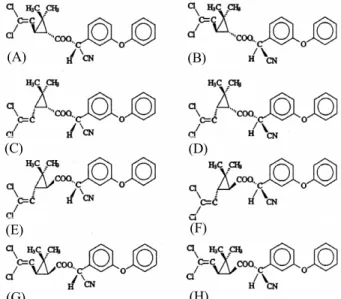
(A) (1R, trans) (αR); (B) (1R, trans) (αS); (C) (1R, cis) (αR);
(D) (1R, cis) (αS); (E) (1S, trans) (αR); (F) (1S, trans) (αS);
(G) (1S, cis) (αR); (H) (1S, cis) (αS)
(A) (B)
(C) (D)
(E) (F)
(G) (H)
Alphacypermethrin Cis 2: (D) and (G) isomers Alphacypermethrin Cis 1: (C) and (H) isomers
Cypermethrin is a mixture of all isomers Fig. 1. Chemical structures of eight cypermethrin stereoi- somers (FAO, 2004).
(FAO Food Nutrition Paper 41/16, 2004). 그러한 예로 cypermethrin류를 들 수 있다. 농약으로서 cypermethrin은 cis:trans 이성질체가 45:55인 제품이 주를 이루며, 동물용의 약품은 45:55와 80:20의 비로 구성된 약제, 소위 high cis cypermethrin (HCC)이 주로 이용되는 특징이 있다. Cyper- methrin류 중 α-Cypermethrin은 두개의 cis 이성체로만 구성 되어 있는데, 동물 대사실험에서 cis와 trans 간의 상호 변환은 일어나지 않으며, 체내에서 trans 형의 감소가 더 빠른 것으로 알려져 있다. 이는 cypermethrin과 α-cypermethrin을 동물 에게 처리하였을 경우 cis형만이 잔류하게 될 가능성이 높으 므로, 실제 어떤 약제를 처리했는지 확인하는 것이 어렵다는 근거가 된다. 본 연구는 농약과 동물용의약품으로 모두 다 사용 되고 있는 cypermethrin류의 잔류허용기준설정과 그 적용에 따른 오류를 잔류분석의 예를 통해 짚어보고, 우리나라에 적 합한 잔류허용기준 설정의 방향에 대해 제시코자 하였다.
재료 및 방법
시약 및 기구
Cypermethrin의 분석용 표준품은 Dr. Ehrenstorfer GmbH (Germany)의 certified grade로 alpha-cypermethrin 97.5%, beta-cypermethrin 98.0%, theta-cypermethrin 96.0%, ze- ta-cypermethrin 96.0%, cypermethrin 94.0%의 순도의 것 을 사용하였다. n-hexane, acetonitrile 등 유기용매는 J.T Ba- ker의 잔류분석용을 사용하였다.
기기분석
기기분석은 μECD가 부착된 HP 6890N GC와 Agilent Chemstation (Agilent Technologies Inc., USA) 프로그램 을 이용하여 분석하였으며, 기기분석조건을 Table 1에 나타 내었다.
시료의 조제
축산물 시료는 국립수의과학검역원의 수입축산물 검사 결과 cypermethrin 검출의 예가 없었던 돼지 등뼈를 공시험 재료 로 하여 회수율 시험을 하였고, cypermethrin의미량 검출량
이 보고된 바 있는 수입산 돼지 등뼈를 대상으로 시험방법에 따 른 잔류량의 변화 확인에 이용하였다. 시료의 조제과정을 요약 하면 다음과 같다. 등뼈로부터 지방과 근육을 고루 채취한 후 균질화한 시료 10 g과 육안으로 확인하여 발라낼 수 있는 지방 부위 (trimmable fat) 1 g을 각각 대상으로, 식품공전 시험법 에 준하여 추출․ 정제 후 기기분석 하였다. 추출 및 정제는 각 시료에 n-hexane 100 mL를 가하여 추출 후 감압 여과하고, 여과액에 acetonitrile 60 mL (30 mL x 2회)를 넣고 분액깔 대기에서의 층 분리를 반복 후 acetonitrile 층을 합하여, 무수 Na2SO4를 이용하여 수분을 제거하였다. Acetonitrile 층을 감 압농축기에서 농축하고 1 mL의 n-hexane으로 정용하여 분석 하였다.
alpha
zeta beta
theta
cypermethrin
Fig. 2. Chromatograms of alpha-, beta-, theta-, zeta-cypermethrin and cypermethrin.
결과 및 고찰
Cypermethrine의 확인
우리나라 식품공전은 cypermethrin의 축산물 중 농약잔 류허용기준에 따른 시험에서 그 적용범위를 가금류고기, 가금 류 부산물, 계란, 닭고기, 쇠고기, 알, 양고기, 우유, 유, 포유 류고기, 포유류 부산물 등으로 정하고 있다. 그런데, 8개의 광 학이성질체인 cypermethrin 중 분석 대상 지표화합물 (mar- ker residue)의 명시가 없어, 본 연구는 alpha, beta, theta, zeta 형과 cypermethrin을 대상으로 분석하였다. Fig. 2는
alpha, beta, theta, zeta 및 cypermethrin 표준품의 chro- matogram으로 각 peak의 머무름 시간에 따라 cypermeth- rin 1, 2, 3으로 표현하였는데, alpha는 1, 3의 2개 peak, beta는 1, 2, 3의 3개 peak, theta는 2, 3의 2개 peak, zeta 와 cypermethrin은 1, 2, 3의 각 3개 peak이 서로 다른 비 율로 검출되었고, 본 실험은 이를 토대로 이성질체 중 3개의 peak에 대한 검출만을 확인하였다. 통상 cypermethrin 표 준품의 경우, GC 분리칼럼의 종류나 분석조건은 물론, 표준 품 제조사 및 보관 기간 등에 따라서도 peak 별 비율은 차이 가 있지만, 일반적으로 beta나 zeta형과 유사한 3~4 개의
1 g fat 10 g muscle
Cypermethrin 1 70.414±6.816 72.601±5.430
Cypermethrin 2 n/a 65.390±6.126
Cypermethrin 3 85.560±15.568 85.783±6.593
*muscle: edible muscular tissue not include trimmable fat in this study
Table 2. Recovery of cypermethrins from 1 g fat and 10 g muscle* of pork back-bone
Sample Crude Fat Content (g) Crude Fat Ratio (%)
1 0.072 0.72
2 0.071 0.71
3 0.069 0.69
Table 3. Crude fat content from 10 g muscle of pork back-bone
1g fata) 10 g muscleb)
cypermethrin-1 0.045 0.003
cypermethrin-2 <0.001 <0.002
cypermethrin-3 0.025 0.002
Total 0.070 0.005
Practical Quantitation Limit of 3 identified peaks of cypermethrin, respectively; 0.001 mg·kg-1 for 1g fat, and 0.002 mg·
kg-1 for 10 g muscle
a), b); n= 6, respectively
Table 4. Cypermethrin residue concentration of pork back-bone
peak이 검출되는 것으로 알려져 있다 (DFG, 1992).
회수율 시험
회수율 시험은 공시험 시료에 대해 각 0.1 mg/kg 이 되 게 약제 처리를 하였으며, 기기상의 검출량, 시료 중량, 기기 주입량, 희석배수 등을 통해 산출 된 최저정량범위는 지방 1 g 시료에 대해 cypermethrin 1, 2, 3 각각 0.001 mg/kg, 혼 합시료 10 g 에 대해서는 0.002 mg/kg 까지 정량 될 수 있게 설정하였는데, 이 값은 축산물 중 최저로 설정 된 잔류허용 기준인 0.05 mg/kg을 충분히 정량 할 수 있는 수준이었다.
조지방 함량측정
포유류 고기 중 우리나라의 cypermethrin 잔류허용기준 은 0.2 mg/kg (f)로, 식품공전은 (f)를 고기 중 지방에 대한 기준이라 명시하고 있다. 한편, 식품공전은 잔류허용 기준 적 용을 위한 축산물 부위 중 포유류 고기와 포유류 지방에 대해 설명하고 있는데, 다이옥신류와 같이 포유류 지방이 아닌 포 유류 고기가 분석대상일 경우, 추출 된 지방함량에 대해 잔류 농도를 산출토록 되어 있으므로, 고기 중 지방 (f)이 포유류 지
방과 동일한 것으로 간주되기는 어렵다. 이런 이유로 혼합 마쇄 한 시료 10 g을 잔류시험법에 따라 n-hexane으로 추출한 후 농축하여 조지방의 함량을 측정하였으며, 평균 0.70 % 수준 이었다 (Table 3).
분석결과의 적용 및 해석
Table 4는 돼지 등뼈 부산물의 부위별 시료 채취에 따른 잔류량을 cypermethrin 이성질체의 합으로 산출한 결과이다.
육안으로 발라낼 수 있는 지방만을 채취한 경우 평균 0.070 mg/
kg으로 지방을 포함한 근육의 잔류량 0.005 mg/kg 보다 14배 높은 결과를 나타내었다. 반면, Table 3의 근육 중 지방함량을 고려하여 환산한 경우는 0.863 mg/kg으로서 지방만을 채취 한 잔류량 보다 12배 높은 값으로 계산 되었다. 이러한 값의 차 이는 시험법 적용 범위의 세부적 정의, 즉 시료 채취에 대한 명확한 설명이 없음으로 해서 나타날 수 있는 결과로, 축산물 중 PCDD/PCDFs (Dioxin), dioxin like-PCBs의 분석 시 단위가 pg TEQ/g fat으로 적용되는 사례와 유사하다 할 수 있다. 다시 말해, 분석대상 시료의 단위에 fat이 명시되어 있는 다이옥신류의 시험에 있어서도, 육안으로 발라낼 수 있는 지방
10 g musclea) 0.07 g crude fatb)
cypermethrin-1 0.003 0.598
cypermethrin-2 <0.002 <0.002
cypermethrin-3 0.002 0.265
Total 0.005 0.863
a), b); n= 6, respectively
Table 5. Conversion residue concentration of cypermetrins from 10 g muscle to 0.07 g of crude fat content
만을 대상으로 잔류량을 측정할 것인가, 전체 육류를 추출 후 지방의 무게를 측정하여 이를 환산해 줄 것인가에 따라 그 측정 값도 달라질 수 있다는 추론을 뒷받침 해줄 수 있다 판단된다.
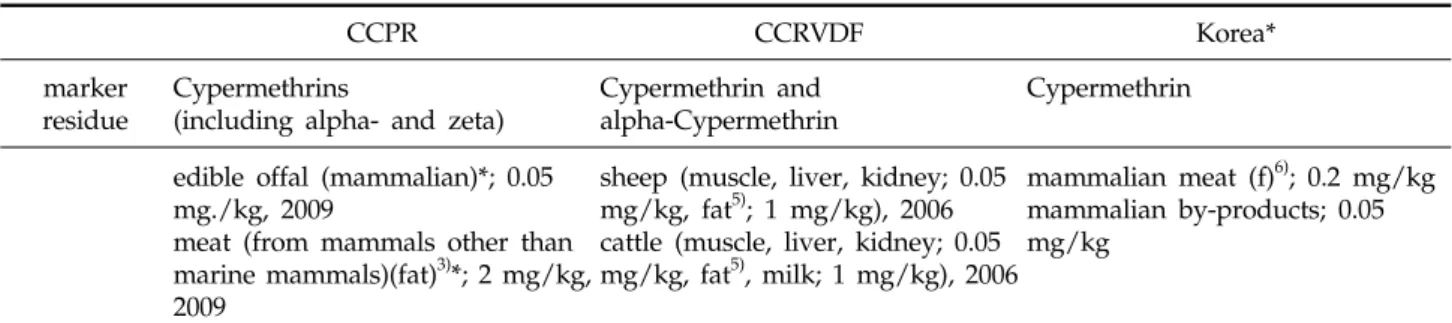
이러한 경우는 지방이 거의 없는 부위가 분석대상일 경우 공통 적인 혼란을 주는 예이다. Table 6은 국제식품규격위원회 CCPR (Codex Committee on Pesticide Residues)과 CCRVDF (Codex Committee on Residues of Veterinary Drugs in Foods), 우리나라의 cypermethrin에 대한 잔류허용기준을 나 타낸 표로 CCPR은 품목 (commodity) 적용을 CCRVDF는 종과 조직 (species/tissue) 적용을, 우리나라도 품목적용의 형태를 취하고는 있지만 적용부위가 다름을 알 수 있다. 즉, CCPR의 원칙에 따라서는 고기 (meat) 중 fat에 잔류허용기준이 적용 되는 반면, CCRVDF는 육류 부위에 해당되는 근육 (muscle) 과 지방 (fat)에 따로 잔류허용 기준을 두고 있으며, 우리나라는 아래의 식품공전에 따른 정의로 비추어 볼 때 고기 중 잔류허용 기준은 CCRVDF의 근육 (muscle)에 가깝다고 판단된다. 이는 지방이나 각 조직, 기준 적용 대상부위가 명확히 정의되어 있 고, 이 들 각각에 대해 잔류허용 기준을 설정하는 경우 식품 중 잔류성 실험 수행에 문제가 되지 않겠지만 그렇지 못한 현 상 황에서는 Table 4와 5와 같은 다양한 잔류허용 결과를 초래 하게 되는 것이다.
잔류허용기준 설정 부위
실험에 이용 된 돼지등뼈는 우리나라 축산물의 유형 분류 체계에 따라 부산물에 해당 된다. 식품공전은 포유류고기, 포 유류 지방과 포유류 부산물을 다음과 같이 정의하고 있다 (Table 6).
- 포유류고기: 근육내 지방 및 피하지방과 같이 부착된 지방 조직을 포함하는 동물의 도체 (혹은 이를 자른 덩어리)의 근육조직으로 소, 돼지, 양, 염소, 토끼, 말, 사슴 등의 고기 를 말한다 (해양동물의 고기는 제외).
- 포유류 지방: 동물의 지방조직에서 얻어진 가공되지 않은 지방으로 소, 돼지, 양, 염소, 토끼, 말, 사슴 등의 지방을 말하며, 유지방은 포함하지 않는다.
- 포유류부산물: 도살된 동물의 고기 및 지방을 제외한 식용 조직 및 기관으로 소, 돼지, 양, 말, 염소, 토끼, 말, 사슴 등의 간, 폐, 심장, 위장, 췌장, 비장, 콩팥, 머리, 꼬리, 발, 껍질, 혈액, 뼈(건, 조직이 포함된 뼈) 등 식용 가능한
부위를 말한다. 국제식품규격위원회 CCRVDF (Glossary of Terms, Veterinary Drug Residues in Food, the 32nd Session of the Codex Alimentarius Commi- ssion, 2009)는 알 (egg), 지방 (fat), 고기 (meat), 우유 (milk), 근육 (muscle)에 대해 다음의 정의를 내리며, 특정 물질에 대해 이들 부위를 target tissue로 정하고 있다.
- Egg: The fresh edible portion of the spheroid body produced by female birds, especially domes- tic fowl.
- Fat: The lipid-based tissue that is trimmable from an animal carcass or cuts from an animal carcass.
It may include subcutaneous, omental or perirenal fat. It does not include interstitial or intramuscular carcass fat or milk fat.
- Meat: The edible part of any mammal.
- Milk: Milk is the normal mammary secretion of milking animals obtained from one or more milk- ings without either addition to it or extraction from it, intended for consumption as liquid milk or for further processing.
- Muscle: Muscle is the skeletal tissue of an animal carcass or cuts of these tissues from an animal car- cass that contains interstitial and intramuscular fat.
The muscular tissue may also include bone, connec- tive tissue, tendons as well as nerves and lymph nodes in natural portions. It does not include edi- ble offal or trimmable fat.
본 연구와 관련하여 1999년 개최된 JECFA (Joint FAO/
WHO Expert Committee on Food Additives)/JMPR In- formal Harmonization Meeting에서 논의된 다음의 의제 검토 사항은 동일 화학물질이 다른 목적으로 사용 될 때나, 검토 주체가 다를 때 가져다 주는 혼란을 잘 설명하고 있다.
- Tissue;
① Codex Alinmentarius Volume 3 중 muscle tissue 정의의 명확화
② 지방용해성 (fat-soluble) 농약/동물용의약품에 대해
Codex Alimentarius Commission1) KOREA2) Egg:
The fresh edible portion of the spheroid body produced by female birds, especially domestic fowl.
Fat:
The lipid-based tissue that is trimmable from an animal carcass or cuts from an animal carcass. It may include subcutaneous, omental or perirenal fat. It does not include interstitial or intramuscular carcass fat or milk fat.
Meat: The edible part of any mammal
Milk: Milk is the normal mammary secretion of milking animals obtained from one or more milkings without either addition to it or extraction from it, intended for consump- tion as liquid milk or for further processing.
Muscle: Muscle is the skeletal tissue of an animal carcass or cuts of these tissues from an animal carcass that con- tains interstitial and intramuscular fat. The muscular tissue may also include bone, connective tissue, tendons as well as nerves and lymph nodes in natural portions. It does not include edible offal or trimmable fat.
Marker Residue: A residue whose concentration decreases in a known relationship to the level of total residues in tissues, eggs, milk or other animal tissues. A specific quantitative analytical method for measuring the concen- tration of the residue with the required sensitivity must be available (Definitions previously established and adopted by the JECFA, which have been modified by the Codex Committee on Residues of Veterinary Drugs in Foods).
Mammalian meat: Muscular tissues of animal body (or its part), including the fat in muscles and subcutaneous fat, obtained from cattle, pig, sheep, goat, rabbit, horse, deer, or others(except those from marine animals)
Mammalian fat: Unprocessed fats from adipose tissues of cattle, pig, sheep, goat, rabbit, horse, deer, or others. The milk fat is not included in this definition.
Mammalian byproducts: Edible tissues and organs, except the meat and fats, from cattle, pig, sheep, horse, goat, rabbit, deer, or others, such as liver, lung, heart, stomach, pan- creas, kidney, head, tail, foot, skin, blood, bone (bone contain- ing tendon and tissues).
Poultry meat: Muscular tissues, including attached fat and skin, from poultry, such as rooster, pheasant, duck, goose, turkey, quail, or others.
Poultry fat: Unprocessed fats from adipose tissues of poul- try, such as rooster, pheasant, duck, goose, turkey, quail, or others.
Poultry byproducts: Edible tissues and organs, except the meat and fats, from poultry, such as rooster, pheasant, duck, goose, turkey, quail, or others. such as liver, heart, gizzard, skin, foot, or others.
Milk: Crude milk from mammals, such as sheep, goat, or others.
Dairy products: Milk, low-fat milk, lactose-hydrolyzed milk, processed milk, goat milk, fermented milk, butter milk, concentrated milk, milk cream, butter, natural cheese, processed cheese, powdered milk, whey products, lactose, milk protein hydrolyzed foods, or others manufactured or processed with use of crude milk or other dairy products as main raw materials.
Eggs: Eggs from poultry, such as roosters, ducks, quails, or others, from which shell is removed.
1); Veterinary Drug Residues in Food, the 32nd Session of the Codex Alimentarius Commission (2009)
2); Applicable scope of limits for residual agricultural chemicals in livestock products, Maximum residue limits for pesticides in livestock, Korea Food Code (KFDA, 2008)
Table 6. Glossary of terms relating to residue analysis in food of animal origin
규제 또는 모니터링 목적의 고기 (meat)/근육 (muscle) 중 잔류량 정량은 발라낼 수 있는 지방 (trimmable fat)을 채취․
분석 (즉, meat (fat) for JMPR, fat for JECFA)하고 지방 단위 (lipid basis)로 잔류량을 보고토록 실험실에 권유, 발라 낼 수 있는 지방이 없고, meat/muscle 단위당 MRL이 설정 되어 있을 때는 meat/muscle로서 전체 품목 (commodity)을 분석할 것
③ meat/muscle 중 비지방 용해성 (non-fat soluble) 농 약/동물용 의약품의 잔류성 시험은 trimmable fat을 제거한 meat/muscle을 분석할 것을 권유
④ 동일 품목 중 분석대상화합물 (residue marker)이 일 치하는 물질에 다른 잔류허용기준이 설정 된 경우 잔류섭취량 (residue intake)이 ADI를 초과하지 않으면, 높은 (higher) MRL이 우선하며, JECFA와 JMPR의 위해성 평가를 통해 공중보건에 유해한 영향이 발생하지 않도록 할 것
⑤ 식육동물로부터 trimmable lipid-based tissue (즉, 피 하; subcutaneous, 신장주변; perirenal 등)를 지방 (fat)으로 기술 할 것을 CCRVDF이 검토할 것
- Harmonization;
① cypermethrin과 alpha-cypermethrin 각각이 동물용 의약품으로 사용 될 경우 cypermethrin과 alpha-cyperme- thrin이 marker residue로 정의되어야 하고, cypermethrin 이 농약으로 사용 될 경우의 marker residue는 cypermeth- rin (이성체의 합; sum of isomer)으로 정의되어야 한다.
② cypermethrin 혹은 alpha-cypermethrin으로 잔류를 표시 ․ 지정 (designation) 하는 것은 시험물질에 대한 크로마 토그래피에 기반을 두어야한다는 실험실 지침을 제공할 것
JECFA/JMPR Informal Harmonization Meeting을 통한 많은 합의점 도출과 조화에 대해, 2000년 32차 CCPR에 참석한
CCPR CCRVDF Korea*
marker residue
Cypermethrins
(including alpha- and zeta)
Cypermethrin and alpha-Cypermethrin
Cypermethrin
Commodity1) Species/
Tissue2)
edible offal (mammalian)*; 0.05 mg./kg, 2009
meat (from mammals other than marine mammals)(fat)3)*; 2 mg/kg, 2009
sheep (muscle, liver, kidney; 0.05 mg/kg, fat5); 1 mg/kg), 2006 cattle (muscle, liver, kidney; 0.05 mg/kg, fat5), milk; 1 mg/kg), 2006
mammalian meat (f)6); 0.2 mg/kg mammalian by-products; 0.05 mg/kg
eggs; 0.01 mg/kg,2009 egg; 0.05 mg/kg
milk fats*; 0.5 mg/kg, 2009
milks, F4); 0.05 mg/kg, 2009 milk (F)7); 0.05 mg/kg
poultry meat (fat)3); 0.05 mg/kg,
2009 poultry meat; 0.05 mg/kg
poultry, edible offals of; 0.05 mg/kg 2009
Commodity1); Pesticide MRL of CCPR is applied along with the classification of commodity.
Species/Tissue2); Veterinary drug's MRL of CCRVDF is applied along with the species and tissues (muscle, liver, kidney, fat and milk).
fat3); (for meat) the MRL/EMRL applies to the fat of meat.
F4); (for milks) The residue is fat soluble and MRLs for milk products are derived as explained in "Codex Maximum Residue Limits/Extraneous Maximum Residue Limits for Milk and Milk Products".
*; The MRL accommodates external animal treatment
fat5); The lipid-based tissue that is trimmable from an animal carcass or cuts from an animal carcass. It may include subcutaneous, omental or perirenal fat. It does not include interstitial or intramuscular carcass fat or milk fat. Glossary of Terms in Veterinary Drug Residues in Food, the 32nd Session of the Codex Alimentarius Commission (2009) (f)6); Unprocessed fats from adipose tissues of cattle, pig, sheep, goat, rabbit, horse, deer, or others. The milk fat is not included in this definition.
(F)7); liphophilic (fat-soluble) pesticides. ≥2 % of fat content in milk product = 25 times of MRL of milk, ∠2 % of fat content in milk product = 50 % of MRL of milk
Table 7. MRLs of cypermethrins in CCPR and CCRVDF of CAC, and Korea
IUPAC 대표단은 다음과 같이 보고하였다 (IUPAC Represen- tative Report by Kenneth D. Racke, Codex Committee on Pesticide Residues, 32nd Session, 2000). ‘일부 축산물 품 목 (animal commodity)의 정의에 대한 조화는 시도 되었지만 CCPR은 고기 (meat)를 CCRVDF의 근육 (muscle)이란 용어로 개명하는 것에 대해 거부했다. 그리고 CCRVDF와 공통 대상인 화학물질의 평가를 위해서, CCRVDF와 동등한 연락책 (JECFA) 을 찾을 것을 JMPR에 명하였고, CCPR의 CCRVDF에 대한 전적인 협조는 동의하였지만, 국제식품규격위원회에 사회에서 명쾌한 조화는 요원하다’. 이후 현재까지 CCRVDF와 CCPR 은 합의나 조화를 이루지 못한 채, 2006년과 2009년 Table 6과 같은 잔류허용기준을 설정하였다.
잔류분석 대상 화합물
잔류허용기준 설정 화합물이 반드시 분석 대상화합물인가?
잔류허용기준 설정물질은 때론 포괄적 명명으로서 분석대상 물질과 동일하지 않을 수도 있다. PCDDs/PCDFs의 경우 17 종의 분석대상 즉, marker residue를 지정하고 있고, 다른
화학물질의 경우 marker residue를 원물질 혹은 대사산물로 포함하여 지정하는 사례가 많이 있으며, 분석대상화합물에 따라 잔류분석법을 설정하는 것이 통상적인 예이다. 이런 사례는 또 한 다양한 이성질체를 가지는 화합물에도 적용되며, 그 예로 cyfluthrin 8개, cypermethrin 8개, fenvalelate 4개, perme- thrin 4개, cis-permethrin 2개, trans-permethrin 2개의 이성 질체를 들 수 있다. 따라서 잔류허용기준설정과 함께, 분석 대 상화합물을 명확히 하는 것은 분석방법의 설정과 그 유효성에 가장 기초적인 요소이다.
1979년 JMPR이 농약으로서의 cypermethrin을 처음 검 토한 이후, 1981, 1986, 1988, 1990에 걸쳐 검토하고, 다양한 작물과 육류 및 유제품, 그리고 사료의 MRL 설정 권고가 있었 다. 1996년 47차 JECFA는 약 300 μg은 농약을 통해, 2,700 μg 은 동물약품으로 cypermethrin이 섭취된다는 노출 섭취량 (expo- sure intake)을 보고하였다. 이후 1981년 JMPR이 ADI를 설정 하면서 비로서 지표물질 (marker residue)로 모화합물 (parent chemical)을, marker tissue로서 지방 (fat), 유 (milk) 그리고 알 (eggs)로 정하였다. Alpha-cypermethrin은 1996년의 47차
JECFA에서 처음으로 검토하고, 동물용의약품으로서의 alpha- cypermethrin에 대해서만 잠정적인 MRL 및 ADI는 설정 하 였는데, 모화합물을 marker residue로 하였으며, 지방 (fat), 유 (milk) 그리고 알 (eggs)을 target tissue로 정하였다. 당시, 47차 JECFA는 alpha-cypermethrin과 cypermethrin에 대해 잔류시험법의 유효성검증과 LOD/LOQ의 산출 등을 요구하였 는데 (WHO Technical Report Series, No. 876, 1998), 2002 년 58차 JECFA에서 alpha-cypermethrin에 대한 분석법 검증 자료가 제출되어 수용되었고, cypermethrin은 분석법 검증이 기술되지 않았다고 보고하였다 (WHO Technical Report Se- ries, No. 911, 2002). 2004년 JECFA는 양의 지방 (periren- tal- , omental- fat of sheep)과 근육 (muscle) 중 cyperme- thrin의 정량은 검증되지 않은 GC-ECD 분석법임을, 우육 (cattle tissue)중 HCC cypermethrin의 정량은 검증되었음을 보고 하고 있다 (FAO Food Nutrition Paper 41/16, 2004).
농약 등록절차의 경우, 현재 우리나라는 농촌진흥청 고시로 농약의 이화학적검사, 유해성분 및 역가검사 대상 농약으로 alpha-cypermethrin (HPLC), cypermethrin (GLC), zeta- cypermethrin (HPLC)을 각각 시험법으로 지정하고 있다.
미국은 1984년 FMC Corporation이 cypermethrin을 등록 한 이후 1992년 zeta-cypermethrin을 등록하였는데, US EPA는 분석과정 중 cypermethrin과 zeta-cypermethrin이 구별되지 않으며, 두 화합물 모두 독성학적 종말점 (toxicological end- points)이 같기 때문에 cypermethrin의 인체에 미치는 영향과 환경 중 거동 위해성 평가 시 zeta-cypermethrin을 포함시 킨다 (US EPA, 2006, Reregistaration Eligibility Decision for Cypermethrin, List B, Case No. 2130). 식품 및 환경 중 오염물질 모니터링의 근본적인 목적은 안전성 확보다. 그러므로, 모니터링 대상화합물은 반드시 용량-반응의 독성학적 자료에 기초를 두고 신중하게 선정하는 것이 규제 및 관리 차원에서 매우 중요하다. 대부분 모화합물 혹은 모화합물과 대사산물이 분석대상이 되지만, cypermethrin과 같이 여러 종의 이성질 체가 있는 경우 분석대상을 명확히 지정하지 않음으로 해서, 분 석과정 중 혼란 초래, 불완전한 위해성 평가 결과 유도, 낮은 활용가치와 신뢰성 없는 데이터 축적의 경우도 발생할 수 있다.
Cypermethrin류는 오랫동안 안전성을 기반으로 하는 다 수의 잔류 모니터링과 연구가 이루어 졌음에도 불구하고, 분석 방법에 대한 문헌은 한정적이다. 독일의 경우 Deutsche Fors- chungsgemeinschaft (DFG)가 1992년 발간한 Manual of pesticide Residue Analysis Vol.Ⅱ에서 cold on-column injector와 ECD를 이용하여 4개의 cypermethrin peak을 검출하는 잔류분석법을 소개하였다. Edwards와 Ford (1997) 는 이성체 분리의 목적으로 HPLC의 칼럼과 용매를 달리하여 cypermethrin에서 4-6개의 이성체를, alpha에서는 2개의 이성질체를 분리하였다. Simonelli 등 (2007)은 GC/MS/SIM 기법을 활용한 분석법 검증에서 단일 peak의 cypermethrin 검출을 보고한 반면, Feo 등 (2010)은 GC-NCI-MS 기법을 활용하여 cypermethrin 1, cypermethrin 2+3, cyperme- thrin 4의 세 개의 peak로 검출 된 네 개의 이성질체 확인법을
보고하였다. Du 등(2010)은 배 쥬스 중 cypermethrin의 모 니터링에서 GC-FID를 이용하여 단일 peak의 cyperme- thrin을 정량하였다. 우리나라는 1992년 농촌진흥청의 농약 잔류성 시험법을 통해, ‘잔류기준치가 이성체의 합계로 정하여 져 있으므로 편이상 분리하지 않고 한 개의 peak로 정량한다.
2개 이상의 성분을 하나로 검출하기 때문에 peak의 형상이 보 통의 농약과 다르고 또 시료의 표준품 간에도 peak의 형상이 달라지는 경향이 있다’고 설명하고 있다.
연구목적의 분석법 개발․모니터링과는 별개로 규제차원의 검 사는 대상의 명확성이 매우 중요하다. 따라서 농약/동물용의약 품으로 모두 사용 되거나, 이성질체를 가지는 약제에 대한 잔류 허용기준 설정을 위해 다음 항에 대한 공통된 조치가 필요하다.
- 분석 대상 시료 및 적용부위의 명확성과 합의된 정의의 도출
- 분석 대상화합물의 명확한 지정
이러한 조치 사항을 기본적으로 정하고 운용한다면, 규제 검사는 물론 연구목적의 모니터링, 그리고 관련 분석법 개발 등이 보다 깊은 연관성을 가지면서 그 효율과 가치를 높이게 될 것이라 기대된다.
요 약
축산물 중 cypermethrin 잔류를 예로 농약 및 농물용의 약품으로 사용되는 약제와 이성질체를 포함한 약제에 대한 잔류허용기준 설정의 문제점과 개선사항을 실험과 문헌을 통 해 검토하였다. 과학적이고 합리적인 잔류허용기준설정을 위 해서는 분석 대상 시료 및 적용부위의 명확성과 합의된 정의의 도출 그리고, 분석 대상화합물의 명확한 지정이 있어야 한다.
그리고 이를 바탕으로 규제 검사, 연구목적의 모니터링, 관련 분석법 개발 등이 보다 깊은 연관성을 가질수 있도록 관련 전 문가들의 관심과 합의점 도출은 매우 중요하다.
감사의 글
This study was funded by grant from the IAEA Research Contract No. 15578/R0 (CRP) and NVRQS Research Work B-FS08-2009-10-02.
참고문헌
Deutsche Forschungsgemeinschaft (DFG), 1992. Manual of pesticide Residue Analysis Vol.Ⅱ, pp 333-342.
VCH, Weinheim, Germany
Du, J., Yan, H., She, D., Liu, B., Yang, G., 2010.
Simultaneous determination of cypermethrin and permethrin in pear juice by ultrasound-assisted dispersive liquid-liquid microextraction combined with gas chromatography, Talanta. 82, 2, 698-703 Edwards, D.P., Ford, M.G., 1997. Separation and anal-
ysis of the diastereomers and enantiomers of cy- permethrin and related compounds, J. Chromatogr.
A. 777, 2, 363-369.
Feo, M.L., Eljarrat, E., Barceló, D., 2010. A rapid and sensitive analytical method for the determination of 14 pyrethroids in water samples, J. Chromatogr.
A. 1217, 15, 2248-2253.
Simonelli, A., Basilicata, P,, Miraglia N., Castiglia, L., Guadagni, R., Acampora, A., Sannolo, N., 2007.
Analytical method validation for the evaluation of cutaneous occupational exposure to different che- mical classes of pesticides, J. Chromatogr. B. 860, 1, 26-33.