韓蠶學誌 51(2), 201~206 (2013) J Seric Entomol Sci
http://dx.doi.org/10.7852/jses.2013.51.2.201
<論 文 >
멸종위기종, 상제나비(나비목, 흰나비과)의 보전을 위한 DNA 바코드 특성 분석
박해철1
*
·한태만1·강태화2·이대암3·김성수4·이영보11국립농업과학원 곤충산업과, 2농림축산검역본부 식물검역기술개발센터,
3영월곤충박물관 곤충자연생태연구소, 4동아시아환경생물연구소
DNA barcode analysis for conservation of an endangered species, Aporia crataegi (Lepidoptera, Pieridae) in Korea
Hae Chul Park1
*
, Taeman Han1, Tae Wha Kang2, Dae-Am Yi3, Sung-Soo Kim4 and Young Bo Lee11Applied Entomology Division, National Academy of Agricultural Science, RDA, Suwon 441-100, Republic of Korea
2Plant Quarantine Technology Venter, Animal and Plant Quarantine Agency, Suwon, Republic of Korea
3Yeongwol Insectarium Center for the Study of Insect Ecology, Yeongwol, 230-874, Republic of Korea
4Research Institute for East Asian Environment and Biology, Seoul, Republic of Korea
(Received September 27, 2013, Accepted October 22, 2013)
ABSTRACT
Aporia crataegi, an Korean endangered species, was first analyzed for DNA barcode sequences based on 28-year-old dried specimens and compared barcode characters with 36 individuals of ten geographical populations of Eurasia. They were revealed to consist of five different haplotypes. Among them, haplotype I was mostly extensive and high frequency with 75%. The south Korean individuals were confirmed to be belonging to haplotype I and have no genetic isolation on COI gene. By these results, we consider that selection of the identical haplotype from other geographical populations may be a requirement prior to performing for conservation and restoration of the Korean population. We also propose to analyse the additional genetic markers in order to understand a more accurate genetic structures between haplotypes of this species.
Key words : Lepidoptera, Pieridae, Aporia crataegi, DNA barcode, Haplotype, Conservation
서 론
상제나비는 흰나비과의 Aporia속에 속하며, 날개의 바 탕이 희고 맥이 검다. 이 종의 애벌레는 장미과의 개살구 나무와 털야광나무를 식초로 삼고, 3령으로 겨울을 나서 이듬해 5-6월에 성충으로 1회 발생한다(Kim and Seo 2012).
또한 이 나비는 광역 분포 종으로 유럽부터 극동 아시아 까지 유라시아 대륙의 한대지역에 넓게 분포하며, 우리나 라가 동아시아 분포의 남한계이다(Paek and Shin 2010).
특히, 한반도에서는 북부 산지에 많이 분포하지만, 남한 에서는 드물게 경기도 명지산(Korean Amateur Lepidopterist 1986) 과 양구(1978) 및 양구군 남면(1981)의 기록이 있고 (Korean Amateur Lepidopterist 1989), 1980 년 말 영월
군 창원리(쌍룡)에 꽤 많은 개체수가 발견된 적도 있었 다(Kim 1992).
상제나비의 보전 가치를 평가한 자료를 보면, 초기에는 비교적 많은 분포집단을 가진 북한에 비해 남한에는 집 단 규모가 아주 작고 희소성이 인정되어 희귀종으로 등 재(Kim 1981, Shin 1990)되기 시작하였다. 법적인 조치는 1989 년 환경청의 특정야생동식물종으로, 1998년에는 환경 부 멸종위기야생동식물로 지정 보호되어 왔고(Park and Kim 2001), 2005 년부터는 멸종위기야생동식물 1급 종으 로 평가되었다(Ministry of Environment 2005). 하지만, 영 월군 쌍용과 그 주변의 집단분포가 확인되면서 향후 개 체수의 감소가 없을 것으로 예상되어, 법적 보호종에서 상제나비를 삭제해도 된다는 주장(Kim and Hong 1990)
*Corresponding author. E-mail:
[email protected]
이 나오기까지 하였다. 그럼에도 불구하고, 1997년의 발 견 기록만 남긴 채 몇 년 사이에 급속히 수가 줄어들었고 최 근에는 공식적으로 서식 개체가 확인되지 않고 있다(Park 2005).
상제나비의 급격한 감소와 절멸위기의 원인으로는 좁은
지역에서 발생한 개체에 대한 남획과 기후온난화 가능성 이 제기되었고(Park 2005), Choi and Kim (2011)은 기후 온난화와 서식지인 관목림 상태의 서식지의 축소가 감소 원인으로 제시하였다. 하지만, 상제나비의 남한 집단에 대
Table 1. Collection and voucher information for specimens used in this studySample
no. Species Locality Date collected Stored Voucher no. Accession no. Reference 1 Aporia crataegi Korea, GW, Yeongwol 6. VI. 1986 Dried L1972 KF709963 This study 2 A. crataegi Korea, GW, Yeongwol 6. VI. 1986 Dried L1973 KF709964 This study 3 A. crataegi China, San Daogou 30. VI. 2000 Dried L2277 KF709965 This study
4 A. crataegi China Jilin VII. 2013 Dried 8282 KF709966 This study
5 A. crataegi China, Jilin VII. 2013 Dried 8283 KF709967 This study
6 A. crataegi China, Jilin VII. 2013 Dried 8284 KF709968 This study
7 A. crataegi China, Jilin VII. 2013 Dried 8285 KF709969 This study
8 A. crataegi Russia, Ussurisk 26. VI. 1990 Dried 8286 KF709970 This study 9 A. crataegi Russia, Ussurisk 22. VI. 1991 Dried 8288 KF709971 This study 10 A. crataegi Russia, Ussurisk 15. VII. 1994 Dried 8289 KF709972 This study 11 A. crataegi Spain, Barcelona 9. V. 2006 – – JN827862 Carnicer et al. (2013) 12 A. crataegi Spain, Catalonia 2. V. 2008 – – JN827863 Carnicer et al. (2013) 13 A. crataegi Spain, Catalonia 4. VI. 2008 – – JN827864 Carnicer et al. (2013) 14 A. crataegi Spain, Catalonia 5. VII. 2008 – – JN827865 Carnicer et al. (2013)
15 A. crataegi Germany, Bavaria – – – HM393180 Hausmann et al. (2011)
16 A. crataegi Germany, Bavaria 10. VI. 2009 – – GU688508 Hausmann et al. (2011) 17 A. crataegi Germany, Bavaria 15. VI. 2008 – – JF415668 Hausmann et al. (2011) 18 A. crataegi Romania, Transylvania 7. VII. 2006 – – HQ003986 Dinca et al. (2011) 19 A. crataegi Romania, Muntenia 27. V. 2000 – – HQ003987 Dinca et al. (2011) 20 A. crataegi Romania, Moldavia 3. VI. 2008 – – HQ003988 Dinca et al. (2011) 21 A. crataegi Romania, Transylvania 1. VI. 2007 – – HQ003989 Dinca et al. (2011) 22 A. crataegi Romania, Muntenia 26. V. 2008 – – HQ003990 Dinca et al. (2011) 23 A. crataegi Romania, Transylvania 29. V. 2006 – – HQ003991 Dinca et al. (2011) 24 A. crataegi Romania, Transylvania 13. VI. 2006 – – HQ003992 Dinca et al. (2011) 25 A. crataegi Romania, Transylvania 1. VI. 2007 – – HQ003993 Dinca et al. (2011)
26 A. crataegi Itatly, Tolfa 2001 – – DQ463376 Shapiro et al. (2007)
27 A. crataegi Europe – – – EU141361 Wahlberg and Wheat
(2008)
28 A. crataegi Mongolia VII. 2010 – – JN796473 Park et al. (2012)
29 A. crataegi Kazakhstan 6. VI. 1999 – – FJ663270 Lukhtanov et al. (2009)
30 A. crataegi Kazakhstan 6. VI. 1999 – – FJ663271 Lukhtanov et al. (2009)
31 A. crataegi Kazakhstan 6. VI. 1999 – – FJ663272 Lukhtanov et al. (2009)
32 A. crataegi Kazakhstan 28. V. 1997 – – FJ663273 Lukhtanov et al. (2009)
33 A. crataegi Kazakhstan 28. V. 1997 – – FJ663274 Lukhtanov et al. (2009)
34 A. crataegi Kazakhstan 28. V. 1997 – – FJ663275 Lukhtanov et al. (2009)
35 A. crataegi Kazakhstan 28. V. 1997 – – FJ663276 Lukhtanov et al. (2009)
36 A. potanini China, Heilongjinag – – – EF584852 Xu and Hao (unpublished)
37 A. bieti
*
China, Yunnan – – – EF584850 Xu and Hao (unpublished)Sample nos.1-36 are treated as the ingroup,
*
Outgrouptaxon, GW,Gangwon-doprovince.한 생태 및 집단유전학적 연구가 수행되기도 전에 남한 에서는 절멸위기의 상황이 되어 버렸다.
상제나비는 종 자체로 보면, 유라시아 대륙 대부분에 분 포하는 광역 분포 종으로, 남한과 인접한 북한 또는 아무 르 지역 등의 동북아 지역에 비교적 풍부한 집단을 유지 하고 있으므로 종 자체의 보전 가치가 낮을 수도 있다.
하지만 남한의 원 집단 분포지는 소수였으며, 인간 간섭 이 그의 급감한 원인이었기 때문에 곤충자원의 관리와 보 전 노력은 더욱 필요하다고 할 수 있다(Park and Kim 2001).
최근 상제나비에 대한 유전자 분석 연구는 미토콘드리 아의 COI (cytochrom c oxidase subunit I)을 대상으로 한 DNA 바코드 분석이 유럽산과 중앙아시아산을 대상으로 수행(Shapiro et al. 2007, Wahlberg and Wheat 2008, Lukhtanov et al. 2009, Hausmann et al. 2011, Dinca et al.
2011, Carnicer et al. 2013, Xu and Hao unpublished) 된 바 있으며, 몽골산을 대상으로 한 미토콘드리아 게놈(Park et al. 2012) 이 분석되었다. 하지만 한국산 개체에 대한 유전 적 분석은 생체나 최근 표본이 없어 시도되지 못하고 있 는 실정이었다. 이에 28년 된 상제나비의 장기건조 표본 에서 DNA 바코드 분석을 시도하였고, 아울러 중국, 러시 아의 지역 집단을 포함한 DNA 바코드 라이브러리를 구축 하면서 지역집단간의 유전적 다양성을 밝히고자 하였다.
또한 haplotype 분석을 통하여 유전자 수준에서 남한 집 단과 가장 근접한 지역 집단을 찾고, 향후 상제나비 국내 집단의 복원을 위한 기초 자료로 활용하고자 하였다.
재료 및 방법
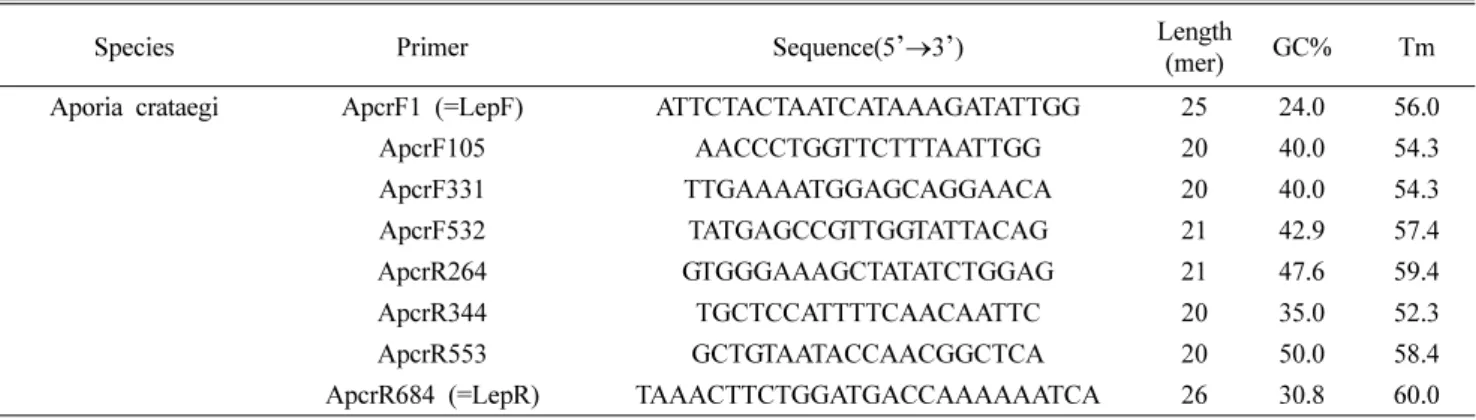
본 연구에서 새롭게 분석된 상제나비는 모두 건조표본 으로 한국산 2개체, 중국산 5개체, 러시아산 3개체를 포 함하여 총 10개체에 대한 DNA 바코드 분석을 실시하 였다(Table 1). 게놈 DNA는 성충의 다리를 적출한 후 QIAamp DNA Mini kit (Qiagen, Korea) 를 사용하여 100 ㎕ 를 추출하였다. 중합효소연쇄반응(PCR)은 상제나비에 대
한 종 특이 프라이머를 Park et al. (2012)에 의해 분석된 COI 염기 서열을 참고하여 DNA 바코드 영역 658 bp 증 폭을 목적으로 하는 8개의 프라이머를 새롭게 디자인하 여 적용하였다(Table 2). 각각의 프라이머는 증폭 길이 152 bp ~ 265 bp 구간으로 선택적으로 프라이머세트를 구 성하여 적용하였다(Fig. 1). PCR 증폭에는 AccuPower PCR PreMix (Bioneer, Korea) 를 이용하여 초기변성은 94
oC 에 서 5분, 목적 단편 구간 증폭은 94
oC 에서 30초, 48
oC 에서 25 초, 72
oC 에서 45초로 35회 반복하였으며, 최종 확장은 72
oC 에서 3분을 가하였다. PCR 산물은 7% 아가로스겔에 서 모니터링 하여 증폭 여부를 확인한 후 QIAquick PCR Purification Kit (Qiagen, Korea) 를 이용하여 정제하고, 시 퀀싱 반응은 automated DNA analyzer (ABI 3730 xl 96- capillary DNA anlayzer; Applied Biosystems, USA) 로 분 석하였다. 분석된 염기 서열은 GenBank에 등록하였다.
DNA 바코드 염기 서열 분석을 위하여 이번에 새롭게 분 석한 10개체와 상제나비로 NCBI에 등록되어 있는 스페인 산 4개체(Carnicer et al. 2013), 독일산 3개체(Hausmann et al. 2011), 루마니아산 8개체(Dinca et al. 2011), 이탈리아 1 개체(Shapiro et al. 2007), 핀란드산 1개체(Wahlberg and Wheat 2008), 몽골산 1개체(Park et al. 2012), 카자흐스탄 산 7개체(Lukhtanov et al. 2009) 등 25개체 서열 정보를
Table 2. The species-specific primers for Aporia crataegi inthis study.
Species Primer Sequence(5
’
→3’
) Length (mer) GC% TmAporia crataegi ApcrF1 (=LepF) ATTCTACTAATCATAAAGATATTGG 25 24.0 56.0
ApcrF105 AACCCTGGTTCTTTAATTGG 20 40.0 54.3
ApcrF331 TTGAAAATGGAGCAGGAACA 20 40.0 54.3
ApcrF532 TATGAGCCGTTGGTATTACAG 21 42.9 57.4
ApcrR264 GTGGGAAAGCTATATCTGGAG 21 47.6 59.4
ApcrR344 TGCTCCATTTTCAACAATTC 20 35.0 52.3
ApcrR553 GCTGTAATACCAACGGCTCA 20 50.0 58.4
ApcrR684 (=LepR) TAAACTTCTGGATGACCAAAAAATCA 26 30.8 60.0
Fig. 1. PCR strategy for retrieving COI sequences from dried specimens of Aporia crataegi. Primer binding site of each species-specific primer for Aporia crataegi within the 658 bp DNA barcoding region. Each primer was alternatively coupled such as ApcrF1/ApcrR264, ApcrF105/ApcrR264, ApcrF331/
ApcrR553 and ApcrF532/ApcrR684, etc that is expected to retrieve the full length of barcoding region.
이용하여 총 35개체 및 중국산 A. potanini도 포함하였으 며, outgroup으로는 A. bieti를 사용해 총 10개 지역개체 군 37개체에 대한 데이터세트를 구성하여 시험에 이용 하였다(Table 1). 658 bp 염기 서열의 데이터세트 중 일 부 분석한 개체에서의 missing sequence data는 haplotype 분석에서 잠재적인 오류를 도출하기 때문에 모두 삭제 하여 최종적으로 567 bp 길이로 보정한 후 분석하였다.
DNA 바코드 염기 서열의 정열 및 유전적 분화율 및 neighbour-joining(NJ) 분석은 MEGA 5.2(Tamura et al.
2011) 를 이용하였다. Haplotype 분석은 TCS 1.21 (Clement et al. 2000) 을 이용하여 NJ tree에 적용시켰다.
결과 및 고찰
1. 상제나비의 DNA 바코드 특성
567 bp 염기 서열을 대상으로 한 COI의 분화율은 상제 나비와 A. bieti는 종간에 6.10 ~ 6.50% 차이로 뚜렷이 구 분되었다. 하지만 중국산 A. potanini (EF584852)는 상제 나비 35 분석 개체와 종내 변이 수준(0 ~ 0.35%)만을 보 였으며, 상제나비 haplotype I에 포함되어 종간의 특성은 없어 이 종에 대한 오동정 여부 또는 분류학적 지위를 재 검토해야 할 것으로 보인다(Fig. 2).
상제나비 35개체 내의 COI 유전자 분화율은 0.00 ~ 0.53%
로 종내 변이수준이였으며, 총 5개의 haplotype을 구성하 였다(Fig 2, Table 3). Haplotype I은 27개체(75%)였으며, 몽 골산을 제외한 9개 지역 개체군 모두 포함되고 있었다. 두 번째로 빈도가 높은 haplotype IV는 5개체(13.9%)로 각각 루마니아산, 몽골산, 카자흐스탄산 개체들로 구성되어 있 었다. Haplotype II는 2개체(5.6%)였으며, haplotype III과 V 는 각각 1개체였다. 이 중 한국산 2개체는 haplotype I 에 속하였다. Haplotype간 유전적 변이는 haplotype III을 haplotype IV 과 V를 비교하였을 때 0.53%로 가장 큰 것 으로 나타났다. 특이점으로는 이들 haplotype간 염기치환 은 전체 567 bp 염기 서열에서 모두 4 개의 염기 위치로 각각 225번째(T→C), 237번째(C→T), 322번째(G→A), 468 번째(C→T)였다(Fig. 3). 225번째, 237번째 염기 위치는 동 의적 치환(synonymous substitution)인 동시에 singleton position 이었으나, 468번째 위치는 동의적 치환인 동시에 haplotype II 와 III에 대한 informative position이였다. 예외 적으로 322번째 위치는 아미노산 서열로 전환하였을 때 108 번째 코돈의 첫 번째 위치에서 일어난 돌연변이로 GGA 가 AGA 치환되어 글리신(Gly)이 아닌 세린(Ser)을 지시 하는 것을 확인하였고, 이는 haplotype IV에 속하는 개체 들만이 갖는 특징이었다(Fig. 3). 결과적으로 10 지역 개 체군에 대한 개체들은 크게 5종류의 haplotype들이 있음 을 확인하였다. 이들 중 108번째 아미노산 돌연변이 유무
Fig. 2. Neighbor-joining phenogram of COI gene of Aporiacrataegi including ten geographical populations.
Table 3. Pairwise distance of cytochrome c oxidase subunit I between haplotypes of Aporia crataegi
Betweenspecies
Haplotype I
Haplotype II
Haplotype III
Haplotype IV
Haplotype V Haplotype
I Haplotype
II 0.0018
Haplotype
III 0.0035 0.0018 Haplotype
IV 0.0018 0.0035 0.0053 Haplotype
V 0.0018 0.0035 0.0053 0.0035
C.inducta
*
0.0650 0.0630 0.0610 0.0630 0.0630 Numbers are indicated as mean (minimum-maximum) of the pairwise distance.Fig. 3. Haplotype network of COI gene for ten geographical populations of Aporia crataegi. The haplotype in a square box denotes the largest root probability.
에 따라 두 개의 유전자 풀 그룹으로 나뉘는데, 그룹 1은 글리신을 갖는 개체들로 haplotype I, II, III, V가 포함되 고, 그룹 2는 세린을 갖는 개체들로 haplotype IV에 속한 다. 하지만 분석개체들 중에서 유전적 분화가 가장 먼저 일어난 것으로 추정되는 것은 haplotype III이며, 이후 Haplotype II 가 갈라진 것으로 보인다. 그룹 2의 haplotype IV 는 haplotype I과 V가 분화되기 이전에 어떠한 돌연변 이압(mutation pressure)에 의해 독특하게 분화된 것으로 판단된다. 한국산 개체가 포함되어 있는 haplotype I은 우리 나라를 포함하여 유럽까지 광범위한 지역에 안정적이고 고 정적인 유전자풀을 유지하고 있는 것으로 사료된다.
2. 상제나비 보전을 위한 추가적인 연구의 제언 상제나비는 형태분류학적으로 9개의 아종으로 이루어져 있으나, 변이성이 매우 약하기 때문에 이들의 분류학적 지위가 의심스러운 것으로 보고 있다(Tuzov 1997). 반면 COI 염기 서열을 이용한 상제나비의 DNA 바코드를 분 석한 결과, 우리나라를 포함한 유라시아 10개 지역 개체 군들은 총 5개의 haplotype으로 구성되었고, 특히, 남한산 영월 개체들은 가장 빈도가 우세한 haplotype I에 속하는 것 으로 확인되었다. 또한 광역 분포종인 상제나비의 haplotype 들이 각각의 빈도는 다를지라도 동일 지역에서도 혼재되어 있음이 밝혀졌다. 이는 상제나비가 남한에서만 귀할 뿐, 인 접 러시아 극동지역에서는 매우 흔하고, 러시아의 다른 지역에서는 여러 번 발생(1-3세대 또는 그 이상)이 가능 하며, 식초(2개과 등: 장미과, 월귤과 등) 다양성이 큰 것 과 관련 있을 것으로 보인다(Tuzov 1997). 우리의 DNA 바코드를 통한 결과로도 남한산 개체군이 고립된 수많은 지역 집단인 메타개체군 중의 하나라고 간주하기는 어렵다 는 결론에 도달하였다.
그럼에도 불구하고, 향후에 상제나비 종 복원 사업에서 타 지역 집단의 개체를 도입하려고 할 때, COI haplotype 분석 을 통해 동일 haplotype 개체인지를 확인하는 것은 유전적 근 연 집단을 찾는데 매우 중요한 일임을 제시해준다. 하지만, 이번 연구보다 더 다양한 분포지역을 포함하는 상제나비의 유전적 변이를 microsatellite DNA 분석을 시도할 필요가 있다. 종 복원 사업을 진행하기 전에 이 같은 한 차원 높 은 유전적 변이분석을 수행하게 된다면, 지리적 집단 간의 유 전자 흐름과 남한 개체군의 유전적 구조의 정도를 세밀하게 파악하게 되어 남한산 상제나비 집단의 유전적 특성 뿐 아니 라 근친 집단을 더 명확하게 구별할 수 있기 때문이다.
적 요
멸종위기종인 남한산 상제나비의 28년 된 장기 건조표
본을 이용하여 DNA 바코드 염기 서열을 최초로 분석하 고, 이를 유라시아 10 지역 개체군 36개체들과 COI 특성 을 비교해 보았다. 이들 개체군에서 총 5개의 haplotype을 확인하였고, haplotype I은 75%로 가장 높은 빈도를 나타 내었으며, 유라시아 전 지역에 광범위하게 분포하고 있음 을 확인하였다. 남한산 개체들은 모두 haplotype I에 속하 고 있어 COI 유전자 상에서는 지역 고립성이 없는 것으 로 밝혀졌다. 이 결과로 추후 남한산 상제나비 보전 및 복원은 타 지역 개체군 중 동일 haplotype 선별이 필수 요 건으로 판단되나, 좀 더 정교한 평가를 위해서는 추가적 인 마커를 이용한 분석이 필요할 것으로 제안한다.
감사의 글
이 연구는 2013년도 농촌진흥청 국립농업과학원 기관고유 사업(과제번호: PJ00680101)과 공동연구과제(PJ008983012013) 에 따라 수행한 결과로 작성하였습니다.
인용문헌
Carnicer J, Stefanescu C, Vila R, Dincã V, Font X, Peñuelas J (2013) A unified framework for diversity gradients: the adaptive trait continuum. Global Ecol Biogeo 22, 6~18.
Choi SW, Kim SS (2012) The past and current status of endangered butterflies in Korea. Ent Sci 15, 1~12.
Clement M, Posada D, Crandall K A (2000) TCS: a computer program to estimate gene geneologies. Mol Ecol 9, 1657~1659.
Dincã V, Zakharov EV, Hebert PDN, Vila R (2011) Complete DNA barcode reference library for a country’s butterfly fauna reveals high performance for temperate Europe. Pro Royal Soc B 278, 347~355.
Hausmann A, Haszprunar G, Segerer AH, Speidel W, Behounek G, Hebert PDN (2011) Now DNA-barcoded: the butterflies and larger moths of Germany. Spixiana (Suppl.) 34, 47~58.
Kim CW (1981) Insects: Rare and endangered species in Korea. pp 30–
153. Korean Asso Conser Nature, Seoul.
Kim HC (1992) Butterfly-fauna of Changwon-ri area in Yongwol-gun, Kangweon-do. Amateur Lep Soc Korea 5, 6~12.
Kim SS, Seo MH (2012) Life histories of Korean Butterflies. Sakyejul Publishing Co.
Kim YS, Hong SP (1990) Review of main butterflies species protected under Korean Law. Amateur Lep Soc Korea 3, 9~16.
Korean Amateur Lepidopterist (1986) list of butterfies from Kyeonggi- do, Korea. Amateur Lep Soc Korea 1, 1~19.
Korean Amateur Lepidopterist (1989) Butterfly-fauna of Kangwon-do, Korea. Amateur Lep Soc Korea 1, 1~19.
Lukhtanov VA, Sourakov A, Zakharov EV, Hebert PDN (2009) DNA barcode central Asian butterflies: increasing geographical dimension does not significantly reduce the success of species identification.
Mol Eco Res 9, 1302~1310.
Ministry of Environment (2005) Endangered plants and animals in
Korea. Ministry of Environment, Seoul.
Paek MK, Shin YH (2010) Butterflies of the Korean peninsula. In:
Cho, YK(eds) <Nature & Ecology> Academic Series 1, Nature &
Ecology press, Seoul.
Park HC (2005) Endangered plants and animals: insect 4: Aporia.
http://www.hani.co.kr/kisa/section-010003000/2005/12/
010003000200512061709348.html.
Park HC, Kim SS (2001) Study on current and new proposal of endangered plants and animals in Korea. Insects. pp 91-114.
Ministry Enviro Kor Asso Conser Nat, Seoul.
Park JS, Cho Y, Kim MJ, Nam SH, Kim I (2012) Description of complete mitochondrial genome of the black-veined white, Aporia crataegi (Lepidoptera: Papilionoidea), and comparison to papilionoid species. J Asia-Paci Ento 15, 331~341.
Shapiro AM, Forister ML, Fordyce JA (2007) Extreme high-
altitude asian and andean Pierid butterflies are not each others’ closest relatives. Arc Anta Alp Rese 39, 137~142.
Shin YH (1990) Study on survey of rare and threatened plants and animals in Korea. Insects. Bull Kor Asso Con Nat 10, 145~169.
Tamura K, Peterson D, Peterson N, Stecher G, Nei M, Kumar S (2011) MEGA5: Molecular evolutionary genetics analysis using maximum likelihood, evolutionary distance, and maximum parsimony methods. Mol Bio Evo 28, 2731~2739.
Tuzov VK (1997) Guide to the butterflies of Russia and adjacent territories. Pensoft Publishers, Sofia, Bulgaria and Moscow, Russia.
Wahlberg N, Wheat CW (2008) Genomic outposts serve the phylogenomic pioneers: Designing novel nuclear markers for genomic DNA extractions of Lepidoptera. Sys Bio 57, 231~242.