청룡산 텃밭공원의 이용실태와 이용주체간 의식 차이
손용훈∙임정언*
서울대학교 환경대학원∙*서울대학교 환경대학원 협동과정 조경학
The Current Status of Use and the Difference of Awareness by User Groups in the Cheongryongsan Vegetable Garden Park
Son, Yong-Hoon∙Lim, Jung-Eon*
Assistant Professor, Graduate School of Environment Studies, Seoul National University
*
Ph.D. Program in Landscape Architecture, Graduate School, Seoul National University
ABSTRACT : This study intended for Cheongryongsan Community Garden in Gwanak-gu, one of the demonstration places for
‘Community Garden’ Project recently implemented by the Seoul Government. This study had two major purposes: investigating the current status of the management and usage and identifying its characteristics; investigating users’ awareness to consider the construction and operation directions of sustainable community gardens. This study was conducted based on several surveys such as an investigation into the spatial configuration and the management system of parks through a field study, a use survey through a questionnaire survey for vegetable garden users and an awareness survey about the construction direction of gardens direction preferred by users through the analytical hierarchy process (AHP). As a result of a questionnaire survey for vegetable garden users, the usage status was summarized as follows: Considering the common trends in the 2012 and the 2013 user survey, women used Cheongryongsan Vegetable Garden more than men. Over fifties used it most of all users. Users were mostly neighborhood residents.
They used to visit there three to five times a week and stayed for about 30 minutes to one hour. Users differently responded to the question related to the order of priority for the use of the garden in the 2012 and the 2013 survey. They had increasingly used it for individuals’ production activities more than social exchanges. As a result of making an AHP analysis for general park users, vegetable garden users there were clear differences in the targets which each subject put emphasis on in relation to the construction and operation of vegetable gardens. General park users recognized a vegetable garden as a park where park functions and the functions of the vegetable garden coexisted. On the other hand, vegetable garden users viewed it as a space where they attached importance to the functions of the vegetable garden like an allotment. Last, this study contemplated subjects related to the construction and operation of vegetable gardens which had to be considered in the future. Vegetable gardens tended to be biased as personal hobby places. It was viewed that the main reason was insufficient support activities for vegetable garden education and exchange programs originally planned when vegetable gardens had been constructed. Vegetable garden users recognized vegetable gardens as places for individuals’ farming activities like allotments. For the desirable operation of vegetable gardens, it would be necessary to give priority to the park management before the production activities in individuals’ vegetable gardens. The important role of the government would be to build the base through the provision of education and opportunities so that a local resident organization could actively participate in the management of a vegetable garden after a vegetable garden was constructed. It would be necessary to make a use survey and an awareness survey for users conducted in this study on a regular basis because the surveys could be important basic data in the decision-making process for the sustainable operations of the vegetable garden.
Key words : Vegetable Garden Park, Vegetable Garden User, Park User, AHP Analysis, Park Management
1)Corresponding author : Son, Yong-Hoon Tel : 02-880-8107
E-mail : [email protected]
I. 서 론
1. 연구배경 및 목적
도시농업은 1차 산업으로서의 농업과 구별되며 생활 권에서 농업체험을 한다는 점과 스스로 안전한 먹거리를 취한다는 점에서 큰 가치를 갖는다. 지난 정부의 대통령 직속 녹색성장위원회는 녹색성장 추진방안의 하나로 도 시농업을 선정하였다. 중앙부처, 지방자치단체, 시민단체, 연구기관이 협의하여 도시농업 활성화 추진방향을 논의 하며 도시농업을 지속가능하게 하는 제도가 제안되었고 (나영은, 2010), 그 결과로 2011년 11월에 ‘도시농업의 육성 및 지원에 관한 법률’이 제정되었다. 동 법에서 도 시농업의 유형은 주택활용형, 근린생활형, 도심형, 농장 형, 공원형, 학교교육형으로 규정되었다. 이 중 공원형은 도시공원을 활용한 도시농업을 말하며 일반적으로 ‘도시 농업공원’이라고 한다. 도시농업공원은 시민의 새로운 여가 활동, 커뮤니티 증진 등에 공익적인 성격을 지니는 새로운 형태의 공원녹지이며, 최근 이에 대한 연구가 많 이 이루어졌다. 윤희정과 조미경(2012)은 도시공원의 진 화상이라는 관점에서 도시농업공원을 평가하며 도시공원 에 부여된 새로운 기능으로 도시농업공원의 발전 가능성 을 논하였다. 허주녕과 김태곤(2013)은 서울시민을 대상 으로 도시농업공원의 조성에 관한 선호도 조사를 하여, 서울시민이 도시농업공원을 통한 농사체험, 학습과 교육, 여가활동 등에 큰 관심이 있음을 확인하였다. 이원석 외 (2012)는 수원시를 대상으로 도시 유휴 공간 내 텃밭 조 성이 가능한 대상지를 발굴하고 어린이공원 내 텃밭을 조성하는 모델을 제안하였다. 강기남 외(2007)는 도시 공 간별 텃밭 설치의 난이도를 분석하여 주제공원 등 상대 적으로 넓은 면적의 공원이 텃밭 조성에 적합하다고 지 적하였다.
현재까지 도시농업공원에 대한 연구 동향은 도시농업 공원의 가치, 조성방향 등에 대한 연구가 주를 이룬다.
반면 실제 조성된 도시농업공원을 대상으로 한 이용실태 에 관한 실증연구와 이를 바탕으로 한 운영관리방안에 대한 제안 등을 수행한 연구는 매우 적다.
본 연구는 서울시가 조성한 도시농업공원을 대상으로 하여 2년 간 모니터링하며 이용실태를 조사하였다. 서울 시가 최근 실시한 텃밭공원사업인 ‘마을공동체공원 (Community Garden)1)’ 시범사업은 서울시가 2006년부터 추진한 ‘동네뒷산공원화 사업2)’의 연장으로 2011년부터 추진하고 있는 사업이다. 2011년 첫 시범사업지로 ‘청룡 산 마을공동체공원’, ‘불암산 마을공동체공원’ 2곳이 선
정되고 공원이 조성되었다(서울시 공원녹지국 공원조성 과 보도자료. 2012년 3월14일). 본 사업은 마을 단위로 지역수요를 반영한 맞춤형 공원사업으로 텃밭을 중심으 로 다양한 활동을 매개하며 마을공동체의 생활권 녹지로 활용되는 것을 목적으로 한 텃밭공원 조성사업이다. 본 사업은 도시농업에 대한 관심이 증가하는 시대적 상황에 서 매우 시기적절한 사업이며, 지역문제에 대한 해결방 안으로 조성된 맞춤형 공원녹지라는 측면도 높게 평가할 만하다.
본 사업의 취지에 대한 일반 서울 시민들의 호응도 컸다. 임미정과 이은희(2011)는 서울시민을 대상으로 계 획단계에서 있는 청룡산과 불암산의 텃밭공원에 대한 가 치를 조사하였는데, 응답자 89.6%(198명)이 좋다고 답하 였다.
하지만, 다른 관점에서 생각하면 텃밭공원이란 모두에 게 개방된 도시공원에 일부 시민이 특정 목적으로 토지 를 점유해 활용하는 형태이기도 하다. 따라서 이용자 간 의 인식 차이가 대립되거나 혹은 이용자 간에 상반되는 요구사항이 발생할 때는 운영관리상에 많은 문제가 발생 한다. 사업의 취지는 좋지만 텃밭공원은 일반 도시공원 에 비교해 공원관리 측면에서 세심한 배려가 필요하고, 또한 지역공동체 회복이라는 큰 목적을 달성해가기 위해 서는 이를 위한 적극적인 운영방법도 필요하다. 즉 조성 후에도 계속적으로 현장을 관찰하고 평가하며 운영관리 방향을 환류(Feedback)하는 활동이 필요하다.
이러한 배경으로 본 연구의 목적은 최근 서울시 ‘마을 공동체공원’ 시범사업으로 조성된 텃밭공원을 대상지로 하여 이용실태를 조사하고 그 특징을 파악하며, 나아가 텃밭 이용자, 공원 이용자 등 다른 이용주체간의 의식 차이를 파악하는 것을 목적으로 한다. 연구결과를 바탕 으로 결론에서 지속가능한 텃밭공원의 운영관리 방향을 제언하였다.
본 연구에서는 심도 있는 실증연구를 수행하기 위해 대상지를 한 곳으로 정하였다. 대상지는 공원 이용자의 접근성이 높고, 공원 전체 경관 면에서도 텃밭이 중요한 역할을 하고 있는 청룡산 텃밭공원으로 하였다. 청룡산 텃밭공원에서 텃밭은 공원의 중심 공간에 조성되어 있어 일반 공원 이용자에게도 영향력 있는 공간으로 작용하고 있다.
II. 연구 방법
1. 대상지 개요
Overview Description
Location 174 Bongcheon-dong Gwanak-gu, Seoul
Opening Date Completed in Dec. 2011 and Opened in Apr. 2012
Vegetable Garden Users
A total of 38 accounts (Family, School, Kindergarten)
All park Areas/Vegetabl
e garden plot Area
6, 263㎡ / 322㎡ 38 plots (the size of a plot is 8.5㎡)
Facilities
Physical fitness field, Promenade, Gazebo, Drinking fountain, Vegetable garden plot, Wild flower garden, Rrain water recycling facility etc.
※ Source: The data provided by the Department of parks and green spaces of Gwanak-gu office
Table 1.Outline of Cheongryongsan Community Garden
관악구 청룡산 텃밭공원은 관악산 도시자연공원구역 (청룡산 지구)에 조성되었다. 위치는 2호선 서울대입구역 에서 500m거리로 접근성이 양호하고, 봉천역과 서울대 입구역 주변으로 6개의 학교와 저층 주거단지가 밀집해 있어 공원이용 수요가 높게 기대되는 곳이다. 본 공원은 조성 단계부터 주민설명회를 실시하며 주민참여를 적극 적으로 유도하였다.
청룡산 텃밭공원의 부지는 주거지에 인접한 도시 산 림의 주연부에 있으며, 공원 조성 전에는 토지소유주의 관리 소홀, 무단 경작, 쓰레기 투기 등의 환경 훼손 문제 를 가지고 있었다. 2012년 구민들에게 첫 개방된 청룡산 텃밭공원의 텃밭 분양 공고에는 “구민들에게 친환경 도 시농업의 참여와 체험기회를 제공하고 단절된 지역공동 체 회복을 도모함”이라는 목적이 명시되어 있다(서울특 별시 관악구 공고 제2012-246호)
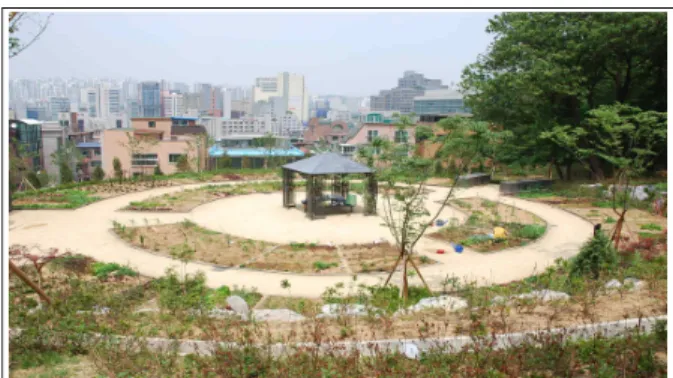
공원의 공간구성요소는 크게 허브, 채소 등을 직접 재 배할 수 있는 텃밭공간, 생활체육공간, 쉼터 및 가재보 등 휴게공간, 그밖에 야생화단지, 우수 저류조, 주변 산 림 및 산책로 등이 있다. 기존의 불법경작과 토사 유실 등의 산림훼손 문제가 발생되던 지역 중 경사가 심한 약 3,000㎡의 토지는 산림으로 복원하였고, 경사가 완만한 곳에 일부 절성토하여 800㎡의 텃밭을 조성하였다. 부대 시설은 급수시설, 농기구 보관소, 퇴비상자, 가재보, 야외 피크닉테이블 등이 있다.
a. Drawing of original condition
b. Site design drawing
c. Pictures of original condition d. Pictures after the park construction
Figure 2. Comparison of before and after the construction of the Cheongryongsan Community Garden
※ Source : a, b and c from Gwanak-gu (2011)
Figure 1. View of the Cheongryongsan CommunityGarden
2. 조사방법
본 연구는 첫째, 이용실태를 파악하기 위해 관계자 인 터뷰, 현장조사를 통한 공원의 운영관리에 대한 현황조 사를 실시하고 텃밭 이용자 설문을 통한 텃밭 이용실태 를 조사하였다. 다음으로 공원의 조성 및 운영방향에 대 해 텃밭 이용자와 그 외 공원 이용자를 대상으로 이용주 체 간 의식차이를 조사하기 위해 AHP(Analytical Hierarchy Process) 분석을 실시하였다. 연구의 공간적 범 위는 청룡산 텃밭공원이며, 시간적 범위는 2012년 개원 부터 현재까지이다.
관계자 인터뷰 및 텃밭이용조사는 2012년, 2013년 2회
Level 1(Goal) Level 2 Level 3 Content
Evaluation for important
factors to create and manage a community
garden
▷
Functions for Open
space
Exchange
facility ∙ Provide a place to meet and chat with neighbors in daily life Convenience
facility
∙ Convenience facilities needed for the park such as exercise facilities, playground, park way, etc
Accessibility ∙ The distance between homes and the park is close, and it is not inconvenient to get to the park.
▷
Functions for Vegetable
garden
Plot scale ∙ Location, size, and form of the vegetable garden are proper for activities.
Supporting facility for
farm work
∙ Facilities that support agricultural activities such as a tool storage, portable water system, compost box, etc. are well equipped.
Resting facility for
farm work
∙ Facilities where people can rest in resting time such as a pavilion, bench, shade area, etc. are well provided.
▷ Program
Vegetable garden
events
∙ Various events related to vegetable garden activities such as a Community Garden’s Best Farm Produce Show, sharing seedling, compost, and vegetables, and harvest festival are frequently held.
Experience program
∙ Execute nature experience programs such as observation, collecting, playing, etc.
by connecting adjacent facilities including a children forest experience place Education
program for farming
∙ Open urban agriculture educational lectures for children such as green diet and eco-friendly agricultural products educations in the vegetable garden.
Figure 3. AHP hierarchy Structure and Contents of Questionnaires 실시하였고, 사업 첫해와 다음해 2년간의 변화를 분석
하였다.
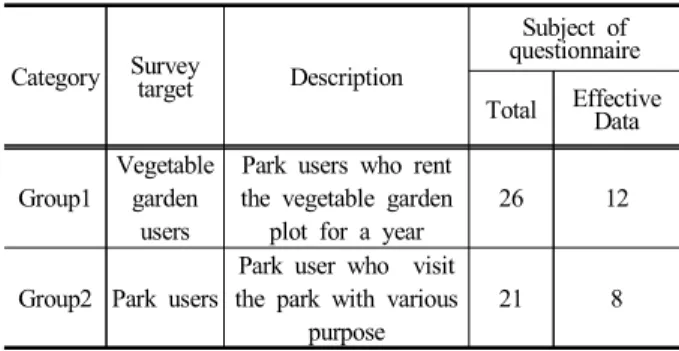
공원조성방향에 대한 AHP 의식조사는 2013년 7월에 서 10월까지 3개월간 실시하였다. 텃밭공원을 잘 운영하 기 위해서는 이용주체의 의식에 대한 올바른 이해가 요 구된다. 텃밭을 분양받아 이용하는 텃밭 이용자와 그 외 공원 이용자 간에는 공원에 대해 이해가 서로 다를 것이 라고 가정하고, 텃밭 이용자와 그 외 공원 이용자 두 그 룹(Table 2)을 대상으로 각 그룹이 갖는 텃밭공원의 조성 및 운영관리 방향에 대한 의식 차이를 분석하였다.
AHP분석에서 최종목표에 대한 항목의 객관적이고 체 계적인 계층화는 매우 중요하다. 본 연구에서 사용한 AHP 계층구조는 2012년 실시한 텃밭공원 이용자의 공 원이용 만족도 연구를 바탕으로 선정하였다. 상위계층 (Level 2)은 요인분석으로 도출한 공원이용 및 여가활동 (1요인), 생산활동(2요인), 교육 및 지원(3요인)으로 정하 였다. 하위계층(Level 3)은 만족도 조사의 세부 질문항목 을 검토하여 대표성 있는 내용을 추출하여 정하였다.
Figure 3은 이렇게 작성한 계층구조도이다. 이에 대해서 Table 2의 두 그룹을 대상으로 설문하였다. 수집한 데이 터 중 응답의 성실성, 논리적 일관성 지수를 바탕으로
유효데이터를 추출하고 이를 분석에 사용하였다.
Category Survey
target Description
Subject of questionnaire Total Effective
Data
Group1
Vegetable garden
users
Park users who rent the vegetable garden plot for a year
26 12
Group2 Park users
Park user who visit the park with various
purpose
21 8
Table 2. AHP
Characteristics of each survey target group
3. AHP 분석법
이용주체 간 의식차이를 조사하기 위해 본 연구에서 사용한 조사방법은 AHP분석법이다. AHP는 1970년대 Satty에 의해 개발된 객관적인 평가요인과 주관적인 판 단을 포괄적으로 수용한 유연한 문제해결형 의사결정모 델(Decision Making Model)이다(Harker, 1989).
일반적으로 국내에서 AHP분석은 평가항목의 중요도 혹은 가중치 산정을 위한 전문가 의견수렴에 많이 활용
된다(홍성언과 박수홍, 2003, 정우수 외, 2008, 이우성 외 2007, 반영운 외, 2011). AHP가 전문가 설문에 의한 가 중치 설정에 매우 용이한 방법이긴 하지만, 실제로 명제 의 복잡한 항목에 대한 객관적 가치평가가 가능한 전문 가 집단을 설정하는 것은 매우 어려운 일이다. 객관적 분석의 명분으로 AHP를 사용하지만 전문가 집단 설정이 부적절하여 신뢰도가 떨어지는 연구논문도 적지 않다.
지태관(2012)은 도시농업정책의 평가요소를 공익적·경제 적·사회적·문화적·환경보전 기능으로 구분하여 도시농업 업무담당자, 시민단체, 사회적 기업 등 전문가 집단 53명 에 대한 AHP 설문을 통해 도시농업정책의 우선순위를 도출하였다. 피설문자로 정한 전문가 집단인 공무원, 시 민단체, 기업 등은 각자의 입장에서 가치를 평가하기 마 련인데 이들의 의견을 모두 묶어서 하나의 객관적 우선 순위를 제시하는 것은 적절한 방법이라고 할 수 없다.
즉 AHP 분석에서 피설문자의 수가 많다고 신뢰성 높은 연구가 되는 것은 아니라는 의미다. 홍성언과 박수홍 (2003)은 GIS를 활용한 공원입지 필요지역의 객관적인 평가기준 연구에서 관련 전문가 2인, 공무원 실무자 8인 을 대상으로 AHP 분석을 하였다. 평가항목의 가중치를 산출을 위한 AHP 분석의 경우는 명제 전체를 이해하고 신뢰 가능한 전문가에게 설문을 하는 것이 중요하다.
AHP분석을 사용하는 또 다른 이유는 특정 그룹이 갖 는 의식을 파악하기 위해서이다. 본 연구도 특정그룹의 의식 파악을 위해 AHP를 활용하였다. 쿠리하라(栗原 외, 2003)는 일본 아소국립공원 키리가미네의 초원경관의 보 전방향에 대한 주민들의 의견 차이를 연구하며 자연 중 시파, 전통문화 중시파, 미관 중시파의 다른 입장을 갖는 3그룹의 관리방향에 대한 미래상의 차이를 확인하는데 AHP 분석방법을 활용하였다. AHP 분석방법은 감에 의 한 가치관의 차를 정량화하는 수단이므로 각기 다른 성 격의 개인 및 단체의 의견 차이를 확인하는데 매우 유용 한 방법이다. 단 일반인을 대상으로 한 AHP분석은 높은 비일관성 지수를 초래할 위험이 있으므로 복잡한 계층 구조도를 가급적 피하는 것이 좋다.
III. 연구결과
1. 공원 운영관리 현황
관계자 인터뷰, 현장조사를 통하여 파악한 청룡산 텃 밭공원의 운영관리 현황은 Table 3과 같다. 텃밭의 분양 대상은 개인(지역주민) 및 단체(학교, 유치원)이다. 첫해 는 총 38구좌의 텃밭 분양에 대해 약 100여명 정도의
지원자가 있을 정도로 이용자 수요가 높았고, 2013년에 는 지원자 수가 두 배 이상 증가하였다.
2012년 개원 첫해와 2013년을 비교하면 두 해 모두 분양대상과 분양방법, 분양가격 등 일반적인 사항은 동 일하다. 다만 2013년에는 원활한 유지·관리가 이루어지 도록 몇 가지 세부기준이 추가되었다. 참여율과 재배율 이 높은 일부 구좌에 분양 우선권을 주었고, 필수 분양 대상으로 하였던 교육기관(단체분양)은 관리가 미흡하였 던 이유로 필수 분양대상에서 제외하였다. 그 대신 이용 참여도가 높았던 관내 주민(개인분양)의 비율을 높였다.
텃밭 운영관리는 인력 부족, 프로그램 기획의 어려움, 운영비 조달의 어려움 등으로 인해 많은 어려움이 있었 다. 개장 당시 관악구는 농사 도우미를 고용하여 농업기 술 교육 지원과 커뮤니티 활성화를 위한 다양한 이벤트 를 계획하였다. 하지만 계획되었던 으뜸농산물 품평회, 모종·퇴비나누기 등의 활동은 제대로 실시되지 못하였 다. 첫해에는 농사도우미가 텃밭활동을 지원해 주었지만 기대한 수준에는 미치지 못하였다. 2013년에는 텃밭 개 장식 날 함께 텃밭일구기, 상추 모종심기 등 체험행사를 하였으나 일회성 이벤트로 마무리되었고, 당초 계획한 인근 유아숲 체험장과 연계한 프로그램 계획도 큰 성과 를 거두지 못했다. 2014년 현재도 프로그램 운영을 계획 하고 있으나 구체적인 추진 전략은 여전히 부족한 상태 이다. 관리주체인 관악구 측에서 운영계획에 대한 아이 디어를 내고는 있지만 그러한 행사들을 관주도로 이행하 기에는 많은 어려움이 존재한다.
2. 텃밭 이용자의 이용실태
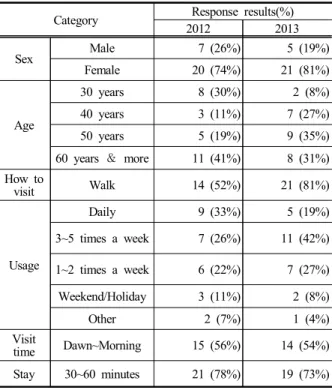
2012년과 2013년을 비교하며 사업시행 이후 텃밭 이 용자의 이용실태의 변화내용을 분석하였다. 2012년, 2013 년 조사에서 유사하게 나타난 이용자 속성 및 실태를 정 리하면 Table 4와 같다. 2012년 이용자의 성별 분포는 남성(26%)에 비해 여성(74%)의 분포가 높았으며, 이용자 의 연령은 50대(19%), 60대 이상(41%) 의 참가비율이 높 게 나타났다. 이는 2013년 조사에도 유사하게 나타났으 며, 이용자 성별 분포는 전체 남성(19%)에 비해 여성 (81%)의 분포가 높았으며, 이용자의 연령은 50대(35%), 60대 이상(31%)의 참가비율이 높게 나타났다.
2012년 조사에서 이용자의 거주지는 전부 관악구로 대부분 공원에서 약 10분 이내 가까운 거리에 거주하고 있었다. 2013년 조사에서도 이용자의 대부분은 공원에서 약 10분 이내 가까운 거리에 거주하고 있었으며 방문수 단은 도보가 약 81%로 매우 높았다.
2012년 조사에서 공원의 이용 빈도는 거의 매일방문
Category Item Description
2012 2013
Rent in plots
Target Residents, schools and kindergartens in Gwanak-gu
Residents, schools and kindergartens in Gwanak-gu
Applicants 128 271
Account
A total of 38 accounts ; 12 accounts (2 plots per a group) for institutions, and 10 accounts for Cheongryong-dong Residents limited, 16 accounts for residents in Gwanak-gu
A total of 38 accounts for Gwanak-gu residents
* Give priority to vegetable garden Users(five accounts) who showed a high level of participation and cultivation
Application receive
Application on the internet or directly summition and draw lots in public
Application on the internet or directly submission and draw lots in public
Price 50,000 won per account(used for compost and seedling support, and maintenance)
50,000 won per account(used for compost and seedling support, and maintenance)
Management plan
Operating
period Spring(April) to autumn(November) in a year Spring(April) to autumn(November) in a year
Managing staff
Shifting in charge with two persons, one agricultural assistant and one Gwanak-gu official as a garden manager
* Agricultural assistant: Recommended by the Gwanak Urban Agriculture Network that is a local grassroots community
* Role: Vegetable garden monitoring, park maintenance, etc
Two forest interpreters
* Forest interpreters: Utilize the workers for a children forest experience place near the park
* Role: vegetable garden monitoring, program and lectures for children
Support Supply organic fertilizer, seeds and seedling Supply organic fertilizer, seeds and seedling
Crops
Spring(A kind of groundsel, lettuce, pepper, eggplant, tomato etc)
Autumn(Chinese cabbage, white radish, young radish, leaf-mustard etc)
* Prohibit cultivating tall crops such as wheat, and vine crops.
Spring(A kind of groundsel, lettuce, pepper, eggplant, tomato etc)
Autumn(Chinese cabbage, white radish, young radish, leaf-mustard etc)
* Prohibit cultivating tall crops such as wheat, and vine crops.
Recommend ation
Cultivate crops with eco-friendly organic farming techniques.
Cultivate crops with eco-friendly organic farming techniques.
Education
Originally planned to distribute educational materials or provide site education by a lecturer with the Urban Agriculture Technology Center (three times a year, April, June, and September), But the reality was only vegetable garden assistant's individual support in the field
Vegetable garden assistant gives individual support in the field
A Community
Garden Committee
All participants
* Evaluate the performance level for users and make decisions on self-regulatory matters
All participants
* Evaluate the performance level for users and make decisions on self-regulatory matters
Program
Originally planned to programs such as the best agricultural product show (two times a year, June and October), sharing seed, seedling and compost etc.
The reality is that it could not be achieved.
Opening event only (Experience program for planting lettuce seedling and making my own flowerpot)
No experience programs to be run after then
※ Source: Gwanak-gu (2012, 2013) and an interview with the person in charge
Table 3. Operation and Management of Cheongryongsan Community Garden이 33%, 주 3~5번 방문이 26% 등으로 전체적으로 방문 빈도가 높았다. 2013년 조사에서도 공원의 이용 빈도는 거의 매일방문이 19%, 주 3~5번 방문이 42%로 전체적으 로 방문빈도가 높았다. 방문시간대는 주로 아침이나 오 전이며 체류시간은 평균 약 30분~1시간 정도였다.
2012년 조사와 2013년 조사에서 특별히 달라진 점은 공원 이용목적의 우선순위이다. 2012년(Table 5), 2013년
(Table 6)의 내용을 비교해 보면 2012년 조사에서 우선 순위 1은 자녀교육 및 학습이 약 40.7%로 많은 비율을 차지하였다. 그 밖에 우선순위 2에서는 가족과의 여가활 동이 25.9%로 비율이 높았다. 반면 2013년 조사에서 우 선순위 1의 경우 채소 등 생산 활동이 약 30.8%, 취미활 동이 23.1%를 차지하였다. 그 밖에 우선순위 2에서도 생 산 활동이 약 38.5%로 높은 비중을 차지하였다. 2012년
Category Priority 1 Priority 2 Priority 3 Priority 4 Priority 5 Hobby 18.5%(5) 11.1%(3) 11.1%(3) 18.5%(5) 11.1%(3) Leisure
activity with family members
7.4%(2) 25.9%(7) 7.4%(2) 14.8%(4) 3.7%(1)
Self-learning and education
for children
40.7%(11) 7.4%(2) 7.4%(2) 3.7%(1) -
Promote exchange and
friendship with neighbors
- 14.8%(4) 7.4%(2) 3.7%(1) 11.1%(3)
Production activity with
vegetables
22.2%(6) 18.5%(5) 18.5%(5) 14.8%(4) 11.1%(3) Improvement
of health 11.1%(3) 3.7%(1) 18.5%(5) 3.7%(1) 14.8%(4)
Other - 3.7%(1) - - 3.7%(1)
No answer - 14.8%(4) 29.6%(8) 40.7%(11) 44.4%(12)
Total 100% 100% 100% 100% 100%
Table 5. 2012 Priority ratio of the objectives to use the park. (Respondents:27)
Category Priority 1 Priority 2 Priority 3 Priority 4 Priority 5 Hobby 23.1%(6) 19.2%(5) 19.2%(5) 3.8%(1) 11.5%(3) Leisure
activity with family members
15.4%(4) 15.4%(4) 11.5%(3) 15.4%(4) -
Self-learning and education for
children
15.4%(4) 7.7%(2) 11.5%(3) 3.8%(1) 3.8%(1)
Promote exchange
and friendship
with neighbors
3.8%(1) - 3.8%(1) 3.8%(1) 15.4%(4)
Production activity with
vegetables
30.8%(8) 38.5%(10) 11.5%(3) 3.8%(1) - Improvement
of health 11.5%(3) 11.5%(3) 23.1%(6) 15.4%(4) 3.8%(1)
Other - - - - -
No answer - 7.7%(2) 19.2%(5) 53.8%(14) 65.4%(17)
Total 100% 100% 100% 100% 100%
Table 6. 2013 Priority ratio of the objectives to use the park. (Respondents:26)
Category Response results(%)
2012 2013
Sex Male 7 (26%) 5 (19%)
Female 20 (74%) 21 (81%)
Age
30 years 8 (30%) 2 (8%)
40 years 3 (11%) 7 (27%)
50 years 5 (19%) 9 (35%)
60 years & more 11 (41%) 8 (31%) How to
visit Walk 14 (52%) 21 (81%)
Usage
Daily 9 (33%) 5 (19%)
3~5 times a week 7 (26%) 11 (42%) 1~2 times a week 6 (22%) 7 (27%)
Weekend/Holiday 3 (11%) 2 (8%)
Other 2 (7%) 1 (4%)
Visit
time Dawn~Morning 15 (56%) 14 (54%)
Stay 30~60 minutes 21 (78%) 19 (73%)
Table 4. The characteristics of respondents참가자에 비교하여 2013년 참가자는 채소 등 생산 활동, 취미활동 등 ‘생산중심’, ‘개인취미’ 등의 목적에서 높은 비율을 보였고, 자녀교육, 이웃과의 교류, 친목도모 등 사회적 교류에서 낮은 비율을 보였다.
이상의 조사 내용을 통해서 텃밭 이용자에게 있어 청룡산 텃밭공원은 사회적 교류를 위한 ‘도시공원’보다 농업활동을 하는 ‘시민농원’으로서의 인식이 강해졌음을 추측할 수 있다.
3. AHP분석으로 나타난 인식차이
텃밭공원은 공원 이용자와 텃밭을 분양받은 텃밭 이 용자라는 다른 성격의 이용자가 공존한다. 관리자인 관 악구는 공공 서비스로서의 공원기능과 도시농업의 장소 로서 텃밭기능을 균형 있게 유지해야 하는 과제를 갖는 다. 따라서 적절한 공원관리를 위해서 공원 관리자가 각 이용자의 인식을 잘 이해할 필요가 있다.
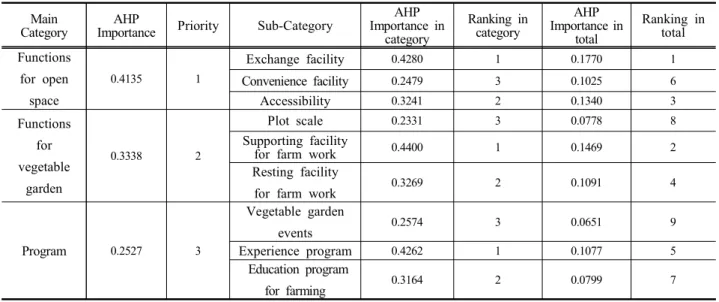
두 그룹을 대상으로 실시한 AHP분석을 통해서 텃밭 공원의 적절한 조성 및 효과적인 운영관리에 관한 세부 항목의 상대적 중요도를 각 그룹 별로 Table 7, Table 8
Main Category
AHP
Importance Priority Sub-Category
AHP Importance in
category
Ranking in category
AHP Importance in
total
Ranking in total Functions
for open space
0.4135 1
Exchange facility 0.4280 1 0.1770 1
Convenience facility 0.2479 3 0.1025 6
Accessibility 0.3241 2 0.1340 3
Functions for vegetable
garden
0.3338 2
Plot scale 0.2331 3 0.0778 8
Supporting facility
for farm work 0.4400 1 0.1469 2
Resting facility
for farm work 0.3269 2 0.1091 4
Program 0.2527 3
Vegetable garden
events 0.2574 3 0.0651 9
Experience program 0.4262 1 0.1077 5
Education program
for farming 0.3164 2 0.0799 7
Table 7. AHP Importance of evaluation criteria by General Park Users. (Respondents:8, Inconsistency ration:0.0163)
Main Category
AHP
Importance Priority Sub-Category
AHP Importance in
category
Ranking in category
AHP Importance in
total
Ranking in total Functions
for open space
0.1240 3
Exchange facility 0.2455 2 0.0304 7
Convenience facility 0.1481 3 0.0184 9
Accessibility 0.6064 1 0.0752 5
Functions for vegetable
garden
0.7281 1
Plot scale 0.6257 1 0.4556 1
Supporting facility
for farm work 0.2297 2 0.1672 2
Resting facility
for farm work 0.1445 3 0.1052 3
Program 0.1479 2
Vegetable garden
events 0.5702 1 0.0843 4
Experience program 0.1617 3 0.0239 8
Education program
for farming 0.2682 2 0.0397 6
Table 8. AHP Importance of evaluation criteria by Vegetable Garden Users. (Respondents:12, Inconsistency ration:0.0023) 에 정리하였다. 연구결과 공원 이용자, 텃밭 이용자가 중
시하는 우선순위가 명백하게 다르다는 점을 확인할 수 있었다.
공원 이용자(Table 7)와 텃밭 이용자(Table 8)를 비교 해 보면 공원 이용자는 상위항목에서 공원기능을 가장 중시하고, 텃밭 이용자는 텃밭기능을 가장 중시하였다.
이는 쉽게 상상할 수 있는 내용이다.
하지만 공원 이용자에게 텃밭기능은 2위(중요도 0.3338)로 높게 나타난 반면 텃밭 이용자에게 공원기능 은 3위(중요도 0.1240)로 1위인 텃밭기능과 큰 차이가 있 었다. 즉 공원 이용자에게 텃밭공원은 공원기능, 텃밭기
능이 함께 공존하는 공원으로 인식되고 있지만, 텃밭 이 용자에게 텃밭공원은 텃밭공간으로 강하게 인식되고 있 다. 이는 하위항목에 있어서도 명백하게 나타난다. 텃밭 이용자는 텃밭규모(1위), 텃밭활동 관련 지원시설(2위), 텃밭 내 휴게시설(3위) 등의 순으로 중시하며, 공원 내 교류시설(8위), 편익시설(9위) 등은 상대적으로 덜 중요 하게 인식하고 있었다.
공원 이용자는 공원 명칭 및 안내판 등에서 텃밭이 존재하는 공원이라는 텃밭공원의 특징을 인식하고 있으 나, 이와 달리 텃밭 이용자는 생산 공간, 분양을 통해 점 유한 공간으로 인식하고 있다. 공원 내에 조성된 텃밭인
만큼 공원 이용자와 텃밭 이용자는 서로 대면할 기회가 많다. 양자 간의 인식의 차이가 커진다면 갈등의 가능성 도 커진다.
IV. 결론 및 제언
관악구는 2012년부터 텃밭공원을 운영해오고 있으며 현재 지원자 수를 볼 때 텃밭공원의 이용자 수요는 매우 높다. 또한, 텃밭공원 조성배경에는 관할구 내에 존재하 는 불법경작지로 이용되는 공한지 문제, 녹지 소외지역 문제 등을 해결하는 방책이라는 측면도 포함되어 있어, 유사한 문제가 있는 지역에도 적용가능한 사업이다.
하지만 본 연구에서는 텃밭공원이 개인적 취미공간으 로 편향되는 경향을 확인할 수 있었다. 청룡산 텃밭공원 시행 첫해인 2012년과 2013년을 비교할 때, 가족과 여가 활동, 자녀 교육 및 학습 등 텃밭 활동을 통해서 기대하 는 교류활동에 대한 동기가 줄고 생산 활동, 취미 등 개 인 활동이 증가 하였다. AHP 분석에서 이러한 경향은 뚜렷하게 나타나 텃밭 이용자들이 중시하는 항목은 텃밭 기능에 관한 항목으로 편중되었다. 이러한 원인 중 하나 는 조성 당초 관악구가 계획하였던 텃밭 관련 교육프로 그램, 행사 등 교류에 관한 지원 활동이 충분히 이루어 지지 못한 것을 들 수 있다. 즉 텃밭공원으로서의 고유 가치가 전달되지 않고, 그 결과 텃밭 이용자에게 텃밭공 원은 시민농장과 크게 다를 바 없는 개인 경작활동 공간 으로 인식되고 있었다. 이는 텃밭을 통한 지역 주민의 교류, 생산 활동 및 수확활동을 통한 지역 내 새로운 이 벤트 창조 등 당초 계획한 희망찬 조성목적을 고려할 때 매우 안타까운 결과이다.
청룡산 텃밭공원은 공원 서비스에서 소외된 지역에 녹지공간을 제공해주고, 지역 공동체 활성화에도 기여할 수 있는 많은 장점을 지닌 공원녹지이다. 단 이러한 형 태의 공원녹지는 일반적 도시공원과는 다른 운영관리방 법이 필요하고, 이용자와 보다 밀접한 교류가 필요하다.
현재의 관악구의 공원녹지 행정이 이를 담당하기에는 인 력 부족, 프로그램 기획의 어려움, 운영비 조달의 어려움 등 많은 과제가 있다. 결과적으로 일반 도시공원과 같은 최소한의 관리에 머물 수밖에 없고 이는 텃밭공원에 기 대하는 기능을 수행하기에는 매우 부족하다. 결국 좋은 취지에서 시작한 새로운 사업이 행정에는 짐이 되고 마 는 결과를 초래하고 있다고 하겠다.
텃밭공원의 운영관리에 관해서는 개별적 텃밭의 생산 활동보다 우선순위에 둔 공원관리가 필요하며, 이를 위 해서는 지속적인 이용평가와 공동체 활성화에 관련한 프
로그램 및 활동들이 필요하다. 또한 이러한 활동의 주체 가 되는 것이 꼭 관일 필요는 없다. 중간조직 혹은 지역 주민조직이 때로는 더 잘 수행할 수 있다.
텃밭공원을 조성한 뒤 관이 해야 할 역할은 지역주민 조직이 ‘개인텃밭’이 아닌 ‘텃밭공원’ 관리에 적극적으로 참여 할 수 있도록 교육하고 활동할 기회를 제공하는 것 에 있다고 하겠다.
주1) 마을공동체공원(Community Garden)사업: 서울시 ‘동네뒷산공 원사업’의 발전된 단계로서 지역커뮤니티 활성화에 초점을 맞 춘 사업이다. 기존의 획일화된 공원시설 조성방법에서 벗어나 텃밭, 허브원 등 노인 및 중년층의 소일거리 공간과 학생층의 체험학습공간 제공을 목적으로 도입되었다. 마을공동체공원은 텃밭과 공원의 기능을 동시에 갖춘 형태로 텃밭공원이라고 할 수 있다.
주2) 동네뒷산공원사업 : 2006년부터 훼손된 동네 산자락을 공원으 로 조성해 시민들에게 휴식공간을 제공하고자 추진된 서울시 공원녹지 조성사업이다.
본 연구는 서울대학교 신임교수 연구정착금으로 지원 되는 연구비에 의하여 수행되었음
Reference
1. Ban, Y., J. Baek, N. Choi, Y. Kim and H. Woo, 2011, Role Allotment of Stakeholders According to Carbon Neutral City of Development Stages Using Expert Survey Method -Focused on Regional Innovation City of Chungbuk-. Journal of the Korean Regional Development Association 23(1): 1-14.
2. Choi, Y., D. Oh, E. Jang, S. Yoon and B. Heo, 2006, Educational Program for Enhancing on Community Garden. Korea Society for people. Plants and Environment 9(1); 7-13.
3. Choi, I., 2013, A Study on Evaluation of Shared Space Performance of Apartment from Daily Life Space Aspects. Pusan National University Doctoral Thesis.
4. Gwanak-gu office, 2011, The Design Development of Cheongryongsan Community garden project.
5. Gwanak-gu office, 2012, 2013, Plan to sell and operate a vegetable garden.
6. Harker, P., 1989, “The art and science of decision
making: the Analytic Hierarchy Process”.(eds.) B. L.
Golden, E. A. Wasil, and P.T. Harker. Analytic Hierarchy Process: Applications and Studies. Berlin : Springer-Verlag. pp3-36.
7. Heo, J. and T. Kim, 2012, Valuation and Preference of Urban Agriculture Park using Choice Experiment.
KOREAN J ORGANIC AGRI 21(2): 125-137.
8. Hong, S. and S. Park, 2003, Analyzing the Location of Urban Neighborhood Parks Using GIS and AHP Techniques. The Journal of The Korea Geographical Society 38(5): 849-860.
9. Jeong, W., W. Park and B. Cho, 2008, A Study on Evaluation Criteria of u-City Feasibility Using AHP.
The korea spatial planning review 56: 123-144.
10. Ji, T., 2012, A Study on Exploring an order of Priority in Urban Agricultural Policies: Using AHP Analysis Method. Pai-Chai University Doctoral Thesis.
11. Kang, K., J. Lee, K. Kim and M. Lee, 2007, Revitalization Planning of Urban Farming Based on Vegetable Gardens. Journal of Institute of Construction Technology 26(1): 167-176.
12. Kim, E., A. Ko, J. Lee and S. Kim, 2011, The Analysis of indicator for Low Carbon Rural Village Planning by AHP. Journal of Agricultural Extension
& Community Development 18(3): 551-567.
13. Kim, J., 2010, A Study on The Implementation of Urban Agriculture Utilizing the Idle Land. The Journal of the Regional Association of Architectural Institute of Korea Autumn Conference 2010(01):
98-103.
14. Kim, M., 2006, Industry Analysis and Recognition Research of Residents in Culture Contents of Jeju Region. Tamla Munwha 29: 45-66.
15. Kim, S., B. Jung and J. Kim, 2002,「Decision Making Analysis and Applications」. Youngji Publishers.
16. Kim, Y., S. An, C. Park and J. Choi, 2009, A Weight Analysis of Health Determinants and Healthy City Projects through Means of the AHP. Journal of the Korean Urban Management Association 22(3):
365-387.
17. Kinoshita, E. and T. Oya, 2012,「Strategic Decision-making Methods AHP」. Cheogram Book.
18. Kurihara, M., K. Furuya, K. Osanai and S. Kumada,
2003, A Study on the Evaluation of the Prospective Image of the Secondary Grassland around Kirigamine. Landscape Research Japan 66(5): 687-692.
19. Kwon, M., B. Koo and K. Lee, 2006, Establishing the Importance Weight Model of IT Investment Evaluation Criteria through AHP Analysis. Information Systems Review 8(1): 265-285.
20. Lee, W., S. Jung, J. You and K. Kim, 2007, Determination of Weight on the Integrated Indicators for Assessing Urban Sustainability. the Journal of the Korea Planners Association 42(3): 7-22.
21. Lee, W., S. Lee, M. Seo, S. Won and S. Kim, 2012, Finding the Idle Space in the City and Making Children Garden Instead of Urban Parks. The Korean Journal of Horticultural Science & Technology 30(S1):
197-197.
22. Lim, B., S. Lee and K. Lee, 2013, A Study on the Priorities of Urban Planing Factors for Energy Saving City Using Analytic Hierarchy Process: Focused on Daejeon. The Journal of The Korean Regional Development Association 25(1,75): 217-232.
23. Na, Y., 2010, Driving Projects of Urban Agriculture for the Energy Independence. Korean Journal of Environmental Agriculture 29(3): 304-308.
24. Oh, S., J. Lee and J. Ha, 2008, A Study on the Evaluation Indicators for Housing Plan on Sloped Site by Using AHP. Journal of the Regional Association of Architectural Institute of Korea 10(2): 207-214.
25. Satty, T. L., 1980, the Analytic Hierarchy Process.
New York: McGraw-Hill.
26. Son, S. and B. Yoon, 2002, A Study on Open Space Policy based on Urban Residents’ Values of Open Space. The Journal of the Korea Planners Association 37(4): 59-81.
27. Yun, H. and M. Cho, 2012, The Consideration of Progressive Urban Park and The Possibility of Urban Agricultural Park. The Journal of Korea Society of Rural Planning 18(2): 81-90.