Improved Densification and Microwave Dielectric Properties of BaO·Nd<sub>2</sub>O<sub>3</sub>·5TiO<sub>2</sub> Modified with an Iso-Component Borate Glass
Share "Improved Densification and Microwave Dielectric Properties of BaO·Nd<sub>2</sub>O<sub>3</sub>·5TiO<sub>2</sub> Modified with an Iso-Component Borate Glass"
Share "Improved Densification and Microwave Dielectric Properties of BaO·Nd<sub>2</sub>O<sub>3</sub>·5TiO<sub>2</sub> Modified with an Iso-Component Borate Glass"
Improved Densification and Microwave Dielectric Properties of BaO · Nd 2 O 3 · 5TiO 2 Modified with an Iso-Component Borate Glass
Dong Joo Shin
†
, Hyung Sub Lee and Yong Soo Cho*
Department of Materials Science and Engineering, Yonsei University, Seoul, Korea 120-749
(Received , 2008 : Accepted , 2008)
Abstract BaO ·Nd
2
O
3
·5TiO
2
(BNT) ceramics modified with a borate glass containing Ba, Nd and Ti as glass constituents were investigated with regard to their sintering behavior and microwave dielectric properties. An addition of iso-component glass significantly improved the sinterabilty of the BNT ceramics and lowered the sintering temperature. A maximum density of 5.29 g/cm
3
and an x-y shrinkage of 17% were obtained for BNT ceramics containing 10wt.% of the glass sintered at 1100
o
C. The dielectric composition without the glass additive was only slightly densified at 1100
o
C. The resulting sample exhibited two crystalline phases, BaNd
2
Ti
5
O
14
and Ba
2
Ti
9
O
20
, regardless of sintering temperature and glass content. When >10wt.% glass was added, exaggerated grain growth with a less uniform microstructure was found, resulting in the subsequent reduction of the fired density and the dielectric properties. BNT ceramics containing 10wt.% of the iso- component glass sintered at 1100
o
C for 4 h showed promising dielectric properties of k = 71.3 and Q = 1,330.
Key words titanates, glass-ceramic, microwave dielectric, densification.
1. Introduction
BaO ·Nd
2
O
3
·5TiO
2
(BNT) has been known as an important microwave dielectric material having desirable charac- teristics for applications in microwave resonators and filters.
1-12)
Cation substitution,
6,7)
composite ceramics of Ba (Mg
1/3
Ta
2/3
)O
3
,
8)
Mn addition
9)
and liquid-phase sintering
11)
were attempted to improve the microwave dielectric pro- perties such as high dielectric constant ( k), low dielectric loss and marginal temperature coefficient of resonance frequency (TCF). However, full densification of the modified BNT ceramics could not be achieved at low temperatures below 1300
o
C.
4)
In the case of pure BNT, sintering at 1500
o
C in O
2
atmosphere has been required for full densification.
The addition of a low melting compound has been the common approach to reduce the sintering temperature of ceramic materials.
11,13-14)
In this study, a new borate glass consisting of identical components such as Ba, Nd and Ti as those of the BNT ceramic was used as a sintering aid in order to facilitate the low temperature sintering of the BNT and to minimize unwanted chemical reaction that results in the significant degradation of dielectric properties. The term of so-called ‘iso-component glass’ is
used to denote the borate glass in this paper. Sintering characteristics and microwave dielectric properties of the samples were investigated as a function of sintering tem- perature and the content of the glass. Understanding of phase development, microstructure variation, and resultant dielectric properties is the major concern of this work.
2. Experimental Procedure
The BNT ceramics were prepared using the conventional mixed oxide route. Raw materials used were high purity powders of BaCO
3
(99%, Aldrich Co.), Nd
2
O
5
(99%, Aldrich Co.) and TiO
2
(99%, Aldrich Co.). The raw materials were ball-milled by yttria-stabilized zirconia balls for 24 h, dried on a hot plate while stirring with a magnetic bar and followed by calcination at 1200
o
C for 5 h.
A glass composition based on Ba-Nd-Ti-B-O was separately prepared by the conventional melting/quenching procedure. The raw materials were properly mixed by hand shaking and melted in an uncovered platinum crucible by soaking at 1450
o
C for 1h and the melt was quenched into a deionized water bath to form transparent glass junks. The quenched glass was ball milled with yttria-stabilized zirconia balls for 24 h, and then dried on a hot plate while stirring with a magnetic bar.
Different amounts of the borate glass (0-50wt.%) were
added to the calcined BNT powder and ball milled for
(2)
24 h. The mixture was dried and pressed uniaxially at
~80 MPa to form disk pellets with a diameter of 12 mm.
Sintering was performed at three different temperatures of 1000, 1100 and 1200
o
C for 4 h in air at a heating rate of 5
o
C/min.
Differential thermal analysis (TG/DTA-92, SETRAM Co., Calurie, France) was carried out for the glass frit at 5
o
C/min heating rate. The crystalline phases of the sintered pellets were identified by x-ray diffractometer (XRD, Rigaku B/Max-2500/PC, Tokyo, Japan) using CuK α radiation.
Microstructures of the sintered samples were examined by scanning electron microscopy (SEM, Hitachi S-4200, Tokyo, Japan). Microwave dielectric properties were measured using a network analyzer (Agilent 8720ES, Palo Alto, CA) in the S
21
transmission mode by Hakki-Coleman die- lectric resonator method .
12)
The temperature coefficient of resonance frequency (TCF) was measured the temperature range from 25
o
C to 70
o
C.
3. Results and Discussion
Fig. 1 shows the DTA curve of the iso-component glass.
The glass transition ( T
g
) and softening temperatures ( T
s
) were ~660
o
C and ~670
o
C respectively. The low softening point suggests that the glass can reduce densification tem- perature effectively during sintering of the BNT ceramics.
It is noticeable that one distinct crystallization peak ( T
c
) was found at 760
o
C, indicating that the glass is crystallizable.
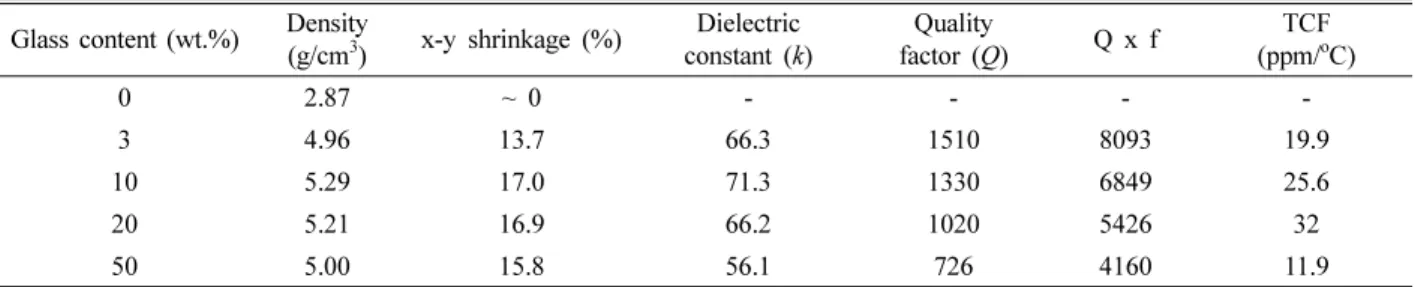
Table 1 shows the values of fired density and x-y shrinkage of BNT ceramics containing different amounts
of iso-component glass and sintered at 1100
o
C. Both the fired density and x-y shrinkage increased with increasing the amount of glass addition. A maximum density of 5.29 g/cm
3
and a highest x-y shrinkage of 17% were obtained for the sample containing 10wt.% iso-component glass. When the glass content was increased above 10 wt.%, both the density and x-y shrinkage tended to decrease gradually. Table 2 shows the sintering density and x-y shrinkage of the BNT ceramics containing 10 wt.% of iso-component glass sintered at three different temperatures. When sintering temperature increased from 1000 to 1100
o
C, the glass-ceramic exhibited a significant increase in density and x-y shrinkage. However the further increase of temperature to 1200
o
C did not seem to improve sinterability significantly.
Fig. 2 shows the XRD patterns of BNT samples containing
Table 1. Densification and microwave dielectric characteristics of the BNT ceramic containing different amounts of iso-component glass and sintered at 1100
o
C.
Glass content (wt.%) Density
(g/cm
3
) x-y shrinkage (%) Dielectric
constant ( k) Quality
factor ( Q) Q x f TCF
(ppm/
o
C)
0 2.87 ~ 0 - - - -
3 4.96 13.7 66.3 1510 8093 19.9
10 5.29 17.0 71.3 1330 6849 25.6
20 5.21 16.9 66.2 1020 5426 32
50 5.00 15.8 56.1 726 4160 11.9
Table 2. Densification and microwave dielectric characteristics of the BNT ceramic containing 10wt% of iso-component glass and sintered at three different temperatures.
Sintering temperature (
o
C) Density
(g/cm
3
) x-y shrinkage (%) Dielectric constant ( k)
Quality
factor ( Q) Q x f TCF (ppm/
o
C)
1000 4.30 11.6 47.5 667 3882 18.4
1100 5.29 17.0 71.3 1330 6849 25.6
1200 5.29 16.3 72.6 1098 5677 30.6
Fig. 1. DTA curve of the borate glass.
(3)
different amounts of the iso-component glass and sintered at 1100
o
C. Fig. 3 shows the XRD of the samples with 10 wt.% iso-component glass, which were sintered at three different sintering temperatures. All these cases showed peaks corresponding to two crystallized phases, BaNd
2
Ti
5
O
14
and Ba
2
Ti
9
O
20
. Reported studies on BNT in literature assigned different compositions such as BaNd
2
Ti
5
O
14
,
12)
BaNd
2
Ti
4
O
1216)
and Ba
3.75
Nd
9.5
Ti
18
O
5417)
for compounds existing in the Ba-Nd-Ti-O system. The present XRD data showed that the BNT ceramics sintered at 1000-1200
o
C contained BaNd
2
Ti
5
O
14
as the main phase and Ba
2
Ti
9
O
20
as a secondary phase. Presence of the secondary phase indicates that the BNT phase undergoes either partial decomposition or incomplete formation of the main phase.
11,16)
Peak intensity of both the phases tended to increase with increasing sintering temperature as well as with increasing the amount of the iso-component glass added. This is attributed to the extensive crystallization with more glass or higher sintering temperature. It is very interesting that the addition of glass did not change the
type of crystalline phases.
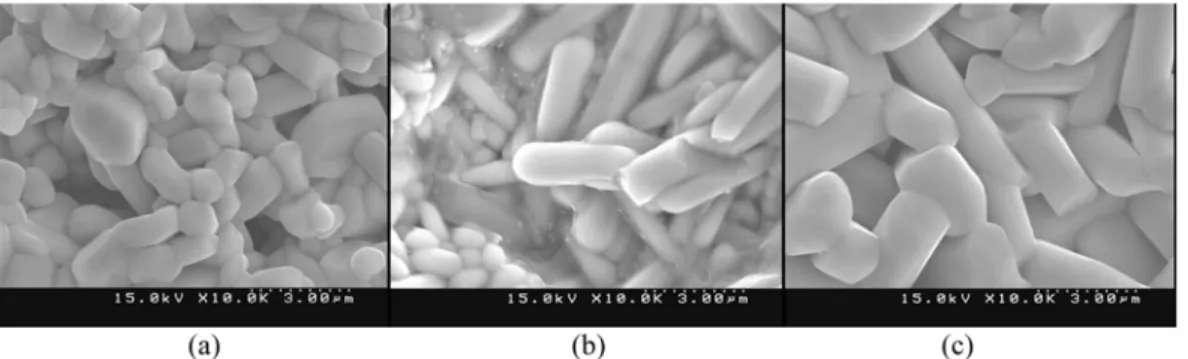
Fig. 4 shows the surface SEM images of the BNT samples containing different amount of the iso-component glass and sintered at 1100
o
C. As expected from the density and shrinkage values, BNT sample with no glass addition exhibited poor densification with many residual pores among the grains. When 10wt.% glass was added (Fig. 4b), a significant improvement in densification was found with apparent morphological changes. The micros- tructure revealed the existence of two types of grains. The large pillar-like grains, which is believed to correspond to the phase Ba
2
Ti
9
O
20
as reported,
11)
were found with isotropic grains presumably of BaNd
2
Ti
5
O
14
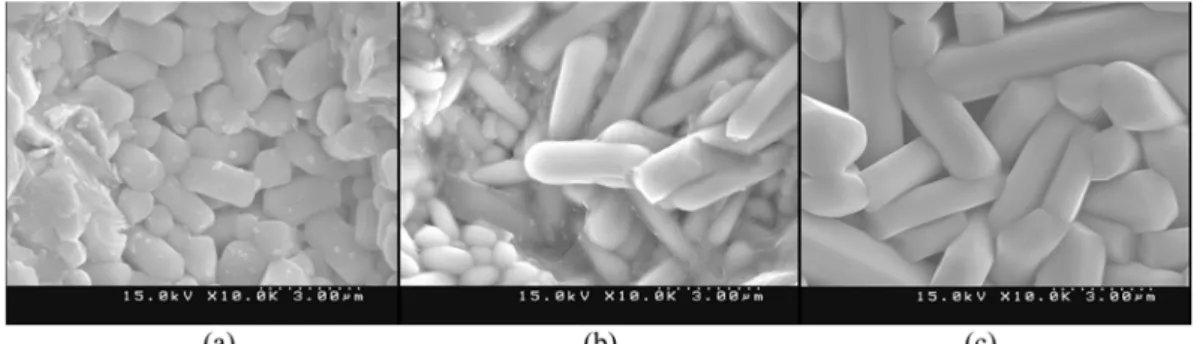
. When 50wt.% glass was added (Fig. 4c), further grain growth occurred. Fig. 5 represents the SEM images obtained for the 10wt.%
glass-containing BNT sample sintered at three different temperatures. Significant grain growth and well-densified surface resulted when sintering temperature increased from 1000 to 1100
o
C (Fig. 5b). When sintering temperature increased further to 1200
o
C, further growth of grains
Fig. 4. SEM images of BNT ceramic containing different amounts of (a) 0wt.%, (b) 10wt.% and (c) 50 wt. % iso-component glass and sintered at 1100
o
C.
Fig. 2. XRD patterns of BNT ceramic containing different amounts of the iso-component glass and sintered at 1100
o
C.
Fig. 3. XRD patterns of BNT ceramic containing 10wt.% of
the iso-component glass as a function of sintering temperature.
(4)
became more apparent. It indicates that densification and grain growth of the BNT samples strongly depend on the content of glass and sintering temperature.
Microwave dielectric characteristics of various BNT samples with the iso-component glass, sintered at different sintering temperatures from 1000 to 1200
o
C, are also shown in Tables 1 and 2. Definitely, the addition of the glass improved the dielectric properties up to 10wt.%
by showing k ~71.3 and quality factor ~1330 for the 10 wt.% glass-containing sample. Higher contents of the glass or a higher sintering temperature did not enhance dielectric properties sufficiently. The variations in dielectric properties must be correlated to the degree of densification and crystallization. Although the influence of the crystallization is unclear in this work since the same type of crystallization was found regardless of the glass content and sintering temperature, densification is believed to affect conclusively the dielectric properties. For example, the 3wt% glass sample and 1000
o
C-sinterd sample, both having lower density and shrinkage values, could not achieve the highest level of dielectric constant. The TCF value ranged from 10 to 30 ppm/
o
C, which is manageable for the subsequent compositional optimization.
It is very interesting to note that the addition of the iso- component glass did not degrade significantly the dielectric properties even though sintering temperature was reduced dramatically from the reported 1500
o
C to 1100
o
C in this work. The glass did not change the type of crystallization while its effect was proven to enhance densification signi- ficantly. It was assumed that the iso-glass approach mainly for reducing sintering temperature may be applicable for other high-temperature dielectric systems.
4. Conclusions
The effect of the iso-component glass addition was
studied by using an example of BaO · Nd
2
O
3
· 5TiO
2
dielectric materials. The iso-component borate glass consisting of Ba, Nd, Ti and B showed a low softening point of ~670
o
C. The sinterability of the BaO · Nd
2
O
3
· 5TiO
2
dielectrics, which is known to become dense at 1500
o
C in O
2
, was significantly enhanced by applying the glass as an additive at the sintering temperature of 1100
o
C. Two crystalline phases of BaNd
2
Ti
5
O
14
and Ba
2
Ti
9
O
20
phases were unexpectedly found regardless of glass content and sintering temperature. Microwave dielectric properties were strongly dependant on the glass content and the level of densification. As a promising example, the sample containing 10wt.% glass exhibited a k value of 71.3 and quality factor of 1330 at the low sintering temperature of 1100
o
C.
References
1. M. Valant and D. Suvorov, Mater. Chem. Phys., 79, 104- 10 (2003).
2. C. L. Lo, J. G. Duh, D. S. Chiou and W. H. Lee, J. Am.
Ceram. Soc., 85, 2230-5 (2002).
3. Q. Zeng, W. Li, J. Shi, J. Guo, M. Zuo and W. Wu, J. Am.
Ceram. Soc., 89, 1733-5 (2006).
4. X. M. Chen, Y. Suzuki and N. Sato, J. Mater. Sci.: Mater.
Electron., 6, 10-6 (1995).
5. Y. S. Cho and K. H. Yoon, Handbook of Advanced Electronic and Photonic Materials and Devices; pp. 175- 99, Academic Press, San Diego, 2001.
6. E. A. Nenasheva and N. F. Kartenko, J. Eur. Ceram. Soc., 21, 2697-701 (2001).
7. A. Ioachim, M. I. Toacsan, M. G. Banciu, L. Nedelcu, H.
Alexandru, C. Berbecaru, D. Ghetu and G. Stoica, Mater.
Sci. Eng. B, 109, 183-7 (2004).
8. X. M. Chen, J. Mater. Sci. Lett., 14, 1041-2 (1995).
9. A. Yamada, Y. Utsumi and H. Watarai, Jpn. J. Appl. Phys., 30, 2350-3 (1991).
10. Y. D. Xia, G. H. Shi, D. Wu and Z. G. Liu, Thin solid Films, 472, 208-11 (2005).
11. C. H. Lu and Y. H. Huang, Mater. Sci. Eng. B, 98, 33-7 (2003).
Fig. 5. SEM images of BNT ceramic containing 10wt.% of iso-component glass as a function of sintering temperature, (a) 1000
o
C,
(b) 1100
o
C and (c) 1200
o
C.
(5)
12. D. Kolar, S. Gaberscek, B. Volavsek, H. S. Parker and R.
S. Roth, J. Solid State Chem., 38, 158-64 (1981).
13. H. Kagata, T. Inoue, J. Kato and I. Kameyama, Jpn. J.
Appl. Phys., 31, 3152-5 (1992).
14. W. C. Tzou, C. F. Yang, Y. C. Chen and P. S. Cheng, J.
Eur. Ceram. Soc., 20, 991-6 (2000).
15. W. Hakki and P. D. Coleman, IRE Trans. Microwave Theory Tech., MTT-8, 402-10 (1960).
16. J. Takahashi, T. Ikegami and K. Kageyama, J. Am. Ceram.
Soc., 74, 1868-72 (1991).
17. T. Jaakola, A. Uusimaki, R. Rautioaho and S. Leppavuori,