• 검색 결과가 없습니다.

A Study on Activation Plans for Overseas Field Training and Overseas Employment to cultivate Global Leaders

N/A
N/A
Protected

Academic year: 2021

Share "A Study on Activation Plans for Overseas Field Training and Overseas Employment to cultivate Global Leaders"

Copied!
8
0
0

로드 중.... (전체 텍스트 보기)

전체 글

(1)

A Study on Activation Plans for Overseas Field Training and Overseas Employment to cultivate Global Leaders

Jiyeun Chang

1

, Kyungil Khoe

2*

1

Professor, Division of Education, Baekseok University, Korea

2

Professor, Division of Business & Commerce, Baekseok University, Korea

글로벌 리더 양성을 위한 해외현장실습 및 해외취업 활성화 방안 연구

장지연

1

, 고경일

2*

1

백석대학교 사범학부 교수,

2

백석대학교 경상학부 교수

Abstract This study tried to diagnose the status of overseas field training and overseas employment through questionnaire surveys, FGI, and success case analysis, and to find implications for the educational direction that universities should take for the efficient operation of overseas employment programs. Specifically, surveys and interviews were conducted for participating students to diagnose the problems of current field training and overseas employment programs, and systematize the derived requirements to extract desirable field training and overseas employment program operation guidelines, and students The purpose of this study was to derive improvement plans and policy proposals by analyzing the causes that affect the satisfaction of employees' on-the-job training and overseas employment.

Key Words : Overseas Field Training, Overseas Employment, FGI, Diagnosis, Global Leader

요 약 최근까지 해외 현장실습 및 해외취업 관련 연구들은 이론적 고찰, 실태 분석, 해외 노동시장 동향 분석과 같이 주로 노동시장과 관련한 이슈들을 다루어 왔을 뿐 실제로 다양한 국가에 파견되어 현장실습 및 해외취업 업무를 경험 한 사람들을 대상으로 설문이나 인터뷰를 통해 실질적인 니드(need)를 파악하고자 하는 연구는 많이 진행되지 못하여 왔다. 본 연구에서는 설문조사, FGI, 성공사례분석 등의 다양한 방법론을 적용하여 해외현장실습 및 해외취업 당자사들 의 현황을 심도있게 진단해 보고, 이를 통해 향후 해외취업 프로그램의 효율적 운영을 위해 대학이 취해야 할 교육 방향에 대해 살펴보고자 하였다. 구체적으로, 해외현장실습 및 해외취업 참여 학생들을 대상으로 설문조사와 인터뷰를 실시하여 현재의 현장실습 및 해외취업 프로그램의 문제점을 진단하고, 도출된 요구사항들을 체계화함으로써 현장실습 및 해외취업 프로그램에 대한 바람직한 운영지침을 도출하고, 학생들의 현장실습 및 해외취업 만족도를 제고하기 위한 개선방안과 정책적 대안들을 도출해 보고자 한다.

주제어 : 해외현장실습, 해외취업, FGI, 진단, 글로벌리더

*Corresponding Author : Kyungil Khoe([email protected]) Received October 6, 2020

Accepted November 20, 2020 Revised November 6, 2020

Published November 28, 2020

(2)

1. Introduction

Today, a very serious youth unemployment problem is an issue that has emerged since the IMF bailout. The new Korean situation of growth without employment has caused increasing job insecurity and social problems such as the massive surge of non-regular workers, and the resulting deterioration in the domestic job market has become a reality. In addition, although export growth is driven by a small number of specific industries and companies securing global competitiveness, the stagnation of many industries and domestic industries without global competitiveness created an environment in which employment cannot occur.

Accordingly, the term '880 thousand won-generation' was also widely used at one time, reflecting the gloomy reality of youth unemployment. However, companies are demanding higher competitiveness in the job market.

Entering the 2000s, the government arbitrated that human competitiveness was an important factor in determining national competitiveness, and thus prepared various support plans to expand the employment stage of young people to the global market and gain various overseas experiences. This overseas experience was a great opportunity not only to cultivate key human resources to lead the country's growth, but also to produce global talents that the companies required. In recent years, the international community has determined that the human competitiveness influences the national competitiveness amid global infinite competition, and has focused on “knowledge” and “human resource development”, such as establishing a national future strategic plan that includes education, training, and employment.

Therefore, in this study, in order to expand the employment stage of our students from the domestic labor market to the global market, and

to support our students to gain various overseas experiences, we analyzed the manpower training programs for field training by collecting the opinions of students who have experience in employment, we intend to suggest a direction for establishing a policy for fostering global talent and developing programs.

2. Theoretical Background

No one can deny that globalization is acting as one of the most important driving forces for the development of the global economy [1]. The area of economic activity, which was operated mainly by the country, is expanding to a wider market, and it has been a long time since the geographical and physical boundaries between countries have been broken [2]. In such a business environment, companies have learned that securing talented individuals with global capabilities to perform their duties in overseas markets is an important factor in business success, and recognize that securing corporate competitiveness and continuing business through talent acquisition [3]. In the research of many scholars, overseas field practice is being evaluated positively in terms of cultivating global competencies through work experience in an actual overseas business environment. Feldman &

Bolino (2000) conducted research on US graduate students who had experienced overseas field training in 23 countries around the world, and it was found that both participating students and field training institutes helped to acquire and develop new skills [4].

In a study by Nohara et al. (2008), a survey of

satisfaction with students participating in

overseas field training at the Tokyo Institute of

Technology and training institutes showed that

both sides were highly satisfied with the program

[5]. Toncar & Cudmore (2000) studied the

benefits of participating students through

(3)

overseas field training conducted for 6 weeks at Oxford University in the UK for business students. Factors such as 'forming a global human network', 'International work experience', 'personal growth' and 'career management' appeared as benefits [6]. Cusher & Mahon (2002) conducted a study on US university students who experienced field training in Austria [7], New Zealand, and Ireland. Overseas field training gave the participating college students 'improvement of understanding of foreign cultures' and 'self-efficacy through adaptation to foreign cultures' and 'Global mind formation'.

Emstrong & Jones (2007) conducted research on students at San Diego State University in the United States who conducted overseas field training in Thailand [8]. The effect of overseas field training resulted in 'understanding of foreign cultures and social norms' and 'through experience of language barriers’. It suggested 'understanding of ethnic minorities', 'increased interest in international and regional issues', and 'improving problem solving ability'. In addition, Bandura (1997) argues that it is possible to improve job competency to work in overseas companies by learning jobs and strengthening work capabilities through observation, imitation, and interaction in various situations encountered while performing work in overseas companies [9]. In a domestic study, Jang Won-seop et al.

(2012) said that overseas field training is a characteristic of gaining experience abroad, so that foreign language skills and job performance skills naturally improve through local life and work, helping to improve the employment ability of participants [10].

Hwang-Won Lee (2011) described the success factors of university students' overseas field training: 'activation of pre-exchange between sister universities abroad', 'improvement of language skills of university student participants', 'holding a result report at the end of internship', 'culture of the country where internships work’

and ‘preliminary knowledge of history and lifestyle habits' were presented [11,12]. Because of these advantages, universities are actively using overseas field training to improve the job skills of students, and the scale is expanding.

However, compared to high level of interest, related domestic studies are insufficient. The reason for this is that it is relatively difficult to select targets for overseas field training who are dispatched to various countries to perform tasks, and conduct surveys and in-depth interviews from them. In addition, as in other education and training studies so far, the resultant measure focuses on the quality of employment such as 'employment status or wage level after completion of internship', 'employment type' and 'company size'. The approach was the main research, and it is a reality that research on the employment possibility linked to the curriculum or competency development was insufficient [13,14].

In summary, it can be said that there were limitations in conducting a research that proves the effectiveness of overseas internships more empirically and objectively, improves the system and proves the effectiveness based on this [15].

3. Status Diagnosis through Survey and FGI

In this study, a survey was conducted on current students or graduates who have experienced overseas employment (overseas field practice). The total number of respondents to the questionnaire was 109. Dividing the sample group by gender, females accounted for 56 persons, 51.4% of the total 109 persons, and males 53 persons, 48.6%. Also, as for the academic background of the sample, 98 were college graduates and 11 were enrolled students.

In the case of situational assessment, the

purpose of participating in overseas employment

(4)

(overseas field training) was the highest in the case of ‘helping my career development in the future,’ followed by ‘improving foreign language proficiency’ and ‘request for overseas experience.’ As for the need for an overseas employment (overseas field practice) program, it was necessary, but accounted for 98.2%, and the channels for obtaining information about overseas employment (overseas field practice) were in the order of professors, neighbors, schools, others, and families. Among the people who influenced the decision to participate in overseas employment (overseas field training), 89% of the people were responsible, and the countries interested in overseas employment (overseas field practice) were in the order of the Americas, Japan, and Australia/New Zealand.

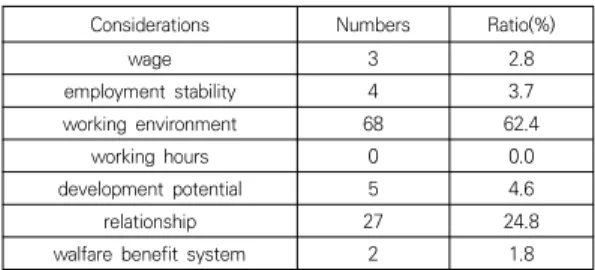
Work environment, human relations, development potential, and employment stability were discussed as considerations for overseas employment (overseas field practice). As for difficulties in preparing for overseas employment (overseas field practice), information on the economics and preparations The survey was conducted in order of shortage, lack of government for foreign industries, and lack of cases of experienced people.

Table 1. Considerations for overseas employment (overseas field training)

Considerations Numbers Ratio(%)

wage 3 2.8

employment stability 4 3.7

working environment 68 62.4

working hours 0 0.0

development potential 5 4.6

relationship 27 24.8

walfare benefit system 2 1.8

Foreign-affiliated companies accounted for 53.2% and Korean-based companies 40.4% in the type of organization and type of business that performed overseas employment (overseas field training), and services (53.2%), technology/

Research (44%) and trade (2.8) were high, and the

relevance between the institutions that conducted overseas employment (overseas field training) and the field of employment hope was very high. The average daily working hours was usually 6-8 hours, and the desirable role of a university or professor for overseas employment (overseas field practice) is to monitor and manage progress, and mediator between companies and students, major knowledge education, foreign language education, and local adaptation education.

Table 2. University or faculty's desirable role

Desirable role numbers ratio(%)

progress check 61 56.0

mediator of company and strudent 27 24.8

major knowledge 11 10.1

local adaption 2 1.8

foreign language 5 7.3

Finally, the fidelity of preparation for overseas employment (overseas field training) was high in job information, prior contact with the person in charge, and preparation for work-related in advance.

In the case of input evaluation, the degree of agreement between the work performed and the subject's major was high, and the specificity of the overseas employment (overseas field practice) program plan, the systemicity of the overseas employment (overseas field practice) program, and overseas employment (overseas field practice) The degree of support from departments and staff were also high.

In the case of course evaluation, 61.5% of the

cases were evaluated as to whether or not the

participants of overseas employment (overseas

field practice) were evaluated, and the subject of

evaluation was the institution’s supervisor,

institution’s HR, university-related personnel, and

advisors. As for the overseas employment

performance evaluation method, 77.3% of the

work evaluation and 21.6% of the report were

written. In the case of a survey on the work

(5)

experience of an agency (company) performing overseas employment (overseas field training), 72.5% of the respondents answered positively about the necessity of prior training, and 73.4%

of the active guidance of mentors or supervisors also answered positively. The mentor or supervisor's leadership capacity is 74.3%, the working environment is 62.3%, the treatment/treatment excellence is 58.7%, the friendly culture is 85.2%, the mentors/supervisors communication is 65.1%, and the employees communicate with each other. In the overall evaluation, positive responses were dominated by 87.1%, 92.6% for the level of effort for the given task, and 87.2% for the job level. In the case of re-application for overseas employment, 87.2%

gave a positive answer, and the intention of recommending overseas employment also showed a positive evaluation of 87.2%.

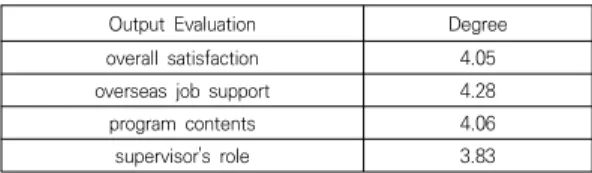
In the case of output evaluation, satisfaction in the process of participation in the overseas employment (overseas field practice) program was high. Compared to that, it was found that a lot of low salaries and limitations of task assistance were selected for practical work acquisition. Satisfaction with the overseas employment (Overseas Field Practice) program was evaluated high with an overall satisfaction of 4.05 points, an overseas job support satisfaction of 4.28 points, a program contents satisfaction of 4.06 points, and a supervisor's role satisfaction of 3.83 points, respectively. It is analyzed that what was low was evaluated differently depending on the degree of experience or the presence or absence of professors with overseas-related business experience by university or by major.

Table 3. Satisfaction with the Overseas Employment (Overseas Field Practice) Program

Output Evaluation Degree

overall satisfaction 4.05

overseas job support 4.28

program contents 4.06

supervisor's role 3.83

Therefore, in order to revitalize overseas employment (overseas field practice), it is important to create a good educational program for students and develop industries, but it is also considered necessary to provide opportunities for professors to develop global competencies for overseas employment (overseas field practice). As for the satisfaction level of each participant decision, the person who made the participation decision with the highest satisfaction level of support for overseas employment (overseas field training) was identified (4.33 points), and this is only when the person decides to participate. It is understood that the degree of support provided has a significant influence on the decision to participate.

In the self-assessment of the Overseas Employment (Overseas Field Practice) program, the item 'I have cultivated my practical skills through overseas employment (overseas field practice)' was rated the highest with 4.16 points.

In the case of the effect of participation in the overseas employment (overseas field practice) program, it was analyzed that it was helpful for career decision and then 4.08 points, and 4.17 points after improving the effect of university education, which gave a positive effect. In contrast, the improvement of foreign language ability and work ability in the major field showed a high score of 3 points.

From the results of FGI (Focus Group Interview) analysis, it was found that students have high expectations for overseas field training, and there are many students who experience their major in the field and evaluate it as a necessary course for future planning.

When comparing before and after the on-site

training, the opinion that a lot of things can be

learned through field experience and the fact

that it is evaluated by one's own work ability

rather than the reputation of the school abroad,

and the opinion that the goal has been adjusted

upward, are also on the overseas field practice. It

(6)

is believed to be a valuable result that can be obtained. On the other hand, there were also requirements for the university, such as supplementing programs to improve language ability, the efforts of the university to mediate between students and local companies, and operating long-term projects of at least one year or two to three years. It was found that there is a need to develop a program that can solve the loneliness and nostalgia for the home country.

4. Case analysis

This is based on the review and analysis of the problems of the conventional industry-university cooperation manpower nurturing system, In a survey of 1,313 students who were employed through K-Move from 2013 to 2016, University B in Cheonan showed that 95.0% said 'overseas employment helped' and 88.5% said 'willing to work abroad again. Reflecting the needs of these students, the university has made an agreement to select more than 20 interns each year through steady meetings with the head offices of hotels and resorts, which have been conducting internships for 10 years, and to apply to the head office to excellent students. Behind these achievements, there was a steady effort at the university level. Through overseas business trips three to four times a year, students were guided to adapt and work well, and the requirements of local managers were reflected in the educational content. In addition, through annual business trips to the head office located in Tokyo, which has the authority to make decisions, the university's efforts for overseas employment and contents of education were shared, and a graduation ceremony was held in the region (Guam) to maintain close industry-university cooperation. Thanks to these efforts, companies and schools have a step-by-step system for mutual cooperation and growth.

In the first stage, a briefing session introducing overseas employment and overseas field training is held, providing procedures for preparing for overseas employment and examples of seniors. If there is a student who wishes, it is possible to prepare for overseas employment with seniors and classmates in the undergraduate overseas employment club. In addition, in-depth counseling was possible at any time by operating a system of foreign employment-only professors in each country. In the second phase, the department dedicated to overseas employment at the university (Global Talent Development Office) held a briefing session to prepare students for overseas employment every year. In addition, by inviting seniors with overseas employment experience, they provided an opportunity to hear the know-how of overseas employment and realistic stories of overseas employment. Students who wish to work abroad (overseas field training) through the preparation stage will cultivate the skills necessary for the desired company through three customized education programs such as K-Move, Cheonghaejin, and the university itself reflecting the requirements of overseas industries. In addition, during this period, the programs introduce industries that can work abroad (overseas field training), basically matches them so that they can apply to the companies they want, and provides at least three interview opportunities.

In the 3rd stage overseas employment

(overseas field practice) process, mentoring with

a supervisor at least once a month is conducted

by wire or wireless (Kakao Talk, e-mail, etc.) so

that students can adapt well and develop their

desired competencies. Monitor student

adaptation through travel and contact with local

managers and general managers. In the final

termination and reorganization phase, students

who wish to find employment at the head office

two months before the end of the one-year

course and received excellent evaluations are

(7)

recommended to the head office so that they can be hired as full-time employees before the end of the course.

5. Conclusion and Limitation

This study is based on the cooperation of general universities and vocational colleges that are sending overseas field training and overseas employment to about 10 countries (US, Japan, Singapore, Australia, Hong Kong, etc.). The conclusions and implications are as follows.

First, by examining the field trips and field training systems of each country, it was possible to recognize commonalities and find complementary points from the standpoint of Korea. It was analyzed that most advanced countries operate various types of on-the-job training systems to suit the needs of students, such as long- and short-term on-the-job training programs or different tracks for each track. In particular, since most of the operating university faculty are adjunct professors in the industry or tend to be highly related to the industry, it is judged that it is necessary to prepare for field practice and further overseas field practice by making good use of the university or industry-centered professor system.

Second, through a questionnaire survey consisting of situation/input/process/output evaluation and result analysis, this study is thought to be able to help in deriving desirable conditions for overseas field practice. First, in order to increase the level of satisfaction of the participants, it is judged that the person's willingness to participate must be strong, and it is necessary to clearly set the goal of overseas field training. It was analyzed that the university system should be built. In addition, it is essential that the field work evaluation of students is performed so that the motivation of the students can be certain, and the selection of a company

whose working conditions and corporate culture are not heterogeneous and that the interaction with local workers can be satisfactory is also performed. It can be seen that it is acting as a factor that determines the success of the company.

In addition, we recognize that the purpose of overseas field training is not to earn money, but rather to improve overseas experience and global competence, enhance language skills, and expand employment opportunities and employment possibilities through specialization.

Third, through case analysis, it was possible to explore the characteristics of universities where overseas field training is well operated. There is a well-prepared overseas field training support system in stages. Specifically, preliminary training should be preceded in the process of preparing for this from before the field input, and a human/financial support system that can support it in the process of preparation and initiation should be established, and regular relationships with local companies should be established. People should have the know-how on business trips and management, and efforts to enhance the effectiveness of the overseas field training program should be carried out so that after the completion of the field training, direct employment can be carried out at the related business and related companies, instead of being in a hurry.

The limitations of the study are as follows.

First, the sample size is relatively small. In the future, it is necessary to acquire more samples.

Second, it is necessary to analyze the differences

according to the countries in which they have

entered. Third, it is necessary to further

investigate the satisfaction of local companies

with participating students. It is expected that

better implications can be obtained by

supplementing these limitations.

(8)

REFERENCES

[1] Silvia (2015). Economic Globalization: From Microeconomic Foundation to National Determinants.

Procedia Economics and Finance, 27, 731–735.

[2] Wim den Dekker, Paul G. W. Jansen & Claartje J.

Vinkenburg. (2005). Dimensions of an Individual Global Mindset, Serie Research Memoranda 0014, VU University Amsterdam, Faculty of Economics, Business Administration and Econometrics.

[3] B. A. Moran, P. Jacobs & C. A. Bunn (2007).

Multi-agency working: implications for an early intervention social work team. Child & Family Social Work, 12(2).

[4] D. C. Feldman & M. C. Bolino (2000). Career Patterns of the Self-Employed: Career Motivations and Career Outcomes. Journal of Small Business Management.

[5] K. Nohara, M. Norton, M. Saijo & O. Kusakabe. (2008).

Overseas Internships as a Vehicle for Developing a Meta-Level Awareness Regarding Science Communication. Journal of Science Communication, 7(1), 1-12.

[6] M. F. Toncar & B. V. Cudmore. (2000). The Overseas Internship Experience. Journal of marketing Education, 22(1), 54-63.

[7] K Cusher & J. Mahon (2002). Overseas student teaching: Affecting personal, professional, and global com-petencies in an age of globalization. Journal of Studies in International Education, 6(1), 44-58.

[8] D. Emstrong & L. P. Jones (2007). A broadened horizon: The value of international social work internships. Social Work Education, 26(2), 136-145.

[9] A. Bandura. (1997). Self-efficacy: The exercise of control. W H Freeman/Times Books/ Henry Holt &

Co.

[10] W. Jang, S. Oh & M. Kim. (2012). A Study on the Mid- to Long-Term Development Plan Policy for Government Overseas Internship Business. National Institute of International Education.

[11] H. W. Lee. (2011). Analysis of the success factors of overseas internships for university students to foster global talent. HRD, 13(1), 139-162.

[12] Y. S. Choi & Y. K. Kim. (2012). Effectiveness and Improvements of the Government-Sponsored College Internship Program in Hospitality Industry. Journal of Tourism Management Research, 16(3), 79-96.

[13] M. S. Jeong. (2009). A plan to improve statistical indicators for measuring the effectiveness of vocational competency development project. Korea Labor Institute.

[14] M. Yorke & P. Knight. (Reprinted 2006). Embedding employability into the curriculum. York, Higher Education Academy.

[15] K. Khoe, S. H. Song & J. Y. Cho. (2020). Activation Plans for Overseas Field Training and Overseas Employment to cultivate Global Leaders , Korea Sanhak Foundation.

장 지 연(Jiyeun Chang) [종신회원]

․ 1996년 2월 : 중앙대학교 대학원 교육 학석사

․ 2002년 8월 : 중앙대학교 대학원 교육 학박사

․ 2004년 3월 ~ 현재 : 백석대학교 사범 학부 교수

․ 관심분야 : 교육심리, 교육철학, ICT 교육, 미래교육, 학습동기

․ E-Mail : [email protected]

고 경 일(Kyungil Khoe) [정회원]

․ 1995년 8월 : 서강대학교 경영학과 석 사

․ 2003년 2월 : 서강대학교 경영학과 박 사

․ 2003년 1월 ~ 2004년 2월 : 삼성경 제연구소(SERI) 금융실 연구원

․ 2004년 3월 ~ 현재 : 백석대학교 경상 학부 교수

․ 관심분야 : IT중소기업, 정책융자, 기업사례

․ E-Mail : [email protected]

수치

Table  2.  University  or  faculty's  desirable  role
Table  3.  Satisfaction  with  the  Overseas  Employment  (Overseas  Field  Practice)  Program

참조

관련 문서