• 검색 결과가 없습니다.

Cis-acting Replication Element Variation of the Foot-and-mouth Disease Virus is Associated with the Determination of Host Susceptibility

N/A
N/A
Protected

Academic year: 2021

Share "Cis-acting Replication Element Variation of the Foot-and-mouth Disease Virus is Associated with the Determination of Host Susceptibility"

Copied!
9
0
0

로드 중.... (전체 텍스트 보기)

전체 글

(1)

Cis-acting Replication Element Variation of the Foot-and-mouth Disease Virus is Associated with the Determination of Host Susceptibility

Hyo Rin Kang

1

, Mi So Seong

1

, Bok Kyung Ku

2

and JaeHun Cheong

1

*

1

Department of Molecular Biology, Pusan National University, Busan 46241, Korea

2

Animal and Plant Quarantine Agency, Gimcheon, Gyeongsangbuk-do 39660, Korea

Received September 10, 2020 /Revised September 21, 2020 /Accepted September 28, 2020

The foot-and-mouth disease virus (FMDV), a member of the Aphthovirus genus in the Picornaviridae family, affects wild and domesticated ruminants and pigs. During replication of the FMDV RNA (ribonucleic acid) genome, FMDV-encoding RNA polymerase 3D acts in a highly location-specific manner. This suggests that specific RNA structures recognized by 3D polymerase within non-coding regions of the FMDV genome assist with binding during replication. One such region is the cis-acting replication element (CRE), which functions as a template for RNA replication. The FMDV CRE adopts a stem-loop conformation with an extended duplex stem, supporting a novel 15-17 nucleotide loop that derives stability from base-stacking interactions, with the exact RNA nucleotide sequence of the CRE producing different RNA secondary structures. Here, we show that CRE sequences of FMDVs isolated in Korea from 2010 to 2017 exhibit A and O genotypes. Interestingly, variations in the RNA secondary structure of the Korean FMDVs are consistent with the phylogenetic relationships between these viruses and reveal the specificity of FMDV infections for particular host species. Therefore, we conclude that each genetic clade of Korean FMDV is characterized by a unique functional CRE and that the evolutionary success of new genetic lineages may be associated with the invention of a novel CRE motif. Therefore, we propose that the specific RNA structure of a CRE is an additional criterion for FMDV classification dependent on the host species. These findings will help correctly analyze CRE sequences and indicate the specificity of host species for future FMDV epidemics.

Key words : CRE, FMDV, host susceptibility, RNA structure, virus variation

*Corresponding author

*Tel : +82-51-510-2277, Fax : +82-51-513-9258

*E-mail : [email protected]

This is an Open-Access article distributed under the terms of the Creative Commons Attribution Non-Commercial License (http://creativecommons.org/licenses/by-nc/3.0) which permits unrestricted non-commercial use, distribution, and reproduction in any medium, provided the original work is properly cited.

Introduction

The foot-and-mouth disease virus (FMDV), which causes severe vesicular disease in livestock, is a member of the Aphthovirus genus in the Picornaviridae family [2, 3]. The FMDV has high potential for antigenic and genetic variation;

based on their induction of cross-protection in host animals, seven serotypes (A, O, C, Asia1, SAT 1, SAT 2, and SAT3) of FMDV have been identified [5, 20]. Additionally, ad- vances in DNA sequencing have dramatically increased the rate at which genotypic and phenotypic variants of FMDV are identified [4].

Replication and translation of FMDV RNA occur in asso- ciation with the cell membrane in the cytoplasm of infected cells. The most critical step of FMDV replication is RNA-de-

pendent RNA synthesis by 3D polymerase, which requires a regulatory network involving viral-encoded proteins (3B and 3D), various host factors, and a non-coding structural RNA element. The 5’ UTR contains two highly structured RNA sequences; the cloverleaf, required for genome repli- cation, and the internal ribosome entry site, which directs translation initiation[8]. RNA replication is carried out on membranous structures by viral RNA-dependent RNA poly- merase in conjunction with other viral and cellular proteins and cis-acting replication element (CRE) [10, 19]. The viral RNA structure is critical for several essential functions, in- cluding replication, translation, and encapsidation [14].

Determining the structure of viral RNA has broadened our understanding of its involvement in the viral infection cycle [9, 24].

Replication of the FMDV is initiated by the 3B protein,

which acts as a primer [7]. Uridylylation by FMDV VPg oc-

curs in a template-dependent manner and requires a small

stem loop structure in the CRE as a natural template [17,

18, 22]. This reflects a common theme among many eukar-

yote-infecting viruses, which have evolved a variety of

mechanisms to manipulate cellular transcription and trans-

(2)

lation machinery, in many cases via elegant RNA-centered strategies.

FMDV can spread through direct or indirect contact with infected animals and related products or by long-distance airborne transmission. Such spreading can occur in an ex- tremely rapid manner for a variety of reasons, including the small amount of virus required to initiate infection, the large amount of virus excreted by affected animals, and the multi- ple routes of infection [23]. Additionally, the rate by which a population of viruses, including the FMDV, evolves can be influenced by genomic mutation rates, genomic archi- tecture, and the speed of replication and recombination [1].

The biological significance of the CRE secondary structure in the 5’ UTR of FMDV is unclear. RNA functionality arises from its ability to fold into complex 3D structures and, often, its ability to change conformations to enable different func- tions, such as binding other types of RNA molecules or proteins. Interestingly, an extensive pan-flavivirus sequence analysis proposed that duplicated or repeated RNA motifs are associated with the acquisition of multiple hosts during viral evolution [9]. Experimental data from a dengue virus model indicated that RNA replication allows viruses to accu- mulate mutations that are beneficial in one host but delete- rious in another, conferring robustness during host switch- ing [24]. Additional studies have revealed the existence of different dengue virus RNA structures in two types of hosts [6, 15, 25]. FMDV infection is usually easier in cows than in pigs, but FMDV replication and transmission are more rapid in infected pigs than in infected cows. Since 2010, FMDV epidemics in Korea seem to be sensitive and specific to one type of host. In this study, we determined that the secondary structure of the FMDV CRE plays a role in de- termining the host specificity of an infection. These results, thus, assist in shedding light on FMDV evolution and host adaptation.

Materials and Methods

FMDV stock production

Viruses were isolated from LFBK (porcine kidney), ZZR- 127 (goat fetal tongue epithelium) and BHK-21 (baby ham- ster kidney) cell lines obtained from the ATCC (LGC Standard). Viurs isolation was performed according to the OIE manual (http://www.oie.int/fileadmin/Home/eng/

Health_standards/tahm/2.01.05_FMD.pdf). To produce an

amplified stock of inoculum for viral serotypes A and O, two cell batches per serotype were inoculated with plaque forming units (PFUs) of field-collected vesicular fluid. For amplification of FMDV, cells were harvested after 24 hr in- fection and subsequently repeated freezing-thawing three times. The supernatants were collected in tubes and an equal volume of MEM with 25 mM HEPES was added to each tube before freezing at -70°C.

RT-PCR and FMDV RNA sequencing

FMDV RNA was extracted using an automatic RNA ex- traction machine (MagNA Pure 96, Roche), according to the manufacturer’s instructions. RNA was stored at -70℃ until use. cDNA was synthesized using a PrimeScript

II 1st strand cDNA Synthesis Kit (TAKARA). Briefly, a 10 μl re- action mixture was prepared containing 10 mM dNTP, 1 μl oligo dT primer (50 μM), 3 μl RNase Free dH

2

O, and 5 μl viral RNA. The mixture was incubated for 5 min at 65°C then cooled immediately on ice. Next, the reaction was mixed with 10 μl of a second reaction mixture containing 5X PrimeScript II buffer, 0.5 μl 40 U/μl RNase inhibitor, 1 μl enzyme, and RNase-free dH

2

O. The mixture was then in- cubated at 42°C for 45 min, then 70°C for 15 min.

The entire genome was amplified using AccuPower®

ProFi Taq PCR PreMix (BIONEER, Korea), according to the manufacturer’s instructions, with nine overlapping pairs of FMDV-specific primers. RT-PCR products were analyzed by QIAxcel (Qiagen).

Purified PCR products were either sequenced directly or after cloning into the pGEM-T easy vector (Promega, USA).

DNA sequencing was performed using an automatic DNA sequencer (ABI 3730) using the BigDye Terminator v3.1 cycle sequencing kit (ABI, USA). Analyses of sequence identity and divergence were carried out using BioEdit software (version 7.2.5.). PCR product sequences were assembled with SeqMan Pro software (DNASTAR, Inc., Madison, WI, USA) using default parameters.

Analysis of sequence arrangement

The FMDV genomic sequence was confirmed based on

our sequencing results and the NCBI database. Viral gene

sequences were arranged using a ClustalW multiple se-

quence alignment of full FMDV genome sequences. Amino

acid sequence alignments of FMDV genes were also per-

formed.

(3)

Table 1. Foot-and-Mouth Disease Viruses used in this study

No. Isolate Serotype Topotype& Genotype Host

species

Collected

year Accession no.

1 2 3 4 5 6 7 8 9 10 11

O/AD/SKR/2010/C O/GH/SKR/2010/C A/PC/SKR/2010/C O/08/SKR/2011/C O/JC/SKR/2014/P O/US/SKR/2014/P O/GJ/SKR/2016/P O/GC/SKR/2016/P O/BE/SKR/2017/C O/JE/SKR/2017/C A/YC/SKR/2017/C

O O A O O O O O O O A

SEA/Mya-98 SEA/Mya-98 Asia/Sea-97 SEA/Mya-98 SEA/Mya-98 SEA/Mya-98 SEA/Mya-98 SEA/Mya-98 ME-SA/Ind2001e ME-SA/Ind2001e

Asia/Sea-97

Swine Swine Swine Cattle Swine Swine Swine Swine Cattle Cattle Cattle

2010 2010 2010 2011 2014 2014 2016 2016 2017 2017 2017

KF112887  KF002886 KC588943 KR401160.1

KX162590 KY322674.1

KY086465 KY086466

*APQA

*APQA

*APQA 

* Unpublished sequence by APQA Phylogenetic analysis

Aligned sequences were used to construct a phylogenetic tree via the neighbor-joining method using MEGA 2.1 software. Evolutionary distances were calculated using Kimura’s two parameter model. The reliability of branching orders was estimated by bootstrapping (1000 replicates). The tree was rooted using the FMDV serotype O strains [O1/

Kaufbeuren (GenBank accession no: X00871), O1/Campos (AJ320488) and O2/Brescia (M55287)] as outgroups. Percent- age similarities/differences were estimated using the Meg Align program from the Lasergene package (DNASTAR Inc., USA).

Modelling the RNA secondary structure

We predicted the RNA secondary structure of the FMDV CRE region using the Fold Web Server (http://rna.urmc.

rochester. edu/RNAstructureWeb/Servers/Fold/Fold.html) with the lowest free energy calculation.

Results

Sample collection and sequence variation analysis of FMDV non-coding regions

Clinical isolates were collected from suspected FMDV outbreaks in Korea from 2010 to 2017 (Table 1). These iso- lates were classified as either A or O. Strain names were generated and recorded as serotype/outbreak place/SKR (South Korea)/outbreak year. Serotype O strains were am- plified in cows and labelled O/GH/SKR/2010, O/AD/

SKR/2010, O/BE/SKR/2017, and O/JE/SKR/2017. Sero- type O strains were amplified in pigs and labelled O/AD/

SKR/2010, O/YJ/SKR/2010, O/JC/SKR/2014, O/US/SKR/

2014, O/GJ/SKR/2016, and O/GC/SKR/2016. Serotype A strains amplified in cows were labelled A/PC/SKR/2010 and A/YC/SKR/2017 and produced yields above 100 PFU/

mL in BHK-21 cells. Viral RNA was extracted using an RNeasy mini kit (Qiagen), and the full genome was PCR-am- plified using a Qiagen one-step reverse transcriptase PCR (RT-PCR) kit and 19 overlapping pairs of FMDV-specific pri- mers based on the sequence of O/SKR/JC/2014 (GenBank accession no. MG257782). PCR products were directly se- quenced using an ABI 3730XL with the BigDye Terminator v3.1 cycle sequencing kit. PCR product sequences were as- sembled using ClustalW multiple sequence alignments with default parameters using BioEdit software (version 7.2.5.).

A single open reading frame (ORF; protein-coding region) was predicted by comparing the O/SKR/JC/2014 sequence with the FMDV reference sequence (GenBank accession no.

MG257782). Sequence homology was determined using BLAST via the NCBI website.

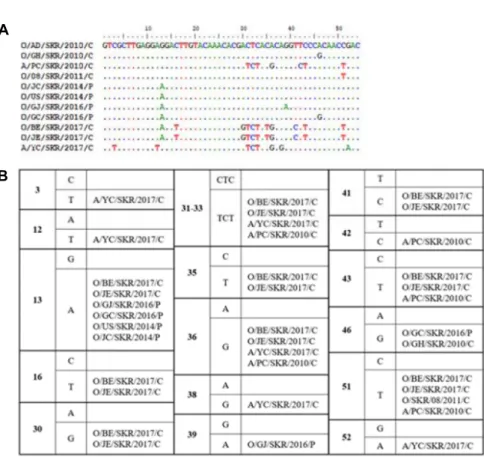
After obtaining the full sequences of 11 different FMDV strains, we focused on the genetic variation of CRE sequen- ces. Fig. 1A shows 55 nucleotide-long CRE sequences of 11 FMDV strains isolated during epidemics from 2010 to 2017 based on the O/AD/SKR/2010/C reference sequence.

Genetic variation patterns of the CRE differed based on iden- tification as either serotype O or A. All nucleotide variations at individual positions of these 55 nucleotide CRE sequences are shown in Fig. 1B. The five nucleotides,

23

A

24

A

25

A

26

C

27

A, were well conserved in all virus strains.

Classification of CRE nucleotide variations based on genotype and host species

All FMDV strains isolated from 2010 to 2017 in Korea in-

(4)

A

B

Fig. 1. Sequence alignment and nucleo- tide variation of FMDV CRE re- gions. (A) Nucleotide variations in the 55 nucleotides of the FMDV CRE. The FMDV strains were isolated in Korea from 2010 to 2017. (B) Summary of the var- iations at each 55 nucleotide position.

A

B

C

D

Fig. 2. Sequence alignment and nucleotide variation of the FMDV CRE region classified by O/A serotypes and host species. (A) Nine virus strains had expected nucleotide sequences of the O serotype. (B) Two strains (A/PC/SKR/2010/C and A/YC/

SKR/2017/C) had expected nucleotide sequences of the A serotype. (C) Seven FMDV strains were isolated from cows. (D) Four FMDV strains from 2014 and 2016 were isolated from pigs.

cluded serotypes O and A and were obtained from either cow or pig host species. To define the relationship between CRE variations, genotypes, and host species, we classified CRE nucleotide variations as shown in Fig. 2A and 2B pres- ent information regarding CRE variants classified as either serotype O or A. The CRE nucleotide sequences appeared to vary based on serotypes. For serotype O, the 13 nucleo- tides of the CRE sequence were either G or A, with A ap- pearing in samples from 2014 onward. Serotype O isolated from 2010 to 2016 showed similar CRE variation patterns as the 2017 endemic FMDV isolate (Fig. 2A and 2B).

Comparisons of the CRE variation between host species in-

dicated that CRE sequences from pig isolates of FMDVs were extremely similar (Fig. 2D), while CREs from cow iso- lates of FMDVs showed large variations in divergence (Fig.

2C). Interestingly, comparisons of nucleotide sequences of FMDV isolates from cows, A/PC/SKR/2010/C, and two O serotypes from 2017 showed similar CRE variation patterns regardless of serotype. These results demonstrate that specif- ic CRE variation patterns are associated with either different genotypes or host species.

Adaptive mutations of the full and CRE sequences

of FMDV show grouped phylogenetic tree patterns

(5)

A B

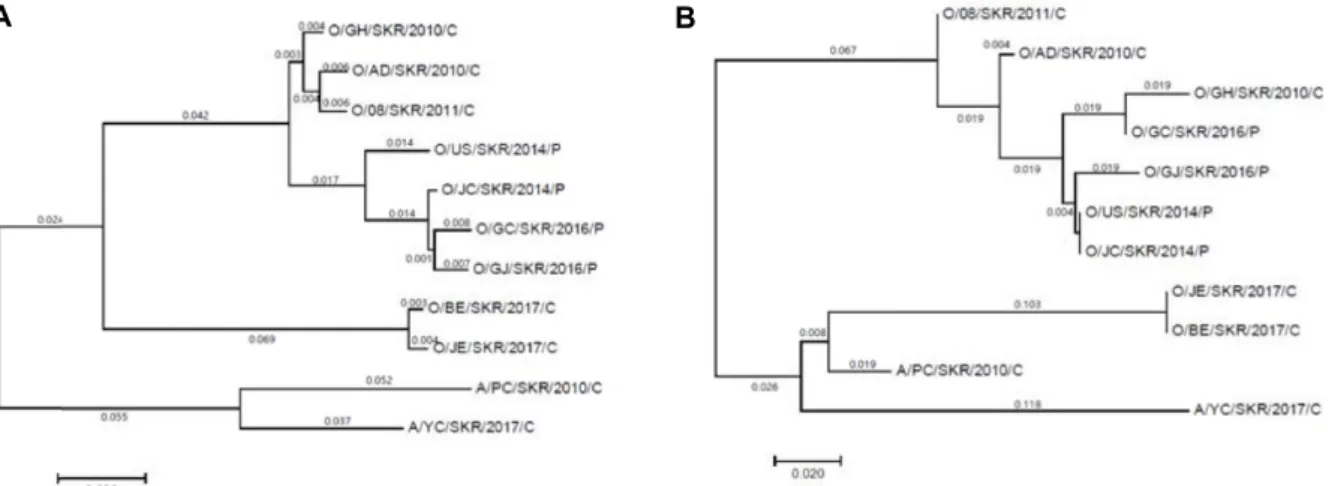
Fig. 3. Maximum Likelihood tree showing phylogenetic relationships of FMDV isolates based on the complete genomic sequence (A) and CRE region sequence (B). Three trees were rooted using the FMDV type O strain (O/AD/SKR/2010/C). Bootstrap support values above 70% out of 1,000 replicates are shown near the major nodes. Horizontal branch lengths are drawn to scale.

Phylogenetic trees were constructed based on the com- plete sequences (Fig. 3A) and CRE regions (Fig. 3B) of FMDV isolates. In the full sequence-based tree (Fig. 3A), SKR/2010, SKR/2014, and SKR/2016 isolates clustered closely and did not share a branch with SKR/2017. In addition, phylogenetic analysis based on CRE regions yielded similar results.

Interestingly, in the phylogenetic tree constructed using CRE sequences, the strain O/GH/SKR/2010/C was more closely related to the O/GC/SKR/2016 strain compared to the phy- logenetic tree constructed using total FMDV sequences. In CRE and full sequence-based trees, SKR/2016 strains were more proximal to SKR/2014 rather than SKR/2017. Results from phylogenetic analyses of serotype A isolates from 2010 to 2017 indicate high genetic homogeneity across cow, but not pig, isolates (Fig. 2), which is similar to what has been observed from published sequences from neighboring coun- tries, confirming previous findings. These results, thus, in- dicate that estimations of viral evolution using CRE se- quences correlate with results generated by comparisons of entire FMDV sequences.

Comparisons of secondary structures of FMDV CREs

Minimum free energy and thermodynamically stable sec- ondary structures of CREs were predicted using the m-fold web server (http://bioweb.pasteur.fr/seqanal/interfaces/

mfold-simple.html) and revealed a single stem loop struc- ture, similar to other lineages. Each 55 nucleotide-long CRE structure included the conserved sequence motif AAACA located within a loop at the end of a stable stem. The A

23

A

24

A

25

C

26

A

27

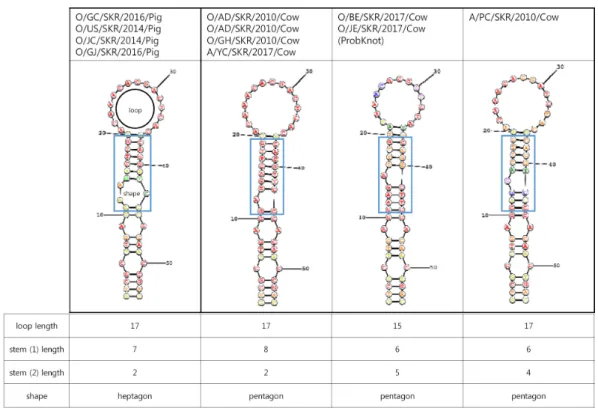
motif in the CRE (Domain I) is essential for virus replication, and VPg uridylylation [17] was fully conserved amongst all examined strains. Since the CRE region is essen- tial for FMDV replication, we focused on sequence variations within the CRE region and identified multiple nucleotide differences between FMDV isolates. We converted these RNA sequences into secondary RNA structures using the Fold Web Server (http://rna.urmc.rochester.edu/RNAstructure Web/Servers/Fold/Fold.html) program and generated RNA structure predictions with the lowest free energy. The FMDV CRE region forms a stem-loop structure composed of 55 nucleotides. The 15 or 17 nucleotide-long circle loop struc- ture consistently contained the five conserved nucleotides (AAACA) for all CRE sequences. In addition, we detected other structures, including pentagon, hexagon, and heptagon structures, within the CREs of various strains (Fig. 4). In summary, the secondary structure of the CRE is composed of a 15~17 nucleotide-long loop, a 4~6 nucleotide-long stem, two hexagons, and one additional structure of either a penta- gon or a heptagon.

Host species-associated differences in the RNA secondary structure of the FMDV CRE

Among FMDV epidemics in Korea over the last decade,

those in 2014 and 2016 were primarily detected in pigs, while

those in 2010, 2011, and 2017 were primarily detected in

cows. For efficient FMDV replication in infected host cells,

the RNA replication complex requires non-coding regulatory

CREs, FMDV 3B/3D proteins, and host cell-specific repli-

cation factors. In addition, species-specific replication factors

(6)

Fig. 4. RNA secondary structures of individual FMDV strains depend on the host species infected. The secondary structure of the CRE RNA of FMDVs was determined using the Fold Web Server with the lowest free energy calculation. The blue-colored box indicates relatively variable regions of RNA secondary structures of FMDV CRE.

in cows or pigs may interact with the RNA replication com- plex of the FMDV while the CRE motif acts as a platform for the RNA replication complex. Therefore, we analyzed whether there are host species-dependent differences in the CRE secondary structure. The CRE secondary structures showed four different RNA structure patterns (Fig. 4). One CRE structural pattern was associated with pig-specific FMDV strains, including O/US/SKR/2014/Pig, O/JC/SKR/

2014/Pig, O/GC/SKR/2016/Pig, and O/GJ/SKR/2016/Pig.

The CRE associated with pig infections showed a 17 nucleo- tide-long loop, a 5 nucleotide-long stem, a heptagon, and two hexagons. CREs from cow infections showed three dif- ferent RNA secondary structure patterns with different nu- cleotide lengths of loops and stems (Fig. 4). Additionally, heptagon structures were unique to the CREs of pig FMDV isolates and did not appear in cow isolates.

Discussion

The functional cooperation of viral replication factors and host cell proteins plays a critical role in the viral replication of several picornaviruses. Based on these observations, FMDVs may acquire a distinct mechanism for efficient viral

replication of their genomic RNA dependent on regulatory RNA elements in addition to host factors and FMDV non- structural proteins [15]. FMDV 3B protein shows weak asso- ciation with the RNA replication complex of the FMDV ge- nome, suggesting the assistance of another host cellular fac- tor for the establishment of a strong viral replication com- plex. The formation of a complete functional complex is a rate-limiting step for FMDV replication [21]. For initial FMDV replication procedures, FMDV 3B and 3D proteins should recognize a cognate CRE RNA site [16]. These RNA secondary structures of FMDV CREs are crucial for acting as docking sites of host replication proteins as well as 3B and 3D viral proteins.

As the FMDV is an RNA virus with a single positive strand, it has shown high genetic variation in viral replication.

For initial FMDV infection, only low levels of the virus may

be required, and several rounds of viral replication with

higher amounts of FMDV can transmit into a host animal

with multiple virus variants. The rapid rate of FMDV repli-

cation induces an immune response in host animals within

a short time, resulting in the decrease of other viral in-

fections by related FMDV variants [12]. For the comparison

of the RNA substitution of the FMDV, no equal distribution

(7)

was shown within the FMDV full genome. The highest gene variation was shown in the VP1 region, resulting from the development of viral escape by vaccine usage and the host immune response. Even though there is only a small portion (less than 8%) of the VP1 gene in the entire FMDV genome, it has been used in calculations of the phylogenetic relation- ship of FMDV variants, since the VP1 site is important for host cell attachment and entry. In addition, VP1 plays a crit- ical role in the induction of the immune response and the determination of serotype specificity [5, 13]. The frequency of genetic variation of the non-coding region of the FMDV is lower than that of the coding region. CRE nucleotide sub- stitutions show low rates of variation, but only one nucleo- tide variation within the CRE contributes to different RNA secondary structures for the recognition of CRE-binding proteins.

Here, we provide novel results regarding the epidemio- logical trends of FMDV outbreaks in Korea over a recent 10-year period, and provide viral determinants for host susceptibility. The endemic viruses from clinically infected animals showed different genetic variations dependent on the number of endemic years and the host species. Early identification of the host species of FMDV susceptibility can contribute toward efficient FMDV control programs, includ- ing vaccine application and quarantine countermeasures.

The inter species transmission of FMDV between pig and cow might provide the genetic background of host specific susceptibility. However, in most of countries including Korea, since pig and cow farms were constituted of sepa- rated places, there were not research reports about FMDV inter-transmission of cow and pig. Generally, while cow might be highly infected by FMDV, pig could transmit FMDV stronger than cow.

The sequence-associated RNA secondary structure analy- sis of the FMDV CRE obtained from infected animal tissues may elucidate relationships between an outbreak and host susceptibility. Despite the presence of the same functional proteins in different host animals, the differential amino compositions of host cellular proteins may provide different CRE RNA recognition and discriminate in favor of specific host species for viral replication and transmission.

The pattern of genetic variation of the FMDV requires host adaptability for viral entry, intracellular replication, and establishment of the cytoplasmic viral assembly environ- ment [11]. Accumulated information regarding the genetic variation of the FMDV may lead to the early determination

of susceptible host species and provide molecular character- istics of emerging FMDV variants.

Acknowledgements

This work was supported by the Korean Animal and Plant Quarantine Agency (Z-1543082-2018-19-0102) and Korea Institute of Planning and Evaluation for Technology in Food, Agriculture, Forestry (IPET) through Animal Disease Management Technology Development Program, funded by Ministry of Agriculture, Food and Rural Affairs (MAFRA) (320058-02).

The Conflict of Interest Statement

The authors declare that they have no conflicts of interest with the contents of this article.

References

1. Alexandersen, S., Zhang, Z., Donaldson, A. I. and Garland, A. 2003. The pathogenesis and diagnosis of foot-and-mouth disease. J. Comp. Pathol. 129, 1-36.

2. Arzt, J., Juleff, N., Zhang, Z. and Rodriguez, L. 2011. The pathogenesis of foot and mouth disease I: viral pathways in cattle. Transbound. Emerg. Dis. 58, 291-304.

3. Arzt, J., Baxt, B., Grubman, M., Jackson, T., Juleff, N., Rhyan, J., Rieder, E., Waters, R. and Rodriguez, L. 2011. The patho- genesis of foot and mouth disease II: Viral pathways in swine, small ruminants, and wildlife; myotropism, chronic syndromes, and molecular virus–host interactions. Trans- bound. Emerg. Dis. 58, 305-326.

4. Carrillo, C., Lu, Z., Borca, M. V., Vagnozzi, A., Kutish, G.

F. and Rock, D. L. 2007. Genetic and phenotypic variation of foot-and-mouth disease virus during serial passages in a natural host. J. Virol. 81, 11341-11351.

5. Carrillo, C., Tulman, E. R., Delhon, G., Lu, Z., Carreno, A., Vagnozzi, A., Kutish, G. F. and Rock, D. L. 2005. Compar- ative genomics of foot-and-mouth disease virus. J. Virol. 79, 6487-6504.

6. de Borba, L., Villordo, S. M., Iglesias, N. G., Filomatori, C.

V., Gebhard, L. G. and Gamarnik, A. V. 2015. Overlapping local and long-range RNA-RNA interactions modulate den- gue virus genome cyclization and replication. J. Virol. 89, 3430-3437.

7. Ferrer-Orta, C., Agudo, R., Domingo, E. and Verdaguer, N.

2009. Structural insights into replication initiation and elon- gation processes by the FMDV RNA-dependent RNA poly- merase. Curr. Opin. Struct. Biol. 19, 752-758.

8. Gao, Y., Sun, S. and Guo, H. 2016. Biological function of

Foot-and-mouth disease virus non-structural proteins and

non-coding elements. Virol. J. 13, 1-17.

(8)

9. Gritsun, T. and Gould, E. 2006. Origin and evolution of 3' UTR of flaviviruses: long direct repeats as a basis for the formation of secondary structures and their significance for virus transmission. Adv. Virus Res. 69, 203-248.

10. Herod, M. R., Ferrer-Orta, C., Loundras, E. A., Ward, J. C., Verdaguer, N., Rowlands, D. J. and Stonehouse, N. J. 2016.

Both cis and trans activities of foot-and-mouth disease virus 3D polymerase are essential for viral RNA replication. J.

Virol. 90, 6864-6883.

11. Horsington, J. and Zhang, Z. 2007. Consistent change in the B–C loop of VP2 observed in foot-and-mouth disease virus from persistently infected cattle: Implications for association with persistence. Virus Res. 125, 114-118.

12. Juleff, N., Windsor, M., Lefevre, E. A., Gubbins, S., Hamblin, P., Reid, E., McLaughlin, K., Beverley, P. C., Morrison, I.

W. and Charleston, B. 2009. Foot-and-mouth disease virus can induce a specific and rapid CD4+ T-cell-independent neutralizing and isotype class-switched antibody response in naive cattle. J. Virol. 83, 3626-3636.

13. Knowles, N. and Samuel, A. 2003. Molecular epidemiology of foot-and-mouth disease virus. Virus Res. 91, 65-80.

14. Liu, Y., Wimmer, E. and Paul, A. V. 2009. Cis-acting RNA elements in human and animal plus-strand RNA viruses.

Biochim. Biophys. Acta 1789, 495-517.

15. Markoff, L., Pang, X., Houng Hs, H. S., Falgout, B., Olsen, R., Jones, E. and Polo, S. 2002. Derivation and character- ization of a dengue type 1 host range-restricted mutant virus that is attenuated and highly immunogenic in monkeys. J.

Virol. 76, 3318-3328.

16. Mason, P. W., Bezborodova, S. V. and Henry, T. M. 2002.

Identification and characterization of a cis-acting replication element (cre) adjacent to the internal ribosome entry site

of foot-and-mouth disease virus. J. Virol. 76, 9686-9694.

17. Nayak, A., Goodfellow, I. G., Woolaway, K. E., Birtley, J., Curry, S. and Belsham, G. J. 2006. Role of RNA structure and RNA binding activity of foot-and-mouth disease virus 3C protein in VPg uridylylation and virus replication. J.

Virol. 80, 9865-9875.

18. Paul, A. V. and Wimmer, E. 2015. Initiation of protein- primed picornavirus RNA synthesis. Virus Res. 206, 12-26.

19. Salonen, A., Ahola, T. and Kääriäinen, L. 2004, "Viral RNA replication in association with cellular membranes" in Mem- brane trafficking in viral replication Springer, pp. 139-173.

20. Samuel, A. and Knowles, N. 2001. Foot-and-mouth disease type O viruses exhibit genetically and geographically dis- tinct evolutionary lineages (topotypes). J. Gen. Virol. 82, 609- 621.

21. Spear, A., Sharma, N. and Flanegan, J. B. 2008. Protein-RNA tethering: The role of poly (C) binding protein 2 in polio- virus RNA replication. Virology 374, 280-291.

22. Steil, B. P. and Barton, D. J. 2009. Conversion of VPg into VPgpUpUOH before and during poliovirus negative-strand RNA synthesis. J. Virol. 83, 12660-12670.

23. Stenfeldt, C., Pacheco, J. M., Brito, B. P., Moreno-Torres, K.

I., Branan, M. A., Delgado, A. H., Rodriguez, L. L. and Arzt, J. 2016. Transmission of foot-and-mouth disease virus dur- ing the incubation period in pigs. Front. Vet. Sci. 3, 105.

24. Villordo, S. M., Filomatori, C. V., Sánchez-Vargas, I., Blair, C. D. and Gamarnik, A. V. 2015. Dengue virus RNA struc- ture specialization facilitates host adaptation. PLoS Pathog.

11, e1004604.

25. Villordo, S. M. and Gamarnik, A. V. 2013. Differential RNA

sequence requirement for dengue virus replication in mos-

quito and mammalian cells. J. Virol. 87, 9365-9372.

(9)

초록:구제역바이러스의 숙주 특이성 결정에 연관되어있는 구제역바이러스 cis-acting replication element 변이 분석 연구

강효린

1

․성미소

1

․구복경

2

․정재훈

1

*

(

1

부산대학교 자연과학대학 분자생물학과,

2

농림축산검역본부)

구제역바이러스(FMDV)는 피코나바이러스 과에 속하는 바이러스로서 야생과 가축화된 소와 돼지에 감염된다.

FMDV는 제어되기 어려워서 가축의 생산과 국제통상에 큰 장애가 되고 있다. FMDV RNA 게놈의 복제 과정에서

3D 중합효소가 특이적인 복제 기능을 담당하는데 게놈에 결합하는 부위가 매우 중요하다. 이 사실은 FMDV 게놈

의 비코딩영역 내에서 3D 중합효소에 의해 인지되는 특이 RNA 구조가 관여함을 제시한다. 이 과정에서 cis-act-

ing replication element (CRE)는 RNA 복제를 위한 개시에 필요하다. FMDV CRE는 15-17 뉴클레오티드의 고리와

이를 지지하는 이중가닥으로 형성된 줄기-고리 모양을 가지며 이들을 구성하는 RNA 뉴클레오티드 서열의 차이

가 다른 RNA 이차구조를 생성한다. CRE 이외에 FMDV 복제를 위해서 많은 바이러스와 세포 인자들이 단백질-단

백질 결합과 단백질-RNA 결합을 통해 협조적인 네트워크를 만들어낸다. 이 연구에서 국내에서 2010년부터 2017

년 까지 구제역이 발생한 소와 돼지에서 FMDV를 분리하여 CRE 서열을 분석하였으며 이들 FMDV들은 A형과

O형의 유전자형을 가졌다. 흥미롭게 국내 FMDV들의 CRE RNA 이차구조의 변이들은 바이러스 간의 계통유전학

적 상관관련성과 일치하며 특정 숙주 동물종의 FMDV 감염의 특이성을 밝혀주었다. 이를 토대로 국내 FMDV의

각 유전군의 분류는 독특한 기능적 CRE에 의해 특징지을 수 있으며 새로운 유전적 계통의 진화학적 연속성은

특징있는 CRE 모티프의 구분과 연관지을 수 있다. 그러므로 CRE의 특이적 RNA 구조는 숙주 동물종 의존적인

FMDV 부류의 부가적인 단서로 활용할 수 있음을 제안한다. 이들 연구 결과들은 향후 FMDV 대량감염이 발생할

때 숙주동물종의 특이성을 CRE 서열로 조기에 정확히 분석하는데 도움이 될 것이다.

수치

Table  1.  Foot-and-Mouth  Disease  Viruses  used  in  this  study
Fig.  1.  Sequence  alignment  and  nucleo- nucleo-tide  variation  of  FMDV  CRE   re-gions
Fig.  3.  Maximum  Likelihood  tree  showing  phylogenetic  relationships  of  FMDV  isolates  based  on  the  complete  genomic  sequence  (A)  and  CRE  region  sequence  (B)
Fig.  4.  RNA  secondary  structures  of  individual  FMDV  strains  depend  on  the  host  species  infected

참조

관련 문서