http://dx.doi.org/10.12925/jkocs.2019.36.2.383
울금(
Curcuma longa
L.) 섭취가 당뇨성 흰쥐의 크레아티닌 및 간 기능 효소 활성에 미치는 영향오다영․이영근․김동섭․정헌식․강동수
1․김한수
✝ 부산대학교 식품공학과, 1전남대학교 해양바이오식품학과 (2019년 5월 1일 접수: 2019년 6월 12일 수정: 2019년 6월 12일 채택)Effects of Turmeric ( Curcuma longa L.) Supplementation on Creatinine and Hepatic Functional Enzyme Activities
in Streptozotocin-induced Diabetic Rats
Da-Young Oh․Young-Geun Lee․Dong-Seob Kim․Hun-Sik Chung Dong-Soo Kang1․Han-Soo Kim✝
Department of Food Science and Technology, Pusan National University, Miryang 50463, Korea
1
Department of Marine Bio Food Science, Chonnam National University, Yeosu 59626, Korea (Received May 1, 2019; Revised June 12, 2019; Accepted June 12, 2019)
요 약 : Streptozotocin (STZ, 45 mg/kg body weight)으로 유도된 Sprague Dawley (SD)계 수컷 흰 쥐에 5% 울금을 섭취시켰을 때, 혈청 크레아티닌(creatinine) 및 blood urea nitrogen (BUN)의 농도와 alkaline phosphatase (ALP), lactate dehydrogenase (LDH), aminotransferase (AST, ALT), 카탈라아 제(catalase), 아밀라아제(amylase) 및 리파아제(lipase) 활성에 미치는 영향을 알아보기 위해 본 실험을 수행한 결과, 기본식이를 급여시킨 대조군(control)인 정상군은 BD군, 기본식이 실험군에 5% 울금 급여 군(BT군), 당뇨 유발 실험군(BS군)인 질환 모델 대조군(control-diabetic)과 질환 실험군(diabetic, BS군) 에 5% 울금을 급여시킨 실험군(ST군)으로 나누었다. 흰쥐의 혈청 크레아티닌 및 BUN 농도와 ALP, AST 및 ALT 활성은 유사한 경향으로 5% 울금의 급여가 감소시킨 것으로 확인되었다. SD계 수컷 흰 쥐의 혈청 LDH 활성은 BS군에서 유의적인 차이를 나타내며 높은 활성을 보였으나(
p
<0.05), 5% 울금의 급여가 감소 효과를 나타내었다(p
<0.05). 카탈라아제 활성은 BS군에서 유의적으로 낮은 활성을 나타내 었고, ST군에서 활성을 증가시켰다(p
<0.05). 혈청 아밀라아제 및 리파아제의 활성은 5% 울금의 급여가 감소시킨 것으로 확인되었다. 본 연구 결과, SD계 수컷 흰쥐를 통한in vivo
실험에서 5% 울금의 섭취 가 당뇨, 내인성 항산화 효소 및 간 기능 개선에 효과가 있는 것으로 나타났다.주제어 : 울금(Curcuma longa L.), 크레아티닌, 간 기능 효소, 카탈라아제, 리파아제
✝
Corresponding author
(E-mail: [email protected])
Abstract : The purpose of this study was to investigate the improvement effect of turmeric (
Curcuma longa
L.) on the hepatic functional enzyme and catalase activity of streptozotocin (STZ)-induced diabetic rats. Sprague-Dawley (SD) male rats were divided into four groups (n
=6), and fed experimental diets containing turmeric meal [basal diet+5% turmeric (BT), basal diet+STZ+5% turmeric (ST)], and control (basal diet, BD), BS groups (basal diet+STZ). Serum concentrations of creatinine and blood urea nitrogen (BUN) were significantly decreased (p
<0.05) by 5% turmeric supplementation diet. The activities of akaline phosphatase (ALP), lactate dehydrogenase (LDH), aspartate transaminase (AST), alanine transaminase (ALT), amylase and lipase were decreased in the BD, BT and ST group than BS group. The catalase (CAT) activity was significantly increased (p
<0.05) in turmeric supplementation diet (BT, ST group) than diabetic group (BS). Furthermore, the activities of amylase and lipase in the sera of turmeric diet group were significantly decreased (p
<0.05).In vivo
experiments with diabetic rats showed that ingestion of turmeric supplementation diet were effective in creatinine concentration, and hepatic functional enzyme activities.Keywords : Turmeric (Curcuma longa L.), Creatinine, Hepatic functional enzyme, Catalase, Lipase
1. 서 론
생강과(Zingiberaceae)에 속하는 울금(
Curcuma longa
L.)은 간장, 심장, 신장, 신경계 및 비뇨기 계 등에 생리적 작용과 당뇨에 효능이 있는 것으 로 알려져 있다[1,2]. 생활 습관의 변화와 함께 고단백, 고지방 식이 등 동물성 식품의 섭취가 증가되어 고혈압, 동맥경화증(atherosclerosis), 관 상동맥성 심장질환 및 고지혈증 등 심장순환기계 질환(coronary heart disease, CHD)과 더불어 당 뇨병(Diabetes mellitus)등의 발병과 합병증이 문 제시 되고 있는 실정으로[3,4,5], 인슐린 저항성, 만성 염증질환, 이상지질혈증 및 고혈압 등 대사 증후군의 위험을 증가시키는 것으로 알려져 있다 [6,7]. 당뇨병은 인슐린 의존형인 제1형과 인슐린 비의존형인 제2형으로 구분되고, 인슐린 분비 및 기능 장애로 발생되는 고혈당이 특징이다[8]. 제1 형 당뇨병은 췌장의 β-세포의 선택적 파괴에 의 한 면역 체계 장애로 발생되고[9], 제2형 당뇨병 은 인슐린 생성의 상대적 부족에 의하여 발생되 어 유전적 감수성 및 비만증 등과 밀접한 관련이 있는 것으로 알려져 있다[3,10,11,12]. 울금은 항 산화, 항고혈압 등의 작용과 α-glucosidase 및 α-amylase 저해 활성을 나타내어 식후 과도한 혈당 상승을 막아 제2형 당뇨병에 효과가 있는 것으로 보고되어 있다[13,14]. Aminotransferase는 glucose 신생합성과 아미노산 대사에 관여하 고[15], 지방간 및 대사 증후군일 경우에 aminotransferase 활성을 상승 시키는 것으로 나 타나 있다[16]. 울금 중에 함유된 calebin-A는 curcuminoid로 혈청 지질성분을 개선시키며, 지 방간 방지 작용과 간 기능 효소인 aspartate aminotransferase (AST), alanine aminotransferase (ALT)의 활성을 조절 하는 것 으로 보고되어 있다[17]. 따라서 본 실험에서는 5% 울금을 급여하였을 때, streptozotocin으로 유 도된 당뇨성 흰쥐의 혈청 creatinine 농도, blood urea nitrogen을 비롯한 ALP, lactate dehydrogenase, aminotransferase, 카탈라아제 (catalase), 아밀라아제(amylase) 및 리파아제 (lipase) 등 간 기능 활성에 미치는 효소의 영향 을 비교한 후, 바이오헬스 기능성 소재 등으로 활용 방안을 검토하기 위하여 실시하였다.
2. 재료 및 방법
2.1. 실험 재료울금(
Curcuma longa
L.)은 전남 진도영농조합 법인(Jindo, Jeonnam, Korea)에서 구입하였고, 진공동결건조(EYELA, FDU-2000, Rikakikai Co., Tokyo, Japan) 시킨 후, 분쇄기(HMF-3250S, Han-I1 Co., Seoul, Korea)로 마쇄한 다 음 -80℃(DF-8514, I1-Shin BioBase Co., Daegu, Korea)에 저장하여 본 실험에 사용하였다.
2.2. 실험 동물
평균 체중이 200±10 g인 7주령된 Sprague Dawley (SD)계 수컷 흰쥐(Daehan Biolink Co., LTD, Eumseong, Korea)를 구입하여, 5% 콩기 름(Ottogi, soybean oil, Anyang, Korea)을 함유 하는 기초식이로 1주일간 예비사육하여 적응시켰 고, 난괴법(randomized complete block design) 에 의하여 각 실험 당 6마리씩 4군으로 metabolic cage (JD-C-71, Jeongdo, Korea)에 나누어 5주간 실험사육하였다. 실험 사육실의 온 도는 20±1℃, 상대습도는 50±10%로 일정하게 유지시켰으며, 명암은 12시간(07:00~19:00) 주 기로 조명하였다[18]. 예비사육 및 실험사육 등 동물 실험은 부산대학교 동물실험윤리위원회의 승인(PNU-2017-1422)과 관리 감독하에 실시되 었다.
2.3. 식이조성 및 실험군
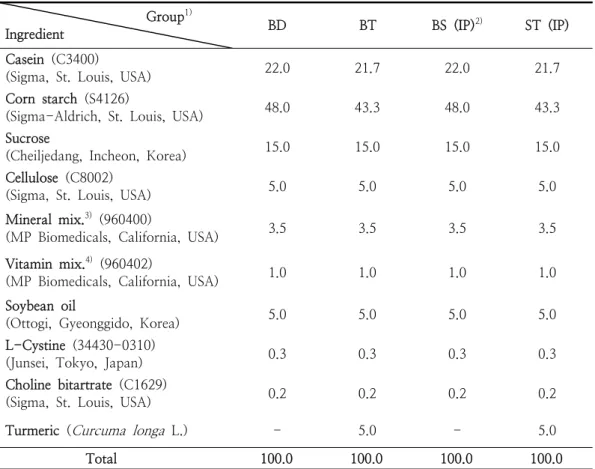
식이조성 및 실험군은 Table 1과 같다. 당뇨를 유발하기 위해 SD계 수컷 흰쥐에 0.01 M citrate buffer (pH 4.6)로 용해시킨 streptozotocin (STZ, Sigma, USA, 45 mg/kg body weight)를 복강 내 주사(IP injection)하여 당뇨를 유발시켰 다. 기본식이를 섭취시킨 대조군(control)인 정상 군(normal-nondiabetic)은 BD군, 정상 실험군에 5% 울금 급여군(BT군), 당뇨 유발 실험군(BS군) 인 질환 모델 대조군(control- diabetic)과 질환 실험군(diabetic)에 5% 울금을 급여시킨 실험군 (ST군)으로 나누었다.
2.4. 실험 동물의 처치
실험 사육 최종일에 7시간 절식시킨 후, 가스 마취기(animal inhalation narcosis control, SK-INC-100A, Daejong, Seoul, Korea)를 사용 하여 CO2 gas 마취하에 심장채혈법으로 채혈하 였으며, 혈액을 취하여 4℃에서 약 1시간 방치한 후, 20분간 분당 3,000 cycle로 원심분리하여 혈 청을 취해 실험에 사용하였다[18].
2.5. Creatinine 및 blood urea nitrogen (BUN) 농도 측정
Creatinine은 Jaffe reaction 방법에 준하여 조
제된 시약(Eiken, Tokyo, Japan)으로 혈액자동분 석기(Hitachi 7150, Tokyo, Japan)를 사용하여 분석하였다. Blood urea nitrogen (BUN)은 효소 법에 의해 조제된 시약(Eiken, Tokyo, Japan)을 사용하여 생화학분석기(Hitachi 7150, Tokyo, Japan)로 분석하였다.
2.6. 혈청의 효소활성 측정
Alkaline phosphatase (ALP), lactate dehydrogenase (LDH), aspartate aminotransferase (AST) 및 alanine aminotransferase (ALT) 활성 측정은 효소법에 의해 조제된 시약(Eiken, Tokyo, Japan)을 사용 하여 생화학분석기(Hitachi 7150, Tokyo, Japan) 로 분석하였다. 혈청 중의 카탈라아제(catalase) 활성은 효소법에 의해 조제된 시약(Cayman Chemical Company, Ann Arbor, Ml, USA)을 이용하여 ELISA reader (Model 550 Microplate Reader, BIO-RAD, USA)로 540 nm에서 측정하 여 mL 당 nmol로 표시하였다. 아밀라아제 (amylase) 활성 측정은 pNPG7법으로 조제된 시 약(Amylase, Roche, Indianapolis, USA)을 이용 하여 측정 장치(Hitachi Modular, Tokyo, Japan)로 분석하였다. 리파아제(lipase) 활성은 비 색법(Colorimetry)에 준하여 조제된 리파아제 측 정용 시약(LIPC, Roche, Indianapolis, USA)을 이용하여 생화학분석기(Integra 800, Roche, Basel, Switzerland)를 사용하여 측정하였다.
2.7. 통계 처리
실험 데이터의 통계 처리는 실험군 당 평균값 과 표준편차로 나타내었다. 결과값 간의 유의성검 정은 one-way ANOVA로 분석 후
p
<0.05 수준 에서 Duncan's multiple range test에 의하여 각 실험군 간의 유의적인 차이를 알아보았다. 통계처 리 프로그램은 IBM SPSS statistic ver. 22를 사 용하였다.3. 결과 및 고찰
3.1. Creatinine 농도Creatinine의 농도는 Table 2와 같다. 당뇨 유 발군인 BS군에 5% 울금의 급여군(ST군)은 1.31±0.02 mg/dL로 나타나 당뇨 유발군인 BS군
Group1)
Ingredient BD BT BS (IP)2) ST (IP)
Casein (C3400)
(Sigma, St. Louis, USA) 22.0 21.7 22.0 21.7
Corn starch (S4126)
(Sigma-Aldrich, St. Louis, USA) 48.0 43.3 48.0 43.3 Sucrose
(Cheiljedang, Incheon, Korea) 15.0 15.0 15.0 15.0
Cellulose (C8002)
(Sigma, St. Louis, USA) 5.0 5.0 5.0 5.0
Mineral mix.3) (960400)
(MP Biomedicals, California, USA) 3.5 3.5 3.5 3.5
Vitamin mix.4) (960402)
(MP Biomedicals, California, USA) 1.0 1.0 1.0 1.0
Soybean oil
(Ottogi, Gyeonggido, Korea) 5.0 5.0 5.0 5.0
L-Cystine (34430-0310)
(Junsei, Tokyo, Japan) 0.3 0.3 0.3 0.3
Choline bitartrate (C1629)
(Sigma, St. Louis, USA) 0.2 0.2 0.2 0.2
Turmeric (
Curcuma longa
L.) - 5.0 - 5.0Total 100.0 100.0 100.0 100.0
1)BD : basal diet (control group). BT : basal diet+5% turmeric (
Curcuma longa
L.). BS : basal diet+ streptozotocin (STZ). ST : basal diet+streptozotocin (STZ)+5% turmeric (Curcuma longa
L.).2)IP : intraperitoneal injection (streptozotocin 45 mg/kg body weight ; 0.01 M citrate buffer sol`n (pH 4.6)) 3)AIN-93G-MX mineral mix. 4)AIN-93-VX vitamin mix (MP Biomedicals, Illkirch, France).
Table 1. Compositions of experimental diet and groups
(%)
의 1.42±0.03 mg/dL 보다 유의적인 감소를 나 타내었다(
p
<0.05). 또한, 대조군(BD) 및 기본식이에 5% 울금의 급여군(BT)에서는 각각
0.74±0.02 및 0.70±0.02 mg/dL로 유의적인 차 이는 없었지만 5% 울금 급여가 농도의 감소를 보였다(
p
<0.05). 혈청 creatinine 농도는 혈액요소 질소 농도와 함께 신장 기능 평가에 이용되는 것 으로 알려져 있으며[21], 신장 장애는 혈청 creatinine 농도와 관련되어 있는 것으로 보고하 였다[22]. 본 실험 결과, 당뇨 유발군에 5% 울금 의 급여는 creatinine 농도의 감소를 나타내어 신장 기능 개선에 효과가 있을 것으로 생각된다.
3.2. Blood urea nitrogen (BUN) 농도 흰쥐의 혈청 BUN의 농도는 Table 2와 같다.
당뇨 유발군인 BS군에 5% 울금의 급여는 26.8±1.9 mg/dL로 나타나, BS군(31.8±1.7 mg/dL)에 비하여 유의적인 차이를 보이며 감소 시킨 것으로 나타났다(
p
<0.05). 대조군(BD) 및 5% 울금의 급여군(BT)은 16.0±1.2 및 14.8±1.4 mg/dL로 나타났으며, 5% 울금의 급여 가 BUN의 농도를 감소시켰지만 유의적인 차이는Group1) BD BT BS ST Creatinine 0.74±0.02a 0.70±0.02a 1.42±0.03c 1.31±0.02b
BUN2) 16.0±1.2a3) 14.8±1.4a 31.8±1.7c 26.8±1.9b
1)BD : basal diet (control group). BT : basal diet+5% turmeric (
Curcuma longa
L.). BS : basal diet+ streptozotocin (STZ). ST : basal diet+streptozotocin (STZ)+5% turmeric (Curcuma longa
L.).2)BUN : blood urea nitrogen.
3)The data are presented as means±SD of 6 independent rats. Means with different letters are significantly different (
p
<0.05) by Duncan’s multiple range tests.Table 2. Effects of turmeric (
Curcuma longa
L.) on serum creatinine and BUN concentration of STZ-induced diabetic rats(mg/dL)
Fig. 1. Effects of turmeric (
Curcuma longa
L.) on serum alkaline phosphatase (ALP) activity of STZ-induced diabetic rats.1)BD : basal diet (control group). BT : basal diet+5% turmeric (
Curcuma longa
L.). BS : basal diet+streptozotocin (STZ). ST : basal diet+streptozotocin (STZ)+5% turmeric (Curcuma longa
L.).2)The data are presented as means±SD of 6 independent rats. Means with different letters are significantly different (
p
<0.05) by Duncan’s multiple range tests.없는 것으로 확인했다(
p
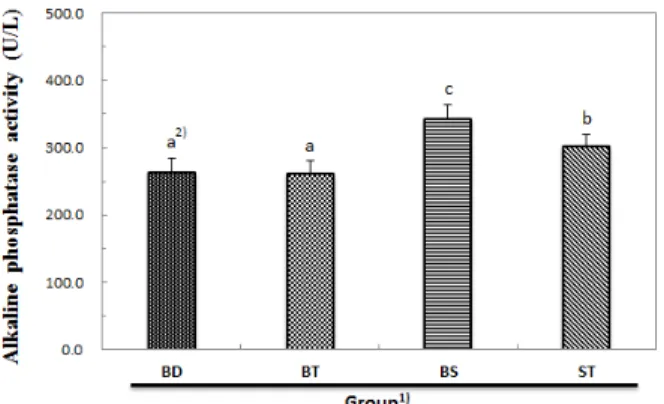
<0.05). Streptozotocin으 로 유도된 당뇨 쥐는 신장질환이 동반되어, BUN 농도를 증가시키는 것으로 보고되어 있으며[19], STZ (65 mg/kg)를 복강 내 주사하여 당뇨를 유 도한 흰쥐에 curcumin 15 및 30 mg/kg의 경구 투여는 BUN 농도를 감소시켜 당뇨에 효과가 있 는 것으로 보고하였다[20]. 본 연구에서 5% 울금 의 급여가 흰쥐의 BUN 농도를 감소시킨 것으로 관찰되었다.3.3. Alkaline phosphatase (ALP) 활성 흰쥐의 혈청 alkaline phosphatase (ALP)의 활 성은 Fig. 1과 같다. 당뇨 유발군에 5% 울금의 급여군인 ST군에서 301.8±18.2 U/L로 나타나, 당뇨 유발군인 BS군(342.5±21.5 U/L)에 비해 유의적인 차이를 보이며 감소시켰다(
p
<0.05). BD 군 및 BT군에서 263.8±20.0 및 261.5±19.8 U/L로 관찰되었다. STZ로 인한 흰쥐의 혈청 ALP 활성의 증가는 간독성이 나타나 간세포 기 질에서 혈류로의 방출에 의한 것으로 보고되어Fig. 2. Effects of turmeric (
Curcuma longa
L.) on serum lactate dehydrogenase (LDH) activity of STZ-induced diabetic rats.1)BD : basal diet (control group). BT : basal diet+5% turmeric (
Curcuma longa
L.). BS : basal diet+streptozotocin (STZ). ST : basal diet+streptozotocin (STZ)+5% turmeric (Curcuma longa
L.).2)The data are presented as means±SD of 6 independent rats. Means with different letters are significantly different (
p
<0.05) by Duncan’s multiple range tests.있다[23]. 당뇨 유발군에 5% 울금의 급여가 ALP 활성 감소를 나타내어 당질대사 개선에 효과가 있을 것으로 사료된다.
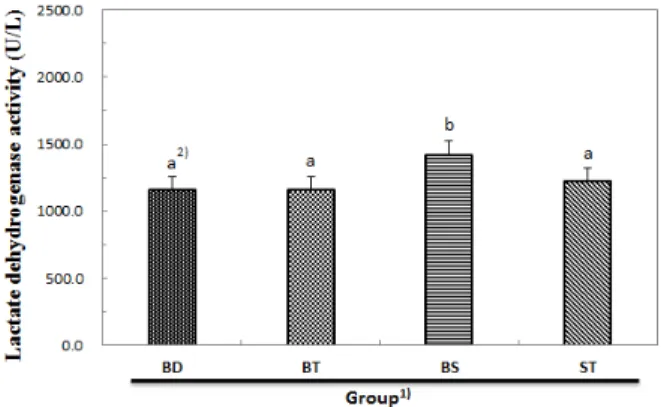
3.4. Lactate dehydrogenase (LDH) 활성 Lactate dehydrogenase (LDH) 활성은 Fig. 2 와 같다. 당뇨 유발군에 5% 울금 급여군인 ST군 은 1221.5±97.6 U/L로 나타나, 당뇨 유발군인 BS군(1421.3±98.9 U/L)과 비교하였을 때 유의 한 차이를 보이며 감소시켰다(
p
<0.05). BD군 및 BT군에서 1159.5±99.5 및 1162.7±97.6 U/L로 나타났으나, 활성의 차이는 없는 것으로 확인하였 다. LDH는 세포질에 존재하는 효소로서 세포 괴 사(necrosis)와 고혈당, 심근경색, 간질환, 거대아 구성빈혈, 신장질환, 근위축 및 폐색전 등의 병리 학적 상태일 때 혈청 LDH 활성이 증가되는 것 으로 알려져 있다[24,25]. 본 실험 결과, 당뇨 유 발군에서 유의적인 차이를 나타내며 높은 활성을 나타내어 STZ로 인한 병리학적 상태에 기인된 것으로 판단되며, 5% 울금의 급여가 유의적인 감 소를 나타내었다(p
<0.05).
3.5. Aminotransferase (AST, ALT) 활성 흰쥐의 혈청 aspartate aminotransferase (AST) 및 alanine aminotransferase (ALT) 활성은 Fig.
3과 같다. AST 및 ALT 활성은 유사한 경향으로
나타났다. AST는 ST군에서 80.9±3.5 U/L로 나 타나, BS(88.5±3.9 U/L)군과 비교하였을 때 유 의적인 감소를 확인하였다(
p
<0.05). BD 및 BT군 에서 각각 73.8±3.7 및 68.5±3.2 U/L로 나타났 으며, BT군에서 농도의 감소를 확인하였으나 유 의적인 차이는 없었다(p
<0.05). ALT는 ST군에서 42.5±1.8 U/L로 BS군(47.3±2.1 U/L)에 비해 유의적인 차이를 보이며 활성의 감소를 확인하였 다(p
<0.05). BD군 및 BT군에서 39.4±2.5 및 38.5±2.6 U/L로 나타나 BT군에서 활성을 감소 시켰지만, 유의적인 차이는 없었다(p
<0.05). 지방 간 등 이상지질혈증에서 AST 및 ALT 활성은 상 승된다고 하며[26], 5% 울금의 급여는 AST 및 ALT 활성의 감소로 지질 및 당질대사 기능 개선 에 효과가 있을 것으로 사료된다.3.6. 카탈라아제(catalase) 활성
혈청 중의 카탈라아제(catalase) 활성은 Fig. 4 와 같다. ST군에서 6.18±0.14 mmol/mL로 나타 나, STZ로 유도된 당뇨 유발군인 BS군 (5.79±0.18 mmol/mL)과 비교하였을 때 활성을 증가시킨 것으로 나타났다. BD군 및 BT군에서 각각 6.69±0.17 및 6.72±0.11 mmol/mL로 BD 군에 비하여 BT군에서 활성이 증가되었다. 카탈 라아제 활성은 당뇨 및 췌장의 β 세포의 산화적 스트레스가 지속되면 감소되는 것으로 알려져 있
Fig. 3. Effects of turmeric (
Curcuma longa
L.) on serum aspartate and alanine aminotransferase (AST and ALT) activity of STZ-induced diabetic rats.1)BD : basal diet (control group). BT : basal diet+5% turmeric (
Curcuma longa
L.). BS : basal diet+streptozotocin (STZ). ST : basal diet+streptozotocin (STZ)+5% turmeric (Curcuma longa
L.).2)The data are presented as means±SD of 6 independent rats. Means with different letters are significantly different (
p
<0.05) by Duncan’s multiple range tests.Fig. 4. Effects of turmeric (
Curcuma longa
L.) on serum catalase activity of STZ-induced diabetic rats.1)BD : basal diet (control group). BT : basal diet+5% turmeric (
Curcuma longa
L.). BS : basal diet+streptozotocin (STZ). ST : basal diet+streptozotocin (STZ)+5% turmeric (Curcuma longa
L.).2)The data are presented as means±SD of 6 independent rats. Means with different letters are significantly different (
p
<0.05) by Duncan’s multiple range tests.다[27]. 본 연구 결과, STZ로 유도된 당뇨 유발 군에서 흰쥐의 혈청 카탈라아제 활성이 낮은 것 으로 나타났으며, 울금의 급여가 유의적인 차이를 보이며 활성을 증가시키는 것으로 관찰되었다.
3.7. 아밀라아제(amylase) 활성
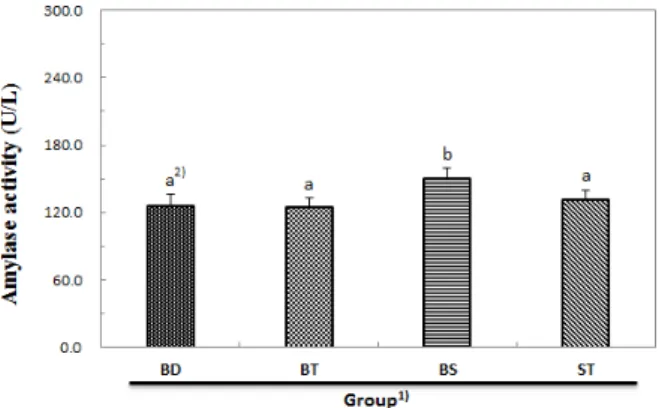
아밀라아제(amylase) 활성은 Fig. 5에 나타내었 다. 울금 급여군인 ST군에서 131.5±8.5 U/L로 BS군(149.9±9.2 U/L)과 비교하였을 때 유의적인
Fig. 5. Effects of turmeric (
Curcuma longa
L.) on amylase activity of STZ-induced diabetic rats.1)BD : basal diet (control group). BT : basal diet+5% turmeric (
Curcuma longa
L.). BS : basal diet+streptozotocin (STZ). ST : basal diet+streptozotocin (STZ)+5% turmeric (Curcuma longa
L.).2)The data are presented as means±SD of 6 independent rats. Means with different letters are significantly different (
p
<0.05) by Duncan’s multiple range tests.감소를 나타내었다(
p
<0.05). BD군 및 BT군에서 126.3±9.8 및 124.5±8.8 U/L로 나타났으며, BT군에서 활성의 감소를 보였으나 유의적인 차 이는 없었다(p
<0.05). 혈청 아밀라아제는 급성 췌 장염에 의해 증가될 수 있으며[28], STZ로 유도 된 당뇨성 흰쥐에 마늘 기름을 투여하였을 때 혈 청 아밀라아제 활성을 감소시킨 것으로 보고하였 다[29]. 따라서 당뇨성 흰쥐에 5% 울금의 급여가 아밀라아제 활성을 감소시켜 당뇨 및 급성 췌장 염에 효과가 있을 것으로 사료된다.3.8. 리파아제(lipase) 활성
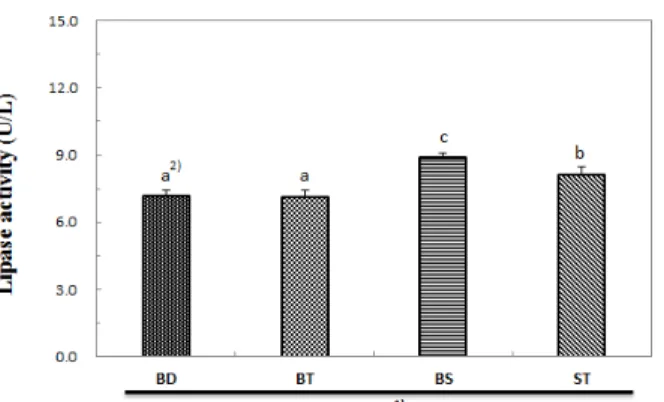
흰쥐의 혈청 리파아제(lipase) 활성은 Fig. 6에 나타내었다. ST군에서 8.1±0.4 U/L로 나타나 BS군(8.9±0.2 U/L)과 비교하였을 때 유의적인 활성의 감소를 나타내었다(
p
<0.05). BD군 및 BT 군에서 각각 7.2±0.2 및 7.1±0.3 U/L로 나타 나, BD군에 비해 BT군에서 활성의 감소를 보였 지만, 유의적인 차이는 없는 것으로 나타났다 (p
<0.05). 리파아제 활성은 췌장질환을 진단하는 지표로 이용되며[30], cerulein으로 유도된 급성 췌장염 쥐에서 혈청 아밀라아제 및 리파아제 활 성은 급격히 증가된 것으로 나타났다[31,32]. 본 실험 결과, 당뇨 유발군에 울금의 섭취는 리파아 제의 활성을 감소시켜 당질대사 개선에 효과가있을 것으로 추정된다.
4. 결 론
Streptozotocin (STZ, 45 mg/kg body weight) 을 복강 주사하여 당뇨를 유발시켜 질환 모델을 설정하여, 본 실험을 통해 5% 울금의 급여가 질 환 모델군에 미치는 영향에 대하여 검토하였다.
흰쥐의 혈청 크레아티닌 및 blood urea nitrogen (BUN) 농도는 유사한 경향으로 STZ로 유도한 실험군인 BS군에 비해, 5% 울금 급여군(ST군)에 서 감소시켰고, 기본식이를 섭취시한 대조군(BD 군)에 비해 5% 울금을 급여시킨 BT군에서 농도 의 감소가 나타났지만 유의적인 차이는 없는 것 으로 확인하였다. Alkaline phosphatase (ALP) 활성은 BS군에 비해 ST군에서 유의한 차이를 나 타내며 감소된 것으로 관찰되었으며(
p
<0.05), BD 군에 비해 BT군에서 활성의 감소가 나타났지만 유의적인 차이는 없는 것으로 확인되었다.Lactate dehydrogenase (LDH) 활성은 STZ로 유 도한 실험군인 BS군에서 높은 활성을 보였으나, 울금 급여군인 ST군에서 유의적인 차이를 나타내 며 활성을 감소시켰다(
p
<0.05). 당뇨성 흰쥐(BS 군)의 혈청 aspartate aminotransferase (AST) 활Fig. 6. Effects of turmeric (
Curcuma longa
L.) on serum lipase activity of STZ-induced diabetic rats.1)BD : basal diet (control group). BT : basal diet+5% turmeric (
Curcuma longa
L.). BS : basal diet+streptozotocin (STZ). ST : basal diet+streptozotocin (STZ)+5% turmeric (Curcuma longa
L.).2)The data are presented as means±SD of 6 independent rats. Means with different letters are significantly different (
p
<0.05) by Duncan’s multiple range tests.성은 높은 활성이 관찰되었으나, ST군은 BS군과 비교하였을 때 유의적인 감소를 나타내었다 (
p
<0.05). Alanine aminotransferase (ALT) 활성 또한, AST 활성과 유사한 경향으로 5% 울금 급 여가 활성을 감소시켰다. 카탈라아제 활성은 STZ 로 유도된 당뇨 유발군인 BS군에서 낮은 활성을 나타내었으나, 울금 급여에 의하여 ST군이 유의 적인 차이를 보이며 활성을 증가시킨 것으로 나 타났다(p
<0.05). 당뇨 유발군에 5% 울금의 급여 는 혈청 아밀라아제 및 리파아제의 활성을 감소 시키는 것으로 나타났다. 따라서, 당뇨성 Sprague Dawley계 수컷 흰쥐를 통한in vivo
실험에서 5% 울금의 급여가 당질대사와 간 기능 개선에 효능이 있을 것으로 사료된다.References
1. C. A. C. Araujo, L. L. Leon, “Biological activities of
Curcuma longa
L”,Mem. Inst.
Oswaldo Cruz
, Vol.96, No.5 pp. 723-728, (2001).2. S. Senan, D. Kizhakayil, T. E. Sheeja, B.
Sasikumar, A. I. Bhat, V. A.
Parthasarathy, “Novel polymorphic
microsatellite markers from turmeric,
Curcuma longa
L. (Zingiberaceae)”,Acta Bot. Croat
., Vol.72, No.2 pp. 407-412, (2013).3. H. S. Kim, “The Effects of
Saururus chinensis
baill extract administration on the blood glucose, electrolyte and lipid metabolism in STZ-induced hyperglycemic rats”,J. Life Sci
., Vol.16, No.6 pp.911-918, (2006).
4. H. S. Kim, S. H. Kim, H. S. Cheong, J.
O. Kang, S. Y. Chung, “Effects of the feeding mixed oils with various levels of n-3 and n-6 polyunsaturated fatty acid on the lipid components and fatty acid metabolism of serum lipoprotein in hyperlipedemic rat”,
J. Korean Soc. Food Nutr.,
Vol.22, No.5 pp. 543-551, (1993).5. S. J. Lim, Y. R. Kim, “Effects of
Benincasa hispida
seeds intake on blood glucose and lipid levels in streptozotocin induced diabetic rats”,Korean. J. Nutr
., Vol.37, No.4 pp. 259-265, (2004).6. A. Dembinska-Kiec, O. Mykkanen, B.
Kiec-Wilk, H. Mykkänen, “Antioxidant
phytochemicals against type 2 diabetes”,
Br. J. Nutr
., Vol.99, No.E-S1 pp.ES109-ES117, (2008).
7. K. Kowalska, A. Olejnik, “Beneficial effects of cranberry in the prevention of obesity and related complications: Metabolic syndrome and diabetes–A review”,
J.
Funct. Foods
, Vol.20, pp. 171-181, (2016).8. K. G. M. M. Alberti, P. F. Zimmet,
“Definition, diagnosis and classification of diabetes mellitus and its complications.
Part 1: diagnosis and classification of diabetes mellitus. Provisional report of a WHO consultation”,
Diabetic Med
., Vol.15, No.7 pp. 539-553, (1998).9. D. Devendra, E. Liu, G. S. Eisenbarth,
“Type 1 diabetes: recent developments”,
Br. Med. J
., Vol.328, No.7442 pp.750-754, (2004).
10. H. E. Lebovitz, “Type 2 diabetes: an overview”,
Clin. Chem
., Vol.45, No.8 pp.1339-1345, (1999).
11. M. P. Stern, C. Gonzalez, B. D. Mitchell, E. Villalpando, S. M. Haffner, H. P.
Hazuda, “Genetic and environmental determinants of type II diabetes in Mexico city and San Antonio”,
Diabetes
, Vol.41, No.4 pp. 484-492, (1992).12. R. A. DeFronzo, “Pharmacologic therapy for type 2 diabetes mellitus”,
Ann. Intern.
Med
., Vol.131, No.4 pp. 281-303, (1999).13. H. Chahdoura, K. Adouni, A. Khlifi, I.
Dridi, Z. Haouas, F. Neffati, G. Flamini, H. Mosbah, L. Achour, “Hepatoprotective effect of
Opuntia microdasys
(Lehm.) Pfeiff flowers against diabetes type II induced in rats”,Biomed. Pharmacother
., Vol.94, pp. 79-87, (2017).14. P. C. Lekshmi, R. Arimboor, V. M. Nisha, A. N. Menon, K. G. Raghu, “
In vitro
antidiabetic and inhibitory potential of turmeric (Curcuma longa
L) rhizome against cellular and LDL oxidation and angiotensin converting enzyme”,J. Food Sci. Technol
., Vol.51, No.12 pp.3910-3917, (2014).
15. B. Vozarova, N. Stefan, R. S. Lindsay, A.
Saremi, R. E. Pratley, C. Bogardus, P. A.
Tataranni, “High alanine aminotransferase is associated with decreased hepatic insulin sensitivity and predicts the development of type 2 diabetes”,
Diabetes
, Vol.51, No.6 pp. 1889-1895, (2002).16. Z. Liu, Y. Hu, X. Yang, A. Tan, Y. Gao, X. Qin, Y. Liang, Z. Mo, T. Peng,
“Combinative analysis of factors influence serum alanine aminotransferase activity in adult male population from southern China”,
Clin. Biochem
., Vol.45, No.18 pp.1683-1688, (2012).
17. C. S. Lai, S. N. Liao, M. L. Tsai, N.
Kalyanam, M. Majeed, A. Majeed, C. T.
Ho, M. H. Pan, “Calebin‐A inhibits adipogenesis and hepatic steatosis in high-fat diet-induced obesity via activation of AMPK signaling”,
Mol. Nutr.
Food Res
., Vol.59, No.10 pp. 1883-1895, (2015).18. D. H. Jin, D. Y. Oh, D. S. Kang, H. S.
Chung, D. S. Kim, Y. G. Lee, J. H.
Seong, H. S. Kim, “Effects of krill (
Euphausia superba
) on free fatty acid and electrolyte concentrations in rats”,J. Korea Oil Chem. Soc.,
Vol.35, No.1 pp.186-193, (2018).
19. J. S. Kim, C. S. Na, “Effect of rehmanniae radix and pear phenolic compound on the STZ-treated mice for induction of diabetes,”
J. Korean Soc. Food Sci. Nutr.,
Vol.33, No.1 pp. 66-71, (2004).20. S. Sharma, S. K. Kulkarni, K. Chopra,
“Curcumin, the active principle of turmeric (
Curcuma longa
), ameliorates diabetic nephropathy in rats”,Clin. Exp.
Pharmacol. Physiol
., Vol.33, No.10 pp.940-945, (2006).
21. S. Shrestha, P. Gyawali, R. Shrestha, B.
Poudel, M. Sigdel, “Serum urea and creatinine in diabetic and non-diabetic subjects”,
J. Nepal Assoc. Med. Lab. Sci
., Vol.9, No.1 pp. 11-12, (2008).22. W. E. Rutherford, J. Blondin, J. P. Miller, A. S. Greenwalt, J. D. Vavra, “Chronic progressive renal disease: rate of change of serum creatinine concentration”,
Kidney Int
., Vol.11, No.1 pp. 62-70, (1977).23. P. Palsamy, S. Subramanian, “Resveratrol, a natural phytoalexin, normalizes hyperglycemia in streptozotocin- nicotinamide induced experimental diabetic rats”,
Biomed. Pharmacother
., Vol.62, No.9 pp. 598-605, (2008).24. A. R. Nunes, M. G. Alves, G. D. Tomás, V. R. Conde, A. C. Cristóvao, P. I.
Moreira, P. F. Oliveira, B. M. Silva,
“Daily consumption of white tea (
Camellia sinensis
(L.)) improves the cerebral cortex metabolic and oxidative profile in prediabetic Wistar rats”,Br. J. Nutr
., Vol.113, No.5 pp. 832-842, (2015).25. V. A. De La Peña, P. D. Dios, R. T.
Sierra, “Relationship between lactate dehydrogenase activity in saliva and oral health status”,
Arch. Oral Biol
., Vol.52, No.10 pp. 911-915, (2007).26. R. K. Schindhelm, M. Diamant, J. M.
Dekker, M. E. Tushuizen, T. Teerlink, R.
J. Heine, “Alanine aminotransferase as a marker of non‐alcoholic fatty liver disease in relation to type 2 diabetes mellitus and cardiovascular disease”,
Diabetes Metab.
Res. Rev
., Vol.22, No.6 pp. 437-443, (2006).27. L. Goth, J. W. Eaton, “Hereditary catalase deficiencies and increased risk of diabetes”,
Lancet
, Vol.356, No.9244 pp. 1820-1821, (2000).28. M. C. Vantyghem, S. Haye, M. Balduyck, C. Hober, P. M. Degand, J. Lefebvre,
“Changes in serum amylase, lipase and leukocyte elastase during diabetic ketoacidosis and poorly controlled diabetes”,
Acta Diabetol
., Vol.36, No.1-2 pp. 39-44, (1999).29. O. C. Ohaeri, “Effect of garlic oil on the levels of various enzymes in the serum and tissue of streptozotocin diabetic rats”,
Biosci. Rep
., Vol.21, No.1 pp. 19-24, (2001).30. S. Kurooka, T. Kitamura, “Properties of serum lipase in patients with various pancreatic diseases”,
J. Biochem
., Vol.84, No.6 pp. 1459-1466, (1978).31. X. Molero, F. Guarner, A. Salas, M.
Mourelle, V. Puig, J. R. Malagelada,
“Nitric oxide modulates pancreatic basal secretion and response to cerulein in the rat: effects in acute pancreatitis”,
Gastroenterology
, Vol.108, No.6 pp.1855-1862, (1995).
32. C. Kong, L. Nimmo, T. Elatrozy, V.
Anyaoku, C. Hughes, S. Robinson, W.
Richmond, R. S. Elkeles, “Smoking is associated with increased hepatic lipase activity, insulin resistance, dyslipidaemia and early atherosclerosis in type 2 diabetes”,