*Corresponding author: Jaehoon Roh, Tel: 02-2228-1905, E-mail: [email protected]
Institute for Occupational Health, Yonsei University College of Medicine, Seoul, Korea. 50 Yonsei-ro, Seodaemun-gu, Seoul 120-749, Korea Received: March 20, 2014, Revised: June 3, 2014, Accepted: June 23, 2014
This is an Open-Access article distributed under the terms of the Creative Commons Attribution Non-Commercial License (http://creativecommons.org/licenses/by-nc/3.0) which permits unrestricted non-commercial use, distribution, and reproduction in any medium, provided the original work is properly cited.
http://dx.doi.org/10.15269/JKSOEH.2014.24.2.152
유증기 회수설비 유무에 따른 주유소 근로자들의
요중 trans, trans-Muconic acid, Hippuric acid에 관한 연구
최재준1․원종욱2․김치년1․노재훈2*
1연세대학교 보건대학원 및 산업보건연구소, 2연세대학교 의과대학 예방의학교실 및 산업보건연구소
A Study on Urinary Trans, Trans-Muconic acid, Hippuric acid of gas station worker according to the use of gasoline vapor recovery system
Jaejun Choi1·Jong-Uk Won2·Chi-Nyon Kim1·Jaehoon Roh2*
1Institute for Occupational Health & Graduate School of Public Health, Yonsei University
2Institute for Occupational Health & Department of Preventive Medicine, Yonsei University College of Medicine
ABSTRACT
Objectives: This study aims to investigate the excretion aspect of urinary t, t-MA and hippuric acid by measuring concentrations of urinary metabolites according to the use of gasoline vapor recovery system.
Materials:In order to analyze urinary metabolites, samples from the 23 gas station workers ten gas stations in the Seoul and Gyeonggi Province area were collected once daily after work. In addition, a survey was conducted on work factors and lifestyle habits as factors affecting the concentration of urinary metabolites.
Results: The average concentrations of t, t-MA and hippuric acid after work were 0.124±0.177 mg/g creatinine and 0.557±0.251 g/g creatinine among workers at gas stations where gasoline vapor recovery systems were installed. The average concentrations of t, t-MA and hippuric acid were 0.160±0.113 mg/g creatinine and 0.682±0.619 g/g creatinine among workes at gas stations where gasoline vapor recovery systems were not installed. Average concentrations were higher at gas stations where a gasoline vapor recovery system was not installed, but the differences were not statistically significant differences. Urinary t, t-MA and hippuric acid average concentrations of smokers and non-smokers were higher in the gas stations where gasoline a vapor recovery system was not installed. T, t-MA as a factor evaluation affecting the concentration of urinary metabolites was not statistically significant in all factors, while hippuric acid was statistically significant only for age(p=0.024).
Conclusions: The average concentrations of urinary t, t-MA and hippuric acid were higher in gas stations where gasoline vapor recovery systems were not installed compared to gas stations where such a system was installed. There needs to be an assessment of biological monitoring according to refueling activity considering skin absorption of benzene and toluene and presence of gasoline vapor recovery system.
Key words : Benzene, Gasoline vapor recovery system, Gas station, Hippuric acid, t, t-MA, Toluene
I. 서 론
한국환경공단의 조사에 따르면 유증기 회수설비를 설치한 주유소에서 인체유해물질 농도가 평균 77%
저감되었다고 발표하였으며, 주유소 종사자의 82%
가 휘발유 냄새가 감소됐다고 보도하였다. 특히 1급 발암물질인 벤젠과 톨루엔의 저감효율이 높았으며 주유원의 건강보호에 크게 기여하는 것으로 나타났 다(KECO, 2012). 하지만 자동차의 대표적인 원료인 가솔린을 주유하는 과정에서 냄새가 감소했더라도
벤젠, 톨루엔, 자일렌, 에틸벤젠 등 유독성이 강한 유 기용제에 노출될 수 있으며(Palma et al., 2012), 근로 자들의 보호복 미착용으로 인해 피부로 노출될 가능 성이 있다. 2013년 9월 현재 우리나라 전국 주유소는 13,100 개소이며(KOSA, 2013), 많은 주유소 근로자 들이 가솔린 증기에 노출되고 있다. 따라서 주유소 근로자들의 유증기 회수설비 사용유무에 따른 노출 양상을 파악하기 위한 생물학적모니터링 연구가 필 요한 실정이다.
지금까지의 연구는 대부분 화학공장, 신발 제조업 사업장, 모제화 공장 등 벤젠, 톨루엔에 직접적으로 노출될 수 있는 사업장에서 공기 중 노출에 따른 생 물학적모니터링 연구로 진행되었다. 과거에 연구가 진행된 작업장소 뿐만 아니라 일상생활에서 자주 이 용하는 주유소의 주유원들은 공기 중 증기노출 뿐만 아니라 피부접촉으로 인한 노출영향이 과소평가될 수 있다. 또한 Song et al.(2000), Lee et al.(2013)의 연구도 공기 중 노출농도만 평가하였으며 피부노출 로 나타날 수 있는 생물학적모니터링 연구는 미비하 였다. 따라서 발암성이 높고 가장 많이 사용하는 유 기용제인 벤젠, 톨루엔 증기에 노출로 인한 생물학적 모니터링 연구를 진행하였다.
벤젠(Benzene, C6H6)은 대표적인 방향족 탄화수소 화합물로 4-12개의 탄소를 가진 비극성의 가연성 액 체로 주로 유기화학물질의 원료로 화학공장 및 플라 스틱 제조업체에서 사용되고 있다(ACGIH, 2013). 국 내법에 따르면 휘발유에 함유된 벤젠의 함량은 2008 년까지 1% 이하, 2009년부터는 0.7% 이하로 제한하 고 있다(MOE, 2013). 또한 납이 함유된 Antiknock 첨가물이 제거됨에 따라 벤젠을 포함한 더 많은 방 향족화합물이 Antiknock 목적으로 가솔린에 섞여 사 용되며 외국의 경우 벤젠 농도가 5% 이상 증가하기 도 한다(Medinsky et al., 1995; Verma & Tombe, 1999). 주로 가솔린 증기, 자동차 배기가스, 화학제 조, 산업체로부터 대기 중으로 방출되고(ATSDR, 2007; Johnson et al., 2007), 담배연기로 인한 노출도 주요한 경로이다(Darrall et al., 1998).
벤젠은 주로 인체에 증기 상태로 흡입되거나 피부 접촉을 통해 흡수되는데 급성 노출 시 중독, 두통, 흐린 시력, 현기증, 구역질 등이 유발되고, 만성 노출 시는 백혈병, 다발성 골수종 등의 질환이 발생할 수
있다(Rosenstock et al., 2005). 벤젠은 국제암연구소 (International Agency for Research on Cancer, IARC) 에서 인체에 발암성이 있는 Group 1으로 분류하고 있으며(Uzma et al., 2011; IARC 2012), 미국정부산 업위생전문가협의회(American Conference of Government Industrial Hygienists, ACGIH)는 8시간 시간가중평균 노출기준(TLV-TWA)을 0.5 ppm, 단시간 노출기준 (TLV-STEL)을 2.5 ppm, 피부흡수 가능 물질(Skin)로 정하고 있으며, 인체 발암성 확인물질인 A1으로 분 류하고 있다(ACGIH, 2013).
국제 원유 상승에 따른 자동차 연료의 대체물질로 휘발유 대신 불법적으로 톨루엔을 사용하기도 한다 (Lee et al., 2004). 톨루엔(Toluene: Methyl benzene:
CAS No. 108-88-3)은 탄소를 함유하고 있는 유기화 합물로서 페인트, 오일, 고무 합성수지 등의 용제로 이용되며 염료 및 약품, 페놀, TDI, TNT, 사카린 등 의 화합물 제조에 사용된다. 페인트 도색 및 제거작 업, 접착제 사용, 세정 작업 등의 직업성 노출뿐만 아니라 담배연기에도 소량 포함되어 있다(KOSHA, 1999). 노출경로는 주로 호흡기를 통해 흡수되며 액 체 및 가스상태에서 피부로 흡수될 수 있다. 노출될 경우 나타나는 증상은 호흡기 및 눈, 코, 피부 등에 자극증상이 나타나며, 중추신경계통에 미치는 영향 으로 피로, 두통, 어지러움 등을 유발한다(Yin et al., 1987; ACGIH, 2013). ACGIH(American Conference of Governmental Industrial Hygienists, ACGIH)에서는 8시간 가중 평균 노출기준(TLV-TWA)을 20 ppm으 로 정하고 있으며, 우리나라 화학물질 및 물리적 인 자의 노출기준에서는 50 ppm으로 정하고 있다 (MOEL, 2013).
현재 우리나라에서는 가솔린을 특수건강진단 대상 유해인자 108종 중 1번 물질로 정하고 있지만 측정 대상이 아니라는 이유로 작업환경측정을 하지 않아 정확한 노출평가가 어려운 실정이다. 특히 벤젠은 낮 은 농도로 지속적으로 장기간 노출될 경우 백혈병과 같은 직업성 암에 걸릴 수 있기 때문에 더욱 중요한 문제로 인식할 필요가 있다(Collins et al., 2003;
Kirkeleit et al., 2008).
작업환경측정을 통한 공기 중 노출농도만으로 인 체에 미치는 영향을 평가할 수 없으며, 피부흡수노출 로 인한 영향도 고려해야하기 때문에 생물학적모니
터링이 필요하다. 유증기 회수설비 사용유무에 따른 공기 중 노출평가는 Lee et al.(2013)에서 연구가 진 행되었지만 생물학적모니터링에 관한 연구는 미비한 실정이다.
따라서 본 연구에서는 유증기 회수설비 사용 유무 에 따른 주유소 근로자의 요중 t, t-MA와 Hippuric acid 배설을 분석하여 노출양상을 알아보고자 하였 다. 또한 흡연여부에 따른 요중 t, t-MA와 Hippuric acid의 노출양상을 알아보고, 설문조사를 기반으로 요중 t, t-MA와 Hippuric acid 농도에 영향을 줄 수 있는 요인들의 관련성을 알아보는 것이 본 연구의 목적이다.
Ⅱ. 연구대상 및 방법
1. 연구대상
본 연구는 2013년 4월~5월까지 서울, 경기 지역의 주유소 중 유증기 회수설비 설치 5개소와 유증기 회 수설비 미설치 5개소의 23명 남성 근로자를 대상으 로 하였으며, 주유소 당 2~3 명이었다. 근로자 작업 종료 후 소변시료를 채취하였으며, 연세대학교 보건 대학원 생명윤리심의위원회에서 윤리연구대상자들 의 생명윤리심의위원회(IRB) 심의를 통과한 후, 연구 참여 동의를 받아 진행하였다.
2. 연구방법 1) 시료채취 및 분석
작업종료 후 근로자들의 소변을 플라스틱 코니칼 튜브(Centrifuge TubesFA 2070, USA)에 채취하여 아 이스박스에 얼음팩을 넣은 후 일정온도를 유지하면 서 실험실로 운반하여 분석 전까지 -20℃냉동고에 보관하였다.
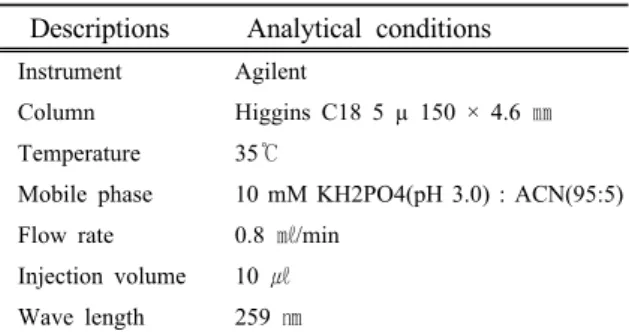
t, t-MA는 고성능 액체 크로마토그래피(High Performance Liquid Chromatography, HPLC)로 An et al.(2003)이 제시한 방법으로 분석하였다. t, t-MA (98%
Aldrich) 0.0005 g을 100 ㎖ 용량플라스크에 옮기고 에 탄올 5 ㎖를 넣고 초산으로 표선을 채워 50 ㎎/L t, t-MA 표준용액을 만들었다. 초산 1 ㎖을 100 ㎖ 용량플라스 크에 넣고 증류수로 표선을 채워 1% acetic acid를 만들 었다. 50 ㎎/L t, t-MA 5 ㎖를 50 ㎖에 넣고 1% acetic acid로 표선까지 채운 후 5 ㎎/L t, t-MA를 만든 후 이를
표준원액으로 하여 0.3, 0.5, 1.0, 2.0, 3.0, 4.0, 5.0 ㎎/L 로 7가지 농도의 표준용액을 만들었다.
HPLC 분석조건은 다음과 같다(Table 1).
요중 Hippuric acid 배설량은 한국산업안전보건공 단에서 제시한 방법으로 분석하였다(KOSHA, 2012).
Hippuric acid 0.3 g을 100 ㎖ 용량플라스크에 옮기고 증류수로 표선을 채워 마뇨산 3000 ㎎/L 표준용액 원액을 만들었다. 표준용액 원액을 각각 10, 20, 40, 80, 100 ㎕를 취하여 1 ㎖ vial로 맞추어 마뇨산은 30, 60, 120, 240, 300 ㎎/L을 표준용액으로 하였다.
HPLC 분석조건은 다음과 같다(Table 2).
3) 통계분석
모든 자료의 통계분석은 SAS (Ver 9.2, Institute Inc., Cary, NC, USA)를 이용하였다. 설문과 인터뷰 를 통해 얻은 연구대상자의 일반적인 특성은 기술통 계를 통해 평균과 표준편차를 구하였으며, 유증기 회 수설비 유무의 차이를 알아보기 위해 t-test 방법을 이용하였다. 작업종료 후의 요중 t, t-MA와 Hippuric
Table 1. Operating conditions of High performance liquid chromatography for t, t-MA
Descriptions Analytical conditions
Instrument Agilent
Column Higgins C18 5 µ 150 × 4.6 ㎜ Temperature 35℃
Mobile phase 10 mM KH2PO4(pH 3.0) : ACN(95:5) Flow rate 0.8 ㎖/min
Injection volume 10 ㎕ Wave length 259 ㎚
Table 2. Operating conditions of High performance liquid chromatography for Hippuric acid
Descriptions Analytical conditions
Instrument High performance Liquid chromatography [Gilson]
Column CS2546-C185
Temperature 30℃
Mobile phase 20 mM KH2PO4(pH 3.0) : ACN(85:15) Flow rate 1.0 ㎖/min
Injection volume 10 ㎕ Wave length 225 ㎚
Variables t, t-MA* p-Value† Hippuric acid* p-Value†
Mean±S.D‡ GM(GSD)§ Mean±S.D‡ GM(GSD)§
Stage Ⅱ
(N=7) 0.124±0.177 0.056(3.605)
0.57
0.557±0.251 0.507(1.618) Non-stage Ⅱ 0.50
(N=16) 0.160±0.113 0.103(3.157) 0.682±0.619 0.533(1.933)
* t, t-MA: mg/g creatinine, Hippuric acid: g/g creatinine; †p-Value by t-test; Statistically significant at p<0.05; ‡Mean±SD:
arithmetic mean±standard deviation; § GM: Geometric mean, GSD: Geometric standard deviation.
Table 4. Concentration of metabolites in urine by smoking status
Smoking status t, t-MA* Hippuric acid*
Mean±S.D† GM(GSD)‡ Mean±S.D† GM(GSD)‡
Total (N=23)
Smoker 0.161±0.146 0.094(3.253) 0.635±0.419 0.542(1.753)
Non-smoker 0.130±0.115 0.074(3.592) 0.659±0.700 0.499(1.990)
Stage Ⅱ (N=7)
Smoker 0.142±0.188 0.066(3.720) 0.588±0.260 0.533(1.658)
Non-smoker 0.020±0.000 0.020(0.000) 0.372±0.000 0.372(0.000)
Non-stage Ⅱ (N=16)
Smoker 0.176±0.117 0.122(2.951) 0.671±0.524 0.549(1.885)
Non-smoker 0.144±0.115 0.087(3.535) 0.694±0.739 0.517(2.067)
* t ,t-MA: mg/g creatinine, Hippuric acid: g/g creatinine; †Mean±SD: arithmetic mean±standard deviation; ‡GM: Geometric mean, GSD: Geometric standard deviation.
Table 3. Concentration of metabolites in urine by vapor recovery system
acid 농도에 영향을 미칠 수 있는 요인을 파악하기 위해 Multiple regression analysis를 실시하였다.
Ⅲ. 연구결과
1. 유증기 회수설비 유무에 따른 요중 대사산물의 비교 유증기 회수설비 설치 유무에 따라 근로자 각각 7 명, 16명의 소변시료를 분석하여 요중 대사산물의 농 도를 비교하였다.
요중 t, t-MA 농도는 유증기 회수설비가 설치된 주유 소에서 0.124±0.177 mg/g creatinine, Hippuric acid 농도 는 0.557±0.251 g/g creatinine 이었다. 유증기 회수설비 가 미설치된 주유소의 t, t-MA 농도는 0.160±0.113 mg/g creatinine, Hippuric acid 농도는 0.682±0.619 g/g creatinine 이었다. 유증기 회수설비 미설치 주유소의 근로자들이 설치된 주유소의 근로자들보다 요중 t, t-MA, 요중 Hippuric acid 농도가 더 높았지만, 통계적 으로 유의한 차이는 없었다(Table 3).
2. 흡연여부에 따른 요중 대사산물의 농도
흡연여부에 따른 요중 t, t-MA의 평균농도는 전반
적으로 흡연자가 비흡연자 보다 높았지만 Hippuric acid는 비흡연자가 미미하게 높았다. 유증기 회수설 비가 설치된 주유소 근로자들의 요중 t, t-MA와 Hippuric acid는 흡연자가 더 높았고, 미설치된 주유 소 근로자들의 요중 t, t-MA 평균농도는 흡연자가 높 았지만 Hippuric acid 평균농도는 비흡연자가 높았다.
흡연자, 비흡연자 모두 유증기 회수설비가 미설치된 주유소에서 요중 t, t-MA와 Hippuric acid 농도가 높 았다(Table 4).
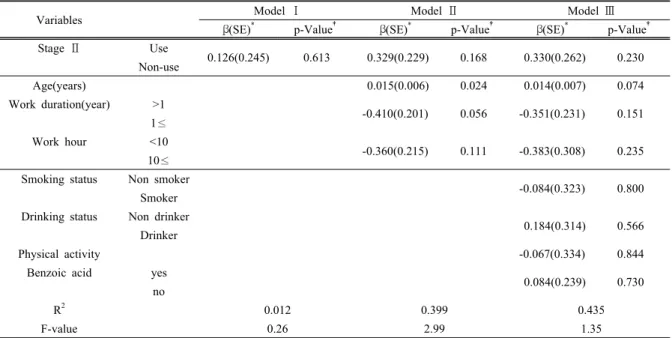
3. 요중 대사산물 농도에 영향을 미치는 요인 요중 t, t-MA와 Hippuric acid 농도에 영향을 미치 는 요인으로 유증기 회수설비 유무, 연령, 근무경력, 근무시간, 개인생활 습관으로 흡연여부, 음주여부로 다중회귀분석을 적용하였다.
Model Ⅰ은 유증기 회수설비 유무와 작업 종료 후 요중 t, t-MA, Hippuric acid 농도의 회귀분석을 실시 한 결과 유증기 회수설비 유무에 따른 요중 t, t-MA 와 Hippuric acid 농도는 통계적으로 유의하지 않았 다(p=0.565, p=0.613).
Model Ⅱ은 Model Ⅰ에 연령, 근무경력, 근무시간
Variables Model Ⅰ Model Ⅱ Model Ⅲ β(SE)* p-Value† β(SE)* p-Value† β(SE)* p-Value†
Stage Ⅱ Use
0.036(0.061) 0.565 0.033(0.067) 0.628 0.039(0.069) 0.581 Non-use
Age(years) -0.001(0.002) 0.577 -0.001(0.002) 0.751
Work duration(year) >1
0.074(0.059) 0.225 0.046(0.060) 0.451 1≤
Work hour <10
-0.060(0.063) 0.358 -0.009(0.072) 0.902 10≤
Smoking status Non smoker
0.103(0.085) 0.240 Smoker
Drinking status Non drinker
-0.132(0.074) 0.096 Drinker
Physical activity -0.019(0.062) 0.768
R2 0.016 0.169 0.335
F-value 0.34 0.92 1.08
n=23; * β; parameter estimate, SE: standard error, Model Ⅰ: stage Ⅱ, Model Ⅱ: Model Ⅰ+ work factors, Model Ⅲ : Model
Ⅱ+ individual custom, †p-Value by Multiple regression analysis, Statistically significant at p<0.05.
Table 6. Affecting factor of Hippuric acid in urine
Variables Model Ⅰ Model Ⅱ Model Ⅲ
β(SE)* p-Value† β(SE)* p-Value† β(SE)* p-Value†
Stage Ⅱ Use
0.126(0.245) 0.613 0.329(0.229) 0.168 0.330(0.262) 0.230 Non-use
Age(years) 0.015(0.006) 0.024 0.014(0.007) 0.074
Work duration(year) >1
-0.410(0.201) 0.056 -0.351(0.231) 0.151 1≤
Work hour <10
-0.360(0.215) 0.111 -0.383(0.308) 0.235 10≤
Smoking status Non smoker
-0.084(0.323) 0.800 Smoker
Drinking status Non drinker
0.184(0.314) 0.566 Drinker
Physical activity -0.067(0.334) 0.844
Benzoic acid yes
0.084(0.239) 0.730 no
R2 0.012 0.399 0.435
F-value 0.26 2.99 1.35
n=23; * β; parameter estimate, SE: standard error, Model Ⅰ: stage Ⅱ, Model Ⅱ: Model Ⅰ+ work factors, Model Ⅲ : Model
Ⅱ+ individual custom, †p-Value by Multiple regression analysis, Statistically significant at p<0.05.
Table 5. Affecting factor of trans, trans-Muconic acid in urine
변수를 포함하여 작업종료 후 요중 t, t-MA, Hippuric acid 농도를 다중회귀분석을 실시하였다. 유증기 회 수설비 유무에 따른 요중 t, t-MA, Hippuric acid 농 도는 통계적으로 유의하지 않았다. 연령, 근무경력,
근무시간에 따른 요중 t, t-MA 농도는 모든 요인에 대해 통계적으로 유의하지 않았고, Hippuric acid 농 도는 연령만 유의하였다(p=0.024).
Model Ⅲ은 Model Ⅱ에 개인생활습관인 흡연, 음
주, 운동을 포함시켰고, 각 변수에 대한 다중회귀분 석을 실시한 결과 유증기 회수설비 유무에 따른 요 중 t, t-MA, Hippuric acid 농도와 흡연, 음주, 운동의 요인에 대해서 요중 t, t-MA, Hippuric acid 농도 모 두 통계적으로 유의하지 않았다(Table 5).
Ⅳ. 고 찰
본 연구에서 요중 t, t-MA, Hippuric acid의 평균농 도는 각각 0.149±0.133 mg/g creatinine, 0.644±0.531 g/g creatinine 이었다. Lauwerys et al.(1994)에 의하면 0.5 ppm의 벤젠에 노출되었을 때 t, t-MA 농도가 0.8 mg/g creatinine으로 보고하였다. 본 연구결과와 비교 해보았을 때 공기 중 벤젠의 노출농도가 낮은 수준 일 것이라고 사료된다. 또한 흡연자와 비흡연자의 t, t-MA 농도의 기하평균값으로 각각 0.130, 0.06 mg/g creatinine을 제시하였는데 본 연구에서 흡연자들의 t, t-MA 기하평균농도는 각각 0.094, 0.074 mg/g creatinine 이었다. Inoue et al.(1989)은 공기 중 0.5 ppm의 벤젠에 노출된 남성 근로자들의 요중 t, t-MA 농도는 2.7 mg/g creatinine으로 제시하였는데 본 연 구에서는 0.149 mg/g creatinine 이었다.
톨루엔의 대사산물인 요중 Hippuric acid 평균농도 는 0.644±0.531 g/g creatinine으로, Lee et al.(1988)의 0.95±0.73 g/g creatinine 보다 낮았다. 톨루엔에 노출 되지 않은 사람들은 Hippuric acid 농도가 1.0 g Hippuric acid/L 미만으로 소변을 통해 배출되는 반 면 톨루엔에 노출된 근로자들은 노출정도에 따라 비 노출 그룹의 2-6배 농도의 Hippuric acid가 배출되는 데(Bergman, 1983), 본 연구결과 Hippuric acid가 0.59 - 1.32 g/L creatinine, 평균 0.78 g/L creatinine의 값으 로 일반인 수준으로 검출되어 공기 중 톨루엔의 노 출수준이 낮을 것으로 사료된다.
설문조사 항목에서는 개인적인 특성을 나타내는 요인으로 근무경력, 근무시간, 연령, 흡연, 음주, 운동 여부, 안식향산나트륨 음료섭취를 조사하였지만 Hippuric acid 농도는 연령만 통계적으로 유의하였고, 나머지 요인은 통계적으로 유의하지 않았다. 특히 흡 연은 t, t-MA 농도에 영향을 미치는 요인으로 비흡연 자(0.130 mg/g creatinine) 에 비해 흡연자(0.161 mg/g creatinine)가 평균적으로 높았다. 또한 유증기 회수설
비가 미설치된 주유소 종사자들의 흡연자 농도가 0.176±0.117 mg/g creatinine으로 설치된 주유소 종사 자들의 평균농도인 0.142±0.188 mg/g creatinine 보다 높았다. Lee et al.(2013)의 공기 중 벤젠, 톨루엔의 농 도는 유증기 회수설비가 설치된 주유소에서 각각 0.0034±0.0067 ppm, 0.0101±0.0163 ppm 이었으며 미 설치된 주유소는 검출한계 이하, 0.0047±0.0094 ppm 으로 유증기 회수설비가 설치된 주유소 종사자들의 개인시료 농도가 높았으나 주유량, 주유회수를 보정 한 결과 유증기 회수설비가 미설치된 주유소 종사자 들의 개인노출수준이 더 높았다. 본 연구 또한 요중 대사산물 농도는 유증기 회수설비가 설치된 주유소 종사자들의 평균이 각각 0.124±0.177 mg/g creatinine, 0.557±0.251 g/g creatinine 이었으며, 미설치된 주유소 종사자들은 0.160±0.113 mg/g creatinine, 0.682±0.619 g/g creatinine으로 더 높았다. 이는 종사자들이 호흡 으로 인한 노출뿐만 아니라 피부흡수 노출로 인한 영 향이 있다고 사료된다.
본 연구를 통해 유증기 회수설비 유무에 따른 주 유소 근로자들의 요중 t, t-MA, Hippuric acid의 평균 농도가 유증기 회수설비가 설치되지 않은 주유소의 근로자 보다 높게 나타났다. 또한 유증기 회수설비 설치 주유소의 흡연근로자들이 유증기 회수설비가 미설치 주유소 흡연근로자들 보다 요중 t, t-MA 농도 가 높았으며, 흡연자의 요중 t, t-MA 농도가 비흡연 자 보다 높았다. 기존의 연구에서는 공기 중 노출농 도에 따른 요중 대사산물에 관한 선행 연구가 대부 분이었으며, 유증기 회수 설비유무에 따른 주유소 근 로자들의 노출양상에 관한 연구는 미비하였다. 유증 기 회수설비를 설치하여 오염물질의 저감 및 냄새감 소 효과를 통해 인체에 미치는 영향을 줄일 수 있지 만, 근로자들의 부적절한 보호구 착용 및 미착용으로 인한 피부흡수를 통한 노출로 인체에 미치는 영향이 발생할 수 있다. 또한 개인의 생활습관, 작업형태, 외 부 환경요인 등에 따라 노출량의 차이가 있을 수 있 기 때문에 종사자들의 작업환경특성을 정확히 파악 하는 것이 중요하다고 본다. 최근 주유소의 주유원에 대한 특수건강진단을 지원하여 근로자의 건강을 보 호해야 한다고 보도되고 있으며 그에 따른 제도적인 지원이 필요하다고 생각한다.
Ⅴ. 결 론
본 연구는 2013년 4월~5월까지 서울, 경기 지역의 주유소 중 유증기 회수설비 설치 5개소와 유증기 회 수설비 미설치 5개소의 23명 남성 근로자를 대상으 로 하였다. 작업 종료 후 채취한 소변시료를 분석하 여 벤젠, 톨루엔의 대사산물인 요중 t, t-MA와 Hippuric acid의 노출양상에 대한 다음과 같은 결과 를 얻었다.
1. 유증기 회수설비가 설치된 주유소 근로자들의 요 중 t, t-MA와 Hippuric acid 평균농도는 각각 0.124±0.177 mg/g creatinine, 0.557±0.251 g/g creatinine 이였으며, 미설치 주유소 근로자들의 평균농도가 0.160±0.113 mg/g creatinine, 0.682±0.619 g/g creatinine 으로 더 높았지만 통계적으로 유의한 차이는 없었다.
2. 흡연자, 비흡연자 모두 유증기 회수설비가 미설 치된 주유소에서 요중 t, t-MA와 Hippuric acid 평균 농도가 높았다.
3. 요중 대사산물 농도에 영향을 줄 수 있는 요인 으로 작업요인, 개인생활습관으로 인한 요중 대사산 물의 농도는 Hippuric acid에서 연령만 통계적으로 유의하였다.
본 연구를 통해 주유소 근로자들의 개인소변시료 에서 요중 t, t-MA와 Hippuric acid이 검출되었고, 유 증기 회수설비 유무에 따른 대사산물의 농도차이가 있었다. 근로자들의 개인의 생활습관, 작업형태에 따 라 노출형태, 노출량이 다를 수 있기 때문에 정확한 노출평가가 중요하다. 향후 유증기 회수설비 유무에 따른 주유소 근로자들의 생물학적모니터링 연구가 진행되어야 하며 다양한 노출가능성을 고려한 지속 적인 연구가 필요하다고 사료된다.
References
An SH, Kim GY, Park NG, Sin JA, Lee DB et al. A Study on Urinay Phenol, Trans, Trans-Muconic acid concentration of exposed worker. 2003(182); 21-30 American Conference of Governmental Industrial
Hygienists(ACGIH). 2013 Threshold limit values for chemical substances and physical agents &
biological exposure indices, Cincinnati. Ohio, ACGIH 2013
ATSDR. ToxGuideTM for Benzene C6H6. CAS# 71-43-2.
U.S. Atlanta GA: Department of Health and Human Services Public Health Service Agency for Toxic Substances and Disease Registry; 2007. Available at:
http://www.atsdr.cdc.gov/toxguides/ toxguide-3.pdf [accessed 24 March 2011].
Bergman K. Application and results of whole-body autoradiography in distribution studies of organic solvents. Crit Rev Toxicol 1983; 12: 59-118
Collins JJ, Ireland B, Buckley CF, Shepperly Dl.
Lymphohaematopoeitic cancer mortality among workers with benzene exposure. Occup Env Med 2003; 60: 678-679
Darrall KG, Figgins JA, Brown RD, Phillips GF.
Determination of benzene and associated volatile compounds in mainstream cigarette smoke, Analyst 1998; 123: 1095-1101
Glass Dc, Gray CN, Jolley DJ, et al. Leukemia risk associated with low-level benzene exposure. Epid 2003; 14: 569-577
IARC, Monographs on the Evaluation of Carcinogenic Risks to Humans, A Review of Human Carcinogens, Part F: Chemical Agents and Related Occupations, vol. 100F, Agency for Research on Cancer, Benzene, World Health Organization Lyon 2012 pp 249-285 Inoue O, Seiji K, Nakatsuka H, Watanabe T, Yin SN, et al.
Urinary t,t-Muconic Acid as an Indicator of Exposure to Benzene. Br J Ind Med 1989; 46:
122-127
Johnson ES, Langard S, Lin YS. A critique of benzene exposure in the general population. Sci Total Environ 2007; 374: 183-8
Korea Environment Corporation, KECO 2012
Kirkeleit J, Riise T, Bratveit M, Moen E. Increased risk of acute myelogenous leukemia and multiple myeloma in a historical cohort of upstream petroleum workers exposed to crude oil. Cancer Causes Control 2008;
19: 13-23
Korean Oil Station Association, KOSA 2013
Korea Occupational Safety and Health Agency. Biological exposure index and Research analysis methods Ⅰ.
2012
Korea Occupational Safety Health Agency. The health effects of hazardous agents and management - Benzene. 1999
Lauwerys RR, Buchet JP, Andrien F. Muconic Acid in Urine: A Reliable Indicator of Occupational Exposure to Benzene. Am J Ind Med 1994; 25:
297-300
Lee SH. Toxicology and biological monitoring of Toluene. J Korean Occup Health. 1986;25(4): 1986 Lee HS, Moon GY, An GH, Seo JH. Health Impairment
and Concentration of Hippuric Acid in Urine of Workers Exposed to Toluene. J of the Environmental Sciences 2004;13(10): 939-946
Lee HM, Roh JH, Won JK, Kim CN. Occupational exposure aspect of gasoline vapor according to the use of gasoline vapor recovery system. 2013
Medinsky MA, Kenyon EM, Schlosser PM. Benzene: a case study in parent chemical and metabolite interactions. Toxicology 1995; 105(2-3): 225-233 Ministry of Environment of Korea(MOE), Air Environmental
Conservation Act; 2013
Ministry of Employment and Labor(MoEL). Exposure limits for Chemical Substances and Physical Agents.
2013
Palma G De, Poli D, Manini P, Andreoli R, Mozzoni P, et al. Biomarker of exposure to aromatic hydrocarbons and methyl tert-butyl ether in petrol station workers.
Biomarkers 2012; 17(4): 343-51
Rosenstock L, Cullen MR, Brodkin CA, Redlich CA.
Textbook of Clinical Occupational and Environmental Medicine. 2nd ed. Elsevier Saunders. Philadelphia.
2005
Song SH, Paik NW, Ha KC. A Study on Exposure to Volatile Organic compounds at Gas Stations in Korea. J Korean Soc Occup Environ Hyg. 2000.
10(1)
Uzma N, Kumar BS, Hazari MA. Exposure to benzene induces oxidative stress, alters the immune response and expression of p53 in gasoline filling workers, Am J Ind Med 2010; 53: 1264-1270 Verma DK, Tombe K. Measurement of benzene in the
workplace and its evolution process. Part II. present methods and future trends. American Industrial Hygiene Association Journal 1999; 60: 48-56
Yin S, Li G, Hu Y, Zhang X, jim C, et al. Symptoms and signs of workers exposed to benzene, toluene or the combination. Industrial Health 1987; 25: 113 http://toxnet.nlm.nih.gov/cgi-bin/sis/search/f?./temp/~LU4
AP1:1(HSDB)