Archetypical System Dynamics Modeling Approach:
Constructing C-S-I model into smart work system
김동환
*․이은규
**Dong-Hwan Kim․ Eun-Kyu Lee Abstract
본 논문은 최근 다양한 사회 분야에 있어서 IT 기술이 적용되는 과정을 SD 모델링 방식을 사 용하여 연구한 경험과 발견을 서술하고자 한다. 모델의 초기 단계에서 우리는 다양한 사회 분야마 다 다른 SD 모델을 만들 것이냐 아니면 기본적으로 유사한 모델 구조를 취할 것이냐를 선택해야 했다. 사회 분야마다 다른 구조의 SD 모델을 만들면, 상호간의 구조와 시뮬레이션 결과를 비교하 기 어렵다. 하지만 상호 모델 구조를 유사하게 구축하려고 하니, 서로 다른 모델링 팀들간의 의사 소통에 노력과 시간 소비가 지나치게 커져 갔다. 이러한 어려움을 극복하기 위하여 본 연구에서는 시스템 다이내믹스 모델링에도 시스템 사고의 원형적 피드백 루프에서와 같은 원형적 SD 모델을 만들고, 이를 사회 각 분야에 적용하는 방식을 취하고자 하였다. 먼저 최근 IT 기술 발전을 이끌 어 가는 핵심적인 요소로서 클라우드 컴퓨팅, 스마트 기기, 사물 인터넷을 선정하고 이들간의 상 호 관계성을 표현하는 SD 모델을 만들었다. 이를 원형(archetype)으로 하여, 교육, 의료, 원격 근 무 등 사회 각 분야의 IT 확산 과정에 적용하여 모델링을 하고 시뮬레이션을 하여 상호 비교하면 서 정책 시사점을 논의할 수 있었다. 본 논문에서는 이 중에서 원격 근무(smart work)에 관한 적 용 사례를 제시함으로써, SD 모델링에 있어서 원형적 접근 방법의 가능성을 탐색한다.
Key words: archetype, smart work, cloud computing, smart device, Internet of Things.(원형, 원격 근무, 클라우드 컴퓨팅, 스마트 기기, 사물 인터넷)
* 김동환
:
중앙대학교 공공인재학부 (제1저자, [email protected])
** 이은규
:
클리브랜드 대학교 도시 및 행정학과 (교신저자, [email protected])I. Introduction
Since beginning of the 21 century, networking and information technology have changed our life in both physical and cyber world. In other words, our world today relies to an astonishing degree on these systems and services. Furthermore the systems are underpinning our life especially in the fields of education, health care, and smart working.
However, it is difficult to understand a simultaneous revolution and progress in networking and information technology area. For instance, from smart phones to iPad; from separated data center to cloud computing; from the Internet to social network – we are undergoing the fastest technical growth and rapid social changes at the same time.
On the other hand, there is no concept frames to connect various networking and IT developments such as cloud computing, smart devices, and the extended Internet network.
From this problem awareness, the study has tried to develop a new frame concept not only to understand today’s change but also to forecast the most likely future of our life in terms of IT development particularly in education, health care, and smart work systems. In addition, system dynamics model was built to simulate the IT development mechanism. [Figure 1]
describes the outline of the study.
[Figure 1] Outline of the Study
As [Figure 1] described above, there are three fields of IT development; cloud computing,
smart devices, and the Internet of things. Cloud computing is one of the most important and
growing platform where everything and everyone is connected including smart devices. It
means that all things are connected to the Internet.
At the middle of [Figure 1], three parts of our life which are the most expected areas for applying the developed information technology are described; they are education, health care and smart work systems.
2. Archetypical System Dynamics Model: C∙S∙I Frame
The purpose of System dynamics modeling is generally classified into two ways. First purpose of modeling is for understanding or describing the past behavior of system. To understand the past behavior of the system, modelers describe Behavior over Time Graph. On the other side, system dynamics modeler simulates the model to prescribe or forecast the future based on the current structure of the system. These two approaches of modeling are often conducted simultaneously.
In this regard, it is sometimes difficult to distinguish clearly between the two purposes because the future state is based on the past and current structure of system. Moreover, if there is no enough time period of the past behavior, it is fundamentally unlikely to prescribe the future based on the past behavior. This kind of difficulty is applied to this study which is building system dynamics model for suggesting policy implication to the future, because three fields of IT development (Cloud Computing, Smart Devices, and the Internet of Things) are the latest techniques to innovate our life particularly on education, health care, and smart work system.
On the other hand, it needs to be decided whether we build independent or integrated model to deal with three policy areas (education, health care, and smart work system). It is described in [Figure 2].
[Figure 2] Three Types of Modeling Education, Health Care, Smart Work
As described above Figure 2, we can consider three types of system dynamics modeling for dealing with several policy fields; education, health care, and smart work system. When a model is built independently, that is, there are three models respectively the model can be applied to each policy field flexibly but it is unlikely to secure the unity of whole system.
Meanwhile, if we build a common model for the each system, the distinct characteristics of each policy field could not be guaranteed. Besides the two approaches above, we can also consider constructing an integrated model, but it has no option but to cost a lot.
To deal with these problems of modeling, we have tried to construct an archetype model which can be applied to three kinds of policy fields. System archetypes can be used as free-standing solutions to complex issues (Wolstenholme 2004).
However, most of former studies on systems archetypes are concentrated on system thinking approach and regarded as useful ways to develop quantitative system dynamics models. In this respect, it is a new experiment and trial to construct quantitative system dynamics archetypes.
We sought common variables which can be applied for various policy fields in common and built an integrated structure including the common variables. On the other hand, we handled each parameter to fit into the characteristics of policy fields respectively.
The most critical variables which can be applied to different policy fields are cloud computing, smart devices, and the Internet of Things mechanism; we call these variables C․
S․I frame. The following [Figure 3] shows the frame. Cloud computing includes industrial
service of big data, drive, software in remote server. Users of smart devices usually connect to
the remote server to get cloud computing service. Also Internet of Things produces vast
amount of data, which will be uploaded and managed in the cloud computing system, and
then provide real-time service to smart device users.
[Figure 3] Three Critical Variables in the Archetype
As shown in Figure 3, cloud computing, smart devices, and the Internet of things are correlated with IT service, human life, and all things that is around or near our life respectively. And, we can imagine that cloud service is in the sky, smart devices exist in the space we use the tools, and the earth consists of all things including nature, house, transportations, laptops, and so on.
From this concept of frame, we constructed an archetype model including stock and flow
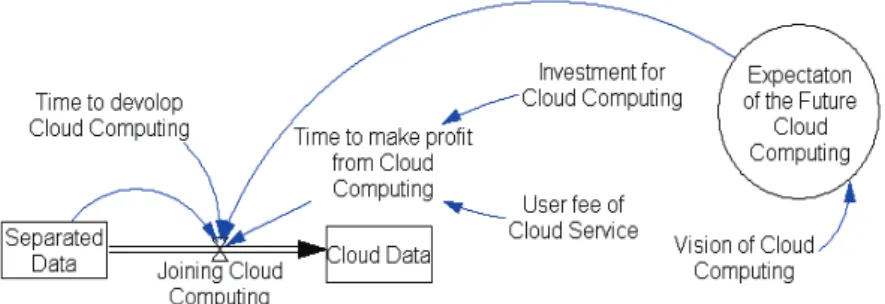
diagrams. First area of the model is about cloud computing. As mentioned above, cloud
computing is one of the most important and growing platform and database services where
everything and everyone is connected including smart devices. In a database perspective,
separated data are integrated into cloud data. It means that we can use online resources
whenever we want without downloading the data. This mechanism is changing our life
progressively today, particularly in health care system. For instance, if all information and data
about one patient’s medical history is stored on cloud data center, the patient can receive
medical care everywhere. In addition, medical doctor can monitor patients’ conditions anytime
because the real time data of the patient in saving on the cloud. [Figure 4] describes a stock
and flow mechanism of cloud computing as well as other related variables.
[Figure 4] Cloud Computing part of the model
Figure 5 shows the principal variables and their interconnections in terms of smart devices.
Recently a lot of cell phone users have been switching their phone from non-smart device to smart one. For example, the number of people with smart phone is at least 10 millions now in Korea and it is about over 20% of entire population of the nation. Moreover, the current trend is in process rapidly. In the system dynamics model following, both cloud computing and the Internet of things affects the flow of switching to smart devices. And, the more supply of smart devices in our society, the more profit from cloud computing as well as the Internet of things.
[Figure 5] Smart Device part of the model
On the other side of the model, Figure 6 illustrates a part of the Internet of Things in the
whole model. The Internet of Things, also known as the Internet of objects, refers to the
networked interconnection of everyday objects such as a smart phone, sensors in various
purposes, and so on. It is also described as a self-configuring wireless network of sensors which
would interconnect all things around us. For instance, in the field of medical care, the remote hypertension monitoring system can be connected to the network so that his or her medical doctor can check a case of dangerous emergency. The basic mechanism of the following diagram depends on the number of place where the things are interconnected to the Internet network. According to the rate of building IoT places, the stock of IoT places are increased and other critical variables are affecting the rate such as cost and time for building places.
Furthermore, the more supplying of smart devices, the larger number of places where can access to the wireless network. Other variables which are correlated to the mechanism are shown in Figure 6.
[Figure 6] The Internet of Things part of the model
To sum up the above three parts of diagram, Figure 7 describes a whole boundary of the
C․S․I (Cloud computing, smart devices, and the Internet of Things) model. We applied
this archetypical model to health care sector, education sector, and smart work sector. And we
can simulate respective sectors to find out future trend and policy leverages.
[Figure 7] The whole model of cloud computing, smart devices, and the Internet of things
3. Simulation of Smart work system
To apply the archetypical C-S-I model to smart work system, we renamed the stocks and put initial values that are calculated from current data of 2010 year as in figure 8. Even though stock-flow diagram of C-S-I mdoel and Smart Work System is identical, each variables names and parameters are changed according to the current and future state of smart working environment of Korea.
[Figure 8] Stocks and initial values of Smart Work System
Simulation result of smart work system is shown in Figure 9. Time period of the simulation is 240 months; that is 20 years from 2010 and the result shows us how the trend of diffusion will continue in the field of smart work system in Korea. There are three lines in the graph, first of all, a dotted line is the number of places where would be used as smart work centers and the parameter of the line is relies on the past record and the government policy plan in this field. As the number of smart work centers is increasing, the number of smart workers, that is illustrated by the thick line, continues to rise. In consequence, the time spending on cloud computing service of thin dotted line increases gradually.
The simulation result means that it is the most important to build enough smart work places at the beginning of diffusion in the smart work system. In other words, if there are no ample spaces where can do smart work with high quality of the Internet network, it would be hard to succeed in smart work system. Building the center can be carried out in governmental sectors as well as private sectors.
[Figure 9] Result of Simulation on Smart Work System
In our study, we also conducted other simulations in the fields of education and health care.
Though the result of simulations, different strategies are adopted to stimulate each fields
respectively, the basic stock-flow structure is almot identical as in the C-S-I model, which
reduce our modeling time and efforts to communicate among different modelers.
In the field of health care service, construction of cloud computing infrasture that is mainly data on the records of health care is the most important factor to succeed. And in the education side, sufficient supply of smart devices is most critical to develop the smart education system in Korea. In this regards, the education department of Korean government has planned to provide electronic textbooks for the primary as well as secondary schools.
4. Discussion and Summary
In this study we developed an archetypical stock flow model of C-S-I which focus on the technological development of IT industry, and we applied the archetypical model to different industrical sectors, especially on smart work system. Our approach is unique in the sense that the concept of archetype is applied into the SD modeling, while traditionally archetype modeling is usually applied in the stage of systems thinking (Doa-Hoon Kim et al. 1999).
Our study shows that an archetypical model can be a modeling platform for diverse modelers.
And it reduces communication burden among them and modeling time for devising stock flow diagram. Furthermore, the archetypical model makes it easier to compare simulation results between different sectors. For example, while the simulation of smart work system shows the importance of initial growth of smart work places, the simulation of education system shows that the increase in the number of smart device users is most key variables in the diffusion of IT technology.
However, our approach is experimental rather than operational until now. One of the most
difficult problems is that there are too many abstract variables lacking real data in the
archetypical model as well as applied ones. Also the archetypical model might inhibit modelers
to construct unique stock flow diagram of their sectors. Our study might be exceptional case
because diffusion of same IT technology may be similar among different sectors. Further study
and discussion on this archetypical approach on system dynamics modeling will shows its
advantages and disadvantages for diverse modeling areas. Our contribution is that we tried it
first time.
【REFERENCES】
Christopher Barnatt. (2010). “A Brief Guide to Cloud Computing”, Constable & Robinson Ltd.
Doa-Hoon Kim, Tae-Hoon Moon, Dong-Hwan Kim, 1999, System Dynamics, Daeyoung Moonhwasa, Seoul, Korea.
Eric Wolstenholme. (2004). “Using Generic System Archetypes to Support Thinking and Modeling”, System Dynamics Review vol. 20, no. 4, pp.341–356
John D. Sterman. (2000). “Business Dynamics, Systems Thinking and Modeling for a Complex World”. MacGraw-Hill Companies, Inc.
Joseph M. Deluca, Fache, and Rebecca Enmark. (2000). “E-Health: The Changing Model of Healthcare”, Frontiers of Health Services Management, vol.17, no.1, pp.3-15
Meadows, D. H. (1980). “The Unavoidable A Priori”, In Jorgen R. (ed.). Elements of the System Dynamics Method. Massachusetts. The MIT Press, pp.31-36
Richard E. Klosterman. (1990). “Community Analysis and Planning Techniques”, Rowman &
Littlefield Publishers, Inc.
▶접수일 : 2015. 8. 31. / 수정일 : 2015. 9. 11. / 게재확정일 : 2015. 9. 20.