• 검색 결과가 없습니다.

Technology Odyssey: An Introductory Engineering Course based on Soft Engineering

N/A
N/A
Protected

Academic year: 2021

Share "Technology Odyssey: An Introductory Engineering Course based on Soft Engineering"

Copied!
6
0
0

로드 중.... (전체 텍스트 보기)

전체 글

(1)

I. INTRODUCTION

1)

We propose and execute an introductory engineering course for investigating the history of technology and the philosophy of technology. Unlike the current engineering course materials that deal with each and individual engineering contents, “soft engineering”, to explore proper technology and proper ways of exercising engineering, has been explored[1].

Creative cases for technology are presented following the most creative, successful, and proficient periods-the ancient greece, the Renaissance period and Silicon Valley era. Ancient greek technology has been investigated in terms of “techne”

with the origin of technology and/or art, and their equivalences The Renaissance period has been investigated in terms of

“Uomo universale(polymath)” with Firenze geniuses. The successful drives for the Silicon Valley creativeness have been based on “entrepreneurship”.

Received May 20 2020; Accepted May 31, 2020

† Corresponding Author: [email protected]

Ⓒ2020 Korean Society for Engineering Education. All rights reserved.

To overcome the difficult goal to grasp course subject-technology issues, we take a stance as a tourist guide and tourists. Categorized course materials are surveyed at the beginning of each historical period and presented following the preference of the students to maintain the students’ interests. Team efforts including group discussions and project executions have been encouraged to seek the aspects of creativeness and/or technology[2].

This paper is a technological research paper which summarizes the lecture experiences over 2 years for Korean students and/or foreign students as an Engineering Certification Course conducted at School of Mechanical Engineering, Pusan National University.

II. COURSE OVERVIEW 1. Soft Engineering

Unlike the current engineering course materials that deal with each and individual engineering contents, this introductory engineering course is aiming at “soft engineering” to explore the proper technology and the

Technology Odyssey: An Introductory Engineering Course based on Soft Engineering

Yoon, Joongsun

Professor, School of Mechanical Engineering, Pusan National University

ABSTRACT

We propose and execute an introductory engineering course for investigating the history of technology and the philosophy of technology.

Soft engineering, to explore proper technology and appropriate ways of exercising engineering, has been explored. Creative cases for technology are presented following the most creative, successful periods-the ancient greece, the Renaissance and Silicon Valley era. Ancient greek technology has been investigated in terms of “techne” with the origin of technology and/or art, and their equivalences.

The Renaissance period has been investigated in terms of “Uomo universale (polymath)” with Firenze geniuses. The successful drives for the Silicon Valley creativeness have been investigated following “entrepreneurship”. To overcome the difficult goal to grasp course subject-technology issues, we take a stance as a tourist guide and tourists utilizing offline onsite experiences and online informations. Categorized course materials are surveyed at the beginning of each period and presented following the preferences of the students to maintain the students’ interests. Team efforts including group discussions and project executions have been encouraged to seek the aspects of creativeness and/or technology. This paper summarizes the 3-lecture experiences over 2 years for Korean students and/or foreign students conducted at Pusan National University.

Keywords: Technology Issue, History of Technology, Philosophy of Technology, Soft Engineerong, Techne, Uomo Universale, Entrepreneurship

(2)

appropriate ways of implementing engineering considering the history of technology and the philosophy of technology.

The history of technology and the philosophy of technology is nether well established area nor an easy discipline to follow especially for the freshmen students who are going to start their career as engineers. The most difficult part on these thinkings is to understand the difference between the technology issues and technological contents. Most engineering students have difficulties in humanistic thinking about technology like what is proper technology and what are appropriate ways of implementing engineering.

To overcome the difficult goal to grasp course subject-technology issues, we take a stance as a tourist guide and tourists. To overcome these difficulties not to follow the chronological happenings in a time table of the technology utilizing offline onsite experiences and online informations. Categorized course materials are surveyed at the beginning of each period and presented following the preferences of the students to maintain their interests.

The lecturer’s previous onsite experiences at Stanford University, Florence, Athens as a visiting scholar are extensively referenced with many collected materials.

Creative cases for technology are investigated following the most creative, successful, and proficient periods in history.

Ancient greek technology has been investigated in terms of “techne” with the origin of technology and/or art, and their equivalences. The Renaissance period has been investigated in terms of “Uomo universale(polymath)” with Firenze geniuses. The successful drives for the Silicon Valley creativeness have been investigated following “entrepreneurship”

and continuation and revitalization of ancient greece and renaissance.

Is the engineering a newly established field around 19th century or 20th century? We start to think the evolution of machines as arms(weapons)-from hunting and collecting tools of the primitive ages to modern warfare weapons and information processing tools in the Information Age. These arms have been evolved to fulfil the required optimized performances. for the survival of mankind. On the contrary to the evolution of machines as offensive arms, we may think machines as instruments or toys linked to be harmonious

to emotion.. Technology has always been with human history with the keyword ‘for humans’.

Engineering has been commonly believed to be objective and universal. to everyone. Art and technology have same coining origin as ‘techne.’ Art is an area which extends the feeling and emotion linked to corporeality(body). At the same time, elementary technology is an area which extends the force and function linked to corporeality. Recent development and reflective attitude regarding technology tends to put technology back closely to humans.

Inquiries about philosophy of technology can be directed to ‘what is technology for human?’ and/or ‘how this technology can be designed?’. In other words ‘how to build machine(s) to restore human prides?’ and/or ‘what are inhumane human conditions to overcome technologically?’. Appropriate approaches to technology problems may require the comprehensive recognition of up to contextual dimension as well as contents ‘Technology Odyssey’ course investigates these technological problems offered as an Engineering Certification Course conducted at School of Mechanical Engineering, Pusan National University.

2. Course Overview

To overcome the difficult goal to grasp course subject-technology issues and course bases-history of technology and philosophy of technology, we take a stance as a tourist guide and tourists. Offline onsite experiences and online informations for successful engineering cases are presented to explore the proper technology and the appropriate ways of implementing technology.

Categorized course materials are surveyed at the beginning of each historical technology period and presented following the preferences of the students to maintain the their’ interests.

Team efforts including group discussions and project executions have been encouraged to seek the aspects of creativeness and/or technology.

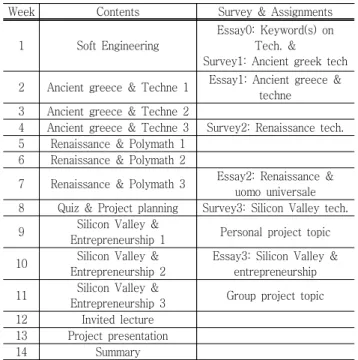
Course syllabus is shown in Table 1. 1) Weekly course contents. 2) Students’ surveys on favorite character(s) and technology area(s), organization(company) are conducted for ancient greece, renaissance, and Silicon Valley periods.

Based on students’ favoritism surveyed course themes and

contents are reorganized to induce their curiosities. 3)

(3)

Following the each period’s discussion, technical essay is required to evolve their technology issues for each period.

4) Group term project presentation developed from essays and 5) Invited talk is provided to have a chance to communicate their ideas from outsiders views.

1) Soft Engineering

Course starts with overview of lecture and core subject-soft engineering[1,2]. For the opening, surveys on engineering experiences and ancient greek technology have been performed. Survey questionnares are as follows-1) when and how students decide their engineering major(s), 2a) who is(are) favorite engineer(s)? b) what is(are) favorite machine(s), c) what is(are) engineering experience(s)? d) reasons. These surveys serve basic data for understanding students’ own background for engineering and their curiosities.

2) Ancient Greece: Techne

For investigating the ancient greece technology, preferences for ancient greek technology themes(areas) and characters(persons) are performed. Top three(3) items each out of sixteen(16) themes and eight(8) characters(person) are surveyed with reasons[3].

Table 1 Weekly course contents.

Week Contents Survey & Assignments

1 Soft Engineering

Essay0: Keyword(s) on Tech. &

Survey1: Ancient greek tech 2 Ancient greece & Techne 1 Essay1: Ancient greece &

techne 3 Ancient greece & Techne 2

4 Ancient greece & Techne 3 Survey2: Renaissance tech.

5 Renaissance & Polymath 1 6 Renaissance & Polymath 2

7 Renaissance & Polymath 3 Essay2: Renaissance &

uomo universale 8 Quiz & Project planning Survey3: Silicon Valley tech.

9 Silicon Valley &

Entrepreneurship 1 Personal project topic 10 Silicon Valley &

Entrepreneurship 2

Essay3: Silicon Valley &

entrepreneurship 11 Silicon Valley &

Entrepreneurship 3 Group project topic 12 Invited lecture

13 Project presentation

14 Summary

Sixteen(16) candidates for ancient greek technology themes(areas) include 1) (sundial/hydraulic/alarm)Clocks/(ηλ ιακά/υδραυλικά/ξυπνητήρι)Ωρολόγια), 2) Tools & machines, measuring & astronomical instruments(Εργαλεία&μηχανές, με τρητικά&αστρονομικά όργανα), 3) Automata(Αυτόματα), 4) Telecommunication(Τηλεπικοινωνίες), 5) Hoisting machines (Ανυψωτικά), 6) Theatre technology(Τεχνολογία του θεάτρο υ), 7) Hydraulic technology(Υδραυλική τεχνολογία), 8) Military technology(Πολεμική τεχνολογία), 9) Naval technology(Ναυπ ηγική τεχνολογία).

Eight(8) candidates for ancient greek characters(persons) are 1) Aristotle(Αριστοτέλης), 2) Archimedes(Αρχιμήδης ο Συρακούσιας), 3) Daedalus(Δαίδαλος), 4) Hero of Alexandria (Ήρων ο Αλεξανδρεύς), 5) (mythology) Hephaestus(Θεός Ήφαι στος), 6) Ktesibio(Κτησίβιος του Αλεξανδρεύς), 7) Plato(Πλάτ ων), 8) Philo of Byzantium(Φίλων ο Αλεχανδρεύς), 9) Claudius Ptolemy(Κλαύδιος Πτολεμαῖος).

3) Renaissance: Uomo Universale(Polymath)

For investigating the Florentine renaissance, 1st candidates for Florentine geniuses are 50 persons[4,5].

4) Silicone Valley: Entrepreneurship

For investigating the Silicon Valley entrepreneurship preferences for Silicon Valley group of people and companies are performed. Top three(3) items each out of nine(9) group of people and nine(9) companies are surveyed with reasons[6].

Candidates for group of people are 1) Leland Stanford, 2) William "Bill" Redington Hewlett & Dave Packard, 3) Steve Jobs, 4) Douglas Carl Engelbart, 5) Mark Weiser, 6) David M. Kelley & Bill Moggridge, 7) Terry Allen Winograd, 8) Larry Page & Sergei Brin, and 9) Mark Zuckerberg.

Candidates for companies are 1) Hewlett_Packard, 2) SRI International(Stanford Research Institute), 3) SLAC, 4) Intel, 5) PARC(Palo Alto Research Center Incorporated), 6) Apple Inc., 8) Facebook, and 9) Twitter.

III. TECHONOLOGY ODYSSEY LECTURE

1. Lecture Overview

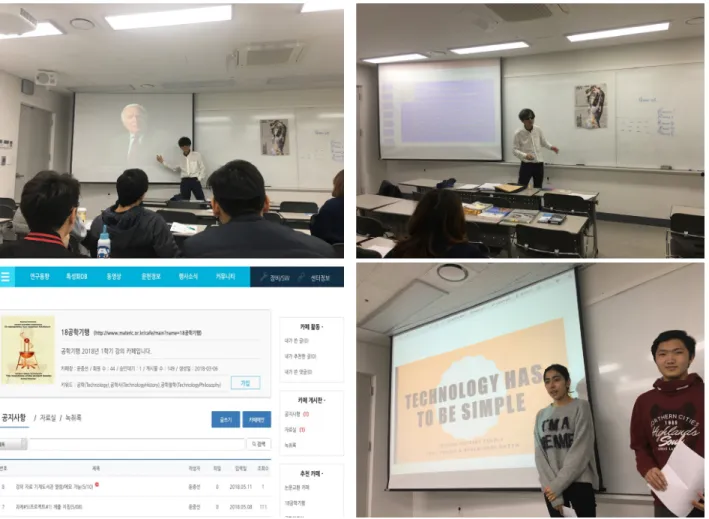
Technology Odyssey lecture as of 2nd semester of 2019

(4)

at Pusan National University is being processed as shown in Fig.1.

Students with engineering major have difficulties to understand the difference between the technology issues and technological contents. Lecturer demonstrates and discusses with students alphabetical keywords for technology issues like A as age, artificiality, assistive, autism, H as handicapped(mentally and/or physically), S as size, synesthesia, etc.

Also, lecturer demonstrated various examples to show technology issue discussions like ‘You Dream, We Display-Universality vs. specialty in technology,’

‘Imagination is the Limit-Technology assisted unlimited imagination,’ ‘μηδέν άγαν(Miden Agan=nothing in excess) at DelphiΔελφοί.’

The 1st essay was to write a essay on technology of personal interest with 1 title and 5 keywords to explain student’s

technology issue and grounds for selections. This assignment is structured(intended) to help students to think more about technology issue than technological contents & to provide grounds for appropriateness for technology issue and implementing ways for technology. Students are still having problems separating technology issues and technological contents.

Course discussions are carried on following the survey results of students’ preferences for representing three(3) periods of technology evolution. Review essays based on soft engineering are assigned to students at the end of the each period. Also, the continuation of theme search helps to students to focus on soft engineering issue(s) and to provide the grounds for proper technology and appropriate ways of implementing technology. Advise student to write essays with title, five(5) keywords to explain the discussion effectively and two(2) cases for each period.

Fig. 1 Introductory technology course-Technology Odyssey

(5)

The 1st essay includes discussions regarding ancient greek technology. The 2nd essay continues on discussions regarding renaissance. Futhermore the 3rd essay continues on discussions regarding Silicon Valley.

2. Ancient Greece

The ranked characters(persons) of interests for ancient greek technology for 14 participants are 1) Archimedes/Αρχιμ ήδης ο Συρακούσιας(33=7/5/2 points), 2) Aristotle/Αριστοτέλ ης(27=7/1/4 points), 3) Plato/Πλάτων(10=1/3/1), 4) Ptolemy/

Κλαύδιος Πτολεμαῖος(6=-/1/4 points), 5) Daedalus/Δαίδαλος

& Hero of Alexander/Ήρων ο Αλεξανδρεύς(5=-/2/1 points), 7) Ktesibios/Κτησίβιος του Αλεξανδρεύς(4=-/2/-), 8) Philo of Aleexander/Φίλων ο Αλεχανδρεύς(1=-/-/1), 9) Haphaestus/

Θεός Ήφαιστος(0=-/-/-).

The ranked themes of interests for 14 participants are 1) Tools & machines, measuring & astronomical instruments/

Εργαλεία & μηχανές, μετρητικά & αστρονομικά όργανα /(16=4/1/2 points), 2) Flying technology/Πτητική τεχνολογία (15=2/4/1 points), 3) Telecommunication/Τηλεπικοινωνίες (14=2/3/1 points) 4) Medical technology/Ιατρική τεχνολογία (8=2/1/- points) & Music technology/(Μουσική τεχνολογία (8=1/2/1 points), 6) Agricultural technologyΑγροτική τεχνολο γία/(7=1/1/2 points)=(14= -/5/4 points), 7) Automata/Αυτόμα τα(5=1/1/- points), 8) Military technology/Πολεμική τεχνολογ ία(4=1/-/1 points)=(8=2/1/- points), 9) Hydraulic technology/

Υδραυλική τεχνολογία(3=-/1/1 points) & ETC.(toy...) technology/Παιχνίδα κτλ./(3=-/1/1 points).

3. Renaissance

Among fifty(50) candidates described in II.2.3) to maintain students’ interest considering familiarity and relevance to the lecture nineteen(19) persons are selected as the 1st stage and finally twelve(12) candidates are selected.

The ranked persons of interests for 13 participants are 1) Leonardo da Vinci(25=7/2/points), 2) Galileo Galilei (24=3/7/1 points), 3) Antonio Meucci(8=-/-/8 points), 4) Michelangelo(7=1/-/-points), 5) Fillippo Bruneleschi (3=-1/-/-points) & Sandro Botticelli(3=1/-/- points), 7) Dante Alighieri(2=-/1/-2points) & Nicolò Machiavelli (2=--/1/-points).

4. Silicon Valley

The ranked group of person(s) of interests for Silicon Valley for 13 participants are 1) Steve Jobs(25=7/2/- points), 2) Mark Zuckerberger(14=1/3/5 points), 3) Leland Stanford &

Larry Page & Sergei Brin(11=1/3/2 points each) 5) David Kelley & Bill Moggridge(8=1/2/1 points), 6) Terry Winograd (6=-/3/-points), 7) Bill Hewlett&Dave Packard(4=-/1/2 points), 8) Mark Weiser(3=1/-/-points), 9) Doug Engelbart (2=-/-/2 points). The ranked organization of interests are 1)Apple Inc.(21=5/3/ points) & Google(21=3/5/2 points), 3) Intel(17=3/4/ points), 4) Facebook(6.5=-/-/6.5 points), 5) Hewlett-Packard(6=1/1/1 points), 6) SRI International (4=1/-/1 points), 7) Twitter(1.5=-/-/1.5 points), 8) PARC (1=-/-/1 point), 9) SLAC(0=-/-/-points).

5. Project

Based on submitted essays for each period students are asked to develop(propose) at least two(2) personal project ideas and to countercheck validity of each other teammate’s ideas. Final decision of team project is to be selected and proposed.

Six(6) projects conducted for the 2nd semester of 2019 are “To rethink the function of contact lenses, ‘Concession of technology to imagination,’ ‘Evolution of transportation,’

‘Simplicity of technology,’ ‘Harmonic music for human sense,’

‘To see the impossible.’ Four(4) projects conducted for the 1st semester of 2019 were ‘Safety-oriented engineering,’

‘Curiosity and engineering,’ ‘Art-based engineering,’

‘Engineering for saving.’ Eleven(11) projects conducted for the 2018 included ‘Soft engineering at Silicon Valley,’

‘Archimedes and techne,’ ‘Soft engineering to learn from the developments of robots,’ ‘What we need to learn in commonality of ancient greece, Florence, Silicon Valley,’

‘Douglas Engelbart and Human-computer interaction(HCI),’

etc.

Projects are evaluated in terms of issue raisng, project completeness, delivery, and/or ideation/planning except the presentation team itself with short comments. Lecturer’s evaluation is added to the students’ evaluation.

Relevant course materials are provided at the designated

lecture bookshelf at the mechanical engineering library

(6)

annex[3-7]. Also, as the lecture proceeds, lecturer gets the information from students’ wish list(s) for materials through lecture website messaging system & provide information materials when these are obtained. When students are ready to start their own projects, they make their problems on technology issue and present it as a team, group of two(2) to 3(three) students. At the end of weekly lecture session consulting and free talking session has been reserved throughout the lecture.

IV. SUMMARY

This paper summarizes the lecture experiences over 2 years for Korean students and/or foreign students as an Engineering Certification Course conducted at School of Mechanical Engineering, Pusan National University.

This course is intended to guide and interact with students who select his or her major as engineering and to endeavor his or her career with joy. Also to guide him or her tackle the soft engineering issues in terms of philosophy of technology and history of technology. This paper and references may help to the people to overcome the lack of organized texts.

This work was supported by a 2-Year Research Grant of Pusan National University

REFERENCES

1. Yoon, J.(2003). An Unfamiliar Technology-Soft Engineering.

Journal of the KSME , 13(12), 47-53.

2. Yoon. J.(2004). The Interactive Education of Introductory Engineering via Multimedia. Journal of Engineering Education Research , 7(3), 52-58.

3. Kostsanas. K.(2015). The inventions of the ancient Greeks . Pyrgos.

4. Il Genio Fiorentino.(2009). I Luoghi del Genio Fiorentino.

Scramasax .

5. Galluzzi. P.(1996). Gli ingegneri del Rinascimento da Brunellesdchi a Leonardo da Vinci . GIUNTI.

6. Winslow, W. ed.(1995). The Making of Silicon Valley: A One Hundred Year Renaissance . Santa Clara Valley Historical Association.

7. Yoon. J.(2001-). Selected multimedia materials obtained from traveling.

윤중선 (Yoon, Joongsun)

1981년: 서울대학교 기계설계학과 졸업 1983년: 동 대학원 기계설계학과 석사 1988년: LEHIGH 기계공학과 박사 1993년~현재: 부산대학교 기계공학부 교수

관심분야: Robotics, Interactive technology, Soft engineering

E-mail: [email protected]

수치

Table  1  Weekly  course  contents.
Fig.  1  Introductory  technology  course-Technology  Odyssey

참조

관련 문서