• 검색 결과가 없습니다.

Occurrence of Pythium Blight Caused by Pythium aphanidermatum on Chewing Fescue

N/A
N/A
Protected

Academic year: 2021

Share "Occurrence of Pythium Blight Caused by Pythium aphanidermatum on Chewing Fescue"

Copied!
6
0
0

로드 중.... (전체 텍스트 보기)

전체 글

(1)

Research Note Open Access

306

Pythium aphanidermatum에 의한 Chewing Fescue에 잎마름병 발생

장태현1*·이용세2

1

경북대학교 생태환경대학 생태환경시스템학부,

2

대구대학교 생명환경과학부

Occurrence of Pythium Blight Caused by Pythium aphanidermatum on Chewing Fescue

Taehyun Chang1* and Yong Se Lee2

1

School of Ecology & Environmental System, College of Ecology & Environmental Sciences, Kyungpook National University, Sangju, 742-711, Korea

2

Division of Life and Environmental Science, Daegu University, Gyeongsan, 712-714, Korea (Received on August 26 2013; Revised on September 05, 2013; Accepted on September 09, 2013)

ABSTRACT. Pythium blight occurred by Pythium aphanidermatum on chewing fescue cv. “Jamestowm II” from early June, 2010 and 2011 at the test field in Daegu University in Gyeongbuk Province, Korea. Disease symptoms on the turfgrass were leaf blights dying from the leaf tip and root rot, which appeared patches of brown to dark brown color or gray brown color in the field. The pathogens (40-1 isolate) of Pythium blight was isolated from the diseased leaf and crown tissue and cultured on potato-dextrose agar (PDA) for identification. Lobulate sporangia were inflated, complex structures, and filamentous sporangia were usually indistinguishable from vegetative hyphae.

Sequences of ribosomal RNA gene of the fungus were homologous with similarity of 100% to those of P.

aphanidermatum isolates in GenBank database. Pathogenicity was also confirmed on the chewing fescue, creeping betgrass and Kentucky bluegrass by Koch's postulates. This is the first report of Pythium blight on chewing fescue caused by P. aphanidermatum in Korea.

Key words: Filamentous sporangia, Hyphae, Lobulate sporangia, Pythium blight

전세계 여러 식물에서 발생하는 Pythium 마름병은 Pythium spp. 의해 다양하게 발생하는 병으로 Pythium 속에는 100 여종 이상이 식물병에 관여 하는 것으로 알려져 있다. 이 들 종 중 전세계에 분포하고 있는 중요한 식물병원균 중 에 하나인 P. graminicola은 주로 벼, 옥수수 등의 곡물류 와 사탕수수, 잔디 등에서 발생하는 병으로 종자와 뿌리 썩음 및 묘잘록병을 일으키며, 분류상으로 포자를 형성하 는 거대한 그룹에 속한다(Van der Plaats-Niterink, 1981). 포 자를 형성하는 이들 그룹에는 또 다른 중요한 식물병원성 종인 P. aphanidermatum (Edson) Fitzp, P. arrhenomanes Drechsler, P. myriotylum Drechsler 및 P. vanterpoolii V.

Kouyeas and H. Kouyeas이 속해 있다(Van der Plaats- Niterink, 1981).

잔디에서 병을 일으키는 Pythium spp.은 대부분의 잔디

에서 모잘록병을 일으키는 것으로 보고 되었다(Andrews, 1943; Freeman, 1980). Pythium 에 의한 잎마름병을 유발하 는 병원균은 주로 P. aphanidermatum, P. graminicola, P.

myriotylum, P. ultimum등에 의해 발생한다고 보고하였고, 대부분의 잔디는 Pythium spp.에 감수성을 나타낸다고 하 였다. 그 외에도 잔디에 잎마름병을 일으키거나 (Muse et al., 1974), 지제부와 뿌리썩음병(root rot)을 일으키는 병원 균인 P. arrhenomanes, P. catenulatum, P. irregulae 등도 보 고되었다(Abad et al., 1994; Hendrix et al., 1970; Hsiang et al., 1995; Saladini et al., 1983).

Pythium spp.의 동정은 과거에는 주로 형태적인 특징으 로 동정되어 왔다(Dick, 1990; Matthews, 1931). 다양한 배 양조건에 따른 형태적인 특성 등을 근거로 동정을 하지만, 매우 어렵고 혼돈이 되는 것은 이들 종들은 형태적으로 다 양한 배양적인 특성과 균학적인 특성을 갖고 있어 구체적 으로 이들 그룹에 종을 표시하기는 어려움이 있는데(Dick, 1990), 그 예로 P. arrhenomanes 와 P. graminicola은 혼돈

*Corresponding author:

Phone) +82-54-530-1204, Fax) +82-54-530-1209 E-mail) [email protected]

(2)

하기 쉽다(Van der Plaats-Niterink, 1981).

분자생물학의 발달은 Pythium spp.의 동정에도 주로 사 용하고 있다. ITS(internal transcribed spacer)에 대한 RFLP (restriction fragment length polymorphic) 와 rDNA(ribosomal RNA) 분석함으로써 Pythium spp.과 밀접하게 연관 돤 종을 동정하는데 유용하게 사용되고 있는데(Chen and Hoy, 1993;

Matumoto et al., 2000), 특히, ITS 염기서열 분석은 Pythium 속 안에 연관성을 명확하게 구분할 수 있다(Uzuhashi et al., 2010; White et al., 1990).

피시움 잎마름병은 여름철 고온 다습한 시기에 빈번하 게 발병하는 병으로(Couch, 1995), 국내 골프장에서도 한 지형잔디인 Kentucky bluegrass(Poa pratensis), creeping bentgrass(Agrostis palustris) 및 한국잔디인 Zoysigrass (Zoysia spp.)에서 발생하는 Pythium spp.이 보고 되었다 (Kim and Park, 1997).

본 연구는 국내에서는 주로 러프용 잔디로 주로 사용되는 chewing fescue 종인 Jamestowm II품종과Kentucky bluegrass 혼 합품종(Midnight 33%, Moonnight 33%, Prosperity 33%)에서 잎마름병 증상을 보인 잔디에서 분리한 Pythium spp.을 형 태적인 방법과 유전자분석을 통하여 병원균을 동정하여 골 프장과 스포츠필드에서 잎마름병 방제에 기초자료로 활용 하려고 한다.

병 발생과 증상

Pythium spp. 에 의한 잎마름과 뿌리썩음병으로 보이는

병이 대구대학교 잔디 시험포장에 chewing fescue 3품종 에서 2010과 2011년 6월 초순에 발생하였고(Fig. 1A), 2012 년과 2013년 7월 하순경에는 경상북도 상주시에 소재한 골프장에 러프 잔디로 심은 Kentucky bluegrass에서 전형 적인 잎마름병이 심하게 발생하였다(Fig. 1B). 발병 초기 증상은 잎의 선단부가 갈색으로 변하고 발병된 잔디의 잎 은 말라서 부정형과 타원형의 작은 patch를 형성하였다 (Fig. 1A, B). Chewing fescue종에 나타난 잎마름병 증상 이 나타난 patch의 크기는 주로 3-5 cm로 나타나지만, 점 차 여러 병반 patch들이 주위 병반과 합쳐지면서 큰 모양 의 patch가 나타나기도 하였다(Fig. 1A). 7월에 하순에 골 프장 러프 잔디로 심어진Kentucky bluegrass종에서 나타난 patch 증상은 초기에는 chewing fescue 품종에서와 비슷한 증상을 보이다가 점차 심해지면서 잔디가 움푹 패여 뿌리 까지 죽는 patch형태로 나타났으며, 병든 잔디 잎은 짙은 갈색과 회갈색으로 말라 죽었고, patch의 크기는 직경이 3-7 cm 에 달했다(Fig. 1B).

병원균은 토양 속에 있거나 토양과 닫는 부분에 생존하 면서 잎, 뿌리 및 지하경에서 병을 일으킨다(Dick, 1990;

Matthews, 1931). 초기증상은 노란색과 괴사된 patch를 형 성하고 점차 넓은 지역으로 확대된다. 감염된 식물은 뿌 리, 근부 및 번식체에 짙은 갈색으로 퇴화되고 잔디는 죽 는다(Couch, 1995). 발병 증상은 마름증상과 뿌리썩음으로 인하여 patch로 나타나는데, 온도가 높고 습도가 높은 봄 철부터 가을철까지 잔디가 생육하는 기간에는 흔하게 나

Fig. 1. Disease symptoms on chewing fescue (A) and Kentucky bluegrass (B) caused by Pythium aphanidermatum. A: Symptoms

on early June were brownish colored and leaf dried patches; B: Patch symptoms by leaf dries (blighted) and damping off on late

July; C: Lobulate sporangia are inflated, complex structures; D: Filamentous sporangia are usually indistinguishable from

vegetative hyphae. Bars=20 µm with X400. E: Mycelial growth on PDA medium for 72 hour after inoculation.

(3)

타난다(Feng and Dernoeden, 1999; Hodges and Coleman, 1985). Patch 의 크기는 보통 2-5 cm이나 가끔은 15 cm까지 크게 나타나지만. 잎마름병 증상은 30-35

o

C 조건에서는 갑 자기 나타나고, 특히 밤 온도가 20도 이상이고, 비 오는 날이나 습도가 90%이상으로 14시간 유지가 되면 잘 나타 난다. 이른 아침에는 잔디 잎은 수침상이 나타나며, patch 는 어두운 색으로 보이고, 그 모양이나 크기는 불규칙적 이고 일정하지 않다(Abad et al., 1994; Couch, 1995; Dick, 1990; Matthews, 1931).

Pythium에 의한 병은 생육기에 잔디를 주로 짧게 예초 를 할 경우에 잘 나타나는데, 이때 나타나는 증상은 작게 나타나서 온도와 습도가 알맞으면 빠르게 크게 확대되며, 봄철과 가을철은 습한 조건에서 증상은 작고, 점차 갈색 의 patchs로 확대가 되며, 보통 직경의 크기는 4-7 cm가 된다(Couch, 1995; Saladini et al., 1983).

P. aphanidermatum 에 의한 병은 주로 묘의 잎마름과 관 련이 있는 중요한 종으로 알려져 왔으나(Montheith, 1933;

Muse et al., 1974), 일부 발표에 의하면 면부병(솜털 같은 균사에 의한 마름병: cottony blight)의 유발하는 우점 종 으로 보고되었고(Hendrix et al., 1970; Saladini et al., 1983), 뿌리썩음병(root rot)의 주요 병원균으로도 보고하 였다(Abad et al., 1994).

병원균의 분리와 동정

병원균은 2010년과 2011년에 경상북도 대구대학교 시험 포장과 상주시 골프장 러프 잔디에서 6월 상순과 7월 하 순에 전형적인 피시움잎마름 증상을 보이는 chewing fescue

“Jamestowm II” 품종과 Kentucky bluegrass의 3종 혼합 품 종에서 이병식물의 잎과 줄기가 포함된 것을 채집하였다.

병원균 분리를 위하여 이병 잎과 줄기의 감염 조직을 잘 라 1% sodium hypochlorite에서 1분간 표면 살균 후, 70%

ethanol 에서 다시 30초간 살균하였다. 표면 살균한 이병 조 직은 멸균수로 세척하여, 멸균된 거름종이(Whatman No.

1)에 올려놓아 수분을 제거하고, water agar(WA)에 항생제 용액(살균증류수 100 ml에 pimaricin 100 mg과 ampicillin 1000 mg 함유)을 1%을 첨가하여 만든 배지에 치상 하여 25

o

C 항온기에서 24일간 배양하였다. 치상한 이병 조직에 서 자라나온 균사는 선단 부분의 균사를 떼어서 PDA(potato dextrose agar) 배지로 옮겨 25

o

C 항온기에서 배양한 20개 균주 중 생리적 반응이 동일한 균주인 40-1을 대표 균주 로 보관하면서 본 실험을 수행하였다. 공시 균주의 보관 은 25

o

C 항온기에서 계대 배양을 하면서 시험하거나, 24 시간 배양한 균총의 선단부에서 직경 5 mm의 균사 조각 을 떼어내어 cap tube(직경: 1 cm; 높이: 10 cm)에 5조각씩 넣고, 보관용액 5 ml(살균수: 5 ml; streptomycin (3,000 µg):

0.5 ml) 를 넣어 25

o

C 항온기에 보관하며 실험에 사용하였다.

형태적인 관찰을 위하여 공시 균주를 CPA(carrot potato agar) 배지에 접종하여 25

o

C 항온기에 7일간 배양한 후 균 사를 조사한 결과 lobulate sporangia(Fig. 1C)를 관찰할 수 있었고, 영양생장 균사로부터 가는 실 같은 포자낭(filamentous sporangia)을 관찰할 수 있었다(Fig. 1D). 그리고 온도 별 (20

o

C, 25

o

C, 28

o

C, 30

o

C)로 배양한 결과, 균사생장에 차이 를 보였다. 균사는 격막(septum) 없었고, 균총은 형태적으 로 차이를 보이지 않았지만, 솜털처럼 왕성하게 생장하는 것을 볼 수 있었다(Fig. 1E).

모든 Pythium spp.은 잔디에서 병원성을 가지며, 균사는 흰색으로 솜털처럼 자라며, 동체성균사(homothallic)로 난 포자를 생산하고, 인공배지에서는 유주자낭을 형성한다 (Van der Plaats-Niterink, 1981). 조직에서 관찰되는 난포자 의 직경은 15-20 um이며, 형태적인 동정은 웅성생식기관 인 장정기(antheridia), 장난기 및 포자낭의 특성에 주로 근 거를 둔다(Dick, 1990; Matthews, 1931).

rDNA의 ITS 염기서열 분석

분자생물학적 동정을 위하여 25

o

C 항온기에서 2일간 배 양한 후 DNA를 추출하여 rDNA의 ITS1-ITS4 프라이머을 쌍으로 증폭하였다(White et al., 1990). DNA의 증폭을 위 하여 universal primer인 ITS5(5'-GGAAGTAAAAGTCG TAACAAGG-3)와 ITS4(5'-TCCTCCGCTTATTGA TAT GCG-3') 를 사용하였다(White et al., 1990). PCR산물은 2%

agarose gel 을 만들어 50V에서 120분 동안 전기영동 하여 밴드를 확인하고, PCR 산물은 PCR purification kit를 사 용하여 순화하여, Eugentech(대전)에 sequencing을 의뢰하 였다. 리보소옴 ITS 지역의 DNA 염기서열을 분석하기 위 하여 ITS1(5'-TTCGTAGGTGAACCTGCGG-3')와 ITS4(5'- AACATGCGTGAGATTGTAAGT-3') primers 사용하여 분석 하였다(White et al., 1990).

공시 균주인 40-1을 ITS 염기서열을 분석한 결과, 증폭 한 rDNA-ITS지역의 크기는 800-960bp이었다. Phylogenetic tree는 MEGA version 4를 사용하여 P. aphanidermatum UZ051 AB468765 염기서열과 GenBank의 염기서열을 참 고로 하여 작성하였다(Uzuhashi et al. 2010). phylogenetic tree 는 Tamura-Nei parameter model을 이용하여 Neighbor- Joining(NJ) 분석을 통하여 구축하였다.

공시 균주인 40-1을 rDNA의 ITS 지역을 분석을 한 결 과 P. aphanidermatum UZ051 AB468765 균주와 100% 일치 하는 결과를 보임으로써 공시균주인 40-1은 P. aphanidermatum 로 동정되었다(Fig. 2).

Pythium spp.의 분류를 위해 7종에 대한 ITS-RFLP 분석

을 한 결과, 종간에 차이를 볼 수 있었고, 그 길이는 820 bp-

(4)

1020 bp 이었으나, P. aphanidermatum, P. arrhenomanes 및 P. perplocum 이 820 bp 이었다고 하였다(Kageyama et al., 1998).

배양적인 특성

분리 동정한 병원균을 PDA배지에 접종 후 25

o

C 항온 기에서 24시간 자란 균사조각을 떼어내어 광학현미경하에 서 격막 등을 관찰하였고, 생리적인 특성은 생육 온도와 배지종류에 대한 반응을 조사하였다.

공시 균주 인 40-1은 생육 온도에 대한 반응을 조사하 기 위하여 PDA배지에서 24간 배양한 균총의 가장자리 부 분을 직경 5 mm 크기의 균사 조각을 떼어내어 PDA배지 에 접종 후 15

o

C, 20

o

C, 25

o

C, 28

o

C 및 30

o

C에서 24시간 배양하여 균총 직경을 조사하였다.

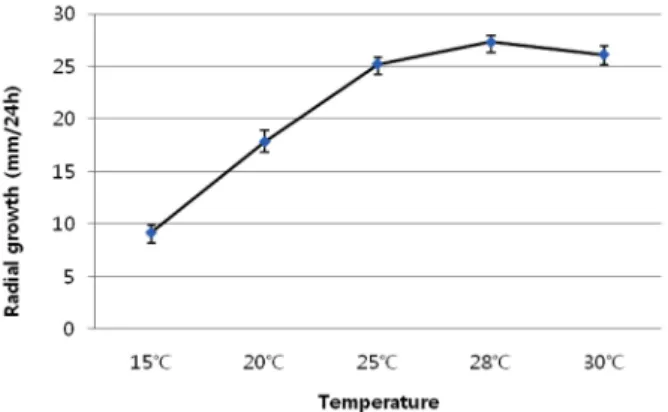
공시 균주 인 40-1은 생육은 온도에 따라서 큰 차이를 보였다(Fig. 3). 28

o

C에서 가장 왕성한 생장을 보였다. 본 시험에서는 온도의 차이를 28

o

C와 30

o

C 로 세분화한 것은 구체적으로 생육 적온을 조사하기 위하여 생육이 왕성한 25

o

C와 30

o

C 사이인 28

o

C에서 균사 생장량을 조사한 결 과, 24시간 동안 균사가 28 mm 생장하는 것을 볼 수 있었다.

Kageyama et al. (1998)에 의하면 7종의 Pythium을 CPA 배지에서 15

o

C부터 5도 차이로 35

o

C까지 배양한 결과, 온 도 차이에 따른 생육의 차이는 없었다고 하였으며, 모든 균은 30

o

C 에서 최대 생장을 보였고, 하루의 최대 생장은 32-34 mm 이었다. 그러나 다른 연구에서는 25

o

C-30

o

C 에서

생장이 왕성하다고 하였다(Couch, 1995; Montheith, 1933).

배지의 종류에 대한 균사생장 반응을 조사하기 위하여 생육온도와 같은 방법으로 공시 균주를 CMA (corn meal agar), OMA (oat meal agar), PDA 및 V-8 (V-8 juice agar) 배지에 접종한 후 25

o

C에서 24시간 배양 후 균사 생장량 을 측정하였다(Fig. 4). V-8배지에서 가장 왕성한 성장을 보였다. 균사의colony 형태관찰이나, 형태적인 동정을 위 한 난포자나 포자낭생산을 위해서는 CMA배지, CPA 및 V-8 배지에서 배양하는 것이 좋다고 한다(Abad et al., 1994).

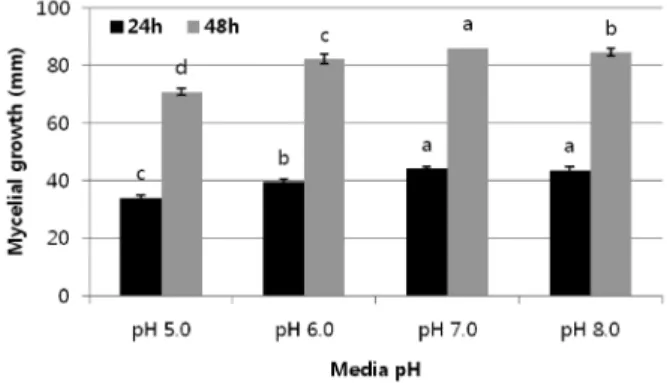
배지의 pH에 따른 균사의 생육을 조사하기 위해서는 PDA 배지에 KOH와 HCl을 이용하여 pH를 5, 6, 7 및 8로 조절하고 공시 균을 접종한 후 25

o

C 에서 24시간과 48시 Fig. 2. Taxonomic position of 40-1 strain based on internal

transcribed spacer (ITS) region of ribosomal RNA. Pythium strains were compared with strains of Uzuhashi et al. (2010).

ITS region sequences were first analyzed using the Tamura-Nei parameter distance calculation model with gamma-distributed substitution rates, which were then used to construct the Neighbor-Joining tree with MEGA version 4.0.2. Numbers below or above nodes are bootstrap values.

Fig. 3. Mycelial growth on potato dextrose agar. Mycelial growth was measured sizes of colony diameter with digmatic caliper on 24 hour after inoculation using a 5 mm cork borer.

Error bars indicate standard deviation and showed significant difference at P = 0.05 level according to Tukey’s HSD test.

Fig. 4. Mycelial growth on several media. Mycelial growth was

measured sizes of colony diameter with digmatic caliper on 24

hour after inoculation using a 5 mm cork borer. CMA: Corn

Meal Agar; OMA: Oat Meal Agar; PDA: Potato Dextrose

Agar; V-8: V-8 Juice Agar. Error bars indicate standard

deviation and mean in column followed by the different letter

that indicates significant difference at P = 0.05 level according

to Tukey’s HSD test.

(5)

간 배양 후 균사 생장량을 측정하였다(Fig. 5). pH7에서 균사 생육이 자장 좋은 것으로 조사되었다.

병원성 검정

병원성을 검정하기 위하여 포장에서 병이 발생한 chewing fescue 품종인 “Jamestowm II”, Kentucky bluegrass 혼용 품 종(Midnight 33%, Moonlight 33%, prosperity 33%) 및 creeping bentgrass 품종인 “Penn Cross” 에서 병원성 시험 을 실시하였다. 잔디는 관행 관리에 의해 1년 이상 자란 시험포장 잔디를 홀 컷터로 잘라내어 화분에 옮긴 후 온실 에서 20일간 관리한 잔디에 병원균을 접종하였다(Chang, 2011; Chang and Lee, 2013). PDA 배지에서 자란 활력이 양 호한 균총의 가장자리 균사를 지름 5 mm의 크기로 자른 균총 1조각을 PDB (Potato Dextrose Broth) 배지에 접종 한 뒤 25±1

o

C 암 상태에서 5일간 배양하였다. 배양된 균사 는 수확하여 멸균된 거름종이에 올려놓아 수분을 제거하고 동일한 량의 균사를 다시 멸균수에 넣고 30초간 균일하게

균사를 마쇄하였다. 접종원은 균사 생체 중 0.1 g· ml

-1

가 함 유된 1 ml를 포트당 접종을 하고, 미리 준비한 플라스틱 상 자 바닥에 1 cm 높이로 물을 채운 접종한 포트를 넣고 뚜 껑을 닫고 밀봉하여 3일간 25±1

o

C 암 상태의 생장상(growth chamber) 에서 배양한 후 온실로 옮겨 발병 정도를 조사하 였다.

인공 접종한 병원균은 3종류의 잔디에서 병원성을 나타 내었다(Fig. 6). 감염 초기에 잎의 선단부가 갈변하고 이 병 부위가 수침상으로 변하면서 점차 갈색이 퇴화하고 시 간이 경과됨에 따라 patch 형태를 유지하면서 잎과 줄기 는 고사하여 최종 회갈색이 되었다(Fig. 6A, B ,C). 인공 접종하여 발병된 병반부에서 다시 병원균을 재 분리하여 PDA 배지에서 배양한 후 병원균의 특성과 광학현미경에서 균사의 격막과 균사모양을 관찰한 결과 동일한 균으로 확 인되었다(Fig. 1D).

따라서 본 병은 한지형 잔디인 chewing fescue 종에서 P. aphanidermatum에 의해 잎마름증상과 뿌리썩음증상을 동반한 잎마름병으로 국내에서 처음 보고하며, 병명은 기 존 병명과 동일한 잎마름병으로 보고하고자 한다.

요 약

Pythium aphanidermatum 에 의한 잎마름병(pythium blights) 이 chewing fescue “Jamestowm II” 품종에서 2011 년 6월 상순에 대구대학교 시험포장에서 발생하였다. 잔 디에 발병증상은 잎 끝으로부터 잎마름 증상과 뿌리 썩음 증상이 나타나고, 잎색은 진한갈색,회 갈색으로 나타났다.

병원균은 병든 잎과 지제부에서 분리를 하였으며, 동정을 위하여 PDA에서 배양하였다. 균사에는 잎 같은 포자가 복 잡한 구조로 부풀어져 있고, 균사로부터 구별되지 않은 실 같은 포자낭이 있다. 리보소옴 DNA의 염기서열을 분석한 결과, 유전자은행 DB에 P. aphanidermatum 균주 와의 100%

상동성을 나타낸다는 것을 확인하였다. 병원성은 chewing Fig. 5. Response of mycelial growth on different pH media.

Mycelial growth was measured sizes of colony diameter with digmatic caliper on 24hr. and 48hr. after inoculation using a 5 mm cork borer. Error bars indicate standard deviation and mean in column followed by the different letter that indicates significant difference at P = 0.05 level according to Tukey’s HSD test.

Fig. 6. Pathogenicity test on chewing fescue cultivar “Jamestone II” (A), creeping bentgrass cultivar “Penn cross” (B) and

Kentucky bluegrass mixed cultivars (Midnight 33%, Moonlight 33%, and prosperity 33%) (C). Inoculation was applied with

mycelium suspension of 1ml by injection in the pots. Disease symptom showed on 5 days after inoculation.

(6)

fescue, creeping bentgrass 및 Kentucky bluegrass에서 코흐 의 원칙에 따라 확인하였다. 이것은 chewing fescue 종에 서 P. aphanidermatum 에 의한 잎마름병을 국내에서 처음 보고 한다.

주요어: 실 같은 포자, 균사, 잎 같은 포자, 잎마름병

References

Abad, Z.G., Shew, H.D. and Lucas, L.T. 1994. Characterization and pathogenicity of Pythium, species isolated from turfgrass with symp-toms of root and crown rot in North Carolina.

Pytopathology 84:913-921.

Andrews, E.A. 1943. Seedling blight and root rot of grasses in Minnesota. Phytopathology 33:234-239.

Chen, W. and, Hoy, J.W. 1993. Molecular and morphological comparison of Pythium arrhenomanes and P. graminicola.

Mycol. Res. 97:371-1378.

Couch, H.B. 1995. Disease of Turfgrass. 3rd (eds). Krieger Publishing Co., Malabar, FL, USA.

Chang, T. 2011. Difference of susceptibility on bentgrass cultivars to pink snow mold caused by Microdochium nivale. Asian J.

Turfgrass Sci. 25(2):177-183

Chang, T. and Lee, Y.S. 2013.Occurrence of brown patch on Kentucky bluegrass caused by Rhizoctonia solani AG-1 IB.

Weed Turf. Sci. 2(1):88-94. (In Korean)

Dick, M.W. 1990. Keys to Pythum. University of Reading Press, Reading, UK.

Feng, Y. and Dernoeden, P.H. 1999. Pythum species associated with root dysfunction of creeping bentgrass in Maryland. Plant Dis. 83:516-520.

Freeman, T.E. 1980. Seedling disease of turf-grasses incited by Pythium. pp. 41-44 in: Advances in turfgrass pathology.

Larsen, P.O. and Joyner, B.G. (eds). Harcourt Brace Jovanovich, Duluth, MN, USA.

Hendrix, Jr. F.F., Campbell, W.A. and Mon-crief, J.B. 1970.

Pythium species associated with golf turfgrass in the South and Southeast. Plant Dis. Rep. 54: 419-421.

Hodges, C.F. and Coleman, L.W. 1985. Pythium-induced root dysfunction of secondary roots of Agrostis palustris. Plant Dis.

69:336-340.

Hsiang, T., Wu, C., Yang, L. and Liu, L. 1995. Pythium root rot associated with cool-season dieback of turfgrass in Ontario and Quebec. Can. Plant Dis. Surv. 75:191-195.

Kageyama, K., Uchino, H. and Hyakumachi, M. 1998.

Characterization of hyphal swelling group of Pythium: DNA polymorphisms and cultural and morphological characteristics.

Plant Dis. 82:218-222.

Kim, J.W. and Park, E.W. 1997. Pythium spp. isolated from turfgrass at golf courses in Korea. Kor. J. Mycol. 25(4):276- 290. (In Korean)

Matthews, V.D. 1931. Studies on the genus Pythium. University of North Carolina Press, Chapel Hill, NC, USA.

Matumoto, C., Kageyama, K., Suga, H. and Hyakumachi, M.

2000. Intraspecific DNA polymorphisms of Pythium irregular.

Mycol. Res. 104:1333-1341.

Montheith, J. 1933. A Pythium disease of turf. Phytopathology 23:23-24

Muse, R.R., Schmitthenner, A.F. and Parthka, R.E. 1974. Pythium spp. Associated with foliar blighting of creeping bentgrass.

Phytopathology 64:252-253.

Saladini, J.L., Schmitthenner, A.F. and Larsen, P.O. 1983.

Prevalence of Pythium species as-sociated with cottony- blighted and healthy turfgrass in Ohio. Plant Dis. 67:517-519.

Uzuhashi, S., Tojo, M. and Kakishima, M. 2010. Phylogeny of the genus Pythium and description of new genera. Mycoscience 51(5):337-365

Van der Plaats-Niterink, A.J. 1981. Monograph of the genus Pythium. Studies in Mycology No. 21, Centraalbureau Voor Schimmelcul-tures, Baarn, Netherlands. p. 242.

White, T.J., Bruns, T., Lee, S. and Taylor, J. 1990. Amplification and direct sequencing of fungal ribosomal RNA genes for phylogenetics. In: Innis, M.A., Gelfand, D.H., Sninsky, J.J.

and, White, T.J. (eds) PCR protocols: a guide to methods and

applications. Academic, San Diego, USA. pp. 315-322.

수치

Fig. 1. Disease symptoms on chewing fescue (A) and Kentucky bluegrass (B) caused by Pythium aphanidermatum
Fig. 3. Mycelial growth on potato dextrose agar. Mycelial growth was measured sizes of colony diameter with digmatic caliper on 24 hour after inoculation using a 5 mm cork borer.
Fig. 6. Pathogenicity test on chewing fescue cultivar “Jamestone II” (A), creeping bentgrass cultivar “Penn cross” (B) and Kentucky bluegrass mixed cultivars (Midnight 33%, Moonlight 33%, and prosperity 33%) (C)

참조

관련 문서

Two matrices A=[a jk ] and B=[b jk ] are equal, written A=B, if and only if they have the same size and the corresponding entries are equal, that is, a 11 =b 11 , a 12 =b 12 ,

(A) Before repair of RCT shows fatty degeneration of supraspinatus (stage 2) and infraspinatus (stage 3) muscle and atrophy (Grade 2) (B) After 18months later

근래에 연구되는 격자형 모델은 각 경계범위에서 각기 다른 변수의 영향을 정확 하게 산출하지 못하고 있으나 , 수용모델링을 병행하는 경우 높은 정확도를 추정할

이것은 이용허락규약 (Legal Code) 을 이해하기 쉽게 요약한 것입니다. 귀하는 원저작자를 표시하여야 합니다.. Sections 3.3 and 3.4 are devoted to dealing with the examples

The aim of this chapter is to collect some definitions and to quickly review basic facts necessary for the proof of our results given in Chapter 3.. First,

출처 : IAEA 발표 자료(Comprehensive inspection exercise at bulk handling facilities, “U-235 Enrichment measurements by gamma-ray spectroscopy”) 13.  Uranium

Higher open conversion rate and prolonged postoperative hospital stay in LATE group were not caused by the delayed operation in this study it seems to be caused by that

Knowing that the cart is initially at rest and can roll freely, determine (a) the final velocity of the cart, (b) the impulse exerted by the cart on the package, and