• 검색 결과가 없습니다.

Ontology Modeling and Its Application for Managing Control Points

N/A
N/A
Protected

Academic year: 2021

Share "Ontology Modeling and Its Application for Managing Control Points"

Copied!
9
0
0

로드 중.... (전체 텍스트 보기)

전체 글

(1)

Ontology Modeling and Its Application for Managing Control Points*

CUI-YULAN

1

⋅Hyun-Suk HWANG

2

⋅Seong-Hyun SHIN

3

Yong-Cheol SUH

4

⋅Chang-Soo KIM

5※

기준점 관리를 위한 온톨로지 모델링과 적용 방안*

CUI YULAN

1

⋅황현숙

2

⋅신성현

3

⋅서용철

4

⋅김창수

5※

ABSTRACT

The control points are important assets of countries which express the most accurate location information that is used in surveying land and other measurements. The location information has played an important role in our daily lives with the development of ubiquitous technology. While many researchers have recently applied new technology like RFID(Radio-Frequency Identification) to the effective management of control points, the research into data retrieval and the interoperability of control point data is still primitive step.

Therefore, we construct a data modeling to effectively manage control points using ontology data structure and focus on semantic retrieval method. Our retrieval system can provide the inferred and associated information among data using Protégé-OWL tool.

Our system has advantages in reducing the number of repeated queries by hierarchy searching and improving the searching time by association searching. Also, we propose an effective method to construct retrieval systems being able to edit items of categories and properties without editing the related codes.

KEYWORD : Control Points, Data Retrieval, Data Interoperability, Ontology, Protege-OWL

요 약

정확한 지리위치 좌표를 나타내는 기준점은 국가의 중요한 자산으로써 전국토의 측량과 기타 측 량 사업에 사용되고 있다. 유비쿼터스 기술의 발전으로 위치정보는 우리 생활에서 중요한 역할을

2008년 4월 28일 접수 Received on April 28, 2008 / 2008년 8월 17일 수정 Revised on August 17, 2008 / 2008년 8월 26일 심사완료 Accepted on August 26, 2008

* This research was supported by a grant(07KLSGC02) from Cutting-edge Urban Development - Korean Land Spatialization Research Project funded by Ministry of Land, Transport and Maritime Affairs.

1 Dept. of Interdisciplinary Program of Infomation Security, PuKyong National University 2 C.A., BK21 Graduate School of Earth Environmental System, PuKyong National University 3 Dept. of Interdisciplinary Program of Infomation Security, PuKyong National University 4 Dept. of Geoinfomatic Engineering, Pukyong National University

5 Dept. of Computer and Multimedia Engineering, Pukyong National University ※ 연락저자 E-mail : [email protected]

(2)

하고 있다. 현재 RFID (Radio-Frequency Identification)와 같은 유비쿼터스 기술을 기준점 관리 시스템에 융합함으로써 관리의 효율성을 제고하기 위해 여러 분야에서 연구가 진행되고 있다. 그 러나 기존의 연구에서는 데이터 관점에서 기준점 관리를 위한 호환성과 효율적인 검색에 대한 연 구는 미비한 실정이다. 따라서, 본 논문에서는 온톨로지 기술을 사용하여 기준점 데이터를 효율적 으로 검색하기 위한 데이터 모델링을 구축하고 그의 적용 방안에 초점을 두어 연구한다. 제안된 온톨로지 기반의 검색 시스템은 계층적 검색으로 사용자의 반복된 검색 수행을 줄일 수 있고, 연 관 검색으로 검색 시간을 줄일 수 있는 장점이 있다. 또한, 사용자 인터페이스와 관련된 소스 코드 를 수정하지 않고 카테고리와 속성의 항목을 편집할 수 있는 효과적인 검색 시스템 구축 방법을 제안한다.

주요어: 기준점, 데이터 검색, 데이터 호환성, 온톨로지, Protege-OWL

INTRODUCTION

The basic function of control points is mainly used to measure land surveying and to manage the land resources and citizens’

property rights, for which every countries depend on the control points. Meanwhile, the controversy of the right of property have frequently occurred(Gwack, 2005; KCSC1, 2006) because of the city redevelopment, the expansion of roads, and the establishment of underground facilities. Although the related national governments check them regularly every year according to the “Measurement”

law, install new control points, and observe them, national budgets have been still consumed in extracting rapid and exact information. Therefore, the development of systems to effectively manage national control points for providing exact location information is required.

With the development of ubiquitous technology, location information becomes to play an important role in our daily life. The satellite image technology, and RFID(Radio-Frequency Identification) technology have been widely utilized for attaining accurate data and convenient management of control points(Lee,

1998; Lee, 2000). Data retrieval is an essential function in information management systems. When the extracted results include useful information, it is a crucial factor to improve users’ convenience in their works.

The existing retrieval system of national control points supports category retrieval with a few available category items such as map name, district name, longitude and latitude, coordinates, and so on(KCSC1, 2006; KCSC2, 2006; NGII, 2007). The core problem of the current system is that the retrieval system can not support intelligent retrieval services and can not process complex queries.

Moreover, users can execute category searching works only with the defined UI (User Interface), and the retrieval system has to be rebuilt when search categories are added or deleted.

In order to deal with above problems, we

use ontology technology to establish a control

point ontology for providing the inferred and

associated information with complicated

queries to ameliorate retrieval system services

of control points. This paper is organized as

follows. Section 2 gives an overview of

related works on the ontology-based retrieval

systems, and Section 3 outlines the defined

ontology of control points in the retrieval

(3)

system. Section 4 contains some searching examples related to the defined ontology.

Finally, Section 5 summarizes this research and draws the future works.

RELATED WORKS

1. Management of Control Points

There are 22,284 national control points in South Korea according to the statistics presented by the National Geographic Information Institute(NGII) in 2005 (NGII, 2007). The NGII manages the national control points, and the local governments install their own control points to manage their areas. Every local area uses national control points to exact the location information of their local control points. As the location information is one of the most important assets in the country, the effective maintenance and management of control points are required. Since the demand of better protection on control points has increased, a series of relative research works have actively progressed.

National Geographic Information Institute(NGII, 2007) developed a management system of control points based on the RFID technology, which can be divided into two modules. The one part is a management module for administrators to register and modify control points, and the other part is a search module for surveyors working at the fields to refer location information of the control points. The two modules are connected by wireless networks.

Korea Cadastral Survey Corporation(KCSC2, 2006) studied on the development of web-based cadastral control point management system.

The system is based on wireless network

technology and can provide the information on real-time communication by connecting central servers at anytime and any places.

Park Seung-Woo(Park, 2004) developed an integrated management system of GPS stations and urban control points whose managers can efficiently maintain control points and is easy to use coordinates of control points. The system has the functions such as insertion and modification, retrieval, connection through Internet, analysis, and statistic.

The above mentioned systems mostly support retrieval function based on key-words with simple queries in the categorized form. From this point of view, users have to repeatedly execute several simple queries in case they want to get useful information. Also, it may be time-consuming works for programmers to modify the systems for adding or deleting search items. Thus, we consider existing problems and propose a new retrieval approach method based on the ontology for managing control points.

2. Ontology and RDF

An ontology defines a common vocabulary in particular domains to share common understanding of the structure of information among people or software agents(Ceravolo, 2007). Ontology can be used to improve the accuracy of information retrieval(Kim, 2005;

Samper, 2008). In other words; the traditional retrieval program can look for the information matched to key-words instead of discovering related and inferred information using the categorized concept.

The Resource Description Framework(RDF)

which is a method of modeling information

(4)

through a variety of syntax formats(Powers, 2003) includes a powerful function for making statements and for connecting those statements(Powers, 2003). Also it provides the means of recording data in a machine-understandable format, allowing more efficient and sophisticated data interchange, retrieval, cataloging, and so on.

The Web Ontology Language(OWL) is an ontology language to describe the semantics of knowledge in a machine accessible way (Antoniou, 2003). It builds upon RDF and RDF schema in Protege-OWL which is the most widely popular OWL development platform (Antoniou, 2003). An OWL ontology interprets a set of “classes” and a set of “property assertions” which are related each other, and consists of a set of axioms which provide semantics by allowing systems to infer additional information based on the constraints.

3. Ontology-based Retrieval Systems The semantic Web called as next generation of the web is the technology to make Web resources more accessible by intelligent semantic agents which are an intelligent system that can distinguish homonymous or synonymous words considering users’ information and can infer some rules automatically. Hence, the computer can understand the useful information based on the key-words and process automatically users’ queries with defined ontologies. Nowadays semantic search based on the ontology is widely applied in many fields that are related to search works.

Sheng Qiuyan(Sheng, 2008) studied on a calculation of semantic similarity between concepts in ontology for avoiding limitations

of simple query based on the key-words and expanded the relative information which increases the search system’s precision and recall ratio. Jose Maria Abasolo(Abasolo, J.M., 2000) developed a prototype based on a professional domain of the resulting medical ontology which combined a large amount of medical literatures in an acceptable way and avoided user’s tedious and imprecise works. Ahmed Abdelali (Abdelali, A., 2003) studied on a cross -language information system with language -ontology lexicons to improve the quality and size of results including different language information.

ONTOLOGY MODELING FOR THE RETRIEVAL SYSTEM OF

CONTROL POINTS

This paper proposes a new retrieval approach to manage control points based on ontology technology for supporting more effective management to administrators and more convenient services to surveyors with the advantages of related and hierarchy retrieval and data flexibility.

1. Ontology Modeling

An ontology has some classes and

properties that are related to different

classes each other, some axioms, some

constraints, and so forth(Xu, 2006). To

determine each of the items, first of all, we

should completely comprehend about the

management and retrieval works on the

control points. It is a primary condition for

creating an ontology.

(5)

FIGURE 1. Hierarchy ontology structure for users

FIGURE 2. A fragment of the search ontology Users are largely divided into staffers and

non-staffers as their role in searching control points in the system. The staffers include administrators, checkers, installers, and observers, and the non-staffers include surveyors and general users. The staffers can retrieve all control points, and the administrators execute not only data retrieval but also modification to maintain, update, and manage the system. The non-staffers cannot retrieve all the control points because of the restriction of their roles. All users are categorized into some

classes with the hierarchy ontology structure as shown in the figure 1.

In retrieval services of control points, all properties in databases of control points can be accessed as users’ privileges. To provide semantic retrieval, table’s properties have to be built in hierarchy. In the retrieval ontology of control points, the main classes are “User” and “SearchWork”. There are 11 subclasses in the “SearchWork” class that be divided into the properties with the same meaning to provide related retrieval function.

We show a fragment of the defined ontology as shown in the figure 2. In our ontology we defined the object properties such as “search”, “isSearchedBy”, “register”,

“hasMetricBase”, “hasDepartment”, and

“hasBranch” to connect the association between the classes.

“User” class is connected to

“SearchWork” class through “search”, and conversely “SearchWork” class is connected to “User” class through “isSearchedBy”. The

“register” object property for “Surveyor” and

(6)

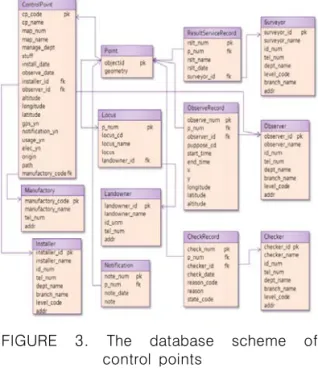
FIGURE 3. The database scheme of control points

“ResultServiceRecordSearch”, for “Checker”

and “CheckRecordSearch”, for “Observer”

and “ObserveRecordSearch” is defined. “X”

and “Y” classes through “hasMetricBase”

are connected to “MetricBase” class, and

“User” classes through “hasDepartment” and

“hasBranch” are connected to “Department” class.

2. The Procedure of Retrieval Engine Based on the Ontology

The retrieval engine we proposed includes two steps to extract information. The first step is extracting resources with SPARQL language which is a powerful RDF query language that includes query statements to find the data in the RDF contents. Next, the resources are used to access the related transaction data from databases of control points. In order to create prototype of the ontology-based retrieval system we constructed the databases for managing control points as shown in figure 3.

EXAMPLES AND RESULTS

We constructed the ontology which has clear hierarchy according to objects' different types and levels for supporting complex queries and inferred information users really want. We present the important functions of the retrieval system of control points based on ontology to show the advantages of our approach with following examples.

1. Hierarchical Searching

If our retrieval engine can not find searching results for users’ query, it tries to retrieve the results from the superclass of defined ontology as the hierarchical characteristic of the ontology structure. In other words, the hierarchical searching can be executed because an individual of a subclass is also an individual of its superclass as to the relationship among superclasses and subclasses have already defined in the ontology.

For example, suppose that a user wants

to retrieve some control points whose

checker is Mike. However in fact, the Mike

is an observer. For this query, normal

retrieval on the database does not return

any results. On the contrary, ontology-based

data retrieval can return some control points

whose observer is Mike if the users want to

know more a resource Mike than a resource

Checker. Figure 4 shows the retrieval

procedure. In consequence, users can reduce

some queries needed to receive accurate

results because the searching results are

provided on the superclass.

(7)

FIGURE 4. An example of hierarchical retrieval

FIGURE 5. An association searching example

2. Association Searching

In control points ontology we defined many object properties like “register”,

“search”, and “hasDepartment” to explain the relationship between the classes. When the users retrieve control points with several conditions, the classic retrieval system which accesses directly the information from database needs mostly to join lots of tables to find the results. The join operation from databases causes the time in searching results to be longer.

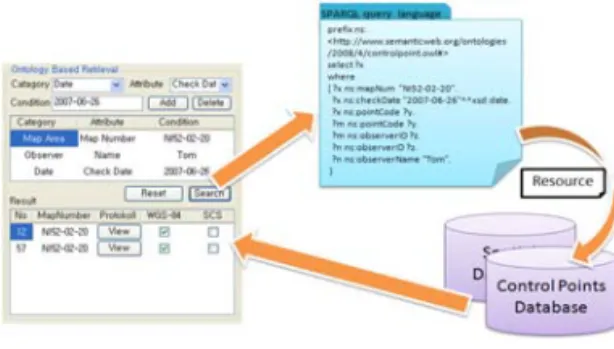
We propose a searching method based on the ontology. First, the system extracts associated resources among related objects by object properties with the SPARQL language.

Next, the search results are discovered from databases with only tables related to extracted resources. Therefore, the proposed approach can avoid complicated join operation among several tables in databases so that the rate of accessing can be improved.

For example, suppose that a user wants to search some control points of which the map number is “NI52-02-20”, the observer is Tom, and the check date is “June 26th, 2007”. Figure 5 shows a retrieval process with three search conditions based on the

ontology and databases. The retrieval work based on the ontology depends on the data properties like “mapNum”, “checkDate”,

“pointCode”, “observerID”, and “observerName”

to extract the control points using the SPARQL query language. Next, the ontology-based searching with the extracted map number resources needs to access only the ControlPoint table. On the contrary, the only classic databases-based searching has to join related three tables like ControlPoint, Observer, and CheckRecord.

3. Flexibility in Constructing Systems When retrieval items of categories and properties are frequently modified, programmers have to edit the source codes for user interfaces and queries. We try to propose effective methods to construct retrieval systems based on the ontology.

The first method is implemented by using

the disjoint object property. Items disjointed to

the first selected item are not displayed in the

second interface screen after selecting a first

query. For instance, items of latitude/longitude,

coordinate, and region are always used

separately to avoid confusion of setting spatial

area. In other words, when users select the

coordinate item in the first query, items of the

(8)

latitude/longitude and region are not shown in the user interface. This can be implemented by referring the disjoint object property of the ontology contents.

Second, it is no difficulty to add or delete new category items by referring the ontology without editing the related codes.

As an example, when an administrator wants to add a new layer user, user interfaces are easily modified by adding properties related with the layer user to the ontology file. This work is means to effectively manage user interfaces.

CONCLUSIONS AND FUTURE WORK

In this paper, the control point retrieval method presents using the ontology technology. We first surveyed the management procedure of control points to model a control point retrieval ontology and constructed databases. Next, we present searching methods such as hierarchical searching, associated searching, and flexibility in constructing system based on the ontology and databases. The proposed retrieval system based on the ontology has three important advantages.

1. Hierarchy Searching

Like our presented example users sometimes input several incorrect conditions to retrieve some information. Though the search conditions are wrong, the ontology-based retrieval engine can extract the most similar results by hierarchical searching of control point ontology structure. With the hierarchical searching, users can reduce repeated queries needed to attain results.

2. Association Searching

The second example we described shows that the ontology-based retrieval engine can understand the relationship between classes and individuals according to the object and data properties to automatically search useful information. With the relation, the searching time can be improved by discovering associated resources between objects.

3. Flexibility in Constructing Systems We have already depicted two simple examples of flexibility in constructing systems with the disjoint object property.

The code modification with ontology structure can be easily executed to avoid the troubles from the modification of UI(User Interface) and parts of the related program codes. Thus, ontology-based retrieval system is able to update, add, and delete items of user interfaces by the system’s administrators not programmers.

We conceptualized management business including relations among users and services to manage control points. Our ontology of control points for management work is simple but helpful in searching for general users as compared to the medical ontology with deep categorization and complicated relationship.

Although our system has the above

outstanding advantages, the research on

discovering keyword resources and detecting

rules from the business domain of control

points to support more effective searching

should be carefully progressed. Estimating

pivot keyword is not simple works because

users also select a variety of search items

at random. Our future work is to develop a

(9)

retrieval system supporting inferred searching as well as hierarchical and associated searching with ontology structure.

ACKNOWLEDGEMENT

This research was supported by a grant(07KLSGC02) from Cutting-edge Urban Development - Korean Land Spatialization Research Project funded by Ministry of Land, Transport and Maritime Affairs.

REFERENCES

Abasolo, J.M., M.Gomez. 2000. MELISA. An ontology-based agent for information retrieval in medicine. Proceedings of ECDL 2000 Workshop on the Semantic Web.

Abdelali, A., J. Cowie., D. Farwell, B. Ogden and S. Helmreich. 2003. Cross-Language information retrieval using ontology.

Proceedings of the 13th ACM SIGKDD international conference on Knowledge discovery and data mining. pp. 143-152.

Antoniou, G., F.V. Harmelen.. 2003. A semantic web primer. Cambridge, MA:MIT Press, UK. 238pp.

Ceravolo, P., E. Damiani., M, Viviani. 2007.

Bottom-Up extraction and trust-based refinement of ontology metadata. IEEE Transactions on Knowledge and Data Engineering 19(2):149-163.

Gwack, I.S., J.H. Koh, C.M. Jun. 2005.

Improving cadastral control-point inspection using PDA. The Korean Society of Cadastre Journal 21(2):131-144.

Kim, M.S., Y.H. Kong. 2005. XML information retrieval by document filtering and query expansion based on ontology. Journal of Korea Multimedia Society 8(5):596-605.

Korea Cadastral Survey Corporation(KCSC1). 2006. A study on the cadastral points using RFID. 148pp.

Korea Cadastral Survey Corporation(KCSC2).

2006. Development of cadastral control-point management system. 108pp.

Lee, B.H., J.H. Kim, K.K. Park, I.H. Chung.

2000. 1/10,000 scale digital mapping using high resolution satellite images. Journal of the Korean Association of Geographic Information 3(2):11-23.

Lee, Y.R., D.S. Shin, H.Y. Lee. 1998.

Construction, search of ground control point database and its application for satellite image correction. Journal of the Korean Association of Geographic Information Studies 1(1):8-17.

National Geographic Information Institute(NGII).

2007. A study on RFID practicability of national control point using wireless communications. 350pp.

Park S.W. 2004. Development of the integrated management system of GPS stations and urban control points. Master's degree Thesis, Chungbuk National University. 52pp.

Powers, S.. 2003. Practical RDF. O'Reilly &

Associates, Inc, USA. 331pp.

Samper, J.J, R.T, Vicente, E Carrillo and P.C.

Rogerio. 2008. Visualization of ontologies to specify semantic descriptions of services.

IEEE Transactions on Knowledge and Data Engineering 20(1):130-134.

Sheng Q.Y., G.S. Ying. 2008. Measuring semantic similarity in ontology and its application in information retrieval. Congress on Image and Signal Processing. Vol. 2, pp.525-529.

Xu, J.B., Z.L. Xu, J.X. Chen. 2006. Semantic retrieval system based on ontology.

Proceedings of the 5th WSEAS Int.

Conference on Information Security and

Privacy. pp.124-129.

수치

FIGURE  2.  A  fragment  of  the  search  ontologyUsers  are  largely  divided  into  staffers  and
FIGURE  3.  The  database  scheme  of  control  points
FIGURE  4.  An  example  of  hierarchical retrieval

참조

관련 문서

So, we proposed a novel method for video event analysis and description on the fundamental of the Domain Knowledge object ontology, the MPEG-7 standard is extended

Although image retrieval method using outline and vertex of figure is used to express spatial information, search speed is relatively slow and it is

Data were analyzed using independent-sample t tests for checking the equivalency between the experimental and control groups at pretest and three-way analysis

[표 12] The true model is inverse-gaussian, out-of-control ARL1 and sd for the weighted modeling method and the random data driven

For each of several tests, elastic, plastic, and total strain data points are plotted versus life, and fitted lines are also

 The simplest method of storing a raster layer in the memory of the computer is using a data structure called an array..  We consider alternative methods for searching through

In this paper, we developed a data management system for shipboard machinery equipment and the monitoring application for the verification of the utility, and we

control points, basis functions, Bezier control points, basis functions, Bezier curve, B-spline curve.y. Why we