건여주의 영양성분 및 항산화 활성 효과
이 연 리 대전보건대학교 식품영양과
Nutritional Components and Antioxidant Activity of Dry Bitter Melon (Momordica charantia L.)
Youn Ri Lee
Department of Food and Nutrition, Daejeon Health Sciences College
ABSTRACT This study investigated the nutritional components and antioxidant activity of dry bitter melon (Momordica charantia L.). The moisture, crude protein, crude fat, crude ash, carbohydrate, and ascorbic acid contents of dry bitter melon were 6.10%, 3.31%, 1.08%, 2.31%, 87.20%, and 908.84 mg/100 g, respectively. Potassium was the most abundant mineral, followed by Mg, P, Na, Ca, Zn, Cu, and Mn, which means dry bitter melon was an alkali material. Regarding amino acid contents, dry bitter melon was rich in arginine, urea, asparagine, γ-aminobutyric acid, and alanine. Total polyphenol and total flavonoid contents of dry bitter melon extract were 36.08 mg gallic acid equivalents/extract g and 15.66 mg tannic acid equivalents/extract g, respectively. The IC50 value for 2,2-di- phenyl-1-picrylhydrazyl radical scavenging activity was 9.81 mg/mL for dry bitter melon ethanol extracts.
Key words: dry bitter melon, ascorbic acid, mineral, amino acid, antioxidant activity
Received 8 December 2015; Accepted 16 February 2016 Corresponding author: Youn Ri Lee, Department of Food and Nutrition, Daejeon Health Sciences College, Daejeon 34504, Korea E-mail: [email protected], Phone: +82-42-670-9246
서 론
최근 급속한 경제성장과 가족형태의 변화 등으로 현대인 들의 식생활이 빠르게 서구화됨에 따라 생활습관병을 포함 한 만성질환이 급속히 증가하고 있으며, 소득 수준의 향상으 로 건강한 삶을 위한 질병 방지, 면역 증강 및 노화를 지연시 키는 노화 억제 등의 생리활성을 갖는 건강기능성 식품에 관한 관심이 점점 높아지고 있다(1).
노화를 포함한 각종 성인병의 발병 원인으로 알려진 활성 산소는 강한 산화력으로 생명체에 치명적인 산소 독성을 일 으켜 암을 비롯한 뇌질환과 심장질환, 염증, 자가면역질환 등을 일으킨다(2). 활성산소를 조절할 수 있는 항산화제는 phenol류, flavonoid류, tocopherol류, ascorbic acid, ca- rotenoids 등의 천연항산화제와 butylated hydroxytolu- ene(BHT), butylated hydroxyanisole(BHA), propylgal- ate(PG) 등의 합성 항산화제가 있다(3). 이에 활성산소종을 조절하거나 제거하는 능력을 지닌 물질 연구의 필요성이 대두 되면서 천연물을 이용한 소재 개발에 연구가 집중되고 있다.
여주(Momordica charantia L.)는 아시아, 아마존, 동아 프리카와 카리브 지역의 열대에서 서식하는 1년생 박과식물 로 옛날부터 단순한 과일이 아니라 귀중한 약재의 역할을
해 왔다(4). 동남아시아 지역에서는 여주가 피부병, 야맹증, 구충, 류머티스, 복통, 황달, 월경촉진과 당뇨 등에 효과가 있는 것으로 알려져 널리 이용되고 있다(5-7). 여주의 쓴맛 에는 식물스테롤 배당체들과 많은 종류의 아미노산, 갈락트 론산, 시트롤린, 펙틴 등의 성분이 들어 있어 혈당 강하 기능 이 탁월한 것으로 알려졌으며, 특히 미성숙과는 비타민 C, 비타민 A와 철 등의 주요한 공급원이 되고 있다(8-11)
여주의 선행연구로는 여주 잎, 줄기, 과실에 대한 부위별 항산화 활성 및 페놀 함량(12), 여주추출 momordicin의 생 리적 활성(13), charantin의 당뇨치료제로서의 가능성(14), 신경세포 보호 효과(15), 조직손상억제(16), 혈중지질 대사 개선(17) 등 각종 생리활성에 관한 연구들이 보고되었다.
현재 여주는 분말제 또는 다류 가공식품으로 한정되어 있으 며 건여주의 영양성분 및 항산화 활성에 대한 기초적인 자료 는 매우 부족한 실정이다.
따라서 본 연구는 건여주의 기능성 소재 활용 차원에서 영양성분 및 항산화 활성을 분석하여 다양한 가공식품 분야 에 널리 이용하고자 하였다.
재료 및 방법
재료 및 추출물의 조제
본 실험에 사용된 여주는 2014년 충북 음성에서 7월에 재배한 생여주를 구입하여 동결건조 후 건여주의 영양성분 을 분석하였다. 항산화 활성 실험을 위한 추출물의 조제는
건여주에 70% 에탄올을 가하여 3회 환류 추출한 후 No 2.
filter paper(Advantec Co., Tokyo, Japan)로 여과하여 농 축한 다음 동결건조기(FD 5508, Ilshin Lab Co., Seoul, Korea)로 동결건조 하였다.
일반성분 분석
건여주의 일반성분은 AOAC의 표준분석법(18)으로 수분 은 105°C 상압건조법, 조지방은 Soxhlet 추출법, 조단백은 micro-Kjeldahl법, 조회분은 550°C 직접회화법으로 분석 하였다. 탄수화물은 전체 100%에서 수분, 조단백질, 조지방 과 조회분 함량을 제외한 값으로 나타내었다.
비타민 C 분석
시료 1 g을 균질화하여 10% metaphosphoric acid(HPO3) 용액을 10 mL 가하여 추출한 다음 4,000 rpm에서 20분간 원심분리한 후에 상등액을 membrane filter(0.45 μm)로 여 과하여 HPLC(LC-10Avp Shimadzu Co., Tokyo, Japan) 로 분석하였다(19). Column은 Dionex C18(300×3.9 mm) 을 사용하고, solvent 0.05 M KH2PO4: acetonitrile(60:40) 과 flow rate는 1.0 mL/min으로 하였으며, UV 파장 254 nm, injection volume은 20 μL로 하였다.
무기성분 분석
시료 0.1 g에 분해용액(HClO4: H2SO4: H2O2=9:2:5) 25 mL를 가하여 열판(hot plate)에서 무색으로 변할 때까지 분 해한 후 100 mL로 정용하여 여과(Whatman No. 2, What- man plc, Maidstone, Kent, UK)한 후 inductively coupled plasma(Aton scan 25, Thermo Jarrell Ash Co., Vitrolles, France)로 분석한다(20).
분석조건 중 radio frequency power는 1.4 kW이며, analysis pump flow rate는 1.5 mL/min으로 하였고, gas flows는 plasma 15, auxiliary 0.2, nebulizer 0.8 L/min으 로 하여 분석하였다.
아미노산 분석
시료를 일정량 취하여 6 N HCl 용액을 가하고 24시간 동안 가수분해 시킨 후 glass filter로 여과한 여액을 회전진 공농축기(Eyela, N-N series, EYLYA, Tokyo, Japan)를 이용하여 HCl을 제거하고 증류수로 3회 씻은 다음 감압 농 축하여 sodium citrate buffer(pH 2.2) 2 mL로 용해한 후 0.22 μm membrane filter로 여과한 여액을 아미노산분석 기 S430(Sykam GmbH, Munich, Germany)을 이용하여 분 석하였다(21).
분석에 필요한 column은 cation separation column(LCA K07/Li)을 사용하고, flow rate는 buffer 0.45 mL/min, re- agent 0.25 mL/min, buffer pH range 2.90~7.95로 하며, column 온도는 37~74°C로 분석하였다.
총폴리페놀 함량 측정
총폴리페놀 함량은 Folin-Denis's phenol method(22) 에 따라 측정하였다. 시료액 150 μL에 2,400 μL의 증류수와 2 N Folin-Ciocalteu reagent(Sigma-Aldrich, St. Louis, MO, USA) 150 μL를 가한 후 3분간 방치하고 1 N sodium carbonate(Na2CO3) 300 μL를 가하여 암소에서 2시간 동안 반응시킨 다음 725 nm에서 흡광도(V-530, Jasco, Tokyo, Japan)를 측정하였다. Gallic acid를 표준물질로 하여 표준 검량선으로부터 추출물의 총폴리페놀 함량을 계산하였다.
총플라보노이드 함량 측정
총플라보노이드 함량은 Kang 등(23)의 방법에 따라 측정 하였다. 시료액 1 mL에 90% diethylenglycol 10 mL와 1 N NaOH 1 mL를 가하여 37°C water bath에서 1시간 동안 반응시킨 후 420 nm에서 흡광도를 측정하였다. Tannic acid 를 표준물질로 하여 표준 검량선으로부터 추출물의 총플라 보노이드 함량을 계산하였다.
2,2-Diphenyl-1-picrylhydrazyl(DPPH) 라디칼 소거능 측정
DPPH 라디칼 소거능은 Dahl 등(24)의 방법에 따라 측정 하였다. 각 추출물을 농도별로 제조한 시료에 DPPH를 200 μL 첨가하여 암 조건에서 30분간 반응시킨 후 517 nm에서 흡광도를 측정하였다. 농도별 라디칼 소거능에 대한 검량선 에서 라디칼 소거능이 50%가 되는 농도인 IC50으로 표시하 였다.
통계처리
실험에서 얻어진 결과는 SPSS(Version 10.0, Statistical Package for Social Sciences, Chicago, IL, USA)를 이용 하여 평균±표준편차로 나타내었다.
결과 및 고찰
일반성분 및 비타민 C 함량
건여주의 일반성분 및 비타민 C 함량을 측정한 결과는 Table 1과 같다. 건여주의 수분은 6.10%, 조단백질 3.31%, 조지방 1.08%, 회분 2.31%, 탄수화물 87.20%로 분석되었 다.
비타민 C는 수용성 비타민으로 다양한 산화 스트레스에 대해 최초의 항산화 역할을 수행하는 것으로 알려졌으며, 지 질의 산화 과정에서 다불포화지방산의 산화적 손상을 보호 하며, 비타민과 산소 유리기를 효과적으로 제거하는 작용을 한다(25).
건여주의 비타민 C 함량을 측정한 결과 908.84 mg/100 g으로 나타났다. Park(26)의 연구에서 건여주의 부위별 비 타민 C의 함량을 측정한 결과 미성숙과는 92.2 mg/100 g, 성숙과 8.41 mg/100 g, 줄기 2.5 mg/100 g으로 보고하였
Table 1. Proximate compositions and ascorbic acid of dry bitter melon
Dry bitter melon Moisture (%)
Crude protein (%) Crude fat (%) Crude ash (%) Carbohydrate (%)2) Ascorbic acid (mg/100 g)
6.10±0.021) 3.31±0.07 1.08±0.01 2.31±0.07 87.20±0.12 908.84
1)Mean±SD (n=3).
2)Carbohydrate=100-(moisture+crude protein+crude fat+crude ash).
Table 2. Contents of minerals in dry bitter melon Minerals Dry bitter melon (mg/100 g)
K Mg
Cu P Na Ca Zn Mn
6,758 79.04 1.51 29.76 29.59 7.84 4.36 0.08
Total 6,910.18
Table 3. Contents of free amino acid in dry bitter melon No. Free amino acid Dry bitter melon
(mg/100 g) 1
2 3 4 5 6 7 8 9 10 11 12 13 14 15 16 17 18 19 20 21 22 23 24 25 26 27 28 29 30 31 32 33 34 35 36 37 38 39 40
Phosphoserine Taurine
Phosphoethanolamine Urea
Aspartic acid Hydroxyproline Threonine Serine Asparagine Glutamic acid Sarcosine
α-Aminoadipic acid Proline
Glycine Alanine Citrulline
α-Aminobutyric acid Valine
Cystine Methionine Cystathionine Isoleucine Leucine Tyrosine Phenylalanine Homocystine β-Alanine
β-Aminoisobutyric acid γ-Aminobutyric acid Histidine
1-Methylhistidine 3-Methylhistidine Carnosine Anserine Tryptophan Hydroxylysine Ornithine Lysine Ethanolamine Arginine
52.620 20.738 26.320 592.626 127.887
ND2) 138.659 93.509 351.552 75.614
ND ND 133.360 45.797 229.732 111.016 3.874 180.726 9.722 5.382
ND 63.524 76.900 120.785 114.538
ND 1.868
ND 283.842 67.556 4.889
ND ND ND 50.721
ND 8.316 82.512 46.689 645.704
Total 3,766.980
Total E.A.A.1) 1,426.222
1)E.A.A.: essential amino acid (Thr, Try, Val, Met, Ile, Leu, Phe, Lys, His, Arg).
2)ND: Not detected.
다. 본 연구와 함량의 차이가 다른 것은 여주의 채취 시기, 품종, 분석방법에 따른 것으로 보인다.
무기성분 함량
건여주에 함유되어 있는 무기성분을 분석한 결과는 Table 2와 같다. K이 6,758 mg/100 g으로 가장 많이 함유되어 있었고 다음으로 Mg, P, Na, Ca, Zn, Cu, Mn 순으로 검출되 었다. Lee 등(27)은 박과식물 중 수세미 오이의 무기질 함량 을 분석한 결과 8종의 무기질이 K, P, Ca, Mg, Na, Fe, Cu의 순으로 분석되었고, Mn은 검출되지 않았다고 보고하였다.
K은 나트륨의 과잉섭취로 유발된 고혈압에 대한 보호기 능이 있는 것으로 알려지면서 나트륨과 더불어 중요성이 증 가하였다(28-30). 칼륨/나트륨의 섭취비율이 높아지면 고 혈압으로 진행될 가능성이 크며, 고혈압의 예방적 차원에서 칼륨/나트륨의 섭취비율을 1에 가깝게 유지하는 것이 좋은 것으로 알려졌다(30).
건여주에 함유된 주요 무기성분은 알칼리성으로 고혈압 및 당뇨와 같은 성인병 예방에 많은 도움을 줄 수 있는 기능 성 식품 소재로 생각된다.
아미노산 함량
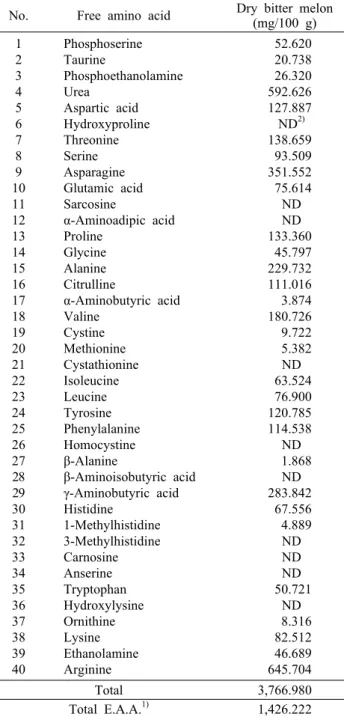
건여주의 유리아미노산 40종의 조성은 Table 3과 같았 다. 건여주의 주요 유리아미노산은 arginine, urea, aspar- agine, γ-aminobutyric acid, alanine 등이었다. 또한 전체 아미노산에 대한 필수아미노산 함량 비율이 37.86%로 나타 나 FAO(31)가 제시한 기준인 32.3%보다 높아 영양학적으
로 우수한 것으로 생각된다. 박과에 속하는 덩굴식물 중 Lee 등(27)은 수세미오이의 아미노산을 측정한 결과 주요 유리 아미노산은 β-aminoisobutyric acid, phosphoethanol- amine, urea, asparagine, valine, alanine, aspartic acid, arginine, citrulline 등이 보고되었으며, 구성아미노산은 glutamic acid와 arginine이 가장 많았고 methionine이 가 장 낮은 함량을 나타낸다고 보고하였다. 건여주의 아미노산 분석 결과 식품으로 반드시 섭취해야 하는 필수아미노산 중 아동에게 필요한 arginine이 높게 나타났으며 γ-aminobu-
Table 4. Total phenolic and flavonoid contents of bitter melon Total polyphenol
(mg GAE1)/extract g) Total flavonoid (mg TAE2)/extract g) Dry bitter
melon 36.08±0.833) 15.66±0.39
1)GAE: gallic acid equivalents. 2)TAE: tannic acid equivalents.
3)Mean±SD (n=3).
Table 5. DPPH radical scavenging activity of 70% ethanol ex- tracts from bitter melon
DPPH radical scavenging activity (IC50, mg/mL) Ascorbic acid
Dry bitter melon 0.12±0.021) 9.81±0.22
1)Mean±SD (n=3).
tyric acid(GABA)는 포유동물의 뇌나 척수에 존재하는 신 경 전달 물질로 의약적으로는 뇌의 혈류를 개선하여 뇌의 산소 공급을 증가시켜 뇌의 대사 향상 및 의욕 저하 등의 치료제로 사용되며, 자연계에 분포하는 비단백질 아미노산 의 일종으로 GABA 함유량이 높은 식품을 brain food라고 도 한다(32,33). 또한, GABA는 혈압강하 작용, 통증과 불안 증세 완화, 당뇨병 예방, 불면, 우울증 완화 등과 같은 기능성 을 나타내는 것으로 보고되었다(34).
총 폴리페놀 및 플라보노이드 함량
식물에 널리 존재하는 phytochemical 중 폴리페놀 화합 물은 식품에 많이 분포되어 있으며, 천연항산화제로의 작용 이 우수하다(35,36). 각종 질병의 치료 및 예방에 효과가 있 어 폴리페놀 함량이 높은 식물은 건강보조식품 재료로 각광 받고 있다. 플라보노이드는 식물에 널리 존재하는 노란색 계열의 색소를 나타내는 약 4,000여 개의 화합물로, 항산화 작용, 순환기계 질환의 예방, 항염증, 항알레르기, 항균, 항 바이러스, 지질저하 작용, 면역 증강 작용, 모세혈관 강화 작용 등이 보고된 바 있다(37-39).
건여주의 총 폴리페놀 및 플라보노이드 함량은 Table 4 와 같다. 건여주의 총 폴리페놀 및 플라보노이드 함량은 각 각 36.08 mg GAE/g, 15.66 mg TAE/g으로 나타났다. Kim 등(40)은 여주열매의 열수 추출물은 69.45 mg/g, 에탄올 추출물은 70.87 mg/g의 폴리페놀 함량을 보고하였다. 천연 소재의 특성상 사용된 시료의 품종, 지역 등의 차이가 있어 보인다.
박과에 속하는 선행연구로 Kang 등(41)은 호박부위별 폴 리페놀 함량이 잎 29.62, 과피 12.08, 과육 7.08, 씨 1.52 mg GAE/g dry matter로 보고하였다. 또한 항산화 소재로 사용되고 있는 야콘(42), 레드비트(43), 버찌(44) 등이 각각 9.6, 12.3, 27.7 mg GAE/g의 총페놀화합물 함량을 보고하 였다.
식물에 함유된 플라보노이드나 폴리페놀 화합물은 천연 항산화제로써 작용할 수 있으며 항산화 작용에 영향을 나타 낸다는 선행연구(37,38)에 근거하여 건여주가 천연항산화 제로서 이용가치가 있을 것으로 판단된다.
DPPH 라디칼 소거능
DPPH는 짙은 자색을 띠는 화학적으로 유도되는 비교적 안정한 라디칼로서 항산화 물질에 의해 전자를 공여받으면 환원되어 고유의 자색이 엷어지면서 노란색으로 탈색되는
성질을 가지고 있다(45).
건여주의 DPPH 라디칼 소거능 측정 결과 ascorbic acid 보다 소거능이 높지는 않지만 건여주의 DPPH 라디칼 소거 능 IC50은 9.81 mg/mL로 나타났다(Table 5). Kim 등(40)의 연구에서도 여주열매의 열수 추출물과 에탄올 추출물 500 μg/mL 농도에서 각각 38%, 62%의 억제율을 보여주었다.
전자공여능은 페놀류와 플라보노이드 등 페놀성 물질에 대한 항산화 작용의 지표로서 식물 추출물의 DPPH 라디칼 소거에 의한 전자공여능이 페놀류나 플라보노이드 물질에 기인하여 항산화 활성을 나타난 것으로 보고하고 있다(46, 47).
요 약
건여주의 다양한 가공식품 개발을 위하여 영양성분 및 생리 활성을 분석하였다. 건여주의 영양성분으로 일반성분은 탄 수화물 87.20%, 수분 6.10%, 조단백질 3.31%, 조지방 1.08
% 및 조회분 2.31%였고 비타민 C 함량은 908.84 mg/100 g으로 분석되었다. 무기질 중 칼륨의 함량이 가장 많이 함유 되어 있었고 다음으로 Mg, P, Na, Ca, Zn, Cu, Mn 순으로 검출되었다. 가장 많이 함유된 아미노산은 arginine, urea, asparagine, γ-aminobutyric acid, alanine이며, 전체 아미 노산에 대한 필수아미노산 함량 비율이 37.86%로 나타났 다. 건여주의 생리활성은 70% 에탄올로 추출하여 측정하였 다. 총 폴리페놀 및 플라보노이드 함량이 각각 36.08, 15.66 mg GAE/g으로 나타났다. 2,2-Diphenyl-1-picrylhydrazyl 라디칼 소거능의 IC50은 9.81 mg/mL로 나타났다.
REFERENCES
1. Han EK, Lee JY, Jung EJ, Jin YX, Chung CK. 2010. Antiox- idative activities of water extracts from different parts of Taraxacum officinale. J Korean Soc Food Sci Nutr 39: 1580- 1586.
2. Freeman BA, Grapo JD. 1982. Biology of disease: free radi- cals and tissue injury. Lab Invest 47: 412-426.
3. McCord JM. 1987. Oxygen-derived radicals: a link between reperfusion injury and inflammation. Fed Proc 46: 2402- 2406.
4. Senanayake GV, Maruyama M, Shibuya K, Sakono M, Fukuda N, Morishita T, Yukizaki C, Kawano M, Ohta H.
2004. The effects of bitter melon (Momordica charantia) on serum and liver triglyceride levels in rats. J Ethnophar- macol 91: 257-262.
5. Grover JK, Yadav SP. 2004. Pharmacological actions and
potential uses of Momordica charantia: a review. J Ethno- pharmacol 93: 123-132.
6. Virdi J, Sivakami S, Shahani S, Suthar AC, Banavalikar MM, Biyani MK. 2003. Antihyperglycemic effects of three ex- tracts from Momordica charantia. J Ethnopharmacol 88:
107-111.
7. An SH. 2014. Quality characteristics of muffin added with bitter melon (Momordica charantia L.) powder. Korean J Food Cook Sci 30: 499-508.
8. Parkash A, Ng TB, Tso WW. 2002. Purification and charac- terization of charantin, a napin-like ribosome-inactivating peptide from bitter gourd (Momordica charantia) seeds. J Pept Res 59: 197-202.
9. Rathi SS, Grover JK, Vats V. 2002. The effect of Momordica charantia and Mucuna pruriens in experimental diabetes and their effect on key metabolic enzymes involved in carbohy- drate metabolism. Phytother Res 16: 236-243.
10. Schmourlo G, Mendonca-Filho RR, Alviano CS, Costa SS.
2005. Screening of antifungal agents using ethanol precip- itation and bioautography of medicinal and food plants. J Ethnopharmacol 96: 563-568.
11. Lee HJ, Moon JH, Lee WM, Lee SG, Kim AK, Woo YH, Park DK. 2012. Charantin contents and fruit characteristics of bitter gourd (Momordica charantia L.) accessions. J Bio- Environ Control 21: 379-384.
12. Kubola J, Siriamornpun S. 2008. Phenolic contents and anti- oxidant activities of bitter gourd (Momordica charantia L.) leaf, stem and fruit fraction extracts in vitro. Food Chem 110: 881-890.
13. Beloin N, Gbeassor M, Akpagana K, Hudson J, de Soussa K, Koumaglo K, Arnason JT. 2005. Ethnomedicinal uses of Momordica charantia (Cucurbitaceae) in Togo and relation to its phytochemistry and biological activity. J Ethnophar- macol 96: 49-55.
14. Lee SY, Eom SH, Kim YK, Park NI, Park SU. 2009. Cucur- bitane-type triterpenoids in Momordica charantia Linn. J Med Plants Res 3: 1264-1269.
15. Choi JR, Choi JM, Lee S, Cho KM, Cho EJ, Kim HY. 2014.
The protective effects of protocatechuic acid from Momord- ica charantia against oxidative stress in neuronal cells. Kor J Pharmacogn 45: 11-16.
16. Lee HH, Cheong MJ, Huh J, Song SY, Boo HO. 2009. Ef- fects of Momordica charantia L. water extracts on the rat liver and kidney with acute toxicated by lead. Korean J Microscopy 39: 355-363.
17. Park JY, Heo YR. 2011. Effects of bitter melon (Momordica charantia) extracts on body weight change and lipid compo- sition in C57/BL6J mice fed high fat diet. J Hum Ecol 21:
113-121.
18. AOAC. 2000. Official methods of analysis of AOAC Inter- national. 17th ed. Association of Analytical Communities, Gaithersburg, MD, USA. p 1-26.
19. Kim DO, Jeong SW, Lee CY. 2003. Antioxidant capacity of phenolic phytochemicals from various cultivars of plums.
Food Chem 81: 321-326.
20. Jeong CH, Kim JH, Shim KH. 2006. Chemical components of yellow and red onion. J Korean Soc Food Sci Nutr 35:
708-712.
21. Jeong CH, Ko WH, Cho JR, Ahn CG, Shim KH. 2006.
Chemical components of Korean paprika according to culti- vars. Korean J Food Preserv 13: 43-49.
22. Folin O, Denis W. 1915. A colorimetric method for the de- termination of phenols (and phenol derivatives) in urine.
J Biol Chem 22: 305-308.
23. Kang MS, Kim SY, Lee YH, Choi JW, Baek OH, Han HK, Kim SN, Kim JB, Park HJ, Cho YS. 2011. Analysis of nutri- tional components of Euonymus sieboldiana leaves. J East Asian Soc Dietary Life 21: 918-923.
24. Dahl LK, Leitl G, Heine M. 1972. Influence of dietary po- tassium and sodium/potassium molar ratios on the develop- ment of salt hypertension. J Exp Med 136: 318-330.
25. Jackson MJ, Edwards RHT, Symons MCR. 1985. Electron spin resonance studies of intact mammalian skeletal muscle.
Biochim Biophys Acta 847: 185-190.
26. Park PS. 1989. Investigation of vitamin C in the lines of bitter gourd (Momordica Charantia L.). J Chinju Nat Agri
& For Jr Coll 24: 235-238.
27. Lee G, You Y, Hwang K, Lee J, Lee HJ, Jun W. 2012.
Physicochemical characteristics and antioxidant activities of Luffa cylindrica (L.) Roem. J Korean Soc Food Sci Nutr 41: 733-738.
28. Tannen RL. 1983. Effects of potassium on blood pressure control. Ann Intern Med 98: 773-780.
29. Goto A, Tobian L, Iwai J. 1981. Potassium feeding reduces hyperactive central nervous system pressor responses in Dahl salt-sensitive rats. Hypertension 3: I128-I134.
30. Macgregor GA, Markandu ND, Smith SJ, Banks RA, Sag- nella GA. 1982. Moderate potassium supplementation in es- sential hypertension. Lancet 320: 567-570.
31. http://www.ncbi.nlm.nih.gov/books/NBK234922/ (accessed Dec 2015).
32. Oh SH, Kim SH, Moon YJ, Choi WG. 2002. Changes in the levels of γ-aminobutyric acid and some amino acids by application of a glutamic acid solution for the germination of brown rices. Korean J Biotechnol Bioeng 17: 49-53.
33. Xing SG, Jun YB, Hau ZW, Liang LY. 2007. Higher accu- mulation of γ-aminobutyric acid induced by salt stress through stimulating the activity of diamine oxidases in Glycine max (L.) Merr. roots. Plant Physiol Biochem 45: 560-566.
34. Lim SD, Kim KS. 2009. Effects and utilization of GABA.
Korean J Dairy Sci Technol 27: 45-51.
35. Sato M, Ramarathnam N, Suzuki Y, Ohkubo T, Takeuchi M, Ochi H. 1996. Varietal differences in the phenolic con- tent and superoxide radical scavenging potential of wines from different sources. J Agric Food Chem 44: 37-41.
36. Fitzpatrick DF, Hirschfield SL, Coffey RG. 1993. Endothe- lium-dependent vasorelaxing activity of wine and other grape products. Am J Physiol 265: H774-H778.
37. Yoon S, Kwak HK, Kim YK, Kim HK, Park MS, Yeum KJ, Oh HS, Lee MJ, Lee JH, Ji GE. 2006. Functional foods.
Life Science Publishing Co., Seoul, Korea. p 222-231.
38. Jia Z, Tang M, Wu J. 1999. The determination of flavonoid contents in mulberry and their scavenging effects on super- oxide radicals. Food Chem 64: 555-559.
39. Hertog MGL, Hollman PCH, Katan MB. 1992. Content of potentially anticarcinogenic flavonoids of 28 vegetables and 9 fruits commonly consumed in the Netherlands. J Agric Food Chem 40: 2379-2383.
40. Kim EY, Baik IH, Kim JH, Kim SR, Rhyu MR. 2004. Screen- ing of the antioxidant activity of some medicinal plants.
Korean J Food Sci Technol 36: 333-338.
41. Kang YH, Cha HS, Kim HM, Park YK. 1997. The nitrite scavenging and electron donating ability of pumpkin ex- tracts. Korean J Food & Nutr 10: 31-36.
42. Park JS, Kim HS, Chin KB. 2012. The antioxidant activity of Yacon (Polymnia sonchifoliaty) and its application to the pork patties as a natural antioxidant. Korean J Food Sci Ani Resour 32: 190-197.
43. Lee JH, Chin KB. 2012. Evaluation of antioxidant activities of red beet extracts, and physicochemical and microbial changes of ground pork patties containing red beet extracts during refrigerated storage. Korean J Food Sci An 32: 497- 503.
44. Choi PS, Kim HS, Chin KB. 2013. Antioxidant activities of water or methanol extract from cherry (Prunus yedoensis) and its utilization to the pork patties. Korean J Food Sci An 33: 268-275.
45. Moon JS, Kim SJ, Park YM, Hwang IS, Kim EH, Park
JW, Park IB, Kim SW, Kang SG, Park YK, Jung ST. 2004.
Antimicrobial effect of methanol extracts from some medic- inal herbs and content of phenolic compounds. Korean J Food Preserv 11: 207-213.
46. Kim H, Shin H, Hwang D, Lee J, Jeong H, Kim D. 2015.
Functional cosmetic characteristics of Momordica charantia fruit extract. Korean Chem Eng Res 53: 289-294.
47. Kang YH, Park YK, Lee GD. 1996. The nitrite scavenging and electron donating ability of phenolic compounds. Korean J Food Sci Technol 28: 232-239.