Implementation of 2D Active Shape Model-based Segmentation on Hippocampus
Yonny S. Izmantoko†, Ho-Sung Yoon††, Enkhbolor Adiya†††, Chi-Woong Mun††††, Young Huh†††††, Heung-Kook Choi††††††
ABSTRACT
Hippocampus is an important part of brain which is related with early memory storage and spatial navigation. By observing the anatomy of hippocampus, some brain diseases effecting human memory (e.g. Alzheimer, schizophrenia, etc.) can be diagnosed and predicted earlier. The diagnosis process is highly related with hippocampus segmentation. In this paper, hippocampus segmentation using Active Shape Model, which not only works based on image intensity, but also by using prior knowledge of hippocampus shape and intensity from the training images, is proposed. The results show that ASM is applicable in segmenting hippocampus from whole brain MR image. It also shows that adding more images in the training set results in better accuracy of hippocampus segmentation.
Key words: Active shape model, hippocampus, segmentation, MRI
※ Corresponding Author : Heung-Kook Choi, Address : (621-749) Department of Computer Engineering, Inje University Injero-197, Gim-Hae Gyeong-Nam Rep. of Korea, TEL : +82-055-320-3437, FAX : +82-055-322- 3107, E-mail : [email protected]
Receipt date : Oct. 1, 2013, Approval date : Nov. 12, 2013
††††††Dept. of Computer Engineering, UHRC, Inje Univer- sity, Korea
(E-mail: [email protected])
††††††Dept. of Computer Engineering, UHRC, Inje Univer- sity, Korea
(E-mail: [email protected])
††††††Dept. of Computer Engineering, UHRC, Inje Univer- sity, Korea
(E-mail: [email protected])
††††††Dept. of Biomedical Engineering, Inje University, Korea
(E-mail: [email protected])
††††††Korea Evaluation Institute of Industrial Technology, Korea
(E-mail: [email protected])
††††††Dept. of Computer Engineering, UHRC, Inje Univer- sity, Korea
※ This research was supported by Basic Science Re- search Program through the National Research Founda- tion of Korea (NRF) funded by the Ministry of Education, Science, and Technology (2012-0002646). Also thanks to Haeundae Paik Hospital, Dong-A University Hospital, Pusan National University Hospital, and Gyeongsang National University Hospital for providing the MR im- ages for this research.
1. INTRODUCTION
Dementia is a brain disease which characterized by the loss of global cognitive ability. Usually it happens because of aging, but there is also a possi- bility that it happens before the age of 65, which is called early onset dementia. Dementia is the sec- ond leading health concern among adults (after cancer) [1]. The common cause of dementia in the elderly is Alzheimer Disease (AD). AD accounts for more than 40% of dementia in the elderly [2].
Early AD can be detected using human brain volu- metric techniques. In order to detect early AD, the anatomy of hippocampus, which is the part of the brain that is involved in memory forming, organiz- ing, and storing, is needed to be obtained from whole brain image.
In MR image, the intensity of hippocampus is difficult to be distinguished with the intensity value of other tissues in its surrounding. Therefore, seg- mentation method that only works based on in- tensity value cannot be used directly. Several methods in previous researches have been applied to segment hippocampus from the whole brain MR
1 2
3 4 5
6 7
8 9 10 11
Fig. 1. The order of markers placement on hippo- campus.
image. Jang, D.P. et al combined dynamic contour model and region growing [3], Xiang Lu et al used watersnake [4], which is a combination of water- shed and snake algorithm. D. Shen et al proposed hippocampus segmentation using a deformable shape model [5], and M. Chupin et al used proba- bilistic atlas to segment hippocampus automati- cally [6]. In this paper, another approach of hippo- campus segmentation called active shape model is performed. A set of images were used for training and an image was used for testing the method.
2. ASM IMPLEMENTATION
Active shape model (ASM) is a method proposed by T.F.Cootes et al in 1994 [7]. This method uses prior knowledge from several sample images. This knowledge is useful to deal with object which var- ies in size and shape. In ASM, we use data from each sample image to make a model which will be used to segment another image [8]. There are four main steps of this method: training, modeling, initi- alization, and segmentation.
2.1 Training
The goal of this step is to make a training set consisting of hippocampus shapes which are ex- pressed by the coordinate of markers. This is the most time-consuming process of ASM because of the manual placement of markers. In our hippo- campus case, we put 11 markers on the hippo- campus. The order of marker is shown in Fig. 1.
The markers were put on the most important and
distinguishable parts of object, e.g. corner, curve, etc.
Even though 11 markers have been put on the most important parts of object, they still cannot represent the actual shape of hippocampus.
Therefore, we put more markers between existing markers automatically using interpolation. The goal of this interpolation process was not only to get better shape of hippocampus, but also to ob- serve the effect of marker numbers in the ASM segmentation.
The shape of hippocampus was represented by a set of n points. These points were represented by a vector xvi
in(1), where xvi
is the number of markers and i is the number of sample images
x
T in in i
i i i
i x y x y x y
xv =( 1, 1; 2, 2;...; , )
(1)
2.2 Modeling
ASM works by examining the statistics of the coordinates of the labeled points over the training set. The variation of hippocampus position on each sample images results in different location of the markers coordinate. Therefore, it is necessary to align all shapes acquired from training step before making any statistical computation. There are sev- eral methods of shape alignment; one of them is Generalized Procrustes Analysis (GPA) which is used to align a set of object [9]. In our work, we moved every shape to the base of the image coor- dinate before applying any transformation. It was done by updating the value of each coordinate in a shape by the mean value of all coordinates in that shape (translation offset).
Variation of object orientation can be removed using the direction of each point in a shape. We compute the mean direction of the shape (rotation offset) and uses it to update the direction of each point. The last step of this alignment is to make new points with updated directions that will be used for further statistical computation.
After aligning all shapes in the training set, we
Fig. 2.The mean shape model of hippocampus.
li
3
- -2 li mean 2 li 3 li
1
2
3
4
5
6
Fig. 3. The mean shape variations of hippocampus.
computed the mean shape of the training set by (2), where xi is the vector of all coordinate in a shape and n is the number of shapes used in the training set.
å
== n
i xi
x n
1
1 (2)
Fig. 2 shows the mean shape of hippocampus acquired from the training set. This shape was the base of all shape variation of ASM. The variations were made by the movement of each markers based on eigenvalue and eigenvector.
Covariance matrix of all training data was com- puted by (3). From this covariance matrix, we ob- tained the eigenvalue li and eigenvector vvi
. It is always possible to get too many eigenvalues from the computation. Too many eigenvalues means too many variations that can be made by the mean shape, and it can result in confusion in segmenta- tion process. To limit the number of eigenvalues, we only use some significant eigenvalues which values are bigger than 98% of total eigenvalues.
å
= - -= ni xi x xi x T S n1 1(v )(v )
(3) The model can be approximated by using mean shape, significant eigenvectors, and weight vector
wv (4), where Vv = (
vi
v vv v v
,..., , 2
1 ). The value of wvi is bounded by the value of eigenvalue li by (5).
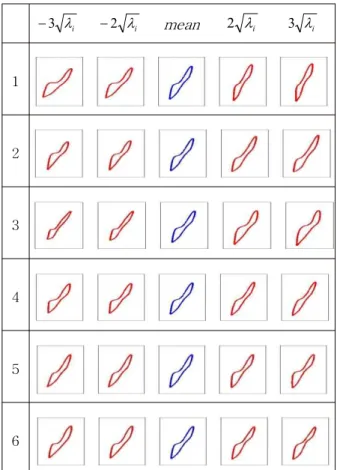
The variations of mean shape by some eigenvalues are shown in Fig. 3. The first parameter adjusts the lower curvature direction of hippocampus. The second and the fourth parameters vary the length of the main shape. The third parameter changes the thickness of the lower part of hippocampus.
The fifth and sixth parameters vary the shape of
upper and lower part of mean shape, respectively.
w V x x vv
+
= (4)
i i
i w l
l 3
3 £ £
- (5)
The next step is to make gray level appearance.
Its function is to get the mean gray level profile along the normal of each marker point. We choose k points outside the marker point and k points in- side the marker point. Therefore, we have 2k+1 gray level profile for each marker. For all shapes in the training set, we will get the mean gray profile.
2.3 Initialization
This is the process to place the mean shape to the image that we want to segment. It is necessary to place the mean shape as precise as possible to the object that we want to segment [10].
Misplacing the mean shape usually results in
(a)
(b) (c)
Fig. 4. (a) the segmentation of hippocampus; (b) the area of hippocampus; (c) the differ- ence between ASM and manual segmenta- tion.
Table 1. Influence of the number of interpolated points between markers
Interpolated
points Total marker
points Time elapsed
(s) Error
(%)
5 29 4.79 30.272
10 64 5.78 25.170
15 99 6.87 28.912
20 134 7.75 26.701
25 169 8.66 24.830
Table 2. Influence of the number of image samples in training set
Number of sample
images Time elapsed Error (%)
10 8.75 49.523
20 8.73 35.612
30 8.71 27.139
40 8.66 24.830
wrong segmentation.
2.4 Segmentation
Segmentation is the last step in ASM. The mean shape evolves by the movement of each marker.
The distance of point movement in the normal is defined as the gray level resolution [11]. This reso- lution can be vary from coarse (far distance be- tween each profile points) to fine (short distance between each profile points). This each point moves along its normal by minimizing the Mahala- nobis distance between the mean gray profile and the gray profile of the image (6) [12]. The segmen- tation is expected to converge. However, specific iteration number was used in the segmentation process to ensure the stop condition of this method.
) ( ) ( )
(g g g S 1 g g
f i = i- g- i- (6)
3. EXPERIMENTAL RESULTS
The input and training images were DICOM files obtained from 1.5T-3T MRI devices from four university hospitals in Korea. 12 MR brain sets ob- tained from 3 volunteer students from 4 university hospitals. For each image set, 2 to 3 slices which correctly resembles the shape of hippocampus were used to make the model.
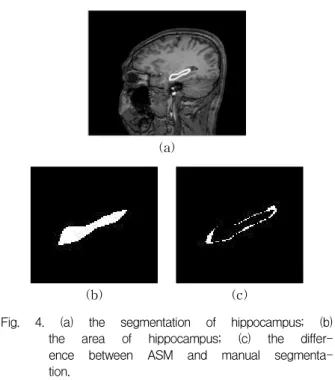
The ASM segmentation result is influenced by some parameters: the number of images in the training set, the number of markers, the initializa- tion coordinate, and the number of pixels along the normal of each marker as gray level profile. In our work, the initialization position and the number of gray level profile were fixed. The modified varia- bles were the number of training images and the number of markers. The segmentation result su- perimposed on the image is shown in Fig. 4a and the hippocampus is shown in Fig. 4b. In order to get the accuracy of hippocampus segmentation us- ing ASM, we use the difference between the ASM segmentation result and manual segmentation re-
sult (Fig. 4c). The manual segmentation was done by doing delineation along the boundary of hippocampus. The accuracy is presented as error percentage. Table 1 and Table 2 show the effect of the number of markers and the number of sam- ple image, respectively.
We used point to point interpolation to get more marker points. 5 types of interpolation; by 5, 10, 15, 20, and 25 points were used, while preserving other parameters (number of image samples,
length of gray profile, and initialization coordinate).
Our hippocampus model with more points needs more time to finish the segmentation process.
However, the accuracy of model with more points is not always better than model with fewer points.
In our result, interpolation by 10 points was the optimum result.
The number of sample images in the training set will also have a direct influence to the segmenta- tion result. More sample images mean richer varia- tions of the model, thus, make the model more ap- plicable in the target image. Different number of sample images were used; 10, 20, 30 and 40. The number of interpolated points was set to 25 for all segmentation process and the initialization coor- dinate was fixed. This result shows that more sample images results in better segmentation re- sult, without any significant difference in time needed for segmentation.
4. CONCLUSION
Active shape model is applicable to segment hippocampus from whole brain image. The best accuracy was achieved by using 40 images in the training set. This result can be improved by em- ploying medical experts in placing the markers on the training images to make the model and doing the manual segmentation.
In addition, to increase the segmentation accu- racy, it is encouraged to add more sample images in the training set instead of adding more markers on the object. If the object model already represents the hippocampus shape, we do not need to add more markers since it will only add the computa- tion time. On the other hand, adding more sample images results in richer variations of the model and better segmentation accuracy.
For further work, along with the medical ex- perts, not only two-dimensional ASM, but also three-dimensional (3D) ASM can be performed. By using more images in the training set, more precise
placement of markers in the training set, and cor- rect manual segmentation, a good accuracy for 3D hippocampus segmentation can be achieved.
REFERENCES
[ 1 ] International Survey Highlights Great Public Desire to Seek Early Diagnosis of Alzheimer’s, http://www.hsph.harvard.edu/news/press- releases/alzheimers-international-survey, 2013.
[ 2 ] Y.Y. Sitoh, J. Karthik, J.C. Rajapakse, W.T.
Hong, W.L. Lee, S. Sahadevan, and J.J. Chin,
“Cerebral and Hippocampal Volumetry in Early Alzheimer’sdisease,” Proc. of the 9th Int.
Conf. on Neural Inf. Process., Vol. 3, pp. 1523- 1526, 2002.
[ 3 ] D.P. Jang, D.S. Lee, and S.I. Kim, “Contour detection of Hippocampus using Dynamic contour Model and Region Growing,”Proc. of the 19thAnnu. Int. Conf. of the IEEE on Eng.
in Med. and Biol. Soc., Vol. 2, pp. 763-766, 1997.
[ 4 ] X. Lu and S. Luo, “Segmentation of Hippocampus in MRI using Watersnakes,”
IEEE Int. Conf. on Complex Med. Eng., pp.
552-555, 2007.
[ 5 ] D. Shen, S. Moffat, S. M. Resnick, and C.
Davatzikos, “Measuring Size and Shape of the Hippocampus in MR Imagesusing a Deformable Shape Model,” NeuroImage, Vol. 15, No. 2, pp. 422-434, 2002.
[ 6 ] M. Chupin, G. Chetelat, L. Lemieux, B. Dubois, L. Garnero, H. Benali, F. Eustache, S. Lehericy, B. Desgranges, and O. Colliot, “Fully Auto- matic Hippocampus Segmentation Discriminates between Early Alzheimer’s Disease and Normal Aging,” 5th IEEE Int. Symp. on Biomed.
Imaging, pp. 97-100, 2008.
[ 7 ] T.F. Cootes, C.J. Taylor, D.H. Cooper, and J.
Graham, “Active Shape Models – Their Training and Application,” Comput. Vis. and
Image Underst., Vol. 51, No. 1, pp. 38-59, 1995.
[8] A. Enkhbolor; I. Yonny S.; H.K. Choi, H,
"Comparison of Active Contour and Active Shape Approaches for Corpus Callosum Seg- mentation,"J. Korea Multimedia Soc, Vol. 16, No. 9, pp. 1018-1030, 2013.
[ 9 ] T.F. Cootes and C.J. Taylor, Statistical Models of Appearance for Computer Vision, University of Manchester, Manchester, 2004.
[10] S. Nyamlkhagva, S. Altansukh, A. Enkhbolor, H.K. Choi, "Contrast Enhancement for Segmentation of Hippocampus on Brain MR
Images," J . Korea Multimedia Soc, Vol. 15, No. 12, pp. 1409-1416, 2012.
[11] B. van Ginneken, A.F. Frangi, J.J. Staal, B.M.
ter Haar Romeny, and M.A. Viergever, ”Active Shape Model Segmentation with Optimal Features,” IEEE Trans. on Med. Imaging, Vol. 21, No. 8, pp. 924-933, 2002.
[12] M. Benjelloun, S. Mahmoudi, and F. Lecron,
“A Framework of Vertebra Segmentation us- ing the Active Shape Model-Based Approach,”
Int. J. of Biomed. Imaging, Vol. 2011, No. 9, pp. 1-14, 2011.
Yonny Septian Izmantoko received the B.S. degree in Elec- trical Engineering from Institut Teknologi Bandung, Indonesia, in 2011. He was theformer mem- ber of Medical Image Technol- ogy Laboratory (MITL), Inje University, who has received his master of Computer Science degree in 2013. His research interests are image segmentation, image vis- ualization, and parallel data computing using GPU.
Ho-SungYoon
received the B.S. degree in Com- puter Engineering from Inje University in 2012. He is cur- rently a master student in Med- ical Image Technology Labor- atory (MITL), School of Com- puter Engineering, Inje Univer- sity. His research interests are image analysis and im- age visualization.
Enkhbolor Adiya
received the B.S., M.S. degrees in Applied Mathematics from School of Mathematics and Computer Science of National University of Mongolia in 2004, 2006 respectively. She is cur- rently a PhD student in Medical Image Technology Laboratory (MITL), School of Computer Engineering, Inje University, South Korea.
Her research interests include image restoration and image segmentation.
Chi-Woong Mun
received the M.S. and Ph.D. de- grees in Electrical Engineering from Korea Institue of Science and Technology, Korea in 1983 and 1991, respectively. He had been a senior researcher of Asan Institute of Life Science (1991- 1995) and principal researcher of Samsung Advanced Institute of Technology (1996-1998). Now he is an as- sociate professor in department of Biomedical Engineering, Inje University. His interesting research fields are in signal and medical imaging system, bio- medical instruments, and so on.
Young Huh
received Ph.D. degree from Department of Electrical Engin- eering, The University of Texasin 1995 andwas Visiting Scholar at University of Washington Medical Center in 2005. He was Director of Medical IT Fusion Research Division at Korea Electrotechnology Research Institute (KERI) andhe is currently working as Medical Devices Program Director at Korea Evaluation Institute of Industrial Technology(KEIT) and Chairman of Korea IEC/TC 62 Standard Technical Expert Committee (Korean Agency for Technology and Standards). His interesting re- search fields are medical imaging devices and system, and semiconductor sensors.
Heung-Kook Choi
has gone the undergraduate studying and graduate studying in computer science and en- gineering at the Department of Electrical Engineering of Linköping University, Sweden (1984-1990) and Ph.D. studying in computerized image analysis at the Center for Image Analysis of Uppsala University, Sweden (1990-1996).
He was President of Industry and Academic Coopera- tion Foundation atInje University and now he is President of Korea Multimedia Society. His interesting research fields are in computer graphics, virtual reality, and medical image processing and analysis.