천연물 복합제가 제 2형 당뇨 마우스에서
혈당 및 지질대사에 미치는 영향
서동효ㆍ주인환ㆍ김동희*
대전대학교 한의과대학 병리학교실서 론
糖尿는 췌장에서 인슐린이 생성되지 않는 제 1형과 인슐린이 생성은 되지만 인슐린에 의해 혈액 내 포 도당 수치가 조절되지 않는 제 2형으로 구분되며, 전 세계 糖尿 환자 수는 4억 2천만 명으로 유병률이 매 년 증가하고 있는 추세이고 90% 이상이 제 2형 당 뇨로 나타났다(1). 현재 糖尿 치료에 사용되고 있는 sulfonylurea 및 biguanides 계의 치료제들은 혈당 강하 효능이 있으나 소화기간 및 간 장애와 조혈기 계 장애, 피부과민증 등의 부작용으로 인해 장기간의 사용이 제한되고 있어 糖尿의 장기성을 고려한 부작 용이 없고 혈당개선에 효과적인 치료제의 개발이 지 속되고 있다. 현재 제 2형 糖尿 동물모델로 널리 사용되고 있는 BKS.Cg-m+/+Leprdb/J는 db/db mouse로 알려져 있 으며, 렙틴 수용체인 db 유전자의 변이로 인해 糖尿 와 肥滿의 증상이 나타나고 생후 4~5주부터 체중 및 혈액 내 포도당 수치가 증가한다(2, 3). 또한 레 지스틴이 증가하여 인슐린 저항성이 높아져 인슐린 농도가 높게 유지된다(3, 4). 한의학적으로 糖尿는 肥滿을 동반하는 질환으로 고 지방 및 고당분 음식을 섭취함으로써 체내에 熱이 축적되어 발생하는 消渴의 범주로 구분되며 多尿, 多 食, 多飮의 증상을 나타낸다(5). 消渴은 渴而多飮,Effects of herbal mixture on blood glucose and lipid metabolism in type 2
diabetic mellitus mouse
Dong-hyo SeoㆍIn-Hwan JooㆍDong-Hee Kim*
Department of Pathology, College of Oriental Medicine, Daejeon University
Objectives: This study aims to investigate the effects of diabetes mellitus care mixture (DCM) on blood glucose and lipid metabolism in type 2 diabetic mellitus mice. DCM consisted of lagerstroemia speciose, allium hookeri, momordica charantia, amaranthus tricolor, and boesenbergia rotunda, which have been proven to have antidiabetic properties.
Methods: In this study, we researched the effects of DCM in type 2 diabetic mellitus mice. C57BLKS/J mouse groups had no treatment, db/db mouse randomly assigned to 2 groups, and treated with distilled water and DCM (200 ㎎/㎏/day). Blood glucose levels and body weight were checked every week. After 4 weeks of treatment, liver function indicators (AST, ALT, and LDH) and lipid metabolites (triglyceride, total cholesterol, LDL-cholesterol, HDL-cholesterol) were measured with a biochemistry analyzer. Diabetic factors (insulin, resistin, and leptin) were measured with ELISA. Results: DCM was decreased blood glucose, diabetic factors, liver function indicators, triglyceride, total cholesterol, and LDL-cholesterol significantly. Also, HDL-cholesterol was significantly increased in DCM group. The bodyweight of DCM group decreased but, no significant difference with the control group. DCM may have the potential to improved diabetes mellitus by regulating blood glucose levels and diabetic factors. Also protecting from diabetic complications by adjusting liver function indicators and lipid metabolites.
Conclusions: These results suggest that DCM to be used as an oriental medicine for diabetes, the results of clinical trials are needed.
消穀善飢, 小便頻數의 증상을 나타내며, 발생 부위에 따라 上消, 中消, 下消로 나누어 腎陰을 補하고 淸火 하는 것으로 치료한다(6, 7). 이에 본 연구에서는 여러 식품을 혼합하여 시너지효 과를 발생시키고 혈당 개선에 대한 효능이 증가한 선행 연구들(8-12)에 착안하여 혈당 강하 및 인슐 린 감수성 증가에 대한 효능이 확인된 바나바잎(13 ), 삼채(14), 여주(15), 아마란스(16), 핑거루트(17) 를 동일하게 배합하여 추출한 복합물이 혈액 내 포 도당 수치와 당뇨 관련 인자, 지질대사 지표에 대한 효능을 평가하고자 실험을 진행한 후, 유의적인 결과 가 도출되어 이를 보고하는 바이다.
재료 및 방법
1. 시료
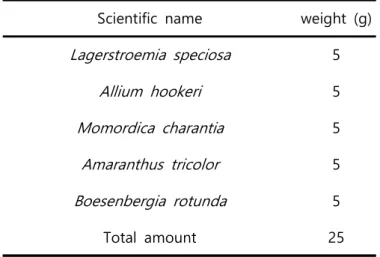
본 실험에 사용한 당뇨 개선 혼합물 (Diabetes mellitus care mixture 이하, DCM로 표기)은 구성하 는 천연물들의 내용과 분량은 Table 1과 같으며, 혼 합물 25 g에 증류수 500 ㎖를 넣고 100℃에서 3시 간 동안 환류추출 하였다. 이후 추출물을 여과지로 여과한 후 rotary vacuum evaporator를 통해 감압농 축하고 freeze dryer를 사용하여 동결건조를 진행하 여 5.23g (수득율 20.92%)의 분말을 얻었으며, 초 저온 냉동고 (-80℃)에서 보관하여 실험에 필요한 농도로 증류수에 희석해 사용하였다.Table 1. The prescription of DCM
2. 실험동물
본 실험을 위하여 사용된 유전자 변형이 발생하지 않은 C57BLKS/J mouse (5주령, 수컷, 20∼27 g) 와 유전자 변형이 발생한 db/db mouse (5주령, 수 컷, 30∼35 g)는 샘타코 (Korea)에서 구입하여 사 용하였다. 실험동물은 2주간의 안정기를 가지면서 순 화를 시켰으며, 안정기 및 실험기간에 모든 실험군에 는 일반 사료(ENVIGO CO., U.K.)와 물을 충분히 공급하였다. 동물 사육실의 조건은 conventional system으로 22±2℃, 1일 중 12시간은 200-300 Lux로 조명하고, 12시간은 모든 빛을 차단하였다. 본 실험은 대전대학교 동물실험윤리 위원회의 승인 (승인번호: DJUARB2017-002)을 받아 동물윤리준 칙에 의거하여 실험하였다.3. 시약 및 기기
사용된 시약은 혈당 체크 스트립 (Roshe CO., Switzerland), Morinaga ultrasensitive mouse insulin ELISA kit (MioBS CO., Japan), Mouse/Rat Leptin Quantikine ELISA Kit (R&D system, U.S.A.), Mouse Resistin Quantikine ELISA Kit (R&D system, U.S.A.) 등을 사용하였다. 사용된 기기는 Rotary vacuum evaporator (EYELA
FDU-540, Japan), Freeze dryer (ilshin biobase, Korea), HPLC (Shimadzu, Co., Japan), 혈당 체크 기 (Roshe CO., Switzerland), Autoclave (Sanyo Co., Japan), Vortex mixer (Vision scientific Co.,
Korea), Centrifuge (Sigma Co., U.S.A.),
Deep-freezer (Sanyo Co., Japan), Ice-maker (Vision scientific Co., Korea), 생화학자동분석기 (Hitachi-720; Hitachi Medical, Japan), Plate shaker (Lab-Line Co., U.S.A.), Microplate reader (Molecular Devices Co., U.S.A.)등을 사용하였다.
4. HPLC 분석
HPLC의 이동상을 0.1% phosphoric acid in water (A)와 0.1% phosphoric acid in acetonitrile (B)로 gradient elution system을 적용시켜 0~20분 (A; 80%, B; 20%), 20~30분 (A; 60%, B; 40%), 30~35분(100% B), 35~40분 (A; 80%, B; 20%), 55~70분(5% B)로 설정하였으며. 유속은 1 ㎖/min, column 온도는 40℃로 유지하였다. 이 후 20 ㎎/㎖ 농도로 준비된 DCM를 주입하여 UV wavelength 280 ㎚에서 6,8-dimethyl esculetin, salvianolic acid B, quercetin 함량을 분석하였다.
Scientific name weight (g)
Lagerstroemia speciosa 5 Allium hookeri 5 Momordica charantia 5 Amaranthus tricolor 5 Boesenbergia rotunda 5 Total amount 25
5. 시료 투여
C57BL/6 mouse를 정상군으로 분류하였고 db/db mouse를 대조군과 실험군으로 분류하였다. 2주간의 안정기 후 실험동물의 혈당체크 후 그룹 당 6마리씩 배분하였다. 실험 시작 7주령부터 실험 종료인 11주 령까지 정상군은 아무것도 처치하지 않았고 대조군 은 증류수를 경구 투여 하였다. 실험군은 DCM를 200 ㎎/㎏의 용량으로 매일 오전 10시에 4주간 경구 투여하였다.6. 혈당 및 체중 측정
혈당 및 체중 측정은 실험시작 일부터 실험종료 일 까지 매주 화요일에 측정을 실시하였으며, 혈당 측정 3시간 전부터 절식시킨 후 꼬리 미정맥을 절단한 뒤 혈당체크기를 이용하여 혈당을 측정하였고 체중은 g단위의 저울을 이용하여 측정하였다.7. 실험동물 희생
사료를 제거하여 실험동물을 18시간 동안 절식한 뒤 에테르를 이용하여 실험동물을 흡입마취하고 심장채 혈을 통해 혈액을 채취하여 희생시켰다. 채취한 혈액 은 30분간 상온에서 굳힌 뒤 3,000 rpm에서 15분간 원심분리 후 상등액을 취해 혈청을 분리하였고 –8 0℃에서 보관하며 실험에 사용하였다.8. 생화학 분석 및 관련 인자 측정
혈청 내 간 기능 지표 (AST, ALT, LDH)와 지질대사 지표 (triglyceride, total cholesterol,
HDL-cholesterol, LDL-cholesterol)는 생화학자동 분석기를 이용하여 측정하였고 당뇨 관련 인자 (insulin, leptin, resistin) 생성량은 각 ELISA kit의 protocol을 따라 반응을 진행 한 후 microplate reader로 450 ㎚ 파장에서 흡광도를 측정하였다.
9. 통계처리
실험 결과는 SPSS 21.0를 이용하여 mean±standard error of mean으로 나타내었으며, ANOVA를 사용하 여 다중 비교하였고 Duncan test를 통해 p<0.001, p<0.01 및 p<0.05 수준에서 유의성을 검정하였다.
결 과
1. HPLC 분석
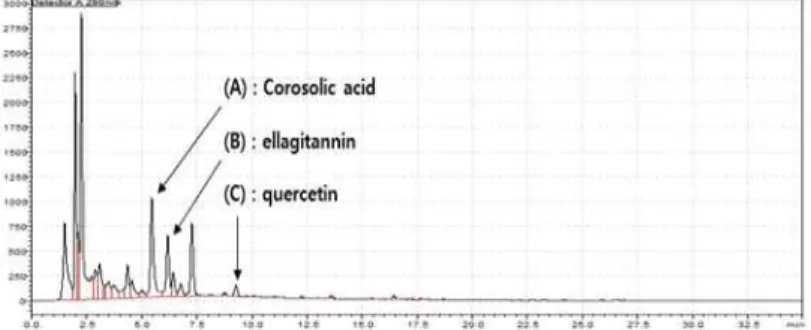
DCM은 당뇨에 효과적인 corosolic acid가 1094.6 ㎎/ℓ, ellagitannin이 634.8 ㎎/ℓ, quercetin이 162.4 ㎎/ℓ 함량으로 검출되었다(Fig. 1).Fig. 1. Indicator components analysis of DCM. Indicator components of DCM were analysis with HPLC chromatogram. 280 ㎚: (A); corosolic acid, (B) ellagitannin, (C) quercetin
2. 간 기능에 미치는 영향
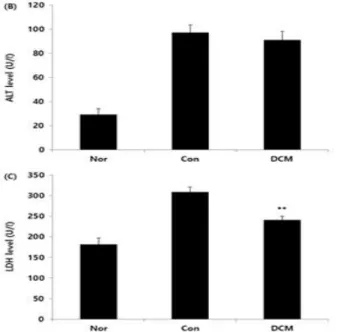
AST는 대조군이 132.0±8.8 U/ℓ, DCM 투여군은 99.0±6.1 U/ℓ로 나타나 25%의 유의적인 감소 (**: p<0.01)가 나타났고(Fig. 2A) ALT는 대조군이 97.2±6.4 U/ℓ, DCM 투여군은 90.8±7.2 U/ℓ로 나타나 7%의 감소가 나타났다(Fig. 2B). 또한 LDH 는 대조군이 308.3±12.2 U/ℓ, DCM 투여군은 241.0±9.0 U/ℓ로 나타나 22%의 유의적인 감소 (**: p<0.01)가 나타났다(Fig. 2C).
Fig. 2. Effect of DCM on the liver functional markers level in serum of db/db diabetic mice. The mice were orally administered with DCM (200 ㎎/㎏) for 4 weeks. The (A) AST, (B) ALT, (C) LDH level in serum were measured. The result are expressed as mean±standard error of mean (n=6/group). AST: aspartate aminotransferase, ALT: alanine transaminase, LDH: lactate dehydrogenase, Nor: normal group, Con: control group, DCM: Diabetes mellitus care mixture treated group (**: p<0.01 compared to Con).
3. 당뇨 관련 인자에 미치는 영향
인슐린은 대조군이 42.6±10.3 ng/㎖, DCM 투여군 은 24.5±7.5 ng/㎖로 나타나 43%의 유의적인 감소 (**: p<0.01)가 나타났고(Fig. 3A), 레지스틴은 대 조군이 22.1±0.9 ng/㎖, DCM 투여군은 12.6±1.3 ng/㎖로 나타나 43%의 유의적인 감소 (***: p <0.001)가 나타났다(Fig. 3B). 또한 렙틴은 대조군 이 76.0±5.3 ng/㎖, DCM 투여군은 64.9±3.9 ng/㎖ 로 나타나 15%의 유의적인 감소 (*: p<0.05)가 나 타났다(Fig. 3C).Fig. 3. Effect of DCM on the diabetes related factors level in serum of db/db diabetic mice. The mice were orally administered with DCM (200 ㎎/㎏) for 4 weeks. The (A) insulin, (B) resistin, (C) leptin level in serum were measured. The result are expressed as mean±standard error of mean (n=6/group). Nor: normal group, Con: control group, DCM: Diabetes mellitus care mixture treated group (***: p<0.001, **: p<0.01, *: p <0.05 compared to Con).
4. 혈당에 미치는 영향
정상군은 실험시작 시 190.6±9.8 ㎎/㎗, 4주 후에 284.2±9.4 ㎎/㎗로 나타나 큰 혈당변화는 나타나지 않았으며, 대조군은 실험시작 시 382.0±80.7 ㎎/㎗, 4주 후에 795.6±76.1 ㎎/㎗로 나타나 혈당이 크게 증가하였다. 그러나 DCM 투여군은 실험시작 2주 후 부터 대조군에 비해 혈당이 감소하는 것으로 나타났 으며, 4주 후에는 595.4±53.2 ㎎/㎗로 나타나 25% 의 유의적인 감소 (*: p<0.05)가 나타났다(Fig. 4).Fig. 4. Effect of DCM on the blood glucose level in db/db diabetic mice. The mice were orally administered with DCM (200 ㎎/㎏) for 4 weeks. The glucose level was measured with blood from mice tail under 3 hours fasting in every week. The result are expressed as mean±standard error of mean (n=6/group). Nor: normal group, Con: control group, DCM: Diabetes mellitus care mixture treated group (*: p<0.05 compared to Con).
5. 지질대사에 미치는 영향
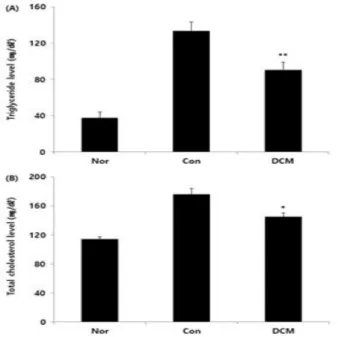
중성지방은 대조군이 133.8±9.6 ㎎/㎗, DCM 투여군 은 90.7±8.4 ㎎/㎗로 나타나 32%의 유의적인 감소 (**: p<0.01)가 나타났고(Fig. 5A) 총 콜레스테롤 은 대조군이 176.3±8.0 ㎎/㎗, DCM 투여군은 145.0±5.1 ㎎/㎗로 나타나 18%의 유의적인 감소 (*: p<0.05)가 나타났다(Fig. 5B). 또한 LDL-콜레 스테롤은 대조군이 10.0±0.7 ㎎/㎗, DCM 투여군은 7.8±0.9 ㎎/㎗로 나타나 23%의 유의적인 감소 (*: p<0.05)가 나타났고(Fig. 5C) HDL-콜레스테롤은 대조군이 78.5±3.7 ㎎/㎗, DCM 투여군은 87.8±6.2 ㎎/㎗로 나타나 12%의 유의적인 증가 (*: p<0.05) 가 나타났다(Fig. 5D).Fig. 5. Effect of DCM on the lipid metabolism markers level in serum of db/db diabetic mice. The mice were orally administered with DCM (200 ㎎/㎏) for 4 weeks. The (A) triglyceride, (B) total cholesterol, (C) LDL-cholesterol, (D) HDL-cholesterol level in serum were measured. The result are expressed as mean±standard error of mean (n=6/group). LDL:
low-density lipoprotein, HDL: high-density lipoprotein, Nor: normal group, Con: control group, DCM: Diabetes mellitus care mixture treated group (**: p<0.01, *: p <0.05 compared to Con).
6. 체중에 미치는 영향
정상군은 실험시작 시 23.5±1.4 g, 4주 후에 27.5±1.2 g으로 나타나 큰 체중변화는 나타나지 않 았으며, 대조군은 실험시작 시 37.5±1.6 g, 4주 후 에 44.0±2.9 g으로 나타나 체중이 증가하였다. 그러 나 DCM 투여군은 실험시작 시 37.6±2.6 g, 4주 후 에 41.5±2.8 g으로 나타나 대조군에 비해 5%의 체 중 감소가 나타났다(Fig. 6).Fig. 6. Effect of DCM on the body weight in db/db diabetic mice. The mice were orally administered with DCM (200 ㎎/㎏) for 4 weeks. The body weight was measured in every week. The result are expressed as mean±standard error of mean (n=6/group). Nor: normal group, Con: control group, DCM: Diabetes mellitus care mixture treated group.
고 찰
糖尿는 인슐린 결핍 및 인슐린 저항성 증가로 인해 혈액 내 포도당 수치가 조절되지 않는 대사성 질환 으로 정의하며, 췌장 베타세포에서 인슐린이 분비되 지 않아 발생하는 제 1형 糖尿와 인슐린 저항성이 증가되어 분비된 인슐린이 작용하지 않아 발생하는 제 2형 糖尿로 구분된다. 이 중 제 2형 糖尿 환자의 수는 전체 환자의 90% 이상을 차지하고 있다(1). 최근 연구들은 지방세포가 대사 작용 및 염증반응에 관여한다고 보고하고 있으며(18), 지방세포는 렙틴, 레지스틴, 아디포넥틴을 분비하고 인슐린 수용체, 렙 틴 수용체등을 보유하여 체내 대사 작용에 상호작용 하는 중요한 역할을 한다(19). 肥滿과 연관된 제 2 형 糖尿는 증가된 인슐린 저항성을 통해 포도당대사 가 조절되지 못하고 이로 인해 지질대사에 이상이 발생하여 혈중 중성지방 및 LDL-콜레스테롤을 증가 시키고 HDL-콜레스테롤은 감소시키는 특징을 나타 낸다(20). 본 연구에서 DCM은 간 기능 및 당뇨 관련 인자들을 조절하여 혈액 내 포도당 수치를 조절하고 지질대사 를 조절하여 체중을 감소시키는 효능이 확인되었다. 우선 당뇨에 효과적인 corosolic acid, ellagitannin, quercetin 함량이 HPLC 분석을 통해 확인되었으며 (Fig. 1), 당뇨로 인해 증가된 간 기능 지표인 AST 와 LDH는 각각 25%, 22%의 유의적인 감소가 나타 났고(Fig. 2A, C), ALT는 7%의 감소가 나타났다 (Fig. 2B). 췌장의 베타세포에서 분비되는 호르몬인 인슐린은 포도당대사를 조절하여 체내의 세포들이 사용하는 포도당 농도를 일정하게 유지해주는 역할을 하고 단 백질과 지질대사에도 중요한 역할을 수행한다(21). 제 2형 당뇨 동물모델에서는 인슐린 저항성이 증가 되어 인슐린 농도가 증가되며, DCM은 43%의 유의 적인 감소를 나타내었다(Fig. 3A). 레지스틴은 성숙된 지방세포에서 분비되는 펩티드 호르몬으로 발견 초기에는 인슐린 저항성 및 비만과 레지스틴과의 관계는 아직 뚜렷하지 않으나 혈중 레 지스틴의 농도가 제 2형 당뇨 환자(22)와 비만 동물 실험(23)에서 정상군에 대비하여 증가하였음을 확인 할 수 있었다. 본 연구에서는 알려진 것과 같이 당뇨 로 인해 레지스틴이 증가하였고 DCM은 43%의 유의 적인 감소를 나타내었다(Fig. 3B). 렙틴도 레지스틴과 동일하게 지방세포에서 분비되는 폴리펩티드 호르몬으로 혈중 렙틴의 농도는 지방조 직과 연관성이 있으며, 체중이 증가할수록 렙틴도 증 가한다(24, 25). 이전 연구(26, 27)에 따르면 렙틴 은 인슐린 저항성과 연관되어 체내 대사 작용에 관 여한다고 알려져 있으며, 본 연구에서도 마찬가지로 인슐린 저항성의 증가로 인해 렙틴이 증가하였고 DCM은 15%의 유의적인 감소를 나타내어(Fig. 3C) 16% 감소시킨 핑거루트(17)와 비교하였을 때, 감소 시킨 정도가 비슷한 것으로 보아 DCM은 핑거루트의 성분을 통해 렙틴을 감소시켰을 것이라 사료된다. 결과적으로 DCM은 당뇨로 인해 증가하는 간 기능 지표와 인슐린을 감소시키고 레지스틴과 렙틴을 통 해 인슐린 저항성을 감소시켜 혈당을 감소시켰을 것 이라 사료되며(Fig. 4), DCM의 구성 재료들이 대부 분 15~20% 정도의 혈당을 감소시킨 반면, 구성 재 료들을 혼합하였을 때, 재료들 간의 상승작용을 통해 혈당 감소량이 증가하였을 것이라 사료된다. 그리고 糖尿와 동반되는 肥滿의 가장 큰 특징은 증 가된 인슐린 저항성으로 인하여 지질대사에 사용되 는 효소들의 활성이 억제되어 중성지방의 분해가 억 제되어 체내 중성지방 농도가 증가하게 되며, 심혈관 계 질환의 강력한 요인으로 알려진 총 콜레스테롤 및 LDL-콜레스테롤의 증가와 HDL-콜레스테롤의 감소가 나타난다(28, 29). DCM을 투여한 후 중성지 방은 대조군에 비해 32%의 유의적인 감소를 나타내 었고(Fig. 5A) 총 콜레스테롤과 LDL-콜레스테롤은 각각 18%, 23%의 유의적인 감소를 나타내었으며 (Fig. 5B, C), HDL-콜레스테롤은 12%의 유의적인 증가를 나타내었다(Fig. 5D). 이러한 결과를 바탕으 로 5%의 체중 감소를 나타내었다(Fig. 6). 이상의 결과를 종합해 볼 때 DCM은 혈액 내 포도당 수치와 당뇨 관련 인자들을 개선시켰고 또한 당뇨로 인하여 증가하는 간 기능 지표와 지질대사 지표도 개선시켰다. 따라서 임상 실험결과가 뒷받침 된다면 제 2형 糖尿에 대한 한의학적 치료제로써 사용 가능 할 것이라 사료된다.결 론
본 연구에서는 당뇨로 인한 혈당 및 지질대사에 대 한 DCM의 효과를 객관적으로 평가하기 위해 렙틴 수용체인 db 유전자의 변이로 인슐린과 인슐린 저항 성이 증가하여 제 2형 糖尿 동물 모델로 사용되고 있는 db/db mouse에 DCM을 투여하여 다양한 바이오마커를 측정하여 다음과 같은 결과를 얻었다. 레지 스틴과 렙틴의 조절을 통해 증가된 인슐린 저항성을 감소시키고 인슐린의 작용 기능을 정상화하여 포도 당대사를 원활하게 유도하였으며, 혈액 내 포도당 수 치를 감소시키는 효능이 검증되었다. 또한 당뇨로 인 하여 증가하는 간 기능 지표인 AST와 ALT, LDH를 유의적으로 감소시켜 당뇨로 인한 합병증에 대한 효 능이 확인되었다. 마지막으로 감소된 인슐린 저항성 을 통해 지질 및 단백질대사도 정상적으로 회복하여 중성지방 및 LDL-콜레스테롤을 감소시키고 HDL-콜레스테롤을 증가시켜 심혈관 질환에 대한 효능도 검증되었다. 향 후, 위 결과를 토대로 임상 실험결과 가 뒷받침 된다면 제 2형 糖尿 및 합병증에 대한 한 의학적 치료제로써 사용 가능 할 것이라 사료된다.
Reference
1. Organization WH. World Health Organization Global Report on Diabetes. Geneva: World Health Organization. 2016.
2. Lyon MF, Searle AG. Genetic variants and strains of the laboratory mouse: Oxford University Press; 1989.
3. Kanasaki K, Koya D. Biology of obesity: lessons from animal models of obesity. BioMed Research International. 2011;2011.
4. Fujita H, Fujishima H, Morii T, Koshimura J, Narita T, Kakei M, et al. Effect of metformin on adipose tissue resistin expression in db/db mice. Biochemical and biophysical research communications. 2002;298(3):345-9.
5. KH K. Hwang-je-nae-kyeong. Seoul: Banryong. 2000;77:120.
6. Kim H-G, Bose S, Kim D-I, Koo B-S, Kim H. Effects of fermented lotus extracts on
glucose intolerance and lipid metabolism-related gene expression. Journal of Korean Medicine Rehabilitation. 2014;24(1):1-12.
7. Yun GW, Lee H. Effect of Cheongawongagam Extract on the Ovariectomized Rat Model of Osteoporosis. Journal of Physiology & Pathology in Korean Medicine. 2020;34(1):14-23.
8. Kim C, Yang Y, Hwang E. Development of bitter melon juice mixed with condensed oat
juice and its hypoglycemic effect in
streptozotocin-induced diabetic rats. Korean J Hum Ecol. 2016;25:227-38.
9. Son H-K, Han J-H, Lee J-J. Anti-diabetic effect of the mixture of mulberry leaf and green tea powder in rats with
streptozotocin-induced diabetes. Korean Journal of Food Preservation. 2014;21(4):549-59.
10. Lee HJ, Moon J-H, Lee W-M, Lee SG, Kim A-K, Woo Y-H, et al. Charantin contents and fruit characteristics of bitter gourd (Momordica charantia L.) accessions. Protected Horticulture and Plant Factory. 2012;21(4):379-84.
11. Lee S-J, Shin J-H, Ju J-C, Kang S-K, Sung N-J. Hypoglycemic and hypolipidemic effects of Orostachys japonicus with medicinal herbs in streptozotocin-induced diabetic rats. Journal of the Korean Society of Food Science and Nutrition. 2013;42(4):587-94.
12. Roh SG, Choi WC. Antidiabetic synergistic effects of medicinal plant extract mixtures on db/db mice. Journal of Life Science.
2011;21(2):165-75.
13. Kim K-H, Roh S-G, Li C-R, Jin C-F, Kim A, Choi W-C. Anti-diabetic effects of banaba leaf extracts (Lagerstroemia speciosa Pers.) through solvents. Journal of Life Science. 2008;18(9):1305-11.
14. Kim N-S, Choi B-K, Lee S-H, Jang H-H, Kim J-B, Kim H-R, et al. Effects of Allium hookeri on glucose metabolism in type II diabetic mice. Korean Journal of
Pharmacognosy. 2015;46(1):78-83.
15. Kim M-W. Effect of bitter melon on plasma blood glucose and cholesterol levels in
streptozotocin induced diabetic rats. Journal of the East Asian Society of Dietary Life.
2013;23(6):704-12.
16. Kim HK, Kim MJ, Cho HY, Kim EK, Shin DH. Antioxidative and anti‐diabetic effects of amaranth (Amaranthus esculantus) in
streptozotocin‐induced diabetic rats. Cell
Biochemistry and Function: Cellular biochemistry and its modulation by active agents or disease.
2006;24(3):195-9.
17. Myoung K-S, Ahn Y-T, Lee M-H, Park D-Y, Ahn Y-M, Huh C-S. Fingerroot
(Boesenbergia pandurata) extract inhibits the accumulation of visceral fat in C57BL/6J mice. Journal of the Korean Society of Food Science and Nutrition. 2013;42(1):26-32.
18. Dıez JJ, Iglesias P. The role of the novel adipocyte-derived hormone adiponectin in human disease. Eur J Endocrinol.
2003;148(3):293-300.
19. Kershaw EE, Flier JS. Adipose tissue as an endocrine organ. The Journal of Clinical
Endocrinology & Metabolism. 2004;89(6):2548-56.
20. Cho HK. Diabetes Mellitus and Disorder of Lipid Metabolism. Journal of Korean Endocrine Society. 2006;21(2):101-5.
21. Kim DJ, Song KE, Park J-W, Cho HK, Lee K-W, Huh KB. Clinical characteristics of Korean type 2 diabetic patients in 2005. Diabetes research and clinical practice.
2007;77(3):S252-S7.
22. Youn B-S, Yu K-Y, Park HJ, Lee NS, Min SS, Youn MY, et al. Plasma resistin
concentrations measured by enzyme-linked immunosorbent assay using a newly developed monoclonal antibody are elevated in individuals with type 2 diabetes mellitus. The Journal of Clinical Endocrinology & Metabolism.
2004;89(1):150-6.
23. Steppan CM, Bailey ST, Bhat S, Brown EJ, Banerjee RR, Wright CM, et al. The hormone resistin links obesity to diabetes. Nature. 2001;409(6818):307-12.
24. Bado A, Levasseur S, Attoub S, Kermorgant S, Laigneau J-P, Bortoluzzi M-N, et al. The stomach is a source of leptin. Nature. 1998;394(6695):790-3.
25. Maffei á, Halaas J, Ravussin E, Pratley R, Lee G, Zhang Y, et al. Leptin levels in human and rodent: measurement of plasma leptin and ob RNA in obese and weight-reduced subjects. Nature medicine. 1995;1(11):1155-61.
26. Silha JV, Krsek M, Skrha JV, Sucharda P, Nyomba B, Murphy LJ. Plasma resistin,
adiponectin and leptin levels in lean and obese subjects: correlations with insulin resistance. European journal of endocrinology.
2003;149(4):331-6.
27. Cnop M, Landchild MJ, Vidal J, Havel PJ, Knowles NG, Carr DR, et al. The concurrent accumulation of intra-abdominal and
subcutaneous fat explains the association between insulin resistance and plasma leptin concentrations: distinct metabolic effects of two fat compartments. Diabetes. 2002;51(4):1005-15. 28. Aizawa K, Inakuma T. Dietary capsanthin, the main carotenoid in paprika (Capsicum annuum), alters plasma high-density
lipoprotein-cholesterol levels and hepatic gene expression in rats. British Journal of Nutrition. 2009;102(12):1760-6.
29. Vaidya H, Prajapati A, Rajani M,
Sudarsanam V, Padh H, Goyal RK. Beneficial Effects of Swertiamarin on Dyslipidaemia in Streptozotocin‐induced Type 2 Diabetic Rats. Phytotherapy Research. 2012;26(8):1259-61.