Digital Processor Module Reliability Analysis of Nuclear Power Plant
Sang Yong Lee, Jae Hyun Jung, Jae Ho Kim, Sung Hun KimSAMCHANG ENTERPRISE CO., LTD. Control Technology Research Institute / R&D group Reliability Research Team #974-1, Goyeon-ri, Woongchon-myon, Ulju-gun, Ulsan, , KOERA, 689-871
1. Introduction
The system used in plant, military equipment, satellite, etc. consists of many electronic parts as control module, which requires relatively high reliability than other commercial electronic products. Specially, Nuclear power plant related to the radiation safety requires high safety and reliability, so most parts apply to Military-Standard level.
Reliability prediction method provides the rational basis of system designs and also provides the safety significance of system operations. Thus various reliability prediction tools have been developed in recent decades, among of them, the MIL-HDBK-217 method has been widely used as a powerful tool for the prediction.
In this work, It is explained that reliability analysis work for Digital Processor Module (DPM, control module of SMART ) is performed by Parts Stress Method based on MIL-HDBK-217F NOTICE2.
We are using the Relex 7.6 of Relex software corporation, because reliability analysis process requires enormous part libraries and data for failure rate calculation.
2. Design description
As application of DPM is broadly used to process the digital signal and can execute quickly sum of products operation, DPM is designed to process all signals of each system module(sub-rack) transmitted and received from Network Interface Card.
It is noted that current DPM design is under development , and therefore design and selected parts is changeable. Subsequently, DPM design may be changed to make a perfect module through the better design and parts of remarkable performance.
3. Reliability Prediction
3.1 Use of the MIL-HDBK-217F method
Generally, reliability of the control module including the electronic parts has consistent failure rate about time. Under that assumption, It can be expressed by following equation.
)
exp(
)
(
t
t
R
=
−
λ
(1)It is known that physical characteristics, operating condition and installation environment determine the failure rate( λ ) of the parts.
Reliability prediction of the control module is quantitative analysis in constituent parts to calculate the total reliability based on it. Consequently, that analysis can improve the design of related module and estimate the reliability according to the time.
There are many kinds of reliability prediction methods the same as MIL-HDBK-217F, Bellcore TR-332, NSWC-98/LE1 and RAC PRISM etc. we use the MIL-HDBK-217F(N2) among them, because parts complying with MIL-STD are attached to electronic circuit boards in nuclear power plant. we calculate the failure rate taking advantage of Parts Stress Method.
Part failure rate in Parts Stress Method is equal to follow . oth E T Q b P
λ
π
π
π
π
λ
=
(2) Pλ
= part failure rate (Failure/10e6 hours)b
λ
= base failure rateQ
π
= quality factor Tπ
= temperature factor Eπ
= environmental factor othπ
= other factorsThe general expression for module failure rate is represented as the following equation.
∑
==
n i p i MN
i
1)
(
λ
λ
(3) Mλ
= module failure ratei P
)
(
λ
= part failure rate for the i th specific parti
N
= quantity of the i th specific partn
= number of different specific part categories Although Parts Counts Method to calculate the failure rate only considers inherent failure data, part quantity, quality level and operating environment, Parts Stress Method adds to much more factors. In accordance with the equation (2), Detailed information for part must be provided.Temperature factor depend on the assumption and provided data.
c
1,c
2in other factors depend on the circuit complexity and the packing technology respectively. Other factors excluding stress factor also depends on data sheet and reliability reference provided by manufacturer. In case of the stress factor, we apply the value in MIL-HDBK-217.3.2. Reliability calculation of DPM
Transactions of the Korean Nuclear Society Autumn Meeting Busan, Korea, October 27-28, 2005
In this paper, Assumption on part failure rate calculation is simply showed from below.
1) When we are calculating the failure rate, we assume the serial combination among parts.
2) MTBF is equaled to 1/Failure rate on the basis of 10e6 hours
3) Environmental factor is assumed that it’s GB (GB,-Ground Benign, Controlled)
4) Ambient temperature is 30 degrees C.
5) Quality factor is ‘1’ that complies with MIL-STD , MIL-SPEC and operating temperature range (-55~+125 degree c). but, some parts apply the value of commercial level (including the parts that can’t be replaced the military level )
6) We perform the reliability prediction except mechanical parts, construction material.
Through 1) ~ 6), applying MIL-HDBK-217F, We get the failure rate of each part in Relex.
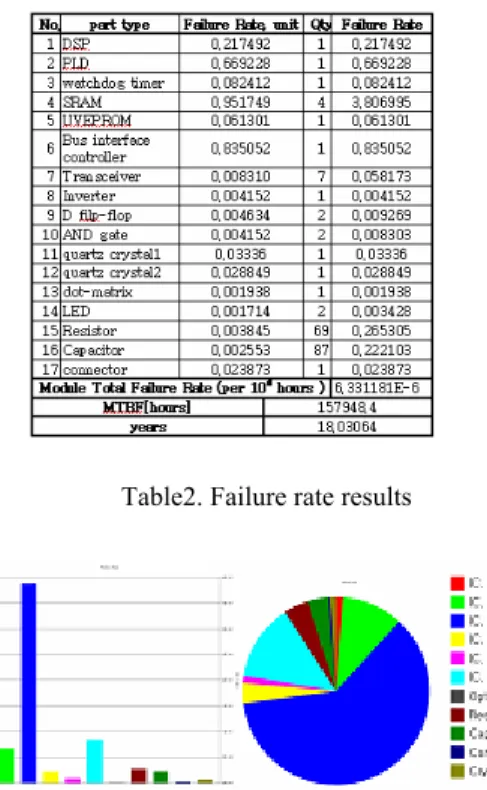
Table 1 is part list of the DPM, The assumption( 1) ~6) ), table 1 and equation (2), (3) can make the failure rate. Using the equation(1), we estimate the reliability in DPM at time. Failure rate for respective parts and total failure rate for module is table 2. The result in Table 2 shows that MTBF for DPM is about 18 years. By the Figure 1, Table 3, you know that ‘Memory’, ‘bus interface controller’ and ‘PLD’ account for the high failure probability in order. The ratio of IC in failure rate of total module occupied 90.86%, It shows high failure rate of IC in digital module. Generally, IC is sensitive to temperature, When operating module in actual state, IC is predicted that its temperature increases in relatively much load. Much load results from software. Memory and PLD applied to commercial level because of the commercial product. But, they are made by major part manufacturer, so their quality is credible. Currently, it must be considered that even some place requiring the high quality level specification at the whole industry use and select the part of commercial level.
Table1. DPM part list
Table2. Failure rate results
Figure 1 Failure rate according to the part category
Table 3. The percentage of part failure rate in module
4. Conclusion
The reliability prediction is currently recognized as an essential need in safe and economic operation of nuclear power plant. It can provide the quantitative prediction data on system safety and reliable system design. The calculation result shows that the Memory and VHSIC/VLSI CMOS are the most critical component affecting to system reliability from each 61.09%, 13.18% in module failure rate. Base on work, it is expected that the result will contribute to safe operation in nuclear power plant and improving the design of the module.
REFERENCES
[1] MIL-HDBK-217F, Reliability Prediction of Electronic Equipment
[2] Won Young Yun, Kyung Woo Choi, A Reliability Analysis on Safety-Related Digital Module in Nuclear Power Plants
[3] Moasoft, System Reliability Prediction Guide [4] RAC(1996), Blueprints for Product Reliability