INTRODUCTION
Argonaute(AGO) proteins are important components of various molecular mechanisms of RNA silencing and DNA double-strand breaks(DSBs) repair system(Mallory and Vaucheret 2010; Parker 2010; Wei et al. 2012). In Arabi-dopsis thaliana, there are 10 AGO genes. The 10 AGO pro-teins are categorized into three clades based on sequence similarity: clade I, AGO1, AGO5, and AGO10; clade II, AGO2, AGO3, and AGO7; and clade III AGO4, AGO6, AGO8, and AGO9(Morel et al. 2002; Vaucheret 2008). The
AGO1 protein is involved in plant development and has an-tiviral roles(Zhang et al. 2006; Bohmert et al. 1998). In ad-dition, AGO1, AGO2, AGO4, AGO5, AGO7, and AGO10 have been reported to have antiviral activities against Tur-nip mosaic virus, TurTur-nip crinkle virus, and Cauliflower mo-saic virus(Qu et al. 2008; Raja et al. 2014; Garcia-Ruiz et al. 2015). The expression of Arabidopsis AGO2(AtAGO2) was strongly induced by γ-irradiation in both mRNA and protein levels, and that the ago2 mutant showed not only re-duced accumulation of DSB-inre-duced small RNAs(diRNAs), but also reduced DSB repair rate compared to wild-type (Wei et al. 2012). Moreover, AtAGO2 regulates the innate immunity upon the infection with the bacterial pathogen Pseudomonas syringae pv. tomato(Pst), which triggers host DNA DSBs in Arabidopsis(Zhang et al. 2011; Song and
DNA Double-Strand Breaks Serve as a Major Factor for
the Expression of Arabidopsis Argonaute 2
Sungbeom Lee1,2,†,*, Moon-Soo Chung1,†, Gun Woong Lee1 and Byung Yeoup Chung1,* 1Advanced Radiation Technology Institute, Korea Atomic Energy Research Institute,
29, Geumgu-gil, Jeongeup-si, Jeollabuk-do 56212, Republic of Korea
2Department of Radiation Biotechnology and Applied Radioisotope Science, University of Science and Technology, 217, Gajeong-ro, Yuseong-gu, Daejeon 34113, Republic of Korea
Abstract - Argonaute 2(AtAGO2) is a well characterized effector protein in Arabidopsis for its functionalities associated with DNA double-strand break(DSB)-induced small RNAs(diRNAs) and for its inducible expression upon γ-irradiation. However, its transcriptional regulation depending on the recovery time after the irradiation and on the specific response to DSBs has been poorly understood. We analyzed the 1,313bp promoter sequence of the AtAGO2 gene (1.3kbpro) to characterize the transcriptional regulation of AtAGO2 at various recovery times after γ-irradiation. A stable transformant harboring 1.3kbpro fused with GUS gene showed that the
AtAGO2 is highly expressed in response to γ-irradiation, after which the expression of the gene
is gradually decreased until 5 days of DNA damage recovery. We also confirm that the AtAGO2 expression patterns are similar to that of γ-irradiation after the treatments of radiomimetic genotoxins(bleomycin and zeocin). However, methyl methanesulfonate and mitomycin C, which are associated with the inhibition of DNA replication, do not induce the expression of the AtAGO2, suggesting that the expression of the AtAGO2 is closely related with DNA DSBs rather than DNA replication.
Key words : Genotoxins, Methyl methanesulfonate, Mitomycin C, Gamma-rays, Arabidopsis thaliana
─ 243 ─ Technical Paper
† These authors contributed equally to this work.
* Co-corresponding author: Byung Yeoup Chung, Tel. +82-63-570-3331, Fax. +82-63-570-3391, E-mail. [email protected]
Sungbeom Lee, Tel. +82-63-570-3384, Fax. +82-63-570-3391, E-mail. [email protected]
Bent 2014). In addition to γ-irradiation, effects of genotox-ins on the damage of DNA or inhibition of DNA replication have been reported. For example, bleomycin and zeocin, which are known as radiomimetic genotoxins, have also been known to induce DNA DSBs(Chankova et al. 2007). On the contrary, an aziridine-containing natural product mitomycin C(MMC) and an alkylating agent methyl meth-anesulfonate(MMS) are believed to be associated with the inhibition DNA replication(Menke et al. 2001).
Given that the expression of the AtAGO2 is inducible upon γ-irradiation, information on the recovery time-depen-dent regulation of the AtAGO2 after the irradiation has been limited. We characterized stable transgenic Arabidopsis plants, which harbor the full-length promoter of AtAGO2 (1,313bp) fused with GUS, after the treatments of γ-rays or four genotoxins. Here, we present the comparative tran-script levels between AtAGO2 and GUS at various recovery times after γ-irradiation, together with histochemical assay of GUS protein. We also show the gene expressions in re-sponse to MMC and MMS treatments to characterize the DSB-specific response of the AtAGO2.
MATERIALS AND METHODS
1. Plant treatments
An Arabidopsis(Columbia-0) transformant was grown at 22°C under 16h light/8h dark cycles, 100-150μmolm-2 s-1 light intensity, and 60-70% relative humidity. For ionizing radiation, two-week-old transgenic seedlings were irradi-ated at 200Gy(50Gyh-1 for 4h) using a 60Co source (IR-222; MDS Nordion Inc., Kanata, Canada)(Kim et al. 2010). For bleomycin(BLM; Sigma, MO, USA) and zeocin(ZEO; Invitrogen, CA, USA) treatments, transgenic plants were incubated with 33μM of BLM and 175μM of ZEO for 1 h, respectively. The plants were subsequently transferred to a half-strength MS media and collected at indicated times
after recovery. For mitomycin C(MMC; Sigma, MO, USA) and methyl methanesulfonate(MMS; Sigma, MO, USA) treatments, transgenic plants were incubated with 0.5mM and 5mM for 2h, respectively.
2. Preparation of an AtAGO2 promoter-GUS construct and Agrobacterium-mediated plant transformation
Genomic DNAs were isolated from seedlings using the ExgeneTM Plant SV mini Kit(GeneAll, Seoul, Republic of Korea), following the manufacturer’s protocol. The 1,313bp AtAGO2 promoter was amplified from the genomic DNA by using a proof-reading polymerase with the primers har-boring the “CACC” sequence in forward primers for the properly oriented DNA recombination(Table 1). The re-sulting amplicon was cloned into the pENTRTM/D-TOPO® vector(Invitrogen, CA, USA), and then integrated into the pKGWFS7 vector to fuse with β-glucuronidase(GUS) gene (Karimi et al. 2002) using the GatewayTM LR ClonaseTM II Enzyme Mix(Invitrogen, CA, USA). The final construct was introduced into Arabidopsis by Agrobacterium tumefa-ciens(strain GV3101)-mediated in planta vacuum infiltra-tion(Bechtold and Pelletier 1998).
3. Histochemical GUS staining analysis
Histochemical staining for GUS activity in the transgenic plants was performed as previously described(Jefferson et al. 1987). After the treatments, whole plants were immersed in 2.4mM 5-bromo-4-chloro-3-indolyl-β-d-glucuronic acid solution(GoldBio, MO, USA) containing 100mM sodium phosphate, pH 7.0, 10mM Na2EDTA, 0.5mM potassium ferricyanide, 0.5mM potassium ferrocyanide, 0.1%(v/v) Triton X-100, and 20%(v/v) methanol, and incubated at 37°C for 24h. Chlorophylls were removed from the plant tissues by immersion in absolute ethanol at 55-60°C.
Table 1. Primers used in the construction of the AtAGO2 promoter deletion mutants and RT-PCR analysis
Construct Sequence(5′ to 3′)
Forward Reverse
1.3kbpro CACCTATGACTTCGATGATGCTAAATCACAATTTGGTATTG CTCCATTGGATCTGATCGGGAAACACTGAG
AtAGO2 AGGGATAGGGACAAGCAAACCG CAGCGAGTGAAAGTGAAGCACA
GUS CAGGAGAAACTGCATCAGCC GATCCCTTTCAAGTTACCGC
4. Reverse transcriptase-polymerase chain reaction (RT-PCR) analysis
Total RNA was isolated from plant leaf tissues using an RNeasy® Plant Mini Kit(Qiagen, CA, USA), following the manufacturer’s recommendation. Total RNA was quantified with Nano-Drop(Thermo Scientific, DE, USA) and reverse- transcribed to complementary DNA using a GoScriptTM Reverse Transcription System(Promega, WI, USA). The PCR amplification(28-30 cycles of 95°C for 40s/51°C for 30s/72°C for 1min) was performed using the gene-specific primers(Table 1).
RESULTS
1. The expression pattern of AtAGO2 in response to γ-irradiation at various recovery times
We employed transgenic Arabidopsis plants containing an AtAGO2 promoter-GUS construct(1.3kbpro-GUS) to monitor the expression pattern of AtAGO2 gene in response to γ-irradiation at various recovery times. Two-week-old transgenic plants were exposed to 200Gy of γ-irradiation
for 4h, and GUS expression at various recovery days after γ-irradiation(RAI) were observed using a histochemical staining and transcript analysis, compared in parallel with the transcript accumulation patterns of endogenous AtAGO2 gene(Fig. 1). Histochemical analysis showed that the GUS expression was highly induced at 1 RAI and 2 RAI, and the expression was dramatically decreased over 3 RAI(Fig. 1B). No GUS accumulation was observed at 5 RAI(Fig. 1B). These results were comparable with the transcript levels of endogenous AtAGO2 and GUS genes. The expressions of the AtAGO2 and the GUS transcripts were immediately induced in response to γ-irradiation. However, the expres-sions were gradually decreased over 1 RAI, continuously maintaining higher expression levels than that of the control during 5d of recovery time(Fig. 1C).
2. Recovery time-dependent response of AtAGO2 promoter after the treatments of radiomimetic genotoxins
We considered DNA DSB-inducing genotoxic agents, bleomycin and zeocin, to mimic the effects of γ-rays on DNA molecules(Menke et al. 2001; Chankova et al. 2007; Kozak et al. 2009). The two-week-old 1.3kbpro-GUS Ara-bidopsis plants were challenged with 33μM bleomycin or 175μM zeocin for 1h, and then allowed them to be recov-ered from the DNA damages for 1d to 5d. Histochemical staining analysis revealed that GUS accumulation was strongly enhanced up to 2d after genotoxin treatments, and gradually decreased until 5d after genotoxin treatments(Fig. 2). Notably, the induced GUS expression was maintained in
Fig. 2. Response of AtAGO2 promoter at various recovery days after the treatments with DNA DSBs-inducing genotoxins.
Two-week-old seedlings of the 1.3kbpro-GUS
overexpres-sion mutant were incubated in a half-strength MS liquid
media, supplemented with 1%(w/v) sucrose solution
con-taining 33μM bleomycin(BLM) or 175μM of zeocin(ZEO)
for 1h. After 1, 2, 3, 4, and 5d of incubation in the MS
me-dium in the absence of the genotoxins, the seedlings were stained for the visualization of GUS expression. Ctr, no treatment.
Fig. 1. Response of AtAGO2 promoter at various recovery days
after γ-irradiation(RAI). Two-week-old seedlings of the
1.3kbpro-GUS overexpression mutant were irradiated at 200
Gy of γ-rays, followed by 1, 2, 3, 4, and 5d of incubation
at room temperature. (A) Schematic representation of the AtAGO2 full-length promoter construct, fused with GUS
gene(1.3kbpro-GUS), (B) Histochemical GUS staining at
the indicated RAI, and (C) Steady-state transcript levels of AtAGO2 and GUS at the indicated RAI. An AtACT2 is used as an endogenous control gene. Ctr, no treatment.
(A) (B)
the higher levels in comparison to that of γ-irradiation, but the GUS expression level was relatively higher in the zeo-cin treatment.
3. The response of AtAGO2 promoter to mitomycin C and methyl methanesulfonate
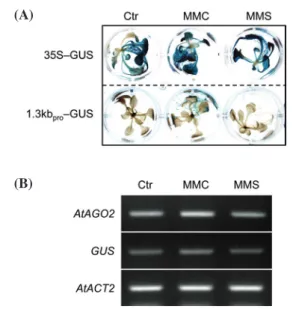
To examine whether the expression of AtAGO2 is in-duced by a different molecular event other than DNA dam-ages(e.g., DNA DSBs), we employed mitomycin C(MMC) and methyl methanesulfonate(MMS), both of which are associated with the inhibition of DNA replication(Menke et al. 2001; Chankova et al. 2007; Kozak et al. 2009). The transgenic Arabidopsis mutants expressing 1.3kbpro-GUS were challenged with 0.5mM mitomycin C or 5mM methyl methanesulfonate for 2h, and the staining of GUS protein were subsequently observed using the histochemical analy-sis. While positive control plants overexpressing GUS gene under the control of 35S promoter showed strong GUS ex-pression in control, MMC, or MMS treatments, no GUS staining was observed in the 1.3kbpro-GUS mutants in re-sponse to all the treatments(Fig. 3A). Notably, the MMC treatment elicited the expression of GUS, but the expression level was negligible. RT-PCR analyses confirmed that ec-topic GUS expression was not induced by MMC and MMS treatments, with the weak increase of endogenous AtAGO2 against MMC treatment(Fig. 3B).
DISCUSSION
We investigated the promoter of the AtAGO2 gene, whose expression is induced by γ-irradiation(Wei et al. 2012), to characterize its transcriptional regulation depending on the recovery days after the irradiation(RAI). We constructed the upstream sequence(1,313bp) of AtAGO2 from the 5′ end fused with GUS as a reporter gene(Fig. 1A). The GUS protein of the transgenic Arabidopsis plants(1.3kbpro-GUS) was strongly induced at 1 RAI, but decreased from 3 RAI, and no GUS staining was observed at 5 RAI(Fig. 1B). The transcript levels of endogenous AtAGO2 and ectopic GUS genes were immediately increased after γ-irradiation, how-ever, the transcript levels were decreased from 1 RAI(Fig. 1C). These results indicate that the recovery of DNA dam-ages derived from γ-irradiation was readily recovered after 1 RAI. The GUS staining at 1 RAI would reflect the time
for translation from induced GUS transcripts, and the stain-ing at 2 RAI could be explained with a half-life of GUS protein in living mesophyll cells of <50h(Jefferson et al.
1987).
We investigated the expression pattern of the AtAGO2 promoter in response to DSB-inducing genotoxic agents, bleomycin and zeocin(Fig. 2). Genotoxin treatments strongly induced GUS expression in the transgenic plants(1.3kbpro- GUS), and the effect was more significant in zeocin treat-ment compared with bleomycin treattreat-ment. The expression levels were decreased by the extension of the recovery days, indicating that a process of DNA damage repair system re-duced the expression of the AtAGO2.
We further investigated the ability of the AtAGO2 pro-moter to be activated by the treatments of other genotoxic agents, MMC and MMS, which make replication blocks and thus inhibit DNA replication. No GUS expression was observed with the treatment of mitomycin C and methyl methanesulfonate(Fig. 3). Together, these results suggest that DNA DSBs would be a major effector to elicit the AtAGO2 promoter activation, however, further
characteri-Fig. 3. Gene expression pattern of AtAGO2 promoter in response
to mitomycin C(MMC) and methyl methanesulfonate
(MMS). Two-week-old seedlings of the 1.3kbpro-GUS
overexpression mutant were incubated in a half-strength
MS liquid medium, supplemented with 1%(w/v) sucrose
containing 0.5mM MMC or 5mM MMS for 2h. Then the
seedlings were subsequently stained for the visualization of GUS expression, or transcript levels were examined. (A) Histochemical GUS staining, (B) Transcript levels of AtAGO2 and GUS. Ctr, no treatments; 35S-GUS, a positive control of GUS expression; AtACT2, an endogenous control gene.
(A)
zations of the promoter will be required using the reagents causing different types of DNA damages.
CONCLUSION
The present study shows that the expression of the AtAGO2 is significantly induced by γ-irradiation, bleomycin and zeocin, which elicit mainly DNA DSBs. These results are indirectly confirmed by determining the decrease of the AtAGO2 and GUS expression during the recovery days of DNA damages after the treatments of γ-rays and genotox-ins. However, the MMC and MMS treatments, which in-hibit DNA replication, have no effects on the activation of the AtAGO2 expression. Therefore, we conclude that DNA DSBs is one of main signals to induce the AtAGO2 expres-sion.
ACKNOWLEDGMENT
This work was supported by the Nuclear R & D Program of the Ministry of Science, ICT and Future Planning(MSIP), Republic of Korea.
REFERENCES
Bechtold N and Pelletier G(1998) In planta Agrobacterium- mediated transformation of adult Arabidopsis thaliana plants by vacuum infiltration. In: Martinez-Zapater JM, Salinas J(eds) Arabidopsis Protoc. Humana Press, Totowa, NJ, pp 259-266. doi:10.1385/0-89603-391-0:259.
Bohmert K, Camus I, Bellini C, Bouchez D, Caboche M and Benning C(1998) AGO1 defines a novel locus of
Arabi-dopsis controlling leaf development. EMBO J.
17(1):170-180.
Chankova SG, Dimova E, Dimitrova M and Bryant PE(2007) Induction of DNA double-strand breaks by zeocin in
Chla-mydomonas reinhardtii and the role of increased DNA
dou-ble-strand breaks rejoining in the formation of an adaptive response. Radiat. Environ. Biophys. 46(4):409-416. Garcia-Ruiz H, Carbonell A, Hoyer JS, Fahlgren N, Gilbert KB,
Takeda A, Giampetruzzi A, Garcia Ruiz MT, McGinn MG, Lowery N, Martinez Baladejo MT and Carrington JC(2015) Roles and programming of Arabidopsis ARGONAUTE proteins during Turnip mosaic virus infection. PLoS
patho-gens 11(3):e1004755.
Jefferson RA, Kavanagh TA and Bevan MW(1987) GUS sions: β-glucuronidase as a sensitive and versatile gene fu-sion marker in higher plants. EMBO J. 6(13):3901-3907. Karimi M, Inzé D and Depicker A(2002) GATEWAYTM vectors
for Agrobacterium-mediated plant transformation. Trends
Plant Sci. 7(5):193-195.
Kim JH, Cho EJ, Lee MH, Kim JE, Chung BY, Kim TH and Kim J-H(2010) Differential modulation of volatile constit-uents in Artemisia princeps and Artemisia argyi plants after gamma ray or electron beam irradiation. J. Radiat. Ind. 6(1): 17-21.
Kozak J, West CE, White C, da Costa-Nunes JA and Angelis KJ(2009) Rapid repair of DNA double strand breaks in
Arabidopsis thaliana is dependent on proteins involved in
chromosome structure maintenance. DNA Repair 8(3):413-419.
Mallory A and Vaucheret H(2010) Form, function, and regu-lation of ARGONAUTE proteins. Plant Cell 22(12):3879-3889.
Menke M, Chen IP, Angelis KJ and Schubert I(2001) DNA damage and repair in Arabidopsis thaliana as measured by the comet assay after treatment with different classes of genotoxins. Mutat. Res. 493(1-2):87-93.
Morel JB, Godon C, Mourrain P, Beclin C, Boutet S, Feuerbach F, Proux F and Vaucheret H(2002) Fertile hypomorphic
ARGONAUTE(ago1) mutants impaired in post-transcrip-tional gene silencing and virus resistance. Plant Cell 14(3): 629-639.
Parker JS(2010) How to slice: snapshots of Argonaute in action.
Silence 1(1):1-10.
Qu F, Ye X and Morris TJ(2008) Arabidopsis DRB4, AGO1, AGO7, and RDR6 participate in a DCL4-initiated antiviral RNA silencing pathway negatively regulated by DCL1.
Proc. Natl. Acad. Sci. U.S.A. 105(38):14732-14737.
Raja P, Jackel JN, Li S, Heard IM and Bisaro DM(2014)
Ara-bidopsis double-stranded RNA binding protein DRB3
par-ticipates in methylation-mediated defense against gemini-viruses. J. Virol. 88(5):2611-2622.
Song J and Bent AF(2014) Microbial pathogens trigger host DNA double-strand breaks whose abundance is reduced by plant defense responses. PLoS pathogens 10(4):e1004030. Vaucheret H(2008) Plant ARGONAUTES. Trends Plant Sci.
13(7):350-358.
Wei W, Ba Z, Gao M, Wu Y, Ma Y, Amiard S, White CI, Rend-tlew Danielsen JM, Yang Y-G and Qi Y(2012) A role for small RNAs in DNA double-strand break repair. Cell 149 (1):101-112.
Zhang X, Yuan Y-R, Pei Y, Lin S-S, Tuschl T, Patel DJ and Chua N-H(2006) Cucumber mosaic virus-encoded 2b
suppressor inhibits Arabidopsis Argonaute1 cleavage acti-vity to counter plant defense. Genes Dev. 20(23):3255- 3268.
Zhang X, Zhao H, Gao S, Wang W-C, Katiyar-Agarwal S, Huang H-D, Raikhel N and Jin H(2011) Arabidopsis Argo-naute 2 regulates innate immunity via miRNA393-mediated
silencing of a golgi-localized SNARE gene, MEMB12. Mol.
Cell 42(3):356-366.
Received: 15 October 2016 Revised: 21 November 2016 Revision accepted: 5 December 2016