Copyright © 2021 Techno-Press, Ltd.
http://www.techno-press.org/?journal=journal=anr&subpage=5 ISSN: 2287-237X (Print), 2287-2388 (Online) 1. Introduction
With the development of nanotechnology (Khodashenas 2015, Rezaee and Maleki 2015, Salimi et al. 2015, Kheradmandan and Barati 2017, Aydogdu et al. 2018), GSs play a very important role in actuators and sensors due to their very special properties. Graphene has become a unique material due to its extraordinary properties such as: thermal, optical conductivity and electrical, high density and excellent mechanical properties (Rezaei et al. 2020). Due to the fact that these materials can have ferromagnetic properties, the use of these plates in a wide range of applications of photonic, electronic and mechanical nanosensors as the most important nanoelectromechanical systems (NEMS), has been considered (Sia 2013, Cicek and Nadaroglu 2015, Ebrahimi et al. 2018, Mohammadian et al. 2019, Le 2020, Attar et al. 2021). One of the newly developed nanostructure is nano-plate, which has various applications in sensors (Tezerjani et al. 2017, Bendaho et al. 2019, Karami and Karami 2019) and actuators (Ponmozhi et al. 2012, Fakhrabadi et al. 2015, Lu et al. 2019). For example, self-powered mass sensor based on electro-magnetic nanoplate was investigated for identification of
Corresponding author, Ph.D., E-mail: [email protected],
Postal Code: 43131, Fax: +98 134 440 0486. aPh.D. Student, E-mail: [email protected] bPh.D., E-mail: [email protected] cPh.D., E-mail: [email protected]
small masses by Asadi et al. (2017). Umar et al. (2021) conducted the fabrication and characterization of CuO nanosheets based sensor device for ethanol gas sensing application. Chen et al. (2019) presented an electro-thermo-mechanical coupling system of micro/nano-scale bistable plates for piezoelectric energy-harvesting applications.
A review of the studies on vibrational behavior of ferromagnetic sheets shows that the major studies in this field are related to metric plates, and very limited studies have investigated the conductive nanosheets. Murmu and Pradhan (2009) applied the nonlocal elasticity theory to investigated the vibration behavior of GSs. Mohammadi et al. (2014) studied the free vibrations of graphene sheets under radial compressive load and temperature changes. In their study, graphene sheets were placed on the elastic substrate, and the nonlocal elasticity theory was used to model the problem. Kumar et al. (2013) investigated the thermal induced vibrations of a monolayer graphene sheet on a polymeric elastic substrate using nonlocal shell theory. The nonlinear vibrational behavior for a rectangular simply supported monolayer graphene sheet in thermal environment is proposed by Shen et al. (2010). Fazelzadeh et al. (2014) analyzed the thermomechanical vibrations of orthotropic nanosheets. Farajpour et al. (2011) studied the buckling of graphene nanosheets on Winkler-Pasternac elastic foundation using the nonlocal elasticity theory. Using the Levy solution model, Samaei et al. (2011) extracted the bending response of graphene monolayer sheets under temperature and external mechanical loads. Pradhan (2009) discussed the buckling behavior of rectangular monolayer GSs using the nonlocal elastic rectangular sheet model and the theory of high-order shear
Nonlinear vibration of nanosheets subjected to
electromagnetic fields and electrical current
Tayyeb Pourreza
1a, Ali Alijani
1,
Vahid A. Maleki
1,2band Admin Kazemi
1c1Department of Mechanical Engineering, Bandar Anzali Branch, Islamic Azad University, Bandar Anzali, Iran 2Department of Mechanical Engineering, University of Tabriz, Tabriz, Iran
(Received December 19, 2020, Revised January 26, 2021, Accepted January 28, 2021)
Abstract. Graphene Nanosheets play an important role in nanosensors due to their proper surface to volume ratio. Therefore, the main purpose of this paper is to consider the nonlinear vibration behavior of graphene nanosheets (GSs) under the influence of electromagnetic fields and electrical current create forces. Considering more realistic assumptions, new equations have been proposed to study the nonlinear vibration behavior of the GSs carrying electrical current and placed in magnetic field. For this purpose, considering the influences of the magnetic tractions created by electrical and eddy currents, new relationships for electromagnetic interaction forces with these nanosheets have been proposed. Nonlinear coupled equations are discretized by Galerkin method, and then solved via Runge–Kutta method. The effect of different parameters such as size effect, electrical current magnitude and magnetic field intensity on the vibration characteristics of GSs is investigated. The results show that the magnetic field increases the linear natural frequency, and decreases the nonlinear natural frequency of the GSs. Excessive increase of the magnetic field causes instability in the GSs.
deformation considering quantum effects. The nonlocal first-order shear deformation elasticity theory is used for buckling of a single-layered graphene sheet embedded in visco-Pasternak by Zenkour (2016). Bouadi et al. (2018) a nonlocal higher order shear deformation theory (HSDT) developed for buckling properties of single graphene sheet. Chandra et al. (2020) suggested a sandwich beam model to investigate the vibrations of bilayer GSs by considering the interlayer shear effect. Tao et al. (2020) based on the higher-order shear deformation theory investigated the nonlinear vibrations of functionally graded graphene platelets-reinforced composite in the thermal loads. Ansari and Ajori (2015) and Ansari et al. (2015, 2016) considered the effects of surface stress on post-buckling modeling, vibration behavior, and instability of a circular nanosheet. Using Kirchhoff’s thin sheet theory, Assadi (2013) analytically investigated the forced vibrations of a rectangular nanosheet by considering the surface effects. Shafiei et al. (2020) studied the small size effect on vibration response and mechanical buckling of single layered GSs based on two variable plate theory. Using the theory of nonlocal elasticity, Naderi et al. (2014) studied the vibration analysis and elastic stability of biaxially loaded GSs. Using the nonlocal elasticity theory, Barretta et al. (2019) considered the small size effect on stress distributions of homogeneous thin nanosheets. They derived the motion equations using classical sheet theory, assuming von Kármán’s nonlinear displacement-strain relations. Ghadiri et al. (2018) analytically studied the steady-state dynamics of a rectangular GSs resting on a viscoelastic substance under thermo-mechanical- magnetic forces via the Kirchhoff plate model and nonlocal Eringen’s theory. Ajri et al. (2018) analytically analyzed the non-stationary free vibration and nonlinear dynamic behavior of the viscoelastic nano-sheets. Singh and Azam (2020) investigated vibration behavior of a nanosheet using Eringen’s nonlocal plate theory. The governing equations of nanosheet have been derived using the principle of virtual work, and the solution is obtained using the Rayleigh–Ritz method and characteristic polynomials. A multiple-scale perturbation method is employed to analyze nonlinear free vibration of nanoplate incorporating surface effects by Allahyari et al. (2020). Ajri and Seyyed Fakhrabadi (2018) studied the nonlinear free vibration of viscoelastic nanoplates based on modified couple stress theory. In most conditions of severe environments, when the nanosheet deflection-to-thickness ratio is greater than 0.4, the nonlinearity is very important and should be given consideration. Therefore, the nonlinear free and forced vibration of nanosheet subjected to different loads has given rise to a number of studies (Shen and Huang 2007, Al-Furjan et al. 2021, Salmani et al. 2021).
Most existing studies in the literature examine the dynamic behavior of nanosheets under different types of forces by various numerical and analytical methods (Saremi et al. 2013, Vahidi Pashaki et al. 2018, Ghannadpour and Moradi 2019, Wong et al. 2019, Kachapi 2020, Mehrez et al. 2020). Many works presented in the literature include the vibration behavior of a nanosheets under electrical currents, as well as eddy currents generated by magnetic
field. Furthermore, the dynamic behavior of ferromagnetic GSs located under the magnetic fields, has not been studied. Accordingly, in the present study, considering the interaction between ferromagnetic material, magnetic field and magnetic traction generated by electric currents, a new magneto-electro-mechanical coupled equations are provided to study the flexural vibration of ferromagnetic GSs carrying electric current and located in magnetic field. For this purpose, the equations of motion are derived using von Kármán’s nonlinear displacement-strain relations. The solutions obtained by the Galerkin and Runge–Kutta method are presented herein. Using these equations, the nonlinear vibration response of GSs is studied.
2. Equations of motion
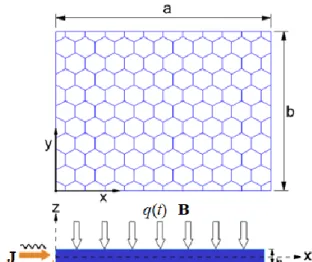
According to Fig. 1, a rectangular ferromagnetic GSs with length a, thickness h and width b is investigated to carry electrical current along the axial axis (x-axis). Amount of the vertical magnetic field and the external force are 𝐵0 and 𝑞(𝑡), respectively.
2.1 Equations of magnetic fields
Basic equations including Biot–Savart law, Ampere law and Cauchy’s relations are used for linear and angular momentum equilibrium equations to solve the dynamic problems of magnetoelastic systems (Trimarco and Maugin 2001, Chung 2007)
𝑡𝑖𝑗,𝑖𝐸 + 𝜌(𝑓𝑗− 𝑣̇𝑗) + 𝐹𝑗𝐸= 0, 𝑒𝑖𝑗𝑘𝑡𝑖𝑗𝐸 = 𝑐𝑘𝑒𝑚, 𝐵𝑖,𝑖= 0, 𝑒𝑖𝑗𝑘𝐻𝑗,𝑘= 0
(1)
where 𝑡𝑖𝑗𝐸, 𝐹𝑗𝐸, 𝑓𝑗, 𝑣𝑗 and 𝑐𝑘𝑒𝑚 are the elastomagnetic stress tensor, electromagnetic body force, the mechanical body force, velocity vector and electromagnetic momentum, respectively. 𝑒𝑖𝑗𝑘, 𝐵𝑖 and 𝐻𝑖 are the permutation tensor, indicate density of magnetic flux and intensity of the magnetic field, respectively. In the present study, 𝐵𝑖= 𝜇0(𝐻𝑖+ 𝑀𝑖) , in which 𝜇0= 4𝜋 × 10−7 𝑁𝐴2 and 𝑀𝑖 are vacuum permeability between the two materials and the magnetization vector, respectively.
Maxwell equations are used to calculate the electromagnetic stresses and the electromagnetic force inside the sheet. According to Maxwell's classical relations (Arani et al. 2013) [−𝑀𝑖𝐵𝑗+ 𝑡𝑖𝑗𝐸]𝑛𝑗= 0, 𝛻 ⋅ 𝑩 = 0 𝛻 × 𝑯 = 𝑱𝑓, 𝒏 × [𝑯] = 0, 𝑴 = 𝜒𝑚𝑯, 𝑯 = 1 𝜇0 𝑩 (2)
in which 𝑡𝑖𝑗𝐸,𝒏 , 𝑱𝑓,𝑯 , 𝑴 and 𝜒𝑚 are elastomagnetic stress tensor, unit vector normal to the surface, current density, magnetic field distribution vector, magnetization constant and susceptibility of the ferromagnetic medium (𝜒𝑚(= 102− 105) >> 1 for linear soft ferromagnetic materials), respectively (Maugin 2013).
Assuming the material to be conductive, polarization for the sheet is zero, and on the other hand, assuming that there
Fig. 1 Ferromagnetic GSs subjected to the magnetic field and electrical current
is no point charge in the problem, the macroscopic electromagnetic body force, 𝑭𝐸𝑀, created by the electrical current passing through the GSs subjected to the magnetic field is achieved as
𝑭𝐸𝑀= 𝛻𝑩 ⋅ 𝑴 + 𝑱 × 𝑩 (3)
Since in this study the electromagnetic momentum is not a function of time, the relationship among momentum, electromagnetic stress components and force is given by
𝑭𝐸𝑀= 𝛻 ⋅ 𝒕𝐸𝑀 (4)
Considering the Maxwell and electromagnetic stress tensor as 𝑡𝑖𝑗𝑀𝑎𝑥𝑤𝑒𝑙𝑙and 𝑡𝑖𝑗𝐸𝑀, the electromagnetic stress tensor is achieved as 𝑡𝑖𝑗𝐸= 𝑡𝑖𝑗𝐸𝑀− 𝑡𝑖𝑗𝑀𝑎𝑥𝑤𝑒𝑙𝑙 (5) where 𝑡𝑖𝑗𝐸𝑀= 𝑃𝑖𝐸𝑗− 𝐵𝑖𝑀𝑗+ 𝜀0𝐸𝑖𝐸𝑗+ 1 𝜇0 𝐵𝑖𝐵𝑗 −1 2(𝜀0𝐸 2+ 1 𝜇0𝐵𝑘𝐵𝑘− 2𝑀𝑘𝐵𝑘) 𝛿𝑖𝑗 (6) 𝑡𝑖𝑗𝑀𝑎𝑥𝑤𝑒𝑙𝑙 = 𝜀0𝐸𝑖𝐸𝑗+ 1 𝜇0 𝐵𝑖𝐵𝑗 −1 2(𝜀0𝐸 2+ 1 𝜇0 𝐵2− 2𝑀 𝑘𝐵𝑘) 𝛿𝑖𝑗 (7)
where 𝜀0 is the vacuum permittivity.
In the ferromagnetic materials, the electricity current generally can be generated by the magnetic field. In these materials, the amount of the magnetic field due to the uniform electrical current applied in the direction of the x-axis in the rectangular plane can be obtained as
𝑩𝐽= { 𝜇0𝐽0 ℎ 2𝒋 −𝜇0𝐽0 ℎ 2𝒋 0 −𝜇0𝐽0𝑧𝒋 𝑧 > −ℎ 2 𝑧 <ℎ 2 𝑧 = 0 −ℎ 2< 𝑧 < ℎ 2 (8)
Therefore, the total magnetic field intensity vector inside the GSs, which is equal to the summation of the magnetic intensity applied to the GSs, 𝐵0= 𝐵0𝑘̂, and the magnetic intensity generated in the GSs due to the electric current, 𝐵𝐽, is obtained as follows
𝑩 = 𝑩0+ 𝑩𝐽= −(𝜇0𝐽0𝑧)𝒋 + 𝐵0𝒌, − ℎ 2< 𝑧 <
ℎ 2 (9) Using Eqs. (3) and (9) the resultant magnetization vector is obtained as 𝑴 = 𝜒𝑚𝑯 = 𝜒𝑚 𝜇 𝑩 = 𝜒𝑚 𝜇 [−𝜇0𝐽0𝑧𝒋 + 𝐵0𝒌] (10) Considering the quasi static state for the problem under study, because the wavelength of electromagnetic waves is much longer than mechanical waves, it is 𝜎𝑤̇ × 𝐵 = 0 and as a result, the electrical current density is obtained as
𝑱 = 𝛻 × 𝑴 + 𝝈(𝒘̇ × 𝑩 + 𝑬) = 𝐽0( 1+2𝜒𝑚
1+𝜒𝑚) 𝒊 (11) in which 𝝈 is the electrical conductivity tensor, 𝑬 is the electric field intensity vector, and since there is no single charge, its value is zero.
2.2 Electromagnetic force and torque
Supposing that the GSs is fully conductive, the magnetic forces acting on the sheet can be obtained by substituting Eqs. (9) and (11) in Eq. (3), and then integrating along the sheet. Therefore, the components of the electromagnetic force acting on the plate due to the property of magnetization and passage of the current through the magnetic field is written as
𝑭𝐸𝑀= −𝐵0𝐽0ℎ 1+2𝜒𝑚
1+𝜒𝑚 𝒋 (12)
Since the magnetic traction vector at the bottom and the top of the GSs generates magnetic coupling, Eq. (13) is used to compute the magnetic torques
𝑡𝑖= 𝑡𝑖𝑗𝐸𝑀𝑛𝑗= [ 𝑡𝑥𝑥𝐸𝑀 𝑡𝑥𝑦𝐸𝑀 𝑡𝑥𝑧𝐸𝑀 𝑡𝑦𝑥𝐸𝑀 𝑡𝑦𝑦𝐸𝑀 𝑡𝑦𝑧𝐸𝑀 𝑡𝑧𝑥𝐸𝑀 𝑡𝑧𝑦𝐸𝑀 𝑡𝑧𝑧𝐸𝑀 ] [ 𝑛𝑥 𝑛𝑦 𝑛𝑧 ] = [ 𝑡𝑥 𝑡𝑦 𝑡𝑧 ] (13)
in which 𝑛𝑗 is the normal vector to the GSs, which is obtained as 𝒏 = − (𝜕𝑤 𝜕𝑥) 𝒊 − ( 𝜕𝑤 𝜕𝑦) 𝒋 + (1 − 1 2[( 𝜕𝑤 𝜕𝑥) 2 + (𝜕𝑤 𝜕𝑦) 2 ]) 𝒌 (14)
The electromagnetic traction forces at the bottom and top of the GSs causes the magnetic couplings. By calculating the tractions generated at top and bottom of the GSs by Eq. (13), the magnetic couplings created on the ferromagnetic GSs can be calculated as
𝐶𝑥=𝑡𝑜𝑝𝑡𝑦 ℎ 2+ 𝑡 𝑏𝑜𝑡𝑡𝑜𝑚 𝑦 ℎ 2, 𝐶𝑦= 𝑡 𝑡𝑜𝑝 𝑥 ℎ 2+ 𝑡 𝑏𝑜𝑡𝑡𝑜𝑚 𝑥 ℎ 2 (15)
2.3 Theory of nonlocal elasticity
point is a function of the strain field, and the relationship between strain and stress is written as
𝑡𝑖𝑗(𝑥) = ∭ 𝛼(|𝑥′− 𝑥|, 𝜏) 𝐶𝑖𝑗𝑘𝑙𝜀𝑖𝑗(𝑥′)𝑑𝑣(𝑥′) (16) where 𝑡𝑖𝑗, 𝜀𝑖𝑗, 𝐶𝑖𝑗𝑘𝑙, |𝑥′− 𝑥| are the nonlocal stress tensor, the strain tensor, and the fourth-order elasticity tensor, the Euclidean form of distance, respectively. 𝛼 is the nonlocal kernel function, which function as the internal characteristic size. According to Eringen’s nonlocal elasticity theory
(1 − 𝜇𝛻2)𝑡
𝑖𝑗 = 𝐶𝑖𝑗𝑘𝑙𝜀𝑖𝑗 (17)
where 𝜇 = (𝜎0𝑙𝑖)2 and 𝛻2 are the nonlocal parameter and the Laplacein operator. Using Eq. (17), the structural relationships are expressed as
(1 − 𝜇𝛻2) { 𝑡𝑥 𝑡𝑦 𝑡𝑥𝑦 } = [ 𝐸 1−𝜈2 𝜈𝐸 1−𝜈2 0 𝜈𝐸 1−𝜈2 𝐸 1−𝜈2 0 0 0 𝐺 ] { 𝜀𝑥 𝜀𝑦 𝛾𝑥𝑦 } (18)
where 𝐺, 𝐸 and 𝜈 are the shear modulus, Young modulus and Poisson ratio, respectively.
2.4 Equations of motion
In order to derive the equations governing the flexural vibrations, the classical plate theory and the von-Kármán nonlinear theory are used. Accordingly, plate displacement fields are given in terms of mid-plane deformations as
𝑢1(𝑥, 𝑦, 𝑧, 𝑡) = 𝑢(𝑥, 𝑦, 𝑡) − 𝑧 𝜕𝑤(𝑥, 𝑦, 𝑡) 𝜕𝑥 , 𝑢2(𝑥, 𝑦, 𝑧, 𝑡) = 𝑣(𝑥, 𝑦, 𝑡) − 𝑧 𝜕𝑤(𝑥, 𝑦, 𝑡) 𝜕𝑦 , 𝑤(𝑥, 𝑦, 𝑧, 𝑡) = 𝑤(𝑥, 𝑦, 𝑡) (19)
where, considering the coordinate system in the mid-plane of the GSs, u, v and w are the displacements components of the GSs center plane in the direction of the axes 𝑥, 𝑦 and 𝑧 , respectively. Therefore, the displacement-strain relationships are as
𝜀
𝑥= 𝑒
𝑥− 𝑧𝜒
𝑥(20)
𝜀
𝑦= 𝑒𝑦− 𝑧𝜒𝑦 (21)𝜀
𝑥𝑦= 𝑒𝑥𝑦− 𝑧𝜒𝑥𝑦 (22) where 𝑒𝑥 = 𝜕𝑢 𝜕𝑥+ 1 2( 𝜕𝑤 𝜕𝑥) 2 , 𝑒𝑦= 𝜕𝑣 𝜕𝑦+ 1 2( 𝜕𝑤 𝜕𝑦) 2 ,𝑒
𝑥𝑦=
1 2(
𝜕𝑢 𝜕𝑦+
𝜕𝑢 𝜕𝑥+
𝜕𝑤 𝜕𝑥 𝜕𝑤 𝜕𝑦)
(23) 𝜒𝑥= 𝜕2𝑤 𝜕𝑥2, 𝜒𝑦= 𝜕2𝑤 𝜕𝑦2, 𝜒𝑥𝑦= 𝜕2𝑤 𝜕𝑥𝜕𝑦 (24)Furthermore, the stress tensor is obtained as
𝑡𝑖𝑗 = 𝑡𝑖𝑗𝑀+ 𝑡𝑖𝑗𝐸 (25) where 𝑡𝑖𝑗𝐸 and 𝑡𝑖𝑗𝑀 are the electromagnetic stress tensor and mechanical stress tensor, respectively. By assuming the studied sheet to be isotropic and elastic (Maugin 2013)
𝑡𝑖𝑗𝑀= 𝐶𝑘𝑙𝑖𝑗𝜀𝑘𝑙𝑀= 𝜆𝜀𝑘𝑘𝑀𝛿𝑖𝑗+ 2𝐺𝜀𝑖𝑗𝑀 (26)
where 𝐺 = 𝐸
2(1+𝜈) and 𝜆 = 𝐸𝜈
(1−2𝜈)(1+𝜈) are the Lamé constants. By using the electromagnetic and mechanical stress from Eq. (5), the total stress tensor is expressed as
𝑡𝑖𝑗= 𝐶𝑘𝑙𝑖𝑗(𝜀𝑘𝑙𝑀+ 𝜀𝑘𝑙𝐸) − 𝐵𝑖𝑀𝑗 (27) where 𝜀𝑖𝑗𝑀 and 𝜀𝑖𝑗𝐸 are mechanical and electromagnetic strain tensors, respectively. Electromagnetic strains are small compared to elastic strains and can be neglected, therefore 𝜀𝑖𝑗 = 𝜀𝑘𝑙𝑀= 1+𝜈 𝐸 𝑡𝑖𝑗 𝑀−𝜈 𝐸𝑡𝑘𝑘 𝑀𝛿 𝑖𝑗 (28) Considering an element of the ferromagnetic sheet, the resultant shear forces and bending moments can be obtained as follows (𝑁𝑥𝑥, 𝑁𝑦𝑦, 𝑁𝑥𝑦) = ∫ (𝑡𝑥𝑥, 𝑡𝑦𝑦, 𝑡𝑥𝑦)𝑑𝑧, ℎ 2 −2ℎ (29) (𝑀𝑥𝑥, 𝑀𝑦𝑦, 𝑀𝑥𝑦) = ∫ (𝑡𝑥𝑥, 𝑡𝑦𝑦, 𝑡𝑥𝑦)𝑧𝑑𝑧, ℎ 2 −2ℎ (30)
Considering the small size effect and the theory of nonlocal elasticity (1 − 𝜇𝛻2) { 𝑁𝑥𝑥 𝑁𝑦𝑦 𝑁𝑥𝑦 } = 𝐾 [ 1 𝜈 0 𝜈 1 0 0 0 1 − 𝜈 ] { 𝜕𝑢 𝜕𝑥+ 1 2( 𝜕𝑤 𝜕𝑥) 2 𝜕𝑣 𝜕𝑦+ 1 2( 𝜕𝑤 𝜕𝑦) 2 1 2( 𝜕𝑢 𝜕𝑦+ 𝜕𝑣 𝜕𝑥+ 𝜕𝑤 𝜕𝑥 𝜕𝑤 𝜕𝑦)} (31) (1 − 𝜇𝛻2) { 𝑀𝑥𝑥 𝑀𝑦𝑦 𝑀𝑥𝑦 } = −𝐷 [ 1 𝜈 0 𝜈 1 0 0 0 1 − 𝜈 ] { 𝜕2𝑤 𝜕𝑥2 𝜕2𝑤 𝜕𝑦2 𝜕2𝑤 𝜕𝑥𝜕𝑦} (32) where 𝐾 = 𝐸ℎ (1−𝜈2) and 𝐷 = 𝐸ℎ3 [12(1−𝜈2)].
Using the Hamilton’s principle, the equations of motion can be expressed as 𝜕𝑁𝑥𝑥 𝜕𝑥 + 𝜕𝑁𝑦𝑥 𝜕𝑦 + 𝑡𝑥 𝐸𝑀= 𝑚 0 𝜕2𝑢 𝜕𝑡2 (33) 𝜕𝑁𝑥𝑦 𝜕𝑥 + 𝜕𝑁𝑦𝑦 𝜕𝑦 + (𝐹𝑦 𝐸𝑀+ 𝑡 𝑦𝐸𝑀) = 𝑚0 𝜕2𝑣 𝜕𝑡2 (34)
𝜕2𝑀 𝑥𝑥 𝜕𝑥2 + 2 𝜕2𝑀 𝑥𝑦 𝜕𝑥𝜕𝑦 + 𝜕2𝑀 𝑦𝑦 𝜕𝑦2 + 𝜕 𝜕𝑥(𝑁𝑥𝑥 𝜕𝑤 𝜕𝑥 + 𝑁𝑥𝑦 𝜕𝑤 𝜕𝑦) + 𝜕 𝜕𝑦(𝑁𝑦 𝜕𝑤 𝜕𝑦+ 𝑁𝑥𝑦 𝜕𝑤 𝜕𝑥) +𝑡𝑧𝐸𝑀+ 𝜕𝐶𝑦 𝜕𝑥 + 𝜕𝐶𝑥 𝜕𝑦 + 𝑞(𝑡) = 𝑚0 𝜕2𝑤 𝜕𝑡2 − 𝑚2( 𝜕4𝑤 𝜕𝑥2𝜕𝑡2+ 𝜕4𝑤 𝜕𝑦2𝜕𝑡2) (35) where 𝑚0= ∫ 𝜌𝑑𝑧 ℎ 2 −ℎ 2 and 𝑚2= ∫ 𝜌𝑧2𝑑𝑧 ℎ 2 −ℎ 2 . 𝜕𝐶𝑦 𝜕𝑥 and 𝜕𝐶𝑥 𝜕𝑦 are the magnetic coupling forces created by magnetic tractions, respectively, and 𝑡𝑧𝐸𝑀 is the forces created by the magnetic tractions. It should be noted that this force component is created due to the presence of magnetic field and electrical current in the GSs, and this term has been not presented in the models reported in previous studies in this field. Using Eqs. (13), (15) and (27), the electromagnetic bending torque and the tractions resultant vector in Eqs. (33)-(35) is obtained as follows 𝜕𝐶𝑦 𝜕𝑥 = − ℎ 8𝜇0(𝜒𝑚+ 1) {4𝐵02(2𝜒𝑚2 − 1) +ℎ2𝐽02𝜇02(𝜒𝑚+ 1)2(2𝜒𝑚− 1)} ( 𝜕2𝑤 𝜕𝑥2) (36) 𝑡𝑧= 𝑡𝑧 top + 𝑡𝑧bottom = 1 8𝜇0(1 + 𝜒𝑚) {4𝐵02[(10𝜒𝑚2 − 2𝜒𝑚− 1) ( 𝜕𝑤 𝜕𝑥) 2 ] +4𝐵02(4𝜒𝑚+ 2) 𝜕𝑤 𝜕𝑥 − ℎ2𝐽2𝜇 02(𝜒𝑚+ 1)2(2𝜒𝑚− 1) (( 𝜕𝑤 𝜕𝑦) 2 − 2𝜕𝑤 𝜕𝑥)} (37) 𝑡𝑥= 𝑡𝑥 top + 𝑡𝑥bottom = − 1 4𝜇0(1 + 𝜒𝑚) (ℎ2𝐽2𝜇 0 2(1 + 𝜒 𝑚)2(−1 + 2𝜒𝑚) +𝐵02(−4 + 8𝜒𝑚2)) ( 𝜕𝑤 𝜕𝑥) (38) 𝑡𝑦= 𝑡𝑦 top + 𝑡𝑦bottom = −1 4𝜇0(1 + 𝜒𝑚) (ℎ2𝐽2𝜇 0 2(1 + 𝜒 𝑚)2(−1 + 2𝜒𝑚) +𝐵02(−4 + 8𝜒𝑚2)) ( 𝜕𝑤 𝜕𝑦) (39)
Assuming that the motion along the z-axis is dominant, with acceptable accuracy, it can be assumed that 𝜕2𝑢
𝜕𝑡2= 𝜕2𝑣
𝜕𝑡2= 0. Accordingly, substituting Eqs. (31) and (32) in Eqs. (33)-(35), the nonlinear differential equations governing the vibrations of ferromagnetic GSs under the influence of magnetic forces in terms of the displacement fields are obtained as
𝐾 (𝜕 2𝑢 𝜕𝑥2+ 𝜕𝑤 𝜕𝑥 𝜕2𝑤 𝜕𝑥2 + 𝜈 ( 𝜕2𝑣 𝜕𝑥𝜕𝑦+ 𝜕𝑤 𝜕𝑦 𝜕2𝑤 𝜕𝑥𝜕𝑦)) (40) +𝐾(1 − 𝜈) 2 ( 𝜕2𝑢 𝜕𝑦2+ 𝜕2𝑣 𝜕𝑥𝜕𝑦+ 𝜕𝑤 𝜕𝑥 𝜕2𝑤 𝜕𝑦2+ 𝜕𝑤 𝜕𝑦 𝜕2𝑤 𝜕𝑥𝜕𝑦) +(1 − 𝜇𝛻2)𝑡 𝑥𝐸𝑀= 0 𝐾 (𝜕 2𝑣 𝜕𝑦2+ 𝜕𝑤 𝜕𝑦 𝜕2𝑤 𝜕𝑦2+ 𝜈 ( 𝜕2𝑢 𝜕𝑥𝜕𝑦+ 𝜕𝑤 𝜕𝑥 𝜕2𝑤 𝜕𝑥𝜕𝑦)) +𝐾(1 − 𝜈) 2 ( 𝜕2𝑣 𝜕𝑥2+ 𝜕2𝑢 𝜕𝑥𝜕𝑦+ 𝜕𝑤 𝜕𝑦 𝜕2𝑤 𝜕𝑥2+ 𝜕𝑤 𝜕𝑥 𝜕2𝑤 𝜕𝑥𝜕𝑦) +(1 − 𝜇𝛻2)(𝐹 𝑦𝐸𝑀+ 𝑡𝑦𝐸𝑀) = 0 (41) 𝐷 (𝜕 4𝑤 𝜕𝑥4 + 2 𝜕2𝑤 𝜕𝑥2𝜕𝑦2+ 𝜕4𝑤 𝜕𝑦4) = (1 − 𝜇𝛻2) (𝑡 𝑧𝐸𝑀+ 𝜕𝐶𝑦 𝜕𝑥 + 𝜕𝐶𝑥 𝜕𝑦 + 𝑞(𝑡)) + 𝑁𝑥 𝜕2𝑤 𝜕𝑥2 +2𝑁𝑥𝑦 𝜕2𝑤 𝜕𝑥𝜕𝑦+ 𝑁𝑦 𝜕2𝑤 𝜕𝑦2 − (1 − 𝜇𝛻 2)𝑡 𝑥𝐸𝑀 𝜕𝑤 𝜕𝑥 −(1 − 𝜇𝛻2)(𝐹 𝑦𝐸𝑀+ 𝑡𝑦𝐸𝑀) 𝜕𝑤 𝜕𝑦− (1 − 𝜇𝛻 2)𝑚 0 𝜕2𝑤 𝜕𝑡2 +(1 − 𝜇𝛻2)𝑚 2( 𝜕4𝑤 𝜕𝑥2𝜕𝑡2+ 𝜕4𝑤 𝜕𝑦2𝜕𝑡2) (42)
3. Solving the governing equations
In order to solve the differential governing equations which are nonlinear coupled equations, the Galerkin decomposition technique is established. Considering the simply supported boundary conditions, the displacement fields are expressed as (Amabili 2006)
𝑢(𝑥, 𝑦, 𝑡) = 𝑈(𝑡) 𝑐𝑜𝑠( 𝛼𝑥) 𝑠𝑖𝑛( 𝛽𝑦) 𝑣(𝑥, 𝑦, 𝑡) = 𝑉(𝑡) 𝑠𝑖𝑛( 𝛼𝑥) 𝑐𝑜𝑠( 𝛽𝑦) 𝑤(𝑥, 𝑦, 𝑡) = 𝑊(𝑡) 𝑠𝑖𝑛( 𝛼𝑥) 𝑠𝑖𝑛( 𝛽𝑦)
(43)
where the functions 𝑈(𝑡) , 𝑉(𝑡) and 𝑊(𝑡) are generalized coordinates. By applying the Galerkin method, 𝑈(𝑡) and 𝑉(𝑡) are obtained from Eqs. (40) and (41) in terms of 𝑊(𝑡). By substituting this function in Eq. (42), the nonlinear differential equation governing the time part of the deflection for the ferromagnetic nanosheet, which is a second-order differential equation, is obtained as follows
𝑑2𝑊
𝜕𝑡2 + 𝑎1𝑊(𝑡) + 𝑎2𝑊(𝑡)2+ 𝑎3𝑊(𝑡)3= 𝜆 𝑠𝑖𝑛( 𝜔𝑡) (44) where the coefficients 𝛼𝑖 are the constants from the stiffness matrices components and the sheet geometric derivatives. The spectrum analysis is conducted by short-time Fourier transform (STFT). The short-short-time Fourier transform allows to perform time-frequency analysis and obtaining the frequencies of nonlinear systems. Despite the FFT method, STFT method breaks up the signal in time domain to a number of signals of shorter duration, then transforms each signal to frequency domain (Allen and Rabiner 1977). For this purpose, after obtaining the numerical solution of Eq. (44) by Runge–Kutta methods, the time response of the system is extracted, and by applying the STFT, the spectrum response of the system is obtained in the frequency domain. Since, the frequency
curve peaks represent the frequencies in the time response, it can be used to extract the nonlinear frequency values of the system for various parameters. Then, by using the numerical solution of Eq. (44), the effect of various parameters on the dynamic response and vibration characteristics of electrically conductive sheets exposed to magnetic field are studied.
4. Numerical results
In this section, the vibrational behavior of GSs carrying electric current and located in magnetic field is investigated. First, the results are validated, and then the effect of different parameters on linear and nonlinear natural frequencies is studied. Considering linear terms and eliminating nonlinear terms from the GSs equations of motion, the linear natural frequencies of the system can be obtained. In Table 1, the obtained natural frequencies of local and nonlocal models for square GSs are compared with the reference results (Wang et al. 2015). According to this table, it can be seen that the results obtained from this study are completely consistent with the reference results (Wang et al. 2015), and this shows the high accuracy of the current method. Also, in Table 2, the natural frequency of a simply supported monolayer GSs (E = 1.02TPa, h = 0.33 nm, ρ = 2300 kg / m3, a = b = 10 nm) have been compared with the exact solution presented in Refs. (Pradhan and Phadikar 2009, Kitipornchai et al. 2005). As it can be seen, the numerical results obtained from this study have acceptable consistency with the solutions obtained from the exact solution.
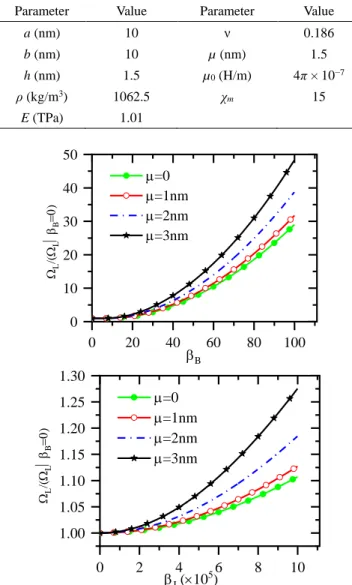
In the next, effect of various parameters on the linear and nonlinear natural frequencies of the system is investigated. The numerical values used to extract the results are given in Table 3. Also, dimensionless parameters, including dimensionless linear natural frequency 𝛺𝐿, dimensionless nonlinear natural frequency 𝛺𝑁 , dimensionless magnetic field intensity 𝛽𝐵 , and dimensionless electric current 𝛽𝐽 are defined as follows
𝛺𝐿= 𝜔 𝑏2 𝜋2√ 𝑚0 𝐷 , 𝛽𝐵=√ 𝐵 (ℎ3 𝜇0𝐷) 2, 𝛽𝐽= √ 𝜇0ℎ5 𝐷 𝐽 (45)
Fig. 2 depicts the effect of the electrical current and magnetic field intensity on dimensionless linear natural frequency of the GSs for different values of µ. Based on the results, it is observed that the magnetic field increases the linear natural frequency of the GSs, and the amount of this increase intensifies with increasing the magnetic field. As can be seen, for values of βB less than 18, the magnetic fields have little effect on increasing the natural frequency, and in these areas the effect of the magnetic field can be ignored. In contrast, as βB increases, the natural frequency of the system increases sharply. As an instance, for βB = 40 natural frequency increases by about 5 times the GSs frequency in the absence of magnetic field. In the case of electric current, the same behavior is observed, with the difference that the effect of electric current on the increase of natural frequency is relatively less than the effect of
Table 1 Comparison of frequency ratios for square nanosheets
µ
𝜔1𝑛𝑜𝑛 𝜔1𝑙𝑜𝑐
Ref. (Wang et al. 2015) Present results
0 1.0000 0.9999
0.5 0.9762 0.9762
1.0 0.9139 0.9139
1.5 0.8321 0.8321
Table 2 Comparison of the natural frequencies of the simply supported GSs with exact solution
µ = 1 µ = 0 Exactb Present result Exactb Exacta Present result 9.67400 9.67153 10.5586 10.5586 10.5546 ω1 (THz) 21.6246 21.6223 26.4753 26.4753 26.4761 ω2 (THz) 37.4075 37.4056 52.7295 52.7295 52.7283 ω3 (THz)
Table 3 Numerical values used in this study
Parameter Value Parameter Value
a (nm) 10 ν 0.186 b (nm) 10 µ (nm) 1.5 h (nm) 1.5 µ0 (H/m) 4π × 10−7 ρ (kg/m3) 1062.5 χ m 15 E (TPa) 1.01
Fig. 2 Influence of electrical current and magnetic field intensity on dimensionless linear natural frequency of the GSs for different values of µ
0 20 40 60 80 100 0 10 20 30 40 50 WL /( WL ½bB =0 ) bB m=0 m=1nm m=2nm m=3nm 0 2 4 6 8 10 1.00 1.05 1.10 1.15 1.20 1.25 1.30 WL /( WL ½bB =0 ) bJ (´105) m=0 m=1nm m=2nm m=3nm
Fig. 3 Effect of aspect ratio on natural frequency of the simply supported GSs
magnetic field. Fig. 3 shows the frequency ratio changes in terms of βB for different aspect ratio values. As can be seen, the frequency ratio increases with increase in aspect ratio, and converges to a certain value. Based on these results, it is observed that values of aspect ratio greater than 3 have no effect on frequency increase.
In the following, the behavior of nonlinear vibrations of the simply supported GSs is investigated. The dynamic
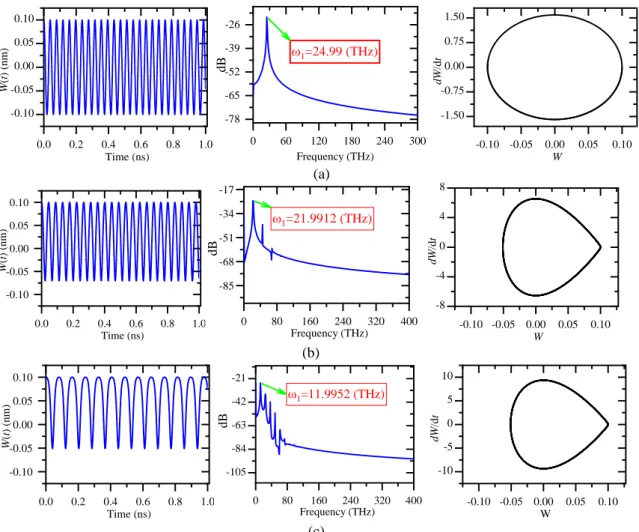
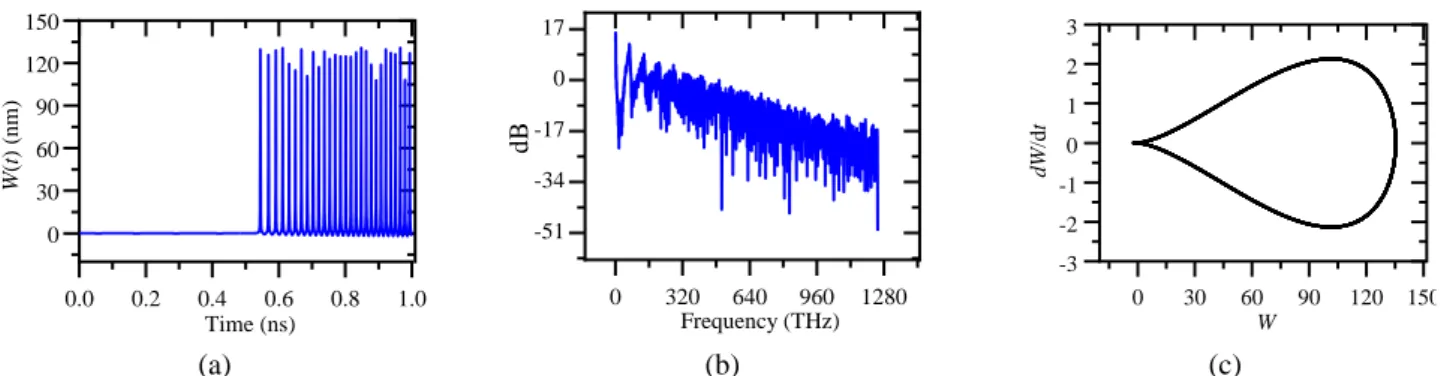
response along with the frequency response curves and the phase curve of the GSs for different values of βB (i.e., 0.01, 0.02 and 0.023) are shown in Fig. 4. As shown, for very small values of βB, the behavior of the system is linear, and the oscillations frequency is approximately equal to the normal frequency of the linear system. In contrast, with increasing βB, the coefficient of nonlinear terms becomes larger, and the nonlinear behavior of the system is amplified, which is clearly visible due to the creation of second- and third-order super-harmonics in the frequency function of Fig. 4(b). Fig. 4(b) shows that for βB = 0.02 and βB = 0.023, the resonance frequency of the system decreases by about 12% and 52%, respectively, compared to the normal frequency of the GSs in the absence of magnetic field. Considering that the magnetic field reduces the natural frequency, it can be said that the magnetic field causes the softening behavior, and as a result, excessive increase of the magnetic field can cause instability in the system. This can be seen in Fig. 5, where the dynamic response of the system for βB = 0.025 is demonstrated. As shown, for the critical βB = 0.025, the amplitude of the system vibrations increases over time, and tends towards very large values. Due to the fact that in such conditions, the motion of the system is oscillating, the intensity of the critical magnetic field will cause dynamic instability.
0 20 40 60 80 100 0 10 20 30 40 WL /( WL ½b B =0 ) bB b/a=1 b/a=2 b/a=3 b/a=4 (a) (b) (c)
Fig. 4 Dynamic response, frequency response curve and phase curve of monolayer GSs for different values of βB (a) = 0.01; (b) 0.02; and (c) 0.023 0.0 0.2 0.4 0.6 0.8 1.0 -0.10 -0.05 0.00 0.05 0.10 W (t ) ( nm) Time (ns) B 0 60 120 180 240 300 -78 -65 -52 -39 -26 Frequency (THz) dB w1=24.99 (THz) -0.10 -0.05 0.00 0.05 0.10 -1.50 -0.75 0.00 0.75 1.50 dW /d t W 0.0 0.2 0.4 0.6 0.8 1.0 -0.10 -0.05 0.00 0.05 0.10 W (t ) ( nm) Time (ns) 0 80 160 240 320 400 -85 -68 -51 -34 -17 Frequency (THz) dB w1=21.9912 (THz) -0.10 -0.05 0.00 0.05 0.10 -8 -4 0 4 8 dW /d t W 0.0 0.2 0.4 0.6 0.8 1.0 -0.10 -0.05 0.00 0.05 0.10 W (t ) ( nm) Time (ns) 0 80 160 240 320 400 -105 -84 -63 -42 -21 Frequency (THz) dB w1=11.9952 (THz) -0.10 -0.05 0.00 0.05 0.10 -10 -5 0 5 10 dW /d t W
Table 4 Influence of magnetic field intensity on nonlinear resonance frequency (THz) of simply supported GSs for b = 10 nm 𝛽𝐵 µ = 0 µ = 1 nm 𝛺𝐿 𝛺𝑁 𝛺𝑁 𝛺𝐿 𝛺𝐿 𝛺𝑁 𝛺𝑁 𝛺𝐿 0 27.71 27.45 0.99 25.32 25.42 1.00 5 27.77 8.34 0.30 25.41 9.21 0.36 10 28.86 5.28 0.18 26.57 6.04 0.23 15 33.10 3.72 0.11 31.13 4.26 0.14 20 42.48 1.09 0.03 40.96 1.83 0.04
Fig. 6 Effect of the nonlocal parameter on critical value of the applied magnetic field intensity
Fig. 7 Frequency-response curve of GSs oscillations in terms of external harmonic force frequency for different values of βB
Table 4 shows the influence of the magnetic field intensity on nonlinear resonance frequency of monolayer simply supported GSs. An interesting result that can be seen according to the results of this table is that linear frequencies increases with increase in magnetic field intensity, while the nonlinear frequency decreases significantly. The reason for this behavior is that with increasing the magnetic field intensity, the effect of geometrical nonlinearity becomes more severe, and the ratio of nonlinear frequency to linear frequency decreases sharply. Based on these results, it can be concluded that with increasing the magnetic field intensity, the coefficient of nonlinear terms increases, and as a result, in larger amounts of magnetic field intensity, geometric nonlinear effects should be considered to achieve accurate and realistic results. Since, the use of linear theory does not predict the instability behavior of these systems, using this theory to predict the dynamic behavior of GSs located in a magnetic field will lead to erroneous results. Another interesting result that can be seen from Table 4 is that the effect of nonlocal parameter on natural frequency is quite different in both linear and nonlinear theories. Increasing the nonlocal parameter increases the linear natural frequency, while decreasing the nonlinear natural frequency. It can be stated that in general, the equivalent stiffness of the structure can be simulated using a linear spring and a nonlinear spring. According to the effect of magnetic field and nonlocal parameter, it can be stated that the magnetic field causes softening behavior, while nonlocal parameter causes hardening behavior in nonlinear model.
Fig. 6 shows effect of the nonlocal parameter on critical value of the magnetic field intensity of the GSs. Increasing the nonlocal parameter, the intensity of the critical magnetic field also increases. Based on this, it can be stated that the nonlocal parameter increases the stability range of the GSs by increasing the equivalent stiffness of the structure. As an example, for 𝛽𝐽= 0 , an increase of µ from zero to 2, increases βB by about 6%. In addition, it is observed that the electrical current also reduces the intensity of the critical magnetic field. Increasing 𝛽𝐽 from zero to 1 decreases the critical βB by about 34%.
In order to investigate the behavior of electro-magnetic coupling of GSs, which carries electric current, and is exposed to magnetic field and external harmonic force, the frequency response of the system in steady state has been extracted. Fig. 7 shows the maximum amplitude of GSs
0 1 2 3 4 1.8 2.0 2.2 2.4 2.6 bB (c ritica l) m (nm2) bJ=0 bJ=1 (a) (b) (c)
Fig. 5 (a) Dynamic response; (b) frequency response curve; and (c) phase curve of monolayer GSs for critical βB equal to 0.025 0.0 0.2 0.4 0.6 0.8 1.0 0 30 60 90 120 150 W (t ) ( nm) Time (ns) B 0 320 640 960 1280 -51 -34 -17 0 17 Frequency (THz) dB 0 30 60 90 120 150 -3 -2 -1 0 1 2 3 dW /d t W
oscillations in terms of external harmonic force frequency for different values of βB. As the results show, due to the nonlinear behavior in the system in certain areas of the excitation frequency, the jump phenomenon occurs. In the absence of a magnetic field, it occurs with increasing frequency of excitation of resonant regions in the system. Resonances are created in the vicinity of 9 and 11, and when this parameter reaches to 10.05, the jump phenomenon occurs, and the behavior of the system becomes unstable. Another conclusion that can be seen from Fig. 7 is that the magnetic field has significant effect on the frequency-amplitude curve of these systems. By increasing the parameter βB, the jump phenomenon is removed from the system behavior. For 𝛽𝐵= 5, the jump phenomenon is observed in the region of 𝜔 = 10.6 and, with increasing the value of this parameter, the maximum amplitude of fluctuations is sharply reduced, and resonant regions are not observed in the dynamic behavior of the system.
5. Conclusions
In the present work, the vibration behavior of simply supported graphene nanosheets was studied by considering the interactions between the displacement fields and magnetic field created forces. Considering the influences of the magnetic tractions created by electrical and eddy currents, new mathematical relationships were presented for the interactions between electromagnetic fields with ferromagnetic materials. The nonlinear governing motion equations were extracted using the nonlocal classical plate theory considering von Kármán nonlinear theory, and then discretized using the Galerkin method. After solving the equations numerically, effect of different parameters on linear and nonlinear frequencies was studied. A summary of the current study results is as follows:
- The magnetic field increases the linear natural frequency, and decreases the nonlinear frequencies of the GSs. These changes are intensified by increasing the magnetic field.
- The interaction between magnetic field and electrical current leads to nonlinear behavior of the structure, and has softening effect, which reduces natural frequencies, and creates instability.
- The critical magnetic field increases with increasing nonlocal parameter and decreases with increasing the electric current.
- The vibrational behavior of GSs located in the magnetic field cannot be analyzed by linear theories. In order to achieve acceptable results, the effects of geometric nonlinearity should be considered in the equations.
References
Ajri, M. and Seyyed Fakhrabadi, M.M. (2018), “Nonlinear free vibration of viscoelastic nanoplates based on modified couple stress theory”, J. Comput. Appl. Mech., 49(1), 44-53. http://doi.org/10.22059/JCAMECH.2018.228477.129.
Ajri, M., Fakhrabadi, M.M.S. and Rastgoo, A. (2018), “Analytical
solution for nonlinear dynamic behavior of viscoelastic nano-plates modeled by consistent couple stress theory”, Lat. Am. J.
Solid. Struct., 15, 78-90. http://doi.org/10.1590/1679-78254918.
Al-Furjan, M., Dehini, R., Paknahad, M., Habibi, M. and Safarpour, H. (2021), “On the nonlinear dynamics of the multi-scale hybrid nanocomposite-reinforced annular plate under hygro-thermal environment”, Arch. Civ. Mech. Eng., 21(1), 1-25. https://doi.org/10.1007/s43452-020-00151-w.
Allahyari, E., Asgari, M. and Jafari, A.A. (2020), “Nonlinear size-dependent vibration behavior of graphene nanoplate considering surfaces effects using a multiple-scale technique”, Mech. Adv.
Mater. Struct., 27(9), 697-706. https://doi.org/10.1080/15376494.2018.1494870.
Allen, J.B. and Rabiner, L.R. (1977), “A unified approach to short-time Fourier analysis and synthesis”, Proceedings of the
IEEE, 65(11), 1558-1564.
Amabili, M. (2006), “Theory and experiments for large-amplitude vibrations of rectangular plates with geometric imperfections”,
J. Sound Vib., 291(3-5), 539-565. https://doi.org/10.1016/j.jsv.2005.06.007
Ansari, R. and Ajori, S. (2015), “Vibrational characteristics of diethyltoluenediamines (DETDA) functionalized carbon nanotubes using molecular dynamics simulations”, Physica B,
459, 58-61. https://doi.org/10.1016/j.physb.2014.11.101.
Ansari, R., Ajori, S. and Darvizeh, M. (2015), “Vibration characteristics of single- and double-walled carbon nanotubes functionalized with amide and amine groups”, Physica B, 462, 8-14. https://doi.org/10.1016/j.physb.2015.01.003.
Ansari, R., Sadeghi, F. and Darvizeh, M. (2016), “Continuum study on the oscillatory characteristics of carbon nanocones inside single-walled carbon nanotubes”, Physica B, 482, 28-37. https://doi.org/10.1016/j.physb.2015.11.028.
Asadi, E., Askari, H., Behrad Khamesee, M. and Khajepour, A. (2017), “High frequency nano electromagnetic self-powered sensor: Concept, modelling and analysis”, Measurement, 107, 31-40. https://doi.org/10.1016/j.measurement.2017.04.019. Assadi, A. (2013), “Size dependent forced vibration of nanoplates
with consideration of surface effects”, Appl. Math. Model.,
37(5), 3575-3588. https://doi.org/10.1016/j.apm.2012.07.049.
Attar, F., Khordad, R., Zarifi, A. and Modabberasl, A. (2021), “Application of nonlocal modified couple stress to study of functionally graded piezoelectric plates”, Physica B, 600, 412623. https://doi.org/10.1016/j.physb.2020.412623.
Aydogdu, M., Arda, M. and Filiz, S. (2018), “Vibration of axially functionally graded nano rods and beams with a variable nonlocal parameter”, Adv. Nano Res., Int. J., 6(3), 257-278. http://doi.org/10.12989/anr.2018.6.3.257.
Barretta, R., Faghidian, S.A. and Marotti de Sciarra, F. (2019), “Stress-driven nonlocal integral elasticity for axisymmetric nano-plates”, Int. J. Eng. Sci., 136, 38-52. https://doi.org/10.1016/j.ijengsci.2019.01.003.
Basutkar, R. (2019), “Analytical modelling of a nanoscale series-connected bimorph piezoelectric energy harvester incorporating the flexoelectric effect”, Int. J. Eng. Sci., 139, 42-61. https://doi.org/10.1016/j.ijengsci.2019.01.007.
Bendaho, B., Belabed, Z., Bourada, M., Benatta, M.A., Bourada, F. and Tounsi, A. (2019), “Assessment of new 2D and quasi-3D Nonlocal theories for free vibration analysis of size-dependent functionally graded (FG) nanoplates”, Adv. Nano Res., Int. J.,
7(4), 277-292. https://doi.org/10.12989/anr.2019.7.4.277.
Bouadi, A., Bousahla, A.A., Houari, M.S.A., Heireche, H. and Tounsi, A. (2018), “A new nonlocal HSDT for analysis of stability of single layer graphene sheet”, Adv. Nano Res., Int. J.,
6(2), 147-162. http://doi.org/10.12989/anr.2018.6.2.147.
Chandra, Y., Mukhopadhyay, T. and Adhikari, S. (2020), “Size-dependent dynamic characteristics of graphene based multi-layer nano hetero-structures”, Nanotechnology, 31(14), 145705.
Chen, L., Pan, S., Fei, Y., Zhang, W. and Yang, F. (2019), “Theoretical study of micro/nano-scale bistable plate for flexoelectric energy harvesting”, Appl. Phys. A, 125(4), 242-267. https://doi.org/10.1007/s00339-019-2539-3.
Chung, T. (2007), General Continuum Mechanics, Cambridge University Press.
Cicek, S. and Nadaroglu, H. (2015), “The use of nanotechnology in the agriculture”, Adv. Nano Res., Int. J., 3(4), 207-231. http://doi.org/10.12989/anr.2015.3.4.207.
Di Sia, P. (2013), “A new theoretical Model for the dynamical Analysis of Nano-Bio-Structures”, Adv. Nano Res., Int. J., 1(1), 29-42. http://doi.org/10.12989/anr.2013.1.1.029.
Ebrahimi, F., Babaei, R. and Shaghaghi, G.R. (2018), “Vibration analysis thermally affected viscoelastic nanosensors subjected to linear varying loads”, Adv. Nano Res., Int. J., 6(4), 399-412. http://doi.org/10.12989/anr.2018.6.4.399.
Fakhrabadi, M.M.S., Rastgoo, A. and Ahmadian, M.T. (2015), “Application of electrostatically actuated carbon nanotubes in nanofluidic and bio-nanofluidic sensors and actuators”,
Measurement, 73, 127-136.
https://doi.org/10.1016/j.measurement.2015.05.009.
Farajpour, A., Mohammadi, M., Shahidi, A. and Mahzoon, M. (2011), “Axisymmetric buckling of the circular graphene sheets with the nonlocal continuum plate model”, Physica E, 43(10), 1820-1825. https://doi.org/10.1016/j.physe.2011.06.018. Fazelzadeh, S.A. and Ghavanloo, E. (2014), “Nanoscale mass
sensing based on vibration of single-layered graphene sheet in thermal environments”, Acta Mechanica Sinica, 30(1), 84-91. https://doi.org/10.1007/s10409-013-0102-6.
Ghadiri, M., Rajabpour, A. and Akbarshahi, A. (2018), “Non-linear vibration and resonance analysis of graphene sheet subjected to moving load on a visco-Pasternak foundation under thermo-magnetic-mechanical loads: An analytical and simulation study”, Measurement, 124, 103-119. https://doi.org/10.1016/j.measurement.2018.04.007.
Ghannadpour, S. and Moradi, F. (2019), “Nonlocal nonlinear analysis of nano-graphene sheets under compression using semi-Galerkin technique”, Adv. Nano Res., Int. J., 7(5), 311-324. http://doi.org/10.12989/anr.2019.7.5.311.
Ghorbanpour Arani, A., Maboudi, M., Ghorbanpour Arani, A. and Amir, S. (2013), “2D-magnetic field and biaxiall in-plane pre-load effects on the vibration of double bonded orthotropic graphene sheets”, J. Solid Mech., 5(2), 193-205.
Kachapi, S.H.H. (2020), “Nonlinear and nonclassical vibration analysis of double walled piezoelectric cylindrical nanoshell”,
Adv. Nano Res., Int. J., 9(4), 277-294. http://doi.org/10.12989/anr.2020.9.4.277.
Karami, B. and Karami, S. (2019), “Buckling analysis of nanoplate-type temperature-dependent heterogeneous materials”, Adv. Nano Res., Int. J., 7(1), 51-65. http://doi.org/10.12989/anr.2019.7.1.051.
Kheradmandan, H. and Barati, F. (2017), “Modeling width of Weld in SAW with Adding Nano Material”, J. Res. Sci. Eng.
Technol., 5(2), 1-7.
Khodashenas, B. (2015), “Nitrate reductase enzyme in Escherichia coli and its relationship with the synthesis of silver nanoparticles”, UCT J. Res. Sci. Eng. Technol., 3(1), 26-32. Kitipornchai, S., He, X. and Liew, K. (2005), “Continuum model
for the vibration of multilayered graphene sheets”, Phys. Rev. B,
72(7), 89-97. https://doi.org/10.1103/PhysRevB.72.075443.
Kumar, T.P., Narendar, S. and Gopalakrishnan, S. (2013), “Thermal vibration analysis of monolayer graphene embedded in elastic medium based on nonlocal continuum mechanics”,
Compos. Struct., 100, 332-342. https://doi.org/10.1016/j.compstruct.2012.12.039.
Le, K.Q. (2020), “Electromagnetic modeling of excited-state dynamics in the vicinity of metallic nanostructures”, Physica B,
45, 81-97. https://doi.org/10.1016/j.physb.2020.412381.
Lu, T.-F., Fan, Y. and Morita, T. (2019), “An investigation of piezoelectric actuator high speed operation for self-sensing”,
Measurement, 136, 105-115.
https://doi.org/10.1016/j.measurement.2018.12.055.
Maugin, G.A. (2013), “Continuum mechanics and electromagnetism”, In: Continuum Mechanics Through the
Twentieth Century, 199-221. Springer, Dordrecht. https://doi.org/10.1007/978-94-007-6353-1_12.
Mehrez, S., Karati, S.A., Dolat Abadi, P.T., Shah, S., Azam, S., Khorami, M. and Assilzadeh, H. (2020), “Nonlocal dynamic modeling of mass sensors consisting of graphene sheets based on strain gradient theory”, Adv. Nano Res., Int. J., 9(4), 221-235. https://doi.org/10.12989/anr.2020.9.4.221.
Mohammadi, M., Farajpour, A., Moradi, A. and Ghayour, M. (2014), “Shear buckling of orthotropic rectangular graphene sheet embedded in an elastic medium in thermal environment”,
Compos. Part B-Eng., 56, 629-637. https://doi.org/10.1016/j.compositesb.2013.08.060.
Mohammadian, M., Abolbashari, M.H. and Hosseini, S.M. (2019), “Axial vibration of hetero-junction CNTs mass nanosensors by considering the effects of small scale and connecting region: An analytical solution”, Physica B, 553, 137-150. https://doi.org/10.1016/j.physb.2018.10.044.
Murmu, T. and Pradhan, S. (2009), “Vibration analysis of nano-single-layered graphene sheets embedded in elastic medium based on nonlocal elasticity theory”, J. Appl. Phys., 105(6), 56-87. https://doi.org/10.1063/1.3091292.
Naderi, A. and Saidi, A.R. (2014), “Nonlocal postbuckling analysis of graphene sheets in a nonlinear polymer medium”,
Int. J. Eng. Sci., 81, 49-65. https://doi.org/10.1016/j.ijengsci.2014.04.004.
Ponmozhi, J., Frias, C., Marques, T. and Frazão, O. (2012), “Smart sensors/actuators for biomedical applications: Review”,
Measurement, 45(7), 1675-1688. https://doi.org/10.1016/j.measurement.2012.02.006.
Pradhan, S. (2009), “Buckling of single layer graphene sheet based on nonlocal elasticity and higher order shear deformation theory”, Phys. Lett. A, 373(45), 4182-4188. https://doi.org/10.1016/j.physleta.2009.09.021.
Pradhan, S. and Phadikar, J. (2009), “Nonlocal elasticity theory for vibration of nanoplates”, J. Sound Vib., 325(1-2), 206-223. Rezaee, M. and Maleki, V.A. (2015), “An analytical solution for
vibration analysis of carbon nanotube conveying viscose fluid embedded in visco-elastic medium”, Proceedings of the
Institution of Mechanical Engineers, Part C: J. Mech. Eng. Sci.,
229(4), 644-650. https://doi.org/10.1177/0954406214538011.
Rezaei, A., Kamali, B. and Kamali, A.R. (2020), “Correlation between morphological, structural and electrical properties of graphite and exfoliated graphene nanostructures”,
Measurement, 150, 76-89.
https://doi.org/10.1016/j.measurement.2019.107087.
Salimi, M., Khoddam, K., Morakkabatchy, D. and Pornadem, M. (2015), “Optimization of carbon nano tube field-effect transistors (CNTFET) and compare them to CMOS silicon”, J.
Res. Sci. Eng. Technol., 3(4), 10-16.
Salmani, R., Gholami, R., Ansari, R. and Fakhraie, M. (2021), “Analytical investigation on the nonlinear postbuckling of functionally graded porous cylindrical shells reinforced with graphene nanoplatelets”, Eur. Phys. J. Plus, 136(1), 1-19. https://doi.org/10.1140/epjp/s13360-020-01009-z.
Samaei, A., Abbasion, S. and Mirsayar, M. (2011), “Buckling analysis of a single-layer graphene sheet embedded in an elastic medium based on nonlocal Mindlin plate theory”, Mech. Res.
Commun., 38(7), 481-485.
https://doi.org/10.1016/j.mechrescom.2011.06.003.
“Modeling of lightly doped drain and source graphene nanoribbon field effect transistors”, Superlatt. Microstruct., 60, 67-72. https://doi.org/10.1016/j.spmi.2013.04.013.
Shafiei, Z., Sarrami-Foroushani, S., Azhari, F. and Azhari, M. (2020), “Application of modified couple-stress theory to stability and free vibration analysis of single and multi-layered graphene sheets”, Aerosp. Sci. Technol., 98, 105-122. https://doi.org/10.1016/j.ast.2019.105652.
Shen, H. and Huang, X. (2007), “Nonlinear vibration and transient analysis of hybrid laminated plates”, Anal. Des. Plated Struct,,
56, 376-421. https://doi.org/10.1533/9781845692292.376.
Shen, L., Shen, H.-S. and Zhang, C.-L. (2010), “Nonlocal plate model for nonlinear vibration of single layer graphene sheets in thermal environments”, Comp. Mater. Sci., 48(3), 680-685. https://doi.org/10.1016/j.commatsci.2010.03.006.
Singh, P.P. and Azam, M.S. (2020), “Free vibration and buckling analysis of elastically supported transversely inhomogeneous functionally graded nanoplate in thermal environment using Rayleigh–Ritz method”, J. Vib. Control, 56, 67-89.
https://doi.org/10.1177/1077546320966932.
Tao, C. and Dai, T. (2020), “Isogeometric analysis for size-dependent nonlinear free vibration of graphene platelet reinforced laminated annular sector microplates”, Eur. J. Mech.
A-Solid., 45, 92-106.
https://doi.org/10.1016/j.euromechsol.2020.104171.
Tezerjani, M.D., Benvidi, A., Dehghani Firouzabadi, A., Mazloum-Ardakani, M. and Akbari, A. (2017), “Epinephrine electrochemical sensor based on a carbon paste electrode modified with hydroquinone derivative and graphene oxide nano-sheets: Simultaneous determination of epinephrine, acetaminophen and dopamine”, Measurement, 101, 183-189. https://doi.org/10.1016/j.measurement.2017.01.029.
Trimarco, C. and Maugin, G.A. (2001), “Material mechanics of electromagnetic solids”, In: Configurational Mechanics of
Materials, 129-171. Springer, Vienna, Austria. https://doi.org/10.1007/978-3-7091-2576-2_3.
Umar, A., Ibrahim, A.A., Nakate, U.T., Albargi, H., Alsaiari, M.A., Ahmed, F., Alharthi, F.A., Ali Alghamdi, A. and Al-Zaqri, N. (2021), “Fabrication and characterization of CuO nanoplates based sensor device for ethanol gas sensing application”, Chem. Phys. Lett., 763, 138204. https://doi.org/10.1016/j.cplett.2020.138204.
Vahidi Pashaki, P., Pouya, M. and Maleki, V.A. (2018), “High-speed cryogenic machining of the carbon nanotube reinforced nanocomposites: Finite element analysis and simulation”,
Proceedings of the Institution of Mechanical Engineers, Part C: J. Mech. Eng. Sci., 232(11), 1927-1936. https://doi.org/10.1177/0954406217714012.
Wang, Y., Li, F.-M. and Wang, Y.-Z. (2015), “Nonlinear vibration of double layered viscoelastic nanoplates based on nonlocal
theory”, Physica E, 67, 65-76.
https://doi.org/10.1016/j.physe.2014.11.007.
Wong, K., Chuan, M., Chong, W., Alias, N., Hamzah, A., Lim, C. and Tan, M. (2019), “Modeling of low-dimensional pristine and vacancy incorporated graphene nanoribbons using tight binding model and their electronic structures”, Adv. Nano Res., Int. J.,
7(3), 20-39. http://doi.org/10.12989/anr.2019.7.3.209.
Zenkour, A.M. (2016), “Buckling of a single-layered graphene sheet embedded in visco-Pasternak”, Adv. Nano Res., Int. J.,
4(4), 309-326. http://doi.org/10.12989/anr.2016.4.4.309.