Paper
3D Weaving Process : Development of Near Net Shape Preforms and
Verification of Mechanical Properties
Vinzenz Klapper
*
,**
,***, Kwang-Hoon Jo*, Joon-Hyung Byun*,
Jung-Il Song
**, Chee-Ryong Joe**
†ABSTRACT:The lightweight industry continuously demands reliable near-net-shape fabrication where the preform just out-of-machine is close to the final shape. In this study, different half-finished preforms are made π-beams. Then the preforms are unfolded to make a 3D shape with integrated structure of fibers, providing easier handling in the further processing of composites. Several 3D textile preforms are made using weaving technique and are examined after resin infusion for mechanical properties such as inter-laminar shear strength, compressive strength and tensile strength. Considering that the time and labor are important parameters in modern production, 3D weaving technique reduces the manufacturing steps and therefore the costs, such as hand-lay up of textile layers, cutting, and converting into preform shape. Hence this 3D weaving technique offers many possibilities for new applications with efficient composite production.
Key Words: 3D weaving, weave pattern, π-beam, T-joint
1. INTRODUCTION
To reduce the product weight and material cost, the light-weight industry is continuously demanding a preform that is close to the final product shape and easy to produce. Common processes are 3D weaving, round knitting, pultrusion, or joint-forming process between metal and preform [1]. Conventional woven fabrics normally consist of warp and fill yarn that interlace with each other to form a 2D textile. In the case of 3D woven textiles, fill yarns form two or more layers that are connected by warp yarns delivered by a spool rack. New mod-eling possibilities are continuously discovered using 3D weav-ing [2]. Within the 3D weavweav-ing process different layers can be interconnected completely or partially. Non-interconnected layers can build two or more bifurcations [3]. This high degree of modification opportunities makes it possible to nearly cus-tomize the mechanical properties of the final preform. There-fore, various weaving pattern and layer-interconnections can be used for a specific application. The variation of the
inter-connection in position and length by the warp yarn is offering many possibilities to create 3D textile preforms. With 3D weaving techniques, many integrated structural solutions such as different beam types and stiffeners can be produced [4]. Since weaving machines generally produce continuous textiles, the 3D preforms are connected by warp fibers and need to be separated after production.
1.1 General Aspects of 3D Woven Preforms
Every 3D textile preform manufacturing technique has its limitations. The braiding process limits the radial size while the weaving of a 3D preform limits the final preform size in its length that is equal to the width of the woven fabric produced by the weaving machine [5]. While 2D textile preforms offer good mechanical in-plane properties, 3D textile preforms exhibit good mechanical properties in z-direction since they are additionally reinforced in the thickness direction. The strength and stiffness of the 3D woven composite material dif-fer by several parameters such as:
Received 8 December 2020, received in revised form 24 February 2021, accepted 30 March 2021 *
** *** †
KIMS, Functional Composites Research Division, Korea Institute of Materials Science, Changwon, Korea School of Mechanical Engineering, Changwon National University, Changwon, Korea
LSTME Busan, Department of Fluid Mechanics, Busan, Korea Corresponding author (E-mail: [email protected])
• yarn size • weave pattern • crimp angle
• fiber volume fraction
• ratio of warp and fill yarn content [6].
A thicker yarn generally leads to higher stiffness and strength, while a plain weave pattern offers less stiffness com-pared to a twill weave pattern due to higher yarn crimp. Often an earlier tensile failure can occur in high crimped 2D textiles since the matrix fails because of the straightening of the fiber during the tensile test [7]. Crimped 3D textiles that are rein-forced in the thickness direction mostly do not show an early matrix failure since the yarn penetrating the plane holds the layers together and supports the crimp against straightening. This integrity of the layers can be achieved by several 3D weave reinforcement pattern [8] such as:
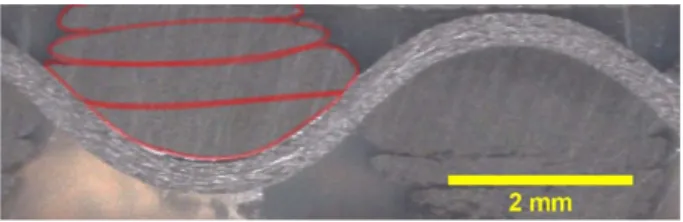
1. Orthogonal (ORT): Warp yarns, which are orthogonal to the plane direction, hold layers together as shown in Fig. 1. 2. Through-the-thickness (TTT): Warp yarns integrate the layers together by reaching through the whole thickness of the plane as shown in Fig. 2.
3. Layer-to-layer (LTL): Warp yarns combine the layers by reaching through several layers but not through the whole thickness of the textile as shown in Fig. 3.
Through-the-thickness weaving, orthogonal and layer-to-layer weaving are the most widely used 3D weaving pattern [9]. All these pattern can be created by a conventional weaving loom. The true orthogonal 3D weave in which fibers are com-bined in x, y and z-direction requires a special weaving loom [10]. This weaving technique is not considered here.
1.2 Material Strength of Different 3D Preform Pattern
All the above-mentioned 3D weaving pattern are produced on a conventional weaving loom using 12k carbon fiber yarn with a standard elasticity modulus of T700. The weaving machine is located at Songwol Tech. in Sacheon, Korea. The woven materials are infused with epoxy resin EP2400 from Cytec. Afterward, the composite panel is cut to manufacture specimen. The mechanical tests are conducted at Korea Insti-tute of Material Science (KIMS) in Changwon, Korea using ASTM D3039, ASTM D3410 and ASTM D2344. It is observed that the ORT weaving pattern provides significantly higher strength values in tensile and compression properties as shown in Fig. 4. In the shear direction, the LTL pattern has 50% higher strength than the ORT pattern while the TTT pattern offers 10% higher strength values than LTL. Since the ORT weave pattern exhibits better mechanical strength in fill yarn direction, the mean value can be seen around 45% higher than for the TTT and LTL weave pattern.
Furthermore, the compression strength in fill yarn direction, as well as the tensile strength in warp yarn direction, provide 30% higher values than the TTT and LTL pattern. The mea-sured values are similar to previous findings [11]. Finally, the material strength of the ORT in the warp yarn compression is exceeding by almost 100% due to meandered warp yarn arrangement that surrounds the fill yarn. Better mechanical properties than TTT and LTL fabric make the ORT 3D weave pattern an excellent reinforcement in 3D textile preforms for Fig. 1. ORT-weaving cross-section
Fig. 2. TTT-weaving cross-section
Fig. 3. LTL-weaving cross-section
Fig. 4.Strength comparison of different weaving pattern: ILS (Interlaminar shear strength); C (Compressive strength); T (Tensile Strength); 0 (warp yarn direction); 90 (fill yarn direction)
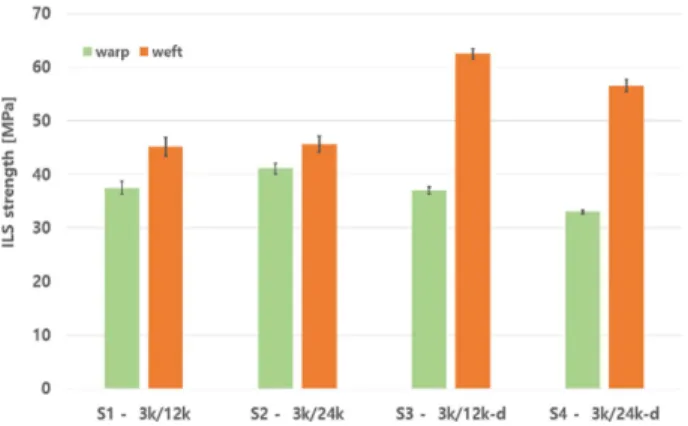
numerous applications. Therefore, the ORT weave pattern is chosen for further investigation and improvements. Since the main target is to achieve higher material strength, the easiest approach is to improve the fiber volume fraction of the com-posite or use carbon fiber roving providing higher filament strength. Therefore, resin pockets need to be reduced and cur-rent carbon fiber yarn T700 (Toray) are replaced with T800 grade yarn of H3055 (Hyosung) with the same amount of fil-ament filfil-aments (sample S3). To reduce the number of resin pockets two 3k-filament warp yarn are added every 8th 12k-filament warp yarn at the spool rack and along with the weav-ing pattern. Furthermore, a second textile type is woven usweav-ing 24k-fill yarn and comparing ILS strength of all woven types (Fig. 5).
A higher ILS strength is measured for sample S3 (T800) while the replacement of 12k fill yarn with 24k fill yarn (sample S2 and S4) show a reduction of the ILS strength. It is also observed that densification of the preform during the weaving process leads to a higher ILS strength as well. The most efficient densification process needs to be evaluated iter-atively since a malfunction of the mechanism of the weaving machine can occur during high densification (e.g. cutting malfunction of the fill yarn, buckling of the woven preform
on the weaving loom). The sizes of the unit cells before and after the densification are measured to calculate the densifi-cation rate. It is found that the new preform could be woven 47% denser than before.
2. WEAVING OF π-BEAMS
Since the dense ORT-woven preform type with 3k and 12k-warp yarn and 12k-fill yarn offer the highest tensile and com-pression strength results, this weaving setup is chosen for manufacturing the π-beam. To surround the two layers of the π-beam evenly, two more 12k yarn are placed along the pre-form width. They are numbered in Fig. 7 as numbers 8 and 9. The π-beam consists of two layers that are woven parallel to each other and are interconnected in the center. One of the layers can be used as the flange of the beam while the other layer will form the ‘legs’ of the π-beam when bended parallel around the interconnection.
3. T-JOINT BENDING TEST
After the weaving process, the preform is trimmed so that the interconnected π-beams out of the weaving machine can be separated. Once the integrity of the beam preform is con-firmed, the resin infusion process is initiated. A polished stain-less-steel plate is used as ground for the beam. Under the vacuum bag, two aluminum blocks are holding the beams legs
Fig. 5.ILS strength: sample 1 (12k, warp/12k, fill), sample 2 (12k, warp/ 24k, fill), sample 3 and 4: a dense setup (12k, warp/ 12k, fill) and (12k, warp/24k, fill)
Fig. 6. Fiber volume fraction for different 3D-woven preforms
Fig. 7. Yarn arrangement of the π-beam
and flange rectangular while a thin aluminum plate of 5 mm thickness ensures the proper distance of the legs. A flow media, peel ply, sealing tape, PU inlets and outlets, and two vacuum bags are used to maintain a proper infusion process. The resin type EP2400 from Cytec is used for the infusion which cures at 180oC for 2 hours.
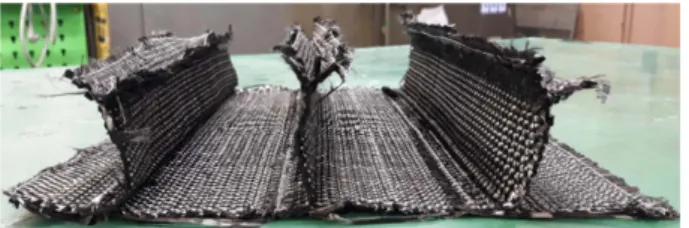
After the infusion, the beam is cut into the shape shown in Fig. 8 and later into smaller specimen with specific dimensions of depth of 50 mm, flange width of 120 mm, and a height of 100 mm, respectively, following the dimensions used for the T-joint pull-off-test [12]. A small 2D textile composite plate, with the dimensions 95 mm × 50 mm and 4 mm thickness, is inserted into the π-beam samples using adhesive LOCTITE EA 9695 AERO to form a strong bond and create a composite T-joint connection. Each T-joint is mounted on a base struc-ture as shown in Fig. 9.
The T-joint is then inserted into a clamping device (green) with a hinge joint. The distance from the hinge joint to the bottom of the π-beam is 130 mm. The T-joint bending test is done on an Instron tensile testing machine with a testing speed of 2.5 mm/min. A linear-elastic behavior is observed in the load-displacement graph in Fig. 10 up to the displacement of 10 mm in most specimen. Then further displacement ini-tiates cracks in the epoxy matrix and fractures of fibers leading to sudden drops of the force in the curve at around 8 mm to 13 mm displacement. After a non-linear elastic-plastic
tran-sition, the samples can take a higher load while several load drops occur during further displacement from 10 mm to 35 mm. In the displacement, range from 28 mm up to 38 mm the integrity of the connection is mostly lost while the resisting force of the composite is heading towards zero, emitting noise from the specimen. As a result, the maximum force that the nine specimen withstood ranged from 138 N to 212 N, yield-ing an average value of 190 N (Table 1).
Mb(edge) = Mb(max)
Fedge × 100 mm = Fmax × 130 mm (1)
Fedge = Fmax × 1.3
(Mb is bending moment, and F is force)
Therefore, the real average force on the specimen edge can be considered as 247.8 N, when calculated using bending moment.
4. CONCLUSION
Several 3D preform pattern being developed. After resin infusion and consolidation, samples of the preform are tested for mechanical properties such as interlaminar shear strength, compressive strength, and tensile strength. The composites of orthogonal weaving pattern show in general better mechanical properties than the other types of pattern. In the case of the tensile test in fill-yarn direction, the ORT pattern provides with a tensile strength of 950 MPa a 40% higher tensile strength than the LTL-pattern. In the ILS test, the ORT-pattern shows an ILS strength of 62 MPa, using a dense pattern com-bined of 12k warp and 12k fill yarn. Theπ-beam samples are woven and tested as part of a T-joint [13]. During a T-joint bending test an average force for the chosen geometry, of 190 N with a standard deviation of 22 N is observed. Further investigation is needed for 3D preforms using weaving Fig. 9. Clamp setup
Fig. 10. T-joint bending test results
Table 1. Results of the T-joint bending test
No. Max. Force [N] Force on Spec. Edge [N]
1 187.7 244.0 2 212.4 276.1 3 175.7 228.4 4 187.7 244.0 5 137.7 179.0 6 155.4 202.0 7 201.2 261.6 8 171.0 222.3 9 195.5 254.2 F 190.6 247.8 σ 21.98
machines considering limitations such as weaving loom width and complexity of the lifting diagram.
Besides, the usability of the elements as connectors or add-on parts should be examined. The productiadd-on of a stiffening panel with integrated stringers could be achieved with the conventional weaving loom. Nevertheless, further develop-ment, improvedevelop-ment, and optimization of the woven preforms needs to be conducted.
After manufacturing, a mechanical test should usually verify the mechanical properties of the whole application or seg-ments of those. Based on the verified strength, the woven and infused beams or panels could be considered to be integrated into larger components e.g. a wing structure of a small airplane in Fig. 12, or as a shell element of a rotor blade [14]. In the end, the 3D weaving technique offers many possibilities for new applications and structures. Considering time and labor as the most cost-driven parameters in modern production, the 3D weaving technique offers a reduction of several manufacturing steps such as hand-lay up of textile layers and cutting and con-verting into preform shape. Therefore, the 3D- weaving tech-nique could be an important processing method for a faster and more efficient composite production.
ACKNOWLEDGMENT
This research is financially supported by Changwon National University 2019~2020.
REFERENCES
1. Kazemahvazi, S., Khokar, N., Hallstrom, S., Wadley, H.N.G., and Deshpande, V.S., “Confluent 3D-assembly of fibrous struc-tures,” Composites Science and Technology, Vol. 127, 2016, pp. 95-105.
2. Ansar, M., Xinwei, W., and Chouwei, Z., “Modeling Strategies of 3D Woven Composites: A Review,” Composite Structures, Vol. 93, 2011, pp. 1947-1963.
3. Bilisik, K., “Multiaxis Three-dimensional Weaving for Com-posites: A Review,” Textile Research Journal, Vol. 82, 2012, pp. 725–743.
4. Mcclain, M., and Georings, J., “Overview of Recent Develop-ments in 3D Structures,” Albany Engineered Composites, 2012, pp. 1–12.
5. Quan, Z., Wu, A., Keefe, M., Qin, X., Yu, J., Suhr, J., Byun, J.H., Kim, B.S., and Chou, T.W., “Additive Manufacturing of Multi-directional Preforms for Composites: Opportunities and Chal-lenges,” Materials Today, Vol. 18, 2015, pp. 503–512.
6. N. Khokar, “3D-Weaving: Theory and Practice,” The Journal of
The Textile Institute, Vol. 92, 2001, pp. 193-207.
7. Stig, F., and Hallström, S., “Assessment of the Mechanical Prop-erties of a new 3D Woven Fibre Composite Material,”
Compos-ites Science and Technology, Vol. 69, 2009, pp. 1686–1692.
8. Jo, K., Klapper, V., Kim, H., Lee, J., Han, J., and Byun, J., “Man-ufacture of 3D Textile Preform and Study on Mechanical Prop-erties of Composites,” The Korean Society for Composite
Materials, Vol. 32, 2019, pp. 65–70.
9. Byun, J., Jo, K., and Klapper, V., “3D Textile Preform Manu-facturing and Composites RTM Technology Development,” in
Proceeding of The Society for Aerospace System Engineering,
2018, pp. 57–59.
10. Han, J.W., Lee, J.W., Park, J.W., and Kim, J.H., “The Study of Equipment System Upgrade for 3D Weaving,” in Proceeding of
The Society for Aerospace System Engineering, 2018, pp. 60–61.
11. Lee, L., Rudov-Clark, S., Mouritz, A.P., Bannister, M.K., and Herszberg, I., “Effect of Weaving Damage on the Tensile Prop-erties of Three-dimensional Woven Composites,” Composite
Structures, Vol. 57, 2002, pp. 405–413.
12. Song, J., “Development of 3d Weaving Preform Beam Structure for Aircraft Wing Application,” Changwon, Korea, 2018. 13. Park, G., Lee, D., and Song, J., “Joint Design and Strength
Anal-ysis of Preform Beam Structure,” in Proceeding of The Society
for Aerospace System Engineering, 2018, pp. 66–67.
14. Mouritz, A.P., Bannister, M.K., Falzon, P.J., and Leong, K.H., “Review of Applications for Advanced Three-dimensional Fibre Textile Composites,” Composites Part A: Applied Science
and Manufacturing, Vol. 30, 1999, pp. 1445-1461.
Fig. 11. Integrally woven stiffening panel with stringers