퍼지 다기준 의사결정분석을 통한 해외 독립발전사업 사업금융 리스크 분석
Risk Evaluation of the Project Finance for Overseas Independent Power Projects Using a Fuzzy Multi-Criteria Decision-Making Analysis
허경구, 김주남 서울종합과학대학원
Kyong-Goo Hur([email protected]), Joo-Nam Kim([email protected]) 요약
이 논문의 목적은 IPPs에서 발생할 수 있는 리스크 요소를 규정하고 퍼지 다기준 결정 방법론(Fuzzy MCDM)을 활용하여 사업 리스크의 우선순위와 가중치의 중요도를 분석함으로써 IPP 개발자에게 투자 의 사결정 도구를 제공하는 것이다. Fuzzy MCDM은 응답자의 고유한 의견을 표현할 때 발생할 수 있는 불확 실성을 보다 명시적으로 반영할 수 있는 추정방법이다. 이 논문은 광범위한 문헌 조사를 통해 신용 리스크, 준공 리스크, 시장 리스크, 연료조달 리스크, 운영 리스크, 재무 리스크, 환경 리스크, 그리고 불가항력 등 PF조달과 관련한 8 개의 주요 사업리스크를 도출한다. 실증분석 결과는 시장 리스크가 사업리스크와 관련 된 의사결정에서 있어 가장 중요한 리스크임을 보여준다. 이는 IPP에서 장기 전력판매계약이 가장 중요한 리스크 요소임을 보여주고 있으며, 점차 발주국 정부의 장기 전력판매계약에 대한 보증이 없는 자유시장에 서 전력을 판매하는 소위 머천트 발전사업에서 시장 리스크를 줄이는 것이 중요함을 암시한다.
■ 중심어 :∣리스크 분석∣사업 리스크∣해외 독립발전사업∣퍼지∣사업금융∣
Abstract
The purpose of this paper is the provision of a decision-making tool for developers to identify the project risks for under-consideration overseas independent power projects (IPPs), and to analyze the priority and importance weights of the risks through the employment of a fuzzy multi-criteria decision-making (MCDM) approach. A fuzzy MCDM is the calculation method for which the imprecision of each respondent’s unique opinion is considered. Through the extensive literature surveys that were conducted for this paper, eight major project finance (PF) risks have been derived credit risk, completion risk, market risk, fuel risk, operating risk, financial risk, environmental risk, and force majeure. The empirical results show that the market risk is the most important risk factor in terms of overseas IPPs, thereby confirming that the long-term power purchase agreement (PPA) guarantee of the host country is one of the most important corresponding factors for the PF.
■ keyword :∣Risk Evaluation∣Project Risks∣Overseas Independent Power Projects∣Fuzzy∣Project Financing∣
접수일자 : 2017년 04월 20일 수정일자 : 2017년 05월 08일
심사완료일 : 2017년 05월 08일
교신저자 : 김주남, e-mail : [email protected]
I. INTRODUCTION
Rapid economic growth has boosted the electricity demand in developing Asian economies such as China, Vietnam, and Indonesia. According to[1], the electricity demand in China, Vietnam, and Indonesia is expected to continue its growth between 2009 and 2035 at the annual growth rates of 4.1 %, 6.4 %, and 5.5 %, respectively. This electricity-demand growth necessitates a major investment in each country’s electricity-generation sector. To secure considerable power-plant-construction project costs, these countries are encouraging foreign private-sector involvement in independent power projects (IPPs).
IPPs are typically limited-liability, investor-owned enterprises that generate electricity either for bulk sale to an electrical utility, or for retail sale to industrial or other customers. The design of an IPP differs according to the ownership structure of the project. The typical IPP-ownership structures for the power sector include BOO (build-own-operate), BOOT (build-own-operate- transfer), and BLT (build-lease-transfer)[2]. In many countries, IPPs are being introduced to reduce public spending, expand capacity, improve reliability, introduce foreign capital, introduce competition, transfer technology, and respond to pressures from large consumers that are seeking more cost-effective alternatives[3].
In general, an IPP scheme involves the provision of the right to construct and operate a specific project for a certain period of time from a project-approval authority (government or utility) to a private contractor, and the private contractor is guaranteed a level of the expected returns within the concession period. The returns are obtained using a power purchase agreement (PPA) that guarantees the product purchases of a power purchaser[4].
Usually, an overseas IPP is a project for which
project finance (PF) is being used. Especially, developing countries encounter difficulties in the construction of infrastructure due to a lack of financing, and the PF of IPP investments is aggressively sought out with the use of private funds and technologies.
The Republic of Korea (ROK) has been active in the overseas implementation of IPPs since the 1990s.
Especially, Korea Electric Power Corporation (KEPCO) has been actively involved in overseas IPPs since it won the international bid for the performance restoration and operation project for a Malaya power plant in the Philippines in 1996. Since then, KEPCO has been leading others in approximately 15 overseas IPPs. Some of the construction and general-trading companies in the ROK are competitively participating in overseas IPP markets due to the impact of the recent recession on the domestic construction industry.
Especially for overseas IPPs, a large-scale funding capacity is essential. Therefore, the purpose of this paper is the provision of decision-making aid for domestic firms that can implement such tools for overseas IPPs by evaluating the corresponding PF risk factors and analyzing the priority and importance weights of the risks that need to be considered.
An overseas IPP involves a certain degree of risk including a country risk and a project risk. The country risk typically arises from a variety of national differences in the relevant economic structures, policies, legal systems, and currencies, and the main risk-factor categories are typically as follows:
political risk, sovereignty risk, transfer risk, and legal risk[5]. Whereas individual projects fall into uncertainty due to a lack of information regarding the risk characteristics that are related to the projects;
that is, the project risk. Many project-risk analyses contain more uncertainties compared with the
well-defined statistical country-risk analyses that, for example, can benefit from the use of the public data from the Economic Intelligence Unit. IPPs are exposed to their own risks, and these can lead to the deterioration of the project economics. Therefore, the focus of this paper comprises the uncertainty-based project risks.
Several multi-criteria decision-making (MCDM) methods have been applied to the management of scientific problems. For the major MCDM methods, the multi-attribute utility theory (MAUT), analytical hierarchy process (AHP), and fuzzy set theory (FST) are used. The MAUT method transforms the diverse criteria into a single common dimensionless scale of utility. The MAUT depends on the suppositions that a decision-maker is rational, is in possession of accurate and complete knowledge, and is consistent in his or her judgments. The AHP uses a quantitative-comparison method that is based on pairwise comparisons of the decision criteria rather than the utility and weighting functions. The AHP relies on the assumption that humans are more capable of making relative judgments than absolute judgments. As a result, the rationality assumption in the AHP is more relaxed than that of the MAUT[6].
The designs of the MAUT and the AHP, however, make it difficult to identify the fuzzy or uncertain factors. The fuzzy-evaluation theory can more effectively deal with the uncertain factors[7]. Also, the FST is a powerful tool that can be used for the handling of imprecise data that are more natural for humans than rigid mathematical rules and equations.
It is obvious that much of the knowledge in the real world is fuzzy rather than precise[8].
Recently, many risk-assessment approaches have been based on the use of linguistic assessments instead of numerical values. Using the FST, data may be defined on vague, linguistic terms such as “low
probability,” “serious impact,” or “high risk.” These terms cannot be defined meaningfully with a precise single value, but the FST provides the means by which these terms may be formally defined in terms of mathematical logic[9]. As its usefulness in the management of project-management science has been recognized, the FST has been widely used in evaluations of project risks and investments.
For this paper, a fuzzy MCDM approach is therefore used for which the FST is applied to induce the weight values of the risk factors in overseas IPPs, and risk evaluations of a number of virtual IPPs are attempted for the case study. The remainder of this paper is organized as follows: Section 2 is a review of the literature surveys on the IPP risks and explains the risk factors that are adopted here, Section 3 describes the procedures of the application of the fuzzy MCDM approach, Section 4 reports the empirical results and the potential uses of the results, and Section 5 discusses the policy implications of the present work. A number of concluding remarks are made in the final section.
Ⅱ. PROJECT RISKS OF OVERSEAS IPPS
1. Overseas IPPs and the PF
In general, a private investor must secure legal grounds to own a power plant to implement an IPP in a country. Further, a legal system must exist to serve as the framework during the mediation of any disputes whereby the compulsory fulfillment of various contracts can be guaranteed. In addition, a utility of the country needs to be entitled to enter into a PPA with private investors. The returns of the PPA, the conversion of foreign currency, the power-grid connection, and a variety of investment incentives must be guaranteed to protect the foreign investors.
Reference [10] explained the way that the host countries form legal frameworks to address the main risks (demand, market, and financial risks, and so on) to facilitate the IPPs from a case study of four IPPs, each of which is respectively in India, Pakistan, Indonesia, and China. Through the frameworks, transparent bidding, capital-investment participation for which subordinated debt is used, governmental PPA guarantees, and the encouragement regarding the participation of export credit agencies (ECAs) and multilateral development banks (MDBs) in the governments’ financial roles and support are all established as essential components.
To boost the foreign investment in IPPs, the host government provides a fair governmental public-approval system whereby the governmental promotion policies including the tax incentives and so on can be issued. In general, since IPPs are long-term projects that last from 20 years to 30 years, an international competitive open-bid process ensures a secure transparency and efficiency, enabling the host government to select the most competitive investor.
Large-scale public projects including power projects have been developed through national finance, and large-scale private projects have been funded by corporate finance based on the credit of large-scale companies. The least developed countries, however, lack national finance and rely on the loans of international financial institutions; but the tendencies of privatization and deregulation allow the fundraising burden of large-scale projects to be transferred from the public sector to the private sector, and in the process, the PF is in the spotlight.
The PF definitions in the previous studies are given in this paragraph. Reference [11] said that PF is the raising of funds on a limited-recourse or nonrecourse basis to finance an economically separable capital investment project in which the providers of the
funds look primarily to the cash flow from the project as the source of the funds to service their loans and provide the return of and a return on their equity invested in the project. Reference [12] explained PF includes a financing of a specific economic unit in which a lender is satisfied to look initially to the cash flows and the earnings of that economic unit as the source of funds from which a loan will be repaid and equity serviced and to the assets of the economic unit as collateral for the loan within a specified risk framework. According to [13], PF involves the creation of a legally independent project company financed with non-recourse debt (and equity from one or more corporate entities known as sponsoring firms) for the purpose of financing investment in a single-purpose capital asset, usually with a limited life.
To be more concrete, the PF is often associated with the financing of capital-intensive deals such as those regarding power plants, petrochemical plants, and road constructions, among others. In particular, unlike corporate finance, the PF is lacking a parent-company payment guarantee, as the cash flow from the project is fully contained in a special purpose vehicle (SPV) that implements the project and absorbs the project-related risks; therefore, banks need a strict examination process for credit loans compared with secured loans. From the perspective of the lenders, the way that the variety of project risks are distributed to the various stakeholders to secure a safe repayment process is an important consideration in terms of the outcome of their loan-approval decision process. The key of the PF depends on the way that the project risks are allocated to the project participants such as the sponsors, project lenders, EPC (engineering, procurement and construction) contractors, and O &
M (operation and maintenance) contractors[14].
Reference [15] explained that the PF has played the role of a driver of economic growth in low-income countries. They hypothesize that the PF is beneficial to the least-developed economies as it can compensate for a lack of domestic financial development, and the study result shows a variety of contract structures for the PF that enable the construction of enhanced management and governance procedure regarding investments.
Reference [13] provided a statistical overview of the PF investments over the years from 1994 to 2013.
Their analysis shows that, in 2013, firms financed US$415 billion worth of capital expenditures globally using the PF from US$41 billion in 1994, which indicates that the use of the PF investment has grown approximately 10-fold over the past 19 years at an annual average rate of 8 %.
Lenders often ask sponsors or EPC contractors completion guarantees because construction risk is much larger than operation risk comparing the one with the other based on IPP’s characteristics.
However these usually are not required to sponsors with high credit ratings or EPC contractors with a plenty of the experience of construction.
As mentioned above, the success of the PF is a key factor of the success of an overseas IPP. In a clinical case study of Quezon Power in the Philippines by [14], the long-term PPA is an important risk-transfer mechanism in terms of the PF, and it also may lead to a default off-taker risk. That is, from the point of view of the lenders, project structures must be formed so that safe cash flow happens in the long term. They focus on a PF model that is based on the economic feasibility including the legal, environmental, and technological feasibilities.
In the case of the PF, the SPV that the sponsors establish plays a vital role in the formulation of various IPP contracts; therefore, the sponsors’ ability
to support the SPV is very important. The typical participants in overseas IPPs are the EPC companies, the general trading companies that oversee large-scale investments, the power-generation companies, the O & M companies, the ECAs, the commercial banks, the financial advisors in charge of fundraising and advising on the tax and accounting matters, a legal advisor that can guide the numerous contractual documents, and technology and insurance advisors, among others.
2. Literature Review: Project Risks of the PF for IPPs
The project risks are different depending on a project’s parties; that is, according to the sponsors developing the project, the lenders providing the PF loans, the EPC contractors, and the host country, discrepancies can emerge regarding their viewpoints on the project risks. This study attempts to analyze the PF project risks for overseas IPPs in consideration of the perspectives of both developers and lenders.
The previous studies explain the PF project risk for the IPPs to some extent. Reference [16] categorized the PF risks into the following three main risks, which were then subcategorized by each phase:
pre-completion-phase risk, post-completion-phase risk, and the risks common to both phases. Reference [17]
included development, construction, cost-increase, performance, operation, market, political, environmental, social, and credit risks as the project risks. Reference [11] divided the project risks into the following 10 main categories: completion, technical, raw-material-supply, economic, operating, financial, currency, political, environmental, and force-majeure risks.
Regarding the PF risk, [18] devised the following three main risk categories: commercial, financial, and political. He explained that the commercial risks are
those project risks that are inherent to the project itself, such as the completion, operational, environmental, force-majeure, and revenue risks.
Reference [12] divided the project risks into those regarding the country, sovereignty, politics, foreign exchange, inflation, interest, appraisal, availability of permits and licenses, operating performance, product price, enforceability of product contracts, price of raw materials and energy, enforceability of contracts for the raw materials, refinancing, force majeure, and legal risks.
In addition to the above-mentioned factors, [19]
classified the main project risks of construction projects as follows: force-majeure, physical, financial and economic, political and environmental, design, and job-site-related risks. He used the AHP method to analyze and assess the construction-project risks.
Reference [20] asserted that the type and degree of PF risk vary depending on the project and the industry, and each project phase―development, construction, and operation―is subject to distinct associated risks. They discussed the major risk components that are faced in each project phase, as follows: The development phase consists of the technology risk, credit risk, and bid risk; the construction phase consists of the completion risk, cost-overrun risk, performance risk, and political risk;
and the operating phase consists of the performance risk, liability risk, equity resale risk, and off-take risk.
The allocation of each risk component to the appropriate participant is the most critical project-success factor.
Reference [21] provided a risk-analysis assessment for the inducement of a private investment in the power sector of Serbia for which the PF was utilized.
They basically followed, [18]’s project-risk classifications of commercial, financial, and political.
Reference [22] empirically proved that the major project risks such as those regarding the construction,
raw-material cost and availability, market, and operations can be shifted through various project contracts, whereby the need to reduce the volatility of the future cash flow facilitates a shared-risk situation. This enables lenders to provide more favorable project loans to the borrower.
Reference [23] asserted that the project-company sponsors can enact a trade-off between the leverage and the cash-flow control to minimize their risks and optimize their returns from the project. The project companies use more leverage when the cash-flow risk is high and less leverage when the risk-reduction measures are being implemented. That is, the project companies use less leverage and instead rely more on off-take agreements when the control benefits of the cash flow from the project are high, suggesting that the leveraging and contractual structures of the project company are important hedging mechanisms.
This study suggests that the capital and contractual structures play a critical role in the PF risk-management strategy.
Reference [24] explained the following 12 project risks: development risk, completion risk, supply risk, market risk, operational risk, equity risk, legal risk, political risk, interest-rate risk, credit risk, environmental risk, and foreign-exchange risk. He also suggested the mitigation method for each project risk, and they are mainly based on the legal perspective.
Reference [25] classified the project risks into market, financial, credit, and business risks according to the project-financing phases. They also empirically tested whether all of the risks negatively affect the profit creation of the project company or not using Structural Equation Modeling.
Reference [26] concluded that the public/private partnership (PPP) arrangements for the infrastructural construction are based on the notion
that the risk transfer from the public to the private sector can most effectively manage the risk. They stated that a profit-incentivized private sector can meet its contractual obligations more properly and efficiently. This paper views the project risks from the perspectives of the procuring entity, the project sponsors, and the lenders in a systematic manner.
Reference [27] examined issues like policy, power purchase, risk factors, financing, and fuel supply, and the key success factors that are related to the development of IPPs and project financing in India.
This paper analyzes India’s first-ever IPP the “Dabhol Power” case. The major risks described by the various participants including the developers, investors, and contractors are as follows: country/political risk, construction risk, O & M risk, fuel-supply and transportation risks, foreign-exchange risk, risk of non-payment by the off-taker, and regulatory-environment risk.
Reference [28] examined the determination of the credit-risk premium regarding the infrastructure projects in the country-risk environments of developing countries. The key finding is that the financial market seems to impose a high-risk premium on the loans to countries with high inflation.
Because from 1980 to 1990, most of the developing countries did not have good investment grade ratings to secure foreign investments, they needed to provide foreign investors with various kinds of governmental guarantees such as a power off-take, a fuel supply, currency convertibility, and a law changeability.
Reference [29] analyzed the relationship between the loan spreads and the political risk, suggesting that the presence of loan guarantees and lower levels of aggregate political risk resulted in cheaper PF loans.
According to this study, the loan spreads are negatively related to the effectiveness, quality, and strength of a country’s legal and institutional systems.
Reference [30] explained the effective use of the PF through the case study of the Petrozuata project that was launched for the development of the Orinoco Belt in Venezuela. For this paper, the Petrozuata-project risk matrix was analyzed as follows: pre-completion risk (resource, force-majeure, technological, timing or delay, and completion risks), post-completion risk (supply, throughput, environmental, and market risks), sovereignty risk (exchange rate, currency-convertibility, inflation, political, and legal risks), and financial risk (funding, interest-rate, and debt-service risks). Reference [31] explained a variety of project risks that are relevant during both the construction period and the operating period, as follows: The risks that are related during the construction period are the cost overruns, delays, start-up and testing problems, contractor-payment defaults, hidden defects, and the force majeure, while the risks related to the operating period are those regarding the operating-efficiency problems, increase of the routine (or major) O & M, market demand and pricing, input availability, and force majeure.
Reference [32] asserted that the main reason that almost 70 % of PPP projects are terminated is because of a failure to allocate the project risk properly among the project participants. The three PPP-project phases with different risk profiles are as follows: development, construction, and operation phase. This paper shows nine of the risks that are faced in any infrastructure project, as follows:
technical, construction, operating, revenue, financial, force-majeure, regulatory and political, environmental, and project-default risks.
Reference [33] explained that multinationals prefer project financing to corporate financing in terms of the requisite coping regarding the host-country investment threat that is due to the incremental expropriation of infrastructure projects. This paper
proves that although a host country may wish to expropriate some of the assets that are invested by foreign investors through a legislative change or a tax increase, if the assets are heavily funded by MDBs (multilateral development banks), then the reluctance of the host country is highly likely given the potential for a significant reputation loss in the international financial market.
To secure sizable investments for the power sector in developing countries, IPPs in particular, [34] argued that project financing should be one of the most useful sources of financing and also explains the advantages of the introduction of IPPs; especially, the solving of power-supply shortages in a short period of time, the reformation of the domestic power sector, and the introduction of new management skills. In addition, the developing countries should follow the rules and regulations that are imposed by the ECAs and MDBs when they build infrastructure projects, as this would lead to the construction of environmentally friendly facilities.
Reference [35] explained the principle of risk-sharing between the private sector and the public sector in the case of a Turkish hydro-power project. For the pursuit of build–operate–transfer (BOT) projects, they classified the project risks as market, financial, political, legal, construction, and operation risks, and suggested a mitigation method for each risk.
As stated above, since the project-risk evaluation must be the project-financing core, the purpose of the risk evaluation should be the determinants of the project bankability. However, the level of the country risk or the sovereignty risk can be noticed through various public data that have been provided by a number of international institutions and financial lenders. Therefore, the sole focus of the present paper comprises the inherent project risks themselves.
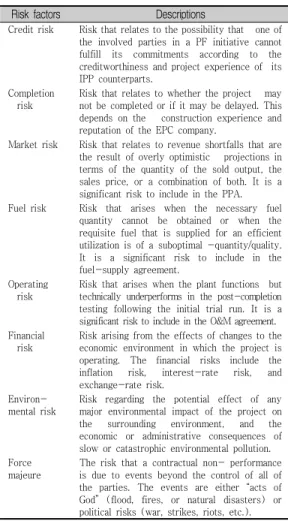
Risk factors Descriptions
Credit risk Risk that relates to the possibility that one of the involved parties in a PF initiative cannot fulfill its commitments according to the creditworthiness and project experience of its IPP counterparts.
Completion risk
Risk that relates to whether the project may not be completed or if it may be delayed. This depends on the construction experience and reputation of the EPC company.
Market risk Risk that relates to revenue shortfalls that are the result of overly optimistic projections in terms of the quantity of the sold output, the sales price, or a combination of both. It is a significant risk to include in the PPA.
Fuel risk Risk that arises when the necessary fuel quantity cannot be obtained or when the requisite fuel that is supplied for an efficient utilization is of a suboptimal -quantity/quality.
It is a significant risk to include in the fuel-supply agreement.
Operating risk
Risk that arises when the plant functions but technically underperforms in the post-completion testing following the initial trial run. It is a significant risk to include in the O&M agreement.
Financial risk
Risk arising from the effects of changes to the economic environment in which the project is operating. The financial risks include the inflation risk, interest-rate risk, and exchange-rate risk.
Environ- mental risk
Risk regarding the potential effect of any major environmental impact of the project on the surrounding environment, and the economic or administrative consequences of slow or catastrophic environmental pollution.
Force majeure
The risk that a contractual non- performance is due to events beyond the control of all of the parties. The events are either “acts of God” (flood, fires, or natural disasters) or political risks (war, strikes, riots, etc.).
Table 1. Major Project Risks (Attributes) and Descriptions
Through the extensive literature surveys eight major project risks have been derived credit risk, completion risk, market risk, fuel risk, operating risk, financial risk, environmental risk, and force majeure.
A summarization of the major project risks that are involved in the securing of the PF for IPPs is shown in [Table 1].
Ⅲ. METHODOLOGY
1. Literature Review
A fuzzy MCDM approach uses the FST. The FST was first introduced by [36] in 1965, and it is considered as useful in cases of uncertainty since it allows for the meshing of a quantitative approach with the qualitative representation through the extension of classical Boolean logic to real numbers[37]. In Boolean logic, “1” represents true and
“0” is false; alternatively, all of the fractions between zero and one are employed to indicate a partial truth in the FST. Therefore, human judgments that are often vague and difficult to estimate with an exact numerical value can be effectively expressed with the use of the FST wherein a sharp boundary does not exist between the sets information.
The FST has been increasingly applied to decision-making in a variety of fields including the fields of energy [38][39], the environment [40] [41], and management science including risk assessment.
In terms of energy and environmental issues, [42]
proposed an evaluation model for which the fuzzy theory is integrated with the MCDM process to assess the comprehensive benefits of combined cooling, heating, and power (CCHP) systems according to technological, economic, societal, and environmental criterions. Reference [43] presented a fuzzy (MCDM) model for the selection and evaluation of tri-generation systems. Reference [44] applied the FST to identify the significance of various environmental impacts for which a specific case study of the electric-power utilities in the ROK was investigated in consideration of the following nine environmental impacts: mortality, morbidity, forest, agricultural production, materials, visibility, thermal discharge water, landscape, and global warming.
When it comes to risk evaluation, Reference [9]
illustrated an example regarding a building-rehabilitation project. Reference [45]
evaluated the risk regarding the BOT projects in the
Iranian power-plant industry. Reference [46] assessed the quality of an airline service. Reference [47]
proposed a fuzzy decision algorithm for investment analysis to select the most suitable advanced manufacturing system. In this paper, triangular fuzzy numbers are used throughout the analysis to quantify the vagueness that is inherent in the financial estimates such as the periodic cash flows, interest rates and inflation rates, the experts’ linguistic assessments for the strategic justification criteria, and the importance weight of each criterion. Reference [48] proposed a methodology for a fuzzy cost-overrun risk rating regarding international construction projects.
2. Framework of the Fuzzy MCDM approach The fuzzy analysis is an important tool to represent vagueness and a kind of imprecision and uncertainty.
The term fuzzy is meant to represent expressions and judgments with no clear values or boundaries; for example, the linguistic expression that the performances of the personnel are outstanding is fuzzy since it cannot be precisely associated with a real number. It is possible, however, to always associate “outstanding” to an expression like
“performance close to 90,” which is vague[49].
A fuzzy MCDM approach induces the weighting values of the respondents through the calculation method for which the imprecision of each respondent in the expression of her or his unique opinion is considered. Subsequently, the total integral values of each attribute are derived by aggregating the weighting of the attributes that each respondent evaluates. Lastly, whether any of the attributes are more important than the others is analyzed to help the decision-makers make an overall decision. The process of a fuzzy MCDM approach is described below.
For sufficiency, nrespondents andkattributes are selected for the questionnaire that is conducted regarding the objectives of this study, as follows:
} , 2, 1,
| { }, , 2, 1,
|
{E i n C C l k
E= i = L = l = L (1)
where i isa respondent,Eis the set of respondents, lis an attribute, andCis a set of attributes. A fuzzy number M is a fuzzy set whose membership functionis fM(x): x →[0,1]. The triangular fuzzy number is denoted as follows:
b x a a b a x x
fM( )=( - ) ( - ); £ £ c x b c b c x x
fM( )=( - ) ( - ); £ £ otherwise
x
fM( )=0; , (2)
wherea,b, and care real numbers;aandcstand for the lower and upper bounds of the fuzzy numberM, respectively; andbis the modal value that is shown in [Fig. 1].
Fig. 1. A triangular fuzzy number M
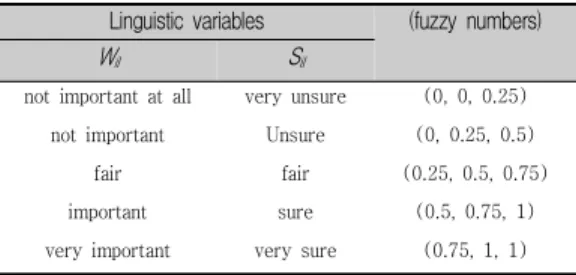
For arithmetic manipulation, the linguistic variables xare converted into fuzzy numbers as the forms of Wil=(ail,bil,cil) for the importance of the attributes and Sil=(oil,pil,qil) for the confidence of each respondent’s judgment in [Table 2].
Linguistic variables (fuzzy numbers)
Wil Sil
not important at all very unsure (0, 0, 0.25)
not important Unsure (0, 0.25, 0.5)
fair fair (0.25, 0.5, 0.75)
important sure (0.5, 0.75, 1)
very important very sure (0.75, 1, 1) Table 2. Triangular fuzzy number corresponding to
each linguistic variable
The fuzzy confidence index, calculated using Eq.
(3), of each respondent implies how confident he or she is in his or her evaluation of the overall criteria.
A number of methods can be used for the aggregation of the respondent’s assessments such as mean, median, max, and mixed operators. The mean operator is the one that is most commonly used to calculate the fuzzy confidence index.
) , , ( i i i
i Y Q Z
F = , (3)
where Yi=ål(oil´ail) k, Qi=ål(pil´bil) k'
å ´
= l il il
i q c k
Z ( ) .
To convert the fuzzy confidence index into a crisp real number, a defuzzification is implemented. A defuzzification is a conversion process that results in the expression of the fuzzy confidence index and the valuation results that are in the form of fuzzy numbers as crisp real numbers [50]. The fuzzy confidence index is defuzzified as follows:
] ) 1 ( [
5 . 0 )
(Fi Zi Qi Yi
I = ´ a + + -a , (4) whereαis the optimism index or the risk attitude that represents the optimism degree of a respondent. The total risk-attitude index α that is addressed in [51]
can be obtained as follows:
) (
)
( W + S n´k+n´k
= a a
a , (5)
where the individual risk-attitude index αw for the fuzzy importance weight Wil and the individual risk-attitude index αs for the fuzzy confidence Sil is defined as follows:
å å - -
=
k
l n
i
il il il il
W (b a ) (c a )
a ,
å å - -
=
k
l n
i
il il il il
S (p o ) (q o )
a . (6)
The defuzzified fuzzy confidence index is then normalized into the respondent weightwi, as follows:
)}
(
{ i
i norm I F
w = , (7)
where,
Eq. (7) is applied to determine the weight of each attribute according to the result of Equation (8). If fi
(θ) is the defuzzified evaluationresult of the ith respondent for the specific attribute θ, its final weight is calculated as follows:
å
= iwifi
f(q) (q) (8)
Ⅳ. EMPIRICAL RESULTS AND THE APPLICATION
1. Empirical Results
To obtain the FST judgments regarding the attributes, a survey was administered to the experts and workers among the IPP developers, an ECA, and related fields. The survey was carried over the course of approximately one month, from September 5 to October 4 in 2016. From the 100 questionnaires that were disseminated, a total of 50 responses was received; therefore, the response rate for the survey is 50 %. As for the demographic statistics, regarding the public companies, 54 % were employed at KEPCO and 2 % were employed at K-Water; regarding the
developers of power-generation projects abroad, 16 % were employed at The Export-Import Bank of Korea, which served as an ECA that facilitated the export transactions and as an executor of an economic-development cooperation fund, enhancing the cooperative ties with developing countries; and in terms of the private companies, 8 % worked at Daelim Energy in the ROK and 20 % worked at the Marubeni and Mitsubishi corporations in Japan.
Attributes α=0 α=0.5 α=0.701 α=1 Rank
Credit risk 0.142 0.137 0.136 0.134 2
Completion risk 0.142 0.136 0.135 0.133 3
Market risk 0.155 0.147 0.144 0.141 1
Fuel risk 0.133 0.132 0.131 0.131 4
Operating risk 0.100 0.107 0.109 0.112 8 Financial risk 0.121 0.122 0.122 0.122 5 Environmental risk 0.102 0.108 0.110 0.112 7 Force majeure 0.102 0.108 0.110 0.112 6 Table 3. Weights of the risk factors
The questionnaires for the inducement of the attribute weights constituted two types of questions, as follows: one for evaluating the importance of each attribute, the other for assessing the reliability of the responses. [Table 3] summarizes the results of the fuzzy MCDM. The attribute weights calculated here have both ordinary and cardinal meanings, indicating by how much they are more important than others[52]. The results indicate that “Market risk” is the most important attribute in project risk-related decision-making processes, followed sequentially by
“Credit risk” and “Completion risk.” This result implies that the pre-completion risks are considered as important. Meanwhile, the weight of “Operating risk” is the lowest.
Fig. 2. The weights by risk preference
Concerning a decision-making or an evaluation problem, the respondents’ risk attitude (i.e., attitude towards vagueness and risk) can be incorporated into a decision-making or evaluation analysis using a measure for the risk attitudes [53]. This risk-attitude index has been developed in many studies (e.g., [54-56]) with respect to the FST context. The evaluation of the total risk-attitude index, the present model, is equal toα=0.701. Becauseαis greater than 0.5, this index represents a risk-aversion preference of the respondents. The weights are therefore calculated according to the risk attitudes, as follows:
absolute risk-prone (α=1), risk-neutral (α=0.5), absolutely risk-averse (α=0), and α=0.701. [Fig. 2]
shows that the respondents may prefer the upper attributes to the lower attributes as α increases, which means that the risk-prone respondents prefer the upper attributes more than the risk-averse respondents.
2. Potential Uses of the Results
As mentioned above, the empirical result in the expert group shows that the Market, Credit, and Completion risks have been evaluated as the more important attributes from among the project risks.
This can be used as a decision-making support tool when an IPP developer needs to investigate more viable alternatives in a project. When a decision is
made through a select-and-concentration strategy due to limited resources, the risk profiles of each project can be analyzed, and the priority of the project alternatives can be set according to the weights that have been induced for this paper and the risk profiling of a developer.
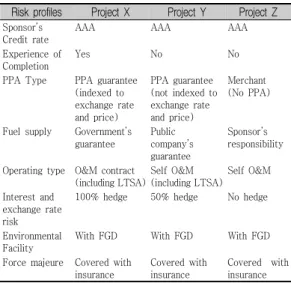
For the case study, three different project alternatives (projects X, Y, and Z), which have their own project risk profiles located at different countries, were assumed as shown in [Table 4]. For the simplification of the analysis, the project costs of all of the project alternatives were assumed as equal to the coal-fired plant with a flue gas desulphurization (FGD) in terms of factors such as the capacity, capacity factor, life time, and combustion option, among others.
Risk profiles Project X Project Y Project Z Sponsor’s
Credit rate
AAA AAA AAA
Experience of Completion
Yes No No
PPA Type PPA guarantee (indexed to exchange rate and price)
PPA guarantee (not indexed to exchange rate and price)
Merchant (No PPA)
Fuel supply Government’s guarantee
Public company’s guarantee
Sponsor’s responsibility
Operating type O&M contract (including LTSA)
Self O&M (including LTSA)
Self O&M
Interest and exchange rate risk
100% hedge 50% hedge No hedge
Environmental Facility
With FGD With FGD With FGD
Force majeure Covered with insurance
Covered with insurance
Covered with insurance Note: LTSA is a Long-Term Service Agreement.
Table 4. Risk profiles by project alternative
It is possible to simulate the manner in which the priority can be changed by a change of the combination of the risk factors from among the project alternatives. To standardize the scores that [57] proposed, the ratio, interval, ordinal, and binary
can be used for the purposes of comparison regarding the alternatives. This paper sets the ordinal scores of A, B, and C on each risk factor according to the project alternative, and it is assumed that A, B, and C are the scores of 1, 2, and 3, respectively. Notably, the differences among the A, B, and C scores can impact on the priority of the project alternative.
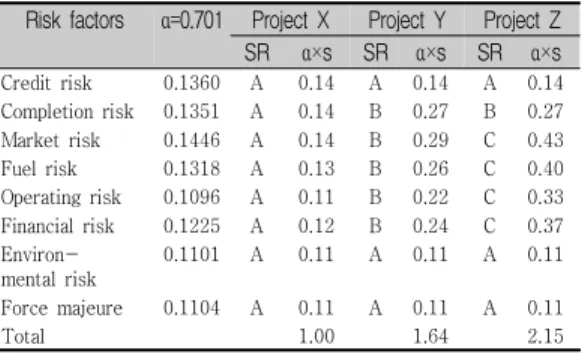
The total estimates that are shown in [Table 5] are calculated by multiplying the weights that are induced byα=0.701 with the scores from a project developer or an evaluator. In this case, it is possible to determine that the risk estimate of project X is the least, and so it can be the best chosen case here.
Risk factors α=0.701 Project X Project Y Project Z SR α×s SR α×s SR α×s Credit risk 0.1360 A 0.14 A 0.14 A 0.14 Completion risk 0.1351 A 0.14 B 0.27 B 0.27 Market risk 0.1446 A 0.14 B 0.29 C 0.43 Fuel risk 0.1318 A 0.13 B 0.26 C 0.40 Operating risk 0.1096 A 0.11 B 0.22 C 0.33 Financial risk 0.1225 A 0.12 B 0.24 C 0.37 Environ-
mental risk
0.1101 A 0.11 A 0.11 A 0.11
Force majeure 0.1104 A 0.11 A 0.11 A 0.11
Total 1.00 1.64 2.15
Note: SR stands for score.
Table 5. Summary of the risk evaluation by project alternative
Ⅴ. CONCLUDING REMARKS
A risk evaluation is at the core of the PF [18], when an overseas IPP is implemented. This paper reviews the requisite risk factors for a risk analysis or an evaluation regarding the PF for overseas IPPs, and their relative importance and weights are induced. It is not an exaggeration to state that all of the risks are significant and that they cannot be neglected in the IPP implementation. The purpose of this paper, however, is the determination of the priorities of the
IPP alternatives for which their own risk profiles are objectively considered due to the select-and-concentration strategy that is adopted by firms. Especially, the weight that is according to each risk that is available for the decision-making processes is a reliable criterion that enables the transfer of a chosen risk to its counterpart during negotiations with lenders and consortium members.
For this paper, a fuzzy MCDM analysis was applied to identify the significance of the various risk factors of the IPPs for which a case study of a number of virtual IPPs was used. A fuzzy MCDM can induce the weighting values of respondents through a calculation method for which the imprecision of each respondent’s expression of her or his unique opinion is considered and compared with those of the AHP and the MAUT, and it can be employed for the uncertainty analysis.
The overall results show that the market risk is the most important risk factor in the IPP risk-related decision-making processes, and this is sequentially followed by the credit risk and the completion risk.
The market risk relates to revenue shortfalls that are the result of overly optimistic projections in terms of the quantity of the sold output, the sales price, or a combination of both. It is a significant risk to include in the PPA. This confirms that the PPA guarantee of the host country is one of the most important factors for the PF in IPPs. Further, this certainly shows the extent of the effort that firms will make to minimize the risks regarding the so-called Merchant Power Plants (MPPs) that perilously sell power on the free market without the gradual spreading of a long-term host-country PPA guarantee. Even developing countries are trying to introduce MPP benchmarking into developed countries wherein the IPPs have already matured.
Because the IPP developers adopt the market risks
with the highest weight and ranking in this study, they should conduct a deep risk analysis in terms of the MPPs. To this end, they can hire globally eminent market-analysis experts and investigate the market risks of MPP-market participation. In addition, risk-reduction efforts need to be made by the developers through the formation of consortiums that consist of local leading companies. The credit risk is also significant because it relates to the possibility that one of the involved parties in a PF initiative cannot fulfill its commitments according to the creditworthiness and project experience of its IPP counterparts.
Comparing to precedent studies, this paper has a further significance of employing a fuzzy MCDM analysis to induce the weighting values of the project risks and attempting to evaluating feasible study as a case study of a number of virtual IPPs. In addition, this paper has a meaningful result of confirming that the market risk is the most important risk factor in the IPPs as it is expected. The present study makes a first step towards estimating the project risks of the construction of IPPs. A fuzzy MCDM analysis can be employed to evaluating project risks in EPC projects and M&A (merger and acquisition) in a future study as second phase of work, because especially EPC projects are getting popular in nuclear power builds.
참 고 문 헌
[1] Asia Pacific Energy Research Center, APEC Energy Demand and Supply Outlook-5th ed., APERC, 2013.
[2] M. Hoskote, Independent Power Projects (IPPs) An Overview, The World Bank Group, Energy Note No.2, 1995.
[3] E. Roseman and A. Malbotra, The Dynamics of
Independent Power, The World Bank, Note No.83, 1996.
[4] S. K. Lee, Understanding on Project Contracts of IPP, IXD, 2015.
[5] D. H. Meldrum, “Country risk and foreign direct investment,” Business economics, pp.1-16, 2000.
[6] G. A. Kiker, T. S. Bridges, A. Varghese, T. P.
Seager, and L. Linkov, “Appication of multicriteria decision analysis in environmental decision making,” Integrated environmental assessment and management, Vol.1, No.2, pp.95-108, 2005.
[7] Y. T Ma, Z. G. Wang, Z. Yang, and C. R. Lu,
“Fuzzy comprehensive method for gas turbine evaluation,” Proceedings of the CSEE, Vol.23, No.9, pp.218-220, 2003.
[8] A. I. Ölçer and A. Y. Odabaşi, “A new fuzzy multiple attributive group decision making methodology and its application to propulsion/maneuvering system selection problem,” European Journal of Operational Research, Vol.166, No.1, pp.93-114, 2005.
[9] A. N. Morote and F. R. Vila, “A fuzzy approach to construction project risk assessment,”
International Journal of Project Management, Vol.29, pp.220-231, 2011.
[10] A. N. Chowdhury and C. Charoenngam,
“Factors influencing finance on IPP projects in Asia: A legal framework to reach the goal,”
International Journal of Project Management, Vol.27, pp.51-58, 2009.
[11] J. D. Finnerty, Project Financing, 3rd ed., Wiley, 2013.
[12] F. J. Fabozzi and C. F. Nahlik, Project Financing, Eighth ed., Euromoney Books, 2012.
[13] B. Esty, C. Chavich, and A. Sesia, An Overview of Project Finance and Infrastructure Finance-2014 Update, Harvard Business School 9-214-083, 2014.
[14] V. Bonetti, S. Caselli, and S. Gatti, “Offtaking agreements and how they impact the cost of funding for project finance deals,” Review of Financial Economics, Vol.19, pp.60-71, 2010.
[15] S. Kleimeier and R. Versteeg, “Project finance as a driver of economic growth in low-income countries,” Review of Financial Economics, Vol.19, pp.49-59, 2010.
[16] S. Gatti, Project Finance in Theory and Practice,2nd ed., Academic Press, 2013.
[17] J. Delmon, Private Sector Investment in Infrastructure, 2nd ed., Kluwer Law International, 2009.
[18] E. R. Yescombe,Principles of Project Finance, Academic Press, 2002.
[19] M. A. Mustafa, and J. F. Al-Bahar, “Project Risk Assessment Using the Analytic Hierarchy Process,” IEEE Transactions on Engineering Management, Vol.38, No.1, pp.46-52, 1991.
[20] C. R. Beidleman, D. Fletcher, and D. Veshosky,
“On Allocating Risk: The Essence of Project Finance,” David Sloan Management Review, Spring, 1999, pp.47-55, 1999.
[21] D. M. Nikolic, S. Jednak, S. Benkovic, and V.
Poznanic, “Project Finance Risk Evaluation of the Electric Power Industry of Serbia,” Energy Policy, Vol.39, pp.6168-6177, 2011.
[22] F. Corielli, S. Gatti, and A. Steffanoni, “Risk Shifting through Nonfinancial Contracts: Effects on Loan Spreads and Capital Structure of Project Finance Deals,” Journal of Money, Credit and Banking, Vol.42, No.7, pp.1295-1320, 2010.
[23] S. Byoun, J. Kim, and S. S. Yoo, “Risk Management with Leverage: Evidence from Project Finance,” Journal of financial and Quantitative Analysis, Vol.48, No.2, pp.549-577. 2013.
[24] J. H. Lee, “A study on the risks in project finance," Business Law, pp.209-248, 2015.
[25] H. Y. Kang and H. Z. Kim, “A study on the risk in construction project finance," The Journal of Finance and Accounting, Vol.11, No.4, pp.117-144, 2011.
[26] D. Grimsey and M. K. Lewis, “Evaluating the risks of public private partnerships for infrastructure projects,” International Journal of Project Management, Vol.20, pp.107-118, 2002.
[27] J. P. Gupta and A. K. Sravat, “Development and project financing of private power projects in developing countries: a case study of India,”
International Journal of Project Management, Vol.16, No.2, pp.99-105, 1998.
[28] M. Dailami and D. Leipziger, “Infrastructure Project Finance and Capital Flows: A New Perspective,” World Development, Vol.26, No.7, pp.1283-1298, 1998.
[29] C. Girardone and S. Snaith, “Project finance loan spreads and disaggregated political risk,”
Applied Financial Economics, Vol.21, pp.1725-1734, 2011.
[30] B. C. Esty, “Petrozuata: A Case Study of the Effective Use of Project Finance,” Journal of Applied Corporate Finance, Vol.12, No.3, pp.26-42, 1999.
[31] J. Ruster, Mitigating Commercial Risks in Project Finance, The World Bank, Note No.69, 1996.
[32] G. Kumar, Y. S. Fouzdar, and P. Duggal, “Risk Management in PPP Projects,” International Journal of Engineering Technology Science and Research, Vol.3, No.5, pp.305-313, 2016.
[33] R. Sawant, “The economics of large-scale infrastructure FDI: The case of project finance,”
Journal of International Business Studies, Vol.41, pp.1036-1055.
[34] J. Dunkerley, “Financing the energy sector in developing countries,” Energy Policy, Vol.33,
No.11, pp.929-939, 1995.
[35] I. D. Ozdoganm and M. T. Birgonul, “A decisin support framework for project sponsors in the planning stage of build-operate-transfer (BOT) projects,” Construction Management and Economics, Vol.18, pp.343-353, 2000.
[36] L. A. Zadeh, “Fuzzy sets,” Information and Control, Vol.8, pp.338-353, 1965.
[37] B. Al-Najjar and I. Alsyouf, “Selecting the most efficient maintenance approach using multiple criteria decision making,” International Journal of Production Economics, Vol.84, pp.85-100, 2003.
[38] M. A. Matos, “Fuzzy filtering method applied to power distribution planning,” Fuzzy Sets and Systems, Vol.102, No.1, pp.53-58, 1999.
[39] S. Medina and J. Moreno, “Risk evaluation in Colombian electricity market using fuzzy logic,”
Energy Economics, Vol.29, pp.999-1009, 2007.
[40] L. T. Tran, C. G. Knight, R. V. O’Neill, E. R.
Smith, K. H. Riitters, and J. Wickham,
“Environmental assessment,” Environmental Management, Vol.29, No.6, pp.845-859, 2002.
[41] G. C. Van Kooten, E Krcmar, and E. H. Bulte,
“Preference uncertainty in non-market valuation: A fuzzy approach,” American Journal of Agricultural Economics, Vol.83, No.3, pp.487-500, 2001.
[42] Y. Y. Jing, H. Bai, and J. J. Wang, “A fuzzy multi-criteria decision-making model for CCHP systems driven by different energy sources,”
Energy Policy, Vol.42, pp.286-296, 2012.
[43] J. J. Wang, Y. Y. Jing, C. F. Zhang, G. H. Shi, and X. T. Zhang, “A fuzzy multi-criteria decision-making model for trigeneration system,”
Energy Policy, Vol.36, pp.3823-3832, 2008.
[44] H. C. Ju and S. H. Yoo, “Using the fuzzy set theory to developing an environmental impact assessment index for a thermal power plant,”
Quality & Quantity, Vol.48, pp.673-680, 2014.
[45] S. Ebrahimnejad, S. M. Mousavi, and H.
Seyrafianpour, “Risk identification and assessment for build–operate–transfer projects: A fuzzy multi attribute decision making model,” Expert Systems with Applications, Vol.37, pp.575-586, 2010.
[46] S. H. Tsaur, T. Y. Chang, and C. H. Yen, “The evaluation of airline service quality by fuzzy MCDM,” Tourism Management, Vol.23, pp.107-115, 2002.
[47] E. E. Karsak and E. Tolga, “Fuzzy multi-criteria decision-making procedure for evaluating advanced manufacturing system investments,”
International Journal of Production Economics, Vol.69, pp.49-64, 2001.
[48] I. Dikmen, M. Birgonul, and S. Han, “Using fuzzy risk assessment to rate cost overrun risk in international construction projects,” International Journal of Project Management, Vol.25, pp.494-505, 2007.
[49] C. K. Lee, H. C. Ju, and S. J. Kang, “The Impact of Industrial Reform on the Efficiency of the Korean Electricity Sector,” Productivity Review, Vol.27, No.1, pp.63-93, 2013.
[50] L. V. Vanegas and A. W. Labib, “A fuzzy quality function deployment (FQFD) model for deriving optimum targets,” International Journal of Production Research, Vol.39, No.1, pp.99-120, 2001.
[51] P. L. Chang and Y. C. Chen, “A fuzzy multi-criteria decision making method for technology transfer strategy selection in biotechnology,” Fuzzy Sets and Systems, Vol.63, pp.131-139, 1994.
[52] H. S. Moon and J. D. Lee, “A fuzzy set theory approach to national composite S&T indices,”
Scientometrics, Vol.64, No.2, pp.67-83, 2005.
[53] S. H. Ghyym, “A semi-linguistic fuzzy
approach to multi-actor decision-making: application to aggregation of experts’ judgments,” Annals of Nuclear Energy, Vol.26, pp.1097-1112, 1999.
[54] S. H. Chen, “Ranking fuzzy numbers with maximizing set and minimizing set,” Fuzzy Sets and Systems, Vol.17, pp.113-129, 1985.
[55] K. Kim and K. S. Park, “Ranking fuzzy numbers with index of optimism,” Fuzzy Sets and Systems, Vol.35, pp.143-150, 1990.
[56] T. S. Liou and M. J. J. Wang, “Ranking fuzzy numbers with integral value,” Fuzzy Sets and Systems,” Vol.50, pp.247-255, 1992.
[57] N. Lee, Environmental Impact Assessment: A Training Guide, Occasional Paper 18, Department of Town and Country Planning, University of Manchester, 1987.
저 자 소 개
허 경 구(Kyong-Goo Hur) 정회원
▪1980년 2월 : 성균관대학교 무역 학과(경제학사)
▪1990년 6월 : 미국 조지워싱턴대 국제경영MBA(경영학석사)
▪2017년 5월 현재 : 서울종합과학 대학원 박사과정
<관심분야> : IPP, 프로젝트 금융, 대체투자
김 주 남(Joo-Nam Kim) 정회원
▪1978년 2월 : 서울대학교(문학사)
▪1988년 2월 : 연세대(경제학석사)
▪2005년 2월 : 가톨릭관동대(경영 학박사)
▪2008년 11월 ~ 현재 : 서울종합 과학대학원 경영학 교수
<관심분야> : 국제무역, 해외직접투자, 지역연구