JDCS Vol. 18, No. 8, pp. 1677-1684, Dec. 2017
기능성 게임의 교육학 요소에 관한 연구
하 수 철1
1
대전대학교 컴퓨터공학과
A Study on Pedagogical Elements of Serious Game
Soo-Cheol Ha
11
Department of Computer Engineering, Daejeon University, Daejeon 34520, Korea
[요 약]
본 논문에서는 하수철[2, 3]의 연구인 기능성 게임의 교육학적 분석을 통해 얻은 사항과 행동주의(behaviorism), 인지주의 (cognitivism), 구성주의(constructivism), 상황학습(situated learning) 및 다른 이론 등의 학습 이론과 결합을 시도하였다. 또 앞서의 연구를 기초로 삼고, 학습 이론을 이용한 모델 및 다른 연구 등으로부터의 이론과 연구를 근거로 하여 기능성 게임의 교육학적 요 소들을 제안하고 있다. 이 제안 요소들을 기능성 게임인 GSS(Global Startup Simulation)에 대한 사례 연구를 하였고, 이를 통해 학 습을 하는 학습자의 설문 평가를 통해 그 결과를 확인하였다.
[Abstract]
In this paper, we tried to combine the findings obtained from pedagogical analysis of serious game, which is a study of Soo-Cheol Ha [2, 3], and learning theories such as behaviorism, cognitivism, constructivism, situated learning, and other theories.
Based on the previous research, we propose pedagogical elements of serious games based on theories and researches from models and other studies using learning theory. The suggested elements were applied on GSS(Global Startup Simulation), which is a serious game, and the results were confirmed through questionnaire evaluation of learners who are learning through it.
색인어 :
기능성 게임, 교육적 게임, 교육학, 학습 이론
Key word : E ducational game, Learning theory, Pedagogy, Serious game
http://dx.doi.org/10.9728/dcs.2017.18.8.1677
This is an Open Access article distributed under the terms of the Creative Commons Attribution Non-CommercialLicense(http://creativecommons .org/licenses/by-nc/3.0/) which permits unrestricted non-commercial use, distribution, and reproduction in any medium, provided the original work is properly cited.
Received 12 December 2017; Revised 25 December 2017 Accepted 25 December 2017
*Corresponding Author; Soo-Cheol Ha Tel: +82-42-280-2542
E-mail: [email protected]
Ⅰ. Introduction
When designing a serious game, there is a balance between learning what the game is designed to teach and learning the game. Placing educational content inside a game can not guarantee that a learner can successfully achieve a fun and motivating experience[1].
Soo-Cheol Ha[2, 3] analyzed the pedagogy-related researches required for serious games. This attempted to find a new methodology or design direction by identifying the necessary elements.
4DF(4 Dimensional Framework) is a model in which educators evaluate the potential of games and simulation-based learning and present a framework for providing contents to learners [4].
The GOM (Game Object Model) is composed of three main spaces, interrelated objects used to describe educational games.
Educational games are composed of multiple object components, each of which is described through an abstract or concrete interface [5].
The LM-GM (Learning Mechanics-Game Mechanics) framework attempts to match the educational model and principles to the game elements. It has the goal of becoming a general tool that can be used by game designers and educators [6].
Teacher’s framework is designed to guide the selection and use of serious games, and it constitute guiding questions according to educational knowledge [7].
In addition to pedagogical content from Soo-Cheol Ha[2, 3], this study examines learning theories and presents pedagogical elements for serious games. To do this, in chapter 2, we discuss learning theories and analyze game models using learning theory.
In chapter 3, we discuss pedagogy considerations and suggest pedagogical elements of serious games extracted from them. In chapter 4, case studies are conducted to examine the pedagogical utility of serious games through extracted factors. In chapter 5 we describe the conclusions of this paper.
Ⅱ. Learning Theory
There are various learning theories such as behaviorism, cognitivism, constructivism, and situated learning that can be applied to serious games.
The addition of pedagogy in relation to the relationship between serious games and pedagogy has led to two changes in the characteristics of computers [8].
(1) The first change has become more important to provide work fidelity (an accurate representation of the problems needed
to solve) rather than providing a rich experience of preference for computer games in serious games.
(2) The second change focuses on providing computer games with fun, while the focus on serious games is on delivering learning objectives
2-1 The Three Generation of Educational Games
BinSubaih and et al stated that there are three generations of educational games defined by basic pedagogy[8].
1) Behaviourism
Learning occurs typically by conditioning into a game element that is rewarded with an accurate response to the stimulus. These games are also called edutainment. Behaviorism is based on a stimuli-response pattern so that the conditional action is automatic.
2) C ognitivism
This focuses on learning content, setting, differences between learners. Learners acquire knowledge through a variety of modalities (e.g. text, pictures, sounds, etc.). These allow players to analyze problems and apply past learning.
The second generation is also a game based on constructivism and is learning by making. Players are immersed in a world where they can include feelings and emotions with society and players can interact with fellow participants in a virtual environment and use the knowledge gained.
3) C onstructionism
Constructivism has become a constructionism that learning is reinforced by explaining it.
One of the other theories of the third generation is situated learning, which is a social culture theory. This theory highlights the need to scrutinize the tools used as intermediary activities.
2-2 Experiential Learning Theory
This theory, which is widely used to describe learning in serious games, is learning by doing.
Kolb's learning cycle is related to experiential learning, which
consists of concrete learning, reflex observation, abstract
conceptualization (theory-based experience formation), and active
experimentation, decision-making and problem-solving. Kolb
described experiential learning as a place where learners can
participate fully openly without prejudice to new experiences [9].
2-3 Model using Learning Theory
1) ARCS Model
Every educator knows the difficulty of stimulating and maintaining a learner's motivation and the difficulty of finding a reliable and effective way to motivate the learner. One approach to solving this problem is a motivational model that analyzes the motivational characteristics of a group of learners and provides guidance for designing motivational strategies[10].
Keller's ARCS (Attention, Relevance, Confidence, Satisfaction) model is shown in Table 1.
Major
Category Sub Category
Attention:
Encourage and maintain learners'
curiosity and interest
Capture Interest (Perceptual Arousal) Stimulate Inquiry (Inquiry Arousal)
Maintain Attention (Variability) Relevance:
Learner needs, interests, and
motivational connections
Relate to Goals (Goal Orientation) Match Interests (Motive Matching) Tie to Experiences (Familiarity) Confidence
/challenge:
Develop positive expectations for
success
Success Expectations (Learning Requirements) Success Opportunities (Learning Activities) Personal Responsibility (Success Attributions) Satisfaction
/success:
Reinforce and reward learners
Intrinsic Satisfaction (Self-Reinforcement) Rewarding Outcomes (Extrinsic Rewards)
Fair Treatment (Equity) Table 1. Keller’s ARCS Model
2) RETAIN Model
RETAIN (Relevance, Embedding, Transfer, Adaptation, Immersion, and Naturalization) models were developed to support game development and assess how well academic content is included in education. This model is based on Keller's ARCS model and Gagne's theory and Piaget's ideas[11].(Gunter, et al, 2008).
Table 2 shows the areas where designers or educators should consider learning objectives[1, 11].
Ⅲ. Pedagogic Considerations
3-1 Felicia’Consideration
Felicia[12] described the pedagogical considerations that are required when a serious game is selected:
Category Required aspects
Relevance
Represent the material in a way that is related to learners, their requirements, learning style The learning units are related to each other, so the elements are linked and based on the previous work.
Embedding
Fantasy / Story Content, which means fantasy is narrative structure, story line, player experience, dramatic structure, virtual elements, etc.
Transfer How players can use previous knowledge in other areas?
Adaption Behavioral changes due to succession of transfers Immersion Players who invest intelligently in the context of the
game
Naturalization Habitual and voluntary use of information derived from the game
Table 2. Required Aspects for Serious Games
(1) Learning curve:
The game uses an easy learning curve to allow the player to make mistakes from the beginning.
(2) Content of Learning:
Even if the game is not closely related to the curriculum, the content of the game should be able to explain the topic being taught. It should be able to express clearly and concisely some of the concepts taught.
(3) Clear goals:
The educator ensures that the purpose of the game is clearly described so that the learner knows exactly what to do. A frustrating situation can arise with ambiguous instructions. The learner can be perceived as a stumbling block because they do not know how to proceed the game further.
(4) Clear progress:
The educator should check the progress of the player in the form of a score or a progress bar. This shows that learners take a positive attitude toward their behavior and that their behavior affects their own progress.
(5) Feedback:
The feedback provided to the player should be smooth.
Linguistic guidelines and hints help maintain their focus.
(6) Collaboration and group work opportunities:
Allows the player to participate in collaborative activities using the game.
(7) Assessment and follow-up:
Using software that educators track the learner's progress, they can analyze what they do not understand and what they need to do more.
(8) Opportunities for creativity:
Make sure that the material included in the game can encourage learners' creativity by allowing learners to create and share things.
(9) Help:
Help sections should be available and comprehensive. If possible, make sure that the learner prepares the output before the game begins.
3-2 Balancing
Harteveld and et al [13] conducted a study not only to develop games but also to guide future developers to make serious, educational games that are fun and educational. They have theorized that a player understands that a game has a certain learning objective in order to get appropriate results. However, without explicit frameworks, player elements can be compromised, so learning can be reduced when players focus on game goals and rules. This means that designer must balance game design and use for educational purposes.
They divided serious game considerations into three components: pedagogy, game, and reality. This is shown in Table 3.
Area Pedagogy Game Elements Reality
Attributes
Reflection Harmony Learning
objectives Experience Uncertainty Target Group Low resource
demanding Interactivity Challenge Exploration Engaging Clients
Incremental Flow Organization
Table 3. Attributes of Serious Game
3-3 Element suggestion
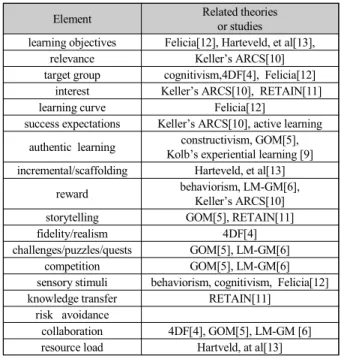
In the paper [2, 3], the contents of the analysis, the learning theory discussed in this paper, and the various studies are combined to extract the pedagogical elements of the serious game and presented in Table 4. The description of each element in Table 4 is as follows.
(1) learning objectives: Do the game precisely define the learner's learning objectives?
(2) relevance: Is it relevant to the learner's learning goals?
(3) target group: Is the target learner age appropriate? Does the learner's experience and prior knowledge be necessary?
Element Related theories
or studies
learning objectives Felicia[12], Harteveld, et al[13],
relevance Keller’s ARCS[10]
target group cognitivism,4DF[4], Felicia[12]
interest Keller’s ARCS[10], RETAIN[11]
learning curve Felicia[12]
success expectations Keller’s ARCS[10], active learning authentic learning constructivism, GOM[5],
Kolb’s experiential learning [9]
incremental/scaffolding Harteveld, et al[13]
reward behaviorism, LM-GM[6],
Keller’s ARCS[10]
storytelling GOM[5], RETAIN[11]
fidelity/realism 4DF[4]
challenges/puzzles/quests GOM[5], LM-GM[6]
competition GOM[5], LM-GM[6]
sensory stimuli behaviorism, cognitivism, Felicia[12]
knowledge transfer RETAIN[11]
risk avoidance
collaboration 4DF[4], GOM[5], LM-GM [6]
resource load Hartveld, at al[13]
Table 4. Suggested Elements for Serious Game
(4) interest: Can it attract the curiosity of the learners and maintain their interest?
(5) learning curve: Does it maintain a learning curve that can be adjusted for difficulty?
(6) success expectations: Can you have active expectations for success?
(7) authentic learning: do they accomplish through learning by doing related tasks?
(8) incremental / scaffolding: Does the game proceed progressively with increasing difficulty?
(9) reward: Is there a prize or benefit that the learner achieves or is gained by being skilled?
(10) storytelling: Does fantasy or fun apply to plot of narrative structure, story line, etc.?
(11) fidelity / realism: What is the level of realism required to achieve the learning objectives?
(12) challenges / puzzles / quests: Is there any development of problem to solve in game progress? Are there processes to overcome this?
(13) competition: Is there a process of self-improvement or competition with others?
(14) sensory stimuli: Is there visual or auditory stimulation?
(15) knowledge transfer: Can the learners' previous knowledge be used in the next phase or in other areas?
(16) risk avoidance: Is the risk or failure in the game irrelevant to the real world?
(17) collaboration: Can the player collaborate with colleagues
while playing the game? Does this apply inside and outside the game?
(18) resource load: Does not it distract the attention of learners with much information and time constraints?
(19) instructor control: Does the educator support the learner's progress and proficiency in help and advice?
(20) assessment / follow-up: Does the game adequately assess the learner's learning outcomes and maintain ongoing action?
(21) utilization of outcome: How can an educator use the summary report / overall report to enhance learning outcomes?
Ⅳ. Case Study of the Suggested Elements
4-1 Case Study of Serious Game
The GSS (Global Starup Simulation), a serious game applied to elements of the serious game in Table 4, is a virtual experience game for entrepreneurship management co-developed by Real Time Tech Co., Ltd. and Institute for Startup KAIST. This game is based on the scenario of a business start-up to help university students, prospective founders, etc. to understand the start-up correctly[14].
The main characteristics of the GSS are as follows.
(1) This game is intuitively designed and easy to understand.
(2) It has a clear learning goal for corporate management because it can simulate entrepreneurship management.
(3) It is possible to compete on a team basis, so that interest in education can be maintained.
(4) It can improve communication and collaboration ability among learners.
(5) It is possible for the educator to set the simulation environment flexibly so that the learner can be guided by the difficulty.
(6) There is a storytelling in which management activities are carried out while carrying out simulation scenarios.
(7) The learners can inquire and analyze the results of the management activities on a quarterly basis.
(8) Educators can monitor real-time management activities of learners.
Taken together, the game maintains an average rating of 3 on the elements in Table 4.
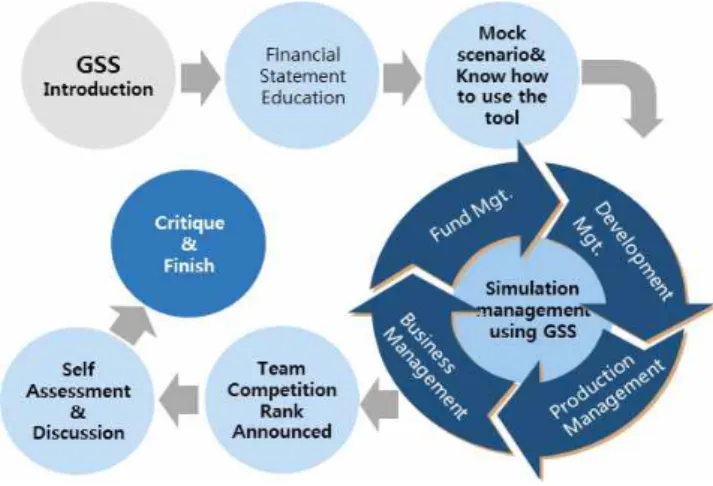
Figure 1 shows an overview of the educational process with the principles of pedagogy in the GSS game.
Fig. 1. Process of Learning
The goal of the GSS is to maximize the value of stocks owned by entrepreneurs and peers by creating profits through business activities during the forthcoming quarter. Participants will make decisions from the initial fund raising to the overall management activities, such as sales of the products, and compete with other teams (other companies) established under the same conditions at the same time. After the end of the management activities, the team that maximizes the value of the stocks owned by the founder and his colleagues will win.
One of the ongoing screen shots of the game is shown in Figure 2.
Fig. 2. Screen Shot of GSS(Production Management)
question Summary of Survey Results (multiple choice) (N = 25)
Number of Responses
① ② ③ ④ ⑤ ⑥ sum
1 Was the GSS learning interesting?
① very much so ② yes ③ normal ④ not ⑤ very bad ⑥ other 12 10 3 0 0 25
2 Do you think the GSS is a useful program for entrepreneurial education?
① very much so ② yes ③ normal ④ not ⑤ very bad ⑥ other 9 11 5 0 0 25
3 What do you think of the GSS UI (user interface)?
① very convenient ② convenient ③ normal ④ uncomfortable ⑤ very uncomfortable ⑥ other 9 7 6 3 0 25 4 What do you think about the virtual scenario complexity of the GSS?
① very complicated ② complicated ③ appropriate ④ simple ⑤ very simple ⑥ other 0 6 15 2 1 1 25 5 Was the study time adequate to understand the content of the study?
① too long ② enough ③ normal ④ insufficient ⑤ very insufficient ⑥ other 0 12 10 2 1 25 6 How difficult was the theoretical education before using the GSS?
① too difficult ② difficult ③ normal ④ easy ⑤ very easy ⑥ other 0 9 12 3 1 25 Table 5. Questionnaires of Case Study
4-2 Evaluation of Case Study
The questionnaires were surveyed on 25 students of A university which were studied by GSS, about educational interest, usefulness of education, user interface, complexity of scenario, appropriateness of play time, difficulty of education. The results are shown in Table 5.
The summary of the questionnaire after GSS game play is summarized as follows.
① Interest in education: very much so (48%), yes (40%), normal (12%)
② Usefulness of education: yes (44%), very much so (36%), normal (20%)
③ Convenience of UI: very convenient (36%), convenient (28%), normal (24%), uncomfortable(12%)
④ Scenario complexity: appropriate (60%), complicated (24%), simple (8%), very simple(4%), other (4%)
⑤ Time appropriateness: enough (48%), normal (40%), insufficient (8%), very insufficient(4%)
⑥ Difficulty of theoretical education: normal (48%), difficult (36%), easy (12%), very easy(4%)
As can be seen from the survey, the pedagogical elements of the serious game presented in this paper can play a role in evaluating the effectiveness of the serious game.
Ⅴ. Conclusion
Serious games provide a platform for active learning. The contrast between active learning and passive learning has been a widely discussed problem. Passive learning is mainly delivered in a way that relies on a single sense channel and maintains the learner's perception and intellectual coherence. Active participation, however, is one of the unique advantages of computer games. Motivation and engagement are the core of computer games and become an effective attribute to the learning environment.
This paper suggests pedagogical elements of serious games.
The theoretical basis is based on the pedagogical analysis of serious games such as 4DF[4], GOM[5], and LM-DM[6] model from Soo Cheol Ha[2,3]. In addition, learning theories such as behaviorism, cognitivism, constructivism, and situated learning, as well as the ARCS[10] model, RETAIN[11] model, and various studies based on this theory became the basis for the factor extraction.
These suggestions were evaluated on the GSS(Global Startup Simulation), which is a real serious game, and the results were confirmed through the questionnaire evaluation of the learners who are learning through it.
Future work will continue to expand the applied serious games, expand the elements, and study the detailed weights of elements.
References
![Table 2 shows the areas where designers or educators should consider learning objectives[1, 11]](https://thumb-ap.123doks.com/thumbv2/123dokinfo/5517629.458521/3.892.464.805.130.424/table-shows-areas-designers-educators-consider-learning-objectives.webp)