http://dx.doi.org/10.7783/KJMCS.2020.28.3.221
기후대별 산림환경에 따른 참당귀의 생육 및 지표성분 특성
김남수
1
· 전권석2
· 이현석3†
Characteristic of Growth and Active Ingredient in
Angelica gigas Nakai according to Forest Environment by Climate Zone
Nam Su Kim
1
, Kwon Seok Jeon2
and Hyun Seok Lee3†
서 언
다년생 초본 식물인 참당귀 (Angelica gigas Nakai)는 산형 과 (Umbelliferae) 당귀속 (Genus Angelica)에 속한다. 국내에 서 참당귀 (A. gigas Nakai)는 약용자원으로 이용하고 중국당 귀 (A. sinensis Diels)는 재배되지 않으나 약용으로 수입되고 있으며, 일당귀 (A. acutiloba Kitag)는 쌈채소 등 식용으로 이용하고 있다 (Kim et al., 2018). 대한민국약전에 따르면 참 당귀는 뿌리를 약용으로 이용하며, nodakenin과 총 decursin (decursin과 decursinol angelate)의 합이 6% 이상 함유해야 한다 (Lee et al., 2019). 현재 동의보감 처방 중 500 회 이 상, 방약합편 처방 중 150 회 이상 당귀가 언급되었으며 한약
처방에 생강, 감초 등과 더불어 가장 많이 이용되고 있다 (Park et al., 2019).
참당귀의 지표성분은 coumarin에 속하는 물질인 decursin과 decursinol angelates으로, 이는 중국당귀와 일본당귀에는 없는 성분이다. 이 성분은 당뇨합병증 개선, 기억력 개선, 항산화, 항균 등의 효능이 있는 것으로 보고되고 있으며 (Kang et al., 2003; Lee et al., 2003; Park et al., 2011; Yoon et al., 2011), 또한 폐암, 전립선암과 같은 항암에도 효능이 있는 것 으로 보고되고 있다 (Yim et al., 2005; Bae et al., 2016;
Kim et al., 2016). 또한 참당귀 추출물의 미백 및 자외선 차 단과 같은 효과로 인하여 최근 사회·경제적으로 관심이 집중 되고 있는 건강기능식품 및 화장품의 원료로 이용하려는 움직 ABSTRACT
Received: 2020 April 21 1st Revised: 2020 May 5 2nd Revised: 2020 May 11 3rd Revised: 2020 May 21 Accepted: 2020 May 21 This is an open access article distributed under the terms of the Creative Commons Attribution Non-Commercial License (http://
creativecommons.org/licenses/
by-nc/3.0/) which permits unrestricted non-commercial use, distribution, and reproduction in any medium, provided the original work is properly cited.
Background: Angelica gigas Nakai, that belong to the Umbelliferae family, is one of the tradi- tional medicinal plants in Korea. Its roots have been used to treat gynecological diseases. In this study, growth characteristics and index components were compared with the forest microclimate at several forest sites.
Methods and Results: A. gigas was planted in three climatic zones according to the temperature (southern temperature zone - Hamyang, central temperature zone - Bonghwa, and northern tem- perature zone - Jeongseon) and growth characteristics were investigated in comparison with the forest microclimate. Our results indicated that the root diameter and length, and fresh and dry weight were the highest in Jeongseon. The total content of decursin was the highest in Jeongseon (9.52%), followed by those in Hamyang (8.07%) and Bonghwa (7.48%), respectively. Addition- ally, the yield of decursin (1.39 g) was the highest in Jeongseon.
Conclusions: The yield and index components were influenced by the microclimate in the forests, and it was assumed that high altitude and low temperature affected the increase in growth and index components. These results will be useful as basic data to study the correlation among envi- ronmental conditions, growth, and index components.
Key Words: Angelica gigas Nakai, Decursin, Growth, Meteorologic Environment, Soil Character- istics
†
Corresponding author: (Phone) +82-54-820-6934 (E-mail) [email protected]
1
국립산림과학원 산림약용자원연구소 석사연구원 / Master’s Degree Researcher, Forest Medicinal Resources Research Center, NIFS, Punggi 36040, Korea.
2
국립산림과학원 산림약용자원연구소 임업연구관 / Researcher, Forest Medicinal Resources Research Center, NIFS, Punggi 36040, Korea.
3
안동대학교 원예·생약융합학부 조교수 / Assistant Professor, Andong National University, Division of Horticulture & Medicinal Plant, Andong 36729, Korea.
임이 증가하고 있다 (Kim et al., 2008; Lee et al., 2019).
우리나라에서는 경상북도 봉화군, 충청북도 제천시, 강원도 평창군과 같은 온대 중·북부 해발고 300 m 이상이며 상대적 으로 여름철 기온이 서늘한 지역에서 주로 재배되고 있다 (Yu et al., 2004). 국내 재배면적은 2018년 457 ㏊으로 2007년 692 ㏊와 비교하여 약 33.9% 감소하였으며, 생산량은 2007년 2,955 M/T에서 2018년 1,135 M/T으로 61.5%로 크게 감소하 였다 (MAFRA, 2019). 고온에 취약한 참당귀의 생육특성을 고려하면 기후변화로 인한 평균기온 상승은 생산량과 재배면 적에 적지 않은 영향을 미칠 것으로 예상된다.
참당귀 재배에 관한 연구는 직파 및 이식 차이 (Nam et al., 1999), 묘두 직경에 따른 생육 차이 (Yu et al., 2000), 온도 및 일장 조건 (Ahn et al., 1994), 친환경 유기질 비료 사용 (Kim et al., 2014), 미네랄 및 호르몬 제제 처리 (Lee et al., 2018), 추대 참당귀의 이용가능성 평가 (Lee et al., 2019) 등이 보고되었다. 최근 기후변화 등 생육환경의 변화와 관련하여 재배지 환경에 따른 생육특성 및 지표성분 비교 (Kim et al., 2019) 연구가 보고되었지만, 참당귀의 자생지인 기후대별 산림 내 입지환경과 생육특성 및 지표성분 관계에 관한 연구는 미흡한 실정이다.
본 연구는 기후변화로 인하여 점진적으로 참당귀의 재배적 지가 감소되고 있는 추세에 대응하고자, 입지환경과 생육특성 간의 상관관계를 구명하고 산림 내 재배를 위한 기초자료를 제공하기 위하여 수행되었다.
재료 및 방법
1. 시험지 조성 및 기후 특성 조사
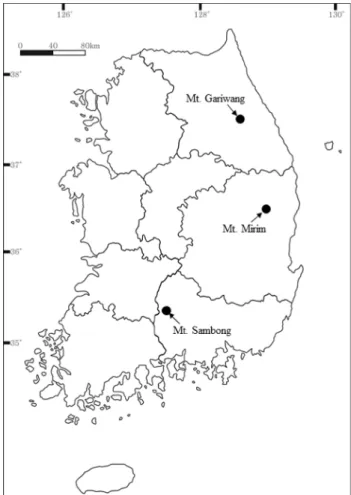
기후대별 온대남부 (경남 함양군 삼봉산), 온대중부 (경북 봉화군 미림산)과 온대북부 (강원 정선군 가리왕산)에 총 3 개소의 시험지를 조성하였다 (Fig. 1). 각 시험지별 3 반복으 로 참당귀 (Angelica gigas Nakai) 실생묘 2년생을 2019년 3 월에 이랑 35 ㎝, 고랑 35 ㎝, 재식거리 30 ㎝로 식재하였다.
시험지의 위치와 고도는 GPS 기기 (NAVA Pro 70, BHCnav Co., Ltd., Beijing, China)를 이용하여 측정하였으며, 기온, 토 양온도, 토양수분함량, 일조량 등 미기후는 기상관측장비 (U30 Data Logger, Onset HOBO, Bourne, MA, USA)를 이용하
였다 (Table 1).
2. 토양특성 조사
토양 시료는 각 시험구에서 유기물을 제거하고 무작위로 100 g씩 3 반복으로 채취하였으며, 2 ㎜로 체별한 후 분석에 사용하였다.
토양 내 모래, 미사, 점토의 함량을 분석하기 위해 USDA (United States Department of Agriculture)에 의한 입도 분류 를 실시하였으며, 토양 내 유기물 함량은 Walkley-Black법 (Walkley and Black, 1934), 전질소는 Kjeldahl 황산분해증류 법 (Konen et al., 2002), 전기전도도 (electiric conductivity, EC)와 토양 pH는 토양과 증류수 비율을 1 : 5 (w/v)가 되도 록 혼합하여 1 시간 후 상등액의 전기전도도와 pH를 측정하 였다. 유효인산은 분광광도계를 이용하여 Lancaster 침출법 분 석을 하였으며, 칼륨, 칼슘, 마그네슘과 같은 치환성 양이온 분 석은 원자방출분광광도계 (Inductively Coupled Plasma Optical Emission Spectrometry, PerkinElmer Inc., Waltham, MA, USA)에 ammonium acetate (Samchun chemical Co., Ltd., Seoul, Korea)을 이용하여 분석하였다.
Fig. 1. The map of A. gigas Nakai cultivation area.
Table 1. The geographical and meteorological information of A.
gigas Nakai cultivation area.
Cultivation area Coordinate
Altitude (m) North latitude East longitude
Hamyang N 35˚ 26' 57" E 127˚ 41' 41" 672 Bonghwa N 36˚ 50' 51" E 128˚ 55' 47" 586 Jeongseon N 37˚ 28' 10" E 128˚ 36' 04" 712
3. 생육특성조사
생육이 왕성한 8월에 지상부의 초장, 줄기 직경, 엽장, 엽 폭을 조사하였으며, 수확기인 10월 말에 지하부의 근장, 근직 경, 지근 수 생중량을 조사하였다. 생육특성은 각 시험지별 10 개체씩 3 반복으로 조사하였다. 그 후 건조기 (DY-420H, Lassele Co., Ltd., Ansan, Korea)를 이용하여 50℃로 7 일간 건조시켜 항량에 도달했을 때 건중량을 측정하였다.
4. 지표성분 함량 분석
지표성분은 뿌리의 nodakenin, decursin과 decursinol angelate을 함량을 분석하였다. 각 시험지별로 10 개체씩 3 반복으로 수집된 시료를 건조 및 분쇄 후 70% ethanol (Samchun chemical Co., Ltd.,, Seoul, Korea)을 이용하여 15
℃ - 35 ℃에서 20 분간 초음파 (WUC-06H, DAIHAN scientific Co., Ltd., Wonju, Korea) 추출하였다.
추출 후 PVDF 0.45 ㎛ syringe filter (Advantec, Tokyo, Japan)를 이용하여 여과하였다. 정량분석은 High Performance Liquid Chromatography (HPLC, Shimadzu Nexera series, Shimadzu Co., Kyoto, Japan)를 이용하였으며, 컬럼은 Hypersil
GOLD C18 (Thermo Fisher Scientific Inc., Waltham, MA, USA)을 사용하였다 (Table 2). 본 실험에 사용된 용매는 물과 acetonitrile으로, 사용 전 sonicator에서 30 min 간 탈기하여 사용하였다. 유속은 1.0 ㎖/min, 컬럼 온도는 30 ℃, UV 파장 은 330 ㎚으로 설정하였으며, water : acetonitrile = 80 : 20 으로 시작하여 45 분간 acetonitrile 비율을 점차 증가시켰다.
각 성분별 표준품 nodakenin, decursin (Sigma-Aldrich Co., St. Louis, MO, USA), decursinol angelate (Biopurify Phytochemicals Ltd., Chengdu, China)을 이용하여 20, 100, 200 ㎍/㎖의 농도로 표준검량선을 작성하였다. 각 성분별 면 적값을 검량선에 대입하여 농도를 측정한 후 시료의 단위 중 량 당 지표성분의 농도 (%)를 나타내었다.
5. 통계분석
통계분석은 SAS (Statistical Analysis System ver. 9.2, SAS Institute Inc., Cary, NC, USA) 프로그램을 이용하여 일 원배치분산분석 (One-way ANOVA) 후 던컨의 다중범위 검정 (Duncun’s Multiple Range Test)을 수행하였다 (p < 0.05).
입지환경과 생육특성 간 상관관계는 동일한 프로그램을 이용 하여 피어슨 상관계수 (Pearson’s correlation coefficient)를 분 석하였다.
결과 및 고찰
1. 기후대별 시험지 미기후 특성
기후대별 시험지 [온대남부 (이하 함양), 온대중부 (이하 봉 화), 온대북부 (이하 정선)]의 기온, 토양온도, 토양수분함량 및 일조량을 비교한 결과 (Fig. 2), 평균 월별 기온과 토양온도는 봉화 > 함양 > 정선 시험지 순으로 높았다. 일반적으로 남부 지역일수록 기온이 높을 것으로 판단되나 본 연구에서는 온대 중부 지역인 봉화 시험지가 가장 높았다. 이는 봉화 시험지의 일조량이 함양과 정선에 비해 높았기 때문으로 사료된다. 토 양 수분함량을 비교한 결과, 함양이 봉화 및 정선과 비교하여 높았다. 일조량, 해발고 및 토양수분 등 입지환경은 식물체의 생육 특성에 크게 영향을 끼치게 된다 (Hautier et al., 2009;
Kami et al., 2010; Li et al., 2010).
2. 기후대별 시험지 토양특성
각 시험지 토양의 특성을 비교하기 위하여 토성과 토양 이 화학성 분석을 실시하였다 (Table 3). 봉화 및 정선은 모래 45% 이상, 미사 28% 이하, 점토 20% - 35%인 사질식양토 (sandy clay loam)로 나타났으며, 함양은 모래 65% - 85%, 점 토 0% - 15%인 사양토 (sandy loam)로 조사되었다. 토양 pH 는 모든 시험지에서 약산성을 보이며, 함양, 봉화 및 정선에서 각각 4.14 5.04 및 5.06으로 나타났다. 유기물 함량은 함양에 Table 2. The HPLC condition of nodakenin, decursin and
decursinol angelate analysis.
Instrument Condition
HPLC
Shimadzu, Japan Degassing unit: DGU-20A Liquid chromatograph: LC-20AD Auto sampler: SIL-20A
Column oven: CTO-20A Diode array detector: SPD-M20A Communications bus module: CBM-20A Column Thermo Hypersil GOLD C18 (5 ㎛, 4.6 ×
250 ㎜) Mobile phase A) Acetonitrile
B) Water Flow rate 1.0 ㎖/min Column temperature 30 ℃
Injection Volume 5 ㎕
Gradient elution
Time (min) Solvent (% A)
0 - 3 20 - 20
3 - 8 20 - 30
08 - 18
30 - 3018 - 19 30 - 50
19 - 40 50 - 50
40 - 41 50 - 90
41 - 45 90 - 90
45 - 50 20 - 20
UV condition Wavelength 330 ㎚
서 12.51%로 가장 높은 함량을 보였으며, 이와 더불어 질소함 량 0.48%, 유효인산량 137.53 ㎎/㎏ 및 전기 전도도 0.13 dS/m 으로 함양이 높은 것으로 나타났다. 유기물 함량이 높다 는 것은 산림토양의 유기물 층이 두껍다는 의미이고, 이는 함 양의 토양수분이 다른 시험지에 비해 높은 것과 관련된다고 사료된다.
토양 유기물과 N, P, K을 처리한 옥수수와 대조군 옥수수의 생산량과 토양환경의 차이를 비교하였는데, 그 결과 유기물과 N, P, K을 처리하였을 때 식물의 생육상황을 긍정적으로 변화 시키고 생산량이 증가하는 것을 확인하는 연구가 보고된 바 있다 (Zhong et al., 2010). 또한 유기물 함량이 높은 재배지 에서 참당귀 (Angelica gigas Nakai)의 근직경, 근장 및 엽장 등 생육상황과 decursin 및 decursinol angelate 등 지표성분 함량이 우수한 경향을 보인 연구 결과가 있다 (Kim et al., 2019).
토양의 양이온치환 용량은 함양에서 29.53 c㏖c+/㎏ 로 가장 높은 수치를 보였으며, 봉화와 정선은 각각 15.83 c㏖c+/㎏, 18.53 c㏖c+/㎏ 으로 비슷하였다 (Table 4). 기후대별로 K+, Na+은 유의적인 차이를 보이지 않았지만, Ca2+ 및 Mg2+은 봉 화에서 각각 2.7 c㏖c+/㎏, 0.56 c㏖c+/㎏ 으로 높게 나타나
통계적으로 유의한 차이를 보였다.
약용작물의 생육상황 개선을 위해 산성화된 토양에 석회를 처리하여 Ca2+ 이온 흡수 촉진을 유도하는 연구가 보고된 바 있으며 (Côté et al., 1995; Ouimet and Camiré, 1995), Ca2+가 뿌리 생육에 도움을 줄 수 있다는 연구가 보고된 바 있다 (Nadeau and Olivier, 2003). 또한 Mg2+의 경우는 병충 해 저항에 도움을 주며, 식물체 내에서 세포의 팽압 유지와 수분조절에 영향을 끼친다는 연구가 보고 된 바 있다 (Ouimet and Camiré, 1995).
하지만 본 연구에서는 기후대별로 생육상황이 가장 양호한 시험지는 정선으로 Ca2+및 Mg2+은 중앙값으로 나타나 선행 연구와는 다른 결과가 나타났다. 이는 토성, 기온, 광량 및 해 발고 등 다른 환경 요인에 의한 결과로 사료된다.
3. 기후대별 시험지 생육특성
기후대별 시험지의 참당귀 생육조사를 실시한 결과, 지상부 의 길이는 정선에서 29.07 ㎝ 로 다른 시험지와 비교하여 유 의한 차이를 보이며 높은 수치를 확인 할 수 있었다. 이와 더 불어 줄기 직경, 엽장 및 엽폭이 각각 7.15 ㎜, 21.63 ㎝ 및 25.90 ㎝ 로 정선이 높은 값을 보였다. 이는 기온, 토양온도 Fig. 2. The graph of meteorological information in A. gigas Nakai cultivation area from January to October. (A); temperature, (B);
soil temperature, (C); soil moisture, (D); solar radiation.
및 수분함량 등 미기후가 지상부의 생육에 영향을 미치는 것 으로 판단되며 기후대 및 해발고와 밀접한 관련이 있다고 사 료된다 (Table 5).
지하부의 생육특성도 지상부 결과와 비슷한 경향을 확인할 수 있었다. 생중량 및 건중량은 정선에서 각각 47.29, 14.61 g 으로 가장 높게 나타났으며 근장은 정선에서 35.72 ㎝ 로 함양과 비교하여 높은 값을 보였으나 통계적으로 유의하지 않 았다. 지근 수는 봉화가 가장 적은 수를 보였으며 근직경은 기후대별로 유의적인 차이가 없었다 (Table 6).
4. 기후대별 지표성분 함량특성
참당귀의 지표성분인 nodakenin, decursin과 decursinol
angelate의 함량을 분석하였다 (Table 7). 결과적으로 nodakenin을 제외한 decursin, decursinol angelate와 지표성분 총 함량이 정선에서 가장 높았다.
Kim 등 (2019)은 주산지인 평창, 제천 및 봉화지역 참당귀 의 지표성분을 비교한 결과, 해발고가 높고 강수량이 낮은 평 창 지역에서 지표성분이 5.31%로 가장 높았으며, 해발고와 유 기물 함량, 전기전도도와 양의 상관관계이고, 강수량은 음의 상관관계에 있다고 보고한 바 있다. 본 연구에서도 해발고가 높고 기온과 토양수분 함량이 낮은 정선에서 생육이 가장 왕 성하였고, 지표성분의 함량이 높게 나타났다. 이는 서늘한 기 후가 참당귀의 생육 적지라는 기존의 문헌 등의 내용과 같은 결과라고 할 수 있다.
Table 3. Edaphic characteristics of A. gigas Nakai among different cultivation area.
Cultivation areas Soil type pH (1 : 5, H2O)
OM1) (%)
Total N (%)
Avai. P2)
(㎎/㎏) EC3)
(dS/m) Hamyang 5)SL4) 4.14±0.09b 12.51±1.36a 0.48±0.09a 137.53±38.53a 0.13±0.04a Bonghwa 5)SCL5) 5.04±0.07a
05.37±1.19
b 0.25±0.03b012.62±3.07
c 0.05±0.01b Jeongseon SCL 5.06±0.19a06.37±1.37
b 0.26±0.06b071.99±16.42
b 0.05±0.02b1)OM; organic matter, 2)Avai. P; available phosphate, 3)EC; electric conductivity, 4)SL; sandy loam, 5)SCL; sandy clay loam. All data are showed by the means ± SD (n ≥ 3). *Values followed by different letters within a column indicate significant difference between substrates for that parameter using DMRT (Duncan’s Multiple Range Test) at 5% level (p < 0.05).
Table 4. The content of exchangeable cation and cation exchange capacity of A. gigas Nakai among different cultivation area.
Cultivation areas K
(c㏖c+/㎏) Na
(c㏖c+/㎏) Ca
(c㏖c+/㎏) Mg
(c㏖c+/㎏) CEC
(c㏖c+/㎏)
Hamyang 0.11±0.03a 0.03±0.02a 0.54±0.17c 0.10±0.02c 29.53±3.65a
Bonghwa 0.13±0.02a 0.05±0.02a 2.70±0.28a 0.56±0.09a 15.83±2.45b
Jeongseon 0.16±0.05a 0.04±0.01a 1.33±0.56b 0.26±0.08b 18.38±3.50b
All data are showed by the means ± SD (n ≥ 3). *Values followed by different letters within a column indicate significant difference between substrates for that parameter using DMRT (Duncan’s Multiple Range Test) at 5% level (p < 0.05).
Table 5. Growth characteristics of A. gigas Nakai shoot among different area.
Cultivation area Shoot length (㎝) Stem diameter (㎜) Leaf length (㎝) Leaf width (㎝)
Hamyang 22.70±5.35b 4.87±1.12c 15.95±3.73b 17.40±3.99b
Bonghwa 23.82±6.33b 6.12±1.50b 20.25±3.36a 22.84±4.75a
Jeongseon 29.07±5.36a 7.15±1.97a 21.63±5.50a 25.90±6.07a
All data are showed by the means ± SD (n ≥ 30). *Values followed by different letters within a column indicate significant difference between substrates for that parameter using DMRT (Duncan’s Multiple Range Test) at 5% level (p < 0.05).
Table 6. Growth characteristics of A. gigas Nakai root among different area.
Cultivation area Root length (㎝) Root
diameter (㎜) Number of supporting root (ea)
Fresh weight (g)
Dry weight (g)
Hamyang 32.35±6.55a 23.00±5.45a 10.73±4.01a 36.78±21.48b
09.99±6.12
bBonghwa 25.39±4.40b 23.64±3.62a
06.90±1.92
b 42.52±16.41ab 12.87±4.81ab Jeongseon 35.72±9.96a 25.20±5.47a09.17±2.90
a 47.29±19.99a 14.61±6.09a All data are showed by the means ± SD (n ≥ 30). *Values followed by different letters within a column indicate significant difference between substrates for that parameter using DMRT (Duncan’s Multiple Range Test) at 5% level (p < 0.05).Lee 등 (2019)은 뿌리 부위에 따라 신, 대미, 중미 및 세미 4 부위로 구분하여 decursin 및 decursinol angelate 함량을 분석하여 부위별로 비교하였으며, 근직경이 가장 큰 신 부위 에서 함량이 낮았고 근직경이 가장 작은 세미에서 함량이 높 다는 결과를 도출하였다. 이는 인삼의 근직경이 작을수록 진 세노사이드의 함량이 증가한다는 연구 결과와 유사하였다 (Yang and Yang, 2000).
기후대별로 지표성분 생산량을 비교하기 위하여 건중량과 nodakenin, decursin 및 decursinol angelate의 함량을 곱하여 지표성분 생산량을 구하였다 (Table 8). 결과적으로 정선의 지표성분 총 1.39 g 으로 가장 높은 생산량을 보였으며, nodakenin은 기후대별로 유의적인 차이를 보이지 않았지만 decursin 및 decursinol angelate은 지표성분 총 생산량과 같은 경향을 보였다.
5. 입지환경, 생육특성과 지표성분 간의 상관관계
참당귀의 입지환경, 생육특성과 지표성분 함량 간의 단순상 관분석 (Pearson’s correlation analysis)을 실시하였다. 초장은 유효인산과 정의 상관관계를 보였으며 Mg2+과는 부의 상관관 계를 보였다 (Table 9). 엽폭은 K+과 정의 상관관계를 보였다.
지근 수는 유효인산과 정의 상관관계를 보이며 Na+, Ca2+, Mg2+과는 부의 상관관계를 보였다. 지표성분의 함량과 토양환 경 간에는 유의한 상관관계는 보이지 않았다 (Table 9).
해발고는 초장, 근장, 지근 수, nodakenin 및 decursin 함 량과 정의 상관관계가 나타났고, 일조량은 지상부, 특히 잎 의 발달과 양의 상관관계를 보였다. 지표성분인 nodakenin, decursin, decursinol angelate 는 해발고와 양의 상관관계가 나타났으나, 나머지 요인들과는 음의 상관관계를 보였다 (Table 10).
Seong 등 (1993)은 생육 초기인 4월부터 7월까지는 일교차 Table 7. The content of active compound in A. gigas Nakai among different cultivation area.
Cultivation area Nodakenin (%) Decursin (%) Decursinol angelate (%) Total (%)
Hamyang 0.54±0.20a* 4.57±1.46b 2.96±0.89a 8.07±2.29b
Bonghwa 0.35±0.08b 4.06±0.96b 3.07±0.59a 7.48±1.44b
Jeongseon 0.41±0.11b 5.81±1.00a 3.30±0.71a 9.52±1.57a
All data are showed by the means ± SD (n ≥ 30). *Values followed by different letters within a column indicate significant difference between substrates for that parameter using DMRT (Duncan’s Multiple Range Test) at 5% level (p < 0.05).
Table 8. The yield of active compound in A. gigas Nakai among different cultivation area.
Cultivation areas Nodakenin (g) Decursin (g) Decursinol angelate (g) Total (g)
Hamyang 0.06±0.04a* 0.48±0.43b 0.31±0.25b 0.85±0.71b
Bonghwa 0.05±0.02a 0.52±0.23b 0.39±0.14ab 0.95±0.39b
Jeongseon 0.06±0.03a 0.84±0.38a 0.49±0.27a 1.39±0.66a
All data are showed by the means ± SD (n ≥ 30). *Values followed by different letters within a column indicate significant difference between substrates for that parameter using DMRT (Duncan’s Multiple Range Test) at 5% level (p < 0.05).
Table 9. Correlation coefficient between edaphic characteristics and growth characteristic in A. gigas Nakai.
Growth characteristic
OM (%)
Total N (%)
Avai. P
(㎎/㎏) K
(c㏖c+/㎏) Na
(c㏖c+/㎏) Ca
(c㏖c+/㎏) Mg
(c㏖c+/㎏) CEC (c㏖c+/㎏)
Shoot length
-0.433 -0.309 -0.711
*-0.288
-0.520 -0.664 -0.744*-0.471
Leaf length -0.267 -0.268
-0.020 -0.528
-0.010-0.053
-0.019 -0.191Leaf width
-0.364
-0.385 -0.097-0.746
*-0.022
-0.004 -0.041 -0.301Root length
-0.164
-0.041-0.368
-0.222 -0.224 -0.600 -0.605-0.126
Root diameter -0.589 -0.712* -0.228
-0.396 -0.119 -0.175 -0.115
-0.552Number of supporting root
-0.655 -0.476 -0.885
** -0.041 -0.742* -0.816** -0.860**-0.663
Fresh weight -0.645 -0.773* -0.290
-0.250 -0.164 -0.169 -0.133
-0.623Nodakenin
-0.185 -0.027 -0.452 -0.477
-0.620 -0.226 -0.292-0.244
Decursin
-0.121
-0.054-0.411
-0.018 -0.339 -0.523 -0.558-0.119
Decursinol angelate -0.007 -0.228
-0.236
-0.218 -0.422 -0.150 -0.175-0.009
All statistical analyses were performed using Pearson’s correlation analysis (*p < 0.05 and **p < 0.01).
가 크고 일사량과 일조시수가 많은 환경이 당귀의 지상부 생 육에 유리하고 생육 후기인 8월부터 10월까지는 기온이 서늘 하고 강수량이 적은 조건이 지하부 비대 및 양분축적에 유리 하다고 보고하였다. Choi 등 (2010)은 토양 유기물로부터 미 생물이 이용할 수 있는 에너지원 (C)과 영양원 (N)을 동시에 얻을 수 있기 때문에 식물 생산량이 토양 유기물 영향이 적지 않고, 토성과 관련하여 유효성분 생산량이 모래와는 음의 상 관관계, 미사와는 양의 상관관계가 나타난다고 보고하였다. 이 는 정선이 지상부 생육상황이 양호하고 생산량이 높은 것으로 나타난 본 연구 결과와 비슷한 경향이라고 할 수 있다. Park 등 (2019)은 점봉산 자생지 8 개 집단에서 참당귀를 수집하여 토양특성과 생육특성 및 지표성분 함량 간의 상관관계를 분석 한 결과 토양의 K+, Mg2+, Na+이 뿌리 생장과 높은 정의 상 관관계를 보였다고 한다.
참당귀의 생산량 및 성분은 입지환경 조건에 따라 크게 영 향을 받는데, 해발고가 높고 기온이 낮은 지역에서 재배하는 것이 지표성분 함량 및 생산량 증가에 유리하다고 사료된다.
참당귀 생육과 관련한 환경인자들의 작용을 명확하게 구명하 기 위해서는, 본 연구결과를 토대로 기온, 일조량 등 단일 혹 은 복합 인자들의 인위적인 제어가 가능한 조건 하에서 추가 적인 연구수행이 가능할 것이다.
본 연구는 기후대별 산림 내 입지환경 조건과 참당귀 생육 및 지표성분 함량의 상관관계 정보를 제공하고 기후변화에 대 응하는 재배환경 연구의 기초자료가 될 수 있을 것으로 판단 된다.
REFERENCES
Ahn SD, Yu CY and Seo JS. (1994). Effect of temperature and daylength on growth and bolting of Angelica gigas Nakai.
Korean Journal of Medicinal Crop Science. 2:20-25.
Bae WJ, Ha US, Choi JB, Kim KS, Kim SJ, Cho HJ, Hong SH, Lee JY, Wang Z, Hwang SY and Kim SW. (2016).
Protective effect of decursin extracted from Angelica gigas in male infertility via Nrf2/HO-1 signaling pathway. Oxidative Medicine and Cellular Longevity. 2016:5901098. http://dx.doi.
org/10.1155/2016/5901098 (cited by 2020 March 20).
Choi BS, Jung JA, Oh MK, Jeon SH, Goh HG, Ok YS and Sung JK. (2010). Effects of green manure crops on improve- ment of chemical and biological properties in soil. Korean Journal of Soil Science and Fertilizer. 43:528-536.
Côté B, O’Halloran I, Hendershot WH and Spankie H. (1995).
Possible interference of fertilization in the natural recovery of a declining sugar maple stand in southern Quebec. Plant and Soil.
168:471-480.
Hautier Y, Randin CF, Stöcklin J and Guisan A. (2009).
Changes in reproductive investment with altitude in an alpine plant. Journal of Plant Ecology. 2:125-134.
Kami C, Lorrain S, Hornitschek P and Fankhauser C. (2010).
Light-regulated plant growth and development. Current Topics in Developmental Biology. 91:29-66.
Kang SY, Lee KY, Park MJ, Kim YC, Markelonis GJ, Oh TH and Kim YC. (2003). Decursin from Angelica gigas mitigates amnesia induced by scopolamine in mice. Neurobiology of Learning and Memory. 79:11-18.
Kim CH, Kwon MC, Han JC, Na CS, Kwak HG, Choi GP, Park UY and Lee HY. (2008). Skin-whitening and UV- protective effects of Angelica gigas Nakai extracts on ultra high pressure extraction process. Korean Journal of Medicinal Crop Science. 16:255-260.
Kim JW, Yun MY, Kim EO, Jung DB, Won GH, Kim BL, Jung JH and Kim SH. (2016). Decursin enhances TRAIL- induced apoptosis through oxidative stress mediated-endoplasmic reticulum stress signalling in non-small cell lung cancers.
British journal of pharmacology. 173:1033-1044.
Kim NS, Jung DH, Jung CR, Kim HJ, Jeon KS and Park HW.
(2019). Comparison of growth and contents of active ingredients of Angelica gigas Nakai under different cultivation areas. Korean Journal of Plant Resources. 32:448-456.
Kim YG, An TJ, Yeo JH, Hur M, Park YS, Cha SW, Song BH Table 10. Correlation coefficient between meteorological characteristics and growth characteristic in A. gigas Nakai.
Growth characteristic Altitutde Temperature Soil temperature Soil moisture Solar radiation
Shoot length 0.278*
-0.011
-0.046 -0.016-0.180
Leaf length 0.013 -0.052 -0.072 -0.291
-0.416
*Leaf width 0.090 -0.100 -0.101 -0.274
-0.246
Root length 0.512**
-0.096 -0.073 -0.192 -0.148
Root diameter 0.099 -0.188 -0.175 -0.237 -0.277
Number of supporting root 0.344** -0.137 -0.146
-0.284
-0.399Fresh weight 0.057 -0.170 -0.178 -0.282
-0.198
Nodakenin 0.261* -0.019 -0.045
-0.090 -0.143
Decursin 0.491** -0.312 -0.316 -0.238 -0.061
Decursinol angelate 0.093 -0.399* -0.398* -0.324 -0.039
All statistical analyses were performed using Pearson’s correlation analysis (*p < 0.05 and **p < 0.01).
and Lee KA. (2014). Effects of eco-friendly organic fertilizer on growth and yield of Angelica gigas Nakai. Korean Journal of Medicinal Crop Science. 22:127-133.
Kim YS, Park HJ, Lee DH and Kim HK. (2018). Development of multiples polymerase chain reaction assay for identification of Angelica species. Korean Journal of Medicinal Crop Science.
26:26-31.
Konen ME, Jacobs PM, Burras CL, Talaga BJ and Mason JA.
(2002). Equations for predicting soil organic carbon using loss- on-ignition for north central U.S. soils. Soil Science Society of America Journal. 66:1878-1881.
Lee SH, Lee SH, Jin ML, Hong CO, Hur M, Han JW, Lee WM, Yun HM, Kim YB, Lee Y and Koo SC. (2019).
Analysis of index component content and antioxidant activity according to the root diameter of Angelica gigas Nakai. Korean Journal of Plant Resources. 32:116-123.
Lee SH, Lee YS, Jung SH, Shin KH, Kim BK and Kang SS.
(2003). Antioxidant activities of decursinol angelate and decursin from Angelica gigas roots. Natural Product Sciences.
9:170-173.
Lee SH, Yun HM, Koo SC, Lee WM, Chang JK, Koo HJ, Jang KJ and Kim YB. (2018). Changes in the growth characteristics and the content of decursin and decursinol angelate in Angelica gigas Nakai by mineral and hormonal agent treatment. Korean Journal of Medicinal Crop Science.
26:227-232.
Li Q, Dong B, Qiao Y, Liu M and Zhang J. (2010). Root growth, available soil water, and water-use efficiency of winter wheat under different irrigation regimes applied at different growth stages in North China. Agricultural Water Management.
97:1676-1682.
Ministry of Agriculture, Food and Rural Affairs(MAFRA).
(2019). 2018 an actual output of crop for a special purpose.
Ministry of Agriculture, Food and Rural Affairs. Sejong, Korea.
p.21.
Nadeau I and Olivier A. (2003). The biology and forest cultivation of American ginseng(Panax quinquefolius L.) in Canada. Canadian Journal of Plant Science. 83:877-891.
Nam HH, Choi DW, Kim KU, Kwon OH and Choi BS. (1999).
Growth analysis of Angelica gigas Nakai affected by cultivation methods. Korean Journal of Medicinal Crop Science. 7:218- 228.
Ouimet R and Camiré C. (1995). Foliar deficiencies of sugar
maple stands associated with soil cation imbalances in the Quebec Appalachians. Canadian Journal of Soil Science.
75:169-175.
Park HY, Kwon SB, Heo NK, Chun WJ, Kim MJ and Kwon YS. (2011). Constituents of the stem of Angelica gigas with rat lens aldose reductase inhibitory activity. Journal of the Korean Society for Applied Biological Chemistry. 54:194-199.
Park YM, Jeong DH, Sim SJ, Kim NH, Park HW and Jeon GS. (2019). The characteristics of growth and active compounds of Angelica gigas Nakai population in Mt. Jeombong. Korean Journal of Plant Resources. 32:9-18.
Seong NS, Lee SW, Kim KS and Lee ST. (1993). Environmental variation of decursin content in Angelica gigas. Korean Journal of Crop Science. 38:60-65.
Walkley A and Black IA. (1934). An examination of the Degtjareff method for determining soil organic matter and a proposed modification of the chromic acid titration method.
Soil Science. 37:29-38.
Yang DC and Yang KJ. (2000). Patterns and contents of ginsenoside in normal root parts and hairy root lines of Panax ginseng C.A. Meyer. Korean Journal of Plant Tissue Culture.
27:485-489.
Yim DS, Singh RP, Agarwal C, Lee SY, Chi HJ and Agarwal R. (2005). A novel anticancer agent, decursin, induces G1 arrest and apoptosis in hunman prostate carcinoma cells. Cancer Research. 65:1035-1044.
Yoon MY, Kim YS, Choi GJ, Jang KS, Choi YH, Cha BJ and Kim JC. (2011). Antifungal activity of decursinol angelate isolated from Angelica gigas roots against Puccinia recondita.
Research in Plant Disease. 17:25-31.
Yu HS, Bang JK, Kim YG, Seong NS, Lee BH and Jo JS.
(2000). Effect of root head diameter of seedling on growth and bolting response in Angelica gigas Nakai. Korean Journal of Medicinal Crop Science. 8:283-289.
Yu HS, Park CH, Park CG, Kim YG, Park HW and Seong NS.
(2004). Growth characteristics and yield of the three species of genus Angelica. Korean Journal of Medicinal Crop Science.
12:43-46.
Zhong W, Gu T, Wang W, Zhang B, Lin X, Huang Q and Shen W. (2010). The effects of mineral fertilizer and organic manure on soil microbial community and diversity. Plant and Soil. 326:511-522.