Technical Trend of the Power Shift Transmission (PST) of Agricultural Tractor
Md Abu Ayub Siddique, Taek-Jin Kim, and Yong-Joo Kim
1. Introduction
Agricultural tractors are being automation and intelligence due to enhance working efficiency, minimize driving effort, and adjust precision agriculture.
Tractors are designed to deliver high traction forces at low speed. It is important for a powertrain to supply continuous power to the driving axles during operations.
That is why several researchers and manufacturers developed various power transmission systems.
There are two types of transmissions for tractor such as manual transmission (MT), automatic transmission (AT). The AT is called auto or self-shifting transmission or n-speed transmission, which changes gear ratios at various steps or automatically. The AT of the tractor is also two types, which are step and stepless transmission. On the basis of variable transmissions, the speeds may be variable in discrete steps or continuously variable within a range. The step-variable transmissions usually employ either gears or chains and provide fixed speed ratios with no-slip (Xu et al. 2018). The step-variable transmission includes the two types of power-shift transmission (PST) and dual-clutch transmission (DCT). According to Blagonravov et al., (2016), the stepless transmissions use either belts, chains, or rolling-contact bodies. It is classified as the hydro-mechanical transmission (HMT) and hydrostatic transmission (HST). This study deals with the power-shift transmission (PST).
The PST is the technology that allows the changing gears on the run under loads conditions of the vehicles.
Li et al., (2018) reported that the PST is one of the key technologies of a tractor for an engaging clutch by an electric control system to improve the power, economy, and driving comfort. In addition, the PST is the most popular advanced technology for power transmission due to be comparatively easier and
convenient to control and maintain on-farm for a driver (Liang et al., 2018). There are two types of PST such as the partial and full PST. The partial PST deals two or more speeds without a clutch, although it must have clutched to shift gears, and a full PST means the users can shift all gears without clutching.
The ZF and CARRARO are specialist companies of transmission, who lead the design, manufacture, and supply of power-shift transmission for a medium and large industrial vehicle, construction machinery, and tractors. They are continuously developing new technologies to improve efficiency, reduce fuel consumption, and improve reliability by implementing the advanced control techniques of their products.
According to Liang et al. (2018), MT efficiency is almost 96%, which is the highest. AT is around 86%
with high torque like MT. In the case of HMT, the overall efficiency is approximately 85% (Zhou et al., 2014), and can transmit power smoothly. However, the HMT is applicable to high-power vehicles. According to John Deere, the HMT is around 5% better in fuel consumption than the e23 power-shift transmission, but the PST has a high performance of shifting, and quick response (Panzani et al., 2010). Tseng and Yu (2015) reported that the PST can remove the clutch friction in the vehicle without losses of the dynamic performance.
Nievelstein (2005) mentioned several factors that influence fuel consumption such as weight, design, speed, and driver of the PST vehicle. Nievelstein observed that the PST can save almost 1.9~4.7% of fuel effectively.
Tanelli et al., (2011) reported that the PST is a very popular technology for power transmission to ensure the maximum flexibility of use at each speed and to exploit the maximum engine power available in all working conditions. Yang et al., (2018) also reported that the most important reason for getting popularity of the PST is the wide range of applications (from low to high
power vehicles) than the HMT. Considering drivers’
comfort, flexibility, smooth shifting power, fuel economy, and especially wide range of applications, the technical trend of the PST technology for agricultural tractors was reviewed, but the limitation of this technical review is that this paper is emphasized on the commercialization of PST technology only. Therefore, the objective of this technical review is to introduce the technical trend of the PST for agricultural tractors.
2. Commercialized PST for agricultural tractors
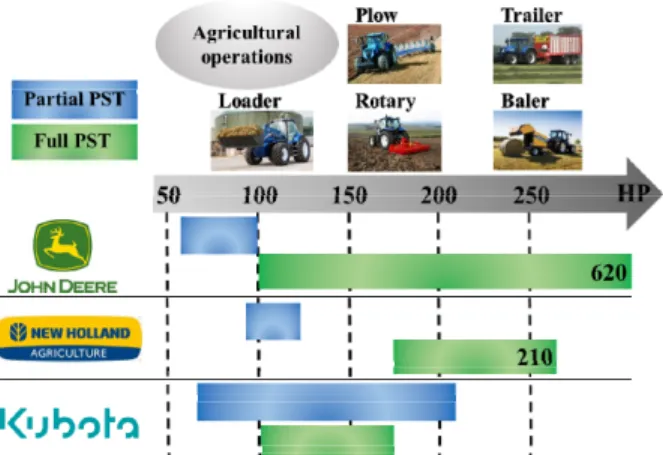
The tractor manufacturing companies such as John Deere, New Holland, Kubota, DEUTZ FAHR, Case IH, and STEYR who are commercially customized their machinery using the partial and full PST technologies and selling globally. It was found that the tractor manufacturing companies have commercialized both partial and full PST. It was noticed that most of the companies customized their low horsepower machinery with partial PST and high horsepower machinery with full PST. New Holland uses partial PST up to T7.210 model tractors, and full PST was applied from T7.170 to the T7.260 model of tractors. In the case of Kubota, it was observed that they manufactured the M8 series (210 hp) tractor with the partial PST. The status of the commercialized PST is in Fig. 1.
In this study, the leading agricultural company John Deere, New Holland, Kubota, as well as Korean company will be investigated for products and patents.
The customized PST technology is discussed two of them in detail.
Fig. 1 The status of the commercialized PST
John Deere (USA) customized the full power-shift e23 transmission for its 7R, 8R, and 8RT Series tractors. The e23 power-shift e23 transmission is shown in Fig. 2. All transmissions use hydraulic wet multi-plate clutches. It is a reliable 23 speeds PST. The e23 has featured 23 forward gears and 11 reverse gears.
The engine power is transmitted to the output shaft through input shaft by operating the gears. The forward and reverse gears were spaced around 15 and 30%
apart, respectively in order to provide smooth shifting between gears, even gears spaced increases the efficiency, smooth shifting, and automated shifting when utilize the efficiency Manager. The maximum ground speed of the e23 can reach in gear F20. As a result, the gears F21 and F23 maintains the engine revolution speed to save fuel. The e23 can control either right hand (Forward and reverse direction, neutral position, and electric park lock) or left hand (Forward and reverse direction, neutral position, and electric park lock) reverser.
The right-hand reverser has three main controls, namely foot brake with integrated AutoClutch, set speed adjuster, and gear selector control lever with integrated reverser, whereas the left-hand reverser has four main controls. The multi-function left-hand reverser is the additional main control of the left-hand reverser.
However, both reversers provide the full power-shifts on driving mode; no need to stop or clutch.
The mechanical front-wheel drive (MFWD) provides four by four capacities to tractors with different sized wheels (front and rear) as front wheels of tractors turn
Fig. 2 The e23 power-shift transmission of John Deere
faster than the rear wheels. The e23 has a spring- engaged or hydraulically-disengaged park brake. The feature control of park brake prevents the accidental braking when the tractor is at high speed, and the air brake system automatically activates. As a result, the e23 PST is easier to operate for all levels of operators.
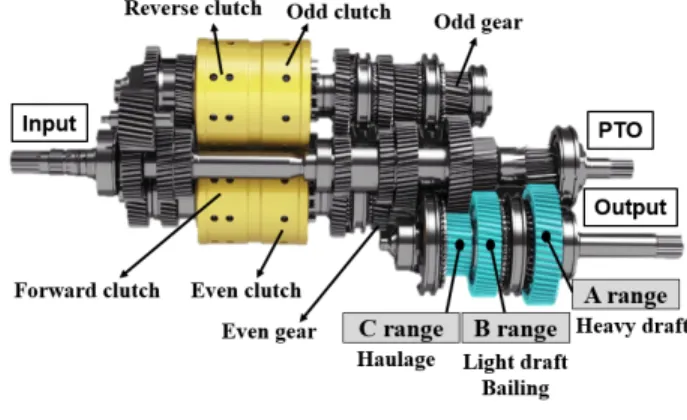
The new dynamic command transmission system is shown in Fig. 3. A dynamic command transmission is developed by New Holland (USA) as a partial power-shift transmission up to T7.210 series tractor, and from T7.170 to T7.260, New Holland customized Range Command and Power Command as a full power-shift transmission. The 8 steps partial power-shift transmission is a dual-clutch concept, similar to that which operates the seamless range shifting within the Auto Command transmission.
The dynamic command transmission consists of 3 ranges (A, B, and C) which help to perform various agricultural works (heavy and light draft, bailing, and haulage). This can deliver either 40 km/h at a reduced engine speed for the economy or a high 50 km/h transport speed. It can set more working speeds, provides programming options that simplify the work. It is an automatic shifting rival to the smoothness of premium automobiles.
It has an additional clutch pack and reduction gears, which provide an additional 16 gears below the standard to deliver a total of 32×32 gears. The engine power is transmitted through the input shaft by the clutch (Even and Odd) and gears (4 Even and 4 Odd) to the output shaft.
Fig. 3 The dynamic command transmission system of New Holland
The 4 odd gears, and reverse and odd clutch are installed on one shaft. The forward and even clutch, and 4 even gears are set on the second shaft. The power is modulated between the two clutches because the odd gear is disengaged with the odd clutch, and the even clutch is engaged in the even gear ratio.
Consequently, the forward and reverse clutches maintain the power shuttle, even on steep gradients while the range shifting is all robotized.
3. Patents on the PST technology
The patents related to PST technology were selected to know the development technique, function, and nobility of the PST for being popular technology for power transmission. The patents are listed in Table 1.
The selected patents are discussed in details as follow:
John Deere mentioned the design and arrangement of the gear pairings of the planetary transmission in different operation modes. In the first shifting operation, a clutch is connected to an input shaft that is connected to the output shaft for operating in the fixed drive mode, wherein the planetary transmission runs as a flywheel. In a second shifting, the clutch is released so that the planet carrier is driven by the planetary set.
This arrangement of the planetary set can be operated in the gear reduction or in the reverse mode.
The diagram of John Deere PST is shown in Fig. 4.
The power shift transmission (10) comprises an input shaft (18) and a first output shaft (20), which can be brought into a drive connection by means of a planetary transmission (22) as well as by means of a first shift element (24) and a second shift element (26), which are both shown herein as clutches. The planetary transmission (22) has a planet gear carrier (28), on which a dual-stage planetary gear set (30) is rotatably mounted. The dual-stage planetary gear set (30) comprises an input-side planet gear (32) as well as an output-side planet gear 34.
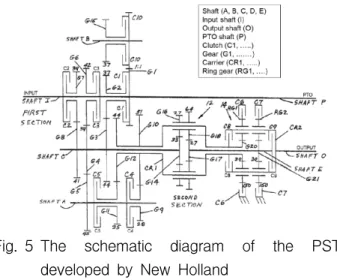
Fig. 5 shows the schematic diagram of the PST developed by New Holland (10). This patent deals with a large number of forward ratios and smooth shifting between gear ratios. In this invention, the PST requires only a single clutch swap for most changeovers
Title of patents Nobility Company, Year Power shift transmission To reduce the production cost, and no
need additional operation mode like a two-stage PST
Deere and Company, 2015
Smoothly shifting multispeed
transmission To reduce jerky shifting, and ensure
smoothness and accuracy New Holland, 2005 Transmission for a tractor To transmit a forward or reverse driving
force into traveling speed at a low cost,
and to enhance the transmission efficiency. Kubota, 1999 Power shift transmission for
vehicle
To provide a speed reducer by using two
selectable clutches and synchronizers LS Mtron, 2015 Table 1 The list of the patents on the PST technology
Fig. 4 The diagram of the PST technology of John Deere
Fig. 5 The schematic diagram of the PST developed by New Holland
between adjacent ratios and uses double swaps for only a few changeovers. Three close-ratio forward speeds and one reverse along with a second output that is an 11 speed, wide ratio, and transmission. The two transmissions are arranged in series resulting in 33 forward ratios and 11 reverse ratios. Although some of the ratios produced are nearly duplicates of others,
skipping these duplicate ratios still yields at least 28 usable forward speeds.
The gear selection 1 produces for clutches C1, C4, and C6 are engaged. The clutch C1 is connected to gear G1 that is attached to input shaft I and that is why the gear G1 is constantly rotating. If the C1 clutch engaged, the G2 rotates, and G2 drives G3. The G3 is connected to the shaft C, and shaft C drives shaft A by G4 and G5. In case, gears G4 and G5 drive shaft A by shaft C so that speed of shaft A is determined by the selection of clutch either C1, C2, C3 or C10 (reverse) that is interconnected shaft I to shaft C with different size gears. This patent is able to reduce jerky shifting and ensure smoothness and accuracy.
The Kubota has developed the Glide Shift Transmission (GST) which employs a power synchro shift and single clutch pack system resulting in improved maneuverability and workability while obtaining a power efficiency equivalent to that of manual gear type transmissions. The main benefit of the Kubota Glide Shift transmission is that you never have to use the clutch. You can shift up through all 12 forward gears without ever needing to touch your clutch. Like the hydraulic shuttle shift, you can also shift from forward to reverse or vice versa without the clutch. The nobility is to transmit a forward or reverse driving force into traveling speed at a low cost, and to enhance the transmission efficiency.
LS Mtron invented a PST to reduce power loss and improve power efficiency. The PST consists of a driving shaft operated by the received power from an engine of a vehicle. A first clutch provided to the driving shaft, and a first and a second gear selectively
Title of papers Keywords Journal, Vol., Year Coordinated control of gear shifting
process with multiple clutches for power-shift transmission
Transmission efficiency, and high fuel economy
Mechanism and Machine Theory, 140, 2019 Analysis of shifting performance of
power shuttle transmission Performance, accuracy, and stability Journal of Terramechanics, 44, 2007
Automatic starting control of tractor with a novel power-shift
transmission
Driving comfort, safety, and service life of a tractor powertrain
Mechanism and Machine Theory, 131, 2019 Analytical study to estimate the
performance of the power shift drive (PSD) axle for a forklift
Accuracy, efficiency, and economy
International Journal of Automotive Technology,
11, 2010 Table 2 The list of the published articles on the PST
receiving power by the first clutch. The nobility is to provide a speed reducer by using two selectable clutches and synchronizers.
It is observed that the patents on the PST are executed to manufacture commercially. Interestingly, it is noticed that the objectives of all studied inventions were to reduce the production cost, convenience to the users, economically efficient, and high accuracy.
Therefore, it is clear that PST technology can fulfill the demand of consumers.
4. Papers published on the PST
There are lots of published articles on PST technology. In this study, 6 published articles were selected from thousands of articles because those articles are published in highly reputed Elsevier and Science direct journals which have an impact factor (IF) over 2.
Also, those articles were conducted based on the keywords of design, performance, failure detection, and control methods of the PST for improving transmission efficiency that suits the interest of this technical review.
The published articles are listed in Table 2.
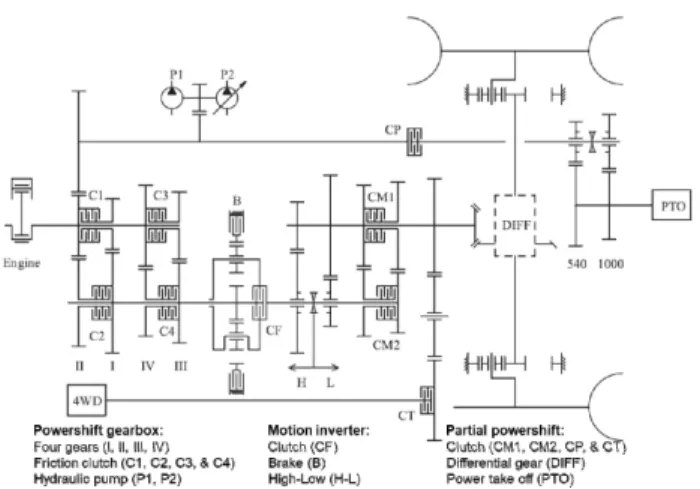
Li et al. (2019a) were conducted an experiment on the control gear shifting process of the PST. They developed a dynamic model of novel PST and analyzed the upshift and downshift processes. The control strategies were also developed to ensure gear shifting quality and continuous power flow for tractor field operations. The structure of the developed powertrain in this study is shown in Fig. 6.
Fig. 6 The structure of the powertrain (Li et al., 2019a)
This novel PST was designed considering some functions: i) Four-speed PST gearbox: the four gears (I, II, III, IV) in the PST gearbox can be shifted by engaging friction clutch C1, C2, C3, and C4, respectively.
ii) Motion inverter: the motion inverter consists of a clutch (CF), brake (B), and 2K-H planetary gear train with the dual planet. iii) Four-speed partial PST gearbox: two of the gears are shifted by controlling the clutches CM1 and CM2, respectively. The other two gears are shifted by synchronizers which can be controlled manually or electronically.
It was found that the work speed was ∼9 km/h at 70% throttle opening of the gear and the upshift command was issued at 0.2 s. The jerk of the vehicle is less than 15 m/s3 during the downshift process (within 1 s), which ensures the excellent power continuity, smoothness, and responsiveness for the gear shifts of transmission with multiple clutches.
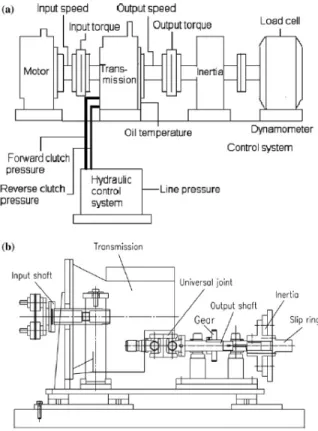
Another research was conducted by Kim et al., (2007) collaborated with Tongyang Moolsan Co., Ltd., Korea and Seoul National University for shifting performance. They developed the EASY 5 models of the hydraulic control system and power shuttle transmission. The models for the hydraulic control system and power shuttle transmission were verified by an experimental powertrain constructed for the validation purpose, which is shown in Fig. 7 (a). The powertrain comprises a variable speed motor (7.5 kW), a power shuttle transmission, an inertia mass, and a direct current (DC) dynamometer. The power driveline was designed using flexible couplings. The experimental powertrain is shown in Fig. 7 (b).
Fig. 7 The experimental powertrain (a) schematic of powertrain, and (b) input and output shaft of power shuttle transmission
It is observed that the modulating pressure and time in the clutch were significantly affected the shifting quality. The peak torques of the input shaft and clutch were increased with the increase of tractor speed and reverse gear ratio. Kim suggested that for a better shifting performance, the reverse speed should be 20%
faster than the forward speed. The weight of the tractor also increases the axle torques but has no effect on the power transmission. The damper did not affect the peak input shaft torque but eliminated the torque fluctuations.
Kim also mentioned that a proper hydraulic control system is important to develop the power shuttle transmission for agricultural tractors.
Li et al., (2019b) also conducted a study, which deals with the hydro-viscous drive (HVD) technology to improve starting comfort without affecting the drivetrain service life of a novel PST of a tractor. This control system obtains the real-time target angular acceleration of clutch driven disk according to the target angular acceleration database and the real-time angular velocity difference between driving and driven disks of the clutch.
Park et al., (2010) conducted an experiment at Ajou University, Korea on the power-shift drive (PSD). In this study, the dynamic simulation model was developed and analyzed the movement. The simulation model is composed of a torque converter, a gearbox, a differential, hub reduction and an engine, which the power source of the 1st forward and reverse PSD axle.
When the transmission is connected to the forward clutch, the power is delivered through the forward coupling, which is linked to the differential box. The power is delivered from the reverse coupling to the wheel through the reverse gear driveline when the reverse signal is turned on.
Other studies were also conducted to improve the transmission efficiency considering shaft torque, acceleration and vehicle jerk. They also considered the comfort of users, the shifting performance, accuracy, fault detection, and failure of the shifting. In these studies, they had developed and applied several algorithms to enhance PST performance.
Finally, the overview stands by that there are several types of research on PST, which have been conducted.
Recently, most of the researcher belonged to the leading countries of agricultural machinery production are trying to detect a fault or enhance the performance by applying various new technique and algorithm. Results indicate that the PST is able to ensure high accuracy and comfort for the users. Also, the continuity and
smoothness of power transmission ensure the service life of a tractor transmission with a guarantee.
5. Conclusion
In this technical review, the research trend such as products, patents, and published papers (3P) of the power-shift transmission (PST) was discussed and analyzed.
In Korea, the PST is not yet commercialized. Though the research on the PST is ongoing, more research and development are needed to customize the PST technology.
Most of the leading companies have already developed PST technology and are extending the coverage of the technology less than 100 hp. It is necessary to secure economic feasibility to apply this technology to small horsepower tractors.
The Korean company is also developing this technology and plans to commercialize it soon.
However, Korean PST should also have the same level of performance and economic feasibility as leading companies. Also, patent avoidance and registration strategy are needed.
Reference
1) X. Xu, P. Dong, Y. Liu, and H. Zhang, “Progress in automotive transmission technology”, Automotive Innovation, Vol. 1, pp. 187~210, 2018.
2) A. A. Blagonravov, A. A. Yurkevich, and A. V.
Yurkevich, “Automatic control of a stepless mechanical transmission with an internal force function”, Russian Engineering Research, Vol. 37, pp. 185~188, 2017.
3) C. Li, M. Ke, and Y. Wu, “Research and implementation of tractor power shift clutch control system”, 2018 MATEC Web of Conference.
4) J. Liang, H. Yang, J. Wu, N. Zhang, and P. D.
Walker, “Power-on shifting in dual input clutchless power-shifting transmission for electric vehicles”, Mechanism and Machine Theory, Vol. 12,1 pp.
487~501, 2018.
5) X. Zhou, P. Walker, N. Zhang, B. Zhu, and J.
Ruan, “Numerical and experimental investigation of
drag torque in a two-speed dual clutch transmission”, Mechanism and Machine Theory, Vol. 79, pp. 46~63, 2014.
6) C. Y. Tseng and C. H. Yu, “Advanced shifting control of synchronizer mechanisms for clutchless automatic manual transmission in an electric vehicle”, Mechanism and Machine Theory, Vol. 84, pp. 37~56, 2015.
7) M. Tanelli, G. Panzani, S. M. Savaresi, and C.
Pirola, “Transmission control for power-shift agricultural tractors: Design and end-of-line automatic tuning”, Mechatronics, Vol. 21, pp.
285~297, 2011.
8) G. Pazani, M. Tanelli, S. M. Savaresi, C. Pirola, G.
Gavina, and F. Taroni, “Transmission control for power-shft agricultural tractors”, 2010 American Control Conference, MD, USA.
9) M. M. J. Nievelstein, “Design of a powershift module for long hsulsge trucks”, MS theiss:
Department of Mechanical Engineering, Eindhoven University of Technology, Netherlands, 2005.
10) Y. Yang, Y. Bao, and C. Y. Fan, “Study in characteristics of hydro-mechanical transmission in full power shift”, Advances in Mechanical Engineering, Vol. 10m pp. 1~13, 2018.
11) B. Li, D. Sun, M. Hu, X. Zhuo, and J. Liu,
“Coordinated control of gear shifting process with multiple clutches for power-shift transmission”, Mechanism and Machine Theory, Vol. 140, pp.
274~291, 2019a.
12) B. Li, D. Sun, M. Hu, and J. Liu, “Automatic starting control of tractor with a novel power-shift transmission”, Mechanism and Machine Theory, Vol. 131, pp. 75~91, 2019b.
13) D. C. Kim, K. U. Kim, Y. J. Park, and J. Y. Huh,
“Analysis of shifting performance of power shuttle transmission”, Journal of Terramechanics, Vol. 44, pp. 11~122, 2007.
14) S. M. Park, T. W. Park, S. H. Lee, S. W. Han, and S. K. Kwon, “Analytical study to estimate the performance of the power shift drive (PSD) axle for a forklift”, International Journal of Automotive Technology, Vol. 11, pp. 49~56, 2010.
[저자 소개]
Md Abu Ayub Siddique E-mail : [email protected] Tel: 042-821-7870
2016: B.Sc. in Agricultural Engineering, Hajee Mohammad Danesh Science and Technology University, Dinajpur, Bangladesh.
2019: M.Sc. in Agricultural Machinery Engineering, Chungnam National University, Korea. Mr. Ayub is doing a Ph.D. in the same department and same university. His research interest is the hydraulic system modeling and analysis.
Taek-Jin Kim
E-mail : [email protected] Tel: 042-821-7870
Graduated from Chungnam National University in 2019. 2008-2018: Senior Research Fellow, Kukje Machinery Co., Ltd., Korea. Recently, Mr. Kim is doing a Ph.D. in Agricultural Machinery Engineering, Chungnam National University, Korea.
Professor Yong-Joo Kim E-mail : [email protected] Tel: 042-821-6716
2008: Ph.D. in Bio-Mechatronics Engineering, Sungkyunkwan University, Korea. 2008~2014: Head of the power machinery technology group, LS Mtron Central Research Institute, Korea.
2014~Present: Associate professor, Department of Biosystems Machinery Engineering, Chungnam National University, Korea. Prof. Kim is the associate member of KSAM, KSPA, KSFC, and so on. His research interest in design and analysis of agricultural power machinery.