Print ISSN: 2288-4637 / Online ISSN 2288-4645 doi:10.13106/jafeb.2021.vol8.no5.0987
Employer Branding, Scale Development and Validation: From the Context of Vietnam
Ha Minh NGUYEN
1, Luan Vinh NGUYEN
2Received: February 10, 2021 Revised: April 05, 2021 Accepted: April 15, 2021
Abstract
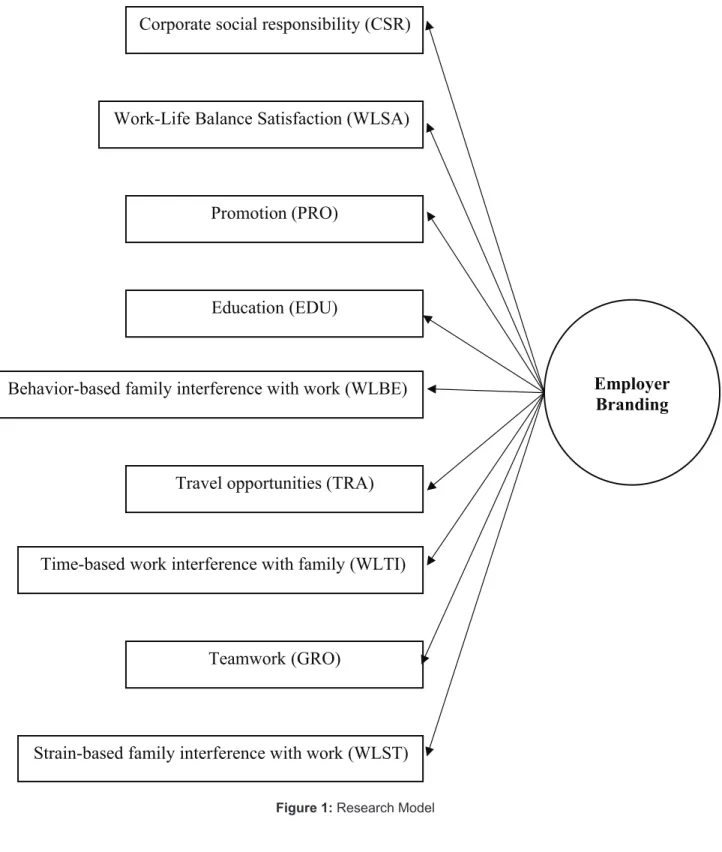
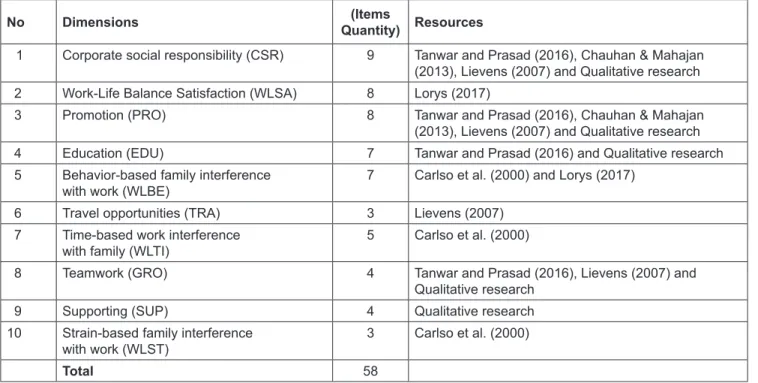
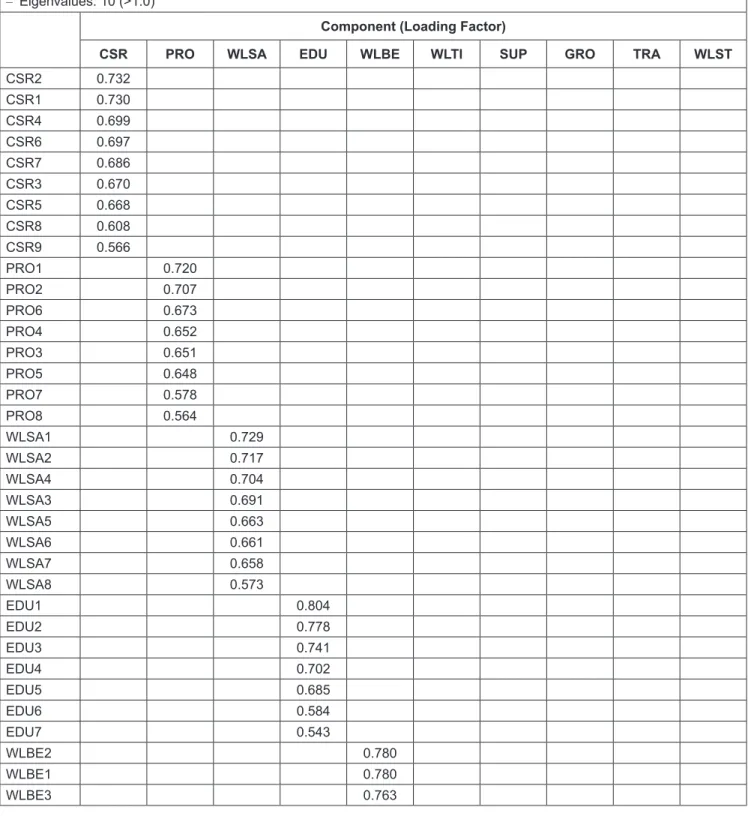
The concept of ‘Employer branding’ (EB) - one effective and sustainable strategy to attract and retain talent - has received a lot of attention from researchers and business managers. This concept becomes more meaningful when the ‘war of talent’ takes place in an extremely fierce manner in Vietnam as well as around the world. However, this concept is rather new; as a result, many points related to ‘EB’ scales should be improved, especially in Vietnamese context. Therefore, this study focuses on developing and confirming the EB scale in the context of Vietnam. Based on EB theory, this research applies the mixed research method: qualitative methods (expert interview and group discussion) and quantitative method (questionnaire survey of 937 respondents). EB is demonstrated to be a quadratic concept, consisting of the following 10 dimensions: Corporate social responsibility (CSR), Promotion (PRO), Work-Life Balance Satisfaction (WLSA), Education (EDU), Behavior-based Family interference with work (WLBE), Travel opportunities (TRA), Time-based work interference with family (WLTI), Teamwork (GRO), Supporting (SUP), and Strain-based family interference with work (WLST) with 58 observed variables. Based on the survey towards the employees in enterprises and organizations in Vietnam, the analysis results affirm that this scale ensures efficiency, reliability, unidirectionality and convergent values.
Keywords: Employer Branding, Work–Life Balance, Corporate Social Responsibility JEL Classification Code: M12, M14, M54, O15
become the best workplace for employees. In addition, EB activities attract other external potential candidates to work for the company. These activities focus on the organization image development as one potential employer in the labor market (Backhaus and Tikoo, 2004). From a more general perspective, Edwards (2010) argued that EB is the concept of intersection between human resources and marketing areas:
This brand-building activity (in marketing field) is related to talent attraction, and attaining (in human resource field).
In contrast, EB, from a more detailed approach, includes intangible asset (corporate culture) and tangible asset (corporate salary) (Ruch, 2002).
Different perspectives result from EB approaching the impact object. Berthon et al. (2005) and Lievens and Highhouse (2003), in which the target audience of EB are the only potential candidates, concentrate on researching the attractiveness factor. In contrast, Backhaus and Tikoo (2004) argue that the target audience of EB includes a wide range of subjects such as potential candidates, current employees, competitors and other intermediaries. The primary role of using EB is to develop the distinction of an external reputation, rather than an internal description.
1
First Author. Professor, Rector, Ho Chi Minh City Open University, Vietnam. Email: [email protected]
2
Corresponding Author. Ph.D. Student, Ho Chi Minh City Open University, Vietnam [Postal Address: 97, Vo Van Tan Street, District 3, Ho Chi Minh City, Vietnam]
Email: [email protected]
© Copyright: The Author(s)
This is an Open Access article distributed under the terms of the Creative Commons Attribution Non-Commercial License (https://creativecommons.org/licenses/by-nc/4.0/) which permits unrestricted non-commercial use, distribution, and reproduction in any medium, provided the original work is properly cited.