* 본 연구는 2012년도 상명대학교 연구비 지원으로 수행되었음
First author:Yoon, Bok Mo. Graduate School, Sang Myung University,
Tel:+82-11-245-1736, E-mail:[email protected]Corresponding author:Koo Bonhak, Sang Myung University,
Tel:+82-10-3412-1471, E-mail:[email protected]
Received:2 November, 2012. Revised:9 January, 2013. Accepted:5 February, 2013.
- 127 -
유리섬유강화슬래그(Glass-fiber Reinforced Slag)의 경관석 성능 적합성 평가*
윤복모1)․이용복1)․구본학2)
1)상명대학교 대학원 환경자원학과․2)상명대학교
The Suitability Assessment of Performance Standards on Landscaping Rocks of GRS(Glass Fiber Reinforced Slag) Panels*
Yoon, Bok-Mo
1)․Lee, Yong-Bok
1)and Koo, Bonhak
2)1)Graduate School, Sang Myung University, 2)Sang Myung University.
ABSTRACT
This study was carried out to verify the suitability of GRS(Glass-fiber Reinforced Slag) as natural type landscape stone according to the material property and structural safety performance standards.
The structural safety performance of the GRS panel showed 12.4MPa and 16.2MPa each in flexural strength at 2 and 3% content of glass fiber while the flexural strength at 4 and 5% of glass fiber content showed 26.9MPa, and 30.2MPa, respectively, all satisfying the standards. In addition, air-dried gravity was found to be 1.82~1.89 in measuring range at 2~5% level of glass fiber content, satisfy the existing standards 1.8~2.3.
In structural safety performance, the range of flexural strength consequent on glass fiber content was surveyed to be 12.8~30.2MPa, all satisfying the performance standards, while 10MPa and more while the compressive strength range was found to be 41.5~53.3MPa, all satisfying the performance standards, 40~60MPa.
This study judged the suitability of only the items for a property of matter of landscape stone GRS
by applying the natural-form landscape stone GFRC material standard, but in case an installation
constructed with GRS material comes into existence later, there should be comprehensive performance guidelines through the research on durability, landscape performance and environmental and ecological performance.
Key words:GFRC, Material property, Structural safety performance, Performance standards, Performance guidelines.
I. 서 론
최근 소득수준 향상으로 인한 생활패턴의 변 화가 진행되면서 테마공원 등과 같은 옥외 조경 공간 조성이 활발히 이루어지고 있다. 또한, 경 관 향상 및 복합기능을 가진 공간조성 등을 위 해 인공폭포 및 벽천 등과 같은 시설들이 도입 되어 지역의 랜드마크로서의 기능과 더불어 지 역의 상징성과 이미지를 제고하고 있다. 이와 같은 수요 증대에 비해 자연석은 점차 고갈되어 자연형 경관석과 같은 대체소재 개발 및 효과적 인 시공기술과 더불어 기존의 재료를 재활용할 수 있는 효과적인 기술이 접목되어야 할 필요성 이 꾸준히 제기되고 있다.
이런 흐름에 따라 그동안 유리섬유강화플라 스틱(Fiber glass Reinforced Plastics; FRP), 유리섬 유강화콘크리트(Glass Fiber Reinforced Concrete/
Cement; GFRC)등과 같은 인조 경관석이 지속 적으로 사용되고 있으나 최근에는 기후변화 대 응 및 자원재활용 등의 환경친화적 잇슈가 대두 되면서 자연석과 같은 표면처리가 가능하고 성 능이 동등하면서도 자원재활용을 통해 유한한 자원을 대체할 수 있는 소재가 요구되고 있다.
이와 관련하여 재생골재 및 슬래그 등의 산 업부산물을 재활용한 제품의 개발이 지속적으 로 이루어지면서 건설폐기물에 대한 일반인들 의 인식개선과 한정된 자원의 절약측면에서 플 라이애쉬(Fly Ash), 고로슬래그(Blast Furnace Slag) 등을 활용하기 위한 많은 연구들이 진행 중이며 이미 현장에서는 콘크리트의 재료로 활 용되고 있다.
본 연구와 관련된 사례로는 슬래그를 활용한 콘크리트 및 시멘트의 재료 특성, 활용 기술, 물 성에 관한 연구가 주로 이루어져 왔다. 재료특성 관련 연구로는 Kim et al.(2007)에 의해 고로슬 래그 미분말을 활용한 콘크리트의 공학 및 내구 특성에 관한 연구, Yang et al.(2011)에 의한 고 로슬래그 기반 알칼리 활성 콘크리트 벽돌의 재 료 특성에 관한 연구, Song(1994)에 의한 고로슬 래그를 이용한 시멘트의 특성에 관한 연구 등이 있다. 또한, Yoon(1995)은 고로슬래그 미분말을 사용한 콘크리트 특성 연구를 수행한 바 있다.
슬래그 제품의 활용기술의 경우 Kim et al.(2006) 에 의해 연안생태계 복원을 위 전로슬래그의 유 효 활용 기술 연구가 있으며, Kim et al.(2002)은 해양의 인공어초 슬래그 콘크리트 제조에 관한 연구를 통해 생태적인 효과를 나타낼 수 있는 제 품의 활용연구를 수행한 사례가 있다. 산업부산 물을 활용한 소재의 물성에 관한 연구사례로 Architectural Institute of Korea(2007)에서는 고 로슬래그시멘트․콘크리트의 물성평가 및 현장 적용 연구를 수행한 바 있으며 Choi and Kang(2008)은 고로시멘트․콘크리트의 현장적 용성 평가에 관한 연구를 각각 수행하였다. 또한, YI and Soh(1998)는 소석회를 혼입한 고로슬래 그 시멘트 모르타르의 강도특성에 관한 연구, Jeong et al.(2006)은 황토와 고로슬래그 미분말 을 첨가한 콘크리트의 역학적 성능평가 연구 등 을 각각 수행하였다.
이와 같은 사례를 종합해 볼 때 산업부산물
을 활용한 재료 중 고로슬래그, 플라이애쉬 등
을 관한 연구와 재료의 특성과 제품의 물성을
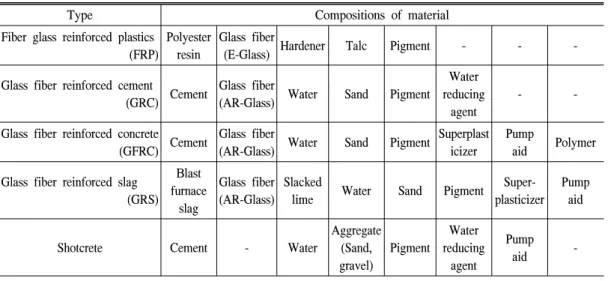
Table 1. The type and material composition of landscaping rocks.
Type Compositions of material
Fiber glass reinforced plastics (FRP)
Polyester resin
Glass fiber
(E-Glass) Hardener Talc Pigment - - -
Glass fiber reinforced cement
(GRC) Cement Glass fiber
(AR-Glass) Water Sand Pigment
Water reducing
agent
- -
Glass fiber reinforced concrete
(GFRC) Cement Glass fiber
(AR-Glass) Water Sand Pigment Superplast icizer
Pump
aid Polymer Glass fiber reinforced slag
(GRS) Blast furnace
slag
Glass fiber (AR-Glass)
Slacked
lime Water Sand Pigment Super- plasticizer
Pump aid
Shotcrete Cement - Water
Aggregate (Sand, gravel)
Pigment
Water reducing
agent
Pump
aid -
측정하여 평가하는 연구는 있으나 재활용 재료 로서의 슬래그를 활용한 소재의 성능기준에 대 한 연구는 이루어지지 않았으며 다만 유사연구 로서 자연형 경관석인 GFRC의 성능기준에 관 한 연구(Yoon and Koo, 2012)를 통해 물성, 내 구성능 및 경관성능에 대한 평가기준 설정과 현 장조사를 통한 검증이 이루어지긴 하였으나 산 업부산물을 활용한 경관석 성능기준에 관련된 연구는 전무하다.
본 연구에서는 자연석 대체 소재의 개발이 요구되고 있는 시점에서 산업부산물인 고로슬 래그를 활용한 경관석으로, 건설 산업 전반에 걸쳐 활용범위가 넓어지고 있는 유리섬유강화 슬래그(Glass fiber Reinforced Slag; GRS)소재 가 일반 시멘트를 대체하여 자연형 경관석 성능 기준에 적합한지를 검증하기 위한 목적으로 수 행되었다.
II. 연구방법
본 연구는 산업부산물인 고로 슬래그를 활용 하여 수밀성 및 내구성이 우수하고 기술적 측면 에서 대표성이 있다고 인정되는 GRS를 대상으 로 수행되었다. 검증항목으로는 GRS를 조경공
간의 경관석으로 인식하여 일반적인 물성이 아 닌 조경구조재로서 요구되는 성능기준을 고려 하였다.
1. GRS소재의 특성
자연형 경관석이란 자연석의 질감 및 외형을 나타내는 대체재로서 적절한 혼화재, 배합비율 조절, 마감처리, 기타 기술적 방법을 통해 제작 되는 시멘트, 콘크리트를 의미한다. 대표적인 자연형 경관석의 종류 및 재료 구성은 다음 Table 1과 같다.
GRS는 주로 산업부산물인 고로슬래그를 사용하 며, 이외에도 플라이애쉬 등을 활용한 공법들이 연 구, 개발되고 있다. 재료구성도 GRC, GFRC의 주재 료인 시멘트 대신 고로슬래그로 100% 대체하고, 수 밀성 증대를 통한 강도를 증가시키는 소석회를 첨가 한 점이 다르다.
GRS는 산화지르코늄(ZrO
2) 15~20%를 함유
한 내알칼리 유리섬유(AR-Glass)를 사용하여
중량을 줄이면서도 패널의 강도를 유지시키며
산업부산물을 재활용한다는 측면에서 경제성이
확보된 소재이다. 즉, 일반 시멘트를 사용한
GFRC에 비해 단위중량이 적고, 하중에 대한
부담이 경감되기 때문에 대규모 시공에 사용되
Figure 1. The specimens for GRS performance test.
Table 2. The manufacture of specimen for GRS performance test.
Glass fiber content ratio
Test item 2% 3% 4% 5% Remarks
Structural safety performance
Flexural strength 2-1,2,3 3-1,2,3 4-1,2,3 5-1,2,3 Three repeated Compressive strength 2-1,2,3 3-1,2,3 4-1,2,3 5-1,2,3 Three repeated Material property Air-dried gravity 2-1,2,3 3-1,2,3 4-1,2,3 5-1,2,3 Three repeated 었을 경우 구조적 안정성 유지가 가능하다. 다
만, 고로슬래그 자체로는 수경성이 존재하지 않 고 알칼리 물질에 의해 서서히 반응하는 잠재수 경성이 있으며 이런 이유로 초기강도가 낮기 때 문에 이를 보완하기 위해 소석회가 첨가된다(YI and Soh, 1998).
이와 같이, GRS는 GFRC의 장점인 내화성, 내구성을 유지하면서도 곡면처리, 요철, 질감 및 색감 등의 조형성을 갖추고 있고 휨강도, 압 축강도 등을 동등 수준으로 유지하면서도 두께 및 중량의 감소를 통한 기타 구조안전성능을 보 장할 수 있다. 가장 보편적인 용도로는 항만, 댐 등의 대용량 시설물에 이용되었으나 경제성과 우수한 내구성능으로 인해 건축구조물, 토목, 조경용 재료 외에도 특히 친환경재료로서 그 사 용범위가 넓어지고 있다.
2. 연구 방법 (1) 연구범위
Kim(2008), Kim et al.(2007), Cheong(2009), Koo et al.(2008)에 의하면 성능은 재료성능, 구
조안전성능, 내구성능, 환경부하저감성능, 경관 성능, 생태성능 등으로 구분이 가능하다. 현재 GRS패널 제품이 대량 생산되어 시공되는 단계 로서 성능기준 적합성에 대한 검증이 시급하나, 아직 목적물의 현장조사가 요구되는 내구성능 및 경관성능의 경우 적용이 어렵다고 판단되어 본 연구에서는 현 단계에서 검증이 가능한 재료 물성 및 구조안전성능으로 국한하여 검증하였 다. 시험기간은 2012년 3월부터 2012년 9월까 지였으며 시험은 국제공인인증기관인 한국건설 생활환경시험연구원에 의뢰, 분석하였다.
(2) 시험용 시편
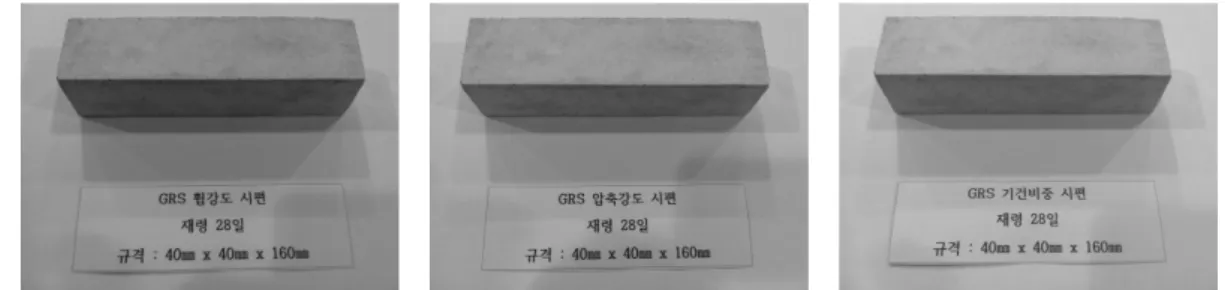
시험용 시편은 재령28일 경관석 GRS 패널 시편 (40×40×160mm)을 제작하였다(Figure 1, Table 2).
주요 재료 배합비율은 고로슬래그 46.5~52.5%,
소석회 15~18%, 모래 28~30% 등이며, 유리섬
유는 2~5%비율로 각각 제작하였다. 유리섬유
함유율과 기건비중은 중소기업청표준(KICM-GQ-
066), 압축강도와 휨강도의 경우 한국산업표준
(KS F 2476)에 의거, 실시하였다. 유리섬유 함유
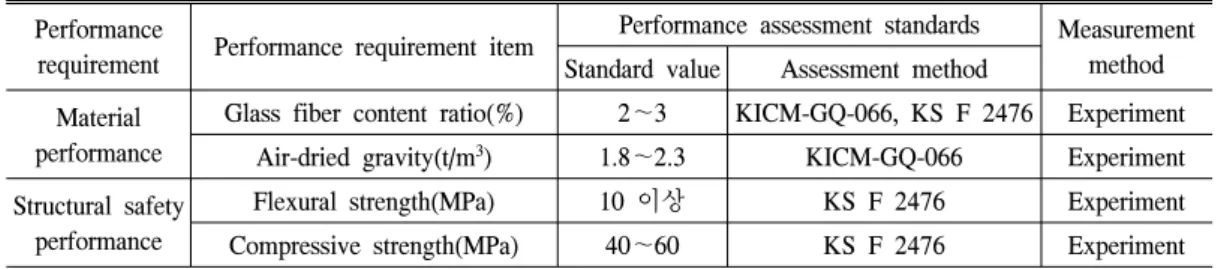
Table 3. The performance standards of landscaping rocks (Material performance, structural safety performance).
Performance
requirement Performance requirement item Performance assessment standards Measurement method Standard value Assessment method
Material performance
Glass fiber content ratio(%) 2~3 KICM-GQ-066, KS F 2476 Experiment Air-dried gravity(t/m
3) 1.8~2.3 KICM-GQ-066 Experiment Structural safety
performance
Flexural strength(MPa) 10 이상 KS F 2476 Experiment
Compressive strength(MPa) 40~60 KS F 2476 Experiment
Table 4. The results of GRS performance test (Structural safety performance).
Performance type
Performance item
Test specimen
Glass fiber content ratio Performance standard
2 %† 3 %† 4 % 5 %
Structural safety performance
Flexural strength
(MPa)
Ⅰ 12.5 16.5 23.9 31.5
More than 10MPa
Ⅱ 13.2 15.8 31.2 29.8
Ⅲ 12.7 16.3 25.7 29.4
Average 12.8* 16.2* 26.9* 30.2*
Compressive strength
(MPa)
Ⅰ 40.4 44.5 47.8 52.8
40-60MPa
Ⅱ 41.2 43.8 43.5 53.4
Ⅲ 42.8 42.4 48.2 53.8
Average 41.5* 43.6* 46.5* 53.3*
※ Test:Carried out by KS F 2476.
* The average of three repetitive test results by specimen(40×40×160mm)(Korea Conformity Laboratories, KCL).
†The performance standard of glass fiber content ratio.
율에 따른 휨강도, 압축강도, 기건비중 실험을 위해 유리섬유 함유율 2%, 3%, 4%, 5% 비율로 함유한 시편을 각 항목별로 3반복 실험을 실시, 총 36개의 시편을 제작하며 평균값을 환산하여 결과를 도출하였다.
(3) 검증
본 연구의 주제인 GRS에 대한 기준 적합성 을 검증하기 위해 기존 연구를 통해 제안된 자 연형 경관석 성능기준(Yoon and Koo, 2012)을 활용하여 휨강도 및 압축강도 측정결과를 도출 하고 이를 기존 사례에 적용하여 기준의 적합 여부를 평가하였다.
제안된 재료성능과 구조안전성능의 항목 및 기준은 다음과 같다(Table 3).
III. 결과 및 고찰
1. 구조안전성능 평가
GRS의 유리섬유 함유율은 자연형 경관석 GFRC 소재와 마찬가지로 휨강도 및 압축강도에 직접적 인 영향을 미치는 가장 핵심적인 항목이다.
검증시험 결과 유리섬유 함유율 2%(휨강도 12.8
MPa, 압축강도 41.5MPa), 3%(휨강도 16.2MPa, 압
축강도 43.6MPa), 4%(휨강도 26.9MPa, 압축강도
46.5MPa), 5%(휨강도 30.2MPa, 압축강도 53.3MPa)
비율에 따른 평균값들이 측정되었다(Table 4). 유리
섬유 함유율 2~5% 범위에서 휨강도의 평균치는
12.8~30.2MPa로서 성능기준 10MPa를 만족하였
으며, 압축강도는 41.5~53.3MPa로 나타나 압축강
도 성능기준 40~60MPa를 만족시킴으로써 GRS
Table 5. The test for GRS performance assessment standards(Air-dried gravity) Performance
classification
Performance item
Test specimen
Glass fiber content ratio Performance standard
2%† 3%† 4% 5%
Material property
Air-dried gravity
(t/m
3)
Ⅰ 1.82 1.83 1.85 1.89
1.8-2.3
Ⅱ 1.84 1.86 1.88 1.91
Ⅲ 1.81 1.82 1.87 1.88
Average 1.82* 1.84* 1.87* 1.89*
※ Test:Carried out by KICM-GQ-066.
* The average of three repetitive test results by specimen(40×40×160mm)(Korea Conformity Laboratories, KCL).
†The performance standard of glass fiber content ratio.
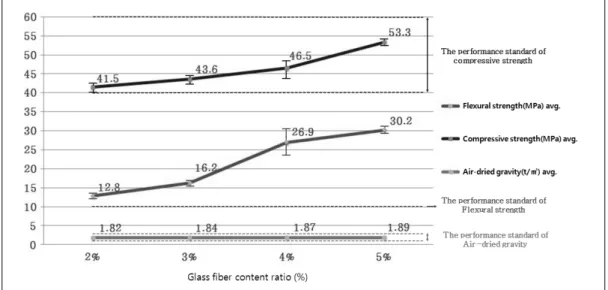
Figure 2. The measurement of performance item by glass fiber content ratio.
패널은 구조안전성능인 휨강도 및 압축강도 성능 기준에 각각 부합되는 것을 알 수 있었다.
구조안전성능과 관련하여 타 사례 결과와 비 교했을 때 휨강도는 Architectural Institute of Korea(1997)의 경우 섬유보강 콘크리트 소재의 유리섬유 함유율 2.5~5% 범위에서 휨강도를 측 정한 결과 2.5%에서는 22.1MPa, 3%에서는 24.5MPa를 나타냈고 4.0%일 때 29.4MPa, 5.0%
에서는 34.3MPa로 나타났으며 전체적으로 22.
1~34.3MPa를 기록하였다. Park(1990)의 연구에 서도 역시 GFRC소재에서 유리섬유 함유율 2.5~
5.5%범위에서 22MPa부터 37MPa를 기록하여 역
시 유사한 결과를 나타냈다. 두 연구에서 모두 유 리섬유 함유율이 증가할수록 휨강도가 지속적인 증가 추세를 나타냈다. 또한, Kim(1978)은 GFRC 소재에서 유리섬유 함유율이 증가할수록 인장강 도, 파열강도, 충격강도가 지속적으로 증가한다 고 보고하였으며 Won(1986)는 유리섬유보강시 멘트에서 휨강도, 인장강도, 충격강도 모두 유리 섬유 함유율이 높아질수록 증가되었다고 하였다.
압축강도는 국내 산업규격 KS L 5210(2011)
에서 시편 재령 28일 고로슬래그 시멘트의 기
준을 42.5MPa이상으로 설정한 사례 및 본 연구
결과에서 모두 자연형 경관석 기준을 충족하는
것으로 나타났다.
결과적으로, 타 연구사례에서도 본 연구에서 와 같이 유리섬유 함유율을 성능기준인 2~3%
범위로 국한해도 휨강도 및 압축강도 모두 성능 기준을 충족하는 것으로 나타나 GRS의 유리섬 유 함량과 관계없이 구조안전성능을 만족하고 있음을 알 수 있었다.
2. 재료물성 평가
재료물성의 주요 항목인 기건비중 시험 결과 유리섬유 함유율 함량에 따른 시편 측정결과 기 건비중 범위는 1.82~1.89로 나타났다. 2~5%
유리섬유 함유율에서 평균치의 범위는 큰 차이 없이 일정한 결과를 나타내었다(Table 5).
기건비중의 시험 결과 역시 평균치 1.82~
1.89(t/m
3)로 측정되었으며 성능기준인 1.8~
2.3(t/m
3)에 포함되어 적합한 것으로 나타났다.
또한, 유리섬유 함유율 성능기준인 2~3% 범위 에서도 각각 1.82(t/m
3), 1.84(t/m
3)를 기록하여 성능기준에 역시 부합되는 것으로 나타났다 (Figure 2).
본 연구 결과를 종합했을 때 재료물성 및 구 조안전성능은 모두 성능기준에 적합한 것으로 나타났다. 이를 현재 사용빈도가 높은 다른 자 연형 경관석인 GFRC의 성능기준에 대한 연구 결과(Yoon and Koo, 2012)와 비교할 때 수치의 차이는 있었으나 모두 성능기준을 만족하여 친 환경 경관석인 GRS는 기존에 조경공간에 경관 요소로 폭넓게 사용되어 온 자연형 경관석 GFRC소재와 동등한 성능을 지닌 것으로 판단 되었다(Figure 2).
IV. 결 론
본 연구는 재활용 슬래그를 활용한 경관석 GRS에 대한 자연형 경관석 성능기준의 적합성 을 판단하기 위해 수행되었다. 자연형 경관석 요구성능 항목 및 성능기준에 따라 GRS의 재
료물성, 구조안전성능을 대상으로 검증시험을 실시하였다.
연구결과를 요약하면 다음과 같다.
1. 구조안전성능 휨강도 기준에 대한 시험 결 과 유리섬유 함유율 2~3%에서 GRS 패널의 휨 강도는 12.4MPa, 16.2MPa를 각각 나타내어 구 조안전성능 휨강도 기준(10MPa이상)에 적합한 것으로 판정되었다.
2. 구조안전성능 압축강도 기준에 대한 시험 결과 유리섬유 함유율 2~3%에서 GRS 패널의 압축강도는 41.5~43.6MPa로 조사되어 역시 구 조안전성능 압축강도 기준(40~60MPa)에 모두 부합되는 것으로 나타났다.
3. 재료물성 기건비중은 유리섬유 함유율 측 정범위 2~3%에서 GRS 패널의 1.82~1.84로 나타나 재료물성 기건비중 기준(1.82~1.84)에 해당하여 부합하는 것으로 나타났다.
4. 본 연구에서 구조안전성능의 경우 타 사례 와 비교했을 때 유리섬유함유율이 증가함에 따 라 휨강도 및 압축강도또한 지속적으로 증가하 는 추세를 나타냈다.
5. 경관석 GRS소재의 물성시험 결과와 자연 형 경관석 성능기준을 비교했을 때 재료물성인 기건비중, 구조안전성능인 휨강도, 압축강도 모 두 성능기준에 부합되는 것으로 나타났으며, 기 존 자연형 경관석 GFRC소재와의 비교에서도 모두 성능기준을 만족하여 동등한 성능을 지닌 것으로 판단되었다.
본 연구에서는 경관석 GRS소재에 대한 성능 기준 적합성 검증이 시급하다는 필요성에 의해 수행되었으나 아직 패널 시공 초기단계에 있기 때문에 측정 가능한 항목만을 대상으로 기 개발 된 성능기준을 적용하여 그 적합성을 판단하였 다. GRS소재로 시공이 확대되고 일정한 시간이 경과된 이후에는 내구성능, 경관성능 및 환경․
성능 등에 대한 연구를 통해 종합적인 성능지침
이 마련되도록 해야 할 것이다.
인 용 문 헌