Print ISSN: 2288-4637 / Online ISSN 2288-4645 doi:10.13106/jafeb.2019.vol6.no2.239
A Structural Analysis on the Influence of Multi-Cultural Families in Psychological Inadequacy for Youth*
Myung-Hee JUNG 1
Received: March 26, 2019 Revised: March 28, 2019 Accepted: April 4, 2019
Abstract
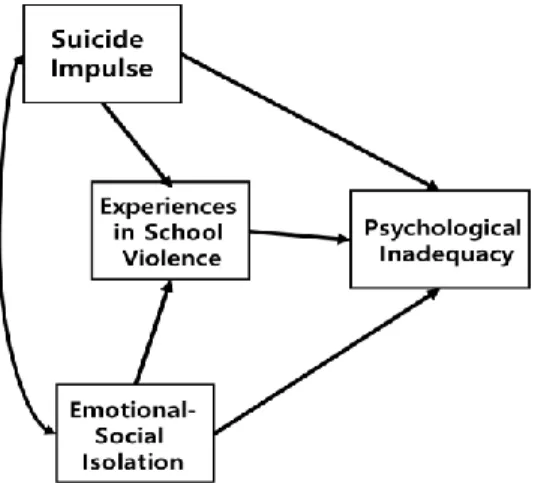
Teenagers in multicultural families are more prone to depression and problem behaviors caused by violence such as bullying in schools due to their appearance, language presentation skills, and poor learning abilities compared to teenagers in general families. This study is meaningful in that it provides basic information for prevention measures in intervening with damage caused by school violence such as depression, anxiety, suicidal impulses and emotional and social. For this purpose, a survey of 300 elementary school students from 4 to 6 grade, junior high school, and high school students was conducted. A total of 400 questionnaires were distributed and of thos e 385 were used for the final analysis. The results of the study are as follows. First, the psychological factors of suicidal ideation w ere higher in the victimized group than school violence. Second, there was a significant difference in the relationship between emotional - social isolation and school violence experience. Third, there was a significant difference in the relationship between experience of suicide ideat ion and depression as well as anxiety of emotional - social isolation with psychological maladjustment. In conclusion, we plan to find ways to stabilize the multicultural society by providing prevention and protection measures against school violence.
Keywords: Suicidal Impulse, Emotional-Social Isolation, Experience Of Violence Damage, Psychological Maladjustment, Anxiety, Problem Behavior.
JEL Classification Code: C31, J12, J13.
1. Introduction 1
South Korea has been transitioning past the preliminary stages of multicultural society since 2000 as the number of foreigners' staying in South Korea has risen. Additionally, the increasing number of international marriages, along with the influx of foreign workers, has contributed to the rise in these numbers. South Korea is now moving to the next phase, which is the transition and settlement phase of multicultural society, including the formation of multicultural families, migrant workers' families and immigrant communities (Jung, 2015; Kim & Chun, 2008). The number of students in elementary, middle and high schools in multicultural families more than quintupled from 9,389 in
* This paper is written as a research support for Jungwon University in 2019.
1 First Author and Corresponding Author. Professor, Department of Social Welfare, Jungwon University, Korea.
E-mail: [email protected]
© Copyright: Korean Distribution Science Association (KODISA)
This is an Open Access article distributed under the terms of the Creative Commons Attribution Non- Commercial License (https://creativecommons.org/licenses/by-nc/4.0/) which permits unrestricted non- commercial use, distribution, and reproduction in any medium, provided the original work is properly cited.