Print ISSN: 1738-3110 / Online ISSN 2093-7717 JDS website: http://kodisa.jams.or.kr/
http://dx.doi.org/10.15722/jds.18.10.202010.121
Determinants of Private Label’s Purchase Intention in the Korean Market
Votchik NATALYA 1 , Jae-Wun CHO 2 , Jong -Woo LEE 3
Received: August 14, 2020. Revised: September 01, 2020. Accepted: October 05, 2020.
Abstract
Purpose: In this study we investigate the determinants of private label (PL) purchase intention in South Korea. Private labels are becoming more and more popular in America and European countries. However, there are not enough studies focusing on PL within the South Korean market. Therefore, the present study has been written in order to understand more about consumers’ purchase intention of store brand in the South Korean market. Many characteristics and aspects of consumers and brand’s behavior have been reviewed in order to bring relevant results. Research design, data and methodology: Data was collected using a quantitative survey of Korea retail store’s consumer. We analyzed using multiple regression method to test the hypothesis. We analyzed how and why do consumers have a strong intention to purchase the PL. Results: a) Trust towards retailer influences the PL purchase intention of customers; b) brand awareness has an impact on the PL purchase intention of customers; c) perceived quality has an impact on the PL purchase intention; d) Price-quality relationship influences on the PL purchase intention. However, there is no direct effect of some of the factors of determinant. Conclusion: For private label products in the Korean market, trust in sellers and brand awareness influences the purchase of PL products.
Keywords: Private Label Purchase Intention, Brand Awareness, Price Consciousness, Perceived Quality, Consequences Of Making A Purchase Mistake.
JEL Classification Code: E44, F31, F37, G15
1. Introduction 12
Nowadays the world of retailing is more complex than ever. Several decades ago, in many countries, strong private brands from retailers appeared and started attracting customers with their low price.
Private labels are also known as private brands, store brands or retailer brands. All of them have the same
* This work was supported by the Ajou University research fund in 2018.
1 First Author, Master’s Program Student, School of Business, Ajou University, South Korea. Email: [email protected]
2 Professor, School of Business, Ajou University, South Korea.
Email: [email protected]
3 Correspondent Author, Ph.D. Program Student, School of Business, Ajou University, South Korea.
Email: [email protected]
ⓒ Copyright: The Author(s)
This is an Open Access article distributed under the terms of the Creative Commons Attribution Non-Commercial License (http://Creativecommons.org/licenses/by-nc/4.0/) which permits unrestricted noncommercial use, distribution, and reproduction in any medium, provided the original work is properly cited.
concepts that has been developed since the 1960s. In the
western countries, market for private labels nowadays has
developed rapidly and has become popular all over the
world. Private brand is a product which is sold under the
private label of a retail store, with either the store’s own
name or the brand name created by the retailer. Store brands
are usually cheaper than their analogs by up to 30%. Since
PLB does not need any advertising and marketing costs,
because the product is promoted in the very place where it
is sold, it significantly reduces the cost of goods. Thanks to
its low price, the store product becomes more and more
attractive to customers. Store brands have mostly focused
on price over the years, as it was the main reason why
customer would buy these products (Kumar & Steenkamp,
2007). This low price these days still remains as the main
benefit attracting customers. However, according to
numerous studies, it has been proved that the difference
between the quality of a private product and a national
product decreases from year to year (Baltas & Argouslidis,
2007), because retailers try to satisfy customers not only
with a low price, but also with the good quality of their
goods. Thus, improvement of product quality and low price at the same time has become the main factors and there is a growing acceptance of the private brands among consumers (Baltas & Argouslidis, 2007).
If we take a look on previous studies about the PL we can divide them into two categories. The first category addresses the proneness between the PL versus national brand promotion where they identified some similarities and differences between the two groups. The second category discusses the factors that influence customer attitude towards the consumption of the PL. In the current study we will take a look at the determinants affecting PL purchase intention in Korean market which were not studied enough.
The purpose of the study is to figure out what makes consumers buy private brand products and which factors influence the desire of buying a private brand. We will investigate the factors which affect the consumers purchase intention of PL. We will also take a look at the PL consumers purchase behavior through a list of predefined factors such as; trust toward retailers, brand awareness, perceived quality, information on the packaging, price consciousness, consequences of making a purchasing mistake and price-quality relationship.
2. Theoretical background
2.1. Private label as a brand
The retailer’s private brand is the product which is marketed by the visual and verbal symbolism of the retailer, produced mainly by contract manufacturers according to the retailer’s specification, owned and controlled by the retailer, sold directly through retailer’s stores, allowing to identify and differentiate the product offer. Importantly, during more than a century of history, the PL has undergone major changes and has evolved from unmarked products of the lower price segment of weightless quality, into full-fledged brands that can compete with modern national brands. Some private brands can be sold not only in the retailer – owner’s store of the brand, but also in competing stores. This practice is mainly observed in the United States and the European countries.
Nowadays, everyone knows what a PL is and in the world market, PL has long established itself and in some countries such as in UK and Germany it strongly competes with national brand (NB) in some categories. But the distribution of private label in South Korea started only right after an Asian financial crisis in 1997. After the crisis a long economical slow down dragged up the demand for PL goods.
Because there was and there is a big gap between prices of NB, people being in a crisis economic situation tended to
buy more products at a low price which exactly were PLs.
Private label products distributed by large retailers have experienced sharp growth over the recent years in the South Korean market thanks to a rising consumer demand for cheaper price tags. It is known that consumers in Korea are open to new products innovations. Therefore, they welcomed private brands with open arms. As the consumer demand increases retailers are relying and using PL as a major strategy to differentiate their brand. Simultaneously while the number of PL product increases the interest in their marketing strategy is growing bigger.
Nowadays the size of the domestic retail market in Korea amounted for more than 296 Trillion Wons ($255 billion). Starting at 3.6 trillion wons in 2008, the PL market reached 9.3 trillion wons ($8.4 Billion) in 2013.
The ratio of PL products accounted for one fourth of combined sales at discount stores, supermarkets and convenience stores as of 2014, but it still only accounted for 3.1% of total sales in the country's overall retail sector. It’s a large marketing sector that we need to pay attention to and constantly study.
In Korea the origin of PL started with food and dairy products. Nowadays it has enlarged to laundry detergent, clothes, electronics and even home appliances. There are actually 3 biggest retailer stores in Korean market which compete with each other. The biggest retailer stores are Emart, Home plus, and Lotte. Lotte Mart currently earns about 25 percent of its total sales from PL products.
There are not only big retailers who sell their store brands but also Korean convenience stores began to produce their own items. For example, 7 eleven`s has coffee PL, CU produced yogurt etc. and the results of sales were high. In South Korea, convenience store networks do not hesitate to experiment with products of the PL, even if they are not related to food or drinks production. For example, in October 2015, CU teamed up with the local toy manufacturer Oxford Block to introduce three limited- edition toys. The price was a 26,000 won and toys were sold out within five days of release. Thereby, the South Korean market of private brands is rapidly and dynamically developing and capture the hearts of a lot of customers.
However, the opinions of customers are different from each other, some say that PLs are acceptable because of low prices, although others said that PL’s quality needs to improve to meet the customer demand. But in reality, it is a very difficult process which consists of many factors influencing the purchase of private brands.
2.2. Purchase intention
The purchase intention is described as the willingness of
a customer to purchase a specific product or service. It is a
very complex process where and how a customer would buy
a product under specific conditions. According to all scholars’ definitions the purchase intention is the process whether consumers tend to buy a particular product or not.
Purchase intention may be changed under the influence of price or perceived quality and value and a lot of other factors. In addition, consumers are affected by internal or external motivations during the buying process (Gogoi, 2013). And a lot of study were done about factors affecting purchase intention. It might be affected by store image, service quality, etc.
2.3. Trust towards seller
Trust toward retailers is a very delicate topic. And it definitely has a national effect, therefore for this variable we used Korean academical studies too.
According to previous studies, the greater the level of confidence in the stores (for example Emart), the greater the likelihood that customers will purchase private label from these retailers. Indeed, a high trust level towards retailer means that the loyalty of customers will lead them to trust the retailer’s products, and therefore purchase them. This trust can be brought by the product itself through experience, by external sources like acquaintances recommendation, online reviews, word of mouth and also by the overall retailer’s image. A retailer with trustable brand image will also appear to customer’s as having trustworthy private label products.
Also, in the recent study of Besra, Kartini, & Hasan (2015) we can see that there is a positive and significant effect between retail image with confidence and interest in buying private label products retail supermarkets.
The relationship with a seller is more attractive when the seller is more trustworthy. If the customer has a trust with the retailer, he/ she will also have a trust to his brands. More trust a consumer has towards retailer more likely he/she will buy the goods of this retailer. Trust towards seller depends on a lot of factors and one of them is a brand image. And we cannot talk about brand images in general because all brands have different images and different credibility. Especially we can not be sure that Korean consumers have the same trust to retailers as American consumers. Hence, there is a need to look at this process on the Korean market.
More importantly, the reason why attitudes towards retailers and their willingness to buy them is that the history of retailers' brand products in Korea is not long. And we are wondering whether trust to retailers could be formed in such a short time. We assume that consumers will be more positive or negative about the products that they trust in the store while they are unsure of the quality and risks of the retailer's brand.
Based on this logic, the following hypothesis can be derived:
H1: The more trust the consumers have towards the seller, more purchase intention to the seller`s PL they will have.
2.4. Brand awareness
Brand awareness consists of brand recall and brand recognition (Aaker 2009). Brand recall means that when consumers see a product category, they can recall a brand name exactly, and brand recognition means consumers have the ability to identify a brand when there is a brand cue. That is, consumers can recognize a brand correctly if they have ever saw or heard about it.
Brand awareness plays an important role on purchase intention because consumers tend to buy a well-known and familiar product (Keller, 1993; Macdonald & Sharp, 2000).
Brand awareness helps consumers to recognize a brand from a product category and make purchase decision (Percy
& Rossiter, 1992). Brand awareness has a great influence on selections and can be a prior consideration base in a product category (Hoyer & Ridgway, 1984). According to the study of Shahid, Hussain, & Zafar (2017) consumers will always prefer to buy the brand they know well and consumers are always hesitant of buying new products.
But even though a consumer is aware of the product, will he/she still want to buy the product from the PL category?
Will buyers trust the retailer’s product and want to purchase, knowing that the mart does not specialize in the production of certain products, but simply produces some variations of products from different categories under his own name?
Would the consumer be likely to buy a product whose brand he/she knows only because of the store, and not because of the good reputation or good quality of this product?
To find out if there is a same effect for purchase intention of private brand, we hypothesize:
H2: The more brand awareness consumers have towards PL, the more purchase intention they will have for it.
2.5. Perceived quality
Aaker (2009) stated that quality grants value to a brand in different ways: it provides a basis to expand the brand, it allows a premium price strategy and differentiates the brand from the competition while providing customers with a relevant reason to buy the product. Zeithaml (1988) defined perceived quality as the customer’s perception of the quality or superiority of a product and service based on its original purpose compared to competition.
The perceived quality of consumer goods is often not assessed by any quantitative criteria, but on the basis of a subjective assessment by consumers of a particular factor.
Consumers would like to use only high-quality products
in our daily life. But the price of the very high-quality
products that we would like to purchase does not always suit us. Some consumers may think that the more expensive product is, the higher the quality of this product is. The perceived quality definition in certain categories is the most important reason to pay more when acquiring a national brand. But if this is absolutely true for all product categories, then customers would not buy private labels at low prices and they would not be in such a good demand position in South Korea. If we look at the UK report, we will see that many private brands turned out to be better in quality than the national brands and 62% ended up with the same quality level as the national brand ( Kumar & Steenkamp, 2007) . And this proves that customers can also trust the quality of the retailer brands as much as NB because in most cases there is no difference in the quality of PL and NB products.
Consumers can also appreciate the quality of the PL and purchase it.
Aaker & Keller (1990) also define the quality sensitivity of a brand in terms of consumers' attitudes to a particular brand, and that attitudes toward the brand may be based on specific attributes. Hoch & Banerji (1993) suggested regression analysis to determine the product quality, consistency of quality, sales and total margins of the retailer, the number of manufacturers, and the cost of advertising per manufacturer. In particular, their research suggests that quality is more important than price.
But, Batra & Sinha (2000), Bao & Sheng (2011) in their studies proposed a model focusing on the effects of product
“signatureness”, quality perception, quality variation and overall store image, on the purchase intention. They concluded that quality perception has a negative impact on purchase intention while the product “signatureness” and the store image both have a positive impact on it.
Therefore, we are going to look at this situation again in the Korean market, to understand whether this affects Korean buyers or not. We are going to test it in the following hypothesis:
H3: The higher the perception of quality of PL, the stronger consumer`s purchase intention of it.
2.6. Packaging
Packaging is the first thing that consumer sees when he/she looks at the product and functions as a final chance to appeal to consumers. This is a face of the product; the appearance of the product and it is so important. Also, it is supposed to be something which is very eye-catching and makes the consumer curious about the product, in other words, it attracts the buyer and make him/her to buy it.
Usually NBs pack their products in an attractive way, they have a memorable logo, they advertise their products and put a lot of efforts that consumers not only purchase
them but also recognize their brand next time and purchase their products repeatedly. But if we will take a look on PLs, we can see that the packaging usually looks very simple and there is a lack of color and design, in other words, the product does not look that attractive as the NB’s packaging does. Consumers probably will not remember the PL packaging after some time or when they come for shopping next time. In the study of Ampuero & Vila (2006) it shows that consumers make evaluation of the product by its packaging. And the packaging is the one of the key elements of consumer’s product evaluation and decision-making processes especially for not-well-known brands. According to the Nelson survey (1974), people tend to buy product to which they can easily identify their functional characteristics, such as: smell, colors, texture etc., before purchasing it just by looking at it. Consumers do not want to spend a lot of time trying to understand a product, its use or what it contains. They will also be more likely to buy the products which they can easily compare with other similar products.
It is important for customers that the product does not look very complicated so that they do not spend much time understanding it. They need to see only the key points of the product which should be clearly indicated on the packaging.
This makes them buy fast and think less about their purchase.
According to Erdem & Swait (1998), the third purchase condition of a product is that the more information is written on the package, the higher the purchase rate. The packaging information helps provide not only useful information to the customers (related to ingredient, health, quantity etc.,) but also makes the product recognizable thanks to branding (packaging, colors, slogan etc.,). However, in the most cases some elements cannot be known before purchase. Among them, taste, flavor and quality are not quantifiable and customers are steadily doubtful about these products, before having any experience with them.
Consumers are more likely to purchase products for which they can easily identify the benefits through searching.
On the other hand, they are less likely to purchase PL if they require experience to understand their benefits. In other words, consumers would like purchasing those goods more which they can understand from the information on the packaging rather than goods which they need to experience to understand which product it is.
Ford, Smith and Swasy (1990) conveyed a research that established that consumers are more skeptical toward claims involving experience attributes than claims about search attributes. Erdem and Swait (1998) added that for a product with experience attributes rather than search attributes, a respected and well known brand will have a higher purchase probability since its brand awareness will reduce customer’s perceived risk.
(Batra & Sinha, 2000) pointed out that the lower the
perceived risk consumers have, the more they are willing to
buy the product. In other words, without experience, when the quality of a product might be known through packaging information, consumers will be more willing to purchase this PL product. That product, which quality can be recognized by packaging will have more purchase intention rather than the product, whose quality can be recognized only by experiencing it.
We will take a look on this situation in the following hypothesis:
H4: The more product information recorded on the PL packaging, the more purchase intention consumers will have for it.
2.7. Price consciousness
Price consciousness is a market segment or buyers who seek lowest (best) prices. Sometimes it is also called as price sensitivity. According to Lichtenstein, Ridgway, &
Netemeyer (1993), price sensitivity is the intention of the consumer not to pay a high price, or the intention to pay a lower price.
As domestic prices continue to rise, consumers who prefer low-priced products tend to prefer PL. In the GS supermarket in 2010, low-priced retailers' brands ranked No.
1 in the number of customers purchasing PL, including the following products: Kimchi, bottled water, and milk from January to October. In the case of kimchi, the retailer brand was purchased 1.4% more times than the NB products and the price was 21.8% cheaper than NB products. In addition, at GS supermarkets, the retail brand accounts for 83% of the total sales of meat-related products. PLs were also selling very well for the following products: tissue, paper cups, kitchen towels and sanitary gloves. Fresh products are constantly being more demanded and the PL fresh products are increasingly being bought since their price remain lower.
However, according to Laurent (1993), consumers who are willing to pay lower prices are less likely to be loyal to certain products, indeed, their concern is about the price not the product itself. Therefore, they will be more likely to shift to any other product with better price for approximately the same features.
In research of Karampour & Ahmadinejad (2014), there was no positive relationship shown between price sensitivity and purchase intention of private brands, which proved that looking for cheaper products with proper quality and performance has no effect on customers' purchase from several brands.
In present study we are going to have a look at this relationship in Korean market again with following hypothesis:
H5: The greater price consciousness consumers have, the more purchase intention they will have for the PL.
2.8. Consequences of making a purchasing mistake Everybody is afraid of making a mistake, especially if it costs you money. While shopping, in the mind of customer there is a difficult and complicated decision-making process.
And one of the factors affecting on this decision-making process is fear of making a mistake (purchase mistake), because this is how they can lose their money. According to a study by Batra & Sinha (2000), researchers found that the less “consequences of making a mistake” consumer have, the higher the intention to buy a product will be. A product without any past dissatisfaction, failures or scandal will obviously be trusted more.
Dunn, Murphy, & Skelly (1986) mentioned that the lower the self-confidence and scariness of “consequences of making a mistake” due to purchase, the more likely it will affect the repurchase rate by more than half. Livesey and Lennon (1978) found that “When monetary damages were incurred due to unsatisfactory purchase, it affected the selection of retailer brands.” A person feeling like his money was not worth his experience with the product is very unlikely to purchase this product again.
According to the social scientists who announced in the August 2011 edition of the Consumer “Research Journal”
that consumers are more confident in purchasing when they buy hedonic product rather than utilitarian product. Since utilitarian products are needed for a defined and an important goal, customers still trust NB more than PL to fulfill their needs. Most of them assume that a NB has more experience in further testing their product and the customers can trust this NB more. Also, an interesting fact was found that English consumers purchase NB tea to serve it for guests, but for their own consumption they purchased less expensive PL tea. Therefore, we can see that in the case, if customer will look for the product for him/her self he/she will be less afraid to make a purchase mistake, rather when he/she will plan to purchase a present for someone else, which shows that the use of the product might also has effect on the fear of making purchase mistake and in turn can influence the purchase intention.
Another finding was about baby`s food. Findings show that consumers will feel more risk when they buy baby food compared with the detergent, hence consumers perceive high consequences of making a mistake in this case (baby`s health). But in the case with the detergent, consumers will perceive lower consequences of making a mistake, which also shows that the use of the product affects the reluctance to make a mistake of purchase and influences purchase intention of it.
This hypothesis aims to investigate how consumers
perceive the consequences of making a purchasing mistake
of PL categories. And in this study, we will take a look at
both categories: utilitarian and hedonic goods. We thus
hypothesize:
H6: Consumers will have more purchase intention for PL when they perceive lower consequences of making a purchase mistake of this product.
2.9. Price-quality relationship
According to the price-expectancy model of consumer choice, consumers evaluate products by comparing the actual price with a reference or expected price determined from 1) product’s quality and 2) the price-quality correlation of the product category.
For many products, consumers have learned from experience that there is a positive correlation between a product’s price and its quality. This expectation simplifies the purchasing decision by allowing the consumer to infer the quality of a product from price alone, without actual product trial (Pechmann & Ratneshwar, 1992). Similarly, the price–quality correlation may also lead consumers to expect to pay a higher price for a higher quality brand than for a lower quality brand.
The price-quality relationship says that consumer perception is that the higher the price of an item, the better the quality. Customers usually perceive price as an indicator of product quality. But price is the only one element in the complicated marketing mix.
A lot of studies indicate that the price affects how consumers perceive product quality. It is obvious that every customer wants to have the cheapest product with the highest quality at the same time. This has led to academic uncertainty that, it is price that influences consumers to purchase product and others are saying that it is quality that influences consumer to purchase product but not the price.
Therefore, we believe that it is necessary to clarify whether consumer select a product by using price as indicator or quality.
The correlation between price and quality is very important to understand the buyer’s decision. As per our everyday experience with PL we see that the correlation between price and quality is negative, therefore a low-priced item doesn’t always mean that quality is low.
In the study of Griliches (1971), it was proven that the best measure of product quality is price and that buyers usually trust price as a symbol of quality, this being their only cue. However, in the event of price being combined to other cues, this link is less obvious. Consumers might evaluate quality at the moment of consumption. At the purchase moment consumer aren’t able to evaluate all the essential attributes of a product.
If you plot the relationship between quality and price, the relationship is fairly linear. Generally, quality and price are positively related but not always. Cosmetics, household paint, lawn care services, software and video games are all examples where the two variables are unrelated.
According to a recent data, we can see that the PL is steadily increasing in the total sales. Since customers trust the retailer and come to the stores again and again to have shopping, they also trust the products, trust the quality of the products that are on their shelves. Consumers already know that the relationship between price and quality is negative in a case of PL. They understand that they can have a good quality product by low price, because it is retailer’s product, which has no big and famous brand image that’s why it is not that expensive. And they do understand that in a case of PL the low price does not mean the low quality otherwise they will never buy the product. In fact, at some German stores like Aldi and Lidl, PLs are perceived as high-quality and low-priced as well.
Therefore, we assume that despite the low price, consumers still trust the product and perceive it with the good quality. Based on present logic, the following hypothesis can be drawn:
H7: The more negative relationship between price and quality, the more purchase intention consumers will have to PL.
3. Research model
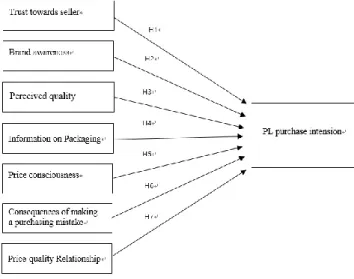
This study empirically analyzed the effects of Trust toward retailer, Brand awareness, Perceived quality, Information on Packaging, Price consciousness, Consequences of making a purchasing mistake, and Price- quality relationship on determinants of private label's Purchase Intention. We established a research model as shown in Figure 1.
Figure 1: Research Model
4. Method
4.1. Research design
This study is considered a descriptive study on the base of data collection method. Also, since the data are obtained through sampling of population to examine its distribution parameters, it is a survey study.
4.2. Sampling and data collection
In the present study we tested our research model using a questionnaire survey in the biggest marts in Suwon city, South Korea. The survey is done in 2015 from July to October in the largest Korean retail stores (Emart, Lottemart and Homeplus), which have their own PLs. In total we prepared 75 satisfaction questionnaires for 6 products. All presented products ranged from utilitarian and hedonic categories which are well known to the Korean customers.
Data was collected straight from the consumers right after they did their purchase in the marketplace.
In the survey 450 people participated including both men and women, who were stores` consumers. We created 2 sets and each of them consisted of 3 products. And for each product there were 75 questionnaires received, which in total amounted to 450 received answers but we used only 358 of them.
4.3. Procedures
For this study we decided to use printed questionnaires and meet consumers directly in Korean retail stores to have only real market consumers participate in our survey. We met men and women who visited stores in the age group of 20-70 years. We promised them that the data from the survey we collected would be only used for academic study.
And individual anonymity was guaranteed. Questionnaires were translated to the Korean language, under the supervision of native speakers. Therefore, the participants fully understood the meaning of the survey questions.
4.4. Participants characteristics
Since individual anonymity was guaranteed we can describe our participants’ characteristics in following sentences. There were 17.3% males and 82.7% females who responded to our questionnaires. Among them were, 8.3%
who were under 24 years, 10.7% of them were 25-29 years old, 9.7% of them were 30-34 years old, 13.3% were 39 years old, 16.7% were in 40-44 age group, 15.0% were in 45-49 age group, 13.3% were in 50-54 age group, 8.0%
were in 55-59 age group and 5.0% were above 60 years old.
Education level of our participants were: people who didn’t
graduate from high school were 37.3%, 17.3% were high school graduates, 35.0% had finished their undergraduate degrees, and 10.4% master and above had completed their master's degree. Monthly income of them were: less than 1.5 million won - 23.3%, 1.5-1.99 million won - 17.7%, 2-2.99 million won - 23.0%, 3-3.99 million won - 14.7%, 4-4.99 million won - 10.6%, 5-6 million won for 7.7%, and more than 6 million won - 3.0%.
4.5. Measures
The following section summarizes the measurement scales, which are considered valid and reliable, and have been adapted from previous studies.
In order to conduct a study, we preliminarily divided all the products we selected for the survey into 2 sets. Both of them consisted of 3 PL products. First set: coffee mix, shampoo, and laundry detergent. Second set: soju, beer and ramyon. With this choice of diverse products, we tried to determine the intentions of buying customers in large retail stores.
Purchase intention: This study adapts the 4-item scale established by Knight and Kim (2007) to measure the purchase intention of the PL. Trust toward retailer (TTR):
The measurement items were adopted from the existing literature of Doney & Cannon (1997) 4 scales. Brand awareness (BA) was measured with 2 items using again 7- point scales which was adopted from the previous study of Batra and Sinha (2000). To measure perceived quality, we used the 4 scales suggested by Knight and Kim (2007). For measuring the Information on packaging (PACK), we used 2 scales which were adopted from the previous study of Batra
& Sinha (2000). Price consciousness (PC): Sinha and Batra (1999) used 3 measures to measure price sensitivity and in this study, the same 3 scales were used. For consequences of making a purchasing mistake (PMM), we used measurement from Batra and Sinha (2000) study by 3 scales. And for price-quality relationship (PandQ), a four- item, seven-point Likert-type scale was used to measure a consumer's belief that there is a positive relationship between product price and quality. For PL purchase intention (PLPI), we used the scale for purchase intention, which includes 4 items developed by Putrevu and Lord (1994) and Taylor and Baker (1994). Consumer purchase intention improves with stronger respondent agreement with each item. The participants were instructed to rate each item of these dependent variables on a 7-point Likert scale from 1 (strongly disagree) to 7 (strongly agree).
5. Results
Among the 450 submitted questionnaires, we excluded
92 inaccurate questionnaires, therefore at the end we had
358 accurate questionnaires. On their basis, we used SPSS24 program to run our data. After examining measurement models and assessing their validity using confirmatory factor analysis, we could study the relationships among variables. Because our study is exploratory and based on survey, in a strict sense, it is not suitable for inferring causality, instead of using structure equations model, we took the averages of measures and multiple regressions were used to test the hypotheses.
5.1. Significance of independent variables
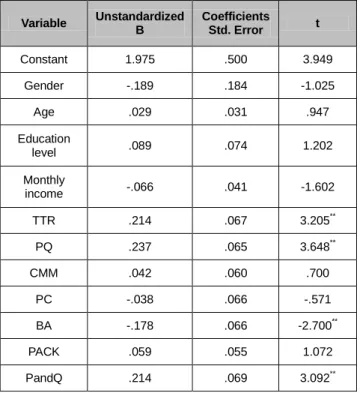
Table 1 is a model summary of the impact of trust towards retailer (TTR), brand awareness (BA), perceived quality (PQ), packaging (PACK), price consciousness (PC), consequences of making a purchase mistake (CMM) and price-quality relationship (PandQ) on PL purchase intention (PLPI).
Coefficient tables of regression analysis indicates the significant effects between trust towards retailers and PL purchase intention; brand awareness and PL purchase intention, perceived quality and PL purchase intention; and price-quality relationship and PL purchase intention.
Table 1: Regression Results Variable Unstandardized
B
Coefficients Std. Error t
Constant 1.975 .500 3.949
Gender -.189 .184 -1.025
Age .029 .031 .947
Education
level .089 .074 1.202
Monthly
income -.066 .041 -1.602
TTR .214 .067 3.205
**PQ .237 .065 3.648
**CMM .042 .060 .700
PC -.038 .066 -.571
BA -.178 .066 -2.700
**PACK .059 .055 1.072
PandQ .214 .069 3.092
****