• 검색 결과가 없습니다.

The response of A.I systems in other countries to Corona Virus (COVID-19) Infections: E-Government, Policy, A.I utilizing cases

N/A
N/A
Protected

Academic year: 2021

Share "The response of A.I systems in other countries to Corona Virus (COVID-19) Infections: E-Government, Policy, A.I utilizing cases"

Copied!
15
0
0

로드 중.... (전체 텍스트 보기)

전체 글

(1)

The response of A.I systems in other countries to Corona Virus (COVID-19) Infections: E-Government, Policy, A.I utilizing cases

Hyejin Kim

Global Digital Policy Research Institute President

코로나바이러스감염증(COVID-19)에 대한

국내 및 해외 A.I 시스템의 대응: 전자정부, 정책, A.I 활용사례

김혜진

글로벌 디지털 헬스케어 정책 연구소 대표

Abstract Outbreak of COVID-19 originated from China resulted significantly high casualties and social and economic damages. Currently the major countries see importance of accurate prediction of originating trend to prevent the spread of infectious disease and AI is actively utilized when establishing the system. Therefore this study has comprehended the status of utilizing the AI in overseas and made comparison and analysis with domestic status. It derived the necessity to establish national control tower based on One Health to respond to infectious disease to effectively utilize AI and suggested to establish higher organization, Medical Big Data Governance, to respond to the infectious disease. It is necessary to conduct further study to utilize the results and suggestions derived from this study into the policy and if the suggestions are reflected to improve institutional imperfection, it will be positively used for prevention of the spreading infectious disease and utilizing medical Big Data.

Key Words : Corona Virus infectious disease, AI, One Health, National Control Tower, Medical Big Data Governance

요 약 중국 우한 시에서 최초로 발병한 코로나바이러스감염증(이하 COVID-19)으로 인한 인명 피해 및 사회 ‧ 경제적 손실은 매우 크며 현재 세계 주요 각국에서는 COVID-19와 같은 감염병의 확산을 막기 위해서는 발생 추이를 초기에 정확히 예측하는 것이 중요하다고 보고 감염병 대응 체계 구축 시 인공지능을 적극 활용하고 있다. 이에 본 연구에서는 감염병 확산에 대응하기 위한 해외 각국의 인공지능 활용 현황을 파악, 국내 현황과 비교 ‧ 분석했으며 몇 가지 시사점 을 도출할 수 있었다. 연구 결과 보다 효율적으로 인공지능을 활용해 감염병에 대응하기 위해서는 원 헬스(One Health) 기반의 국가 컨트롤타워 구축이 필요하다는 결론이 도출되었으며 이에 컨트롤타워가 갖춰야 할 요건을 살펴 보았다. 또한 국가 안보 차원에서의 감염병 대응을 위해 상위 기관인 의료 빅데이터 거버넌스를 설립할 것을 제안하였 다. 향후 본 연구에서 도출된 결론 및 시사점을 정책적으로 활용하기 위한 연구가 필요할 것으로 보이며 본 연구가 제안하는 바를 반영해 제도적 미비점을 보완한다면 감염병 확산 방지 및 의료 빅데이터를 유용하게 활용하는데 긍정적 으로 작용할 것으로 전망된다.

주제어 : 코로나바이러스감염증, 인공지능, 원 헬스(One Health), 국가 컨트롤타워, 의료빅데이터 거버넌스

*Corresponding Author : Hyejin Kim([email protected])

Received April 1, 2020 Revised April 22, 2020

Accepted June 20, 2020 Published June 28, 2020
(2)

1. Introduction

In the 21st century, as the globalization accelerates due to the development of transportation, the outbreaks of new infectious diseases are increasing. According to the 2015 Infectious Disease Monitoring Report, Korea has been exposed to infectious diseases such as measles, chicken pox, and influenza A (H1N1) since the 2000s [1] and COVID-19, the first outbreak in Wuhan, China, has reached 8,236 domestic confirmed patients as of March 17.

Currently, the expansion of COVID-19 is very strong, and the number of confirmed cases is increasing due to the continuous group infections. Currently, the number of domestic deaths from COVID-19 infection is 75 [2]. After the first confirmed cases of COVID-19, the government entered the quarantine system of airports and ports and community response system and released the circulations, contact information, and hospital information of the first confirmed patient [3]. In addition, in response to the COVID-19, the National Assembly passed the Corona 3 Act on February 26, 2020, based on the grounds for banning entry into infected areas and the regulations on forced hospitalization [4].

However, in Korea's current crisis response system to overcome COVID-19, various problems such as insufficient efficiency of the quarantine system have been pointed out [5] and as the number of confirmed patients increases, there are 140 foreign countries that have restricted entering the country immigration from Korea resulting diplomatic issues [6] that requires a response from the national security level.

Meanwhile, COVID-19 is rapidly spreading not only in Korea but also abroad, and the World Health Organization (WHO) has declared a third pandemic in history, urging countries to prepare urgently. According to the World Health Organization (WHO), COVID-19 can be controlled when responding quickly and

proactively and it is time to take proactive and preemptive respond by each country as its significantly spreading [7]. Therefore, the developed countries have seen the importance of accurate prediction of the outbreaks in the early stages to prevent the spread of the COVID-19 virus and in order to establish an infectious disease surveillance system, artificial intelligence based on big data is actively used to respond to infectious diseases. These days, big data is positioned as the most competitive across various industries and in the digital healthcare industry that combines information and communication technology and medical information technology to link disease prevention, diagnosis, treatment, and follow-up services, artificial intelligence is more accurate than medical specialists in terms of disease diagnosis.

The utilization of artificial intelligence based on big data is expanding and thanks to this trend, overseas countries are currently using artificial intelligence to respond to COVID-19 in various ways. Korea is also using artificial intelligence to respond to COVID-19 through applications such as Corona maps, Corona reminders, and mask reminders, but since these artificial intelligence is based on big data, it is necessary to share accurate information across medical, educational, economic, and industrial sectors. But as the integration system for data collection and connection is insufficient, the effective utilization of artificial intelligence has not been achieved.

Therefore, this study was conducted to examine the overseas cases of the use of artificial intelligence to respond to infectious diseases and to compare and analyze the policies adopted by foreign countries for efficient utilization of artificial intelligence to suggest improvements.

To this end, this study intends to derive

suggestions regarding the response to infectious

diseases utilizing artificial intelligence of the

(3)

government by examining the problems of crisis response system of Korea in response to COVID-19 and comparing and analyzing them with overseas cases. In addition, through this study, it is expected that an effective infectious disease response system using artificial intelligence based on big data will be established and it will also help in establishing the correct policy.

2. Theoretical Background

2.1 Problems of the crisis response system to overcome coronavirus infection-19 (COVID-19)

2.1.1 Lack of scalability of information service utilizing artificial intelligence

Currently, the infection rate of COVID-19 is very high, and in Korea, COVID-19 is classified and managed as a first-class infectious disease.

According to the Korea Centers for Disease Control and Prevention, 8 out of 10 domestic COVID-19 confirmed cases belong to 'group infection cases' and so far, it has been reported that they were infected collectively through 13 infection paths [8]. On the other hand, the Corona map service that informs the circulations of the infected in the early stages of COVID-19 through the app was expanded significantly with the high number of users in a short period of time. But it has become difficult to guarantee accuracy and efficiency in a way that depended on the small number of developers and competence of participants.

In addition, various services related to COVID-19 that individual developers are making that uses big data-based artificial intelligence are also pointed out as a problem of crisis response system due to lack of interoperability and scalability between services [9].

The so-called 'drive-through' test that quickly diagnosis the virus test using a diagnostic kit allows more than 10,000 people to receive

COVID-19 tests per day [10]. But the failure to fully share the circulation of the infected and prevention guidelines of the disinfection authorities is causing social conflict and fear [9].

2.1.2 Limitations of data collection and processing to prevent the spread of infectious diseases

In 2015, after the MERS crisis, our society experienced that infectious diseases cause social anxiety and enormous economic loss and afterwards, it was suggested to establish a system of social crisis management using big data to quickly respond to the social crisis. [11]. In particular, in the case of quarantine using big data, it is possible to predict the mechanism of patient migration and the spread of infectious disease through accumulated data, and through this, it is possible to select and proactively prevent quarantine, thereby reducing the likelihood of secondary infection, which has a positive effect.

As for the current COVID-19 response, a research team at a university has made data with the official announcement of Center for Disease Control and Prevention and shared with developers to predict the growth trend of domestic COVID-19 infected patients.

However, in Korea, the response to COVID-19 using artificial intelligence has not been sufficiently efficient. One of the reasons is that the experience of using big data is restricted due to related regulations to have short period of history and limited amount of accumulated data resulting lack of competence [12]. In addition, as the Data 3 Act was passed in January, legal grounds for liberal use of big data were prepared but additional legislation and system establishment for safe use of big data are challenges to be resolved. Currently it is the restriction on the responding to COVID-19 using artificial intelligence.

2.1.3 Insufficient efficiency of Drug Utilization

Review (DUR) and related system utilization

(4)

Currently, in order to respond to the crisis of purchasing excessive masks, the government has changed its plan to use the Drug Utilization Review (DUR) and utilizes the 'Health Care Service Portal' operatedby the Health Insurance Review and Assessment Service. The plan using DUR (Drug Utilization Review) was reviewed while the current pharmacist suggested it on the Blue House National Petition bulletin board.

Definition of Drug Utilization Review is a data service used by doctors and pharmacists to prescribe andprepare medicines to prevent side effects caused by overlapping medications andit provides medicine safety and prescription-related information in real time. However, there is no legal basis to apply the quasi-drugs, mask purchase information, to the Drug Utilization Review (DUR) which provides information only for drugs under the medical law. It resulted the use of 'Health Care Service Portal' and provides various implications from the prospective ofutilizing medical big data.

First, as it became difficult to use the DUR (Drug Utilization Review) as a respond against the crisis of the mask, it was adjusted to use the 'nursing agency work portal' with the suggestion of the DUR (Drug Utilization Review) manager of the Health Insurance Review and Assessment Service. The lack of understanding by the staff of the Korean Ministry of Information and Communication has created confusion and increased chaos due to anxiety over the supply and demand of masks [13]. In addition, since the government's response began with the proposal of a current pharmacist, the problem of the formal decision-making system according to bureaucracy has been pointed out, and in this connection, the need to establish big data governance for the efficient use of medical big data is once again raised [14].

2.1.4 Limitations of existing manuals for dealing with new infectiousdiseases

Since the spread of COVID-19 in Korea, the government elevated the COVID-19 crisis warning to the highest level of 'severity' on February 23, and responded with significant efforts to stop the spread according to the Infectious Diseases Manual for Risk Management of Ministry of Health and Welfare Standards.

According to the Standard Manual for Infectious Disease Crisis Management, from the 'warning' stage of the infectious disease crisis warning, the government should prepare for the operation of the Central Disaster and Safety Countermeasures Headquarters (CDSCHQ), but in this COVID-19 situation, only after the government raised the crisis stage to 'warning' the CDSCHQ was established and operated.

Not only is the government's response was slower than the existing manual, but the current COVID-19 spread rate is known to be faster than the existing manual response to pointed out that it is urgent to improve the standard manual for crisis management in response to new infectious diseases. [15].

In addition, when the spread of newi nfectious disease during the 2015 MERS incident, the importance of an advanced response system that utilizes the results of the 4th Industrial Revolution to ensure proper initial response as well as treatment of diagnoses and prevention of the spread of infectious diseases has been raised [16]. Other than the passage of the Data 3 Act that is the legal basis for enabling the liberal use of medical big data, there is insufficient legal and institutional support to utilize the results of the fourth industrial development.

2.2 Necessity of responding to infectious diseases at thenational security level

2.2.1 Domestic and foreign COVID-19 occurrence and spreadtrend

On December 31, 2019, after a number of

unexplained pneumonia patients in Wuhan City,

Hubei Province, China, on January 11, 2020,

(5)

Wuhan City officially announced 41 confirmed pneumonia patients. Afterwards, COVID-19 confirmed cases occurred in Thailand, Japan, Beijing, China, and Shenzhen, Guangdong Province and Korea also had the first domestic confirmed patient on January 20th. By February 2020, 1,115 death were reported from of 45,138 confirmed cases from 27 countries, including 44,653 cases in China, due to COVID-19. As a result, 28 confirmed patients were found in Korea, from 5,624 people designated as target management who show respiratory symptoms such as coughing, over 37.5 ° C temperature and visiting China in China [17]. Since then, the number of confirmed cases of COVID-19 in Korea has increased sharply since the occurrence of 31

st

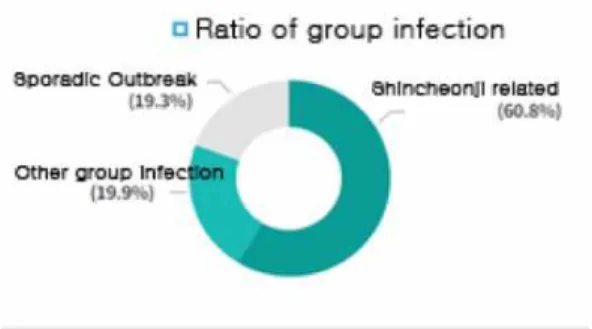
patient in the Sincheonji Church and on February 29th, 909 confirmed patients were added in one day. According to the Korea Centers for Disease Control and Prevention, the incidence of COVID-19 diagnosed cases in Korea is high due to group infection.

Among them, Shincheonji-related group infection was the highest with 60.8%(Shown in Figure1).

In addition, other group outbreaks such ascall centers are 19.9%, and sporadic outbreak rates are 19.3% [18].

Fig. 1. Ratio of Group Infection

On the other hand, overseasCOVID-19 infected patients seemed to be concentrated in Asian countries such as Thailand, Japan, Hong Kong, Taiwan, Malaysia, and Korea, mainly in China, where they originated. According to the

'Wuhan Coronavirus (2019-nCoV) Global Cases',the number of confirmed patients on the 17th of March was highest in Italy with27,980 cases, with the exception of China where is the first place of origin.

Then, 14,991 and 9,942 confirmed cases of COVID-19 in Iran and Spain were reported showing the spread of COVID-19 worldwide [19].

In response, the World Health Organization (WHO) declared the third pandemic in the history on March 12, urging countries to respond quickly including prompt diagnosis [7].

2.2.2 COVID-19 from the perspective of the rise of Biosecurity and the Global Health Security Agenda

Since the MERS incident in Korea, infectious diseases have been recognized as a national problem in Korea, but the MERS and Ebola infections have spread and the perception that infectious disease response is no longer limited to one country, but that international response along with health and security cooperation are needed.

In addition, a social consensus was established agreeing that it is a matter for the private sector and the government to cope with together.

Infectious diseases that have disappeared due to the development of medical technology and the emergence of vaccination have been reemerged by globalization, urbanization, environmental pollution, and climate change. Human losses and socio-economic losses due to the spread of infectious diseases are very serious to affect national security.

In particular, as it is known that infectious

pathogens can be used for bio terrorism and

biological weapons, it is argued that the response

to the spread of infectious diseases should be

expanded to national security issues. The World

Health Organization (WHO) has been operating

the International Health Regulations (IHR) to deal

with the national security crisis caused by

(6)

naturally occurring infectious diseases since 1948, but there are clear limits to responds to the rapid spread of infectious diseases due to globalization.

This is because each country's rights as an independent nation is placed above the importance of international public health and values economic interests. Currently, the World Health Organization (WHO) is spreading around the world to declare the third pandemic in history. The need for global health and security governance at the diplomatic and security level, rather than nationally oriented governance, has emerged through the COVID-19 incident.

As a result, the 'Global Health and Security Agenda (GHSA)', which the United States launched to deal with security threats caused by infectious diseases after the 9/11 terrorism, is considered to be an effective agenda to prevent and respond to naturally or intentionally occurring infectious diseases [20].

2.2.3 Overseas cases of the occurrence and response to new and unknown infectious disease outbreak

2.2.3.1 Intestinal hemorrhagic E. coli in Germany In May 2011, the massive outbreak of food poisoning in Germany and Europe remains a precedent to inform that accurate epidemiological investigations and data analysis should be performed when responding to infectious diseases.

In the early days of the incident, Germany announced that cucumbers from Spain were the source of the infection, but later it turned out to be a sprout vegetable, and the Spanish government also claimed a large amount of damages against the German government. This has led to a significant drop in Germany's trust in the international community. At that time, the causative bacterium was revealed as enter ohemorrhagic Escherichia coli. In the early stages of the situation, the German government misjudged the infectious originating agent

because of the error in the epidemiological investigation and data analysis as described above. Accordingly, there has been a need to encourage experts and establish a nationwide surveillance network so that rapid and accurate epidemiological investigations can be made in order to respond to new infections of unknown cause in early stage and to prevent the spread. In addition, it was argued that due to the nature of the infectious disease, a management system that can quickly identify the exact source of infection is needed when the disease spreads in multiple places at the same time [21].

2.2.3.2 United States SARS Initial Response System

SARS, which first occurred in Guangdong Province, China in November 2002, spread to 30 countries over about 9 months, leaving a record of 8,500 deaths worldwide. At the time, casualties continued in Hong Kong and Singapore that are adjacent to China, but in the United States, there was no single fatality resulting the importance of the national system for the response to new infectious diseases. At the time, the United States found and quarantined infected people early, and conducted thorough quarantine for the general public, including those around them. After the SARS event ended, this case provided the implication that response to quarantine and thorough quarantine should be conducted promptly and accurately in the event of a new infectious disease without the right treatment or vaccine. In addition, it proved that the establishment of an early response system is more important than anything else in order to prevent the spread of new infectious diseases and to end the disease in early stage so that the infected people are found and quarantined early.

Accordingly, in Korea, the necessity of

establishing an initial response system was raised

by predicting the characteristics of infectious

diseases and possible routes to spread based on

(7)

monitoring data on factors that can cause infectious diseases such as climate change and bird migration.

Also, for this purpose, on the premise that humans, animals, and the environment are in an organic relationship, a One Health concept response system based on cooperation and dialogue between related ministries was established to collect, integrate and analyze information. It was proposed to establish policies for responding to infectious diseases using advanced systems such as monitoring systems and predictive simulations [21].

2.2.4 Trends in the use of artificial intelligence in some countries to respond to COVID-19

Artificial Intelligence (Human Intelligence Exhibited by Machines) is a computer engineering technology that focuses on solving cognitive problems linked to human intelligence and refers to the highest concept of a system that learns to help the system to voluntarily solve problems. Deep Learning, one of the most commonly mentioned algorithms, along with Artificial Intelligence (Human Intelligence Exhibited by Machines) is one of the algorithms for machine learning. It is a technology that induces optimal decision making by applying error data values suitable for each case after calculation. For example, technologies for reading images and videos embedded in data are actively used in the field of artificial intelligence Healthcare as a technology utilizing deep learning. Currently, major countries around the world are using artificial intelligence in a variety of ways to respond to COVID-19 and In silico Medicine, located in Maryland, USA, succeeded in identification of the molecule that is the basis for the treatment of COVID-19 virus using artificial intelligence. The biggest foundation for ability of In silico Medicine' to identify thousands of molecules with the potential for treating COVID-19 virus is an AI-based system, and In

silico has also announced that they are uploading its libraries from time to time to be shared with other researchers. In addition, In silico announced plans to design a new small molecule capable of inhibiting viruses by combining with proteolytic enzymes and this is a technology that uses artificial intelligence to develop a structure that can bind to proteolytic elements to generate new molecules. As can be seen from the case of In silico Medicine, artificial intelligence has a huge impact on the rapid response to new infectious diseases and it is actively used to respond to infectious diseases in major foreign countries with excellent health care systems which has great implications for us [22].

2.2.5 Prepare and respond to infectious diseases based on One Health perspective

As new infectious diseases such as Ebola, HIV, and Influenza spread worldwide, the concept of

“One Health” emerged which views humans, animals, and the environment as the same organically connected system. Currently, world health organizations such as the World Health Organization (WHO) and the United Nations Food and Agriculture Organization (FAO), the World Animal Health Organization (OIE), and major international organizations have established a system to prepare and respond to infectious diseases based on the concept of 'One Health' such as 'OFFLU', 'GLEWS', and 'GloPID-R'.

OFFLU is a network for animal influenza experts established by the World Health Organization, the United Nations Food and Agriculture Organization (FAO), and the World Animal Health Organization (OIE) to develop surveillance strategies to prevent the spread of infectious diseases caused by animal influenza.

In addition, GLEWS (Global Early Warning

System for Major Animal Diseases, including

Zoonoses) is a global early warning system

designed to quickly respond to common

(8)

infectious diseases that infect both humans and animals. It can be seen as a platform based on sharing, connection, and integration of big data held by FAO, OIE and WHO.'GloPID-R(Global Research Collaboration for Infectious Disease Preparedness)' is a so-called global research collaboration network to prepare for infectious diseases, and Korea Research Foundation is participating from Korea [23].

As mentioned above, these international organizations and networks of infectious diseases experts have formed various networks based on the concept of 'One Health' to effectively respond to new infectious diseases that have been spread all over the world and the basis for connecting these alliances are achievements of the 4th industrial revolution called artificial intelligence and big data. This proves that AI can be very useful in responding to new infectious diseases that cause a lot of losses andit shows examples of strategies using AI to predict and prevent spread in major countries around the world with advanced health prevention systems.

3. Cases of responding to and predicting infectious diseases in domestic and abroad using artificial

intelligence

3.1 U.S. AI Case

3.1.1 Google's Flu Trends

Google's flu trend that appeared in 2008, is a service that predicts the outbreak of flu and has attracted a lot of attention in the short term that users have rapidly increased. However, as the result of the 4th industrial revolution, 'Big Data' appeared and it was divided into those who insist on efficient use of big data and those who point out the disadvantages of big data analysis. The weakness of big data analysis at the time was that result of Google's flu trend was higher than

the actual value for 100 weeks out of flu outbreaks announced in 108 weeks since August 2011. However, Google's flu trend is a way to 'supplement' other methods and experts have since revealed that the unique methodology inherent in Google's flu trend contributed to the development of epidemiology [24].Google's flu trend is regarded as a good example of using artificial intelligence to predict and prepare for infectious diseases because it uses artificial intelligence to predict the occurrence of infectious diseases and enables early preparation and response (Shown Fig.2).

Fig. 2. CoronavirusCOVID-19 Global Cases by the Center for Systems Science and Engineering (CSSE)at Johns Hopkins University (JHU)

3.1.2 Johns Hopkins University CSSE provided COVID-19 Global StatusCollection (Wuhan Coronavirus (2019-nCoV) Global Cases)

The first COVID-19 virus in Wuhan, China is spreading not only to neighboring regions of China but also to the United States and Europe.

The CSSE team of Johns Hopkins University in theUnited States visualized the status of the global COVID-19 diagnoses on a map. This map developed by using big data of the World Health Organization (WHO) and the United States Centers for Disease Control and Prevention (CDC) shows the number of confirmed cases and the number of casualties for each country at a glance. The number of confirmed patients is displayed in a graph to be able to check the recent trends.

This map is currently being evaluated as the

(9)

most readable in relation to the provision of COVID-19 information because it enables to check the current status of the infected person and the route of the infected person at a glance and suggests that the quick and easy delivery of information about infectious diseases is very important for early response.

In addition, it is regarded as a case of COVID-19 response using big data-based AI by collecting and utilizing data from health authorities and websites of individual countries including international organizations and also highly suggests the importance of connecting and integrating big data.

3.2 Canadian startup BlueDot

In the early days of COVID-19, it was announced that Canadian startup BlueDot warned of the spread of new Corona viruses before the World Health Organization (WHO) which the importance of preventing infectious diseases using big data-based artificial intelligence is drawing attention again. BlueDot is an artificial intelligence-based medical startup established to proactively warn quarantine authorities by predicting the possibility of the outbreak and spread of infectious diseases and preparing for the spread. It is equipped with artificial intelligence machine learning and natural language processing technology (NLP) to have a system that can process in real time to predict the spreading path of the infectious disease.

'BlueDot' accurately predicted the spread of COVID-19 virus in Wuhan, China to Seoul, Bangkok, Taipei and Tokyo [26] which the background of BlueDot's success is due to the effort of Canadian government in national AI development strategy since 2017. In Korea, research on foundation of artificial intelligence technology is progressing in startup ecosystem of Canada and deep learning, AR / VR, and big data technologies have been added to achieve the same outcome as 'BlueDot'.

3.3 AI chatbots in China

In China, the originating region of COVID-19, it uses artificial intelligence, big data, and 5G technology to test and analyze for virus infection, develop vaccines and new drugs and the improve effectiveness of quarantine. China's leading companies, Alibaba and Baidu, are also responding to COVID-19 by using IT technology.

Currently, China installs thermal imaging cameras in densely populated areas such as airports and railways to measure passengers' body temperature in real time, while providing an app service to check the transportation of COVID-19 virus-infected patients and in the isolation ward, artificial intelligence is widely used to prevent the spread of COVID-19 by using robot-based automatic cleaning technology.

Among them, AI chat bot is very useful to collect information such as health status, personal information, and identification of individuals who are highly susceptible to infection and saves about 30 times of the time compared to the case manual work of people. Although these AI-based technologies are not able to directly prevent the spread of infectious diseases, they are evaluated to be useful in reducing and responding to the spread of infectious diseases and also have implications in that they are fully supported by the Chinese government [28].

3.4 COVID-19 response and Corona map using big data of Korea-China integrated platform

The fact that a company's big data analysis technology that was used to provide various mobile services in connection with Wechat, China's largest mobile platform, to analyze the behavior of group tourists and to analyze inbound customers in commercial areas utilized in COVID-19-related status and problems shows various values in the liberal connection and integration of big data.

In addition, the 'Corona Map', released on

(10)

January 30th, showed the route of the COVID-19 infected patients at a glance by integrating the data provided by the Center for Disease Control and user reports. Also 'Corona Notifier' was released afterward to notify users with history of visiting by infected patients when searching for a destination. Furthermore, as an application was developed to show the status of COVID-19 infection around the world, not limited to Korea, and show preventive measures and real-time media reports, it was evaluated as a good precedent for infectious disease responding by using big data and artificial intelligence in the early stages of COVID-19 [29]. However, as the number of infected patients through group infection rapidly increased from the 31

st

infected patient and the path of the infected person increased exponentially, it was concluded that it is difficult to secure accuracy with services that depend on individual capabilities. Also the lack of scalability due to the inability to connect or integrate organically was also pointed out as a limitation of COVID-19 response using artificial intelligence [9].This is due to the lack of legal and institutional foundation for using AI to respond to infectious diseases such as COVID-19 and it provides many implications for us with the fact that the above-mentioned major overseas countries have built a government-level control tower to support the effective use of artificial intelligence

4. Requirements to establish a national control tower based on One Health to

respond to infectious diseases

4.1 Establish integrated information system for infectious diseases

Human beings belong to the same ecosystem along with animals and environment. Therefore,

in order to have a crisis response system that can effectively respond to infectious diseases, national control tower with the concept of One Health must be established that includes humans, animals and the environment [31].

In addition, as infection should be promptly prevented, quarantine to identify the path of infection and prevention of spread should be made in early stage and for this, it is essential to build an integrated information system that operates information related to infectious diseases. Furthermore, it is suggested that the establishment of an integrated information system for the safe use of data has been suggested because most researchers have insufficient measures for data security, such as backup [32].

4.2 Promotion of big data centers for predicting and responding to infectious diseases

While major foreign countries are actively using artificial intelligence to respond to new infectious diseases, government-level policy support and budgets are continuously being invested to facilitate the use of fourth industrial technologies such as big data and artificial intelligence. On the other hand, in Korea, in 2015, after the MERS crisis, the government has promoted the 'Early warning system for new and strained infections and on-site response systems' that have been initiated by government agencies since 2016 but it appears to be still on the development stage clearly showing limitations on the establishment of an infectious disease response system.

In addition, among the detailed projects that

were decided to be progressed in 2018, plans

were made to collect information on the

outbreaks of infectious diseases from overseas

countries, analyze them with artificial

intelligence, and notify relevant information

tothe health authorities to prepare an early

(11)

response system. It appears to bethe same system as Canada's BlueDot, which predicted and warned ahead of theWorld Health Organization (WHO) on the spread of COVID-19. But fundamental improvements are needed to increase the effectiveness of the business and policy-making process for establishing an infectious disease response system[33]. In addition, roaming data in China provided by SK Telecom, KT, and LG U + to the Center for Disease Control is very useful for identifying the COVID-19 infection route. As an infectious disease prevention system using communication big data is being developed [34], the establishment of a big data center for meaningful use of big data should be promoted.

4.3 Establishment of cooperation system across Ministries

In order to have an infectious disease response system, it is essential to establish an integrated information system as described above.

Currently, the Korea Centers for Disease Control and Prevention is pursuing an Information Strategy Plan (ISP) to ‘Established One Health Infectious Disease Risk Information System and Infectious Disease Information Center’. In order to meet One Health in this plan, not only humans but also animals and the environment must be brought together and therefore, an information sharing system between related ministries must be established and a cross-ministerial cooperation system should be established. To date, there has been no new system for sharing information on infectious diseases among ministries and different ministries have different jurisdictions according to various infection conditions, such as humans, humans and animals common, and antibiotic resistance. Since the ministries have different jurisdictions it is difficult to respond effectively by different ministries when infectious diseases outbreak. As a result it is essential to establish a system to

integrate cooperation of the ministries [35].

4.4 Opening and sharing big data related to infectious diseases and establishing a public-private collaboration system

The Korea Centers for Disease Control and Prevention has been holding “public-private council meeting in the field of infectious disease diagnosis and testing” on a regular basis (every 6 months) and has maintained a cooperative system with public and private experts related to infectious disease diagnosis and testing [36].

However, in the case of a fast spreading like COVID-19, a closer cooperation system needs to be established and therefore, a council composed of private and public experts who can respond at all times is necessary. In particular, when an infected person occurs, it is necessary to open and share big data related to infectious diseases because it is necessary to understand the path of infection and to perform rapid quarantine and diagnosis.

5. Discussion and suggestions

Infectious diseases have a long history, similar with the history of humanity, and it was expected that the development of medicine will end with the development of antibiotics and vaccines.

However, new infections such as SARS, influenza (H1N1), and MERS have started due to frequent exchanges between countries and climate change and the spread of new infectious diseases without treatment or vaccines has led to massive social and economic losses.

Currently, rapid expansion of COVID-19 which

originated in Wuhan will harm  global supply

chain and there is concern that the global

economy may be paralyzed as COVID-19 spreads

in the United States [37].Meanwhile, the World

Health Organization (WHO) is strengthening

cooperation with international organizations

(12)

based on the concept of One Health encompassing humans, animals, and the environment to respond to infectious diseases that threaten human health and well-being. This is because there is a need to respond to transnational infectious diseases spreading around the world from year 2000 on the national security level. In addition, as the possibility that the virus could be developed as a biological weapon rather than a naturally occurring infectious disease, countries around the world recognized the need to discuss the spread of the infectious disease by upgrading it to the level of biosecurity. In response, the United States launched the Global Health Security Agenda (GHSA) in 2014 to identify medical health issues from a security perspective and seek solutions and International Health Regulations (IHR) of World Health Organization (WHO), which deals with security issues caused by massive infectious diseases still maintains the role of governance focused on individual countries and the United States' Global Health Security Agenda (GHSA) aims to establish a global network based on the 4th industrial technology [20] such as big data and artificial intelligence.

Meanwhile, in order to respond to COVID-19 that is rapidly expanding as the World Health Organization (WHO) declares pandemic for the third time in history, artificial intelligence and big data are being actively used by major countries around the world. Legal and institutional support is continuously provided for more meaningful use of the fourth industrial technology but in the case of Korea, the artificial intelligence, which has been the main axis of the private sector, is under-utilized due to the ineffectiveness of the business progress and policy establishment for the establishment of an infectious disease response system.

Therefore, in this study, it is recommended to urgently establish a national control tower based on the concept of One Health in order to

overcome the problems of the infectious disease crisis response system in the event of COVID-19 and respond proactively when an infectious disease occurs. At the same time, it was considered that institutional and policy support for the use of big data and artificial intelligence should be fully provided. In addition, for the efficient operation of the control tower, we propose the establishment of a higher level medical institution big data governance.

Professionals such as individuals, companies, and organizations with expertise participate in medical big data governance to discuss ways to utilize the 4th industrial technologies including big data and artificial intelligence in health care issues such as infectious diseases and to lead smooth cooperation among ministries.

Furthermore, various discussions can be made on health care issues that are not limited to infectious diseases such as how to use medical big data safely as a council composed of experts in each field.

6. Conclusion

On December 31, 2019, the first outbreak of

COVID-19 in Wuhan, China, was rapidly

spreading around the world, and major countries

around the world actively utilize artificial

intelligence to build a surveillance system to

prevent the rapid spread of COVID-19. The first

place predicted and warned of the spread of

COVID-19 was the Canadian startup BlueDot and

the basis for predicting the occurrence of

COVID-19 was artificial intelligence-based

algorithms analyzing the big data caused the

infectious diseases. Also, the reason Canada's

startups was able to achieve this is because of

the full support from the government which

suggests a lot in the situation of Korea. In Korea,

there are many restrictions on the use of big data

accumulated in each institution and the data 3

(13)

Act that allows more liberal use of big data was recently passed the National Assembly, but there are challenges such as additional legislation and system establishment for safe use of big data.

This is currently acting as a limitation of COVID-19 response using artificial intelligence.

On the other hand, major countries around the world are aware of the necessity of responding to infectious diseases at the national security level and actively utilize big data and artificial intelligence to prevent and respond to infectious diseases, while maintaining the view that humans, animals, and the environment belong to the same system to establish global network based on the concept of One Health. This means that the utilization of 4th industrial technologies such as artificial intelligence and big data has a great potential to influence the competitiveness of the country. As can be seen from the COVID-19 situation, Korea is currently in need of Institutional preparation for a policy to utilize 4th industrial technology.

Therefore, in order to improve this and resolve the current spread of COVID-19, it is necessary to establish a national control tower and medical big data governance for efficient operation of the control tower. Also it seems that specific research is needed to reflect conclusions and suggestions of this study to the policy.

REFERENCES

[1] D. E. Lee (2017). Trend of domestic and overseas infectious disease prevention and respond KHIDI.

[2] Korea Center for Disease Control and Prevention.

KCDC. http://www.cdc.go.kr/index.es?sid=a2

[3] Democratic Press Citizens' Union. (2020). Abusing

‘Saeweolho crisis’ toattack government for ‘COVID-19’.

Media Today [Press release]. Retrieved from

http://www.mediatoday.co.kr/news/articleView.html?i dxno=205703

[4] ’COVID-19 3 Act‘ passed the National Assembly.

Prosecuted to deny on hospitalization or treatment.

Hangyeorae[Press release]. Retrieved from

http://www.hani.co.kr/arti/politics/assembly/929901.html [5] J. H. Bae & E. J. Kim. (2020). Status and future task

issues and discussion for COVID-19 respond system

#1656. National Assembly Legislative Survey.

[6] 103 countries restricted entering from Korea…more than half of the world. J. Y. Park. (2020.3.7.) Chosun Daily [Pressrelease]. Retrieved from

https://news.chosun.com/site/data/html_dir/2020/03/

07/2020030700640.html?utm_source=naver&utm_med ium=original&utm_campaign=news

[7] E. J. Lim. (2020). WHO, announced epidemic for COVID-19..”Can be controlled” Yunhap News [Pressrelease]. Retrieved from

https://www.yna.co.kr/view/AKR20200312002152088?

input=1195m

[8] Major cases of ’COVID-19‘ group infection Yunhap News. [Pressrelease]. Retrieved from

https://www.yna.co.kr/view/GYH20200309002200044?

input=1363m

[9] S. J Kim. (2020). Responding to COVID-19 and blockchain Hangyoraecolumn. [Press release]. Retrieved from

http://www.hani.co.kr/arti/opinion/column/93133 0.html

[10] K. K. Lim. (2020). Korea’s ability to test COVID-19, US and Japan should learn from Korea. [Pressrelease]

Retrieved from.

http://www.pressian.com/news/article/?no=282006&u tm_source=naver&utm_medium=search

[11] Y. C. Jeong, I. K. Choi & Y. K. Bae (2017).Utilization of big data of e-government for social crisis management. Journal of the Korea Information and Communication Society, 21(2), 435-442.

[12] J. W. Kim. (2020). From prediction of infection chances to research on the cure. ‘War against Corona’

all the AI experts have gathered Hankyung [Press release]. Retrieved from

https://www.hankyung.com/it/article/202003100677i [13] [Fact Check] Measurement for masks the reason for

throwing ’DUR’ and select ‘Medical Institution portal’?.

Newspim[ Press release]. Retrieved from.

http://www.newspim.com/news/view/20200311000687 [14] I. K. Lee. (2020). Expected ‘mask crisis’ originated

from failure of initial policy Issue Impact. [Press release]. Retrieved from .

http://www.issueinfact.com/news/articleView.html?id xno=15234

[15] [Cannot see control tower] ‘Virus’ faster than Government Newspim. [Press release]. Retrieved from http://www.newspim.com/news/view/20200302001349 [16] S. Choi & T. Y. Kim. (2019). Review on smart national

crisis management system – focused on case study of

integrated crisis respond level. Society for Korean

Government Administration, 33(2).

(14)

[17] CDC New infection respond team J. H. Hyun, J. H.

Kim, H. Y. Lee, J. Kwak.

* CDC Incheon airport quarantine station J. E. Kim, E.

Y. Lee, T. K. Kim, H. S. Kim COVID-19 #1 patient contact person interview result Daily Health and Disease13(7).

[18] Ministry of Health and Welfare Status of domestic outbreak COVID-19

http://ncov.mohw.go.kr/bdBoardList_Real.do?brdId=1

&brdGubun=11&ncvContSeq=&contSeq=&board_id=&

gubun=

[19] Coronavirus COVID-19 Global Cases by the Center for Systems Science and Engineering (CSSE) at Johns Hopkins University (JHU)

[20] S. J. Kang. (2015). Rise of Biosecurity and Global Health Security Agenda, Major International Problem Analysis Korea National Diplomatic Academy No.

[21] S. K. Kim, M. R. Kim, S. J. Kim & S. K. Han. (2016).

Trend analysis of infectious disease information analysis technology and roadmap Ministry of Health and Welfare

[22] C. H. Choi. AI... in the forefront to eliminate COVID-19(2019-nCoVAL Newspaper [Press release].

Retrieved from

http://www.aitimes.kr/news/articleView.html?idxno=1 5297

[23] D. E. Lee. (2017). Trend of prevention and respond to domestic and overseas infectious disease Science and Technology Policy Institution. KHIDI Expert report.

[24] A. C. MADRIGAL In Defense of Google Flu Trends The Atlantic

https://www.theatlantic.com/technology/archive/2014 /03/in-defense-of-google-flu-trends/359688/

[25] S. H. Ahn. (2020). COVID-19, how to confirm the status “at a glance”. Biotimes [Press release]. Retrieved from

http://www.biotimes.co.kr/news/articleView.html?idx no=2426

[26] C. Y. Park. (2020). AI, COVID-19, rise as a watch dog for infectious disease Medi. Consumers News [Press release]. Retrieved from

http://www.medisobizanews.com/news/articleView.ht ml?idxno=66579

[27] I. G, Oh. (2020). Success background of‘ Blue Dot’

who predicted the outbreak of COVID-19 Medical Journal [Press release]. Retrieved from

http://m.bosa.co.kr/news/articleView.html?idxno=212 0612.

[28] Y. H. Kim(2020) Domestic AI company, war with COVID-19 AI Times. [Pressrelease]. Retrieved from http://www.aitimes.com/news/articleView.html?idxno

=125524

[29] Y. J. Yoo. (2020). COVID-19, respond with cutting edge technology Kwangju Daily [Press release].

Retrieved from

http://m.kwangju.co.kr/article.php?aid=158082840068 8513166

[30] S. H. Kim. (2020). Want to CM, Korea-China O2O Service big data analysis for ‘COVID-19’ Newstown Economy [Press release]. Retrieved from

http://www.newstown.co.kr/news/articleView.html?id xno=445140

[31] M. R. Kim. (2018). Study on Korean One Health progressing plan to secure national health Ministry of Health and Welfare

[32] K. H. Ko, T. M.n Song, Y. H. Lee, M. A. Oh, Y. C. Jung, Y. S. Jang & H. S.Choi (2016). Health and welfare statistics and information technology integrated service status and institutional tasks. Health and Welfare Column, 2016(1).

[33] S. H. Cho. (2020). Big concerns of secondary infection.

Government infectious disease responding system has been developing for 3 years Money Todat[Press release]. Retrieved from

https://news.mt.co.kr/mtview.php?no=2020012917043 676787

[34] S. Y. Kim. (2020). Ways of COVID-19, Big data knows Nocut News [Pressrelease]. Retrieved from.

https://www.nocutnews.co.kr/news/5280894

[35] Y. C. Jung. (2019). ‘Integrated NationalInfectious Disease Management making across Ministries connectingplatform Electronic Times [Pressrelease]. Retrieved from.

https://www.etnews.com/20190705000183

[36] J. Y. Noh. (2018). CDC, Continue public-private collaboration to prepare for new overseas infectious disease Medi Pharms [Pressrelease]. Retrieved from http://www.medipharmhealth.co.kr/news/article.html?

no=45748.

[37] D. H. Ahn. (2020). ‘Blind Virus’ money doesn’t work’

Daily Chosun [Pressrelease]. Retrieved from https://news.chosun.com/site/data/html_dir/2020/03/

18/2020031800031.html .

(15)

김 혜 진(Hye-jin Kim) [정회원]

․ 2006년 2월 : Teachers College, Columbia University 교육심리학(임 상심리학) (석사)

․ 2007년 5월 : Teachers College, Columbia University 장애인 재활 학 (석사)

․ 2009년 5월 : Teachers College, Columbia University 철학 (석사)

․ 2009년 5월 : Teachers College,Columbia University 특수교육학 (박사)

․ 2012년 8월 : 국회 입법자문위원

․ 2012년 2월 : 국회 전 5급비서관

․ 2010년 ∼2020년 : 단국대, 백석대, 서경대 (외래교수)

․ 2019년 6월 ∼ 현재 : 글로벌 디지털 헬스케어 정책연구소 대표(Global Digital Policy Research Institute President)

․ 관심분야 : Digital Healthcare Policy, healthcare big data for early prediction of dementia. Senior Wellness IT, digital sex crime

․ E-Mail : [email protected]

수치

Fig.  1.  Ratio  of  Group  Infection
Fig.  2.  CoronavirusCOVID-19  Global  Cases  by  the  Center  for  Systems  Science  and  Engineering  (CSSE)at  Johns  Hopkins  University  (JHU)

참조

관련 문서