https://doi.org/10.12750/JET.2017.32.2.53
Analysis of Semen Parameters in α1,3-Galactosyltransferase-/- Boars
In-Sul Hwang1, Seung-Chan Lee1, Sung Woo Kim2, Dae-Jin Kwon1,3, Mi-Ryung Park1, Hyeon Yang1, Keon Bong Oh1, Sun-A Ock1, Jae-Seok Woo1, Gi-Sun Im1, Seongsoo Hwang1,†
1Animal Biotechnology Division, National Institute of Animal Science, RDA, Wanju 55365, Republic of Korea
2Animal Genetic Resources Research Center, National Institute of Animal Science, RDA, Namwon 55717, Republic of Korea
3International Agricultural Development and Cooperation Center, Chonbuk National University, Jeonju 54896, Republic of Korea
ABSTRACT
It is very difficult to get the information about semen quality analysis in transgenic pigs because of limited numbers and research facilities. Therefore, in the present study, we analyzed the semen quality of transgenic boars generated for xenotransplantation research. Briefly, the semen samples were collected from 5 homozygous α1,3-Galactosyltransferase knock-out (GalT-/-) transgenic boars and immediately transported to the laboratory. These semen samples were decupled with DPBS and conducted to analyze semen parameters by a computer-assisted semen analysis (CASA) system. The boar semen were examined all 12 parameters such as total motility (TM), curvilinear velocity (VCL), straight line velocity (VSL), average path velocity (VAP), and hyperactivated (HYP), etc. In results, among the 5 GalT-/- boars, three boars (#134, 144, and 170) showed normal range of semen parameters, but #199 and 171 boars showed abnormal ranges of semen parameters according to standard ranges of semen parameters. Unfortunately, #171 boar showed azoospermia symptom with rare sperm counts in the original semen. Conclusively, assessment of semen parameters by CASA system is useful to pre-screening of reproductively healthy boar prior to natural mating and artificial insemination for multiplication and breeding.
(Key words: Semen parameters, CASA, Transgenic boars, Xenotransplantation)
†Correspondence: Seongsoo Hwang, Ph.D.
Phone: +82-63-238-7253; Fax: +82-63-238-7297 E-mail: [email protected]
INTRODUCTION
Xenotransplantation of pig organs into human has been considered as a promising solution to the critical shortage of organs from deceased human donors for transplantation (Abouna 2008). However, the immune rejection response caused by species differences between pigs and human are the main obstacle for successful xenotransplantation (Kwon et al.
2016, Yamada et al. 2005). To overcome this problem, many research groups are still striving to produce transgenic pig with controlled immunodeficiency, including knockout of the α -1,3-galactosyltransferase (GalT) gene for the deletion of galactose-α-1,3-galactose antigens and the knock-in of human complement-regulatory genes for inhibition of human complement activation, such as CD46, CD55 and CD59 (Kwon et al. 2016, Lai et al. 2002, Lee et al. 2011). On the other hand, the reproductive disorder in transgenic pigs has been observed occasionally including irregular estrus (Lee et
al. 2008), testicular abnormality (Choi et al. 2012), and decreased sperm fertility (Park et al. 2006) even though we reported the production of the heterozygous GalT (GalT-/+) pigs with normal reproductive ability (Hwang et al. 2012).
For diagnosis of reproductive disorder, one possible method is direct analysis of semen quality and motility through the use of computer-assisted semen analysis (CASA) system (Amann and Waberski 2014). Although the relationship between semen parameters and fertilization ability has not yet been analyzed well, the CASA system is the most popular and reliable method used to evaluate sperm quality and motility (Gil et al.
2009, Verstegen et al. 2002). Additionally, many studies have been described the possible correlations of sperm motility and fertility from many species including cattle (Budworth et al.
1988), horse (Samper et al. 1991), humans (Hirano et al.
2001), rabbits (Lavara et al. 2005), and pigs (Vyt et al. 2008).
Therefore, in the present study, we conducted to investigate the sperm quality and motility by CASA system to diagnose
Table 1. Analysis of movement-related semen parameters in individual transgenic boar.
Individual IDs
Movement-related sperm parameter of *
LIN (%) ALH (μm) HYP (%) STR (%) BCF (Hz) MAD (º) WOB (%)
#134 43.3±1.3a 4.0±0.1a 49.4±2.9a 53.8±1.4a 5.1±0.2a 9.6±0.3a 70.9±1.1a
#144 39.4±0.9b 4.5±0.1b 61.0±1.7b 50.4±0.8a 5.7±0.2b 8.4±0.5a 70.6±1.0a
#170 39.7±1.0b 4.6±0.1b 61.7±2.2b 51.0±0.6a 6.0±0.1b 9.4±0.5a 71.2±0.8a
#171 68.2±11.0c 1.3±0.3c 3.6±0.5c 77.8±10.7b 1.0±0.3c 2.2±0.1b 87.8±5.0b
#199 48.1±1.4d 2.1±0.0d 7.6±2.5c 47.2±7.9a 2.4±0.4d 1.8±0.4b 78.2±2.5b
*Data are expressed as Mean±SEM of five replicates in each individual transgenic boar. a-d Different superscripts denote significant differences within column (P < 0.05). Full name of semen parameters are indicated in Figure 1.
whether the GalT-/- pigs are reproductively healthy or not.
Additionally, the semen parameters were categorized into three parts based on total motility, velocity, and movement of sperm.
MATERIALS and METHODS
1. General information
All chemicals used in the present study were obtained from Sigma-Aldrich (St. Louis, MO, USA) unless otherwise indicated. Also, our study protocol and standard operating procedures for the treatments of the pigs used present study were reviewed and approved by the Institutional Animal Care and Use Committee of the National Institute of Animal Science, RDA.
2. Production and breeding of GalT-/- boars
Production of GalT-/+ transgenic cloned pigs by somatic cell nuclear transfer was performed as previous study reported by Hwang et al. (2013). Briefly, ovaries were obtained from local slaughterhouse (Nonghyup Moguchon, Gimje, Korea), and the oocytes were matured in vitro. The cloned transgenic embryos were transferred into both oviducts of the surrogate (Landrace) on the same day or 1 day after the onset of estrus. After gestation period, the transgenic cloned piglets (Chicago minipigs) were delivered by natural parturition or Caesarean section. Using the GalT-/+ transgenic cloned pigs, GalT-/- pigs were generated by breeding.
3. Semen collection and CASA analysis
Semen samples from 5 GalT-/- transgenic boars (36±5 months and 86±6 kg) were collected once a week by conventional globed-hand method. Briefly, each ejaculate was
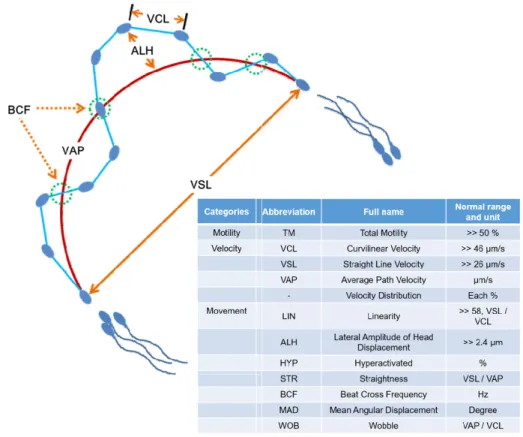
collected within a paper cup (350 ml-sized) covered with sterilized gauze to remove the gel fraction. Freshly ejaculated semen samples were transported to laboratory immediately and decupled with DPBS. Then, the semen samples were conducted to analyze sperm quality with CASA system (Medical Supply Co. Ltd, Korea). The total motility scores of each semen samples were obtained on a routine basis using a CASA system attached to a microscope (Olympus, Japan) in a laboratory at room temperature (25±5 °C). Approximately 5 μl of decupled semen samples was mounted on a MAKLER counting chamber (Irvine Scientific, USA) placed on warm plate (Kitazato, Japan). All semen parameters and their relationships were recorded by CASA system which is described minutely in Figure 1. As described in Figure 1, the semen parameters were categorized into three parts based on total motility (TM), velocity (VCL, VSL, VAP, and velocity distribution), and movement of sperm (LIN, ALH, HYP, STR, BCF, MAD, and WOB). Normal range and unit of semen parameters were also indicated in Figure 1.
4. Statistics
All semen parameters were analyzed 5 times in individual semen samples. Using the datasets recorded by CASA system, the significant differences were analyzed by the Student’s t test. A value of P < 0.05 was considered to be a significant difference.
RESULTS
1. Semen morphology and total motility analysis of sperm from individual transgenic boars
Freshly ejaculated semen samples were decupled with DPBS prior to analysis of morphological abnormality and motility by
Figure 1 Terminology of semen parameters by computer-assisted sperm analysis (CASA) system.
These semen parameters were divided into three groups based on total motility (TM), velocity (VCL, VSL, VAP, and velocity distribution), and movement of sperm (LIN, ALH, HYP, STR, BCF, MAD, and WOB).
Figure 2 Analysis of total motility in individual GalT-/- transgenic boars.
The values of TM for each boar were produced by CASA system automatically. a-c Different superscripts denote significant differences (P<0.05). TM, total motility.
CASA system. A semen sample from transgenic boar #171 showed that the number of sperm was very limited and very high abnormality was observed (data not shown). Thus the semen sample from #171 was conducted following experiment and analysis with original fresh semen without dilution. The
morphological abnormality was not found from transgenic boars except transgenic boar #171. As shown in Figure 2, the total motility of transgenic boars #134 (85.2 %), #144 (85.6 %), and
#170 (87.9 %) were significantly (P<0.05) higher than that of transgenic boars #171 (6.1 %) and #199 (21.2 %).
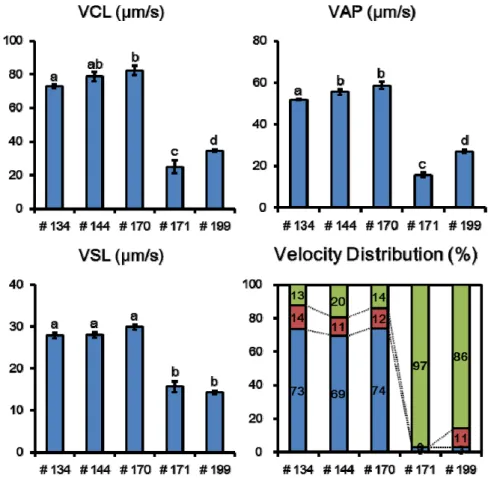
Figure 3 Analysis of velocity-related sperm parameters in individual GalT-/- transgenic boars.
The values of VCL, VAP, and VSL for each boar were produced by CASA system automatically. In velocity distribution histogram, the green, red, and blue bars indicate velocity distribution of slow (1-49 μm/s), medium (50-99 μm/s) and rapid (>100 μm/s), respectively.
a-d Different superscripts denote significant differences (P<0.05). VCL, curvilinear velocity; VSL, straight line velocity; VAP, average path velocity.
2. Velocity analysis of sperm from individual transgenic boars Results of sperm velocity and velocity distribution are represented in Figure 3. Firstly, the value of VCL in transgenic boars #134 (72.7 %), #144 (78.6 %), and #170 (82.3 %) were significantly (P<0.05) higher than that of transgenic boars #171 (25.0 %) and #199 (34.5 %). Secondly, the value of VSL in transgenic boars #134 (27.8 %), #144 (28.0 %), and #170 (29.8
%) were significantly (P<0.05) higher than that of transgenic boars #171 (15.6 %) and #199 (14.3 %). Thirdly, the value of VAP in transgenic boars #134 (51.6 %), #144 (55.5 %), and
#170 (58.6 %) were significantly (P<0.05) higher than that of transgenic boars #171 (15.6 %) and #199 (26.9 %). Finally, the portion of rapid sperm was significantly (P<0.05) in transgenic boar #134 (73.4 %), #144 (69.3 %), and #170 (73.9 %) than
#171 (3.0 %) and #199 (2.8 %). On the other hand, the portion
of slow sperm was significantly (P<0.05) higher in transgenic boar #171 (97.0 %) and #199 (85.9%) than #134 (12.7 %), #144 (19.7 %), and #170 (14.2 %). Additionally, the portion of medium sperm in transgenic boar # 171 was not observed while other transgenic boars showed comparable (#134, 14.0 %; #144, 11.0 %; #170, 11.9 %; #199, 11.3 %).
3. Movement analysis of sperm from individual transgenic boars Results of sperm movement analysis are represented in Table 1. Among the 5 transgenic boars, three (#134, 144, and 170) showed normal range in 7 criteria (LIN, ALH, HYP, STR, BCF, MAD, and WOB) for sperm movement, but #199 and #171 boar showed significantly (P<0.05) abnormal range in 7 criteria compared with normal three transgenic boars (#134, 144, and 170).
DISCUSSION
Conventional methods for analyzing sperm quality, such as morphology, motility, and concentration or volume, allow researcher to judge an optimal qualification of boar for breeding and multiplication by artificial insemination (Jung et al. 2015).
The CASA system also allows researcher to judge a best candidate for breeding and multiplication by artificial insemination. However, not all of these standard sperm parameters are directly related to boar fertility (Berger et al.
1996). Because, fertilization procedures by artificial insemination are very complex process involving a large number of events occurred in the female reproductive tract between sperm and oocyte.
When the GalT-/+ produced for the first time, we tried to multiply the number of transgenic pigs by artificial insemination and natural mating. The GalT-/+ founder successfully produced the next generation and reproductive disorder was not observed during this period (Hwang et al. 2012). Then the GalT-/- were generated successfully from the GalT-/+ pigs. In the present study, we analyzed semen quality of GalT-/- by the CASA system because, we found that some of GalT-/- showed reproductive disorders such as relatively low pregnancy rates and relatively small litter size. According to recent reports, the reproductive disorder in transgenic pig has been occurred occasionally such as irregular estrus (Lee et al. 2008), testicular abnormality (Choi et al. 2012), and decreased sperm fertility (Park et al. 2006).
In the present study, two fifths of transgenic boars showed decreased total motility, reduced sperm velocity, and abnormal movement among 5 transgenic boars. Additionally, the first GalT-/- pig was developed more than a decade ago, there is still no enough report about reproductive disorder. Therefore, genetic and physiological analysis of GalT-/- will be required to confirm this phenomenon.
Regarding the relationship between sperm motility and fertility, many studies has been reported. Flowers (1997) reported that no relationship between the sperm motility and fertility was founded in vitro as well as in vivo when the sperm motility was more than 60 %. However, the sperm motility was less than 60 %, fertility was reduced (Flowers 1997). In the present study we also found that boars with very low (less than 20 %) sperm motility showed infertility symptom. Additionally, the kinetic parameters such as VAP, VSL, VCL, STR and BCF of spermatozoa after 2-h incubation at 39°C were significant
predictors of litter size (Holt et al. 1997).
Conclusively, we reported the symptom of infertility and/or reproductive disorder in GalT-/- for the first time by analysis of semen with CASA system. Further studies are still needed to be clarified the problems related to reproductive disorder in GalT-/- pigs by genetic and physiological analysis.
ACKNOWLEDGEMENTS
This work was carried out with the support of "Animal Science & Technology Development (Project No. PJ01202202)”
and 2017 the RDA Fellowship Program (for SC Lee) of National Institute of Animal Science, Rural Development Administration, Republic of Korea.
REFERENCES
Abouna GM. 2008. Organ Shortage Crisis: Problems and Possible Solutions. Transplantation Proceedings 40:34-38.
Amann RP, Waberski D. 2014. Computer-assisted sperm analysis (CASA): capabilities and potential developments.
Theriogenology 81:5-17 e11-13.
Berger T, Anderson DL, Penedo MCT. 1996. Porcine sperm fertilizing potential in relationship to sperm functional capacities. Anim. Reprod. Sci. 44:231-239.
Budworth PR, Amann RP, Chapman PL. 1988. Relationships Between Computerized Measurements of Motion of Frozen-Thawed Bull Spermatozoa and Fertility. Journal of Andrology 9:41-54.
Choi MS, Shim MR, Oh MY, Kim KW, Lee HC, Yang BC, Chung HK, Kim JH, Lee HT, Hwang IS, Hochi S, Heo YT, Kim NH, Uhm SJ, Park JK, Chang WK, Chung HJ.
2012. Proteins associated with reproductive disorders in testes of human erythropoietin gene-harboring transgenic boars. Theriogenology 78:1020-1029.
Flowers WL. 1997. Management of boars for efficient semen production. Reprod. Fertil. 52(suppl.): 67-78.
Gil MC, Garcia-Herreros M, Baron FJ, Aparicio IM, Santos AJ, Garcia-Marin LJ. 2009. Morphometry of porcine spermatozoa and its functional significance in relation with the motility parameters in fresh semen. Theriogenology 71:254-263.
Hirano Y, Shibahara H, Obara H, Suzuki T, Takamizawa S, Yamaguchi C, Tsunoda H, Sato I. 2001. Relationships between sperm motility characteristics assessed by the computer-aided sperm analysis (CASA) and fertilization rates in vitro. J. Assist. Reprod. Genet. 18:213-218.
Holt C, Holt WV, Moore HD, Reed HC, Curnock RM. 1997.
Objectively measured boar sperm motility parameters correlate with the outcomes of on-farm inseminations:
results of two fertility trials. J. Androl. 18:312–323 Hwang S, Oh KB, Kim DH, Woo JS, Shim H, Yun IJ, Park
JK, Im GS. 2012. Production of α1,3-Galactosyltransferase (GalT) Double Knock-out (-/-)Transgenic Pigs for Xenotransplantation. Journal of Embryo Transfer 27:9-14.
Hwang S, Oh KB, Kwon DJ, Ock SA, Lee JW, Im GS, Lee SS, Lee K, Park JK. 2013. Improvement of cloning efficiency in minipigs using post-thawed donor cells treated with roscovitine. Mol. Biotechnol. 55:212-216.
Jung M, Rudiger K, Schulze M. 2015. In vitro measures for assessing boar semen fertility. Reprod. Domest. Anim.
50(suppl. 2):20-24.
Kwon D-J, Kim D-H, Hwang I-S, Kim D-E, Kim H-J, Kim J-S, Lee K, Im G-S, Lee J-W, Hwang S. 2016. Generation of α-1,3-galactosyltransferase knocked-out transgenic cloned pigs with knocked-in five human genes. Transgenic Research 1-11.
Lai L, Kolber-Simonds D, Park KW, Cheong HT, Greenstein JL, Im GS, Samuel M, Bonk A, Rieke A, Day BN, Murphy CN, Carter DB, Hawley RJ, Prather RS. 2002.
Production of alpha-1,3-galactosyltransferase knockout pigs by nuclear transfer cloning. Science 295:1089-1092.
Lavara R, Moce E, Lavara F, Viudes de Castro MP, Vicente JS. 2005. Do parameters of seminal quality correlate with the results of on-farm inseminations in rabbits? Theriogenology 64:1130-1141.
Lee HJ, Lee BC, Kim YH, Paik NW, Rho HM. 2011.
Characterization of transgenic pigs that express human decay accelerating factor and cell membrane-tethered human tissue factor pathway inhibitor. Reprod. Domest.
Anim. 46:325-332.
Lee HG, Lee HC, Chung HJ, Hwang IS, Choi MS, Byun SJ, Kim MJ, Woo JS, Chang WK, Lee P, Lee HT, Park JK.
2008 Study on the reproductive function in transgenic pig harboring human erythropoietin (hEPO) gene. Reprod. Dev.
Biol. 32:117-121.
Park CG, Kim S, Lee P, Han JH, Lee HG, Byun SJ, Yang BS, Lee CH, Lee HT, Chang WK, Park JK. 2006. Sperm fertility of transgenic boar harboring hEPO gene is decreased. Reprod. Dev. Biol. 30:27-34
Samper JC, Hellander JC, Crabo BG. 1991. Relationship between the fertility of fresh and frozen stallion semen and semen quality. J. Reprod. Fertil. Suppl. 44:107-114.
Verstegen J, Iguer-Ouada M, Onclin K. 2002. Computer assisted semen analyzers in andrology research and veterinary practice. Theriogenology 57:149-179.
Vyt P, Maes D, Quinten C, Rijsselaere T, Deley W, Aerts M, Kruif A, van Soom A. 2008. Detailed motility examination of porcine semen and its predictive value towards reproductive performance in sows. Vlaams Diergeneeskd.
Tijdschr. 77:291-298.
Yamada K, Yazawa K, Shimizu A, Iwanaga T, Hisashi Y, Nuhn M, O'Malley P, Nobori S, Vagefi PA, Patience C, Fishman J, Cooper DK, Hawley RJ, Greenstein J, Schuurman HJ, Awwad M, Sykes M, Sachs DH. 2005. Marked prolongation of porcine renal xenograft survival in baboons through the use of alpha1,3-galactosyltransferase gene-knockout donors and the cotransplantation of vascularized thymic tissue. Nat.
Med. 11:32-34.
Received March 18 2017, Revised March 30, 2017, Accepted June 05, 2017