축열조 공사의 위험분석지수 비교에 관한 연구
이상욱․맹인영 * ․이영섭
서울과학기술대학교 에너지환경대학원․
*
한진중공업(2014. 8. 6. 접수 / 2014. 9. 12. 수정 / 2014. 10. 2. 채택)
A Study on the Comparison of the Indices
of Hazard Analyses for the Construction of Heat Accumulator
Sang-wook Lee․In-young Maeng * ․Young-seop Yi
Graduate School of Energy and Environment, Seoul National University of Science and Technology
*
Hanjin Heavy Industries & Construction(Received August 6, 2014 / Revised September 12, 2014 / Accepted October 2, 2014)
Abstract : This study is conducted to compare three methods of hazard analyses and to propose the control for the accidents arising
under construction of heat accumulator of group energy projects(co-generation plants). The analysis of fatal accidents and the Analytic Hierarchical Process(AHP) using by the questionnaire survey for the workers engaged in the construction of heat accumulator and the quantitative questionnaire survey of expert group has been carried out. In order to analyze the fatal accidents, the 115 cases of accidents from 2001 to 2012 published by Korean Occupational Safety and Health Agency(KOSHA) and workers suffered from industrial accidents are collected and analyzed. The AHP is applied and analyzed for 66 persons of the construction site managers, safety engineers and construction engineers and the questionnaire survey of expert group is carried out and analyzed for the 51 persons of contractors and construction inspectors. The analyses of the types of accidents and the jobs of the suffered workers and the hazardous construction processes which are occurred accidents frequently are shown. The results of the analysis of fatal accidents and the AHP as well as the questionnaire of expert group are shown similar results.Key Words : hazard analysis of heat accumulator, indices of hazard analysis of heat accumulator, heat accumulator, AHP
†
Corresponding Author : Young-seop Yi, Tel : +82-2-970-6387, E-mail: [email protected]
1.
서 론최근 전력난 등 에너지 부족의 위기를 극복하기 위한 대책으로 원자력발전과 집단에너지사업(열병합발전소) 에 관심이 집중되고 있는 실정이다. 원자력발전의 신축 공사는 여러 이유로 인하여 검토단계에 있지만 집단에 너지사업은 발전플랜트로서 국가적으로 주목을 받으면 서 발주물량과 건설 투자가 꾸준히 증가할 것으로 예상 되는 1) 가운데 활발히 진행되고 있는 실정이다. 본 연구 는 증가 추세인 열병합발전소 공사의 핵심인 축열조 공 사에 대하여 다음과 같이 3종의 위험분석기법을 이용하 여 위험지수 결과를 비교 분석한다. 이 중 위험도가 높 은 공종에 대하여 공종별 유해․위험 요인을 도출한다.
또한 공종별 재해의 강도와 빈도를 정량화된 위험지수 를 제시하여 경제적이고 합리적인 축열조공사의 안전
관리 계획을 수립하는 자료를 제공하고자 한다. 축열조 공사의 공종을 분류하기 위하여 안전보건공단 발간 ‘탱 크공사의 이해’ 2) 를 참조하여 축열조 공사의 공종분류 표를 작성하였다. 첫 번째 기법인 중대재해 분석을 위 하여 안전보건공단의 플랜트 탱크공사 중대재해사례
3) (2001.9~2012.6)와 축열조 공사 참여 근로자 중 피재
자 등 115건을 분석하여 ‘건설업 공종별 위험성 평가모
델 4) 의 위험도 산정식을 활용하여 빈도와 강도를 분석
하여 단위작업분류표에 대입하고 위험도를 산정하였다 .
두 번째 계층별 분석법은 공사관계자 (현장 소장, 안전
관리자 , 공사담당자) 66명을 대상으로 설문지를 통하여
계층별 분석법 (AHP : Analytic Hierarchical Process) 5-6) 을
활용하여 위험지수를 산정하고 비교하였다 . 세 번째 기
법인 전문가 집단 설문조사 7-8) 는 축열조 공사 발주자 및
감리원 51명을 대상으로 조사 분석을 실시하였다.
2.
축열조공사의 위험지수 비교 분석축열조 공사의 공종은 대분류로 가설공사, 기초공사, 하부공사, 상부공사 및 기타공사로 구분한다. 가설공사 는 Wind girder(작업대) 설치, 낙하물방지망 및 수직보 호망 설치 그리고 비계의 설치 및 해체로 구분한다. 기 초공사는 토공사, 기초파일 작업, 바닥 콘크리트 공사, Oil sand 포설, Annular plate(바닥 테두리 철판) 설치 그 리고 Bottom plate(바닥 철판) 설치로 구분한다. 하부공 사는 Shell plate(옆면 철판) 설치, Internal Parts(내부기 계장치 ) 설치, Stairway(계단) 설치 및 Insulation(보온)과 Painting(도장) 작업으로 구분한다. 상부공사는 Roof (Rafta철골/지붕판) 설치 및 Platform 설치로 구분하고 기타공사는 비파괴검사와 Hydraulic Test(충수검사)로 구분한다.
2.1 재해사례의 조사․분석
플랜트 탱크공사의 중대재해 사례는 2001.9~2012.6 까지 11년간 발생한 중대재해 사례 8건을 발굴하고 또 한 축열조 공사 전문건설업체의 상위 4개 업체에서 2013.3월 1개월간 산업재해 피재자 101명 중 91명이 작성한 107건의 설문지를 수집하여 총 115건에 대하여 분석하였다. 축열조 공사의 공종은 위와 같이 분류하 였고, 재해의 분석을 위하여 재해형태, 기인물 및 직종 등을 주관적으로 작성토록 하였다. 재해형태별 분석에 서는 추락(36.5%), 협착(19.1%) 및 낙하물(13.9%)의 순
Table 1. Accident frequency by the construction types
Work type Work type
(Mid classification) number frequency
Temporary work
Wind girder installation 17 14.8 Flared shielding installation 4 3.5 Scaffolding installation & dismantling 7 6.1
Foundation work
Earth work 1 0.9
Foundation Pile 3 2.6
Reinforced concrete floor construction 3 2.6
Bottom plate installation 3 2.6
Lower work
Shell plate installation 29 25.2 Internal parts installation 9 7.8
Stairway installation 5 4.4
Insulation & Paint 12 10.4
Upper work
Roof(rafta) installation 16 13.9
Platform installation 2 1.7
Miscellaneous Non-destructive test 4 3.5
Total 115 100
으로 나타났다. 기인물별 분석에서는 작업발판(9.6%), wind girder(7.8%) 및 shell plate(7.0%)의 순으로 나타났 고, 피재자 직종은 제관공(33.0%), 용접공(25.2%) 및 비 계공 (10.4%) 순으로 나타났다. 그 외에도 작업공종별 재해형태에 대하여 쌍대비교(Cross-tabulation)로 분석하 였으며 , 각 공종별 대분류, 중분류 및 소분류에 의한 재해건수를 분석하였다 . 그 대상은 가설공사, 기초공 사, 하부공사, 상부공사 및 기타공사로 나누어 각각 분 석하였다. 안전보건공단에서 제시한 건설업 공종별 위 험성평가모델 위험도 계산식에 의거 발생빈도를 산정 한 결과는 다음 Table 1과 같이 Shell plate(옆면 철판) 설치 25.2, Wind girder(작업대) 설치 14.7 및 Roof(rafta 철골 /지붕판) 설치 13.9의 순으로 나타났다.
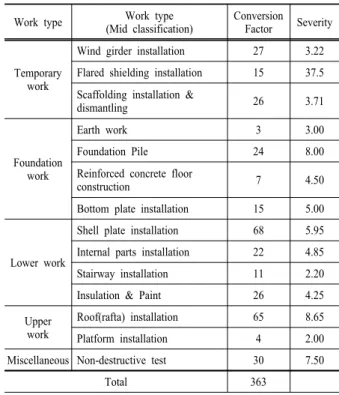
안전보건공단에서 제시한 건설업 공종별 위험성평 가모델 위험도 계산식에 의거하여 근로손실일수의 환 산지수 9) 는 재해자수에 4일~10일은 1, 11일~30일은 2, 31일~90일은 3, 91일~180일은 4, 181일~360일은 5, 360일 이상과 질병 사망은 6 그리고 사고로 인한 사망 은 10을 곱하여 산정한 발생강도를 계산한 결과는 다 음 Table 2와 같이 Roof(rafta철골/지붕판) 설치가 8.65, 기초파일작업이 8.00 및 비파괴 검사 7.50의 순으로 나 타났다 .
안전보건공단에서 제시한 건설업 공종별 위험성평 가모델 계산식인 사고의 발생빈도 × 사고의 발생강도 의 식으로 계산한 결과는 Table 3과 같이 나타났다.
Table 2. Accident severity by the construction types
Work type Work type
(Mid classification) Conversion Factor Severity
Temporary work
Wind girder installation 27 3.22 Flared shielding installation 15 37.5 Scaffolding installation &
dismantling 26 3.71
Foundation work
Earth work 3 3.00
Foundation Pile 24 8.00
Reinforced concrete floor
construction 7 4.50
Bottom plate installation 15 5.00
Lower work
Shell plate installation 68 5.95 Internal parts installation 22 4.85
Stairway installation 11 2.20
Insulation & Paint 26 4.25
Upper work
Roof(rafta) installation 65 8.65
Platform installation 4 2.00
Miscellaneous Non-destructive test 30 7.50
Total 363
Work type work type
(mid classification) Work unit Frequency Severity Risk
Temporary work
Wind girder Installation & dismantling 9.57 1.55 14.83
Welding & solidarity 5.22 1.67 8.71
Flared shielding Installation & dismantling 3.48 3.75 13.04
Scaffolding Outside installation & dismantling 6.09 3.71 22.58
Foundation work
Earth work Dig & back filling 0.87 3.00 2.61
Foundation Pile Piling work 2.61 8.00 20.87
Ground cnn'c Rebar Processing & Assembly 1.74 2.50 4.35
Casting & curing 0.87 2.00 1.74
Bottom Metal welding & cutting 2.61 5.00 13.04
Lower work
Shell plate Material lifting & installation 6.09 2.86 17.41
Steel plate fixed & welded 19.13 3.09 59.11
Internal parts Material lifting & installation 4.35 2.60 11.30
Pipe lifting & installation 3.48 2.25 7.83
Stairway Lifting & Welding 4.35 2.20 9.57
Insulation & paint Tin installation 3.48 2.00 6.96
Exterior painting 6.96 2.25 15.65
Upper work Roof installation Rafta Steel lifting 6.09 6.43 39.14
Shingles lifting 7.83 2.22 17.37
Platform Material Lifting & Installation 1.74 2.00 3.48
Miscellaneous Non-destructive test Test 3.48 7.50 26.09
Table 3. Hazard rate of work units
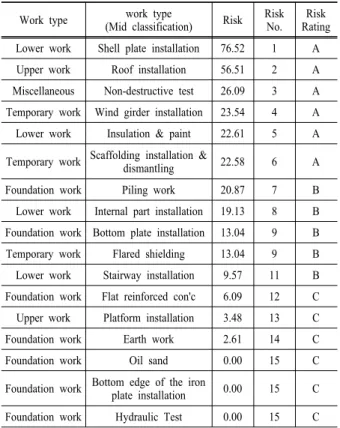
위의 Table 3에 의하여 작업공종별 위험도 등급순위 는 다음 Table 4와 같이 상(A) 6개, 중(B) 5개 및 하(C) 6개 공종으로 분류하였다.
Table 4. Hazard rate of work units
Work type work type(Mid classification) Risk Risk No. Risk
Rating Lower work Shell plate installation 76.52 1 A
Upper work Roof installation 56.51 2 A
Miscellaneous Non-destructive test 26.09 3 A Temporary work Wind girder installation 23.54 4 A Lower work Insulation & paint 22.61 5 A Temporary work Scaffolding installation &
dismantling 22.58 6 A
Foundation work Piling work 20.87 7 B
Lower work Internal part installation 19.13 8 B Foundation work Bottom plate installation 13.04 9 B Temporary work Flared shielding 13.04 9 B Lower work Stairway installation 9.57 11 B Foundation work Flat reinforced con'c 6.09 12 C Upper work Platform installation 3.48 13 C
Foundation work Earth work 2.61 14 C
Foundation work Oil sand 0.00 15 C
Foundation work Bottom edge of the iron plate installation 0.00 15 C Foundation work Hydraulic Test 0.00 15 C
2.2 설문조사를 통한 AHP 위험지수 산정
위의 2.1에서 제시한 위험도에 대한 정당성을 확보 하기 위하여 축열조 공사현장의 시공전문가인 현장소 장 3인, 안전관리자 12인, 공사관계자 35인, 공무직원 4 인 및 협력사 직원 12인 등 총 66인을 대상으로 설문 지를 배포하고 66부의 설문지를 회수하여 분석하였다.
축열조 공사의 공종별 계층화를 위하여 Table 4를 근거 로 Group A, B, C에 관한 쌍대비교(Cross-tabulation) 설문 을 실시하였다 . 설문은 AHP기법을 이용하여 각 Group별 쌍대비교로 가중치를 결정하게 된다 . 각 Group별 가중치 를 구하기 위하여 AHP기법을 EXCEL Program을 이용하 여 분석하였다 . Saaty의 9점 평가스케일을 근거로 Group A가 Group B에 비해 5만큼 중요하고, Group B는 Group C에 비해 4만큼 중요하다는 가정 하에 쌍대비교 매트릭 스가 구축된다. 이들의 평균 가중치는 Group A, B, C가 각각 0.72, 0.21, 0.07로 구해진다. 의사결정자의 논리적 일관성은 평균값이 3.10, 일관성 비율(CR : Consistency Rate)이 0.1 이하이면 일관성이 있다고 보기 때문에 0.08 이므로 일관성이 있다고 판단된다.
회수된 설문지 66부 중 일관성 비율 0.1 이하인 56부
만으로 분석하였는데 Group별 가중치는 A는 0.70, B는
0.22, C는 0.08로 나타났고, 일관성비율도 0.06으로 나
타났으므로 0.1 이하로 유효하다고 할 수 있다. 각
Group별 가중치를 각 공종에 대한 쌍대비교를 통하여
위험도를 분석한 결과는 다음 Table 5, 6 및 7과 같이
Table 5. The weight value of Group A by types
Worktype Shell
plate Roof Non-destructive test Wind girder Insul'
paint Scaffold
ing CR
Total 0.29 0.34 0.06 0.16 0.06 0.10 0.08
Table 6. The weight value of Group B by types
worktype foundation file Inter'
parts Bottom
plate Flared
shielding Stairway CR
Total 0.10 0.47 0.09 0.19 0.15 0.07
Table 7. The weight value of Group C by types
worktype Ground
con'c Platform Earth work Oil
sand Annular
plate Hyd'Test CR
Total 0.14 0.35 0.13 0.16 0.17 0.12 0.07
나타났다.
AHP기법을 활용하여 도출한 Group별 가중치(A)와 Group내부에서의 공종별 가중치(B)를 각각 구하여 이 를 곱한 값 (A x B)에 의하여 위험 순위를 등급화한 결 과치는 Table 8과 같이 Roof(Rafta 철골/지붕판) 설치, Shell plate 설치, Wind Girder(작업대) 설치, Internal Parts(내부기계장치) 설치 및 비계 설치 및 해체 등의 순으로 나타났다.
Table 8. The order of AHP hazard rates by work types
Group Work typeGroup Weight (A)
work type Weight
(B)
Risk index (A×B)
Risk ranking
A
Shell plate 0.70 0.29 0.201 2
Roof installation 0.70 0.34 0.235 1
Non-destructive test 0.70 0.05 0.035 8
Wind girder 0.70 0.16 0.114 3
Insulation & paint 0.70 0.06 0.043 6
Scaffolding 0.70 0.10 0.070 5
B
Foundation file 0.22 0.10 0.022 11
Internal part 0.22 0.47 0.104 4
Bottom plate 0.22 0.09 0.019 13
Flared shielding 0.22 0.19 0.041 7
Stairway 0.22 0.15 0.033 9
C
Flat reinforced con'c 0.08 0.14 0.011 14
Platform 0.08 0.35 0.028 10
Earth work 0.08 0.13 0.010 15
Oil sand 0.08 0.10 0.008 17
Annular plate 0.08 0.17 0.013 13
Hydraulic test 0.08 0.12 0.010 16
2.3 전문가 설문조사를 통한 위험지수 산정
위에 제시한 위험도의 정당성을 확보하기 위해서 플 랜트 축열조 공사현장의 감리원 24명과 발주자 27명, 총 51명에게 설문을 의뢰하였으며, 총 51부의 설문지 를 회수하여 분석하였다.
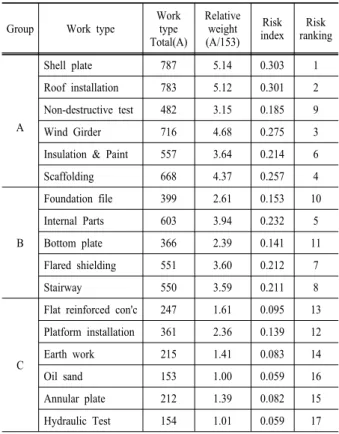
전문가의 정성적 설문조사 분석결과는 Table 9와 같 이 A그룹이 Shell plate 등 6개 공종, B그룹이 기초파일 작업 등 5개 공종 및 C그룹 바닥 콘크리트 공사 등 6 개 공종으로 나타났다.
2.4 위험지수 비교 분석
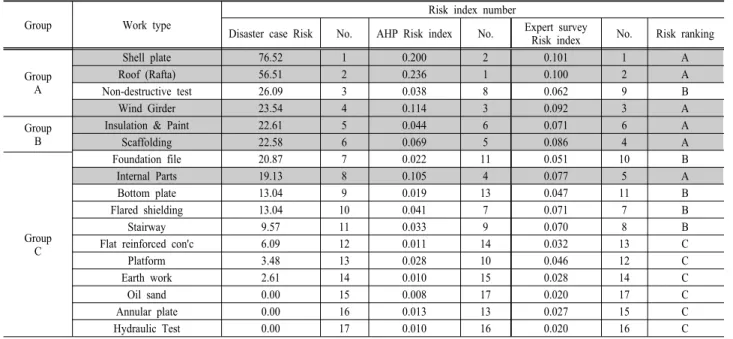
재해사례 설문 분석을 통하여 발생빈도와 발생강도 를 곱하여 산정된 위험도와 AHP기법을 이용하여 산정 된 위험지수 , 전문가의 정성적 설문을 통해 산출된 위 험지수를 비교 정리한 순위가 Table 10과 같다.
설문조사를 통한 계층별분석법 (AHP) 결과에서 계층 화(Group A, B, C)한 Group별 가중치 결과는 Group A 는 0.70, Group B는 0.22, Group C는 0.08로 분석되었 고, 평균 일관성 비율은 0.06으로 나타났다. 이는 재해 사례분석 결과와 AHP 결과의 위험도 높은 순위가 일 치하여 가중치 분포가 적정한 것을 알 수 있었다.
작업공종에 대한 위험지수 순위는 Roof(Rafta/지붕 판) 설치, shell plate 설치, Wind Girder 설치, Internal Table 9. Work type risk ranking by Expert survey
Group Work type
Work type Total(A)
Relative weight (A/153)
Risk index Risk
ranking
A
Shell plate 787 5.14 0.303 1
Roof installation 783 5.12 0.301 2 Non-destructive test 482 3.15 0.185 9
Wind Girder 716 4.68 0.275 3
Insulation & Paint 557 3.64 0.214 6
Scaffolding 668 4.37 0.257 4
B
Foundation file 399 2.61 0.153 10
Internal Parts 603 3.94 0.232 5
Bottom plate 366 2.39 0.141 11
Flared shielding 551 3.60 0.212 7
Stairway 550 3.59 0.211 8
C
Flat reinforced con'c 247 1.61 0.095 13 Platform installation 361 2.36 0.139 12
Earth work 215 1.41 0.083 14
Oil sand 153 1.00 0.059 16
Annular plate 212 1.39 0.082 15
Hydraulic Test 154 1.01 0.059 17
Group Work type
Risk index number
Disaster case Risk No. AHP Risk index No. Expert survey
Risk index No. Risk ranking
Group A
Shell plate 76.52 1 0.200 2 0.101 1 A
Roof (Rafta) 56.51 2 0.236 1 0.100 2 A
Non-destructive test 26.09 3 0.038 8 0.062 9 B
Wind Girder 23.54 4 0.114 3 0.092 3 A
Insulation & Paint 22.61 5 0.044 6 0.071 6 A
Group
B Scaffolding 22.58 6 0.069 5 0.086 4 A
Foundation file 20.87 7 0.022 11 0.051 10 B
Group C
Internal Parts 19.13 8 0.105 4 0.077 5 A
Bottom plate 13.04 9 0.019 13 0.047 11 B
Flared shielding 13.04 10 0.041 7 0.071 7 B
Stairway 9.57 11 0.033 9 0.070 8 B
Flat reinforced con'c 6.09 12 0.011 14 0.032 13 C
Platform 3.48 13 0.028 10 0.046 12 C
Earth work 2.61 14 0.010 15 0.028 14 C
Oil sand 0.00 15 0.008 17 0.020 17 C
Annular plate 0.00 16 0.013 13 0.027 15 C
Hydraulic Test 0.00 17 0.010 16 0.020 16 C