JESK
http://jesk.or.kr eISSN:2093-8462Affective Evaluation of Interior Design of Commercial Cars using 3D Images
Kunwoo Park1, Jaekyu Park1, Sungmin Kim1, Jaeho Choe2, Eui S Jung1
1Department of Industrial Management Engineering, Korea University, Seoul, 136-713
2Department of Industrial System Engineering, Daejin University, Pocheon, 487-711
Corresponding Author Eui S Jung
Department of Industrial Management Engineering, Korea University, Seoul, 136-713
Phone : +82-2-3290-3901 Email : [email protected]
Received : October 12, 2014 Revised : November 11, 2014 Accepted : November 21, 2014
Objective: The purpose of this study is to define consumers' affection on the interior design of commercial cars in terms of its design factors: color, embossing and gloss as independent factors.
Background: Existing affective studies related to interior of vehicle focus on just sedans. However, there is no affective study about the interior of commercial cars.
In addition, it is hard to change levels to which manufactures want.
Method: Representative design factors were drawn using ANOVA and SNK analysis and definitive affective vocabularies were drawn using factor analysis. Furthermore, the results of 3D experiment were analyzed using ANOVA and LSD analysis. 3D images for the experiment were made using 3D max program. The experiment revealed that consumers discerned the differences in levels of each design factor and affective vocabulary.
Results: The ANOVA revealed that beige color "A" type and non-gloss were the most preferred design in terms of the affective vocabularies and total preference.
Conclusion: The result of the experiment may help manufactures to design the interior of commercial cars in the near future. Furthermore, the ANOVA result of affective vocabularies evaluation is expected to suggest a meaningful guideline.
Application: The study results may be utilized as a guideline for interior design of commercial cars.
Keywords: Commercial car, 3D image, Interior design, Affective vocabulary, Affective evaluation
Copyright@2014 by Ergonomics Society of Korea. All right reserved.
○cc This is an open-access article distributed under the terms of the Creative Commons Attribution Non-Commercial License (http://
creativecommons.org/licenses/by-nc/3.0/), which permits unrestricted non-commercial use, distribution, and reproduction in any medium, provided the original work is properly cited.
1. Introduction
Today's cars have become a complex item expressing and offering user's individuality and flavor beyond the purpose as a means of transportation. When users buy products, they value various aspects, as well as functions of the products (Jiao et al., 2007). In this regard, car manufacturers endeavor to diversify and gentrify the materials reflected to interior design including plastic, wood, chrome and leather in order to improve affective quality (Ryu et al., 2006). Especially, affective design is an important factor of a product, when users use the product (Horn & Salvendy, 2009).
In this context, researches reflecting user's affective factors are necessary for affective design applying futuristic cutting-edge technology and differentiated car design
suitable for customer needs through studies on exterior and interior designs of cars by analyzing user's affective factors. Therefore, affective engineering procedures reflecting user's affective factors in designing cars are required (Ban et al., 2006). Unlike exterior design with high overall design ratio, interior design becomes a psychological space in which a driver feels comfort and pleasure during the drive, and simultaneously driver's affection is stimulated. Not only overall interior design of a car, but the detailed design factors, such as the characteristics of surface, colors, surface treatment method and application of chrome, wood and stitch line, can have impacts on the interior design. In buying a car, driver's affective requirements on interior design are valued, and studies using affective engineering on the interior design of cars are carried out diversely (Hsiao & Chen, 2006). Also, car manufacturers make an effort to develop interior design that takes into account driver’s affection (Cho & Lee, 2005). Meanwhile, there is limitation in defining affection, since a variety of parts are complicatedly installed in terms of car's interior design. Because, existing studies on the interior design of cars using the affective engineering (Ban et al., 2006, Kim & Han, 2014) developed affective models by focusing on sedan's interior design variables, the affective studies on commercial cars' interior design lack.
Although, the definitive affective vocabulary of interior design is expressed as luxurious in the affective study on sedans (Ban et al., 2006), it is difficult to express definitive affective vocabulary for commercial cars' interior design. It is difficult to acquire different levels of samples, when affective evaluation is made on the interior design of commercial cars, and there are many spatial constraints as well. This study conducted a variety of affective evaluations at 18 levels using the 3D interior images of commercial cars, because affective evaluation cannot be conducted, because affective evaluation cannot be conducted by easily and randomly changing levels, when a designer designs interior design. In this manner, this study identified relevance between each design variable and affective vocabulary of commercial cars' interior design. Actually, this study is expected to present an important direction on the improvement of commercial cars' interior design to be launched later, based on the affective evaluation results.
2. Method
2.1 Visual design factors 2.1.1 Selection of participants
The mean age of 14 experiment participants for the vision-related design variables selection experiment was 28.3 [standard deviation (SD): 2.80)]. All the participants had three years and more of driving experience and did not have vision disorder.
2.1.2 Selection of visual design factors
Seven design variables on vision were selected by reflecting existing studies on car interior and materials, market research and experts' opinions.
To select design variables deeply related with commercial cars' interior design, an experiment was conducted, based on the selected design variables in Table 1. Concerning the experiment, the design variables were subjectively evaluated, according to the importance of design variables by looking at actual commercial cars' interior design photos through devised questionnaires using design variables. The photos of actual commercial cars' interior design are shown in Figure 1.
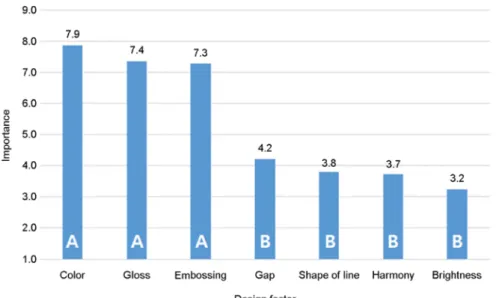
The experiment was carried out with the interior design photos of nine types of cars, and 9-point Likert scale was used for scoring. To select design variables, ANOVA (analysis of variance) was conducted using SPSS. As a result of post SNK analysis, three design variables were classified into A group with high score in importance as shown in Figure 2.
As a result of design variables section, the definitive three design variables were selected as demonstrated in Table 2.
2.1.3 Selection of affective vocabularies related to design factors
For affective vocabularies related to color, embossing and gloss, this study selected 100 affective vocabularies through existing studies, literature and magazines.
On the basis of 100 affective vocabularies in Table 3, this study undertook a questionnaire survey on each design variable and relevance with a 9-point Liker scale by using the ten different levels of colors, six different levels of embossing samples and images according to the status of gloss. Through a mean analysis, 12 affective vocabularies for color, ten affective vocabularies Table 1. Visual design factors
Design factors Definition of factors
Visual design factors
Color Color of material
Brightness Brightness of material
Gloss Gloss of material
Embossing Type of embossing
Gap Gap between parts
Shape of line Design shape
Harmony Harmony of color and shape
Table 2. Definitive visual design factors
Design factors Definition of factors
Definitive visual design factors
Color Color of material
Embossing Type of embossing
Gloss Gloss of material
Table 3. Affective vocabularies
Soft Dense Gorgeous Smeary
Genial Fresh Bright Thick
Comfortable Damp Refreshing Flexible
Cheap Smooth Brilliant Stiff
Luxurious Deep Profound Sleek
Solid Rough Attractive Uncomfortable
Cute Hard Fine Convex
Strong Tight Fresh Awesome
Wide Exclusive Bad Well-worn
Dynamic Delicate Polished Energetic
Active Agglomerated Clean Elegant
Voluminous Good Neat Flat
Crude Ordinary Unusual Colored
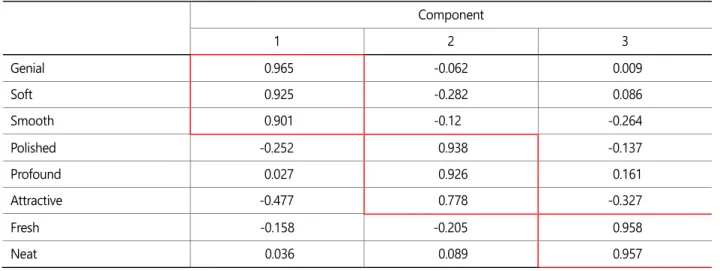
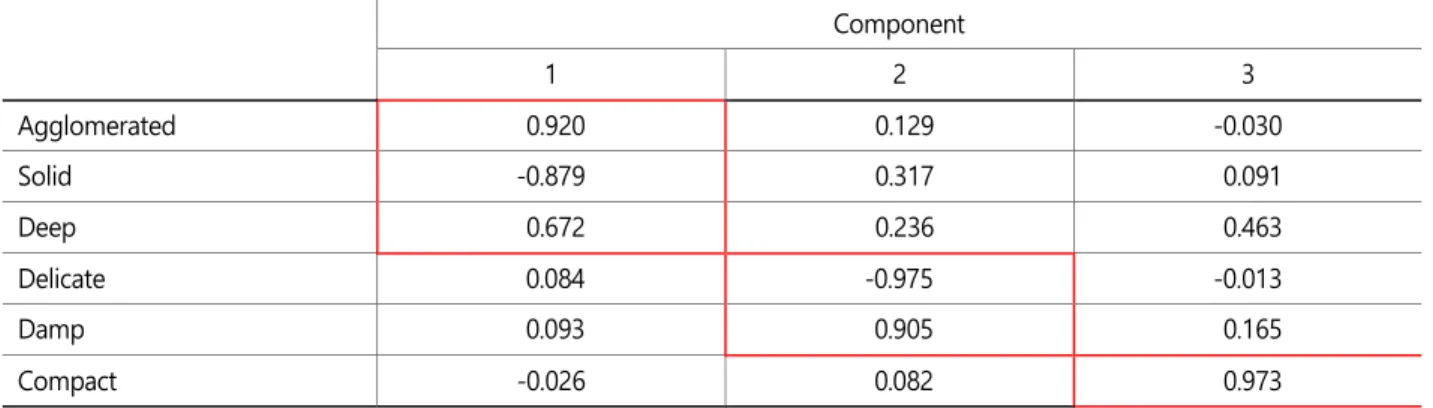
for embossing and seven affective vocabularies for gloss that scored six and higher mean points were selected. A factor analysis was conducted targeting the affective vocabularies selected by each design variable, and the multiple loaded affective vocabularies were removed. In this manner, eight affective vocabularies for color, six affective vocabularies for embossing and six affective vocabularies for gloss were selected. Table 4, 5, 6 show factor analysis results of affective vocabularies for color, embossing and gloss.
Using the factor analysis result, this study defined the definitive affective vocabulary of each design variable as a representative affective vocabulary. Table 7 reveals the definitive affective vocabularies for the 3D image experiment.
Table 3. Affective vocabularies (Continued)
Soft Dense Gorgeous Smeary
Narrow Fancy Sexy Vintage
Vivid Sensuous Relaxed Compact
Standout Classic Beloved Unconventional
Innovative Decency Lovely Convenient
Simple Expensive Light Unique
Cool Platinum Bleary Excellent
Sporty Trendy Free Dark
Sharp Clear Complex Cozy
Chic Sweet Modern Snug
Unnatural Fantastic Heavy Fabulous
Sordid Glamorous Uppity Consistent
Slimy Empty Well-defined Pure
Table 4. Factor analysis result of color vocabularies
Component
1 2 3
Genial 0.965 -0.062 0.009
Soft 0.925 -0.282 0.086
Smooth 0.901 -0.12 -0.264
Polished -0.252 0.938 -0.137
Profound 0.027 0.926 0.161
Attractive -0.477 0.778 -0.327
Fresh -0.158 -0.205 0.958
Neat 0.036 0.089 0.957
Table 5. Factor analysis result of embossing vocabularies
Component
1 2 3
Agglomerated 0.920 0.129 -0.030
Solid -0.879 0.317 0.091
Deep 0.672 0.236 0.463
Delicate 0.084 -0.975 -0.013
Damp 0.093 0.905 0.165
Compact -0.026 0.082 0.973
Table 6. Factor analysis result of gloss vocabularies
Component
1 2
Clear 0.985 0.026
Sweet -0.904 -0.079
Refresh 0.893 -0.262
Bright -0.132 0.929
Dynamic 0.236 0.893
Gorgeous -0.192 0.855
Table 7. Definitive affective vocabularies for 3D image experiment
Representative affective vocabularies Sub-affective vocabularies
Genial Genial Soft Smooth
Polished Polished Profound Attractive
Neat Fresh Neat
Solid Agglomerated Solid Deep
Delicate Damp Delicate
Compact Compact
Clear Clear Sweet Refresh
Dynamic Bright Dynamic Gorgeous
2.2 3D image experiment 2.2.1 Selection of participants
The mean age of the 16 participants for the 3D image experiment was 28.2 (SD: 2.1). All the participants had three years and more of driving experience and did not have vision disorder.
2.2.2 Experimental environment
A questionnaire was devised on the basis of the definitively selected affective vocabularies in Table 7. The experiment was performed by displaying the 3D images on TV, which were embodied using 3D Max by measuring the color, embossing and gloss similar to actual commercial cars' interior design, and actual interior design's visual size. Also, the scores of affective vocabularies on color, embossing and gloss, which are visual variables, were subjectively evaluated. The 3D image experiment environment is shown in Figure 3.
2.2.3 Experimental design
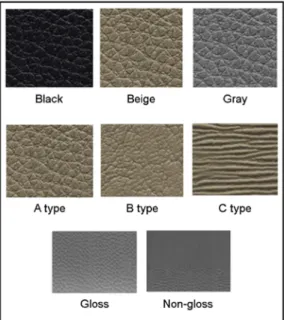
This study selected color, embossing and gloss as independent variables through a preference analysis. By referring to generally used colors and embossing levels, this study selected three levels of colors, namely, black, beige and gray, three levels of embossing, A, B and C types and two level of gloss, that is, gloss and non-gloss. Figure 4 exhibits each level selected.
The questionnaire was made on the basis of three affective vocabularies for color, three affective vocabularies for embossing and two affective vocabularies for gloss and total preference through the factor analysis. Using a 9-point Likert scale, they were subjectively evaluated. This study made 3D images in line with each level by changing the levels of color, embossing and gloss with the 3D Max program using S company's commercial car interior design rendering file to embody 3D images similar to actual interior design of commercial cars. The 3D image experiment was carried out using Within Subject Design in order to reduce
error, according to individual characteristics of the participants. Pollution, according to the experiment sequence, was minimized by composing the experiment sequence randomly. Concerning experiment results, the results of each design variable's affective vocabularies and total preference were drawn using ANOVA. As for 3D images, the experiment was performed, on the basis of total interior images in consideration of actual interior design's visual size viewed when a driver rode car, and the zoomed-in images of materials, through which embossing can be clearly seen. Tables 8 and 9 show the dependent and independent variables.
Table 8. Independent variable
Independent variable Level
Color Black Beige Gray
Embossing A type B type C type
Gloss Gloss Non-gloss
Table 9. Dependent variable
Dependent variable Definitive affective vocabularies
Color affective vocabularies Genial Polished Neat
Embossing affective vocabularies Solid Delicate Compact
Gloss affective vocabularies Clear Dynamic
Preference Total preference
2.2.4 Experimental organization
This study made three color levels (black, beige and gray) and three embossing levels used for actual commercial cars using the 3D Max program to make them similar to actual images, the two levels of gloss (gloss and non-gloss) were expressed as the status of gloss, because it difficult to perfectly actualize gloss level of actual cars. Through each design's variable level, the experiment levels were composed of 18 levels. The experiment photos of each level consisted of total interior design images and zoomed-in materials images. Figure 5 shows the experiment photos.
2.2.5 Experimental procedure
Regarding experiment procedure, the participants carried out affective evaluation by the sequence specified in the questionnaire, after reading and understanding the detailed definitions of each design variable-related affective vocabularies. Prior to this experiment, the status of gloss and embossing types were identified through a pre-test. By displaying total interior design image and material-zoomed-in image per level on TV in the order, the participants evaluated effective vocabularies and total preference on 18 levels.
3. Result
The ANOVA result of affective vocabularies and total preference on 18 levels of color, embossing and gloss, which are the design variables of commercial car interior, acquired by using SPSS, are revealed in Table 10.
3.1 ANOVA result of affective vocabularies related to color
As a result of ANOVA for an affective vocabulary, genial, the design variables, color (F=101.302, p<0.000) and gloss (F=6.914, p=0.019) were statistically significant at significance level of 0.05, but embossing (F=2.587, p=0.092) was not statistically significant. The reciprocal action of color and embossing (F=5.310, p=0.001) was statistically significant, however, the reciprocal
Table 10. ANOVA result of affective vocabularies
Affective vocabularies Design factors SS df MS F - value p - value
Genial
Color 494.646 2 247.323 101.302 0.000**
Embossing 6.750 2 3.375 2.587 0.092
Gloss 5.937 1 5.837 6.914 0.019**
Color*embossing 18.854 4 4.714 5.310 0.001**
Color*gloss 1.715 2 0.858 1.018 0.374
Embossing*gloss 3.694 2 1.847 2.448 0.104
Color*embossing*gloss 1.910 4 0.477 0.576 0.681
Polished
Color 44.424 2 22.121 10.960 0.000**
Embossing 14.111 2 7.056 8.543 0.001**
Gloss 3.337 1 3.337 2.582 0.129
Color*embossing 13.431 4 3.358 3.800 0.008**
Color*gloss 8.695 2 4.483 6.156 0.006**
Embossing*gloss 2.694 2 1.347 2.462 0.102
Color*embossing*gloss 1.847 4 0.462 0.543 0.705
Neat
Color 160.424 2 80.212 41.956 0.000**
Embossing 1.444 2 0.722 0.670 0.519
Gloss 3.337 1 3.337 7.575 0.015**
Color*embossing 24.389 4 6.097 5.981 0.000**
Color*gloss 0.090 2 0.045 0.067 0.935
Embossing*gloss 0.861 2 0.431 0.806 0.456
Color*embossing*gloss 2.806 4 0.701 0.922 0.457
Solid
Color 7.111 2 3.556 2.892 0.071
Embossing 478.694 2 239.347 172.445 0.000**
Gloss 2.531 1 2.531 2.785 0.116
Color*embossing 6.306 4 1.576 0.865 0.490
Color*gloss 1.000 2 0.500 0.542 0.587
Embossing*gloss 8.083 2 4.042 2.740 0.081
Color*embossing*gloss 2.667 4 0.667 0.558 0.694
Delicate
Color 3.965 2 1.983 0.837 0.443
Embossing 76.174 2 38.087 9.780 0.001**
Gloss 0.281 1 0.281 0.181 0.677
Color*embossing 12.931 4 3.233 2.012 0.104
Color*gloss 3.271 2 1.635 0.909 0.414
Embossing*gloss 1.313 2 0.656 0.872 0.428
actions of color and gloss (F=1.018, p=0.374) and embossing and gloss (F=2.448, p=0.104) were not statistically significant.
As a result of ANOVA for an affective vocabulary, polished, the design variables, color (F=10.960, p<0.000) and embossing (F=8.543, p=0.001) were statistically significant at significance level of 0.05, but gloss (F=2.582, p=0.129) was not statistically significant. The reciprocal actions of color and embossing (F=3.800, p=0.008) and color and gloss (F=6.156, p=0.006) were Table 10. ANOVA result of affective vocabularies (Continued)
Affective vocabularies Design factors SS df MS F - value p - value
Delicate Color*embossing*gloss 5.292 4 1.323 1.457 0.227
Compact
Color 30.361 2 15.181 9.979 0.000**
Embossing 340.799 2 170.399 82.184 0.000**
Gloss 0.420 1 0.420 0.371 0.551
Color*embossing 6.722 4 1.681 1.012 0.408
Color*gloss 0.028 2 0.014 0.017 0.984
Embossing*gloss 1.382 2 0.691 0.912 0.413
Color*embossing*gloss 1.014 4 0.253 0.198 0.939
Clear
Color 44.215 2 22.108 8.855 0.001**
Embossing 14.424 2 7.212 5.951 0.007**
Gloss 175.781 1 175.781 100.780 0.000**
Color*embossing 8.118 4 2.030 1.137 0.348
Color*gloss 159.813 2 79.906 49.519 0.000**
Embossing*gloss 0.771 2 0.385 0.627 0.541
Color*embossing*gloss 5.104 4 1.276 1.629 0.179
Dynamic
Color 236.646 2 118.323 38.069 0.000**
Embossing 36.583 2 18.292 18.515 0.000**
Gloss 17.503 1 17.503 8.625 0.010**
Color*embossing 11.833 4 2.958 3.154 0.020**
Color*gloss 2.924 2 1.462 0.818 0.451
Embossing*gloss 0.528 2 0.264 0.325 0.725
Color*embossing*gloss 0.889 4 0.222 0.340 0.850
Total preference
Color 10.491 2 8.094 10.491 0.000**
Embossing 234.646 2 117.323 114.695 0.000**
Gloss 3.337 1 3.337 1.257 0.280
Color*embossing 6.042 4 1.510 1.790 0.143
Color*gloss 9.507 2 4.753 1.932 0.163
Embossing*gloss 0.215 2 0.108 0.071 0.932
Color*embossing*gloss 2.347 4 0.587 0.402 0.807
**: significant at α=0.05 level
statistically significant, however, the reciprocal action of embossing and gloss (F=2.462, p=0.102) was not statistically significant.
As a result of ANOVA for an affective vocabulary, neat, the design variables, color (F=41.956, p<0.000) and gloss (F=7.575, p= 0.015) were statistically significant at significance level of 0.05, hut embossing (F=0.670, p=0.519) was not statistically significant.
The reciprocal action of color and embossing (F=5.981, p<0.000) was statistically significant, however, the reciprocal actions of color and gloss (F=0.067, p=0.935) and embossing and gloss (F=0.806, p=0.456) were not statistically significant. Figure 6 shows interaction graphs for 'genial', 'polished' and 'neat'.
3.2 ANOVA result of affective vocabularies related to embossing
As a result of ANOVA for an affective vocabulary, solid, the design variable, embossing was (F=172.445, p<0.000) statistically significant at significance level of 0.05, but color (F=2.892, p=0.071) and gloss (F=2.785, p=0.116) were not statistically significant.
The reciprocal actions of color and embossing (F=0.865, p=0.490), color and gloss (F=0.542, p=0.587) and embossing and gloss (F=2.740, p=0.081) were not all statistically significant. According to the post analysis of LSD, A type, B type and C type were all defined as statistically independent respective group. As a result of ANOVA for an affective vocabulary, delicate, the design variable, embossing (F=9.780, p=0.001) was statistically significant at significance level of 0.05, but color (F=0.837, p=0.443) and gloss (F=0.181, p=0.677) were not statistically significant. The reciprocal actions of color and embossing (F=2.012, p=0.104), color and gloss (F=0.909, p=0.414) and embossing and gloss (F=0.872, p=0.428) were not all statistically significant. According to the post analysis of LSD, the embossing B and C types were grouped in the same group without statistical difference. As a result of ANOVA for an affective vocabulary, compact, the design variables, color (F=9.979, p=0.000) and embossing (F=82.184, p<0.000) were statistically significant at significance level of 0.05, but gloss (F=0.371, p=0.551) was not statistically significant. The reciprocal actions of color and embossing (F=1.012, p=0.408), color and gloss (F=0.017, p=0.984) and embossing and gloss (F=0.912,
p=0.413) were not all statistically significant. According to the post analysis of LSD, embossing A, B and C types were all defined as statistically independent respective group, and A type showed the highest score. Figure 7 shows LSD results for 'solid', 'delicate' and 'compact'.
3.3 ANOVA result of affective vocabularies related to gloss
As a result of ANOVA for an affective vocabulary, clear, the design variables, color (F=8.855, p=0.001), embossing (F=5.951, p=0.007) and gloss (F=100.780, p=0.000) were all statistically significant at significance level of 0.05. The reciprocal action of color and gloss (F=49.519, p=0.000) was statistically significant, however, the reciprocal actions of color and embossing (F=1.137, p=0.348) and embossing and gloss (F=0.627, p=0.541) were not statistically significant. According to the post analysis of LSD, beige and gray were grouped into the same group without statistical difference, and showed high scores. As a result of ANOVA for an affective vocabulary, dynamic, the design variables, color (F=38.069, p=0.000), embossing (F=18.515, p=0.000) and gloss (F=8.625, p=0.010) were all statistically significant at significance level of 0.05. The reciprocal action of color and embossing (F=3.154, p=0.020) was statistically significant, but the reciprocal actions of color and gloss (F=0.818, p=0.451) and embossing and gloss (F=0.325, p=0.725) were not statistically significant. Figure 8 shows LSD result for 'clear'. Figure 9 shows interaction graphs for 'clear' and 'dynamic'.
3.4 ANOVA result of total preference
As a result of ANOVA for total preference, the design variables, color (F=10.491, p<0.000) and embossing (F=114.695), p<0.000) were statistically significant at significance level of 0.05, but gloss was not statistically significant. The reciprocal actions of color
and embossing (F=1.790, p=0.143), color and gloss (F=1.932, p=0.163) and embossing and gloss (F=0.071, p=0.932) were not all statistically significant. According to the post analysis of LSD, beige and gray colors were grouped into the same group without statistical difference, and showed high scores. Embossing types A, B and C were all defined as statistically independent respective group. Figure 10 shows LSD results for total preference.
4. Discussion
This study carried out affective evaluation on the affective vocabularies at 18 levels on color, embossing and gloss, which are the design variables of interior design of commercial cars through 3D images. This study identified whether the affective vocabularies related with each design variable selected through preference investigation were a single affection or a complex affection. As a result of ANOVA for affective vocabularies, the beige color was analyzed to offer more soft and genial feeling than the other two colors in relation with a color affective vocabulary, genial. This was analyzed that black or gray color takes on darker color than beige, and thus, the beige color received higher score in "genial". At significance level of 0.05, embossing was not statistically significant, but was significant at significance level of 0.1, and also reciprocal action was statistically significant. This can be seen as complex affection that color and embossing complexly affect "genial". With regard to "polished", the beige color was analyzed as more urban and attractive than the other two colors. Because the beige color emerges as the interior design color of a luxurious car, such a trend was analyzed to function towards the affection of the participants. Looking into the reciprocal action of color and embossing, the embossing C type showed low score in the black color, but showed a score similar to the other two embossing types in the beige color. This was analyzed that beige affected the preference for embossing, based on that beige appeared to be the most polished to the participants. Looking into the reciprocal action of color and gloss, gloss showed higher score than non-gloss in the black color, but non-gloss showed higher score in the beige and gray colors than gloss. This was analyzed that the participants preferred gloss in dark color, and preferred non-gloss in bright color. The reciprocal action of color and gloss was significant, from which, the affective vocabulary, "polished", is known to be a complex affective vocabulary of color and gloss. In relation with an affective vocabulary, "neat", color was statistically significant, but embossing was not. The reciprocal action of color and embossing was analyzed to be statistically significant. "Neat" was analyzed to be a complex affection having an impact on embossing and color. From "solid", an embossing affective vocabulary, embossing A type was analyzed to offer more solid feeling, because it appeared to be more concentrated and harder. Because of no reciprocal action with other design variables, the solid affective vocabulary was analyzed to be a single affection expressing embossing. Regarding "delicate", an embossing affective vocabulary, since embossing A type appeared to be more concentrated, it was also analyzed to appear more delicate than the other two embossing types. Because, "delicate" had no reciprocal action with other design variables, it was analyzed to be a single affection expressing embossing. Concerning an embossing affective vocabulary, "compact", embossing type A showed the highest score as seen in the result of "delicate". The reason is that the definitions of the affective vocabularies,
"delicate", and "compact", are similar and therefore, they were analyzed to show the same affection. The affective vocabulary,
"compact", was also analyzed to be a single affection that expresses embossing. In "clear", a gloss affective vocabulary, beige and gray were analyzed to offer bright and refreshed feeling, compared to black. In addition, color, embossing and gloss were all analyzed to be statistically significant, and therefore, not only gloss, but color and embossing were analyzed to be the complex affection having an impact on the affection of "clear". In the affective vocabulary for gloss, "dynamic", the reciprocal action of color and embossing occurred, and this was analyzed that color and embossing affected the affection offering bright and vibrant feeling of gloss complexly. The gloss affective vocabulary, "dynamic" was analyzed to be a complex affection having an impact on color, embossing and gloss. Lastly, in total preference, the beige color from design variable colors showed the highest score, compared to the other two colors. This was analyzed that preference score for color affective vocabulary equally affected total preference. In the embossing design variable, A type showing the highest score of embossing affective vocabulary also showed the highest total preference score as well. The beige color, which is the most genial, polished and neat, showed the highest score in the total preference score on 18 levels. Embossing A type that appeared to be solid, delicate and compact was analyzed to offer durable and sophisticated feeling. The study participants preferred gloss in terms of the darkest color, black. But, they preferred non-gloss for brighter color, beige or gray. The level with the highest total preference among the 18 levels was level 7 (beige, A type and non-gloss). This can be a design meeting affective satisfaction in terms of a certain level of preference aspect of the broad range of consumers having diverse affections on color, embossing and gloss. Level 7 image is shown in Figure 11.
Although, the color of the interior design of most commercial cars sold in the market is mostly gray and black, there can be a
need to attempt the beige color, rather than simply sticking to gray, because European commercial car manufacturers are considered to attempt to use beige for the interior design color of commercial cars like sedans.
As a result of ANOVA for affective vocabularies of each design variable, "genial" and "neat" are the complex affection affected by color and embossing. The affective vocabulary, "polished" is a complex affection affected by color and gloss. All embossing affective vocabularies were analyzed as single affection. The affective vocabularies, "clear" and "dynamic" were analyzed to be complex affection affected by color, gloss and embossing.
5. Conclusion
The analysis results of this study are expected to be important results in selecting major design variables and affective vocabularies related with color, embossing and gloss for the affection research of commercial cars. Especially, color, embossing and gloss were selected as the design variables the most deeply related with the interior design of commercial cars as shown in the experiment results. The color and gloss affective vocabularies have all complex affection, and color, embossing and gloss affect the scores of affective vocabularies. Because, all the affective vocabularies of embossing have single affection, the color and embossing did not affect the score of embossing affective vocabularies. The participants preferred non-gloss of a bright color, beige, and also were analyzed to prefer embossing A type that appeared to be compact and solid. When designing the interior design of a commercial car in consideration of the analysis results in this study, the results can be meaningful data. It was identified that the experiment participants felt differences in each design variable and reflect the differences in affective evaluation through 3D images in this study. Based on the results, a direction that can be reflected in design is expected to be provided using the trend and each level of each effective vocabulary. Through 3D images, there is a merit that evaluation can be conducted by freely changing the visual design variables, such as color, embossing and gloss, according to desirable level. Therefore, such a merit is expected to be helpful to the development and improvement of the visual design variables of the interior design of sedans and commercial cars in the future.
References
Hsiao, K.A. and Chen, L.L., Fundamental dimensions of affective responses to product shapes, International Journal of Industrial Ergonomics, 36(6), 553-564, 2006.
Jiao, J.R., Simpson, T.W. and Siddique, Z., Product family design and platform-based product development: a state-of-the-art review, Journal of Intelligent Manufacturing, 18(1), 5-29, 2007.
Kim, J. and Han, K., Dashboard Design Factors on Emotional Change: How Separation between Center-Fascia and Center-Console, Button Orientation and Button Arrangement Influence Emotion, In HCI International 2014-Posters'Extended Abstracts (pp. 95- 100). Springer International Publishing, 2014.
You, H., Ryu, T., Oh, K., Yun, M.H. and Kim, K.J., Development of customer satisfaction models for automotive interior materials, International Journal of Industrial Ergonomics, 36(4), 323-330, 2006.
Ban, S.U., Yun, M.H., Lee, C. and Lee, J.H., Development of Luxuriousness Models for Automobile Crash Pad based on Subjective and Objective Material Characteristics, Journal of the Ergonomics Society of Korea, 25(2), 187-196, 2006.
Cho, K.S. and Lee, M.K., A study on the instrument panel Design trend for automobile interior, Journal of Korean society of design science, 129-138, 2005.
Horn, D. and Salvendy, G., Measuring consumer perception of product creativity: Impact on satisfaction and purchasability, Human Factors and Ergonomics in Manufacturing & Service Industries, 19(3), 223-240, 2009.
Jung, G.H., Effects of Design Factors of the Instrument Cluster Panel on Consumers' Affection Applying Robust Design, Journal of the Ergonomics Society of Korea, Vol 29(1), 25-31 (7 pages), 2010.
Kim, H.J., A study on the form Inter relationship between the sense of sight and the sense of touch, Journal of the Korean Society of the Design Science, 258-259 (2 pages), 2006.
Khalid, H.M. and Helander, M.G., Customer Emotional Needs in Product Design, Concurrent Engineering: Research and Applications, 14(3), 197-206, 2006.
Author listings
Kunwoo Park: [email protected]
Highest degree: BS, Department of Industrial engineering, Hongik University
Position title: Ms. Candidate, Department of Industrial Management Engineering, Korea University Areas of interest: Product Development
Jaekyu Park: [email protected]
Highest degree: Ms, Department of Industrial Management Engineering, Korea University Position title: PhD. Candidate, Department of Industrial Management Engineering, Korea University
Areas of interest: Product Development
Sungmin Kim: [email protected]
Highest degree: Ms, Department of Industrial Management Engineering, Korea University Position title: PhD. Candidate, Department of Industrial Management Engineering, Korea University Areas of interest: Product Development
Jaeho Choe: [email protected]
Highest degree: PhD, Department of Industrial Engineering, Pohang University of Science and Technology Position title: Professor, Department of Industrial Management Engineering, Daejin University
Areas of interest: Product Development
Eui S Jung: [email protected]
Highest degree: PhD, Department of Industrial Engineering, Pennsylvania State University Position title: Professor, Department of Industrial Management Engineering, Korea University Areas of interest: Product Development