201
*Corresponding author: Hyo-in Yun
Division of Veterinary Pharmacology and Toxicology, Chungnam National University, Daejeon 305-764, Korea [Tel: +82-42-821-6759, Fax: +82-42-822-5780, E-mail: [email protected]]
Comparative pharmacokinetics of norfloxacin-glycine acetate after single oral administration and medication with drinking
water in broilers
Jong-hwan Lim, Byoung-yong Lim, Byung-kwon Park, Myong-seok Kim, Beom-su Jang, Seung-chun Park1, and Hyo-in Yun*
College of Veterinary Medicine, Chungnam National University, Daejeon 305-764, Korea
1College of Veterinary Medicine, Kyungpook National University, Daegu 702-701, Korea OAccepted: April 2, 2004)
Abstract : Norfloxacin (NFX) is a fluorquinolone antibacterial agent with a high antimicrobial activity and might have great potential for treating common infections in poultry. The objective of this study was to obtain comparative pharmacokinetic data after a single oral administration and medication with drinking water of norfloxacin-glycine acetate (NFX-GA) at the dose rate of 10 mg/kg bw in broilers.
Fifty minutes following oral administration of NFX-GA, serum concentrations peaked at 1.32µg/mL (range 1.03-1.45µg/mL). Serum concentration of NFX declined with a half-life of 7.21±1.81 h. On the third day after administration of medicated drinking water, steady-state was reached, with mean concentrations of NFX of 0.70±0.35µg/mL. The concentration of NFX after medication of NFX-GA with drinking for 3 days provides sufficient levels to obtain maximum therapeutic effects and maintains the serum persistence of concentration exceeding MIC.
Key words : Norfloxacin, LC/MS, oral administration, broiler, drinking water
Introduction
Norfloxacin, (1-ethyl-6-fluoro-1,4-dihydro-4-oxo-7- [1-piperazinyl]-3-quinoline carboxylic acid, NFX) is a fluorquinolone antibacterial agent with a high antimicrobial activity against a very wide range of gram-negative and a number of gram-positive aerobes as well as most pathogenic mycoplasmas [3, 17]. NFX inhibits DNA gyrase by interacting with the DNA, with their broad spectrum of antibacterial activity and good distribution in most tissues and body fluids as well as low incidence of adverse effects [17]. The favorable antimicrobial properties of NFX indicate that it might have great potential for treating common infections such as mycoplasmosis, colibacillosis and pasteurellosis in poultry [6, 16].
Drinking water is the most favored method of administration in determining the method of administration to bird. Drug formulations based on suspension medication
should strongly be avoided because of sedimentation of the suspended drug particles within the drinking water system [20]. However, NFX is very slightly soluble in water [3]. Therefore, many authors have attempted to improve the NFX oral bioavailability by increasing its solubility or by the use of absorption enhancers [8, 11].
We have attempted to use a water-soluble derivative of NFX, NFX-glycine acetate (NFX-GA) in order to increase oral bioavailability of NFX for medication of drinking water for poultry. For an efficient and safe therapy, information on formulation, pharmacodynamic and pharmacokinetic aspects for each drug are required.
However, notwithstanding the fact that drugs are frequently administered to poultry (17% of the total of therapeutic drugs used in veterinary medicine are ad- ministered to poultry), information on avian pharmacotherapy is still scarce [23].
The present study was undertaken to obtain comparative pharmacokinetic data after a single oral administration
and medication with drinking water of NFX-GA in broilers.
Materials and Methods
Chemicals
NFX-GA was given by Deasung Microbials (Seoul, Korea) and NFX for standard was purchased from SIGMA (Missouri, USA). HPLC grade water, methanol, acetonitrile, acetic acid, and hexane were purchased from TEDIA (St. Louis, USA).
Animals
Thirty healthy broilers of 4-5 weeks of age were used in the present study and the body weight (Mean±S.D.) of broilers was 1056.8±87.6 g. Before the experiment the animals were acclimatized for 1 week. The birds were monitored daily, and no clinical signs of disease were observed. The room temperature ranged between 20 and 22oC and the relative humidity was maintained at 50- 70%. A dark period was given between 0:00 h and 6:00 h. Water and commercial feed were available ad libitum.
Experimental design
For the determination of single oral pharmacokinetics, NFX-GA was administered at the dose rate of 10 mg/
kg bw as NFX by crop gavage to 10 birds each. Blood samples were obtained from the right brachial vein immediately prior to medication (time = 0), and then at 0.25, 0.5, 0.75, 1, 2, 4, 8, 12 and 24 h after treatment.
At each sampling time, blood samples were collected and after centrifugation (1,500× g for 10 min), the serum was stored at -70oC until analysis.
Over a period of 3 consecutive days, NFX-GA was administered via the drinking water to 20 birds. To ensure daily dosages of 10 mg/kg bw as NFX for NFX- GA, drug concentrations added to the drinking water were based on daily water consumption rates and daily weight measures of the birds. Mean water consumption during the medication period ranged from approximately 140 mL/kg bw to 160 mL/kg bw in these study.
Therefore, drug concentrations of NFX-GA in the drinking water were made approximately 93 mg/L, as has been additionally confirmed by LC/MS analysis of reserved water samples. On the first day of treatment, prior to initiating the medication (time=0), blood samples were obtained from 10 birds in the treatment group.
Blood samples were collected from 10 broiler chickens each at 12 and 24 h after time 0. In addition to sampling on the initial day of treatment, the aforementioned schedule was also repeated on day 3. After collection, blood samples were centrifuged (1500×g for 10 min) and the separated serum was stored at -70oC until analysis.
Analytical method
Samples were analyzed on a Hewlett-Packard 1100 series LC/MSD system. Separation was achieved on Nova-Pak C18 reverse phase column (4 µm, 3.9 mm×
150 mm, Waters, USA). Flow rate was operated at 0.4 mL/min. The mobile phase consisted of water-acetic acid (98:2, v/v, A) and acetonitrile (B). Gradient runs were programmed as follows: 100% A for 10 min, increase from 0% to 90% B in 8 min, 90% B for 2 min, re-equilibration with 100% A for 5 min, until the next sample injection.
Each 1 mL serum sample was added to 2 mL of extraction solution and homogenized, and then shaken for 10 min. Extraction solution consisted of methanol and acetic acid (98/2, v/v). The samples were centrifuged at 1,300×g for 10 min, the supernatant being transferred into other tube and evaporated to dryness at 30oC under a stream of nitrogen. The residue was reconstituted with 1 mL of the extraction solution and added to 2 mL of saturated hexane with acetonitrile and vortexed for 5 min. The samples were centrifuged at 1,300×g for 10 min, and upper layer being discarded. The lower phase was transferred into the other tube and evaporated to dryness at 30oC under a stream of nitrogen. The residue was reconstituted with 1 mL of the extraction solution and vortexed for 30 s. Aliquot of 10 µl was injected after filtration with 0.4 µm filter.
Pharmacokinetic analysis and statistical analysis Non-compartmental pharmacokinetic analysis of serum concentration- time data following single oral admini- stration and medication with drinking water were performed with the PCNOLIN version 4.0 (SCI software, USA). Cmax was the highest recorded concentration and tmax was the time when Cmax was achieved. The serum concentration vs. time data after medication with drinking water was analyzed for each broiler, using model-independent standard methods. The terminal elimination rate constant (λZ) was calculated from the log-linear portion of the elimination curve using linear
regression analysis. The terminal half-life was calculated according to the equation t1/2=ln 2/λZ.
Non-compartmental analysis based on statistical moments was also performed. The area under serum concentration-time curve (AUC) and the area under the moment curve (AUMC) were calculated by the method of trapezoids and extrapolation to infinity. The mean residence time (MRT) was determined as:MRT=AUMC /AUC.
Serum and tissue concentration values are given as mean ± standard deviation (S.D.). The significant cor- relation between pharmacokinetic parameters of single oral administration and medication with drinking water was determined by a one-way analysis of variance (ANOVA). Statistical analyses were performed using a computer software program (Microsoft Excel, Microsoft, USA). The differences between pharmacokinetic parameters of treatment groups were performed using Student’s t - tests and was considered significant at the level of p <0.05.
Results
A highly sensitive and specific method for the determination of NFX in the serum of broilers by LC/
MS was developed and validated. As a result of analysis of blank samples, matrix interference was not detected.
NFX eluted from the analytical column with a retention time of 18.7 min and increased in proportion to concentrations. The limit of detection (LOD) and limit of quantitation (LOQ) of NFX in the present study were 1 ng/mL and 5 ng/mL, respectively. The linear regression line for NFX in the range of 1 ng/g to 10 µg /g showed high correlation coefficients (r) of 0.999.
The recovery of NFX in serum was ranged from 87.5±9.1% to 92.7±8.9 and The coefficient of variance (C.V.) ranged from 8.5% to 10.7% for spiked samples.
The method has been successfully applied to determine serum concentrations of NFX in broilers for pharmacokinetic studies.
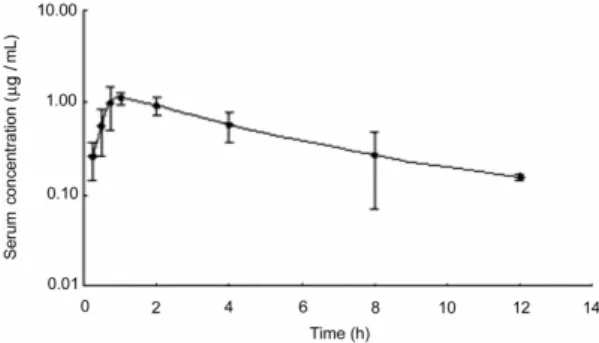
Semilogarithmic plot of serum concentration-time and estimated pharmacokinetic parameters following oral administration of NFX are presented in Fig. 1 and Table 1, respectively. Fifty minutes following oral administration of NFX-GA, serum concentrations peaked at 1.32µg/
mL (range 1.03-1.45 µg/mL). Serum concentration of NFX declined with a half-life of 7.21±1.81 h.
NFX serum concentration-time profiles, following
administration of medicated drinking water, are shown in Fig. 2. Pharmcokinetic parameters of NFX-GA after steady-state are presented in Table 1. Steady-state serum concentrations were not attained within the sampling time period of the first day of administration.
On the third day, steady-state was reached (Fig. 2), with mean concentrations of NFX of 0.70±0.35µg/mL.
Serum concentration of NFX declined with a long half- Fig. 1. Mean serum concentrations of NFX-GA obtained after single oral administration (10 mg/kg body weight based on NFX). Each point represents the mean±S.D. of ten birds.
Table 1. Pharmacokinetic parameters for NFX-GA (10 mg/kg bw as NFX) after single oral ad- ministration to broilers and oral administration of medicated drinking water for 3 consecutive days Pharmacokinetic
parameters Unit
Route of administration Oral Via drinking
water
tmax h 0.90±0.14 −
Cmax µg/mL 1.26±0.15 0.70±0.35 λz h−1 0.23±0.11* 0.05±0.01
t1/2 h 4.09±2.91 14.32±3.29*
AUC0-∞ µg.h/mL 7.08±4.37 9.37±0.94 Cl/F L/h.kg 1.80±0.83 1.08±0.11 AUMC0-∞ µg . h2/mL 55.95±68.57 192.96±44.52*
MRT h 6.05±3.76 20.56±4.11*
*Statistically significant difference between pharmacokinetic parameters following routes of administration.
Cmax, maximum serum concentration; tmax, time of Cmax; λz, terminal elimination rate constant; t1/2, terminal elimination half-life; Cl/F, total body clearlence divided by bioavilablility;
AUC0-∞, area under the serum concentration-time curve;
AUMC0-∞, area under the moment curve; MRT, mean res- idence time.
life of 14.32±3.29 h as compared with single oral administration of NFX-GA.
Discussion
Various analytical methods have been developed for the qunatitation of NFX or other flouroquionolones.
Liquid chromatography, capillary electroporesis and mass spectrometry have been used, but some methods achieved only relatively high detection limits [4, 5, 9, 14, 22].
In the present study, LOD and LOQ were 1 ng/g and 5 ng/g, respectively. These values satisfied the acceptance criteria of the limit of detection and limit of quantitation.
The LOQ of this method is more sensitive than previously reported [4, 5, 9, 14, 22].
In broilers, NFX appeared in serum within a short period of time with mean maximum concentration (Cmax) of 1.26µg/mL reaching at 0.90±0.14 h after single oral administration. The elimination half-life was 4.09± 2.91 h indicating fast disappearance of the NFX from the blood. Due to the relatively high peak con- centration, the calculated value for area under the concentration-time curve was quite large (AUC: 7.08±
4.37µg
.
h /mL) with an oral clearance of 1.80±0.83 L/h
.
kg. Our findings obtained in chickens partly differ from those reported by Anadon et al. who found much faster absorption (tmax,0.22 h) and a higher peak concentration (Cmax,2.89µg/mL) of NFX after a single oral dose of 8 mg/kg in chickens [2]. The reason for these differences is not clear and several factors might be involved, e.g. in the referred study the sodium salt of NFX was administered and we used a water-soluble derivative of NFX, NFX-GA. As regards the appearanceprofile (Cmax, tmax) of NFX-GA in the blood, our results are, however, in good agreement with those reported for a related fluoroquinolone compound in chickens [2, 12].
After continuous medication via the drinking water, the steady-state serum concentration of NFX achieved at 0.70±0.35µg/mL and the derived AUCsteady state-∞
values of 9.37 µg
.
h/mL (range 8.06~9.75 µg.
h/mL)were consistent with the AUC values obtained in single oral administrations (range, 7.01~8.44 µg
.
h/mL). Oursteady-state serum concentrations for NFX-GA are in agreement with other published data for a related fluoroquinolones, enrofloxacin, in chicken (Scheer et al., 0.50 µg/mL; Ganière et al., 0.84 µg/mL) [10, 21].
There are several publications reporting the in vitro activity of NFX against the following economically significant pathogens of broiler [3, 17, 16]: Escherichia coli, Pasterurella multocida and Mycoplasma gallisepticum.
MIC values derived from such studies are dependent on many factors and therefore, comparisons between different studies are of limited value. In recent studies, in vitro activity for NFX based on the obtained MIC90
values were as follows: against E. coli≤0.15 µg /mL, against P. multocida≤0.15µg/mL and against M.
gallisepticum 0.5 µg/mL [3]. We found that peak serum concentrations of NFX in this study were more than 5 times the MIC after single oral administrations of NFX-GA at a dose rate of 10 mg/kg body weight. In addition, serum concentration following administration of NFX-GA via drinking water over 3 days showed 3 times higher than MIC.
Flouroquinolones are active against bacterial pathogens in a concentration-dependent manner [19]. The efficacy of flouroquinolones can therefore be predicted by the ratio of the area under the drug concentration-time curve (AUC) to the MIC (AUC/MIC) or otherwise noted as AUIC (area under the inhibitory concentration curve) [13, 18]. In birds, both the magnitude of exposure (peak concentration) and the duration of exposure (time above the MIC) are important for an optimal anti-bacterial effect [13]. Meinen et al. showed that the total dose of enrofloxacin, rather than the frequency of dosing, was significant in determining drug efficacy [15].
Predicting the efficacy of NFX-GA in the present study, the time for which serum concentration remained above the MIC was calculated from t>c=[ln (B)−ln (C)] /λz, where C is MIC, B and λz are intercept and slope of the elimination phase. In this study, serum concentration Fig. 2. Mean serum concentrations of NFX-glycine acetate
obtained after medication with drinking water (approximately 10 mg/Kg body weight based on NFX). Each point represents the mean±S.D. of ten birds.
of NFX-GA after single oral administration and medication with drinking water were maintained above 0.5 µg/mL for 8.21±2.73 h and 15.32 ±3.28 h, respectively. The results from this study indicate that under practice conditions, NFX-GA can be given in drinking water without compromising efficacy. This is important when considering the variety of husbandry conditions in the field and the consequent access to drinking water.
In conclusions, LC/MS is a simple, rapid and effective technique for the determination of NFX in the poultry tissues. The precision and accuracy developed in this method are suitable and sensitive to determine the concentration of NFX for its pharmacokinetics profiles.
The concentration of NFX after medication of NFX- GA with drinking for 3 days provides sufficient levels to obtain maximum therapeutic effects and maintains the serum persistence of concentration exceeding MIC.
In consideration of the variety of husbandry conditions in the field and the consequent access to drinking water, NFX-GA can be given in drinking water without compromising efficacy.
References
1. Alkaysi, H. N., Abdel-Hay, M. H., Sheikh Salem, M., Gharaibeh, A. M. and Nawas, T. E. Chemical and microbiological investigations of metal ion interaction with norfloxacin. Int. J. Pharm. 1992, 87, 73-77.
2. Anadón, A., Martínez-Larrañaga, M. R., Velez, C., Díaz, M. J. and Bringas, P. Pharmacokinetics of norfloxacin and its N-desethyl and oxo-metabolites in broiler chickens. Am. J. Vet. Res. 1992, 53, 2084-2089.
3. Appelbaum, P. C. and Hunter, P. A. The fluoroquinolone antibacterials: past, present and future perspectives. Int. J. Antimicrob. Agents. 2000, 16, 5-15.
4. Ballesteros, O., Toro, I., Sanz-Nebot, V., Navalon, A., Vilchez, J. L. and Barbosa, J. Determination of fluoroquinolones in human urine by liquid chromatography coupled to pneumatically assisted electrospray ionization mass spectrometry. J. Chromatogr.
A. 2003, 798, 137-144.
5. Cordoba-Borrego, M., Cordoba-Diaz, M. and Cordoba-Diaz, D. Validation of a high-performance liquid chromatographic method for the determination of norfloxacin and its application to stability studies (photo-stability study of norfloxacin). J. Pharm. Biomed.
Anal. 1999, 18, 919-926.
6. Crumplin, G. C., Kenwright, M. and Hurst, T.
Investigations into the mechanism of action of the antibacterial agent norfloxacin. J. Antimicrob.
Chemother. 1984, 13(Suppl. B), 9-23.
7. Dorrestein, G. M. Formulation and bioavailability problems of drug formulations in birds. J. Vet.
Pharmacol. Ther. 1992, 15, 143-150.
8. Fawaz, F., Bonini, F., Guyot, M., Bildet, J., Maury, M. and Lagueny, A. M. Bioavailability of norfloxacin from PEG 6000 solid dispersion and cyclodextrin inclusion complexes in rabbits. Int. J. Pharm. 1996, 132, 271-275.
9. Fierens, C., Hillaert, S. and Van den Bossche, W.
The qualitative and quantitative determination of quinolones of first and second generation by capillary electrophoresis. J. Pharm. Biomed. Anal., 2000, 22, 763-772.
10. Ganière, J. P., Hervouet, P., Delaporte, J. and Froyman, R. Serum kinetics of enrofloxacin in chickens during continuous drinking water medication. J. Vet.
Pharmacol. Ther. 1997, 20(Suppl. 1), 202-203.
11. Guyot, M., Fawaz, F., Bildet, J., Bonini, F. and Lagueny, A. M. Physicochemical characterization and dissolution of norfloxacin/ cylodextrin inclusion compounds and PEG solid dispersions. Int. J. Pharm.
1995, 123, 53-63.
12. Laczay, P., Semjén, G., Nagy, G. and Lehel, J.
Comparative studies on the pharmacokinetics of norfloxacin in chickens, turkeys and geese after a single oral administration. J. Vet. Pharmacol. Ther. 1998, 21, 161-164.
13. Madaras-Kelly, K. J., Ostergaard, B. E., Backer, H.
L. and Rotschafer, J. C. Twenty-four-hour area under the concentration-time curve/MIC ratio as a generic predictor of fluoroquinolone antimicrobial effect using three strains of Pseudomonas aeruginosa and in vitro pharmacodynamic model. Antimicrob. Agents.
Chemother. 1996, 40, 627-632.
14. Mascher, H. J. and Kikuta, C. Determination of norfloxacin in human plasma and urine by high- performance liquid chromatography and fluorescence detection. J. Chromatogr. A. 1998, 812, 381-385.
15. Meinen, J. B., McClure, J. T. and Rosin, E.
Pharmacokinetics of enrofloxacin in clinically normal dogs and mice and drug pharmacodynamics in neutropenic mice with Escherichia coli and staphylococcal infections. Am. J. Vet. Res. 1995, 56, 1219-1224.
16. Neu, H. C. and Labthavikul, P. In vitro activity of norfloxacin, a quino-linecarboxilic acid, compared with that of β-lactams, aminoglycosides, and trimethoprim.
Antimicrob. Agents. Chemother. 1982, 22, 23-27.
17. Norrby, S. R. and Jonsson, M. Antibacterial activity of norfloxacin. Antimicrob. Agents. Chemother. 1983, 23, 15-18.
18. Park, S. C. and Yun. H. I. Clinical pharmacokinetics of norfloxacin-glycine acetate after intravenous and intramuscular administration to horses. Res. Vet. Sci.
2003, 74, 79-83.
19. Raemdonck, D. L., Tanner, A. C., Tolling, S. T. and Michener, S. L. In vitro susceptibility of avian Escherichia coli and Pasteurella multocida to danofloxacin and five other antimicrobials. Avian Dis.
1992, 36, 964-967.
20. Santos, M. D. F., Vermeersch, H., Remon, J. P., Schelkens, M., De Backer, P., Ducatelle, R. and Haesebrouck, F. Administration of doxycycline hydrochloride via drinking water to turkeys under
laboratory and field conditions. Poult. Sci. 76, 1342- 1348.
21. Scheer, M, de Jong, A, Froyman, R. and Heinen, E.
Antimicrobial activity in the digestive tract of broiler chickens treated orally with enrofloxacin. J. Vet.
Pharmacol. Ther. 1997, 20(Suppl.1), 201-202.
22. Schneider, M. J. and Donoghue, D. J. Multiresidue analysis of fluoroquinolone antibiotics in chicken tissue using liquid chromatography-fluorescence-multiple mass spectrometry. J. Chromatogr. B. 2002, 780, 83-92.
23. Vermeulen, B., De Backer, P. and Remon, J. P. Drug administration to poultry. Adv. Drug Deliv. Rev. 2002, 54, 795-803.
24. Wallis, S. C., Charles, B. G., Gahan, L. R., Filippich, L. J., Bredhauer, M. G. and Duckworth, P. A.
Interaction of norfloxacin with divalent and trivalent pharmaceutical cations. In vitro complexation and in vivo pharmacokinetic studies in the dog. J. Pharm. Sci.
1996, 85, 803-809.