Note(단보)
NCEP 계절예측시스템과 정준상관분석을 이용한 북동아시아 여름철 강수의 예측
권민호*·이강진
한국해양과학기술원 해양순환기후연구부, 426-744, 경기도 안산시 상록구 해안로 787
A Prediction of Northeast Asian Summer Precipitation Using the NCEP Climate Forecast System and Canonical Correlation Analysis
MinHo Kwon* and Kang-Jin Lee Ocean Circulation and Climate Research Division,
Korea Institute of Ocean Sciences and Technology, Gyeonggi 426-744, Korea
Abstract: The seasonal predictability of the intensity of the Northeast Asian summer monsoon is low while that of the western North subtropical high variability is, when state-of-the-art general circulation models are used, relatively high. The western North Pacific subtropical high dominates the climate anomalies in the western North Pacific-East Asian region.
This study discusses the predictability of the western North Pacific subtropical High variability in the National Centers for Environmental Prediction Climate Forecast System (NCEP CFS). The interannual variability of the Northeast Asian summer monsoon is highly correlated with one of the western North Pacific subtropical Highs. Based on this relationship, we suggest a seasonal prediction model using NCEP CFS and canonical correlation analysis for Northeast Asian summer precipitation anomalies and assess the predictability of the prediction model. This methodology provides significant skill in the seasonal prediction of the Northeast Asian summer rainfall anomalies.
Keywords: monsoon, seasonal prediction, the western North Pacific subtropical high, canonical correlation analysis 요 약: 현재 최고 수준의 대순환 모형에서 북동아시아 여름몬순 강도의 계절예측 능력은 낮으나 북서태평양 아열대 고 기압 강도의 예측률은 상대적으로 높다. 북서태평양 아열대 고기압은 북서태평양 지역 및 동아시아 지역에서 가장 주된 기후 변동성이다. 본 연구에서 NCEP 계절예측시스템에서 예측된 북서태평양 아열대 고기압의 예측성에 대해 논의될 것이다. 한편, 북동아시아 여름몬순의 경년변동성은 북서태평양 아열대 고기압과 높은 상관성을 가지고 있다. 본 연구에 서는 이 관계에 근거하여, NCEP 계절예측시스템과 정준상관분석을 이용한 계절예측 모형을 제안하고 그 예측률을 평 가하였다. 이 방법은 북동아시아 지역 여름철 강수량 편차에 대한 계절예측에 있어 통계적으로 유의한 예측성능을 제공 한다.
주요어: 몬순, 계절예측, 북서태평양 아열대고기압, 정준상관분석
서 론
아시아 지역은 연중 강수량이 여름철에 집중되어 있는 몬순(monsoon) 현상이 뚜렷하게 나타난다. 아시 아 지역에서 여름철에 강수량이 집중된 여름몬순 (summer monsoon)은 지역적 특성에 따라 인도 여름 몬순, 동아시아 여름몬순, 그리고 북서태평양 여름몬
*Corresponding author: [email protected]
*Tel: +82-31-400-7761
*Fax: +82-31-408-5829
This is an Open-Access article distributed under the terms of the Creative Commons Attribution Non-Commercial License (http://
creativecommons.org/licenses/by-nc/3.0) which permits unrestricted
non-commercial use, distribution, and reproduction in any medium,
provided the original work is properly cited.
NCEP 계절예측시스템과 정준상관분석을 이용한 북동아시아 여름철 강수의 예측 89
순으로 나뉘며, 우리나라 지역은 동아시아 여름몬순 의 영향을 크게 받는다(Wang and LinHo, 2002). 동 아시아 여름몬순은 경년변동성뿐만 아니라 장기변동 성도 가진다(e.g., Kwon et al., 2005). 변화하는 몬순 시스템에 효과적으로 대처하기 위해서 우리나라를 포 함하는 북동아시아 지역의 여름철 강수량의 변동성 이해 및 이의 정확한 장기예측(long-range forecast) 시스템의 구축은 과학적으로 중요하며, 아울러 사회·
경제적으로 매우 중요하다.
통계모형과 대기대순환모형(Atmospheric General Circulation Model)을 이용하여 북동아시아 여름철 강 수를 예측하려는 많은 노력이 있어 왔다(e.g., Kang et al., 1992; Yun et al., 2005; Lim et al., 2012).
Barnett and Preisendorfer (1987)는 계절예측에 예측 인자(predictor)와 예측변수(predictand)간의 결합 패턴 의 주요모드를 추출할 수 있는 정준상관분석(canonical correlation analysis, CCA)을 도입하였다. 특히, Hwang et al. (2001)과 Lim et al. (2012)은 각각 정준상관분 석과 변형된 CCA 방법을 계절예측에 적용하여 예측 률을 살펴보았다. 그들은 객관적이면서 보다 일반적 방식으로 접근하여 예측인자 또는 예측변수의 영역을 넓게 설정하였기 때문에 상대적으로 여름철 북동아시 아 지역의 강수량 예측에는 특화되어 있지 않아 그 지역의 예측률은 높지 않을 수 있다. 한편, 현재 수 준에서 경계조건에 따른 대기대순환모형을 이용한 북 동아시아 지역의 여름철 강수의 예측률은 적도 부근
의 지역에 비해 현저히 떨어진다(Yun et al., 2005;
Wang, 2006).
그러나 상대적으로 예측률이 좋은 북서태평양 여름 몬순(the western North Pacific summer monsoon)의 원격상관을 이용하면, 북동아시아 지역 여름철 강수 의 예측성을 크게 향상 시킬 수 있다(Kwon, 2013).
왜냐하면 아시아 여름몬순의 경년변동성(interannual variability)은 서태평양의 대류활동에 의해 크게 영향 을 받기 때문이다(Nitta, 1987; Wang et al., 2000;
Lee et al., 2005). 본 연구에서는 계절예측 시간 규모 에서 기후모형에 의해서 예측된 값과 CCA를 이용하 여 북동아시아 지역 여름철 강수의 예측모형을 구성 하고 그 모형의 예측성을 평가해보고자 한다.
자료
분석을 위하여 월평균 NCEP/NCAR (the National Centers for Environmental Prediction/the National Center for Atmospheric Research) 재분석 자료가 이 용되었다(Kalnay et al., 1996). NCEP/NCAR 재분석 자료의 수평격자는 위도 2.5o와 경도 2.5o이다. 강수 량 자료로 월평균 CMAP (the CPC Merged Analysis of Precipitation)이 이용되었다(Xie and Arkin, 1997).
CMAP자료의 수평격자는 위도 2.5o와 경도 2.5o이다.
사용된 예측모형의 계절 예측값으로 NCEP CFS (Climate Forecast System)의 결과가 이용되었다(Saha
Table 1. Institution, model ID, and approximate horizontal resolution in degree of the atmospheric general circulation models used in this study
Institution Model ID Horizontal Resolution
CSIRO (Commonwealth Scientific and Industrial Research Organisation, Australia), and
BOM (Bureau of Meteorology, Australia) ACCESS1.0 1.875 ×1.25
Beijing Climate Center, China Meteorological Administration BCC-CSM1.1 2.812 ×2.767
Canadian Centre for Climate Modelling and Analysis CanAM4 2.812 ×2.767
National Center for Atmospheric Research CCSM4 1.25 ×0.942
Centro Euro-Mediterraneo per I Cambiamenti Climatici CMCC-CM 0.75 ×0.742
Commonwealth Scientific and Industrial Research Organisation in collaboration with the
Queensland Climate Change Centre of Excellence CSIRO-Mk3.6.0 1.875 ×1.85
LASG, Institute of Atmospheric Physics, Chinese Academy of Sciences FGOALS-gl 2.812 ×2.812
Geophysical Fluid Dynamics Laboratory GFDL-CM3 2.5 ×2
NASA Goddard Institute for Space Studies GISS-E2-R 2.5 ×2
Institut Pierre-Simon Laplace IPSL-CM5A-MR 2.5 ×1.268
Atmosphere and Ocean Research Institute (The University of Tokyo), National Institute
for Environmental Studies, and Japan Agency for Marine-Earth Science and Technology MIROC5 1.406 ×1.406
Max Planck Institute for Meteorology (MPI-M) MPI-ESM-MR 1.875 ×1.875
Meteorological Research Institute MRI-CGCM3 0.562 ×0.562
Norwegian Climate Centre NorESM1-M 2.5 ×1.895
et al., 2013). NCEP CFS의 모형은 대기, 해양, 해빙, 그리고 지면과정이 포함된 대기-해양 결합 대순환 모 형(Coupled General Circulation Model)이다. 모형의 수평격자는 위도 2.5o와 경도 2.5o이다. 한편, 재분석 해수면온도를 이용한 대기대순환모형의 성능을 비교 하기 위하여 CMIP5 (Coupled Model Intercomparison Project phase 5)의 AMIP (Atmospheric Model Intercomparison Project) 형태의 모의 결과를 이용하 였으며(Taylor et al., 2012), 사용된 모형은 Table 1 에 나타내었다. 분석을 위하여 모든 모형 자료는 수
평격자 2.5o로 내삽되었다. 분석에 이용된 기간은 모 두 1982년부터 2008년까지이다.
NCEP CFS를 이용한 북서태평양 고기압의 예측
2011년부터 NCEP에서 계절예측을 위하여 모형 및 자료동화 시스템이 모두 개선된 NCEP 계절예측시스 템의 두 번째 버전이 미국에서 현업에 활용되고 있 다(Saha et al., 2013). NCEP CFS는 엘니뇨 예측을
Fig. 1. (a) Normalized JJA (June, July, and August)-mean precipitation anomalies averaged over 115E-150E, 30N-50N and from CMAP (black solid line), NCEP CFS (green dashed line), and 14-model ensemble mean AMIP-type simulations of CMIP5 (pur- ple dashed line). (b) Normalized western North Pacific subtropical High index (WNPSH) from NCEP/NCAR reanalysis (black solid line), NCEP CFS (green dashed line), 14-model ensemble mean AMIP-type simulations of CMIP5 (purple dashed line).
Thin lines indicate individual model results of AMIP-type simulations.
NCEP 계절예측시스템과 정준상관분석을 이용한 북동아시아 여름철 강수의 예측 91
비롯한 장기예측 뿐만 아니라 MJO (Madden-Julian Oscillation)와 같은 계절내진동(intra-seasonal oscillation) 규모의 예측 정보도 생산한다. 또한, NCEP CFS에서 6월, 7월, 그리고 8월의 여름철 기후를 예측하기 위 하여 5월 1일의 초기조건이 활용된다.
우선, NCEP CFS를 이용한 여름철 동아시아 강수 량을 예측한 결과가 Fig. 1a에 도시되었다. 여름철 북동아시아 지역의 강수량을 지수화하기 위하여 북동 아시아 지역(115oE-150oE, 30oN-50oN)을 평균한 여름 철 강수량(East Asian Summer Rainfall Anomaly;
EASRA)이 이용되었는데(Lee et al., 2005), 그림에서 보이듯이 NCEP CFS에서 예측된 북동아시아 지역 강수량과 재분석자료의 강수량과의 선형상관계수는 0.26으로 비교적 예측성능이 매우 낮다. 또한, 관측 해수면온도를 이용한 CMIP5의 14개 AMIP 형태 모 의 결과를 평균한 북동아시아 지역 강수량 예측도 상관계수 0.19로 예측성능이 낮다. 즉, 모형을 이용한 여름철 북동아시아 지역의 강수량을 직접적으로 예측 하는 것은 선행연구에서 제시된 것과 같이 어렵다.
여름철 북동아시아 지역의 강수량을 보다 정확하게 예측하기 위하여 북서태평양 지역의 고기압 변동성이 이용될 수 있다. 북서태평양 고기압 지수는 여름철 평균 850 hPa 지위고도편차에 대하여 북서태평양 일 부지역(115oE-150oE, 15oN-25oN)을 평균한 값으로 정 의되는데(Wang et al., 2012), 편의상 이 지수를 이후 WNPSH (Western North Pacific Subtropical High)라 고 하자. 그러면, WNPSH와 EASRA의 상관계수는 0.60이다. 특히, 이러한 상관성은 1990년대 중반 이후 크게 증가하였다(Kwon et al., 2005). 그러므로 WNPSH를 정확하게 예측할 수 있으면, 여름철 북동 아시아 지역의 강수량도 상대적으로 더 정확하게 예 측할 수 있다. Fig. 1b는 NCEP CFS에서 예측된 WNPSH를 보인다. NCEP CFS에서 예측된 WNPSH 와 재분석자료에서의 WNSPH는 상관계수 0.66으로, 북동아시아 지역 강수량과는 달리 북서태평양 고기압 변동성은 비교적 정확히 예측될 수 있다. 또한, 14개 모형의 앙상블 평균한 AMIP 결과에서도 북서태평양 고기압 변동성은 잘 모의된다.
CCA를 이용한 북동아시아 강수량의 예측
북서태평양 고기압 변동성과 여름철 북동아시아 지
역 강수량이 높은 상관성을 가지므로 이를 이용하여 통계적 모형을 구성할 수 있다. 북서태평양 고기압의 중심은 시간에 따라 고정되어 있지 않으므로 북서태 평양 고기압 변동성을 예측인자로 활용하기 위하여 CCA 모형이 활용되었으며, 그 구성은 다음과 같다.
우선, 여름철 북동아시아 지역 강수량 편차(Pik)와 북서태평양 지역의 동서바람편차(Hjk)는 특이값분해 (Singular Value Decomposition, SVD)에 의해 다음과 같이 분해될 수 있다.
여기서 Uim과 Vjm은 정규화된 특이벡터(singular vector)이고 pmk와 qmk는 그에 상당하는 시계열이다.
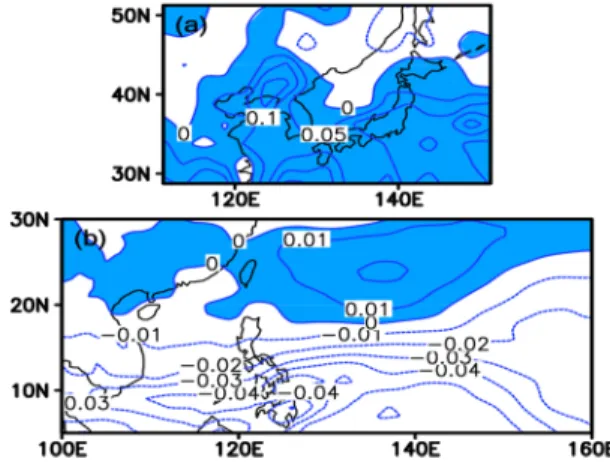
또한, i, j, k, m은 각각 북동아시아 지역 공간, 북서 태평양 지역, 시간, 그리고 SVD 모드에 대한 인덱스 이다. 북서태평양 고기압 변동성을 위하여 지위고도 대신 동서바람을 이용한 이유는 그 지역에서 바람은 계절적으로 지균적(geostrophic)이며, 지위고도 보다 동서바람에 의한 주성분 모드가 더 뚜렷하기 때문이 다. Fig. 2는 SVD에 의한 첫 번째 결합모드 패턴을 보인다. 첫 번째 결합 모드의 정규화된 평균 제곱 공 분산의 비율은 약 72.1%이다. 동서바람에 대한 모드 는 북서태평양 고기압의 변동성을 나타내며, 강수량
Pik Uimpmk
∑
m=
Hjk Vjmqmk
∑
m=
Fig. 2. Normalized singular vectors of JJA-mean (a) precipi-
tation from CMAP and (b) 850 hPa zonal winds predicted
by NCEP CFS from for the period 1982-2008. NCEP CFS
is initiated from 1 May of every year. Positive areas are
shaded.
에 대한 모드는 우리나라를 비롯한 여름철 동아시아 강수의 경년 변동성을 나타낸다. 이를 이용하면, 특 정한 해 에 대하여 예측된 여름철 북동아시아 지역 강수량 편차 pik1는 다음과 같이 표현될 수 있다.
여기서 Hik1는 NCEP CFS에 의해서 예측된 여름철 북서태평양 지역의 850 hPa 동서바람 편차이다. 한편, SVD 모드의 재조합은 5개 모드만 사용되었으며, 모 형의 검증을 위하여 매해마다 강수량을 개별적으로 예측하였다.
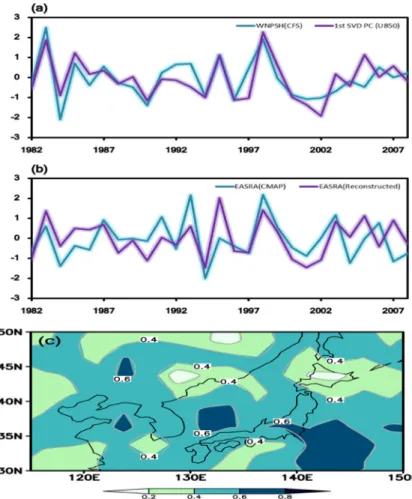
NCEP CFS에서 예측된 WNPSH와 북동아시아 지 역 강수량과의 첫 번째 결합모드에 해당하는 동서바
람의 시계열은 비교적 잘 일치하는 것으로 보인다 (Fig. 3a). 이 두 시계열의 상관계수는 0.76이다. 또한, 구성된 CCA 모형을 이용하여 북동아시아 지역 강수 량을 예측한 결과, 예측된 EASRA와 관측의 EASRA 의 상관계수가 약 0.50로 각 시계열을 랜덤으로 가정 했을 때, 통계적으로 99% 신뢰수준을 넘는 높은 예 측성능을 가지며(Fig. 3b), NCEP CFS를 이용하여 직접 여름철 북동아시아 지역 강수량 편차를 예측한 예측성능과는 큰 차이를 보인다(Fig. 1a). Fig. 3c는 CMAP 강수량과 모형에 의해 예측된 강수량의 점간 (point-by-point) 상관도를 보인다. 그림에서 보이는 바와 같이 우리나라를 비롯하여 많은 영역이 상관계 수 성능 0.4 이상이며, 특히 동해와 일본 일부 지역 은 0.6 이상의 높은 상관계수 성능을 보인다.
Pik1 Uim pmk
∑
k ⋅qkm⁄∑
k qkm2⎩ ⎭
⎨ ⎬
⎧ ⎫
VmjHjk1
∑
j∑
m=
Fig. 3. (a) WNPSH predicted by NCEP CFS (blue line) and time series corresponding to the leading SVD mode of 850 hPa
zonal winds (purple line). (b) EASRA from CMAP (blue line) and EASRA predicted by the CCA model (purple line). (c) Maps
of the point-by-point correlation coefficients between JJA-precipitation anomalies from CMAP and the CCA model for the
period 1982-2008.
NCEP 계절예측시스템과 정준상관분석을 이용한 북동아시아 여름철 강수의 예측 93
결론 및 토의
현재 수준의 대기대순환모형을 이용한 중위도 지역 강수 예측은 해수면온도 등 경계조건과 초기조건이 정확하다고 하더라도 그 예측률은 매우 낮은 반면에 북서태평양을 비롯한 저위도 지역 역학적 변수의 예 측률은 비교적 높다. 특히, 북서태평양 아열대 고기 압의 기작(mechanism)은 인도양-북서태평양 결합모드 와 라니냐 강제 모드(La Nina-forced mode)로 설명 할 수 있어(Wang et al., 2012), 그 변동성을 진단하 거나 예측하기 용이하며, 특히 대기대순환모형은 물 론 대기-해양 결합 대순환모형에서도 그 변동성이 잘 모의된다(Lee et al., 2008). 본 연구에서는 북서태평 양 고기압을 예측하기 위하여 NCEP CFS가 이용되 었다. 또한, 여름철 북서태평양 고기압 변동성과 북 동아시아 강수량은 높은 상관성을 가지고 있어 (Kwon, 2013), CCA 모형을 이용하여 북동아시아 지 역 평균한 여름철 강수량 편차의 예측성을 크게 향 상시킬 수 있었다. NCEP CFS와 CCA 모형을 이용 한 EASRA의 예측 상관계수 성능은 0.50이다.
본 연구에서는 예측을 위하여 NCEP CFS만 이용 하였으나, 다른 기관의 모형을 같이 사용하면 예측의 신뢰성과 정확성을 더욱 높일 수 있을 것으로 기대 된다. 한편, 북서태평양 아열대고기압 변동성뿐만 아 니라, 북인도양 해수면온도변동성이나 EU패턴(Eurasian pattern)은 대기의 파동을 통해 북동아시아의 여름철 강수량 변동성에 영향을 줄 수 있으므로(Lee et al., 2005; Kripalani and Ashwini, 2001), 계절시간 규모 에서 우리나라를 포함하는 북동아시아 지역 여름철 강수량을 정확히 예측하기 위하여 동아시아 여름몬순 변동성의 지배역학을 이해하기 위하여 더욱 노력하여 야 한다.
감사의 글
본 연구는 기상청 기상기술개발관리단의 기후변화 감시 예측 및 국가정책지원 강화사업(CATER 2012- 3072)의 지원으로 수행되었습니다.