국내 하천에서 분리된 그람 음성 Enterobacteriacaea의 항생제 다제내성
장예진1, 송기봉2, 정인영3, 김혁3, 석광설3, 고은별1, 김벼리1, 유용재1, 이옥재4, 채종찬1*
1전북대학교생명공학부및환경신기술연구소
2화학물질안전원연구개발교육과
3국립환경과학원화학물질연구과
4
DK EcoV
환경미생물연구소Received: December 8, 2015 / Revised: December 9, 2015 / Accepted: December 9, 2015
항생제는인간및동물의건강증진또는가축의생장발
달을위하여널리사용되고있다
[16].
항생제의발견은의학및축산분야에획기적인전기를이루었으나항생제내성미 생물의출현으로인해새로운대처방안의모색이시급해지
고있다
[5].
지속적인항생제내성미생물의증가와다제내성균의출현은심각한보건학적문제가초래되고있으며이 에대응하여세계각국에서항생제오남용에대한교육등
다양한정책을마련하고있다
[14].
항생제내성미생물의증가는항생제노출량증가에의한 현상으로여겨지고있는반면
,
항생제노출량이외의환경요 인과상관관계가있다는연구결과도발표되고있다.
고대 영구동토층으로부터분리된미생물로부터항생제내성유전 자가검출되었고검출된유전자들이최근보고되는유전자 들과상동성이높으며구조가유사한것으로밝혀짐에따라 항생제 내성 미생물의 존재는 자연현상이라는 내성체(resistome)
개념이발표되었다[5].
또한잔류항생제가남아 있는축산분뇨로부터분리된미생물에서일시적인항생제 저항성증가가관찰되기는하였으나지속적으로유지되지Prevalence of Multi-drug Resistant Bacteria Belonging to Gram Negative Enterobacteriaceae Isolated from a Domestic Stream
Yejin Jang
1, Ki-Bong Song
2, In-Young Chung
3, Hyuk Kim
3, Kwang-Seol Seok
3, Eun Byeul Go
1, Byeori Kim
1, Yong-Jae Yoo
1, Ok-Jae Rhee
4, and Jong-Chan Chae
1*
1
Division of Biotechnology and Advanced Institute of Environmental and Bioscience, Chonbuk National University, Iksan 54596, Republic of Korea
2
Development and Education Division, National Institute of Chemical Safety, Daejeon 34111, Republic of Korea
3
Chemicals Research Division, Environmental Health Research Department, National Institute of Environmental Research Complex, Incheon 22689, Republic of Korea
4
DK EcoV Environmental Microbiology Lab., Cheonan 31075, Republic of Korea
Enterobacteriaceae is one of the major families responsible for public health threats. Due to the emergence of pathogens with antibiotic resistance, great concern has been raised regarding the prevalence of antibiotic resistant bacteria in natural environ- ments. Therefore, the diversity of Gram negative Enterobacteriaceae was investigated in water samples collected from five streams in Korea using the cultivation method. Profiling of multi-drug resistance was conducted with isolates via disk diffusion assay. The results indicated that the Gram negative Enterobacteriaceae consisted of the following genus; Citrobacter, Entero- bacter, Escherichia, Klebsiella, Kluyvera, Pantoea, Plesiomonas, Raoultella, Shigella and Enterobacter. These latter strains represented 49% of identified isolates. In addition, 78.3% of the identified genus exhibited resistance against more than seven out of thirteen tested antibiotics, suggesting a high prevalence of multi-drug resistant bacteria in natural environments.
Keywords: Multi-drug resistance, prevalence, Enterobacteriaceae
*Corresponding author
Tel: +82-63-850-0840, Fax: +82-63-850-0834 E-mail: [email protected]
© 2015, The Korean Society for Microbiology and Biotechnology
않음을증명한결과역시발표되었다
[6, 13].
그러나이와달 리활성슬러지내에서잔류한항생제농도가높을수록항 생제내성유전자를보유한플라스미드의전이율이증가한 다고보고되었으며,
항생제에대한노출빈도가항생제내성 미생물발생및확산의주요인자로작용한다고보고되었다[2, 9].
또한축산농가종사자와비종사자의분변으로부터각각분리된
Escherichia coli
의다제내성을평가한결과축 산농가종사자유래E. coli
에서2
배이상의높은내성율을 보였다.
이러한결과는축산농가에서항생제를빈번하게사 용함에따라해당종사자의항생제노출빈도가높아졌기때 문에나타나는결과로추정할수있다[3].
항생제내성문제와관련된대표적인균주들로
Staphylococcus aureus, Enterococci, Pseudomonas aeruginosa, Streptococcus, Enterobacter, Klebsiella, Acinetobacter, Salmonella
등이 알려져있으며,
해당균주들이다제내성을보유하고있는경 우심각한문제를초래할수있다[8, 14].
이중에서도그람음 성Enterobacteriaceae
과의미생물로인한감염질환은개발 도상국을비롯하여전세계적으로큰위협이되고다제내 성으로인해점점제어가어려워지고있다[1, 7].
그람음성
Enterobacteriaceae
는요로감염,
혈류감염,
폐 렴,
복강감염등의주요원인이되는균주로β-lactamase
를 생성하여penicillin, carbapenem, cephamycin
등의 β- lactam
계열항생제에대한내성을갖는다[11].
최근프랑스파리에서
50%
이상의입원환자로부터다제내성그람음성병원균이검출되었고
[15],
독일의도축장에 서항생제내성을갖는그람음성미생물이검출됨에따라이에의한인체감염의위험성을경고하고있다
[12].
태국의가장규모가큰대학병원에서도
carbapenem
에저항성을갖 는그람음성박테리아가검출된보고가있어,
항생제내성 박테리아의확산및통제와지속적인모니터링의필요성이 강조되고있다[10].
본연구에서는국립환경과학원이실시한잔류의약물질분
석방법연구및실태조사에서잔류항생제가검출되었던국 내
3
곳의하천과가축농가밀집지역인근하류하천1
곳,
하 수처리시설이위치한인근하류하천1
곳에서채취된하천 시료로부터그람음성Enterobacteriaceae
분포조사를배양 법을통해실시하였다.
시료채취는2013
년9
월에이루어졌 으며시료의이화학적분석결과는Table 1
과같다.
수온과pH,
탁도는 현장에서 온도계(Thermo, USA), pH
미터(Thermo, USA),
및탁도계(Hach, USA)
를이용하여측정하 였다.
양이온과음이온의분석을위해시료를0.45
μm
실린 지필터를이용하여여과한후, IC(Metrohm 761 Compact IC, Switzerland)
를이용하여각항목을측정하였다.
음이온 컬럼은Metrosep A Supp5(150/4.0 mm, Switzerland)
를사 용하였으며양이온분석에사용한컬럼은Metrosep C4 150 (150/4.0 mm, Switzerland)
이었다.
수질시료의BOD
측정은 수질오염공정시험방법에따라분석을실시하였으며,
수질 에용해되어있는DO(dissolved oxygen)
농도는DO meter (HI 9146, Hanna Instruments, USA)
를이용하여측정하 였다.
세곳의하천시료들(H, Y, N)
은유사한생물학적 오 염도를보였으며J
시료의경우방류수의특성으로인하여 염소이온농도가 다른시료에비해11
−33
배높게측정되 었다.
그람음성
Enterobacteriaceae
세균을배양하기위해그람 양성균에 항균효과가 있는vancomycin(40
μg/ml, Sigma, USA)
이첨가된Enterobacteriaceae Enrichment(EE)
고체 배지(MBcell, Korea)
를사용하였다.
하천시료를0.85%
생리 식염수용액에연속희석법으로희석하여고체배지의표면 에도말하였다.
그리고25
oC
에서48
시간동안정체배양하여 생성된군집락중에서50
개씩을선발하였다.
선발된균주의
16S rRNA
유전자를증폭하기위한PCR
반응을실시하였다
.
총50
μl
의반응액에1
μl
의균주현탁액 과0.2
μM
의16S rRNA primer
인27F
와1492R universal primer(Cosmogenetech, Korea),
그리고25
μl
의Taq mastermix Table 1. Characteristics of water samples collected from domestic streams.
Sampling site
(latitude/longitude) Tm pH Turbidity (NTU)
DO (mg/l)
TOC (mg/l)
BOD (mg/l)
NO
3-(mg/l)
PO
43-(mg/l)
Cl
-(mg/l) H
(37.24.06 / 127.55.50) 20.0 7.6 2.03 7.7 10.00 0.4 3.06 0.375 32.9
Y
(34.47.11 / 126.27.52) 21.0 7.6 41.70 8.0 12.19 1.6 1.34 0.910 99.6
N
(35.53.15 / 128.38.31) 21.0 8.3 4.65 9.1 11.08 1.7 9.02 0.068 43.5
I
(35.54.01 / 127.01.41) 20.0 7.8 39.30 7.6 15.55 6.9 1.23 1.073 43.8
J
(35.52.38 / 127.06.02) 21.0 7.1 13.80 4.6 16.60 5.8 1.60 0.752 303.6
(Doctor protein, Korea)
를첨가하여진행하였다. PCR
은95
oC
에서10
분간의boiling
후에, 95
oC
에서30
초, 55
oC
에서30
초, 72
oC
에서1
분30
초씩30
회증폭후,
최종extension
을72
oC
에서7
분간실시하였다.
PCR
산물은PCR DNA Purification kit(Doctor protein,
Korea)
를이용하여정제하였고,
염기서열분석을위하여정제된
PCR
산물을Cosmogenetech(Korea)
에의뢰하였다.
염 기서열결정은27F primer
를이용하여Sanger
방법으로진 행하였다.
결정된염기서열은Ez-Taxon
데이터베이스[4]
에 서동정된세균들의분류학적정보와비교하였다.
그결과,
조사된세균들모두데이터베이스와99.9%
이상의유사도를 보였다.
비록
EE
배지에서배양되어분리되었지만균주동정결 과(Fig. 1), 41%
만Enterobacteriaceae
에속하는균주였으며30% Pseudomonadaceae, 20% Aeromonadaceae, 3%
Neisseriaceae, 2% Rhizobiaceae, 2% Brucellaceae, 1%
Shewanellaceae, 1% Xanthomonadaceae
로분류되었다. H
시료에서는Enterobacteriaceae
와Aeromonadaceae
가 각각47.6%
씩분포하였고Y
와N
시료에서는Aeromonadaceae
가44.5%
과41.7%
로 우점하였다. I
시료에서는Entero- bacteriaceae
와Pseudomonadaceae
가36%
와44%
로유사하 게분포하였으며, J
시료에서는Enterobacteriaceae
가70.4%
로우점하였다
.
동정된균주들중에서
Enterobacteriaceae
에속하는41%
의균주를속에따라분류한결과는
Fig. 1
과같다. Citrobacter, Enterobacter, Escherichia, Klebsiella, Kluyvera, Pantoea, Plesiomonas, Raoultella, Shigella 9
개의속으로분류되었으며
Enterobacter
가49%
로서우점종으로조사되었다. Enterobacteriaceae
로동정된세균의항생제감수성검사 를위해Muller-Hinton(MH)
배지(MBcell, Korea)
를사용하 였으며분리된세균들을MH
액체배지를이용하여25°C
에 서16
시간진탕배양시켰다.
그리고MH
고체배지에균주를도말한후항생제디스크를올려놓고
25°C
에서16
시간정체배양시켰으며균의생장이억제된원의직경을측정함으로 서균의항생제감수성을분석하였다
.
항생제감수성검사를 위해13
종의항생제감수성테스트디스크(Liofilchem, Italy)
를사용하였으며항생제디스크종류와농도는다음과같 다: penicillin G, 10 IU; ampicillin, 10
μg; lincomycin, 15
μg; clindamycin, 2
μg; tetracycline, 30
μg; gentamicin, 120
μg; kanamycin, 30
μg; erythromycin, 15
μg; tylosin, 30
μg; cephalexin, 30
μg; sulfamethoxazole, 50
μg;
trimethoprim, 5
μg; ciprofloxacin, 5
μg.
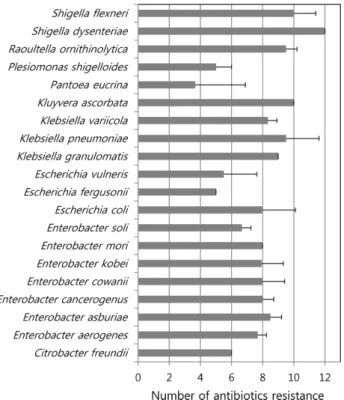
항생제감수성조사결과
(Fig. 2), Pantoea eucrina 1
개균 주이외의모든균주들이4
개이상의항생제에대해내성을 보이는다제내성특징을나타내었다. 8
종의항생제에내성 을보이는내성균들이30%
비율로가장우점하였으며7
종 이상의항생제에내성을보이는내성균들의분포가78.3%
를 차지하였다.
그러나조사된항생제내성균의분포비율은하 천의수질과는상관관계가나타나지않았으며(
결과미제시)
기작으로서자연내성과획득내성을구분하지않는결과이다.
본연구결과는자연하천에존재하는세균들중에서다제 내성을보이는항생제내성균들이서식생태계를우점하고 있다는것을제시한다.
그러나내성균들의내성기작이자연 내성인지전이유전자에의한획득내성인지분석되지못했으Fig. 1. Diversity of bacteria isolated from domestic streams.
며이를위해서는항생제내성유전자및전이관련유전자 의분석이후속되어야한다고사료된다
.
요 약
Enterobacteriaceae
에속하는세균들은보건학적문제를 발생시키기도하며항생제내성병원균의발생으로인하여 자연환경중의항생제내성균에분포에대한관심이증대되 고있다.
따라서배양법을이용하여국내5
개의하천시료로 부터그람음성Enterobacteriaceae
의종다양성을조사하였 으며분리된세균에대한다제내성을항생제디스크확산법 으로분석하였다.
그결과,
분리된그람음성Enterobacteriaceae
는Citrobacter, Enterobacter, Escherichia, Klebsiella, Kluyvera, Pantoea, Plesiomonas, Raoultella, Shigella
로 동정되었으며49%
가Enterobacter
로서우점종으로분석되 었다.
또한이들세균들의78.3%
가조사된13
종의항생제중 에서7
종이상에내성을보였으며이것은국내자연하천환 경에높은비율의다제내성균이서식한다는것을제시한다.
Acknowledgments
This study was supported by grant from National Institute of Environmental Research, Ministry of Environment in 2013.
References