• 검색 결과가 없습니다.

Review on Proton Exchange Membranes for Microbial Fuel Cell Application

N/A
N/A
Protected

Academic year: 2021

Share "Review on Proton Exchange Membranes for Microbial Fuel Cell Application"

Copied!
15
0
0

로드 중.... (전체 텍스트 보기)

전체 글

(1)

Online ISSN: 2288-7253 DOI: https://doi.org/10.14579/MEMBRANE_JOURNAL.2020.30.4.213

1. Introduction

1)

An alternative system to produce renewable energy is in large demand due to depleted levels of unrenewable

natural energy and increased usage of energy worldwide.

Polymer electrolyte membrane fuel cells (PEMFCs) is a key field within fuel cells which use a proton ex- change membrane to transport ions (H

+

and OH

-

). The key PEMFCs that will be focused on in this review

Corresponding author(e-mail: [email protected], https://orcid.org/0000-0002-3820-141X)

미생물 연료 전지 적용을 위한 양성자 교환막에 대한 검토

김 지 민*

⋅라즈쿠마 파텔

**,†

*연세대학교 융합과학공학부 바이오융합과, **연세대학교 융합과학공학부 에너지환경융합과

(2020년 7월 5일 접수, 2020년 7월 16일 수정, 2020년 7월 17일 채택)

Review on Proton Exchange Membranes for Microbial Fuel Cell Application

Ji Min Kim* and Rajkumar Patel**,†

*Bio-Convergence, Integrated Science and Engineering Division (ISED), Underwood International College, Yonsei University, 85 Songdogwahak-ro, Yeonsu-gu, Incheon 21983, South Korea

**Energy and Environmental Science and Engineering (EESE), Integrated Science and Engineering Division (ISED), Underwood International College, Yonsei University, 85 Songdogwahak-ro, Yeonsu-gu, Incheon 21983, South Korea

(Received July 5, 2020, Revised July 16, 2020, Accepted July 17, 2020)

요 약: 재생 불가능한 에너지 자원이 수년에 걸쳐 고갈됨에 따라, 재생 에너지 생산을 위한 보다 효과적인 방법에 대한 연구가 증가되었다. 연로전지 개발의 한 분야인 미생물 연료전지(MFC)는 이중 성능의 잠재력 덕분에 발전하였다. MFC는 박 테리아와 같은 전극 감소 생물에서 전력을 모아서 전기 에너지를 생산한다. MFC는 폐수를 연료로 사용하여 에너지를 생산하 고 폐수를 정화한다. 양성자 교환막(PEM)은 양극과 음극 챔버의 분리막으로, 양성자만 효과적으로 통과할 수 있게 하는 중요 한 역할을 한다. Nafion은 MFC에 상업적으로 사용되는 PEM이지만 비용, 생산 시간, 양성자 전도성 차원에서 보완할 점들이 많다. 본 리뷰 논문에는 Nafion을 대체할 수 있는 새로 개발된 PEM 몇 가지를 논의하였다. 또한, PEM, 혼합 PEM 및 복합 PEM에 기반한 MFC를 요약하고자 한다.

Abstract: As unrenewable energy resources have depleted over the years, the demand for renewable energy has increased promoting research for more effective methods to produce renewable energy. The field of fuel cell development, specifically microbial fuel cells (MFCs), has developed because of the dual performance potential of the technology. MFCs convert power by facilitating electrode-reducing organisms such as bacteria (microbes) as a catalyst to produce electrical energy.

MFCs use domestic and industrial wastewater as fuel to initiate the process, purifying the wastewater as a result. Proton exchange membranes (PEM) play a crucial role in MFCs as a separator between the anodes and cathodes chambers allowing only protons to effectively pass through. Nafion is the commercially used PEM for MFCs, but there are many setbacks:

such as cost, production time, and less effective proton conductivity properties. In this review there will be largely two parts. Firstly, several newly developed PEM are discussed as possible replacements of Nafion. Secondly, MFC based on PEM, blended PEM and composite PEM are summarized.

Keywords:

microbial fuel cell, graphene oxide, proton exchange membrane, membrane

(2)

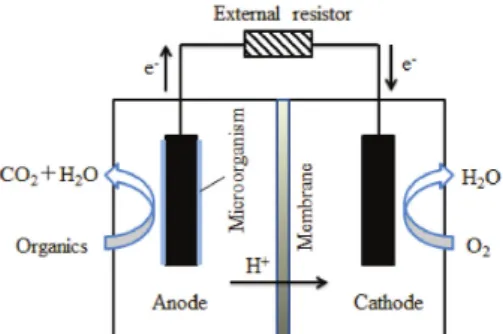
Fig. 1. Schematic diagram of microbial fuel cell.

paper are microbial fuel cells (MFCs) which use in- dustrial/domestic wastewater to harvest energy and con- vert into electricity[1-14]. It can convert energy stored within the microbes (microorganisms) of the waste- water to electrical energy. Not only does MFCs gen- erate electricity, but also purifies the domestic/in- dustrial wastewater that produce fresh water for further use. Advanced research of optimizing MFC perform- ance will result into many benefits such as energy gen- eration, environmental safety, and freshwater production.

Schematic representation of MFC is presented in Fig.

1. The most crucial factor of the MFC that effects the overall performance is the proton exchange membrane placed in the middle of the two chambers (anode and cathode). It allows the H

+

to effectively pass through from the anode chamber to the cathode chamber.

Additionally, it avoids short circuiting between the elec- trons and protons and maintain anaerobic conditions in the anode chamber.

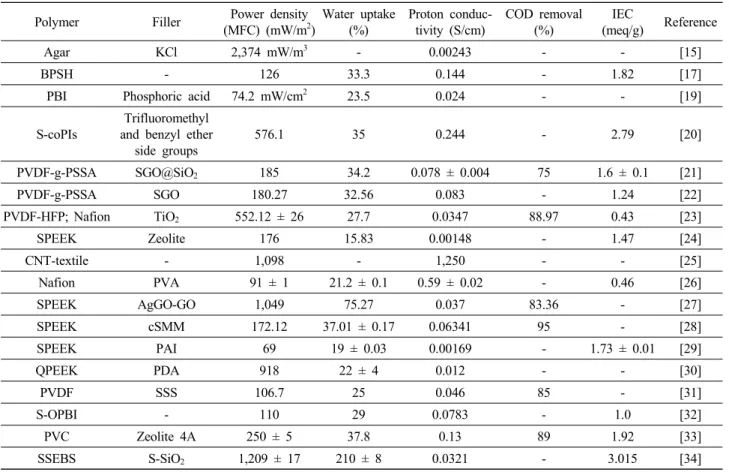
The most used proton exchange membrane (PEM) is the Nafion-117. Although Nafion is used the most, there are several setbacks to it including high cost of manufacture, unsatisfactory proton conductivity levels, and a long and complex manufacturing process. To im- prove MFC performance, extensive research is con- ducted to produce a superior alternative to the Nafion-117 with improved proton conductivity and an- ti-fouling properties. Performance of the different mem- branes in MFC is presented in Table 1. To characterize the synthesized membranes, the main imaging methods used were scanning electron microscopy (SEM), water uptake, proton conductivity, and transmission electron

microscopy (TEM). Many of the membranes synthe- sized goes through multiple steps that need to be re- checked to make sure that the reactions occurred effec- tively on the membranes. All the membranes introduced further are also tested by performance in either a two-chambered or single-chambered MFC over a des- ignated time period. The data is compared to the per- formance of Nafion-117 and if it performed better, it was thought to be a potential replacement for it. In this review microbial fuel cell primarily based on com- posite and blended proton exchange membrane are discussed.

2. Microbial Fuel Cell

Hernandez-Florez et al. reported synthesis of agar membranes by mixing different weights of agar from red algae as a polymer and distilled water as a sol- vent[15]. Once mixed, it was poured in Petri dishes and dehydrated into dry membranes. Agar-KCl mem- branes were synthesized in a similar fashion but mixed with corresponding amounts of KCl salt and agar poly- mer into distilled water. Three sets of membranes were synthesized which are: different percentages of only agar polymer (2, 4, 6, 8%), different percentages of agar polymer (2, 4, 6, 8%) and same percentage of KCl salt (10%), same percentage of agar (2%) with different percentages of KCl salt (2, 4, 6, 8, 10%).

The surface morphology of the synthesized membranes was analyzed using scanning electron microscopy.

Mechanical properties such as tensile strength and

maximum strain were tested as well as resistance and

proton conductivity. SEM images revealed a superficial

morphology of the composite membranes without po-

rosity and the KCl salts as “dots” on the surface. The

more KCl salt incorporated into the membranes, the

weaker and more brittle it was while an increase of

agar concentration with same concentration of KCl salt

showed an increase in strength. Proton conductivity of

membranes containing only agar polymer did not in-

crease much as the concentration increased. But the

conductivity of agar-KCl membranes increased drasti-

(3)

cally as agar component increased and KCl component stayed the same at 10%. MFC incorporated with the synthesized membranes were tested in single-chambers with Nafion-117 as the control. The dry membranes were coated with a catalyst before use and the electro- chemical characteristics were analyzed. SR-I was used as the biocatalyst over a short time interval. A trend showed which was that the increase of agar concen- tration resulted in better SC-MFC performance. When analyzed for a longer period of time of around 15 days, the same trend was found. Overall, the synthe- sized membranes seem to be a promising potential re- placement of Nafion-117 which is not only expensive and time-consuming to produce. Pictorial presentation

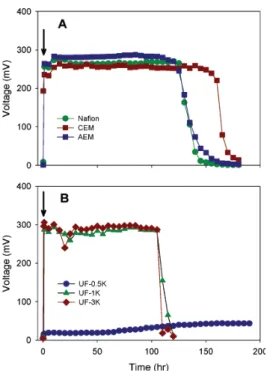
of MFC and time voltage plot is represented in Figs. 2 and 3[16].

2.1. Proton exchange membrane

Poly (arylene ether sulfone) membranes were syn- thesized by reacting 4,4’-Dichlorodiphenlysolfone (DCDPS), 4,4’-biphenyl (BP), 3,3’-Disulfonated-4,4’-di- chlorodiphenylsulfone (SDCDPS), and potassium into a viscous solution[17]. The precipitate of the solution was then dried and dissolved in DMAc and finally cast onto a glass plate. Different samples were synthesized according to the different degrees of sulfonation (20, 30, 40, 60). The synthesized membranes were tested for ion exchange capacity using titration and proton con-

Polymer Filler Power density

(MFC) (mW/m2)

Water uptake (%)

Proton conduc- tivity (S/cm)

COD removal (%)

IEC

(meq/g) Reference

Agar KCl 2,374 mW/m3 - 0.00243 - - [15]

BPSH - 126 33.3 0.144 - 1.82 [17]

PBI Phosphoric acid 74.2 mW/cm2 23.5 0.024 - - [19]

S-coPIs

Trifluoromethyl and benzyl ether

side groups

576.1 35 0.244 - 2.79 [20]

PVDF-g-PSSA SGO@SiO2 185 34.2 0.078 ± 0.004 75 1.6 ± 0.1 [21]

PVDF-g-PSSA SGO 180.27 32.56 0.083 - 1.24 [22]

PVDF-HFP; Nafion TiO2 552.12 ± 26 27.7 0.0347 88.97 0.43 [23]

SPEEK Zeolite 176 15.83 0.00148 - 1.47 [24]

CNT-textile - 1,098 - 1,250 - - [25]

Nafion PVA 91 ± 1 21.2 ± 0.1 0.59 ± 0.02 - 0.46 [26]

SPEEK AgGO-GO 1,049 75.27 0.037 83.36 - [27]

SPEEK cSMM 172.12 37.01 ± 0.17 0.06341 95 - [28]

SPEEK PAI 69 19 ± 0.03 0.00169 - 1.73 ± 0.01 [29]

QPEEK PDA 918 22 ± 4 0.012 - - [30]

PVDF SSS 106.7 25 0.046 85 - [31]

S-OPBI - 110 29 0.0783 - 1.0 [32]

PVC Zeolite 4A 250 ± 5 37.8 0.13 89 1.92 [33]

SSEBS S-SiO2 1,209 ± 17 210 ± 8 0.0321 - 3.015 [34]

KCl: potassium chloride; BPSH: disulfonated poly (arylene ether sulfone); PBI: polybenzimidazole; S-coPI: sulfonated co-poly (ether imide);

PVDF-g-PSSA: poly (-vinylidene fluoride) grafted poly (styrene sulfonic acid); SGO@SiO2: sulfonated graphene oxide @ silicon dioxide; SGO:

sulfonated graphene oxide; PVDF-HFP: poly (vinylidenefluoride-co-hexafluoropropylene); TiO2: titanium dioxide; SPEEK: sulfonated polyether ether ketone; CNT: carbon nanotube; PVA: polyvinyl alcohol nanofiber; AgGO-GO: silver graphene oxide and graphene oxide; cSMM: charged surface modifying macromolecule; PAI: poly (amide imide); QPEEK: quarternized poly (ether ether ketone); PDA: polydopamine; PVDF: poly (vinylidene fluoride); SSS: sodium styrene sulfonate; S-OPBI: sulfonated polybenzimidazole; PVC: polyvinylchloride; SSEBS: Sulfonated polystyrene ethylene butylene polystyrene; S-SiO2: sulfonated SiO2: SGO@SiO2.

Table 1. Summary of Membranes used in MFC

(4)

Fig. 2. (A) Two-bottle (B-MFC) and (B) and two-cube

(C-MFC) MFCs used for experiments (Reproduced with permission from Kim et al., 16, Copyright 2007, American Chemical Society).

Fig. 3. Time-voltage curves of B-MFCs using (A) proton,

cation, and anion exchange membranes and (B) UF membranes. Arrow indicates acetate injection (1 mM at fi- nal) (Reproduced with permission from Kim et al., 16, Copyright 2007, American Chemical Society).

ductivity using the four-point probe technique in water.

Water uptake was measured by comparing dry and wet membranes and the surface morphology of microbial growth was tested using scanning electron microscopy.

Compared to the other research articles, Nafion-212 was used as the reference of commercial products rath- er than Nafion-117 which is more widely used. IEC of the synthesized membranes increased as the degree of sulfonation increased and was all higher than Nafion-212 (0.93 meq/g). The highest was 2.21 meg/q for BPSH 60. Proton conductivity also increased as the degree of sulfonation increased but BPSH 20 (0.039 S/cm) and BPSH 30 (0.066 S/cm) had lower con- ductivity than Nafion-212 (0.118 S/cm). The highest was 0.186 S/cm for BPSH 60. Water uptake of BPSH 60 was significantly higher (160%) than the rest of the samples and even Nafion-212 at 11.6% proving that the highest sulfonation was better for membrane characterization. Bacteria clustering on the membrane may cause biofouling leading to decreased performance of the MFC. Surprisingly, the least bacterial cluster oc- curred in BPSH 60 leading to the analysis that hydro- philicity has an impact in biofouling.

The performance of MFC incorporated with the syn- thesized membranes were analyzed in both two-cham- ber and single-chamber MFCs. Two-chamber MFC performance was analyzed in a continuous feeding sys- tem and voltage rapidly increased and peaked for all the samples but a rapid decrease followed right after showing that proton conductivity is highly susceptible to the cations related to microbial metabolism. For the single-chamber MFCs, performance was highly depend- ent on the PEM and BPSH 40 generated the highest voltage of 20 mV which was higher than Nafion-212 of 15 mV. This revealed that the membranes result in different activities in two- and single-chamber MFCs.

Because these membranes performed better in the sin-

gle-chamber MFCs, they seem to be a better alter-

native, specifically BPSH 40, for single-chamber MFCs

than two-chamber MFCs. Fig. 4 represents the pictorial

diagram of MFC membrane with Nafion membrane

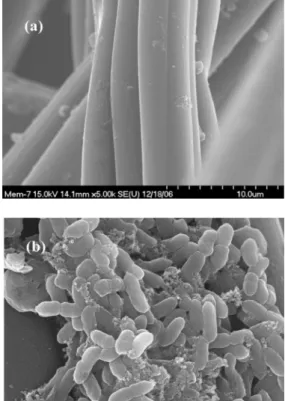
[18]. SEM image of bacteria grown on the MFC mem-

(5)

Fig. 4. Two-chamber MFC used in this experiment: (1)

anode, (2) cathode, and (3) Nafion. The arrows indicate where the components are (Reproduced with permission from Chae et al., 18, Copyright 2008, American Chemical Society).

brane is shown in Fig. 5[18]. Picture of bacterial growth on the membrane after use of 50 days and SEM image is presented in Fig. 6[18].

To synthesize acid-doped polybenzimidazole (PBI) membranes, PBI, N, N-dimethyl acetamide (DMAc), and lithium chloride (LiCl) were reacted, filtered, and concentrated into a viscous solution[19]. The solution was then cast on glass plates and dried. Finally, the membranes were doped using phosphoric acid yielding about 500 mol% of doping. Because the synthesized membrane is incorporated in air-breathing MFCs, oxy- gen permeability was analyzed as well as the proton conductivity using a four-point probe measurement.

The lower the oxygen permeability, the better the per- formance of the MFCs. Pristine PBI membranes had a higher oxygen permeability than the commercial Nafion-117 membranes which negatively affects the performance of MFCs but PBI membranes doped with 500 mol% phosphoric acid showed a sharp decrease in oxygen permeability. Also, water uptake was lower than Nafion-117 for pristine PBI membranes but once it was acid-doped, it increased significantly. This was due to strong interactions of phosphoric acid and water

Fig. 5. SEM images: (a) new carbon felt and (b) bacteria
growing on the anode carbon felt surface in the MFC fed with acetate (0.5 mM) as an electron source for over 50 days (Reproduced with permission from Chae et al., 18, Copyright 2008, American Chemical Society).

molecules. This trend was also visible for maximum power density of the synthesized membranes. Pristine PBI membranes on its own had a significantly lower maximum power density. Acid-doped PBI membranes reached a maximum power density of 471 mV which was higher than that of Nafion membranes of 396 mV.

Overall, acid-doped polybenzimidazole membranes seem to be a suitable alternative to the commercial Nafion membranes.

Diamine monomer TADBE is used to synthesize sul- fonated co-poly (ether imide) s reacted with six-mem- bered dianhydride and 1,4,5,8-naphthalene tetracarbox- ylic dianhydride (NTDA)[20]. Different degrees of sul- fonation was applied and labeled correspondingly (DBN- 60, 70, 80, 90). Transmission electron microscope (TEM) was used to analyze the surface morphology.

IEC values were found using titration method and wa-

(6)

ter uptake was calculated by comparing wet and dry polymer films. Proton conductivity of the synthesized polymer membranes were tested in different humidity levels. TEM images of the copolymer membranes shows dark spots corresponding to the hydrophilic parts and the bright parts to the hydrophobic parts. Ionic clusters were small which is a positive feature and the hydro- phobic parts depicts the bulky group which decreases the cohesive forces between the polymer chains leading to the small clusters[20]. Both water uptake and IEC values increased as the degree of sulfonation increased showing that sulfonation enhances the PEM perform- ance in MFCs. Moreover, proton conductivity increased significantly as degrees of sulfonation increased.

MFCs incorporating the synthesized copolymer mem- branes were tested using synthetic wastewater and 3,000 mg/L chemical oxygen demand (COD) as the feed. It was operated under fed batch mode with three days retention time in moderate temperatures[20]. The highest power density was recorded for the highest sul- fonated membrane (DBN-90) which was higher than the commercial Nafion-117. Conclusively, DBN-90 is

the most ideal alternative to be used in PEM to the commercial Nafion-117 membranes.

2.2. Composite proton exchange membrane

A mixture of Graphene Oxide (GO) and a solution of CH3OH and sulfuric acid was centrifuged and dried to obtained SGO particles. SGO@SiO

2

nanoparticles were obtained through ultrasonication and centrifugation of SGO particles mixed in a solution of ethanol and water[21]. Different ratios of SGO@SiO

2

particles and PVDF-g-PSSA were mixed at moderate temperatures and cast into glass molds. The resulting PEM had a thickness of around 80 µm. PEM immersed in sulfuric acid to change to H

+

from Na

+

. BET was used to ob- tain specific surface area of the synthesized hybrid par- ticle with the result of 99.053 and 101.196 m

2

/g for GO and SGO@SiO

2

particles respectively. No signi- ficant difference was found. Particles were observed us- ing TEM at 120 kV which showed that the thin-mem- brane structure of SGO and agglomerated state of SiO

2

was favorable to produce the sandwich structure of SGO@SiO

2

nanoparticles. Proton conductivity of the

Fig. 6. (a) Photograph of new Nafion. (b) Photograph of Nafion used for over 50 days in an acetate fed MFC. (c) SEM im-

age of bacteria growing on the anodic side of the used Nafion in part b. (d) Differential interference contrast (DIC) image.

(e) DAPI (4’,6-diamidino-2-phenylindole dihydrochloride) image for the biofilm taken out of the used Nafion in part b

(Reproduced with permission from Chae et al., 18, Copyright 2008, American Chemical Society).

(7)

membrane was experimented using four-point probe AC impedance spectroscopy (EIS) while water uptake was obtained by observing the membrane in DI water for 48 hours. Proton conductivity data proved that syn- thesized membranes performed at the same rate or su- perior to the control, Nafion-117. Water uptake was significantly higher for the synthesized membrane (an average of 10% difference) resulting from the adequate water absorption capacity of SGO and SiO

2

. Overall, the results proved that doping of SGO@SiO

2

sig- nificantly enhanced performance when compared to the commercial product Nafion-117. The performance of MFCs incorporated with the synthesized SGO@SiO

2

/ PVDF-g-PSSA was tested by obtaining power density and internal resistance. Maximum power density of MFC with Nafion-117 was 132 mW/m

2

while MFC with synthesized membrane was 185 showing a sig- nificant increase. Internal resistance was 210 Ω for Nafion-117 while it was 152 Ω for the synthesized membrane. These data show that performance of MFC using SGO@SiO

2

/PVDF-g-PSSA membrane shows su- perior performance over Nafion-117 proving that doping SGO@SiO

2

not only brings down the cost of MFCs but performs equally if not better than the commercial membrane Nafion-117.

Modified Hummer’s method was used to synthesize graphene oxide (GO) from natural graphite. Graphite powder, sodium nitrate, and sulfuric acid was stirred at 0°C and potassium permanganate was added to pro- duce the solution form of GO[22]. DI water and HCl is incorporated to produce the final GO solution which is freeze-dried at -40°C. GO nanosheets and DI water is sonicated and mixed with sulfanilic acid at 70°C then dried in an oven to produce sulfonated graphene oxide (SGO). PVDF-g-PSSA copolymer at its H

+

form is used to produce SGO/PVDF-g-PSSA membrane by solution casting method. Copolymer is dissolved in NMP with different amounts of SGO. The resulting solutions are cast in glass plates to produce membranes that are around 80µm thick. The different percentages of SGO loadings are 0.1, 0.5 1.0, 1.5, and 2.0 wt%.

Water uptake of all the SGO samples were higher and

particularly highest for the SGO/PPSSA1.0 membrane (32.56%) which was significantly higher than that of Nafion-117. SEM imaging of the SGO/PPSSA1.0 mem- brane showed a uniform surface without any visible flaws (such as cracks) which could be seen as result of strong interactions between the membrane and copolymer.

While other sample of SGO/PPSSA showed a lower proton conductivity than Nafion-117, SGO/PPSSA1.0 showed higher conductivity showing that this sample could be an ideal replacement of Nafion-117. MFCs using the composite membranes synthesized were oper- ated with a mixture of 20% anaerobic sludge and 80%

PBS. The performance was compared to MFC using PPSSA and Nafion-117. Since data of SGO/PPSSA1.0 showed the highest performance efficiency, the data of other wt% samples were not considered for the com- parison with the control (Nafion-117). The maximum power density was observed for the MFC using SGO/

PPSSA1.0 composite membrane at 180.27 mW/m

2

while Nafion-117 had a maximum of 132.02 mW/m

2

. To further observe the effect of biofouling of the membranes, the MFCs were observed for three months after initial operation. The lowest reduction of perform- ance was measured for SGO/PPSSA1.0 while the great- est reduction was observed for Nafion-117. Overall, SGO/PPSSA1.0 seems to be a promising alternative to the commercial composite membranes such as Nafion-117 and PPSSA.

VDF-HFP polymer is sulfonated with chlorosulfonic acid at 60°C, washed, and dried to produce sulfonated polymer pellets[23]. The pellets dissolved in NMP, Nafion resins, and nano-TiO

2

are mixed in certain ra- tios (5 different ratios) at moderate temperature. The polymer solutions are poured into Petri-dishes and dried to produce nanocomposite membranes. Furthermore, SEM imaging was obtained to analyze the morphology and proton conductivity was tested to analyze the effi- ciency of the nanocomposite membranes. Water uptake of the nanocomposite membranes increased with in- creasing amounts of TiO

2

content proving that TiO

2

plays a significant role in performance enhancement.

Of the nanocomposite membrane samples, T-7 showed

(8)

the highest water uptake of 27.7% which was sig- nificantly higher than Nafion-117 of 17.4%. The same trend was observed for the proton conductivity where T-7 membrane had the highest at 34.7 mS/cm com- pared to Nafion-117 at 30.2 mS/cm which is a smaller difference compared to water uptake but still worth highlighting. SEM imaging of the samples showed that the nanoparticles made a more porous surface and dis- tribution was uniform. MFCs incorporating the nano- composite membranes were operated for 48 days using air as catholyte and microbial enriched wastewater as anolyte. Highest power density and COD removal was observed of the T-7 sample membrane incorporated MFC at 552.12 mW/m

2

and 88.97% respectively. It had higher levels even compared to Nafion-117 in- corporated MFC further proving its potential to replace commercial membranes. Furthermore, SEM images of Nafion-117 and T-7 membranes after bio-fouling shows that an anti-biofouling effect occurred due to TiO

2

in- corporated in the membrane resulting in enhanced hydrophilicity. Not only does T-7 show great potential as an alternative to Narion-117, it predicts a future sig- nificance of nanocomposites being utilized in different systems of bio-electrochemistry.

Sulfonated poly (ether ether ketone) (SPEEK) was obtained by sulfonating PEEK polymer with sulfuric acid as the sulfonating agent[24]. The obtained SPEEK is washed to neutral pH, dried, then dissolved in NMP to be cast in petri dishes. Different weight percentages of zeolite (2.5, 5, 7.5, 10%) is added to SPEEK ion- omers dissolved in the NMP solvent and cast into petri dishes. To view the surface morphology of the synthe- sized membranes, SEM was used, and proton con- ductivity was measured using electrochemical impedance spectrometer. Water uptake was calculated by compar- ing wet and dry composite membranes and ion ex- change capacity was determined using a volumetric method. Water uptake of the membranes increased as zeolite component increased until 7.5% due to the 3D structure of pores absorbing water well. The same trend occurred for IEC and proton conductivity further prov- ing that 7.5 wt.% of zeolite is the ideal proportion.

SEM images of the composite membranes show a uni- form dispersity as well as specks of zeolite particles increasing as zeolite content increases. The perform- ance of single chamber MFCs incorporating the synthe- sized composite membranes were tested using E. coli as bacteria in the anodic chamber. Columbic efficiency increased until 7.5% (74%) and decreased to 73%

finally. All the composite membranes showed a better performance than the commercial Nafion-117 and pris- tine SPEEK membranes. The SPEEK/zeolite composite membranes resulted in superior characteristics such as IEC, proton conductivity, and power density. Overall, the synthesized composite membranes proved to be a promising and cheaper alternative to the costly com- mercial membranes such as Nafion-117.

Various carbon-based porous anodes such as carbon cloth, carbon paper, and carbon foam have been in- corporated in MFCs, but the quick microbial growth clogs the pores decreasing the efficiency of MFCs at a fast pace[25]. For satisfactory MFC application, a large specific surface area should be acquired. To meet the requirements, a 3D anode configuration design with a porous structure for improved electron transfer has been introduced. The proposed carbon nanotube (CNT) is suitable for substrate transport and colonization of microorganisms which results in a high anolyte-bio- film-anode interfacial area[25]. Since it is a highly conductive structure, a strong interaction with microbial biofilms is possible. The synthesized CNT was tested in MFCs using domestic wastewater and glucose.

Although not active right after operation of the MFC, the voltage increased significantly after 12 days. SEM images proved that the CNT-textile anode was bio- compatible and able to support colonization. Compared to the MFCs incorporated with the commercial carbon cloth, CNT-textile anode had greater porosity allowing for more substrate transport and colonization to occur.

Moreover, charge-transfer resistance improved 10-fold

from 300 Ω to 30Ω also meaning that is has a sig-

nificantly higher electron-transfer efficiency which proves

to be a promising alternative to the commercial car-

bon-based porous anodes available.

(9)

Porous PVA mats were obtained through standard electrospinning using water-based solution of polyvinyl alcohol (PVA)[26]. Water was removed through heat- ing and catalyzed in 4-formyl-1,3-benzenedisulfonic acid disodium salt and chlorhydric acid. Nanofiber mats dipped in 5 wt.% Nafion solution in isopropanol and water is then annealed using a hot plate press to 125°C and the resulting composite membranes’ thick- ness was measured (an average of ten samples was calculated). The thickness of Nafion-PVA-15 was around 15 µm while Nafion-PVA-23 was around 23 µm.

SPEEK-based membranes were produced using two different bases (water and DMAc). After dissolving SPEEK and the corresponding bases separately, they are mixed until complete homogenization and cast on Teflon dishes which are left overnight. The membranes are crosslinked at different temperatures. The last type of sample, SPEEK-PVA-PVB composite membranes were synthesized by first obtaining SPEEK-30PVB nanofibers using SPEEK solution in DMAc using elec- trospinning and repetition of heating and drying. Finally, SPEEK-35PVA composite membranes were reinforced using the SPEEK-30PVB nanofibers in climate cham- bers of moderate temperature and humidity. Water up- take was calculated by comparing the weight of dry and wet membrane samples and ion-exchange capacity (IEC) was obtained by submerging in NaCl solution and titration with NaOH. Membrane conductivity was measured using impedance analysis. Water uptake was highest for the DMAc-based SPEEK-35PVA composite membrane with 490% and the lowest for Nafion-PVA-15 with 21.2% mostly because the thickness of Nafion-PVA-15 was much thinner than DMAc-based SPEEK-35PVA. Conductivity of SPEEK-30PVB-35PVA was the highest at 1.03 × 10

2

S/cm and the other com- posite membranes were significantly higher than the commercial Nafion-117 membrane at 3.1 × 10

-2

S/cm.

The performance of MFCs incorporated with the synthesized composite membranes were tested in single chamber microbial fuel cells. Electrochemically enriched sodic saline inocula was used as the biocatalyst. The conductivity of the composite membranes did not cor-

respond to the results of the MFC performance.

Nafion-PVA-15 resulted in the highest power density at 1,053 mW/m

3

which was significantly higher than all the other composite membranes synthesized for this research. Furthermore, the current density was the high- est at 3,099 mA/m

3

followed by Nafion-117 at 3,009 mA/m

3

. Overall, any composite membrane which in- corporated PVA nanofibers seem to result in the better performance offering a cheaper alternative to Nafion-117.

A homogeneous mixture of graphene oxide solution and silver nitrate solution prepared separately was mixed with a reducing agent solution (sodium borohy- dride solution) at a controlled temperature of 15°C[27].

The resulting mixture was washed and centrifuged mul- tiple times and dried to obtain silver graphene oxides. A dry phase inversion method using N-Methyl-2-Prroli- done as a solvent was used to fabricate the composite membranes GO-SPEEK and AgGO-GO-SPEEK. The respective membrane solutions were ultrasonic to ob- tain homogeneous mixtures and cast on glass plates.

The cast membrane is dried at two different temper-

atures (45 and 60°C) for 48 h each. The dried mem-

brane is peeled off and put in H

2

SO

4

solution for acti-

vated sulfonic groups and finally washed off with DI

water. Characterization of the synthesized membranes

were performed to obtain the water uptake level and

proton conductivity and ultimately compared with

Nafion-117 membranes. Water uptake was found by

comparing masses of hydrated and dried membrane

while the Electrochemical Impedance Spectroscopy

(EIS) was used to determine the proton conductivity

ultimately obtaining the membrane’s resistance. Water

uptake was significantly higher for the synthesized

membranes (around 76%) compared to Nafion-117

(23.76%). This proves that the structure of the said

membranes was more ideal for water uptake than

Nafion-117. Proton conductivity also showed to be su-

perior to the Nafion-117. The synthesized membranes

averaged at about 3.75 while Nafion-117 was at 2.40

proving that incorporation of graphene oxide significantly

improved performance of the membrane. Performance

was tested in a dual-chamber MFC chamber with the

(10)

anolyte solution made up of synthetic wastewater (90%) and mixed bacteria culture (10%). The catholyte sol- ution was 50.0 mM phosphate buffer solution and the data obtained were internal resistance, maximum power density, and COD (Chemical oxygen demand) removal rate. Results showed that MFC incorporated with GO-SPEEK membrane has the lowest internal resist- ance of 48.59 Ω with the highest maximum power density of 1,134 mM/m

2

. AgGO-GO-SPEEK membrane followed meaning that Nafion-117 was the least effec- tive out of the three samples. COD removal rate was not significantly different for the three samples with an average of 83%. The three different MFCs were ob- served for 100 days and the results showed that dura- bility of the synthesized membranes (AgGO-GO-SPEEK in particular) were better than the MFC system equip- ped with Nafion-117. Overall, this proves that both GO-SPEEK and AgGO-GO-SPEEK membranes showed adequate potential as replacements of Nafion-117 in MFC systems.

2.3. Blended proton exchange membrane

Sulfonated poly (ether ether ketone) referred as SPEEK is produced by sulfonating PEEK. Dried PEEK dissolved in concentrated sulfuric acid (room temper- ature) produces the polymer solution[28]. Temperature is increased to around 70°C until needed degree of sul- fonation (60, 70, and 76%) is achieved. Temperature is dropped significantly to stop the sulfonation and wash- ed/dried to obtain SPEEK at different sulfonation degrees. 10% solution of pure SPEEK is produced by dissolving SPEEK in NMP and cSMM is mixed with SPEEK to prepare cSMM in solid state. The membranes were then cast on glass plates and dried. Finally, the membranes were ionized using sulfuric acid solution.

SEM images captured 2 months after initial operation of the MFC showed different microorganisms attached to the electrode. This proves that not only was the MFC in a stable condition, there were enough micro- organisms attached to produced protons and electrons from the membrane synthesized. Characterization of the membrane was performed to obtain proton conductivity

levels using AC impedance technique and water uptake (method mentioned above). Water uptake was signifi- cantly higher for all three synthesized membranes (29~

37%) compared to Nafion-117 (9.31%) and SPEEK76/

cSMM particularly had the highest percentage. This proves that the morphology of the SPEEK membranes were better suitable for water uptake. Proton con- ductivity for SPEEK60 (25.71 mS/cm) and SPEEK68 (35.68 mS/cm) were significantly lower than Nafion-117 (61.03 mS/cm). On the other hand, SPEEK76 (63.41%) was superior to Nafion-117 showing that the higher level sulfonation improved performance drastically. The performance of MFCs incorporated with the four sam- ples were observed for 2 months from initial experimentation. The highest power density of 172.1 mW/m was measured from the MFC with SPEEK76/

cSMM membrane followed by Nafion-117. This might be due to the high sulfonic acid group content which is associated with high water uptake levels. COD re- moval showed no significant differences between the four samples ranging from 85 to 94%. The overall data showed that SPEEK76/cSMM performed the most effi- ciently out of the four samples and it is suitable as a replacement of the Nafion-117 membranes for its lower cost and higher performance levels.

Sulfonated poly (ether ether ketone) (SPEEK) was prepared by dissolving PEEK into sulfuric acid and precipitating in cold deionized water[29]. The resulting fiber is tested to be 65% sulfonated. Solvent casting method is used to synthesize the polymer electrolyte membrane by dissolving corresponding amounts of PAI and SPEEK in DMF. The solution is then dried on a petri dish until the solvent it completely evaporated.

The different PAI/SPEEK compositions are labeled as

YA1 (0/100), YA2 (5./95), YA3 (10/90), and YA4

(20/80). Water uptake was calculated by comparing the

weight of dry and wet membranes and proton con-

ductivity of polymer electrolytes were analyzed. SEM

images of the membranes were obtained to analyze the

surface morphology. Water uptake results showed that

the percentage decreases as PAI component increases

from 37% to 13%. This is due to the reduction of block-

(11)

age of porous structure[29]. Proton conductivity showed the same decreasing trend as PAI component increased.

As PEEK is sulfonated, it is turned into a cation ex- change membrane which is hydrophilic compared to the hydrophobic nature of PEEK membranes. SEM im- ages show a smooth surface for YA1 while an even distribution of PAI particles can be seen for the other membranes. The performance of MFCs incorporated with YA2 used as the electrolyte was observed for about 30 days containing both pure and mixed culture.

Both MFCs increased in voltage production each time the PBS was fed and stabilized for longer days. This showed that biodegradation occurred in a slow rate while power output was effective. But due to biofoul- ing, the energy decreased significantly meaning that passage of protons through the membrane was restricted.

Overall, this study shows that the increased SPEEK component of synthesized membranes resulted in en- hanced performance of MFCs. Although highest water uptake and proton conductivity was measured for YA1, YA2 was chosen as the ideal PAI/SPEEK proportion because it decreased the least in proton conductivity over time.

A solvent casting method was used to synthesize quaternized poly (ether ether ketone) (QPEEK) mem- branes. The membranes were further modified using different concentrations of PDA (0.5, 1.0, 1.5, 2 kg/m

3

) and were named accordingly[30]. Different concen- trations of dopamine hydrochloride are dissolved in Tris-HCl buffer which polymerizes from the PDA.

Surface morphology of the synthesized membranes were viewed using SEM as well as the surface rough- ness using a noncontact profile meter. Hydrophilicity was tested using water drops and water uptake was measured by comparing wet and dry membranes.

Because antiadhesion is an important feature of anti- biofouling potential, it was tested using a mixed cul- ture bacteria. SEM images of the different membranes reveal an undulated morphology showing that the membranes were successfully modified although grains of PDA can be seen as the concentration increases. As the concentration of PDA increases, the water contact

angle increased meaning that hydrophilicity improved too. The reference membrane in this research is AMI-7001. Antiadhesion tests were performed on four membranes which revealed that hydrophilicity was the highest for QPEEK-1.0 and lowest for the commercial membrane (AMI-7001). Because high antiadhesion means less microorganism buildup on the membranes, it is beneficial for MFC performance. MFC performance incorporated with QPEEK, QPEEK-0.5, QPEEK-1.0, and AMI-7001 membranes were tested in single-cham- bered MFCs. 10% v/v of sewage culture was used to inoculate the MFCs and sodium acetate was used as microbial oxidation meal source. Power density of the modified membranes showed significantly higher power density curves compared to the AMI-7001 membrane proving that the increase of hydrophilicity led to en- hanced performance of MFCs with slower buildup of microorganisms on the surface. In summary, PDA modification of membranes led to improved antibiofoul- ing properties ultimately improving MFC performance.

O

3

/O

2

mixture was continuously bubbled through a polyvinylidene fluoride (PVDF)/NMP mixture at room temperature for ozone pretreatment[31]. After degassing the treated PVDF with nitrogen, nitrogen-bubbled SSS/

DMSO and benzoyl peroxide (BPO) is reacted together

resulting in a PVDF-g-PSSS copolymer. The copolymer

was cast as a liquid film on a glass plate at a thick-

ness of around 100 µm. Finally, the membranes were

protonated to H

+

form with 1 M HCl solution. Water

uptake was analyzed by comparing the soaked mem-

branes with dry membranes at room temperature. Proton

conductivity was measured using the AC impedance

technique and the results is as following. Compared to

pristine PVDF membranes, additional peaks correspon-

ding to C-C aromatic rings and SO

3-

groups were seen

for PVDF-g-PSSA membranes. The water uptake in-

creased as SSS monomer concentration increased due

to the increase of sulfonate groups. Proton conductivity

showed the same trend of increasing as SSS component

increased. The highest proton conductivity was seen for

1 : 5 mass ratio of PVDF/SSS at 0.046 S/cm. MFC in-

corporating the synthesized composite membranes were

(12)

observed and analyzed. Compared to the other research articles, MFC with PVDF-g-PSSA membranes per- formed less effectively than Nafion-117 membrane in- corporated MFCs. The PVDF-g-PSSA membrane pow- er density was 106.7 mW/m

2

while Nafion-117 was 132.0 mW/m

2

. The same trend applied to internal resistance. Although performance was inferior to Nafion-117, the data still showed significant possibility to be used in MFCs and lower production cost and easier production process also makes this composite membrane an adequate candidate to be used in MFCs.

Solutions of oxy-polybenzimidazole (OPBI) and sul- fonated oxy-polybenzimidazole (S-OPBI) were used to form membranes on petri dishes through evaporation using a vacuum oven[32]. S-OPBI goes through an ex- tra step of protonation using sulfuric acid followed by evaporation once again. Proton conductivity was meas- ured using AC impedance spectroscopy and the result proved that S-OPBI membrane (0.0783) had a proton conductivity slightly higher than Nafion-117 (0.0765) while OPBI was less conductive than Nafion-117. Water uptake was higher for both OPBI and S-OPBI at around 27% while Nafion-117 was 12.5%. Because wa- ter uptake is a crucial property for proton conductivity, this result proves that the synthesized S-OPBI mem- brane was a possible alternate to Nafion-116 produced at a significantly lower cost. The performance of MFCs using OPBI and S-OPBI as proton exchange membranes (PEM) was tested and observed for approximately 14 hours after initial operation. Power density of S-OPBI membrane was the highest followed by Nafion-117 and OPBI membrane proving that sulfonation helped the efficiency of PEM to increase drastically. Over time, the voltage of the S-OPBI membrane dropped the least of the three samples. The overall data showed that sul- fonation plays a key role in enhancing the membrane potential and is a suitable replacement of the commer- cial Nafion-117 membrane. Further research and analy- sis of sulfonated-OPBI as an alternative to Nafion-117 will further prove its potential.

A proton conducting composite membrane made of polyvinyl chloride (PVC) and inorganic hydrophilic

zeolite 4A is synthesized and tested for incorporation in microbial fuel cells[33]. Different amounts of zeo- lite-4A (5, 10, 15, and 20 wt%) are mixed with NMP and stirred until a homogeneous mixture is obtained.

PVC was added to the different mixtures and stirred for another 6~8 hours. The prepared solutions are cast on petri dish and evaporated until fully dry. The sam- ples are named Z1, Z2, Z3, Z4 according to the amounts of zeolite incorporated (5, 10, 15, 20 wt% re- spectively). SEM images of the samples indicate that there is an increase of crystal-like structures as the zeolite content increased. Membranes showed a suitable surface until 15 wt% but 20 wt% zeolite content start- ed to show agglomeration. Proton conductivity of the samples were measured and Z3 membrane had the highest at 0.13 S/cm while Nafion-117 was significantly lower at 0.067 S/cm. The same trend appeared for wa- ter uptake and tensile strength further proving the po- tential of 4A zeolite composite membrane as an alter- native of Nafion-117.

Performance of MFC incorporated with the synthe- sized composite membrane (Z3) was tested using bac- terial cultures obtained from kitchen wastewater and buttermilk which is sufficient in generating electrons for MFC operation. The Z3 membrane was the most efficient with maximum power density at around 250 mW/m

2

while Nafion-117 was significantly lower at 125 mW/m

2

. The COD reduction rate was also the highest for Z3 membranes further proving its potential as Nafion-117 replacement. The performance was ob- served for around 18 days and the performance of the Z3 membrane incorporated MFC was the most im- proved superior to Nafion-117. Overall, Z3 membrane proved to be a better alternative cost and performance wise.

Polystyrene ethylene butylene polystyrene (SEBS) is

mixed with required amounts of chloroform, tributyl

phosphate (TBP), and CSA in a nitrogen atmosphere

until a uniformly mixed solution is obtained[34]. The

obtained solution is cast on glass plates and evaporated

until a dry sulfonated polymer is obtained. The compo-

site membranes are synthesized by adding varying

(13)

amounts of sulfonated SiO

2

to the SSEBS/THF solution.

The mixtures are cast on glass plates and evaporated.

All membranes are pretreated (boiled) in DI water.

Compared to non-sulfonated membranes, sulfonated products showed additional peaks corresponding to Si-O-SO

3

H bonds proving that sulfonation occurred.

SEM images of the composite membranes showed that they were uniformly dispersed in the polymer matrix.

Sulfonation further distributed the component mem- branes evenly proving that sulfonation is a procedure that enhances composite membrane morphology. Of the six samples synthesized, SSEBS-S-SiO

2

7.5% mem- brane showed the highest water uptake and ion ex- change capacity at around 210% and 3.015 meq/g respectively. As S-SiO

2

component increased, the pro- ton conductivity increased but it decreased from 7.5%

component. MFC performance incorporating the syn- thesized membranes were observed for about 3 weeks.

Of the synthesized samples, SSEBS-S-SiO

2

exhibited the highest performance data of proton conductivity at 3.21 × 10

-2

S/cm and IEC of 3.01 meq/g which are both significantly higher than the Nafion-117 membrane.

The sulfonated membranes reduced the internal resist- ance which means a faster reaction between the elec- trode and electrolyte ultimately leading to satisfactory performance. Not only is the performance superior to the Nafion-117 membranes, the cost of production is estimated to be significantly lower which is another merit of membranes incorporated sulfonated inorganic components to nanocomposite membranes.

3. Conclusions

Developing an alternative to Nafion-117 PEM to en- hance the performance of microbial fuel cells have be- come an important crucial field of research and it is still a relatively new topic compared to other renew- able energy sources. Although many new procedures and upgraded materials have been introduced through- out this paper, none of them have been actually ap- proved for commercial use meaning that much more

research needs to be done to lessen the risk and cost while increasing the performance of MFCs. This re- view paper aimed to introduce the different research that has been going on around the world to synthesize more effective PEMs while highlighting the fact that there is still a large gap to cover to synthesize an ide- ally performing PEM. Several different approaches were introduced throughout the paper and PEMs that incorporated sulfonated functional groups such as SPEEK, QPEEK, GO-SPEEK, and SSEBS show higher proton conductivity levels than Nafion-117. Not only was the proton conductivity levels higher, but also the overall performance of MFCs incorporated with those PEMS were relatively consistent and better performing over the time it was tested. PEMs which incorporated nanomaterial proved to perform well, but the toxic na- ture of the material hinders it from commercial use un- less researchers find a more effective way to control the toxicity. All the membranes introduced had a more evenly dispersed surface morphology than Nafion-117 which means that it is beneficial regarding biofouling and can be used for a longer time than Nafion-117.

Further research should be conducted on improving the sulfonated and other functionalized material surfa- ces because it seems to result in the most satisfactory performance results. Materials such as carbon nano- tubes, ozone-induced grafts, and graphene oxide nano- materials used to fabricate PEMs are also promising routes to take since the application of these materials improves the performance of MFCs overall significantly.

With further research, an optimum replacement of Nafion-117 might be synthesized with lower cost, bet- ter performance, and improved properties.

Reference

1. X. J. Lee, P. L. Show, T. Katsuda, W. H. Chen,

and J. S. Chang, “Surface grafting techniques on

the improvement of membrane bioreactor: State-of-

the-art advances”, Bioresour. Technol., 269, 489

(2018).

(14)

2. M. T. Noori, M. M. Ghangrekar, C. K. Mukherjee, and B. Min, “Biofouling effects on the perform- ance of microbial fuel cells and recent advances in biotechnological and chemical strategies for miti- gation”, Biotechnol. Adv., 37, 107420 (2019).

3. S. Rajendran, M. Naushad, K. Raju, and R.

Boukherroub, “An overview of current trends in emergence of nanomaterials for sustainable micro- bial fuel cells”, pp 341, Springer International Publishing, Cham (2019).

4. Z. He and F. Mansfeld, “Exploring the use of electrochemical impedance spectroscopy (EIS) in microbial fuel cell studies”, Energy Environ. Sci.,

2, 215 (2009).

5. M. Aghababaie, M. Farhadian, A. Jeihanipour, and D. Biria, “Effective factors on the performance of microbial fuel cells in wastewater treatment - A review”, Environ. Technol. Rev., 4, 71 (2015).

6. D-E. Kwon and J. Kim, “Forward osmosis mem- brane to treat effluent from anaerobic fluidized bed bioreactor for wastewater reuse applications”, Membr.

J., 28, 196 (2018).

7. J. H. Kim, R. Patel, X. Z. Lei, and S. Y. Heo,

“Preparation and characterization of proton con- ducting crosslinked P(VDF-co-CTFE)-MAA/SEMA membranes”, Membr. J., 23, 290 (2013).

8. M. E. Lee, J. Oh, N-S. Park, D-G Koh, H. Jang, and Y. Ahn, “Change of sludge denitrification and nitrification rate according to the operating con- ditions in advanced wastewater treatment proc- esses”, Membr. J., 28, 31 (2018).

9. S. E. Kang and C. H. Lee, “Perfluorinated sulfonic acid ionomer-PTFE pore-filling membranes for pol- ymer electrolyte membrane fuel cells”, Membr. J.,

25, 171 (2015).

10. S-H. Do, J. S. Roh, and H. B. Park, “Carbon-free hydrogen production using membrane reactors”, Membr. J., 28, 297 (2018).

11. B. E. Logan, “Exoelectrogenic bacteria that power microbial fuel cells”, Nat. Rev. Microbiol., 7, 375 (2009).

12. S. Das, K. Dutta, and D. Rana, “Polymer electro-

lyte membranes for microbial fuel cells: A review”, Pol. Rev., 58, 610 (2018).

13. J. X. Leong, W. R. W. Daud, M. Ghasemi, K. B.

Liew, and M. Ismail, “Ion exchange membranes as separators in microbial fuel cells for bioenergy conversion: A comprehensive review”, Renew. Sust.

Energ. Rev., 28, 575 (2013).

14. P. Miao, “Electrochemical sensing strategies for the detection of endotoxin: A review”, RSC Adv.,

3, 9606 (2013).

15. G. Hernandez-Florez, A. Andrio, V. Compan, O.

Solorza-Feria, and H. M. Poggi-Varaldo, “Synthesis and characterization of organic agar-based mem- branes for microbial fuel cells”, J. Power Sources,

435, 226772 (2019).

16. J. R. Kim, S. Cheng, S.-E. Oh, and B. E. Logan,

“Power generation using different cation, anion, and ultrafiltration membranes in microbial fuel cells”, Environ. Sci. Technol., 41, 1004 (2007).

17. T. H. Choi, Y. B. Won, J. W. Lee, D. W. Shin, Y. M. Lee, M. Kim, and H. B. Park, “Electro- chemical performance of microbial fuel cells based on disulfonated poly(arylene ether sulfone) mem- branes”, J Power Sources, 220, 269 (2012).

18. K. J. Chae, M. Choi, F. F. Ajayi, W. Park, I. S.

Chang, and I. S. Kim, “Mass transport through a proton exchange membrane (Nafion) in microbial fuel cells”, Energy & Fuels, 22, 169 (2008).

19. G. Bahlakeh, M. M. Hasani-Sadrabadi, S. H.

Emami, S. N. S. Eslami, E. Dashtimoghadam, M.

A. Shokrgozar, and K. I. Jacob, “Experimental in- vestigation and molecular dynamics simulation of acid-doped polybenzimidazole as a new membrane for air-breathing microbial fuel cells”, J. Membr.

Sci., 535, 221 (2017).

20. A. G. Kumar, S. Saha, H. Komber, B. R. Tiwari, M. M. Ghangrekar, B. Voit, and S. Banerjee, “Tri- fluoromethyl and benzyl ether side groups contain- ing novel sulfonated co-poly(ether imide)s: Appli- cation in microbial fuel cell”, Eur. Polym. J., 118, 451 (2019).

21. Q. Xu, L. Wang, C. Li, X. Wang, C. Li, and Y.

(15)

Geng, “Study on improvement of the proton con- ductivity and anti-fouling of proton exchange membrane by doping SGO@SiO

2

in microbial fuel cell applications”, Int. J. Hydrogen Energy, 44, 15322 (2019).

22. C. Li, L. Wang, X. Wang, C. Li, Q. Xu, and G.

Li, “Fabrication of a SGO/PVDF-g-PSSA compo- site proton-exchange membrane and its enhanced performance in microbial fuel cells”, J. Chem.

Technol. Biotechnol., 94, 398 (2019).

23. P. Kumar, and R. P. Bharti, “Nanocomposite poly- mer electrolyte membrane for high performance microbial fuel cell: Synthesis, characterization and application”, J. Electrochem. Soc., 166, F1190 (2019).

24. P. N. Venkatesan and S. Dharmalingam, “Effect of zeolite on SPEEK/zeolite hybrid membrane as elec- trolyte for microbial fuel cell applications”, RSC Adv., 5, 84004 (2015).

25. X. Xie, L. Hu, M. Pasta, G. F. Wells, D. Kong, C. S. Criddle, and Y. Cui, “Three-dimensional car- bon nanotube-textile anode for high-performance microbial fuel cells”, Nano Lett., 11, 291 (2011).

26. S. K. Kamaraj, S. M. Romano, V. C. Moreno, H.

M. Poggi-Varaldo, and O. Solorza-Feria, “Use of novel reinforced cation exchange membranes for microbial fuel cells”, Electrochim. Acta, 176, 555 (2015).

27. K. Ben Liew, J. X. Leong, W. R. Wan Daud, A.

Ahmad, J. J. Hwang, and W. Wu, “Incorporation of silver graphene oxide and graphene oxide nano- particles in sulfonated polyether ether ketone mem- brane for power generation in microbial fuel cell”, J. Power Sources, 449, 227490 (2019).

28. A. Mayahi, H. Ilbeygi, A. F. Ismail, J. Jaafar, W.

R. W. Daud, D. Emadzadeh, E. Shamsaei, D. Martin,

M. Rahbari-Sisakht, M. Ghasemi, and J. Zaidi,

“SPEEK/cSMM membrane for simultaneous elec- tricity generation and wastewater treatment in mi- crobial fuel cell”, J. Chem. Technol. Biotechnol.,

90, 641 (2015).

29. G. Sowmya and M. R. Prabhu, “Fabrication of blend polymer electrolyte membrane with poly (amide imide)-sulfonated poly (ether ether ketone) for mi- crobial fuel cell”, Mater. Res., 6, 025519 (2018).

30. M. Elangovan and S. Dharmalingam, “Effect of polydopamine on quaternized poly(ether ether ke- tone) for antibiofouling anion exchange membrane in microbial fuel cell”, Polym. Adv. Technol., 29, 275 (2018).

31. C. Li, L. Wang, X. Wang, M. Kong, Q. Zhang, and G. Li, “Synthesis of PVDF-g-PSSA proton ex- change membrane by ozone-induced graft copoly- merization and its application in microbial fuel cells”, J. Membr. Sci., 527, 35 (2017).

32. S. Singha, T. Jana, J. A. Modestra, A. Naresh Kumar, and S. V. Mohan, “Highly efficient sulfo- nated polybenzimidazole as a proton exchange membrane for microbial fuel cells”, J. Power Sources, 317, 143 (2016).

33. H. Nagar, N. Badhrachalam, V. V. B. Rao, and S.

Sridhar, “A novel microbial fuel cell incorporated with polyvinylchloride/4A zeolite composite mem- brane for kitchen wastewater reclamation and pow- er generation”, Mater. Chem. Phys., 224, 175 (2019).

34. A. Sivasankaran, D. Sangeetha, and Y. H. Ahn,

“Nanocomposite membranes based on sulfonated

polystyrene ethylene butylene polystyrene (SSEBS)

and sulfonated SiO

2

for microbial fuel cell applica-

tion”, Chem. Eng. J., 289, 442 (2016).

수치

Fig.  1.  Schematic  diagram  of  microbial  fuel  cell.
Table  1.  Summary  of  Membranes  used  in  MFC
Fig.  3.  Time-voltage  curves  of  B-MFCs  using  (A)  proton,  cation,  and  anion  exchange  membranes  and  (B)  UF  membranes
Fig.  4.  Two-chamber  MFC  used  in  this  experiment:  (1)  anode,  (2)  cathode,  and  (3)  Nafion

참조

관련 문서