A Comparison of the Image of Korea as Perceived by Foreign Tourists Before and
After the International Trade Show
- The Case of 2005 Seoul International Sports & Leisure Industry Show -
Sang-Su Choi
Department of Hospitality and Tourism Management, Dongguk Universityy, Korea
Contents
. Introduction
Ⅰ
. Literature Review
Ⅱ
. Methodology
Ⅲ
. Results
Ⅳ
. Implications and Conclusions
Ⅴ
References Abstract
Abstract
This research empirically examined changes in the images of Korea over three points in time among Japanese, Chinese, and U.S. visitors to South Korea. Between March 14 and May 31, 2005, about two to three months after the 2005 Seoul International Sports & Leisure Industry Show ended, 153 tourists from America, 129 from China, and 156 from the Japan completed the survey instrument. The results from a General Linear Model (GLM) with repeated measures showed that tourists from all three countries had more positive images after the Seoul International Sports & Leisure Industry Show than before it. It was concluded that the 2005 Seoul International Sports & Leisure Industry Show appeared to have a significant positive effect in enhancing the image of South Korea. The study suggests that an internationally significant trade Show can change the image of a tourism destination in a short time period.
Key Words International Trade Show, Destination Image, Image Modification:
I. Introduction
Trade show with international appeal provide impressions of a host country to spectators from foreign countries, television viewers and users of other information media because, along with the Sports & Leisure Industry trade Shows themselves, a variety of social and cultural activities supporting the trade Shows offer powerful opportunities to promote the host country’s culture and traditions (Allen, O’Toole, McDonnell &
Harris, 2002; Bramwell, 1997; Gamage & Higgs, 1996; Getz, 1997; Hall, 1987; Mihalik & Simonetta, 1999).the 2005 Seoul International Sports & Leisure Industry Show was held in March 9 and 12, 2005.
The Seoul International Sports & Leisure Industry Show had various impacts on Korean society. First, according to a report of the economic impacts of the 2005 Seoul International Sports & Leisure Industry Show, 43,000 foreign tourist visited Korea during the period and spent US$1,242 per person (Korea National Tourism Organization, 2005). The direct effects of the total expenditures produced US$351 million of output, US$37 million of income, US$11 million of indirect taxes, and US$113 million of value added (Korea National Tourism Organization, 2005).
Therefore, the 2005 Seoul International Sports & Leisure Industry Show was a significant enough international trade Show to potentially change the image of Korea. The goal of this study was to empirically measure the image of Korea as perceived by foreign tourists who visited Korea two to three months after the Show and compare their perceptions of Korea before and after the Show. The three objectives were to investigate images of Korea as perceived by Japanese, Chinese, and U.S. tourists over these three points in time. In essence, this study attempted to investigate the cultural of national image from the hosting of this international trade Show.
. Literature Review
Ⅱ
According to Pike’s (2002) study, more than 53 articles about tourism destination image have been published in international tourism journals or proceedings of major conferences since 1973. This wealth of papers confirms there is a consensus on the importance and usefulness of the study of destination image (Pike, 2002). Some of the previous studies have found differences in image perceptions between pre-visitors and post-visitors (Chon, 1991); before and after trips(Andreu, Bigne & Cooper, 2000; Chaudhary, 2000; Pearce, 1982; Phelps, 1986);
before and after advertising campaigns (Perry, Izraeli & Perry, 1976); between first-time and repeat visitors (Crompton, Fakeye & Lue, 1992; Fakeye & Crompton, 1991; Phelps, 1986); between visitors and non-visitors
(Fakeye & Crompton, 1991; Hu & Ritchie, 1993); before and after internationally significant political events(Gartner & Shen, 1992); and between ideal and actual images (Botha, Crompton & Kim, 1999; Crompton, 1979; Ross, 1993). A summary of major studies on differences in image perceptions follows.
Gunn (1972) explained a traveller’s experience process on the basis of seven stages indicating an imagery modification process. This includes the accumulation of mental images about the vacation experience (1st stage), modification of those images by further information (2nd stage), the decision to take a vacation trip (3rd stage), travel to the destination (4th stage), participation at the destination (5th stage), return travel (6th stage), and new accumulation of images based on the experience (7th stage). As a result, Gunn suggested that a tourism destination image could be modified or changed over the seven stages. He suggested that destination images are conceptualized into two levels: organic and induced images. That is, an organic image is formed by non-tourism market-oriented information, whereas an induced image is formed by efforts of marketers through advertising and promotions (Crompton, Fakeye & Lue, 1992; Fakeye & Crompton, 1991; Gunn, 1972).
Perry, Izraeli & Perry (1976) investigated the image change of Canada as a tourism destination as a result of a promotional campaign conducted over a five-month period. Respondents indicated that after the promotional campaign their perceptions of Canada changed on items such as ‘Canada is a boring country,’ and ‘the ease of accessibility,’ and ‘cheaper transportation through Canada to the U.S.’ However, even after the promotional campaign, perceptions of Canada did not change on, ‘Canada is a good place to ski,’ ‘it has many business opportunities,’ and ‘it is a huge country.’ In addition, the study found that after the advertising campaign to improve Canada’s image was completed, respondents indicated they had better images of Canada than they had before the promotional campaign. This study concluded that the image of a country could be modified by advertising efforts.
In a study of images of Mexico as a potential destination for U.S. tourists, Crompton (1979) reported that the ideal images and actual images of Mexico as a holiday destination were significantly different. For example, negative perceptions were found in a comparison of Mexico’s actual and ideal destination images related to climate and low cost. Crompton suggested that the larger the gap between actual and ideal images, the less was the likelihood that a potential U.S. tourist would make a decision to travel to Mexico.
Chon (1991) investigated how American tourists’ perceptions of Korea changed through the 4th stage and the 6th stages in the traveller’s experience process, assuggested by Gunn (1972). His study found significant differences in the perceptions of the image of Korea between pre-visitors and post-visitors. Post-visitors showed more positive perceptions of the national image of Korea than pre-visitors.
Pearce (1982) investigated whether or not tourists to Greece and Morocco had different images of these countries after their trips. His study revealed changes in tourists’perceptions of these countries as a holiday tourism destination. For example, tourists to Greece considered the country’s holiday environment to be more
adventurous, better for cheap shopping, and freer from other tourists than they did before their travel.
Phelps (1986) found differences in the images of Minorca between first-time and repeat visitors. For example, first-time visitors had images of Minorca as having Spanish-like holiday features such as large hotels, olive groves, disco and flamenco dancing, whereas repeat visitors did not have dominant perceptions of these image items. In a comparison of expected and perceived images of Minorca, respondents believed that the island was less commercialized, quieter, greener, and less populated than expected, while the weather was hotter than anticipated. Thus, Phelps’ study concluded that there was a gap between expected and perceived images in Minorca’s case. Finally, the study suggested that false images of a country could be modified by consistent promotional efforts.
Gartner (1986) found that the images of states in the U.S. as perceived by tourists showed minor changes between November 10, 1982 and February 25, 1983. He suggested that advertising or promotions can be effective in modifying image even over a short-term period because images are sensitive to shifts in seasonality and changes of environment.
Fakeye & Crompton (1991) explored differences among non-visitors, first-time visitors, and repeat visitors in images of the Lower Rio Grande Valley in Texas. Significant differences among the three groups were found on five extracted image factors. For example, repeat visitors perceived the highest level of image on the social opportunities and attractions factor, followed by first-time visitors and non-visitors. In addition, they extended Gunn’s (1972) concept of two levels of destination image (organic and induced images) by adding a complex image, which is achieved after the actual travel to a destination.
Gartner & Shen (1992) attempted to investigate whether the Tiananmen Square conflict, which occurred in June 1989, affected China’s tourism destination image by comparing the images before and after the event. They found that U.S. citizens showed more negative perceptions of the attributes of China as a tourism destination after the event compared to before the conflict. They concluded that an international event could have an effect on a country’s image.
Andreu, Bigne & Cooper (2000) explored differences between projected and perceived images of Spain in the British market. They argued that the projected image of a tourism destination is transmitted through the promotion or advertising efforts by tourist destination bodies and tour operators as well as news and information about the destination, while perceived image is generated from previous knowledge and direct experience. They empirically found that differences existed between projected and perceived images of Spain.
In summary, the image of a tourist destination plays a significant role in a tourist’s decision on where to travel. Previous studies have concluded that images measured over two or more points in time can vary through the influence of such factors as the amount and kind of information or promotional efforts, and changes in the political or social environments. Gartner & Shen’s (1992) study, which compared images before and after the
Tiananmen Square conflict, reported that it had a significant effect on China’s image as a tourism destination.
Likewise the 2005 Seoul International Sports & Leisure Industry Show was an international trade Show big enough to modify the image of Korea as a host country. The image of Korea as perceived by foreign tourists before the Seoul International Sports & Leisure Industry Show may be different from the image of Korea after the trade Show. In addition, previous studies have reported that the images tourists have after their trips may be different from those they had before their trips (Andreu, Bigne & Cooper; 2000; Crompton, 1979; Hu & Ritchie, 1993; Pearce, 1982; Phelps, 1986; Ross, 1993). Likewise, travellers to Korea may develop more complex images as a result of visiting the country than they had developed through exposure to mass media coverage of the Seoul International Sports & Leisure Industry Show. This research study attempted to empirically investigate changes in the images of Korea over three points in time among Japanese, Chinese, and U.S. visitors to South Korea.
. Methodology
Ⅲ
1. Data collection
The data used in this study were collected from tourists to South Korea between March 14 and May 31, 2005, about two to three months after the 2005 Seoul International Sports & Leisure Industry Show ended. The sample for the study was composed of American, Chinese and Japanese visitors to Korea, because they are the three major national visitor origin groups to Korea, representing approximately 20.2%, 18.7%, and 33.8%
respectively (Korea National Tourism Organization, 2005).
Twenty-one items representing the image of Korea were generated based on a literature review on the image of a region or nation as a tourism destination (Ahn, Var & Kim, 1989; Chen & Hsu, 2000; Chon, 1991; Fakeye
& Crompton, 1991; Goodrich, 1978; Kim, 1999; Kim, Crompton & Botha, 2000; Lee, 1997). A pretest, involving a sample of graduate students, was conducted to refine the list of image items.
Since the respondents were Japanese, Chinese, and U.S. tourists, the Korean questionnaire was translated into Japanese, Chinese, and English. During the translation process, various people with knowledge of the languages involved were consulted. For the Japanese version, two Korean-Japanese citizens and a professional Japanese translator were consulted. The Chinese version was referred to three Korean-Chinese citizens and one Chinese resident of Korea. Finally, for the English version, two Korean-American citizens and two American professors living in Korea were consulted. Then, in a meeting of the seven overseas Korean residents who participated in
the translation process, each of the language versions was translated back to Korean. This was done to compare the accuracy of the translated version with that of the original Korean version. After this meeting, questionnaires in each of the three languages were developed.
The primary data collection effort involved an on-site, self-administered questionnaire to those sitting and waiting in restaurants at the Incheon International Airport and COEX. A total of 466 usable questionnaires were collected, for 153 American, 141 Chinese, and 172 Japanese tourists respectively. However, the questionnaires of respondents who visited Korea during the Seoul International Sports & Leisure Industry Show had to be excluded, because the images of Korea formed through direct experiences during the Seoul International Sports
& Leisure Industry Show might influence the images during subsequent visits. Finally, 135 questionnaires from American, 129 from Chinese, and 156 from Japanese tourists were used for the statistical analyses.
2. Measurement of images of Korea
Items relating to the image of Korea were measured by having respondents indicate their agreement-disagreement with statements describing attributes of Korea that might be differently perceived after the 2005 Seoul International Sports & Leisure Industry Show. More specifically, respondents were told: "We would like to know the image of Korea you perceived before the 2005 Seoul International Sports & Leisure Industry Show. For each statement below, please circle the number that you agree with best on items of the image of Korea." For example, one image item was "Korea is a calm country." Then, respondents were presented with a 7-point Likert-type scale [strongly disagree (1)-neutral (4)-strongly agree (7)].
3. Analysis
Results were analysed using a General Linear Model (GLM) with repeated measures. This method is appropriate when the same individuals are measured two or more times for a series of continuous dependent variables (Tabachnick & Fidell, 1996). In this study, each respondent was measured three times on the same dependent variables.
. Results
Ⅳ
For all three national visitor origins, the proportion of males was higher than for females. Individuals upper
the age of 30 represented the majority of respondents for the three groups, ranging from 63.8 to 67.4 percent.
The educational levels of the Japanese and American respondents were dominated by college graduates (54.2 and 61.8 percent respectively), whereas the Chinese respondents had a higher proportion of senior high school graduates (49.3 percent). The main purpose of visit to Korea for all three national groups was pleasure, and most of the respondents were visiting Korea for the first time. Detailed information on the demographic profiles of respondents is presented in Table 1.
Table 1. Socio-demographic characteristics of respondents (1)
Variables Categories
American tourists (n=138)
Chinese tourists (n=129)
Japanese tourists (n=156)
Gender Male
Female
73.0%
27.0%
67.4%
32.6%
65.9%
33.2%
Age
Less than 20 20-29 30-39 40-49 50 or more
18.4%
17.8%
27.6%
26.4%
9.8%
13.9%
18.8%
27.8%
26.4%
13.2%
15.9%
18.6%
19.0%
30.1%
16.4%
Education level
Junior high school Senior high school University students University graduate Post graduate school
6.4%
27.2%
4.6%
52.6%
9.2%
10.6%
49.3%
9.2%
30.3%
0.7%
5.8%
30.7%
9.3%
50.2%
4.0%
Purpose of this visit
Pleasure trip Friends/relatives
Convention Business events/festivals
Others
15.5%
9.8%
9.8%
58.6%
1.7%
4.6%
10.4%
2.8%
2.8%
60.4%
20.5%
3.1%
5.3%
3.6%
3.1%
56.4%
25.8%
5.8%
Number of nights spent in Korea
1-2 nights 3-4 nights 5-6 nights 7 nights or more
1.1%
14.9%
44.8%
39.1%
3.6 54.7 25.3 16.4
1.2%
40.1%
36.5%
22.2%
Total number of visit to Korea
One time Two times Three times Four times or more
71.3%
19.1%
5.2%
4.0%
79.7%
11.2%
7.6%
2.1%
55.2%
22.7%
10.2%
11.9%
Table 2 shows the images of Korea as perceived by American tourists before and after the 2005 Seoul International Sports & Leisure Industry Show, and during their visits. For the third time, there were significant differences (p<.001) on all 21 items. The pattern of image changes among the American tourists was similar to those for the Chinese and Japanese. For example, the America respondents had the most positive perceptions of the safety of travel within Korea during their actual visits. They also perceived greater safety in travel within Korea after than before the Show. American tourists showed a relatively low mean score (3.85) for "Korea is run democratically" before the Show. After the trade Show, they indicated a much more favourable image of this (5.3), and this was significantly higher than both before and after the 2005 Seoul International Sports & Leisure Industry Show. American tourists showed higher mean scores on "Korea is a cultural nation" and "Korea has been changing very fast" during actual visits. This might mean that, as a result of visiting South Korea, they realized it was a cultural nation and was changing very quickly. This was also true after the Show than before it.
Table 2. Images of Korea as perceived by American tourists before and after the trade Show and during their actual visit (N=138)
Items Before
Show*
After Show
During this visit
F-value*
* P-value
1. Korea is a calm nation.
2. It is safe to travel within Korea.
3. Korea is run democratically.
4. Korea hosts a wide variety festivals and event.
5. Korea is a weak (powerless) nation.
6. Korea is a small nation.
7. Korea maintains social stability.
8. Korea is politically stable.
9. The tourist industry is advanced in Korea.
10. Products made in Korea are of excellent
11. The telecommunication industry is advanced Korea.
12. Korea has a wide variety of tourist attractions.
13. Korea has unique cultural resources.
14. Korea has successfully preserved its traditions.
15. Korea is rich in historic and heritage tourism resources.
16. Korea has natural beauty.
17. Disorder is prevalent in Korea.
18. I have a good impression of Korea.
19. Korea is a cultural nation.
20. Korea has been changing very fast.
21. Korea is a trivial nation.
4.51 4.15 3.85 4.12 4.43 4.50 3.52 3.05 4.10 3.58 4.34 4.30 4.30 4.38 4.33 4.41 3.85 4.34 4.34 4.35 3.43
4.18 4.35 4.33 4.53 4.18 4.31 3.98 3.93 4.43 4.35 4.89 4.59 4.53 4.00 4.08 4.83 3.53 5.19 5.15 4.95 3.11
3.53 5.13 5.31 4.53 3.83 4.15 4.35 4.15 4.53 4.51 5.33 4.84 5.33 5.31 5.35 5.38 3.35 5.33 5.38 5.31 3.50
35.0 58.3 133.3 35.5 34.5 38.5 35.3 38.5 30.8 54.3 63.0 45.1 51.3 54.5 83.0 55.1 38.5 54.9 110.1 59.5 63.0
.000 .000 .000 .000 .000 .000 .000 .000 .000 .000 .001 .000 .000 .000 .000 .000 .000 .000 .000 .000 .000 Note: * 2005 Seoul International Sports & Leisure Industry Show
** Within-subject one-way ANOVA
Table 3 shows the images of Korea among the Chinese respondents before and after the 2005 Seoul International Sports & Leisure Industry Show, and during their visits. Once again, significant differences (p<.001) were found for all 21 items. As with the Japanese tourists, the Chinese had the highest level of agreement with, "It is safe to travel within Korea," during their actual visits to Korea, compared to before and after the Show. They also had more positive images of the safety of travel within Korea after than before the Show. On the item, "I have a good impression of Korea," Chinese tourists had a higher level of agreement after than before the Show. Furthermore, they had more positive perceptions for this item during their actual visits than before and after the Show. For all items, the Chinese tourists had more positive images of South Korea after than before the Show. Additionally, their images were more positive during actual visits when compared to before and after the Show.
Table 3. Images of Korea as perceived by Chinese tourists before and after the trade Show and during their actual visit (N=129)
Items Before
Show*
After Show
During this visit
F-value*
* P-value
1. Korea is a calm nation.
2. It is safe to travel within Korea.
3. Korea is run democratically.
4. Korea hosts a wide variety festivals and event.
5. Korea is a weak (powerless) nation.
6. Korea is a small nation.
7. Korea maintains social stability.
8. Korea is politically stable.
9. The tourist industry is advanced in Korea.
10. Products made in Korea are of excellent
11. The telecommunication industry is advanced Korea.
12. Korea has a wide variety of tourist attractions.
13. Korea has unique cultural resources.
14. Korea has successfully preserved its traditions.
15. Korea is rich in historic and heritage tourism resources.
16. Korea has natural beauty.
17. Disorder is prevalent in Korea.
18. I have a good impression of Korea.
19. Korea is a cultural nation.
20. Korea has been changing very fast.
21. Korea is a trivial nation.
3.05 4.35 4.33 4.33 3.43 3.89 4.45 4.35 4.43 5.38 5.30 4.10 4.35 4.13 4.15 4.30 3.13 4.34 4.31 4.33 3.53
3.19 4.54 4.93 4.94 3.93 3.39 4.04 4.04 4.80 5.09 5.91 4.53 4.05 4.53 4.53 4.01 3.09 5.38 5.53 5.30 3.33
3.13 5.44 5.33 5.38 3.53 3.35 4.88 4.80 5.15 6.14 6.31 4.84 4.94 4.55 4.54 5.31 3.53 5.03 5.84 5.53 3.38
34.5 230.1 55.5 93.3 49.0 33.4 34.3 30.3 45.3 54.3 81.1 53.5 61.9 49.9 46.3 40.9 31.5 154.4 165.4 93.8 39.4
.001 .000 .000 .000 .000 .000 .000 .000 .000 .000 .000 .000 .000 .000 .000 .000 .000 .000 .000 .001 .000 Note: * 2005 Seoul International Sports & Leisure Industry Show
** Within-subject one-way ANOVA
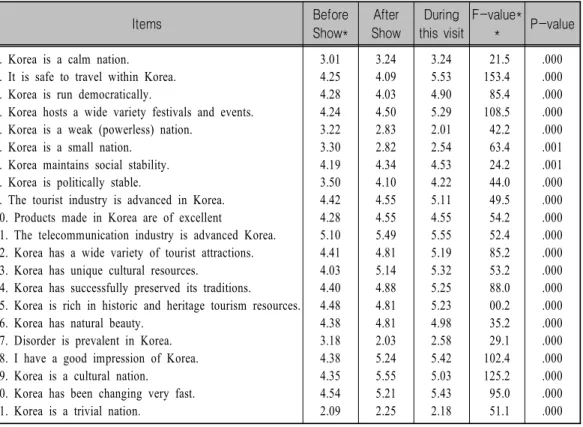
Table 4 shows the results for the General Linear Model (GLM) with repeated measures, which detected differences in the images of Korea as perceived by Japanese tourists over the three time points. Significant differences (p<.001) were found for all 21 items. Table 4 indicates that the images of Korea after the Seoul International Sports & Leisure Industry Show were consistently more positive than before the trade Show.
Furthermore, the images of Korea perceived during the tourist’s actual visit were better than those before and after the Show. There were significant differences in Japanese tourists’ images before the Show and during actual visits, indicating more positive images during their visits to South Korea.
Table 4. Images of Korea as perceived by Japanese tourists before and after the trade Show and during their actual visit (N=156)
Items Before
Show*
After Show
During this visit
F-value*
* P-value
1. Korea is a calm nation.
2. It is safe to travel within Korea.
3. Korea is run democratically.
4. Korea hosts a wide variety festivals and events.
5. Korea is a weak (powerless) nation.
6. Korea is a small nation.
7. Korea maintains social stability.
8. Korea is politically stable.
9. The tourist industry is advanced in Korea.
10. Products made in Korea are of excellent
11. The telecommunication industry is advanced Korea.
12. Korea has a wide variety of tourist attractions.
13. Korea has unique cultural resources.
14. Korea has successfully preserved its traditions.
15. Korea is rich in historic and heritage tourism resources.
16. Korea has natural beauty.
17. Disorder is prevalent in Korea.
18. I have a good impression of Korea.
19. Korea is a cultural nation.
20. Korea has been changing very fast.
21. Korea is a trivial nation.
3.01 4.25 4.28 4.24 3.22 3.30 4.19 3.50 4.42 4.28 5.10 4.41 4.03 4.40 4.48 4.38 3.18 4.38 4.35 4.54 2.09
3.24 4.09 4.03 4.50 2.83 2.82 4.34 4.10 4.55 4.55 5.49 4.81 5.14 4.88 4.81 4.81 2.03 5.24 5.55 5.21 2.25
3.24 5.53 4.90 5.29 2.01 2.54 4.53 4.22 5.11 4.55 5.55 5.19 5.32 5.25 5.23 4.98 2.58 5.42 5.03 5.43 2.18
21.5 153.4 85.4 108.5 42.2 63.4 24.2 44.0 49.5 54.2 52.4 85.2 53.2 88.0 00.2 35.2 29.1 102.4 125.2 95.0 51.1
.000 .000 .000 .000 .000 .001 .001 .000 .000 .000 .000 .000 .000 .000 .000 .000 .000 .000 .000 .000 .000
Note: * 2005 Seoul International Sports & Leisure Industry Show
** Within-subject one-way ANOVA
For the Japanese, several examples of image changes over the three points in time are worthy of mention. For example, the Japanese respondents had a higher level of agreement on the item, "It is safe to travel within Korea," after the Show than before the trade Show, and showed the highest level of agreement during their
actual visits. For the item, "Korea hosts a wide variety of festivals and trade Shows," Japanese tourists had the highest mean score during their actual visits, compared to before and after the Show. They reported the highest mean score on the item, "Korea is a cultural nation" during their visits to Korea, when compared to before and after the Show. Detailed information on the images of South Korea among the Japanese tourists is reported in Table 4.
All three groups had higher levels of disagreement with the statement that Korea was "a calm nation" on their actual visits and after the Seoul International Sports & Leisure Industry Show. Here, the meaning of "calm" that was given to the respondents was negative, implying a static and somewhat slow moving, backward country. The respondents also had significantly higher levels of agreement with the two statements about Korea being a
"cultural" and "fast changing" nation. The Korean government has promoted Korea as the "Land of the Morning Calm" for about 50 years. Changing this national slogan to "Culture Korea" or "Dynamic Korea" or a similar theme, as suggested recently in social and academic circles, seems justified by these results.
. Implications and Conclusions
Ⅴ
The objective of this study was to empirically examine the images of South Korea as perceived over three points in time by American, Chinese, and Japanese tourists. Significant differences were found for all 21 items relating to the image of Korea for the three national tourist groups. The visitors from all three countries had more positive images after the Seoul International Sports & Leisure Industry Show than before it. This seems to suggest that the 2005 Seoul International Sports & Leisure Industry Show contributed to an improvement in the image of South Korea as a tourism destination.
The images of the three groups during their visits were consistently the most positive for the items related to the variety and uniqueness of Korea’s tourism resources. Additionally, the perceptions of Korea’s tourism resources were more positive after the Show than before it. While other factors may be involved, it appears that the 2005 Seoul International Sports & Leisure Industry Show effectively contributed to enhancing the image of Korea as an attractive tourism destination.
In addition, the three groups had higher levels of disagreement with the negative statements about South Korea during their actual visits, and after compared to before the Show. Stated in another way, the respondents had the highest level of agreement with the negative statements before the Seoul International Sports & Leisure Industry Show; including being a small, nation, a trivial nation, and a weak country.
The Show seemed to have a significant positive effect in enhancing the image of South Korea. The results
are consistent with those of previous studies that have found that the actual image formed during or after a real visit is different from the pre-trip organic or induced (Andreu, Bigne & Cooper, 2000; Crompton, 1979; Hu &
Ritchie, 1993; Pearce, 1982; Phelps, 1986; Ross, 1993). In contrast, this study’s results contradict some previous studies, which have argued that the overall image of a tourism destination does not fluctuate much over time, even though components of image may be changeable (Crompton, 1979; Crompton & Lamb, 1986; Gartner &
Hunter, 1986).
This study suggests that an internationally significant trade Show can change the image of a tourism destination in a short time period. Moreover, the results indicate the 2005 Seoul International Sports & Leisure Industry Show may have caused temporal changes in the overall national image of South Korea. However, there is a need to investigate whether or not these image modifications are stable or will return to their previous levels over a longer time period. This study suggests that tourism destination images can be enhanced positively through international trade Shows and actual visits. Future research is needed to understand whether image changes occur due to negative trade Shows such as wars, terrorism and other conflicts, health problems, and worsening economic conditions.
References
Ahn, J. Y., Var, T. and Kim, Y. K., "An investigation of Olympic tourists’ perception of Korea," Journal of Tourism Sciences, Vol. 13 : 109-122, 1989.
Allen, J., O’Toole, W., McDonnell, I. and Harris, R., Festival and special event management. 2nd edition. John Wiley & Sons Australia, Ltd. 2002.
Andreu, L., Bigne, J. E., and Cooper, C., "Projected and perceived image of Spain as a tourist destination for British travellers," Journal of Travel and Tourism Marketing, Vol. 9, No. 4 : 47-67, 2000.
Botha, C., Crompton, J. L. and Kim, S., "Developing a revised competitive position for Sun/Lost City, South Africa," Journal of Travel Research, Vol. 37, May : 341-352, 1999.
Bramwell, B., "Strategic planning before and after a mega-event," Tourism Management, Vol. 18, No. 3 : 167-176, 1997.
Chaudhary, M., "India’s image as a tourist destination: A perspective of foreign tourists," Tourism Management, Vol. 21 : 293-297, 2000.
Chen, P. and Hsu, C. H., "Measurement of Korean tourists’perceived images of overseas destinations," Journal of Travel Research, Vol. 38 : 411-416, 2001.
Chon, K., "Tourism destination image: Marketing implications," Tourism Management, Vol. 12, No. 1 : 68-72, 1991.
Crompton, J. L., "An assessment of the image of Mexico as a vacation destination and the influence of geographical location upon that image," Journal of Travel Research, Vol. 17, Spring : 18-23, 1979.
Crompton, J. L., Fakeye, P. C. and Lue, C. C., "Positioning: The example of the Lower Rio Grande Valley in the winter long stay destination market," Journal of Travel Research, Vol. 31, No 2 : 20-26, 1992.
Crompton, J. L. and Lamb, C., Marketing government and social services. New York: John Wiley, 1986.
Fakeye, P. C. and Crompton, J. L., "Image differences between prospective, first time, and repeat visitors to the Lower Rio Grande Valley," Journal of Travel Research, Vol. 30, No. 2 : 10-16, 1991.
Gamage, A. and Higgs, B., "Economics of venue selection for special sporting events: With special reference to the 1996 Melbourne Grand Prix," Journal of Tourism Research, Vol. 1, No 2 : 15-26, 1996.
Gartner, W. C., "Temporal influences on image change," Annals of Tourism Research, Vol. 13 : 635-644, 1986.
Gartner, W. C. and Hunt, J. D., "An analysis of state image change over a twelve-year period (1971-1983),"
Journal of Travel Research, Vol. 26, Fall : 15-19, 1987.
Gartner, W. C. and Shen, J., "The impact of Tiananmen Square on China’s tourism image," Journal of Travel Research, Vol. 31 : 47-52, 1992.
Getz, D., Event Management and Event Tourism. New York: Cognizant Communication Corporation, 1997.
Goodrich, J. N., "A new approach to image analysis through multidimensional scaling," Journal of Travel Research, Vol. 16, No. 3 : 3-7, 1978.
Gunn, C. A., Vacation scape: Designing tourist regions. Austin, Texas: University of Texas Press, 1972.
Hall, C. M., "The effects of hallmark events on cities," Journal of Travel Research, Vol. 26, No. 2 : 44-51, 1987.
Hu, Y. and Ritchie, J. R., "Measuring destination attractiveness: A contextual approach," Journal of Travel Research, Vol. 32, No. 2 : 25-34, 1993.
Kim, S. S., Crompton, J. L. and Botha, C., "Responding to competition: A strategy for Sun/Lost City, South Africa," Tourism Management, Vol. 21 : 33-41, 2000.
Kim, Y. S., "A study on comparison of national image," Journal of Tourism Politics, Vol. 5, No. 2 : 87-104, 1999.
Korea National Tourism Organization, A report of monthly statistics of tourism. Korea National Tourism Organization: Seoul, 2005.
Kotler, N., Haider, J. and Miller, L., Marketing places: Attracting investment, industry, and tourism to cities, states, and nations. New York, NY: The Free Press, 1993.
Lee, T., "Development of image construct to measure Korean tourism destination," Journal of Tourism Sciences,
Vol. 20, No. 2 : 80-95, 1997.
Mihalik, B. J. and Simonetta, L., "Midterm assessment of the host population's perceptions of the 1996 Summer Olympics: Support, attendance, benefits, and liabilities," Journal of Travel Research, Vol. 37, No. 3 : 244-248, 1999.
Pearce, P. L., "Perceived changes in holiday destinations," Annals of Tourism Research, Vol. 9 : 145-164, 1982.
Perry, M., Izraeli, D. and Perry, A., "Image change as a result of advertising," Journal of Advertising, Vol. 16, No. 1 : 45-50, 1976.
Phelps, A., "Holiday destination image: The problem of assessment," Tourism Management, Vol. 7, September : 168-180, 1986.
Ross, G. F., "Destination evaluation and vacation preferences," Annals of Tourism Research, Vol. 20 : 477-489, 1993.
Schreyer, R. and Beaulieu, J. T., "Attribute preferences for wild land recreation settings," Journal of Leisure Research, Vol. 18, No. 4 : 231-247, 1986.
Tabachnick, B. G. and Fidell, L. S., Using multi variate statistics. 3rd edition. New York : Harper Collins College Publishers, 1996.