Introduction
In nature, plants experience abiotic stresses when exposed to various environmental factors such as light, water and temperature deviated from appropriate ranges. Soil and wa- ter salinity are raising problems facing rice production [13,26]. Also, rice is not adapted to low temperature and is damaged by temperatures below 15
oC [16]. Many crop spe- cies including rice are sensitive to chilling [2,17,25,29]. to chilling undergo much severe damages when exposed to low temperature in combination with irradiation [19,20].
Photoinhibition occurs as an initial response to primary damage by low temperature [4,14]. Photosynthetic damage and disturbances are basically caused by ROS formation and its visual symptoms can be detected by necrotic lesions on the surface of leaf [1,5]. However, in spite of no visual symp- toms with short-term exposure to chilling, injury can be manifested gradually when plants return to normal growth temperature. Therefore, it is helpful in rapid screening stress tolerance of rice [17]. One of the main causes of chilling in- jury is ROS generation during light-chilling including photo-
oxidation [28]. In general, plants facing to ROS generation have very intensive antioxidant scavenging systems. For ex- ample, low-molecular weight antioxidants such as ascorbate and glutathione act directly against oxygen free radicals to scavenge their toxicity with the help of antioxidant enzymes such as SOD, CAT and peroxidase (POX). The initial ROS scavenging enzyme is SOD. Higher plants have three types of SOD which convert O
2-into H
2O
2and O
2[32]. As H
2O
2generated from SOD reaction is harmful, CAT or POX detox- ify it into H
2O and O
2. APX, more important than other ROS scavengers is an essential component of ascorbate-gluta- thione pathway removing ROS generated through photosynthesis. Similar pathway also exists in the cytosol of leaf cells [3]. Guo et al. [15] have reported that APX activ- ity increased in both drought- and chilling- tolerant rice cultivars. Ascorbate-glutathione pathway includes APX which uses ascorbate as a substrate with GR. Increase in GR activity during salt stress was observed in rice and during cold stress in pea [10,22]. Additionally, it was reported re- peatedlythat GR is important in oxidative stress [31].
Functional interaction of the enzymes is important to effec- tively scavenge ROS. Studies on chilling have been widely conducted for chilling-sensitive varieties as well as chill- ing-tolerant varieties in relation to production of grain crops including rice [12,17,27,30]. In the present work, we inves-
Photochemical Damage and Responses of Antioxidant Enzymes in Rice Leaves Induced to Light-Chilling
Jeung Suk Koo, Yeon Sik Choo
1and Chin Bum Lee*
Department of Molecular Biology, Dong-eui University, Busan 614-714, Korea
1
Department of Biology, Kyungpook National University, Daegu 702-701, Korea Received February 6, 2009 /Accepted February 12, 2009
W e investigated photooxidation and responses of antioxidant enzymes involved in scavenging reactive oxygen species (ROS) after light-chilling (4
oC) for 2 days and post chilling (25
oC) in rice leaves.
Chilling leaves indicated a 50% reduction in photosynthetic efficiency (F
v/F
mratio) and a 48% increase of H
2O
2, respectively, compared to the control group. In comparison with the control, activities of su- peroxide dismutase (SOD) and glutathione reductase (GR) increased at light-chilling and post-chilling.
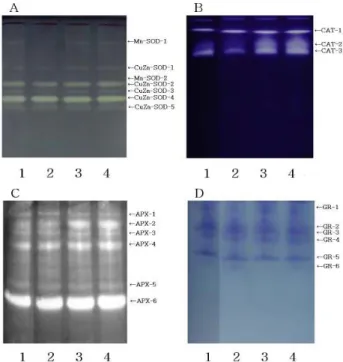
CuZn-SOD and Mn-SOD among SOD forms were detected in rice leaves, while Fe-SOD was not found. The increase of SOD and GR activity may serve as a basis for defense against chilling injury as it dismutase superoxide generated by light-chilling. Catalase (CAT) activity decreased during light-chilling, while activity of APX showed remarkable increase during light-chilling in rice leaves.
Among CAT isoforms analyzed by 10% native PAGE, activities of isoform -2 and -3 were inhibited during light-chilling. From the elevated APX activity and decreased CAT activity, we suggest that these two enzymes show mutual supplementary relationships, indicating different tendency during light-chilling.
Key w ords : Chilling, H
2O
2, F
v/F
m, rice, RO S scavenging enzym es
*Corresponding author
*Tel +82-51-890-1525, Fax +82-51-890-1521
: :
*E-mail : [email protected]