세그먼트 그룹화
이종득*
Object Segment Grouping for Wireless Mobile Streaming Media Services
Chongdeuk Lee *
요 약 최근에 무선 모바일 네트워크상에서 모바일 클라이언트 요청증가로 인하여 스트리밍 미디어 객체를 관리하
고 서비스하기 위한 새로운 기법이 제안되고 있다
.
본 논문에서는 무선 모바일 네트워크상에서 스트리밍 미디어 서비 스의 성능을 향상시키기 위한 새로운 객체 세그먼트 그룹화 방법을 제안한다.
제안된 기법은 분할된 객체 세그먼트들 에 대해서 유사성 척도를 수행하며,
유사성 척도를 위해disjunction, conjunction,
그리고filtering
연산을 수행한다.
이 들 연산 척도에 따라 분할된 세그먼트들의 그룹화가 결정되며,
스트리밍 미디어 서비스 성능이 결정된다.
시뮬레이션 결과 제안된 기법은 처리율,
평균 시작지연,
그리고 캐시 히트율의 성능이 우수함을 보였다.
주제어 : 모바일 클라이언트
,
스트리밍,
객체 세그먼트,
그룹화,
유사성Abstract Increment of mobile client's information request in wireless mobile networks requires a new method to manage and serve the streaming media object. This paper proposes a new object segment grouping method for enhancing the performance of streaming media services in wireless mobile networks. The proposed method performs the similarity metric for the partitioned object segments, and it process the disjunction, conjunction, and filtering for these metrics. This paper was to decided the partitioned group of object segments for these operation metrics, and it decided the performance of streaming media services. The simulation result showed that the proposed method has better performance in throughput, average startup latency, and cache hit ratio.
Key Words : Mobile Client, Streaming, Object Segment, Grouping, Similarity
*전북대학교 전자공학부 교수
논문접수 : 2012년 4월 25일, 1차 수정을 거쳐, 심사완료 : 2012년 5월 9일
1. Introduction
In the wireless mobile network environment, the streaming media service is performed by connecting various mobile devices through the base station. In a wireless mobile network, mobile devices access the wireless network throughput base stations, which are inter-connected by access routers to perform WLANs.
For the streaming media service in this environment, managing huge amounts of multimedia data is an important issue [1][2][3]. The reason is because the
above environment can utilize efficiently the limited resources and channel bandwidth of wireless networks.
Above all, managing and caching popular media object
segments at locations close the mobile clients is an
effective strategy to improve the quality of streaming
media services. Especially, managing streaming media
objects at the proxy cache is an attractive approach to
reduce network traffic and improve quality of
streaming media services, due to the high network
bandwidth demand and continuous playback constraints
of streaming media applications. To realize this,
segment-based proxy caching methods have been proposed, and this cache partial segments of media objects instead of entire media objects [5][7][9].
However, typical segment-based proxy mechanism makes streaming media services difficulty due to the large sizes and low-latency and continuous streaming demands of media objects. To solve this problem, segment-based caching methods have been proposed and the existing segment-based methods can be divided into the following two type according to the performance metric. The first type is to reduce startup latency by always giving a higher priority to caching the beginning segments of media objects. The second type is to reduce network traffic and jitter delay due to retransmission workload by improving cache hit ratio.
Most proxy caching methods for streaming media services cache only a small portion of the media object in the proxy cache, and let the media server stream the remaining portions to the clients. The startup delay occurs when the request of clients can not be matched in the proxy cache. To solve this problem, the prefix method have been proposed and media objects in this method are divided into several segments, which are segments used by the proxy cache management [3][7].
For larger media objects, however, if segments do not arrange according to size, the delay due to cache replacement will be increased. Thus prefix proxy caching method are not efficient for streaming media services. To address the problems, Wu et al. [7]
proposed a segmentation proxy caching method, in which the media object is partitioned into variable-length segments. The sizes of the segments vary based on their distances from the start of the media object. Segment 0 has a size of 1. In this method, cache replacement is based on the caching value a segment, which is a combination of a segment's distance from the start of its object and the reference frequency of the object. However, this method has the drawback of victimizing and caching more than necessary media objects. Therefore, this paper proposes an object segment grouping method for improving the
performance of streaming media service in the wireless mobile network. The proposed method decides the grouping of media object segments by using fuzzy similarity, namely,
-cut. Our method arranges the object segments according to fuzzy value
, and streams the object segments according to fitness metric. The proposed method not only gives an effective solution to address startup latency problem, but also improves the cache hit ratio and reduces the congestion due to retransmission. The paper is organized as follows. Some related work is introduced in section 2. In section 3, we propose object segment grouping for streaming media services. Some simulation results are given and discussed in section 4.
Finally, the conclusions are drawn.
2. Related works
There has been research work on various aspects of multimedia caching and proxy services.
Generally, users in an excellent network service environment may enjoy a high quality transmission service while users with poor a network service environment may not. Thus, most proxy structures perform services with the bit rate unequal to the bandwidth for streaming media clip objects. Typical media proxy mechanisms neither consider streaming by partitioning segment versions of media objects nor perform services by integrating various versions of media objects [11][12]. Chang and Chen [1] proposed a mechanism that partitions different versions of objects during caching. This mechanism is efficient for segmenting web objects. For media objects, however, this mechanism has restrictions due to the large size.
Miao and Ortega [13] proposed a selective caching
mechanism to improve playback quality. This is an
intermediate frame selection mechanism that caches
frames according to the transmission rate. This
mechanism, however, has the problem that it cannot
cache frames directly after the initial segment. Wu et
al. proposed a dynamic control video buffer mechanism and transmission scheduling mechanism for flexible playback. Generally in terms of video referencing, frames are classified as high usage frames and low usage ones. This kind of mechanism appears mainly in Internet videos, such as live news.
Previous segment-based caching strategies cache segments with constant or exponentially increasing lengths, and they typically favor caching the beginning segments of the media objects [6][8][10]. Chen et al. [1]
proposed a segment-based buffer management approach for caching large media streams. Blocks of a media stream received by a proxy server are grouped into variable-sized segments. The segment-based caching mechanism is very effective when the cache size is limited, when the media object size is constant, and when streaming requests are restricted. In contrast, this mechanism has the drawbacks in that it needs to know in advance the size of media objects, the caching capacity, and the sequence of media object streaming before the cache is accessed.
3. The proposed object segment grouping mechanism
3.1 Similarity
Similarity analysis is to specify relationship occurring in object segments. This paper reflects the Fuzzy Similarity (FS) of each media object segment to transcode relationship occurring in grouping and to provide differentiated services. Fuzzy similarity is defined by membership function
,where
is a number in [0, 1]. Each member in FS has a membership value defined by
[8].
(S) is the fuzzy set generated from the existing item set S. Each item of crisp set S has the membership value in [0, 1]. In this section, we describe the fuzzy similarity and fuzzy relation, which is used to derive the fuzzy similarity.
Definition 1 Fuzzy Relation: A fuzzy set A on the domain G×M, where G and M are two crisp sets in a fuzzy relation on G, M. Fuzzy set A on domain U is defined by a membership function
from U to [0,1], i.e., each item in A has a membership value given by
. We denote
(S) as a fuzzy set generated from a traditional set of items S. Each item in S has a membership value in [0,1].
Definition 2 Intersection of Fuzzy Sets: The Fuzzy Intersection of A and B is A∩B, and
∩
=Min {
,
}.
Definition 3 Union of Fuzzy sets: The Fuzzy Union of A and B is A∪B, and
∪
=Max{
,
}.
Definition 4 Max-Min Composition of fuzzy sets:
Let P(X, Y) be the fuzzy relation of X and Y, and P(Y, Z) be the fuzzy relation of Y and Z.
Then, the Max-Min combination for P(X, Y) and Q(Y, Z) is
∙
=
∈
∈
{
}.
where the Max-Min combination represents the relationship between sets X and Z.
After fuzzy similarity analysis is completed, the grouping process is performed to specify relationship in more detail.
3.2 Relationship decision
In the process of segment acquisition of media
objects, if there is a relationship satisfying the
properties of media objects, the media objects is
grouped, if not, the media objects isn't. Generally, the
inclusion relation for grouping is determined in the
process of the media partition of objects, and then it is
important to search most general media object among
media object blocks. Here, most general media object
determines which media objects is grouped and is
operated in a connection with other media objects.
Table 1 is the parameters to decide an object relationship.
<Table 1> The parameters for the relationship decision
Parameters meaning
P(S) The partitioned media object segments R(S) Object segments performed the relationship.
SR(S) Object segments assigned the similarity G(S) Object segments for the grouping decision F(S) Object segments satisfied the fuzzy filtering NF(S) Object segments don't satisfy the fuzzy
filtering
Here, the relationship decision of the partitioned object segments is represented as a SR(S) = {F(S)-NF(N)}.
This paper decides the similarity by using
-cut, and it plays a role in filtering less referring segments in order as to determine relationship of object segments, the following:
Definition 5
-cut={ c | SR(S)≥0.6-cut}
Here, SR(S)≥0.6-cut is to decide the object segments assigned the similarity.
Thus, SR(S)≥0.6-cut must be satisfied a following conditions.
(1) Reflexive relation:
≈(os
i, os
j)=1 (2) Symmetric relation:
≈(os
i, os
j)=(os
j, os
i) (3) Transitive relation:
(os
i, os
k)≥min{
-cut
≈(os
i, os
k),
≈(os
j, os
k)}
Transitive relation is decided to similarity by
-cut, and
is membership function and fuzzy value between 0 and 1.
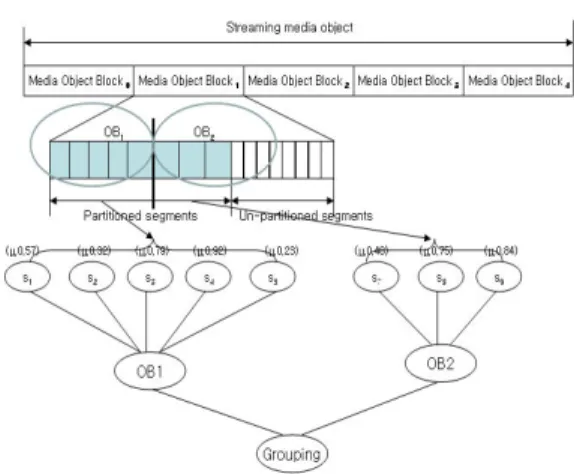
is a membership which decide a relationship of SR(S) and Fig.1 depict a hierarchy based on by
-cut.
[Figure 1] A hierarchy based on by -cut
As shown in figure 1, the grouping mechanism performs the similarity analysis to identify segments between partitioned segments and unpartitioned segments in media object blocks.
Here, a segment identification between the partitioned segment and unpartitioned segment in media object blocks is depicted as a SR(S)=
{F(S)-NF(S)}.
Therefore, when
-cut is applied in figure 1, segments satisfying the grouping mechanism is selected.
3.3 Grouping decision
Grouping decision process is to drop the objects with low referring similarity in the grouping system.
The unbalance between the encoding rate and decoding
rate in mobile streaming media services is caused if
less relevant objects are referred repeatedly the proxy
cache structure. Then, cache underflow occurs if the
objects are partitioned into too small segments and
cache overflow occurs for too big segments. This
problem induces the overhead of startup latency,
congestion, and throughput decrease. This paper solves
this problem by applying the object segment grouping
mechanism. The object segment grouping mechanism
is to control the streaming media service that is
restricted by similarity, namely,
-cut. The proposed
grouping mechanism are restricted by cache capacity,
size of objects, and similarity.
For restrictions C and
∈, the proposed grouping process is carried through grouping by disjunction(∪), grouping by conjunction(∩), and grouping by filtering.
3.3.1 Grouping by disjunction
The Disjunction (∪) mapping groups object segments with Min-Max relation considering the cache capacity and the size of objects.
and
denote the
replacement mapping that considers the cache capacity and the size of objects, respectively. Thus, disjunction (∪) mapping is defined as the following.
Definition 6
∪ :
∀′∈c is c∪c'.C is cache capacity, and s is the size of object segments.
3.3.2 Grouping by conjunction
The grouping by conjunction(∩) considers the capacity of the cache, the size of objects, and similarity, and it is used to group the object segments with Min-Max relationship.
,
, and
represent conjunction grouping considering the capacity of the cache, size of objects, and similarity, respectively. Thus, the grouping by conjunction is defined as follows.
Definition 7
∩∩
: c∩c'∈C, ∀c,c'∈C where ∀c,c'∈C and
∅is null.
3.3.3 Grouping by filtering
The grouping by filteringis used to control object segments that do not satisfy similarity.
The grouping by filtering, which is performed by similarity and relationship, is denoted by
for
∈and is defined as follows.
Definition 8
={
(o)
Min{
≤
(Bi) and
(Sj)≥0.6-cut}
As shown in figure 1, if
∪ is performed for each media object block OB
1and OB
2, then such objects as OB
1={s
1,so
4}, OB
2={s
8, s
9} selects as object segments for grouping, and such objects as OB
1={s
1, s
2, s
5} and OB2={s
7} are filtered out. These objects are filtered out since they are segmented into too small sizes or too large sizes.
4. Simulation results
In the simulation, the total number of media objects is set to N, and 3 VoD sources are used as standard video sequences. VoD sources have media object frames of 1,500, 1,500, and 1,500 in 3 news video, respectively. To simplify the simulation, the media object version is assumed to have Pareto distribution and is limited to 5Mbyte in size. The other parameters are as follows: maximum bit rate is 1.5Mbps, packet size is 512kb, link bandwidth is 10/100Mbps, and the average link bandwidth is 1.2Mbps. The simulation continued for 560s with
≥0.7 and the time stamp of stream
in [1, 20s]. The mobile client is assumed to be connected to the IP backbone network using a wireless IP. We evaluated the performance of the proposed scheme by using the simulation parameters shown in the Table 2.
[Table 2] Simulation parameters
Parameters value
Total number of media objects 4,500 The partitioned segment number 5 Media object block size 25Mbyte
Segment size 5Mbyte
Total simulation time 560s Request time interval 2s
Time stamp [1, 20s]
Maximum cache full 90%
Similarity 0< ≤1
Link bandwidth 10/100Mbps Average link bandwidth 1.2Mbps Maximum bit rate 1.5Mbps
We evaluated the performance with changing the
similarity, the size of media objects, and the cache full
state. Major metrics used in the simulation are throughput, average startup latency, and average cache hit ratio. The proposed method is compared and analyzed with the other existing methods of segment-based method and prefix-based method.
Table 3 shows the result of this performance.
[Table 3] The result of performance
performance segment prefix grouping startup latency 0.41 0.31 0.04 cache hit ratio 0.81 0.86 0.9
In the first simulation, we analyzed the performance of the average startup latency and average cache hit ratio with varying fuzzy similarity. Fig. 2 shows the performance of average startup latency when similarity is 0.2, 0.4, 0.6, and 0.8, respectively.
Fig. 2 Average startup latency with fuzzy similarity
As shown in Fig. 2, the average startup latency showed the best performance when similarity is 0.8.
Fig. 3 Average cache hit ratio with fuzzy similarity
Fig. 3 shows the performance of the average cache hit ratio when similarity is 0.2, 0.4, 0.6, and 0.8, respectively. As shown in Fig. 3, the average cache hit ratio showed the best performance when similarity is 0.8. This is because the proposed method performed the grouping based on similarity for media object segments.
In the second simulation, we analyzed the performance of the average startup latency and the average cache hit ratio with increasing similarity.
Fig. 4 is the simulation result performing the media object block size from 10Mbyte to 50Mbyte.
As shown in Fig. 4, the proposed method showed average performance improvement compared with segment-based method and prefix-based method, respectively.
Fig. 4 Average startup latency according to the media object size
Fig. 5 Average cache hit ratio according to the media object size