고구마 연작장해 경감을 위한 바이러스 무병묘 재배와 심토반전 효과
송해안* ・ 김갑철** ・ 이승엽***†
*전주대학교 경제학과, **전북농업기술원 기후변화대응과, ***원광대학교 생명자원과학연구소
Effect of Virus-free Plant and Subsoiling Reversion Soil for Reduction of Injury by Continuous Cropping of Sweet Potato
Hae-Ahn Song*, Kab-Cheol Kim**, and Seung-Yeob Lee***†
1
Department of Economics, Jeonju University, Jeonju 560-759, Korea
2
Jeollabuk-do Agricultural Research and Extension Services, Iksan 570-704, Korea
3
Institute of Life Science and Natural Resources, Wonkwang University, Iksan 570-749, Korea
254
†
Corresponding author: (Phone) +82-63-850-6665 (E-mail) [email protected]
<Received 13 June, 2012; Revised 11 July, 2012; Accepted 18 July, 2012>
ABSTRACT To reduce the injury by continuous cropping
of sweet potato (Ipomoea batatas (L.) Lam.), the farmer’s plant and virus-free plant were cultivated with the density of 70×25 cm (June 10, 2011) in continuous cropping soil (CCS) and subsoiling reversion soil (SRS). Fertilizer was applied at the rates of 55-63-156 kg ha-1 (N-P2O5-K2O) and 10 ton ha-1 of cattle manure in CCS, and it was applied the 50% increased cattle manure compost and nitrogen in DRS. Symptoms of viral infection were revealed in the farmer’s plant at 30 days after planting, but there were no symptoms in virus-free plant.The yield of virus-free plant was more increased 15% and 10.5% than that of farmer’s plant in DRS and CCS, respectively. The yield of sweetpotato in SRS was more increased 8.8% and 3.2% in farmer’s plant and virus-free plant compared to CCS, respectively. In DRS, the rate of marketable tuber of virus-free plant was increased by 80% compared to the farmer’s plant (60.1%). The virus-free plant was produced the tuber with more brilliant peel color and well-formed shape compared to the farmer’s plant. The increased yield of virus-free plant and in SRS soil condition showed a positive relationship (p=0.05) with the number of leaf per plant at 30 days and the number of branch per plant at 120 days after planting. The results showed that the early growth after planting was very important for the development of storage root.
Therefore, the deep-subsoil reversion and cultivation of virus-free plant could be reduced the injury by continuous cropping of sweet potato, and increased farm income.
Keywords : Ipomoea batatas, marketable tuber, quality, vine
growth, yield고구마(Ipomoea batatas (L.) Lam.)는 중앙아메리카 원산 으로 식용, 주정 및 다양한 가공식품과 바이오에탄올 생산 에 이용되는 중요한 전분작물이다. 고구마는 안토시아닌, 토코페롤 및 베타카로틴 등과 같은 항산화 물질이 풍부하 고, 다량의 식이섬유가 들어있어 항암작용, 노화방지 및 비 만억제 등에 좋은 건강 기능성 식품으로 알려져 있다(Teow
et al., 2007). 이에 따라 고구마는 최근 소비증가와 함께 지
속적인 가격상승으로 농가수익에도 크게 기여하고 있으나, 기존 주산지에서는 연작으로 인한 수량감소 및 품질저하가 크게 나타나고 있다.영양번식 작물인 고구마는 바이러스에 감염되면 수량감소 와 표피의 터짐이나 얼룩무늬와 같은 품질저하가 나타나며, 연작지에서는 덩굴쪼김병, 선충 등과 함께 연작장해의 한 원 인이 된다(Jun et al., 2002; Karyeija et al., 1998). 고구마에 발생하는 바이러스는 전 세계적으로 20여종이 동정되었는데 (Loebenstein et al., 2003), sweet potato feathery mottle virus(SPFMV)와 sweet potato chlorotic stunt virus (SPCSV), Sweet Potato Mild Mottle Virus(SPMMV) 등이 가장 널리 분포되어 있다(Tairo et al., 2005). 국내 주요 고구마 주산지 역의 바이러스 포장 발병율은 100%에 달하며, SPFMV가 43%로 가장 높은 감염을 보였고, sweet potato G virus (SPGV)를 비롯한 미동정 바이러스에도 감염된 것으로 나타 났다(Chung, 2008). 대부분의 바이러스는 단독감염에서는 증상이 거의 없거나 약간의 증상만 나타날 뿐 수량감소는 나 타나지 않지만(Untiveros et al., 2007), sweet potato leaf curl virus(SPLCV)나 SPCSV의 단독 감염에서는 수량감소가 크
Table 1. Chemical properties of the soil before experiment by deep-subsoil reversion.
Cultivation
soil pH
Organic matter (g kg
-1)
Av. P
2O
5(mg kg
-1)
Ex. cation(cmol
+kg
-1)
Electrical Conductivity(dS m-1)
K Mg Ca
Control soil
x5.3 12.3 203 0.30 2.11 4.65 0.24
Deep-subsoil
reversion
y4.9 11.0 119 0.16 1.35 2.57 0.18
x
Continuous cropping soil over 5 years.
y
Reversion of deep-subsoil over 70cm.
게 나타나며(Clark and Valverde, 2000; Gutierrez et al., 2003; Ling et al., 2010), 2종 이상의 복합감염에 의한 수량 감소 및 품질저하는 고구마 주산지역을 중심으로 심각한 경 제적 손실을 끼치고 있다(Gutierrez et al., 2003; Untiveros et
al., 2007). 이러한 바이러스 감염 피해를 경감시키기 위해서
는 저항성 품종이나 바이러스 무병묘의 재배가 바람직하다.최근 국내에서도 고구마 연작장해 경감대책의 일환으로 익산, 해남 등의 주산지를 중심으로 바이러스 무병묘 보급 이 농업기술센터를 중심으로 활발하게 이루어지고 있다. 심 토반전은 연작장해 경감대책의 한 방법으로 이용되는데 (Jun et al., 2002), 고구마 연작지에서도 심토반전 후 3-4년 간 수량증가와 품질향상이 뚜렷하다고 하여 전업농들을 중 심으로 연작토양을 심토반전하여 재배하고 있다. 그러나 아 직까지 고구마 연작지에서 심토반전 효과에 대한 학술적 연 구는 거의 없는 실정이다.
본 연구는 고구마 연작장해 경감대책의 일환으로 바이러 스 무병묘 재배 및 심토반전 효과를 구명하기 위하여, 연작 지 토양과 심토반전 토양에서 농가묘와 무병묘를 재배하여 생육, 수량 및 품질특성 등을 조사하였다.
재료 및 방법
공시품종 및 시험구 준비
심토반전과 바이러스 무병묘 재배를 통한 고구마의 연작 장해 경감효과를 구명하기 위하여, 맛나미, 신자미, 안노베 니 3품종의 농가묘와 바이러스 무병묘를 공시하였다. 씨고 구마 준비는 맛나미, 신자미, 안노베니 3품종을 5년 이상 자 가채종한 농가에서 구입하여 사용하였다(이후 농가묘). 시 험구 준비는 5년간 단작으로 고구마를 재배한 전북 익산시 삼기면 소재 연작토양을 선정하였고, 이 중 330 m2 면적의 표토를 약 70 cm 깊이로 걷어낸 후, 심토를 뒤집어 심토반 전 시험구로 사용하였다(Table 1). 시비량은 정식 30일전에 우분퇴비 10 ton ha-1을 살포하고 경운한 다음, N-P2O5-K2O
= 55-63-156 kg ha-1을 전층시비하였고, 심토반전 토양은
질소비료와 퇴비를 50% 증시하였다.
육묘 및 정식
농가묘의 육묘는 무가온 유리온실에서 3월 30일 씨고구 마를 파종하여, 30 cm 크기의 균일한 종순을 채취하여 정 식하였다. 생장점 배양으로 얻은 바이러스 무병묘를 0.2 mg L-1 BA를 첨가한 MS(Murashige and Skoog, 1962)배지에 서 마디배양으로 기내증식하였다. 5cm 크기로 자란 무병묘 는 버미큘라이트:펄라이트(1:1, v/v) 혼합토를 채운 72공 플 러그트레이에서 일본원시액으로 저면관수하여 30 cm 길이 로 자랐을 때 채취하여 정식하였다. 당일 채취한 농가묘와 무병묘를 6월 10일 70 × 25 cm 간격으로 두둑을 지어 반복 당 30개체씩 수평삽식하여, 고구마용 흑색비닐로 멀칭재배 를 하였다. 정식 후 30, 120일째의 생육과 수량 및 품질특성 을 조사하였다. 피색은 Chroma meter(Model CR 2000, Minolta camera Co., Ltd)로 L(lightness: black = 0, white = 100), a (redness to greeness:red = 100, green = -80), b(yellowness to blueness: yellow=+70, blue=-70)값을 측정하여 비교하였다.
데이터 분석
시험구 배치는 분할구배치법 3반복(30개체/반복)으로, 반 복당 10개체의 생육특성을 조사하였다. 데이터 분석은 SAS 통계프로그램(statistical analysis system, V 9.12, SAS Institute Inc.)을 이용하여, ANOVA(analysis of variance) 분석으로 각 처리평균 간의 유의성을 비교하였다.
결과 및 고찰
생육특성
정식 30일경에 무병묘에서는 바이러스 병반이 관찰되지 않았으나, 농가묘에서는 대부분의 개체에서 바이러스 병반 이 뚜렷이 나타났는데, 품종간에는 신자미보다 맛나미와 안 노베니에서 심하게 나타났다(Fig. 1). Kano and Nagata(1999) 에 의하면 바이러스 감염주는 무병주보다 주당 괴근수가 적
Fig. 1. Virus symptom between virus-free plant and farmer’s plant of sweet potato after 30 days’ cultivation. A and B, virus-free and farmer’s plant of Mannami; C and D, virus-free and farmer’s plant of Annobeny.
Table 2. Growth of sweet potato among different cultivated soil, planting source and cultivar after 30 days’ cultivation.
Cultivated soil
xPlanting
source Cultivar Vine length (cm)
Vine diameter (mm)
No. of leaves (plant
-1)
No. of branches (plant
-1)
CCS
Farmer’s cutting
Annobeny 60.6 6.53 29.4 2.4
Mannami 41.0 6.52 26.1 2.9
Shinjami 59.0 5.94 48.3 3.8
Mean 53.5 6.33 34.6 3.0
Virus-free cutting
yAnnobeny 50.2 6.73 32.0 3.4
Mannami 35.8 6.96 27.1 3.7
Shinjami 56.9 6.25 60.7 5.6
Mean 47.6 6.7 39.9 4.2
SRS
Farmer’s cutting
Annobeny 46.3 6.13 27.0 2.2
Mannami 37.2 5.90 25.9 2.5
Shinjami 50.4 5.40 34.7 2.4
Mean 44.6 5.81 29.2 2.4
Virus-free cutting
Annobeny 41.7 6.10 28.7 2.6
Mannami 36.4 6.13 26.7 2.7
Shinjami 48.2 5.73 45.0 3.7
Mean 42.1 5.99 33.5 3.0
Significance
Cultivated soil (S) Planting source (P) Cultivar (C) S × P S × C P × C S × P × C
**
*
***
ns ns ns ns
ns ns ns ns ns ns ns
**
*
***
ns
* ns ns
***
***
***
ns
**
* ns
x
CCS, continuous cropping soil over 5 years; SRS, subsoiling reversion soil over 70 cm.
y
Virus-free plant produced by single-node propagation in T
0generation
ns, *, **, *** Nonsignificant or significant at p=0.05, 0.01, or 0.001, respectively.
고 큰 괴근이 생산되며, 무병주에서 괴근 형성수가 증가하 여 주당 괴근수 및 수량이 증가한다고 하였다. 본 연구에서 정식 30일째에 농가묘에서 바이러스 병징이 뚜렷이 나타나 는 것으로 보아 생육초기부터 괴근 형성에 바이러스 감염이 영향을 미칠 수 있다는 것을 알 수 있었다. 정식 후 30일째 에 심토반전 토양과 연작 토양에서 바이러스 무병묘와 농가 묘의 지상부 생육특성을 비교한 결과, 줄기두께를 제외한 줄기길이, 엽수, 분지수 등은 심토반전과 연작토양, 무병묘 와 농가묘, 그리고 품종 간에 유의한 차이가 인정되었다 (Table 2). 줄기신장은 연작토양보다 심토반전 토양에서 짧 았는데, 이는 심토반전 토양의 기본 시비량이 질소 및 우분 퇴비 50% 증비만으로는 부족하였기 때문으로 보였으며, 향 후 심토반전 1년차 토양에는 100%, 2년차 토양은 50% 정 도의 증비가 적합할 것으로 판단되었으며, 향후 심토반전 토양의 시비량에 대한 후속연구도 필요하다고 본다. 또한 심토반전 토양에서 무병묘의 줄기생육은 농가묘의 평균 94%에 달하여 비교적 초기생육도 양호한 것으로 나타났다.
Table 3. Growth of sweet potato among different cultivated soil, planting source and cultivar after 120 days’ cultivation.
Cultivated soil
xPlanting
source Cultivar Vine length (cm)
Vine diameter (mm)
No. of branches (plant
-1)
Fresh wt. of vine (g plant
-1)
CCS
Farmer’s cutting
Annobeny 154 40.6 4.6 524
Mannami 132 36.2 5.7 532
Shinjami 125 33.7 6.6 448
Mean 137 36.8 5.6 501
Virus-free cutting
yAnnobeny 137 37.0 6.3 601
Mannami 123 32.2 6.4 581
Shinjami 118 30.3 8.0 504
Mean 126 33.2 6.9 562
SRS
Farmer’s cutting
Annobeny 143 38.5 4.7 507
Mannami 124 34.6 5.3 503
Shinjami 122 31.4 6.7 429
Mean 130 34.8 5.6 479
Virus-free cutting
Annobeny 133 35.3 6.1 544
Mannami 117 33.3 6.3 523
Shinjami 112 32.7 10.8 468
Mean 121 33.8 7.7 512
Significance
Cultivated soil (S) Planting source (P) Cultivar (C) S × P S × C P × C S × P × C
ns
*
***
ns ns ns ns
ns
**
***
ns ns ns ns
ns
***
***
ns ns ns ns
ns
*
***
ns ns ns ns
x
CCS, continuous cropping soil over 5 years; SRS, subsoiling reversion soil over 70 cm.
y
Virus-free plant produced by single-node propagation in T
0generation
ns, *, **, *** Nonsignificant or significant at p = 0.05, 0.01, or 0.001, respectively.
농가묘보다 무병묘에서 줄기신장이 짧았던 이유는 T0 세대 의 기내 무병묘를 순화시켜 바로 정식함으로써 씨고구마 유 래의 농가묘와 차이가 있었기 때문으로 생각되었다. 줄기두 께는 심토반전, 종순 및 품종에 따른 차이가 없었다. 분지수 는 심토반전과 연작 토양, 무병묘와 농가묘, 그리고 품종 간 에 유의한 차이가 인정되었다. 특히 무병묘의 분지수는 심 토반전 토양과 연작 토양에서 모두 농가묘보다 증가하였다.
분지수 증가는 엽수의 증가와도 관련이 있었는데, 무병묘의 엽수가 농가묘보다 증가하였으며, 품종간에도 고도의 유의 성이 인정되었다. 세 품종 중에서 신자미는 맛나미와 안노 베니보다 짧은 절간을 가지며, 곁가지 발생이 많고 작은 잎 이 많이 발생하는 품종적 특성을 보였다.
한편 정식후 120일째에 줄기길이, 줄기두께, 분지수, 생 체중은 무병묘와 농가묘, 품종 간에 유의한 차이가 인정되 었으며, 심토반전과 연작토양 간에는 유의성이 없었다 (Table 3). 신자미의 줄기신장은 112-115 cm로 맛나미와 안
노베니보다 짧은 특성을 보였다. 분지수는 무병묘와 농가 묘, 품종 간에 고도의 유의성이 인정되었으며, 무병묘에서 1.3-2.1개 많았다. 특히 생체중은 품종 간에 유의한 차이를 보였으며, 안노베니, 맛나미, 신자미 순으로 높았고, 분지수 가 많은 무병묘에서 농가묘보다 높았다. 따라서 정식 30일 째의 초기생육은 줄기길이만 심토반전 토양에서 유의한 감 소를 보였고, 분지수와 엽수는 심토반전 토양과 무병묘에서 높게 나타났다. 정식 120일째에 줄기길이, 분지수, 생체중 등은 심토반전과 연작토양 간에는 유의한 차이를 보이지 않 았으나, 무병묘의 줄기길이와 줄기두께는 농가묘보다 감소 한 반면, 분지수와 생체중은 농가묘보다 유의한 증가를 보 였다. Untiveros et al.(2007)도 고구마 바이러스 감염묘와 무병묘의 지상부 생육을 비교한 결과, 50일째의 생육은 SPCSV를 제외한 단일 바이러스 감염주에서는 무병주와 유 의한 차이를 보이지 않았으나, SPCSV+SPMMV 이중감염 에서 60.6%의 생육저하를 보였고, 160일째의 지상부 생체
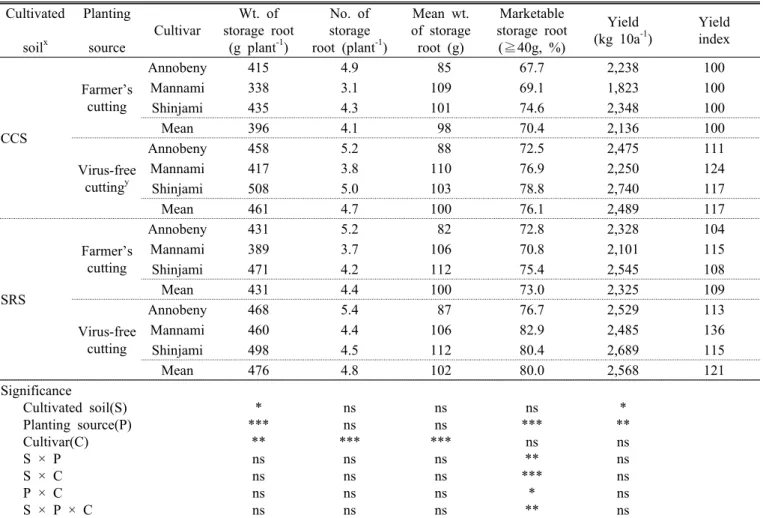
Table 4. Yield of sweet potato among different cultivated soil, planting source and cultivar after 120 days’ cultivation.
Cultivated soil
xPlanting source
Cultivar
Wt. of storage root
(g plant
-1)
No. of storage root (plant
-1)
Mean wt.
of storage root (g)
Marketable storage root
(≧40g, %)
Yield (kg 10a
-1)
Yield index
CCS
Farmer’s cutting
Annobeny 415 4.9 85 67.7 2,238 100
Mannami 338 3.1 109 69.1 1,823 100
Shinjami 435 4.3 101 74.6 2,348 100
Mean 396 4.1 98 70.4 2,136 100
Virus-free cutting
yAnnobeny 458 5.2 88 72.5 2,475 111
Mannami 417 3.8 110 76.9 2,250 124
Shinjami 508 5.0 103 78.8 2,740 117
Mean 461 4.7 100 76.1 2,489 117
SRS
Farmer’s cutting
Annobeny 431 5.2 82 72.8 2,328 104
Mannami 389 3.7 106 70.8 2,101 115
Shinjami 471 4.2 112 75.4 2,545 108
Mean 431 4.4 100 73.0 2,325 109
Virus-free cutting
Annobeny 468 5.4 87 76.7 2,529 113
Mannami 460 4.4 106 82.9 2,485 136
Shinjami 498 4.5 112 80.4 2,689 115
Mean 476 4.8 102 80.0 2,568 121
Significance
Cultivated soil(S) Planting source(P) Cultivar(C) S × P S × C P × C S × P × C
*
***
**
ns ns ns ns
ns ns
***
ns ns ns ns
ns ns
***
ns ns ns ns
ns
***
ns
**
***
*
**
*
**
ns ns ns ns ns
x
CCS, continuous cropping soil over 5 years; SRS, subsoiling reversion soil over 70 cm.
y
Virus-free plant produced by single-node propagation in T
0generation
ns, *, **, *** Nonsignificant or significant at p = 0.05, 0.01, or 0.001, respectively.
중도 무병주의 24.5%로 유의하게 감소하였다고 하여 본 연 구결과와 같은 경향을 보였다. 그러나 Matimati et al.(2005) 은 무병묘와 농가묘 간에 줄기길이는 정식 6주까지는 품종 에 따라 차이를 보였으나, 10주 후부터는 유의한 차이를 보 이지 않았다고 하여 초기생육에서만 품종간 차이를 인정하 였다.
한편 고구마 재배에서 활착후 초기생육은 괴근형성에 영 향을 미치므로 토양수분 관리가 중요하다. Villordon et
al.(2009)에 의하면 괴근 형성시기는 정식 20일 전후부터
시작되어 35일경까지 대부분 결정되며, 괴근 형성수의 86-89%가 정식 1주일 이내에 발생한 부정근으로부터 발달 한다고 하여 초기생육의 중요함을 보여주었다. 본 연구에서 30일째의 엽수와 수량 간에는 높은 정의상관(r = 0.620)을 보였고, 120일째에도 분지수와 수량(r = 0.635), 분지수와 상저비율 간(r = 0.658)에는 유의한 정의 상관관계(p = 0.05)를 보인 것은 흥미로웠다. 이러한 결과로부터 무병묘의 초 기 생육특성 중 엽수와 분지수가 농가묘보다 유의한 증가를 보인 것이 괴근형성을 촉진하였고, 무병묘의 수량과 상저비 율의 증가에도 기여한 것으로 보였다.
수량 및 품질
120일째에 수확한 주당 괴근중 및 괴근수, 평균 괴근중, 수량 등을 조사한 결과, 주당 괴근중은 심토반전과 연작 토 양, 무병묘와 농가묘 및 품종 간에 유의한 차이가 인정되었 으며, 주당 괴근수 및 평균 괴근중은 품종 간에만 유의한 차 이를 나타냈다(Table 4). 10a 수량도 연작 토양, 무병묘와 농가묘 간에 유의한 차이를 보였으며, 품종 간에는 신자미, 맛나미, 안노베니 순으로 높은 경향을 보였다. 특히 연작토 양에서의 농가묘 재배와 비교할 경우, 무병묘의 수량은 평 균 17% 증가하였고, 심토반전 토양에서는 평균 21% 증가
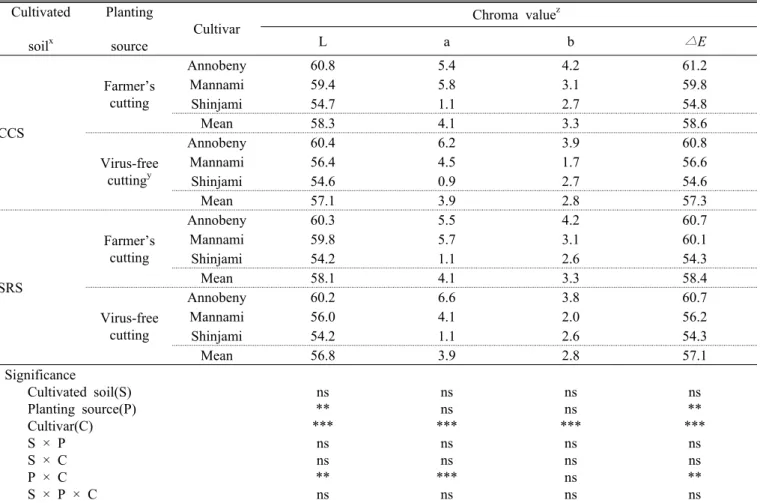
Table 5. Skin color of sweet potato tuber among different cultivated soil, planting source and cultivar after 120 days’ cultivation.
Cultivated soil
xPlanting source
Cultivar Chroma value
zL a b
△E
CCS
Farmer’s cutting
Annobeny 60.8 5.4 4.2 61.2
Mannami 59.4 5.8 3.1 59.8
Shinjami 54.7 1.1 2.7 54.8
Mean 58.3 4.1 3.3 58.6
Virus-free cutting
yAnnobeny 60.4 6.2 3.9 60.8
Mannami 56.4 4.5 1.7 56.6
Shinjami 54.6 0.9 2.7 54.6
Mean 57.1 3.9 2.8 57.3
SRS
Farmer’s cutting
Annobeny 60.3 5.5 4.2 60.7
Mannami 59.8 5.7 3.1 60.1
Shinjami 54.2 1.1 2.6 54.3
Mean 58.1 4.1 3.3 58.4
Virus-free cutting
Annobeny 60.2 6.6 3.8 60.7
Mannami 56.0 4.1 2.0 56.2
Shinjami 54.2 1.1 2.6 54.3
Mean 56.8 3.9 2.8 57.1
Significance Cultivated soil(S) Planting source(P) Cultivar(C) S × P S × C P × C S × P × C
ns
**
***
ns ns
**
ns
ns ns
***
ns ns
***
ns
ns ns
***
ns ns ns ns
ns
**
***
ns ns
**
ns
x
CCS, continuous cropping soil over 5 years; SRS, subsoiling reversion soil over 70cm.
y
Virus-free plant produced by single-node propagation in T
0generation
z
Chroma value: Chroma meter CR-200 (Minolta camera co., Ltd); L, lightness: black=0, white = 100; a, redness to greeness:
green = -80, red = +80; b, yellowness to blueness: blue = -80, yellow = +80;
ΔE = √a
2+b
2+L
2. ns, *, **, *** Nonsignificant or significant at p = 0.05, 0.01, or 0.001, respectively.
하였다. 특히 맛나미 무병묘에서 36%로 가장 높은 증가를 보였다. 또한 상저비율도 무병묘 재배에서 유의한 증가를 보였으며, 무병묘 재배는 심토반전 및 품종과의 유의한 상 호작용 효과가 인정되었다. 상저비율은 심토반전-무병묘 재 배에서 연작-농가묘 재배보다 약 10% 증가하여 80% 이상 의 상저비율을 보여 심토반전의 효과가 크게 나타났다. 국 내 성주지역의 시설내 참외 연작지에서도 심토반전을 한 결 과, 토양선충 밀도 감소, 수량증대 및 품질향상으로 연작장 해 경감효과가 높았다고 하였다(Jun et al., 2002). 본 연구 결과도 고구마 연작지에서 심토반전이나 무병묘 재배를 통 하여 연장장해를 경감시킬 수 있다는 것을 보여 주었다. 특 히 바이러스 무병묘 재배는 품종 고유의 수량성과 품질이 회복되며, 검은점박이병(Monilochaetes infuscan), 검은무늬 병(Ceratocystis fimbriata), 뿌리썩이선충(Pratylenchus coffeae)
등의 다른 병해충에도 저항력이 증진되는 장점이 있다(Yang
et al., 1998). 고구마에 감염되는 SPFMV, SPVG, SPMMV
등은 단독감염에서는 수량 및 품질에 미치는 영향이 제한적 인 것으로 알려졌으나(Clark and Hoy, 2006; Untiveros etal., 2007), SPCSV, SPLCV 등은 단독감염으로도 품종에
따라 10-80%의 수량감소를 초래하며(Clark and Valverde, 2000; Gutierrez et al., 2003; Ling et al., 2010), 이들과 SPFMV, SPMMV 등과의 복합감염은 20-98% 수량감소와 상저수량 감소가 나타나므로(Gibson et al., 1997; 1998;Untiveros et al., 2007), 무병묘 재배가 중요하다고 생각되 었다. Chung(2008)에 의하면 국내 고구마 주산지의 바이러 스 포장 발병율은 100%에 달하며, SPFMV가 43%로 가장 높은 감염을 보였고, SPFMV+SPGV가 13.4%, 미동정 바이 러스 감염율도 20.7%에 이른다고 하여, 고구마 연작지에서
는 무병묘를 재배하는 것이 바람직하다고 생각되었다. 또한 심토반전 후 무병묘를 재배하면 토양선충 등으로부터 바이 러스 재감염을 줄일수 있어, 몇년간 자가채묘가 가능하므로 경제적일 것으로 보였다. 바이러스 무병묘의 재배도 세대경 과에 따라 바이러스 재감염으로 인하여 품종 고유의 수량성 과 품질특성이 나타나지 않게 되는데, 마늘의 무병주에서는 재배 3년차에 1년차 수량보다 28% 감소하였고(Melo Filho
et al., 2006), 고구마 무병묘 재배에서도 품종에 따라 3년차
수량은 농가묘와 유의한 차이를 보이지 않는 것으로 나타났 다(Fuglie et al., 1999). 따라서 농가에서 자가채종하는 무 병묘 재배는 3년주기로 교체하는 것이 바람직할 것으로 보 였다. 그러나 Ling et al.(2010)에 의하면 SPLCV에 감염되 지 않은 무병묘를 재배한 결과, 1년만에 재감염으로 인하여 수량 및 품질에서 감염묘와의 차이가 없었다는 결과로 미루 어, 심토반전 포장에서 바이러스 매개충인 진딧물과 온실가 루이 등을 적극 방제하는 것이 바이러스 재감염 방지를 위 하여 중요하다고 판단되었다.한편, 수확한 괴근의 피색을 색도계로 조사한 결과, 명도 를 나타내는 L값은 심토반전 토양과 연작지 토양간에 유의 한 차이를 보이지 않았으나, 무병묘와 농가묘, 품종 간에는 고도의 유의성을 보였다(Table 5). 적색을 나타내는 a값은 안노베니에서는 무병묘에서 높고, 농적색과 농자색을 가지 는 맛나미와 신자미는 농가묘에서 높게 나타나 무병묘의 피 색이 더 밝은 적색을 보였다. 황색을 나타내는 b값은 안노 베니 품종에서 높았으며, 무병묘보다 농가묘에서 높은 경향 을 보였다. 따라서 괴근의 피색은 무병묘에서 농가묘보다 명도가 높고, 밝은 적색을 보여 피색이 선명해진다는 것을 알 수 있었다. Carrolla et al.(2004)도 고구마 무병묘 재배는 상품 고구마 비율이 유의하게 증가하고, 피색은 적색(a값) 이 선명해지며, 육색은 황색(b값)이 증가하는 것으로 나타 나서, 본 연구결과와 같은 경향을 보고하였다. 이와 같이 고 구마 바이러스는 수량감소 뿐 아니라, 잎에 얼룩무늬를 만 들고, 괴근의 피색 퇴화 및 모양 등에서 품질저하가 나타나 경제적으로 큰 피해를 주기 때문에 바이러스 무병묘 재배가 바람직 하다(Clark and Valverde, 2000).
이상에서와 같이 심토반전 토양에서 바이러스 무병묘를 재배하는 것이 주당 평균중의 증가로 단위면적당 수량과 상 저비율을 유의하게 증가시키며, 피색의 선명도 향상과 고구 마 모양을 좋게 하여 품질향상에도 크게 기여한다는 결과를 얻었다. 따라서 고구마 연작지에서는 심토반전을 실시하고 무병묘를 재배하는 것이 연작장해 극복과 고구마 수량 및 상품가치를 높여 농가수익 증대에도 크게 기여할 것으로 기 대되었다.
적 요
고구마의 연작장해를 경감시키기 위하여, 연작지 토양과 심토반전 토양에서 농가묘와 바이러스 무병묘를 70×25 cm 간격으로 재배하였다. 연작지 토양의 시비량은 N-P2O5-K2O
= 55-63-156kg ha-1과 우분퇴비 10ton ha-1으로 표준시비를 하였고, 심토반전 토양은 질소비료와 퇴비만을 50% 증시하 였다. 삽식 30, 120일째의 생육과 수량 및 품질특성을 조사 한 결과는 다음과 같다.
1. 삽식 30일경부터 농가묘에서는 바이러스 병징이 뚜렷 하였으나, 무병묘에서는 나타나지 않았다.
2. 무병묘의 수량성은 농가묘보다 심토반전 토양 15.0%, 연작지 10.5%의 증가를 보였다.
3. 심토반전 토양에서의 수량성은 연작지보다 농가묘 8.8%, 무병묘 3.2%의 증가를 보였으며, 심토반전 토 양에서 바이러스 무병묘 재배는 상저비율이 농가묘 (60.1%) 대비 80%로 높아져 경제성이 있었다.
4. 무병묘에서 수확한 고구마의 품질은 농가묘보다 피색 이 선명하고, 고구마 모양이 좋아져 외관 품질향상에 도 유리하였다.
5. 심토반전 토양 및 무병묘에서 수량증가는 30일째 엽수 와 120일째 분지수와 정의 상관관계(p=0.05)가 인정되 었으며, 이는 고구마 괴근형성에 초기생육이 중요하다 는 것을 보여주었다.
사 사
본 연구는 농촌진흥청 지역전략작목산학연협력사업(9-23- 52-050700)의 연구비지원으로 수행되었음.
인용문헌